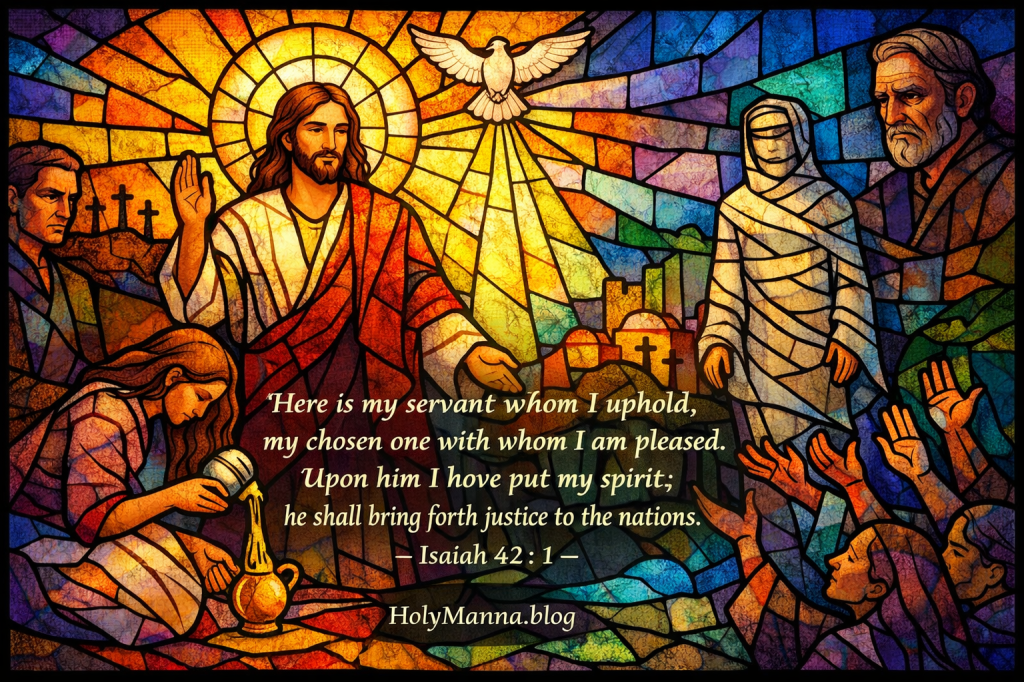
Monday of Holy Week – Lectionary: 257
The Fragrance of the Servant King
Holy Week begins in a quiet but piercing way. Before the noise of the crowd, before the injustice of the trial, before the nails and the Cross, the Church leads the heart into a scene of stillness, tenderness, and decision. Today’s readings are bound together by one central theme: the humble glory of Christ, the Servant who brings light into darkness, and the call to respond to him with trusting, costly love.
The first reading from Isaiah 42:1-7 gives the Church one of the great portraits of the Messiah. This is not a conqueror in the worldly sense. This is the chosen Servant upon whom the Spirit rests, the One who comes not to crush but to heal, not to dominate but to save. “A bruised reed he will not break, and a dimly burning wick he will not quench.” Those words prepare the soul to recognize Jesus as he truly is during Holy Week. He is strong enough to establish justice for the nations, yet gentle enough to stoop toward the weak, the wounded, and the forgotten. The ancient longing of Israel finds its fulfillment in him, and the nations themselves are drawn into his light.
That light shines again in Psalm 27, where the faithful soul answers the Lord with confidence. “The Lord is my light and my salvation; whom should I fear?” This is the prayer of a people who know danger, enemies, and uncertainty, yet still choose trust. During Holy Week, that confidence matters. The shadow of suffering is already falling across the Gospel, but the Psalm teaches the heart not to panic. It teaches the soul to wait, to stand firm, and to believe that God’s goodness is not a distant hope but a living reality.
Then the Gospel in John 12:1-11 brings everything into Bethany, into a home filled with friendship, gratitude, and the scent of burial spices. Mary’s anointing of Jesus is not merely a beautiful gesture. It is an act of faith, reverence, and love that understands something the others do not yet fully grasp. She pours out what is precious because Christ himself is precious. Judas, by contrast, speaks the language of concern while hiding a divided heart. That contrast gives this day its sharp edge. Holy Week does not simply reveal who Jesus is. It also reveals what lives in the human heart when it stands before him.
There is also a deeper background to all three readings that gives this day its weight. Israel had long awaited the servant of the Lord, the one who would restore justice, open blind eyes, and free those living in darkness. At the same time, Passover was drawing near, the great memorial of deliverance, when God had once freed his people from slavery. Now, as Jesus approaches his Passion, those old promises begin to converge. The Servant of Isaiah stands in Bethany as the true Lamb moving toward sacrifice. The light of Psalm 27 stands in a world already preparing to reject him. The house filled with fragrance becomes a quiet doorway into the mystery of death, redemption, and divine love.
That is why today feels so intimate and so serious. The Church does not rush into Holy Week. She pauses here, at the feet of Jesus, and asks the soul to look closely. Christ comes as the gentle Servant, the light in darkness, and the one worthy of everything. The question beneath all three readings is simple and searching: Will the heart trust him, receive him, and pour itself out for him?
First Reading – Isaiah 42:1-7
The Quiet Strength of the Servant Who Brings Light
The first reading opens one of the great mysteries of Holy Week. Long before Christ entered Jerusalem, long before the Last Supper and Calvary, the prophet Isaiah was already sketching the face of the Messiah. This passage comes from what is often called the first of the Servant Songs, written in the later chapters of Isaiah, when Israel knew suffering, exile, humiliation, and the painful longing for deliverance. The people of God were waiting for restoration, but many expected power in the way the world expects power. Instead, the Lord reveals a Servant.
That matters deeply on Monday of Holy Week. The Church places this reading before the faithful so that Christ may be seen rightly. He is not merely a teacher moving toward a tragic death. He is the chosen Servant of the Father, filled with the Spirit, sent to establish justice, heal the weak, and bring light to those trapped in darkness. This reading fits today’s theme perfectly because it shows the heart of Jesus before the Gospel shows the response to him. In Bethany, Mary pours out costly love upon Christ. In Isaiah, the Father reveals why he is worthy of that love. He is the gentle Servant King.
Isaiah 42:1-7 – New American Bible (Revised Edition)
The Servant of the Lord
1 Here is my servant whom I uphold,
my chosen one with whom I am pleased.
Upon him I have put my spirit;
he shall bring forth justice to the nations.
2 He will not cry out, nor shout,
nor make his voice heard in the street.
3 A bruised reed he will not break,
and a dimly burning wick he will not quench.
He will faithfully bring forth justice.
4 He will not grow dim or be bruised
until he establishes justice on the earth;
the coastlands will wait for his teaching.5 Thus says God, the Lord,
who created the heavens and stretched them out,
who spread out the earth and its produce,
Who gives breath to its people
and spirit to those who walk on it:
6 I, the Lord, have called you for justice,
I have grasped you by the hand;
I formed you, and set you
as a covenant for the people,
a light for the nations,
7 To open the eyes of the blind,
to bring out prisoners from confinement,
and from the dungeon, those who live in darkness.
Detailed Exegesis
Verse 1 – “Here is my servant whom I uphold, my chosen one with whom I am pleased. Upon him I have put my spirit; he shall bring forth justice to the nations.”
Everything begins with the Father’s initiative. The Servant is not self-appointed. He is upheld, chosen, and loved by God. The language echoes what the Church later hears at the Baptism and Transfiguration of Jesus, when the Father publicly identifies the Son as the beloved one. The Spirit resting upon him reveals that this mission is divine, not political. The justice he brings is not shallow social balance or earthly revenge. In Scripture, justice means right order before God, the restoration of what sin has wounded, and the setting right of human life under the Lord’s rule. This justice is not for Israel alone. It is for the nations. Even here, the horizon is universal.
Verse 2 – “He will not cry out, nor shout, nor make his voice heard in the street.”
The Messiah does not come as a loud revolutionary. He does not force himself into history by spectacle or manipulation. His authority is real, but it is marked by humility. This verse is especially striking during Holy Week. Christ will enter conflict, but not like worldly rulers. He speaks truth without theatrical self-promotion. He stands before accusers without panic. He goes to the Cross without summoning earthly armies. The verse teaches that divine strength is often quiet, steady, and deeply secure.
Verse 3 – “A bruised reed he will not break, and a dimly burning wick he will not quench. He will faithfully bring forth justice.”
This is one of the most tender lines in all of Scripture. The bruised reed is the wounded soul, bent and fragile. The dimly burning wick is the person whose faith is weak, whose hope is flickering, whose charity feels exhausted. The Servant does not finish off what is already damaged. He restores. He protects. He heals. At the same time, the verse does not soften justice into sentimentality. It says he will faithfully bring it forth. His mercy is not weakness. His gentleness does not mean indifference to evil. In Christ, mercy and truth meet. He saves sinners without blessing sin.
Verse 4 – “He will not grow dim or be bruised until he establishes justice on the earth; the coastlands will wait for his teaching.”
There is a beautiful reversal here. The Servant protects the dim wick and the bruised reed, but he himself will not grow dim or be bruised in the sense of failing in his mission. He will persevere until the Father’s will is accomplished. During Holy Week, that perseverance becomes visible in the most dramatic way. Christ will be opposed, betrayed, mocked, and struck, yet he will not turn aside from obedience. The mention of the coastlands waiting for his teaching shows again that the Servant’s mission stretches far beyond one place or one people. The nations are waiting, even if they do not yet know what they are waiting for. The world aches for the teaching of Christ.
Verse 5 – “Thus says God, the Lord, who created the heavens and stretched them out, who spread out the earth and its produce, Who gives breath to its people and spirit to those who walk on it:”
The reading pauses to remind the listener who is speaking. This is not a tribal deity or a local religious voice. This is the Creator, the Lord of heaven and earth, the giver of breath and life. The mission of the Servant rests upon the authority of the God who made all things. That gives the passage tremendous weight. The same God who created the world is now acting to re-create humanity through his Servant. Redemption is not an afterthought. It is the saving work of the Creator entering the brokenness of his own creation.
Verse 6 – “I, the Lord, have called you for justice, I have grasped you by the hand; I formed you, and set you as a covenant for the people, a light for the nations,”
This verse moves from identity to mission. The Servant is called, grasped, formed, and sent. The phrase about being set as a covenant is especially powerful. The Servant does not simply announce a covenant. He embodies it. In Christ, God does not merely send a message of reconciliation. He sends his Son as the living bond between God and man. To call him a light for the nations means that revelation, truth, and salvation radiate from him. He does not reflect light from another source. He brings the light of God into the darkness of the world.
Verse 7 – “To open the eyes of the blind, to bring out prisoners from confinement, and from the dungeon, those who live in darkness.”
The mission becomes concrete here. Blindness, imprisonment, confinement, and darkness all describe the human condition under sin. They also point to real suffering in the world, because the Messiah’s work touches both soul and body. Christ opens blind eyes in the Gospels, but he also heals spiritual blindness. He frees those oppressed by demons, but he also breaks the chains of sin and death. This verse is already looking toward the Paschal Mystery. Through his Passion, Death, and Resurrection, Christ will enter the deepest dungeon of fallen humanity and open a way out.
Teachings
This reading is one of the clearest Old Testament windows into the person and mission of Jesus Christ. The Church has always read the Servant Songs as shining light on the Messiah, especially during the Passion. The chosen one upon whom the Spirit rests is fulfilled in Christ, the anointed Son sent by the Father. The Catechism explains this beautifully in CCC 436: “The word ‘Christ’ comes from the Greek translation of the Hebrew Messiah, which means ‘anointed.’ It became the name proper to Jesus only because he accomplished perfectly the divine mission that ‘Christ’ signifies.” The Servant is anointed for mission, and Jesus fulfills that mission completely.
The Church also sees in this passage a strong connection to the Baptism of the Lord. The Father’s pleasure in the Servant and the gift of the Spirit point directly to Christ revealed in the Jordan. The Catechism says in CCC 536: “The Holy Spirit comes upon Jesus and the voice from heaven proclaims him the beloved Son of the Father. This is the manifestation (‘Epiphany’) of Jesus as Messiah of Israel and Son of God.” That moment in the Jordan is not separate from Holy Week. It leads to Holy Week. The One publicly revealed there now walks steadily toward the Cross.
This reading also helps correct false ideas about justice. In modern ears, justice often sounds cold, legal, or ideological. In biblical language, justice is the restoration of right relationship with God and neighbor. The Servant establishes justice precisely by being faithful to the Father and merciful toward the weak. This is why the image of the bruised reed matters so much. Christ is not careless with wounded souls. He is patient with the repentant, tender toward the suffering, and firm against evil. His justice heals because it is rooted in truth and charity.
There is also a profound missionary note in the passage. The Servant is sent not only to Israel but to the nations. This matters in Holy Week because the Passion is not a private religious drama for one people alone. It is the turning point of history. Christ goes to the Cross for the life of the world. The mention of light for the nations anticipates the universal reach of the Gospel and the Church’s mission to preach salvation to every people and language.
Saint Matthew later applies this Servant prophecy directly to Jesus in Matthew 12:18-21, showing that the early Church did not treat this passage as vague symbolism. It saw Christ in these words. The Fathers of the Church loved this prophecy because it revealed both majesty and meekness in the Lord. They saw a Messiah who could save without crushing and reign without violence. That vision remains deeply important today because many still imagine power apart from holiness, strength apart from tenderness, and truth apart from mercy. Isaiah 42 refuses all of those distortions.
Reflection
This reading meets ordinary life with surprising force. Many hearts know what it is to feel bruised, bent, tired, or close to burning out. Some carry old wounds. Some carry secret sins. Some carry the heaviness of grief, fear, or discouragement. Today’s reading says that Christ does not come near such weakness in order to finish it off. He comes to restore what is fragile and strengthen what is failing. That truth alone can change the way a soul approaches confession, prayer, suffering, and even daily relationships.
The reading also asks something serious of those who follow Christ. If the Servant does not crush the bruised reed, then his disciples cannot live with harshness as though it were strength. The Christian home, the parish, the workplace, and the hidden life of the heart should all begin to reflect the gentleness of Christ. That does not mean softness toward sin or indifference to truth. It means learning how to speak truth without cruelty, correct without humiliation, and remain faithful without becoming hard.
There is also a call here to perseverance. The Servant does not grow dim until the mission is complete. That matters for anyone trying to remain faithful in a tiring season. Holiness is often quiet. It may look like continuing in prayer when prayer feels dry, continuing in charity when patience feels thin, and continuing in obedience when the path is costly. Holy Week reminds the faithful that Christ did not abandon his mission halfway. He went all the way in love.
This reading can be lived in simple but real ways. Spend time this week asking Christ to reveal where spiritual blindness still lingers. Bring one area of discouragement honestly into prayer. Practice deliberate gentleness with someone who is already carrying a burden. Choose one act of mercy that brings light into another person’s darkness. Stand before the Lord and let him be both justice and peace.
Where has the heart become more bruised than it has admitted?
Is there trust that Christ is gentle enough to heal without humiliating?
How can daily life reflect the quiet strength of the Servant instead of the loud anxiety of the world?
Responsorial Psalm – Psalm 27:1-3, 13-14
Waiting for the Light When the Shadows Gather
The Responsorial Psalm gives the Church her voice in the middle of Holy Week. After hearing in Isaiah 42:1-7 about the Lord’s chosen Servant who brings justice with gentleness, the faithful are taught how to answer: not with panic, not with despair, but with trust. Psalm 27 has long been treasured as a psalm of confidence in the face of danger. Traditionally linked to David, it rises out of a world where enemies were real, wars were not distant rumors, and the survival of God’s people often felt uncertain. Its prayer is not built on comfort. It is built on covenant faith.
That is why this psalm belongs so beautifully to Monday of Holy Week. The Gospel will lead into Bethany, where love and betrayal already stand close to one another. The Cross is approaching. Darkness is gathering. Yet the Church places these words on the lips of the faithful so that the heart may not collapse under fear. The Servant of the Lord is coming, and the proper response is steadfast trust. The one who brings light to the nations becomes the reason the soul can say, “The Lord is my light and my salvation; whom should I fear?”
Psalm 27:1-3, 13-14 – New American Bible (Revised Edition)
Trust in God
1 Of David.
The Lord is my light and my salvation;
whom should I fear?
The Lord is my life’s refuge;
of whom should I be afraid?
2 When evildoers come at me
to devour my flesh,
These my enemies and foes
themselves stumble and fall.
3 Though an army encamp against me,
my heart does not fear;
Though war be waged against me,
even then do I trust.13 I believe I shall see the Lord’s goodness
in the land of the living.
14 Wait for the Lord, take courage;
be stouthearted, wait for the Lord!
Detailed Exegesis
Verse 1 – “The Lord is my light and my salvation; whom should I fear? The Lord is my life’s refuge; of whom should I be afraid?”
This opening line is one of the clearest cries of confidence in all the Psalms. The psalmist does not begin with enemies or anxiety. He begins with the Lord. God is called light, salvation, and refuge. Light means more than comfort. It means truth, direction, purity, and the presence of God pushing back darkness. Salvation means deliverance, rescue, and victory that comes from the Lord rather than from human strength. Refuge means a secure place of protection when danger is near.
During Holy Week, this verse takes on even deeper meaning. Christ himself is the light entering the darkness of sin and death. The soul is taught to measure its fears by the greatness of God, not the greatness of the threat. Fear may still exist as a feeling, but it is no longer allowed to reign as master.
Verse 2 – “When evildoers come at me to devour my flesh, these my enemies and foes themselves stumble and fall.”
The language is intense because the danger is serious. The psalm does not pretend that evil is weak or imaginary. The enemies are described almost like wild beasts, eager to consume and destroy. This is how evil often feels in real life. It does not merely inconvenience. It threatens to overwhelm.
Yet the turning point comes quickly. The enemies stumble and fall. The emphasis is not on the psalmist’s skill, but on the Lord’s protection. This verse teaches that opposition does not have the final word. In the setting of Holy Week, the enemies of Christ seem powerful, organized, and determined, but the deeper truth is already present. Evil can gather itself against the Lord, but it cannot triumph over him in the end.
Verse 3 – “Though an army encamp against me, my heart does not fear; though war be waged against me, even then do I trust.”
This verse expands the image from personal enemies to full-scale conflict. The psalmist imagines being surrounded by an army and still says that the heart does not fear. This is not bravado. It is faith. The courage here is not based on personality or natural boldness. It is based on the Lord’s nearness.
The phrase “even then do I trust” is where the verse reaches the soul. Trust is easiest when danger is distant. The psalm teaches trust in the middle of the siege. That is the lesson of Holy Week as well. Christ does not save from a safe distance. He walks into suffering with complete confidence in the Father. The faithful are invited to let their trust become steadier, deeper, and less dependent on outward calm.
Verse 13 – “I believe I shall see the Lord’s goodness in the land of the living.”
This verse sounds almost like a declaration wrestled out of darkness. The psalmist is not speaking from easy circumstances. He is choosing hope in the midst of threat. To believe that one will see the Lord’s goodness in the land of the living is to refuse despair. It is to say that God’s goodness is not a myth, not a memory, and not only a promise for some distant future. It will be seen.
For Christians, this verse opens toward the Paschal Mystery. The land of the living points not only to earthly deliverance, but ultimately to the life won by Christ. Holy Week leads through death, but never ends there. The Church prays this verse knowing that God’s goodness shines most fully in the Passion and Resurrection of Jesus.
Verse 14 – “Wait for the Lord, take courage; be stouthearted, wait for the Lord!”
The psalm ends not with instant resolution, but with a command to wait. That is deeply biblical. Waiting in Scripture is not passive resignation. It is courageous endurance rooted in God’s faithfulness. To be stouthearted means to let the heart be strengthened, steadied, and made firm.
This final verse fits Holy Week perfectly. The Church enters days of solemn mystery. There is no rush to Easter morning. There is waiting, watching, praying, and staying close to Christ. This verse teaches the soul how to remain faithful when God’s work is unfolding slowly and painfully. The answer to darkness is not frantic control. It is courageous waiting before the Lord.
Teachings
The Church has always recognized the Psalms as a privileged school of prayer. The Catechism says in CCC 2586, “The Psalms are the masterwork of prayer in the Old Testament.” That is especially clear here. Psalm 27 teaches the heart how to move from fear to trust, from danger to confidence, from unrest to waiting upon God. It is not simply a poem from ancient Israel. It is living prayer for every age.
The psalm also carries the voice of David, and the Church sees David as a model for the praying people of God. The Catechism says in CCC 2579, “David is, par excellence, the king ‘after God’s own heart,’ the shepherd who prays for his people and in their name, the one whose submission to the will of God, whose praise and whose repentance, will be a model for the prayer of the people.” That matters here because this psalm is not private spirituality cut off from salvation history. It belongs to the long prayer of Israel, which reaches its fulfillment in Christ.
There is also a distinctly Christological depth to this psalm. Jesus prayed the Psalms. He did not stand outside them. He entered into them and brought them to completion. When the Church prays Psalm 27 during Holy Week, she does not merely remember David’s confidence. She hears the voice of Christ, the true Son of David, entrusting himself to the Father in the face of betrayal, violence, and death. The line “The Lord is my light and my salvation” takes on even richer meaning when read in the light of the Passion. Christ is both the speaker and the fulfillment of the prayer.
Saint Augustine saw the Psalms as the voice of Christ and his Body, the Church. That insight fits this reading beautifully. The Christian does not pray alone. The Church prays in Christ, with Christ, and through Christ. When this psalm is prayed in the liturgy, the faithful are being taught how to stand inside the confidence of Jesus himself.
Historically, the Psalms have shaped Jewish and Christian worship for centuries. In the Temple, in the synagogue, in monastic prayer, in the Divine Office, and in the Mass, they have given language to fear, repentance, hope, praise, and longing. During Holy Week especially, the Psalms become the Church’s breathing. They steady the soul and teach it how to remain near the Lord when mysteries grow dark and deep.
Reflection
This psalm speaks clearly to ordinary life because fear is never far from the human heart. Fear about health, fear about family, fear about money, fear about the future, fear about suffering, and even fear about what God may ask next can quietly take over a person’s interior life. Psalm 27 does not shame the frightened heart, but it does challenge it. It asks whether fear will be allowed to become the lens through which everything is seen.
The psalm offers a better way. It begins by fixing the eyes on who God is. That is where daily spiritual renewal often has to start. Before the mind runs toward problems, it must be taught again to say that the Lord is light, salvation, and refuge. This is not denial. It is the recovery of perspective. The soul becomes stronger when God is remembered first.
This reading also teaches patience. Holy Week is full of waiting. That is not comfortable for modern life, which wants quick answers, visible results, and immediate relief. Yet much of real Christian maturity is learned in the waiting. Waiting in prayer. Waiting in suffering. Waiting for clarity. Waiting for healing. Waiting for God’s promises to unfold. The psalm says that courage is not only found in action. Sometimes courage is found in remaining faithful without rushing ahead of God.
A practical way to live this psalm is to return to its first line during moments of anxiety and pray it slowly. Another is to examine what tends to provoke fear and consciously place that area before the Lord each morning. It also helps to practice holy patience by refusing unnecessary panic, refusing dark imagination, and choosing one concrete act of trust each day. That act may be small, but repeated acts of trust slowly reshape the heart.
What fear has been speaking louder than the voice of God lately?
Is there real belief that the Lord’s goodness will be seen even in the middle of uncertainty?
What would it look like to wait for the Lord with courage instead of restlessness this Holy Week?
Holy Gospel – John 12:1-11
The House Filled with Fragrance and the Shadow of the Cross
The Holy Gospel for Monday of Holy Week brings the soul into Bethany, a village just outside Jerusalem, at a moment when love, gratitude, death, and betrayal are all standing in the same room. The setting matters. Saint John says this takes place six days before Passover, which means the great feast of Israel’s deliverance is near, and Jesus is already moving toward the hour of his Passion. Bethany was a place of friendship and refuge for him, the home of Martha, Mary, and Lazarus. Yet even here, where affection surrounds him, the shadow of the Cross is falling.
This Gospel fits today’s theme with remarkable precision. The first reading from Isaiah 42:1-7 revealed the gentle Servant of the Lord, the one chosen by the Father and sent to bring light and justice. The Responsorial Psalm from Psalm 27 taught the faithful how to respond with courage and trust. Now the Gospel shows what such trust and love look like in a human heart. Mary of Bethany recognizes, perhaps more deeply than those around her, that Jesus is worthy of everything. Judas, by contrast, speaks the language of concern while hiding corruption. The house becomes a place of revelation. It reveals the beauty of costly devotion, the ugliness of false piety, and the growing hostility that will soon send Christ to Calvary.
John 12:1-11 – New American Bible (Revised Edition)
The Anointing at Bethany. 1 Six days before Passover Jesus came to Bethany, where Lazarus was, whom Jesus had raised from the dead. 2 They gave a dinner for him there, and Martha served, while Lazarus was one of those reclining at table with him. 3 Mary took a liter of costly perfumed oil made from genuine aromatic nard and anointed the feet of Jesus and dried them with her hair; the house was filled with the fragrance of the oil. 4 Then Judas the Iscariot, one [of] his disciples, and the one who would betray him, said, 5 “Why was this oil not sold for three hundred days’ wages and given to the poor?” 6 He said this not because he cared about the poor but because he was a thief and held the money bag and used to steal the contributions. 7 So Jesus said, “Leave her alone. Let her keep this for the day of my burial. 8 You always have the poor with you, but you do not always have me.”
9 [The] large crowd of the Jews found out that he was there and came, not only because of Jesus, but also to see Lazarus, whom he had raised from the dead. 10 And the chief priests plotted to kill Lazarus too, 11 because many of the Jews were turning away and believing in Jesus because of him.
Detailed Exegesis
Verse 1 – “Six days before Passover Jesus came to Bethany, where Lazarus was, whom Jesus had raised from the dead.”
The timing is deeply significant. Passover recalled Israel’s deliverance from slavery through the blood of the lamb. By placing this scene six days before Passover, Saint John is quietly directing attention toward Christ as the true Paschal Lamb. Bethany is not just a geographic stop. It is the place where the Lord stands beside one he has already called back from the tomb. Lazarus is living evidence that Jesus has authority over death. That makes the coming Passion even more striking. The one who gives life is now moving toward his own death.
Verse 2 – “They gave a dinner for him there, and Martha served, while Lazarus was one of those reclining at table with him.”
This verse shows a household marked by gratitude and hospitality. Martha serves, which fits what is already known of her generous and active love. Lazarus reclines at table, a quiet but astonishing image. The man once buried now sits in fellowship with the one who raised him. This meal is more than a social gathering. It is a sign of communion, restoration, and the peace that Christ brings. Yet even this peaceful table is set within Holy Week, so joy and sorrow are already interwoven.
Verse 3 – “Mary took a liter of costly perfumed oil made from genuine aromatic nard and anointed the feet of Jesus and dried them with her hair; the house was filled with the fragrance of the oil.”
This is one of the most tender and unforgettable gestures in the Gospels. The perfume is costly, not symbolic pocket change, but something precious and sacrificial. Nard was an imported perfume, rare and expensive. Mary’s act is extravagant in the eyes of the world, but in the eyes of love it is fitting. She anoints the feet of Jesus, taking a place of humility before him, and then dries them with her hair, which adds a striking note of personal devotion and self-forgetfulness.
The fragrance filling the house is also rich with meaning. Love that is true does not remain hidden in its effects. It spreads. It marks the atmosphere. This act of anointing also points toward burial. Without fully explaining every detail, Jesus will soon interpret her action in relation to his death. Mary’s love is not sentimental. It is prophetic.
Verse 4 – “Then Judas the Iscariot, one of his disciples, and the one who would betray him, said,”
Saint John identifies Judas not only as a disciple, but as the one who would betray Jesus. The Gospel does not let his objection sound neutral. From the start, it places his words under the shadow of treachery. This is important because evil often enters the scene clothed in ordinary language. Judas is near Jesus externally, yet inwardly far from him. The verse reminds the reader that closeness to holy things does not guarantee holiness of heart.
Verse 5 – “Why was this oil not sold for three hundred days’ wages and given to the poor?”
On the surface, this sounds reasonable and even virtuous. Three hundred days’ wages is an enormous amount, nearly a year’s labor for an ordinary worker. Judas frames Mary’s act as wasteful and contrasts it with care for the poor. This is where the Gospel becomes spiritually searching. Not every seemingly moral objection is born from love of God. Sometimes the language of justice is used to mask resistance to worship, sacrifice, and surrender.
The verse also forces an important question. What is fitting to give to Christ? Mary answers with abundance. Judas answers with calculation. Holy Week presses that contrast hard upon the conscience.
Verse 6 – “He said this not because he cared about the poor but because he was a thief and held the money bag and used to steal the contributions.”
Saint John removes all ambiguity. Judas is not speaking from charity. He is speaking from greed. This is one of the great warnings of the Passion narratives. Sin does not always present itself as open hatred of God. Sometimes it hides behind noble language. Judas uses the poor as an argument, but he does not love the poor. He loves what he can control and consume.
The verse also exposes how a divided heart can remain outwardly religious while inwardly corrupt. Judas is still among the disciples. He is still within the circle. Yet theft has already prepared the ground for betrayal. Smaller acts of infidelity, left unchecked, form the soul for greater ones.
Verse 7 – “So Jesus said, ‘Leave her alone. Let her keep this for the day of my burial.’”
Jesus immediately defends Mary. He receives her act, honors it, and interprets it in light of his burial. That means her anointing is not misplaced emotion. It belongs to the mystery of his coming Passion. Whether Mary understood the full depth of what she was doing or not, Jesus makes clear that her act is in harmony with the truth of the hour.
This defense is also a defense of worship. There are moments when love must simply be poured out before the Lord. There are moments when the proper response to Christ is not efficiency or analysis, but adoration. Mary has chosen such a moment, and Jesus protects it.
Verse 8 – “You always have the poor with you, but you do not always have me.”
This verse has often been misunderstood, but the Church reads it in continuity with the whole of Scripture. Jesus is not dismissing the poor. He is not weakening the command of charity. He is drawing attention to the uniqueness of the present moment. His earthly Passion is near. The hour is urgent. The beloved must be honored as he moves toward sacrifice.
The statement also echoes Deuteronomy 15, where the continuing presence of the poor is precisely the reason Israel must remain generous. So Jesus is not setting devotion against mercy. He is exposing the hypocrisy of a heart that refuses worship while pretending concern for the needy.
Verse 9 – “The large crowd of the Jews found out that he was there and came, not only because of Jesus, but also to see Lazarus, whom he had raised from the dead.”
The raising of Lazarus has made Jesus impossible to ignore. The crowd comes not only for Christ, but also for the living sign of his power. Lazarus has become a witness simply by being alive. This verse reveals how miracles generate decision. They do not leave the world neutral. Some are drawn into faith. Others harden themselves further.
Verse 10 – “And the chief priests plotted to kill Lazarus too,”
This line is chilling. The hostility has become so deep that even Lazarus must die, not because of wrongdoing, but because his existence points to Christ. When hearts are committed to rejecting the truth, even evidence becomes a threat. The chief priests do not ask whether Jesus has done a divine work. They plan how to silence the sign.
This is also a preview of Christian witness through the ages. To belong to Christ is often to become inconvenient to a world that does not want its darkness exposed.
Verse 11 – “Because many of the Jews were turning away and believing in Jesus because of him.”
Lazarus leads others to faith simply by standing as testimony to what Christ has done. This final verse makes the stakes plain. The Gospel is not just recounting an intimate household scene. It is showing a crisis of belief. Mary responds with love. Lazarus stands as witness. The crowd is stirred. The priests harden themselves. Judas conceals corruption. Every heart in the passage is being revealed by its proximity to Jesus.
Teachings
This Gospel reveals one of the deepest truths of Holy Week: true love for Christ is willing to be costly. Mary does not offer leftovers. She offers something precious. The Church has long seen in her gesture an image of adoration, self-giving love, and reverence before the Lord. The Catechism teaches in CCC 2097, “To adore God is to acknowledge him as God, as the Creator and Savior, the Lord and Master of everything that exists, as infinite and merciful Love.” Mary’s act is exactly that kind of acknowledgment. She places herself low before Christ because she recognizes who he is.
The Gospel also guards the Church from a false opposition between love of God and care for the poor. The Church’s tradition insists on both. The Catechism says in CCC 2449, “The Church’s love for the poor is a part of her constant tradition.” It continues, “This love is inspired by the Gospel of the Beatitudes, of the poverty of Jesus, and of his concern for the poor.” Jesus’ defense of Mary, then, cannot be twisted into an excuse for indifference. Rather, it condemns hypocrisy and teaches that authentic charity must flow from a heart rightly ordered toward Christ.
Saint Augustine saw Mary’s act as a model for discipleship. He wrote, “Let us anoint the feet of the Lord by living well; let us wipe them with our hair, by offering to him even what is superfluous for us.” Augustine reads the scene not as a distant memory, but as a pattern for the Christian life. To anoint Christ now is to love him concretely, to follow him humbly, and to pour out what is precious in his service.
Saint John Chrysostom, with his usual sharpness, saw in Judas a warning about greed hidden beneath noble speech. He noted that Judas spoke as if he cared for the poor, yet his real master was money. That lesson remains painfully relevant. A person may use religious or moral language while inwardly resisting surrender to Christ. Holy Week has a way of stripping away those disguises.
There is also a deeply sacrificial tone to the whole passage. Jesus interprets Mary’s act in relation to burial, which means Bethany is already facing Calvary. The anointing anticipates the death of Christ, and the fragrance in the house quietly foreshadows the offering of his life. The Church has often seen in such moments the beauty of love that intuits the Cross before others are ready to face it. Mary may not deliver a theological speech, but her action speaks with remarkable clarity. She knows, at least in part, that this is no ordinary hour.
Historically, Bethany holds an important place in the final days before the Passion. It is a place of friendship near Jerusalem, but it is also a place from which Jesus moves toward his suffering. That makes the Gospel especially poignant. Before betrayal is completed and violence erupts, the Lord receives a pure act of devotion. Holy Week is severe, but it is not loveless. This scene proves it.
Reflection
This Gospel reaches straight into ordinary life because it asks what kind of love Christ is receiving. Mary does not love Jesus in a careful, measured, socially safe way. She loves him with a devotion that costs something. That is often where modern discipleship becomes thin. It can remain verbal, respectable, and tidy, while avoiding anything truly sacrificial. Bethany challenges that instinct. Love for Christ should have weight, beauty, and real surrender in it.
There is also a warning here about hidden motives. Judas sounds practical, but the Gospel reveals a corrupt heart. That should make every disciple pause. It is possible to say impressive things while protecting selfishness inside. Holy Week is a fitting time to ask where appearances have become stronger than honesty, where spiritual language has outpaced actual conversion, and where concern for good things has become an excuse to avoid wholehearted devotion.
This Gospel also teaches that witness matters. Lazarus says nothing in the passage, yet his life draws others toward Jesus. Some of the strongest Christian witness is like that. A transformed life, a healed marriage, persevering faith in suffering, calm courage in grief, fidelity in hidden sacrifice, and visible gratitude to God can all become living signs that point others toward Christ.
A practical way to live this Gospel is to make one deliberate act of costly love for Christ this Holy Week. That may mean extra time in adoration, a more serious confession, a hidden fast, a generous gift, a work of mercy done quietly, or a concrete act of reverence that has been neglected. It is also worth examining whether there has been more of Mary or more of Judas in the recent spiritual life. One pours out. The other calculates.
What would it mean to offer Christ something truly costly instead of only what is convenient?
Has concern for worthy things ever become a disguise for resisting deeper surrender to the Lord?
Does daily life, like Lazarus, quietly point others toward the power and goodness of Jesus?
When the Heart Learns to Stay Near Jesus
Today’s readings open Holy Week with a lesson that is both gentle and searching. In Isaiah 42:1-7, the Church sees the face of the Servant of the Lord, the one chosen by the Father, filled with the Spirit, and sent to bring justice without crushing the weak. In Psalm 27:1-3, 13-14, the faithful learn how to stand before that Servant with courage, trusting that even when darkness gathers, the Lord remains light, salvation, and refuge. Then in John 12:1-11, the Gospel brings everything into one room at Bethany, where Mary pours out costly love, Lazarus stands as a living witness, and Judas reveals how easily a divided heart can hide behind respectable words.
Taken together, these readings show that Christ is both mighty and meek, both King and Servant, both light for the nations and the one moving quietly toward burial for the salvation of the world. They also show that every heart must answer him. Some, like Mary, respond with love that does not count the cost. Some, like the psalmist, cling to trust in the face of fear. Some, like Lazarus, bear witness simply by the changed life Christ has given them. Others, like Judas and the chief priests, resist the truth even while standing close enough to see it.
That is what makes this day so important. Holy Week is not only about remembering what Jesus did. It is also about allowing his presence to uncover what is happening within the soul. The gentle Servant still comes near the bruised reed. The light still shines in dark places. The question is whether the heart will welcome him with trust, reverence, and surrender.
This is a beautiful day to slow down and stay close to Christ. Let prayer become more attentive. Let love become more concrete. Let fear give way to confidence in the Lord. Let one hidden act of devotion, sacrifice, or mercy rise like fragrance before God. Holy Week has begun, and the Lord is drawing near. Will the heart remain at his feet, listen for his voice, and give him what is most precious?
Engage with Us!
Share your reflections in the comments below. Holy Week has a way of bringing hidden things to the surface, and today’s readings invite a sincere look at the heart. There is great beauty in praying with the Word of God together, learning from one another, and encouraging one another to stay close to Christ as he walks toward the Cross.
- In Isaiah 42:1-7, the Lord reveals his chosen Servant as gentle, faithful, and full of justice. Where is Christ inviting the heart to trust his tenderness more deeply, especially in places that feel bruised, weary, or dim?
- In Psalm 27:1-3, 13-14, the soul declares that the Lord is its light and salvation. What fear, worry, or burden needs to be placed more honestly into God’s hands this Holy Week?
- In John 12:1-11, Mary pours out costly love at the feet of Jesus while Judas hides selfishness behind respectable words. What would it look like to love Christ more like Mary this week, with greater sincerity, sacrifice, and reverence?
- Looking at all three readings together, how is the Lord calling daily life to reflect his light, his mercy, and his quiet strength in the home, at work, and in prayer?
May this Holy Week be lived with a faithful heart, a courageous spirit, and a love that is willing to give itself fully to Christ. Let every word, every sacrifice, and every act of mercy be shaped by the love and compassion Jesus has taught, so that life itself becomes a witness to his goodness.
Sacred Heart of Jesus, we trust in You!
Immaculate Heart of Mary, pray for us!
Saint Michael the Archangel, defend us in battle!
Follow us on YouTube, Instagram and Facebook for more insights and reflections on living a faith-filled life.

 Holy Manna!
Leave a comment