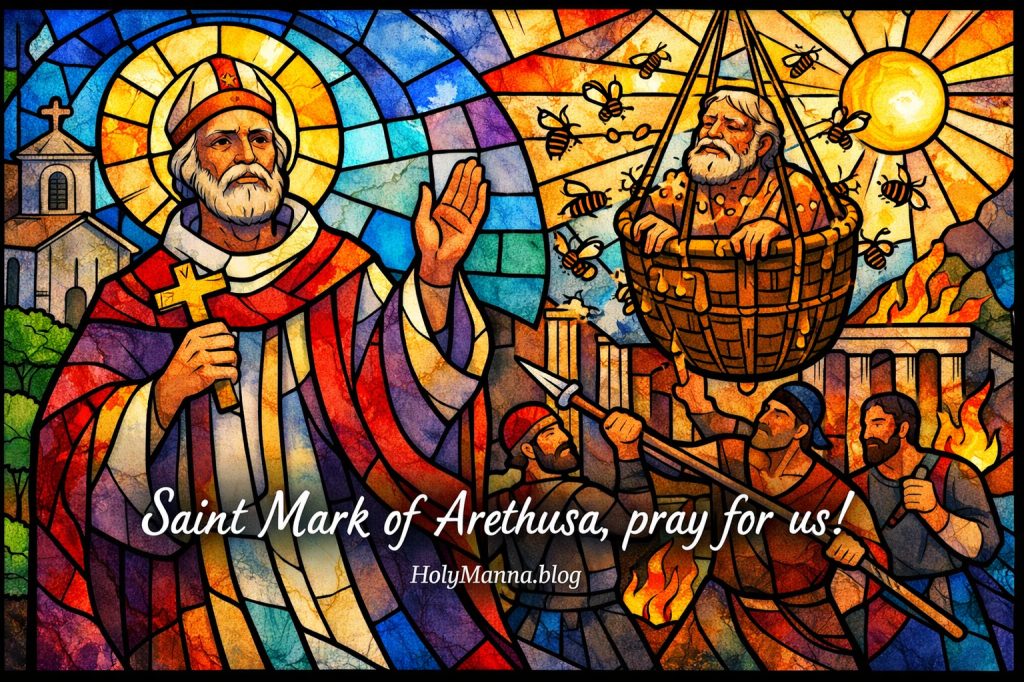
A Shepherd Remembered for Courage
Saint Mark of Arethusa stands out as one of those saints whose story feels both ancient and very present. He was a fourth-century bishop in Syria, remembered by the Church for his courage, his loyalty to Christ, and his refusal to compromise with idolatry even when it cost him dearly. His name is kept in the Church’s memory on March 29, and his witness still speaks with force because it shows what happens when a pastor loves God more than comfort and loves his people more than his own safety.
He is revered because he stood firm during one of the most confusing and dangerous periods in early Christian history. The Church was still fighting through the wounds of the Arian controversy, paganism had not fully disappeared, and political power could turn hostile in a moment. In that unstable world, Mark became known not for worldly success, but for steadfastness. He is remembered as a bishop who would not help rebuild a pagan temple, who would not purchase peace by cooperating with false worship, and who willingly suffered so that others would not suffer in his place.
A Life Partly Hidden, A Faith Clearly Seen
Much of Saint Mark’s early life remains hidden from history. Catholic sources do not preserve a full childhood biography, detailed family background, or a dramatic conversion narrative. He comes into view only after he had already become bishop of Arethusa, a city in Syria. That silence can feel frustrating, but it also says something beautiful. Sometimes the Church remembers a saint less for the details of his upbringing and more for the holiness revealed when the decisive test finally comes.
Even so, it is clear that Mark was not an obscure man in his own time. He lived during the great doctrinal battles of the fourth century and was involved in the tense struggles surrounding Arianism. Some older writers viewed him with caution because of his connection to formulas associated with the controversy. Yet the Church’s later judgment is important. The Roman Martyrology honors him as a man who did not depart from the true faith. That matters. It means the Church ultimately remembered him not as a compromiser, but as a bishop whose final witness shone with fidelity.
What he is most known for is not a theological treatise or a famous council speech. He is most known for refusing to cooperate with idolatry and for enduring terrible suffering rather than betray the Lord.
The Old Bishop and the Temple of Idols
The defining moment of Saint Mark’s life came during the reign of Emperor Julian, often called Julian the Apostate. Before Julian’s rise, when Christian rulers held power, Mark had destroyed a pagan temple and, according to tradition, a church was built in its place. When Julian tried to restore pagan worship, he demanded that those who had destroyed pagan shrines either rebuild them or pay for their restoration.
Mark refused.
That refusal was not stubbornness for its own sake. It was a clear act of conscience. The Church teaches in CCC 2113 that idolatry is not just bowing before statues. It is the false honoring of something that is not God as though it were divine. Mark understood that even funding the restoration of pagan worship would be a betrayal of the First Commandment.
At first he fled, likely out of prudence. There is no need to pretend that every saint always marched straight into danger at the first moment. But then he learned that others from his flock were being seized and tormented in his place. That changed everything. He returned voluntarily and handed himself over. That single act reveals the heart of a true bishop. He would rather suffer himself than let his people suffer for him.
This is one of the reasons he should still be remembered and imitated. Saint Mark shows what spiritual fatherhood looks like. He did not hide behind his office. He did not let others pay the price for his decision. He came back.
A Witness Stronger Than Violence
The cruelty inflicted on Saint Mark was horrifying. He was beaten, mocked, dragged through the streets, and publicly humiliated. Ancient accounts say he was cast into filth, pierced with sharp instruments, and smeared with honey so that insects would swarm over his body in the heat. His persecutors tried to break him physically and shame him publicly. They also tried to pressure him into compromise by reducing their demands little by little.
He still refused.
One of the most memorable lines attributed to him comes from this suffering. When his persecutors tried to force even partial compliance, he answered with the logic of a man who knew the difference between inconvenience and sin: “It is as impious to give an obole as to give all.” In plain English, even the smallest compromise with idolatry would still be wrong.
Another line preserved from the tradition shows his boldness under torture: “You are groundlings and of the earth; I, sublime and exalted.” That can sound severe to modern ears, but in context it reflects the spiritual freedom of a man whose dignity could not be stripped away by humiliation. They could torment his body, but they could not drag his soul down with them.
No verified miracle cycle surrounds his life in the way some saints are remembered for healings, visions, or spectacular signs. The miracle in Saint Mark’s story is moral and spiritual. He remained unbroken. His endurance itself became a sign of grace. Even some pagans were said to admire his courage. His suffering became a sermon stronger than any speech.
The Price of Fidelity
Saint Mark’s hardships were not random. They came because he would not separate religion from real life. He would not say that outward gestures did not matter. He would not pretend that a small act of cooperation with false worship was harmless. He knew that faith is not just something hidden in the heart. Faith shapes actions, loyalties, and boundaries.
This is where his story becomes painfully relevant. The world often asks for just a little compromise. It rarely begins by asking for total denial of Christ. It starts smaller. Stay quiet. Go along. Make the gesture. Say the words. Fund the thing. Pretend it means nothing. Saint Mark saw through that lie. He knew that if something was false worship, then even a token act in support of it mattered.
The tradition suggests that his persecutors were eventually defeated by his endurance and released him. Because of that, some remember him more precisely as a confessor, while others honor him with martyr language because of the extreme violence he endured for Christ. Either way, his witness has the same spiritual meaning. He accepted suffering rather than betray God.
His life reflects the strength described in CCC 1808, where the virtue of fortitude is said to ensure firmness in difficulties and constancy in the pursuit of the good. Saint Mark did not merely admire courage. He lived it.
What Followed After His Witness
Unlike many saints, Saint Mark does not seem to have a large body of verified posthumous miracle stories preserved in Roman Catholic sources. No reliable tradition surfaced of healings at his tomb, famous apparitions, or a widespread pilgrimage cult tied to his relics. That absence is worth stating plainly because his story deserves honesty.
There are, however, a few later traditions and layers of memory attached to him. Some older writers preserve the story that he may once have helped protect the young Julian before Julian became emperor. That story cannot be firmly verified. It has been repeated, but it does not rest on the strongest evidence. If true, it would make the later persecution even more tragic. If not, it still shows how later Christians saw Mark as a man marked by generosity.
His greatest impact after death was not through a famous shrine, but through remembrance. The Church kept his name. The Roman Martyrology continued to honor him. His city remained part of ecclesiastical memory. His witness also survived in the writings of the ancient historians and in the praise of Saint Gregory of Nazianzus, who remembered him as a holy old man of remarkable life. That matters more than it may seem at first. In an age when many names vanish, his endured because the Church judged his suffering to be worth remembering.
Culturally, Saint Mark’s legacy belongs to the wider memory of Christians who suffered under Julian and to the Church’s long struggle to defend the truth about Christ in the fourth century. He is not one of the saints with a massive popular following in modern Catholic life, but he remains deeply important as a witness of conscience, pastoral charity, and fidelity under pressure.
What Saint Mark Teaches the Soul Today
Saint Mark of Arethusa teaches that holiness is not measured by visibility. It is measured by fidelity. A saint may leave behind no famous books, no international shrine, and no dramatic legend of wonders after death, yet still shine brightly in the Church because he remained faithful when it mattered most.
His life asks serious questions of modern Christians. Do convictions disappear when obedience becomes costly? Does love for neighbor remain strong when sacrifice becomes personal? Does faith stay firm when compromise looks easier, more practical, and socially acceptable?
He also teaches that Christian courage is not loud for the sake of being loud. It is clear because truth matters. He did not suffer because he enjoyed conflict. He suffered because false worship is still false worship, even when society blesses it.
There is also something deeply moving about the way he returned for his people. This is the part of his story that stays in the heart. He could have stayed away. Instead, he went back because others were paying the price. That is a shadow of the shepherd’s heart, and every Christian can learn from it. Parents can learn from it. Priests can learn from it. Friends can learn from it. Any believer who has ever been tempted to protect comfort at the expense of duty can learn from it.
In practical daily life, Saint Mark’s example means choosing truth over convenience, refusing to cooperate with sin even in small ways, and bearing hardship with patience when fidelity becomes costly. It means asking Christ for the grace to stand firm in a culture that constantly rewards compromise. It means remembering CCC 2473, which teaches that martyrdom is the supreme witness given to the truth of the faith. Not every Christian will be called to bloody persecution, but every Christian is called to some form of costly fidelity.
Where in life has compromise started to look harmless?
What would it mean to love Christ enough to refuse even a small betrayal?
How can a person become more willing to suffer inconvenience, misunderstanding, or loss rather than offend God?
Engage With Us!
Share your thoughts and reflections in the comments below. Saint Mark of Arethusa is not the kind of saint the modern world talks about often, which makes his witness all the more striking. His story forces the heart to take faith seriously and to ask whether love for God is deep enough to endure real cost.
- What part of Saint Mark’s story speaks most powerfully to the heart?
- Have there been moments when doing the right thing felt costly or lonely?
- What does Saint Mark teach about resisting small compromises in faith and morals?
- How can his example help Christians become more courageous in daily life?
- What would change if more believers chose truth and charity with the same firmness he showed?
May Saint Mark of Arethusa inspire a life of steady faith, courageous love, and clear conscience. May every trial become an opportunity to cling more closely to Christ, and may everything be done with the love and mercy Jesus taught us.
Saint Mark of Arethusa, pray for us!
Follow us on YouTube, Instagram and Facebook for more insights and reflections on living a faith-filled life.

 Holy Manna!
Leave a comment