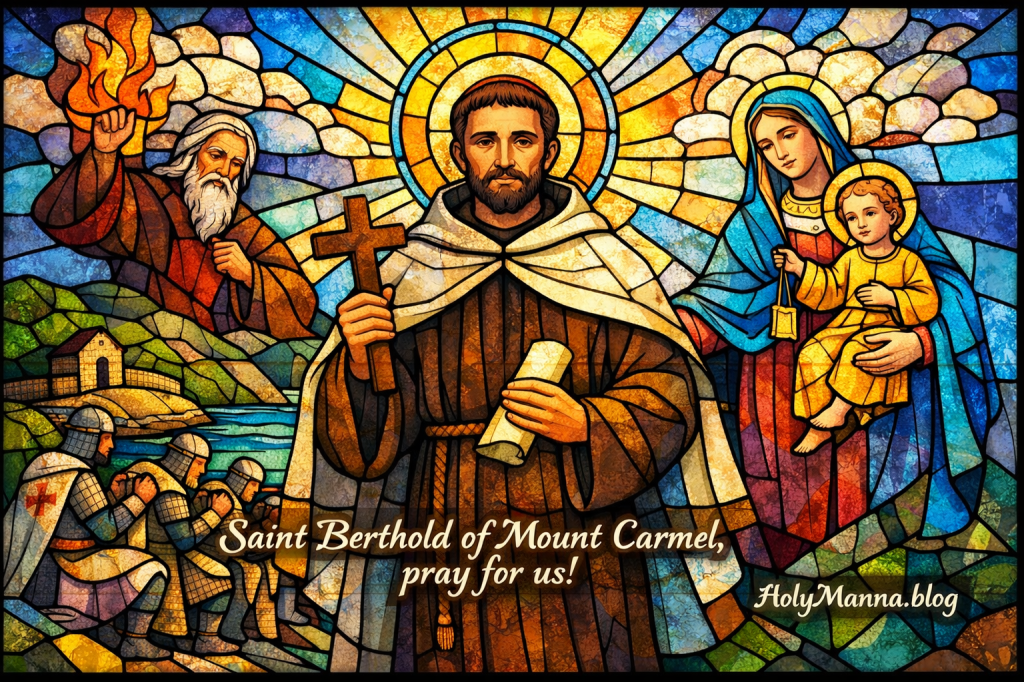
The Quiet Man at the Beginning of Carmel
Saint Berthold of Mount Carmel stands near the beginning of one of the most beloved spiritual families in the Catholic Church. He is remembered as an early leader of the hermits on Mount Carmel, a man who helped gather them into a more stable community of prayer, penance, and devotion to the Blessed Virgin Mary. He is revered because Catholic tradition sees in him one of the earliest visible builders of what would later become the Carmelite Order.
His story does not come with the same kind of rich documentation found in the lives of later saints like Saint Teresa of Avila or Saint John of the Cross. Even so, his importance is real. The Church remembers him because he helped shape a life centered on God, silence, detachment, and Marian trust. In a world obsessed with noise, Saint Berthold is a reminder that some of the greatest work in the Church begins in hidden places, with humble men who simply stay close to God.
What he is most known for is this: he helped organize the early hermits of Mount Carmel and placed their life under the care of the Mother of God. That alone gave him a lasting place in Catholic memory.
From the West to the Holy Mountain
Later Catholic tradition says Saint Berthold was born in Limoges, France, and was related to Aymeric, the Latin Patriarch of Antioch. Some accounts remember him first as a soldier, while others emphasize his education in Paris and his priestly formation. The older traditions are not identical in every detail, but they agree on the broad picture. He was a man formed in the Christian West who eventually made his way to the Holy Land and gave himself to the service of God on Mount Carmel.
His deepening of faith appears to have come through contact with the sacred places of salvation history and through the spiritual seriousness of Christian life in a time of conflict. He did not become known for worldly success, military prestige, or public power. He became known for helping create a community where men could seek God with an undivided heart.
Mount Carmel itself matters here. This is the mountain associated with the prophet Elijah, the great defender of the worship of the one true God. For the Carmelite tradition, Elijah became a model of zeal, prayer, and interior listening. In time, the hermits living there also came to be known as the Brothers of the Blessed Virgin Mary of Mount Carmel. Saint Berthold is remembered as one of the men who helped that identity take shape.
Building a Life of Prayer on Mount Carmel
The strongest historical memory of Saint Berthold is tied to his work on Mount Carmel. A Greek monk named John Phocas reported that Berthold came there in the middle of the twelfth century, built a small chapel, and gathered a small group of brothers near Elijah’s spring. That may sound like a simple beginning, but in the life of the Church, simple beginnings often become mighty works of grace.
This is why Saint Berthold should be remembered. He helped form a community where prayer was not an accessory to life, but the center of life. He helped give shape to a way of living that treasured silence, sacrifice, fraternity, and devotion to Our Lady. Long before the Carmelite family spread across the world, there was a small band of men on a mountain trying to belong wholly to God. Saint Berthold helped make that possible.
Several traditional stories are connected to his life. One tradition says that during the siege of Antioch he urged Christians to turn to prayer and penance, and that relief followed. This story has long been repeated in Catholic sources, but it cannot be verified. Another tradition says he received a vision of Christ that stirred him to call Christian soldiers to moral reform. This story also cannot be verified. An older Carmelite tradition even says that an apparition of the prophet Elijah helped inspire the gathering of the hermits on Carmel. This too cannot be verified.
Even where the miraculous details remain uncertain, the heart of the story still says something beautiful. Saint Berthold belonged to that kind of Christian life that believes prayer changes things, penance matters, and God is not distant from the struggles of His people.
The Hard Road of Hidden Fidelity
Saint Berthold was not a martyr in the strict sense. He did not die by execution for the faith. But he still knew hardship, and his hardships were real.
To build a contemplative community in the Holy Land during a time of instability was no easy task. The land was marked by political tension, danger, and uncertainty. The community itself was small and fragile. Everything could have failed. Humanly speaking, this was not the kind of project that promised security or recognition. It demanded perseverance, patience, and faith.
There is also a quieter kind of suffering that often goes unnoticed in the lives of saints. Saint Berthold seems to have lived that kind of suffering. He accepted obscurity. He labored without applause. He spent himself on a community that would become famous only long after his death. Many people want a holy life that feels dramatic and visible. Saint Berthold shows that holiness is often built through steady fidelity in ordinary sacrifice.
This is deeply Catholic. The Church teaches that the path to holiness passes through struggle, renunciation, and perseverance. The Catechism teaches that “the way of perfection passes by way of the Cross” and that there is no holiness without spiritual battle and self-denial, CCC 2015. Saint Berthold lived that truth in a hidden way.
The Legacy That Grew After His Death
Saint Berthold’s legacy after death is far greater than the amount of detail preserved about his personal life. From the small beginning associated with him on Mount Carmel came a spiritual family that would later include friars, nuns, religious sisters, hermits, and lay faithful throughout the world. His personal story may be partially veiled by time, but the fruit of the life he helped shape is impossible to ignore.
There is no strong, well-documented Catholic tradition of posthumous miracle stories attached specifically to Saint Berthold in the way there is for many later saints. No major verified healing accounts or relic miracles stand out in the sources commonly cited about him. Still, his impact after death can be seen in a different kind of miracle, the miracle of spiritual inheritance.
The Carmelite tradition matured over the centuries into one of the great schools of prayer in the Church. It gave the Church saints, mystics, teachers, martyrs, and contemplatives. It nourished devotion to Our Lady of Mount Carmel and helped spread the beloved scapular tradition. Saint Berthold did not create every later Carmelite devotion by himself, but he is remembered as one of the early men who helped prepare the ground.
Mount Carmel remains the great place associated with his memory. It is not merely a geographic location. It is a spiritual symbol. It speaks of prayer, waiting, zeal for the Lord, and trust in Mary. In that sense, Saint Berthold’s memory still lives anywhere the Carmelite spirit lives.
His cultural impact is strongest in the life of the Carmelite family itself. He is especially honored within Carmelite tradition because he stands near its earliest visible roots. His feast is kept on March 29, and his name remains a quiet but meaningful part of Catholic memory.
Learning from a Saint Who Did Not Need the Spotlight
Saint Berthold has a lot to teach modern Catholics precisely because he is not flashy. He was not known for writing famous books. He was not known for public controversy or dramatic speeches. He was known for helping build a life ordered toward God.
That matters. So many souls today feel spiritually scattered. Attention is broken. Prayer is rushed. Silence feels uncomfortable. Saint Berthold reminds the soul that God often does His deepest work in hiddenness. A man can change the future of the Church simply by helping a small community become faithful.
His life also points toward a healthy Catholic love for Our Lady. The Church teaches that devotion to the Blessed Virgin belongs within Christian worship and always leads the faithful more deeply to Christ, CCC 971. Saint Berthold is remembered for entrusting his community to Mary. That was not a sentimental gesture. It was a deeply Catholic act of confidence. To place a work under Our Lady’s care is to admit that grace, not human skill, sustains the Church.
Readers can apply his example in practical ways. Make room for silence every day. Guard time for prayer instead of treating it like leftover time. Stay faithful in hidden duties. Love the Church even when the work feels small. Entrust the home, work, family, and interior life to the Blessed Virgin Mary. Persevere when holiness feels slow.
What small corner of life needs to be rebuilt into a place of prayer? What would change if daily life were ordered around God instead of around distraction? How might deeper devotion to Our Lady make the heart more available to Christ?
Engage with Us!
Share your thoughts and reflections in the comments below. Saint Berthold’s life is quiet, but it opens the door to some very important questions about prayer, perseverance, and hidden holiness.
- What part of Saint Berthold’s life speaks most deeply to the heart right now?
- Is there a place in daily life that needs to become more like Mount Carmel, a place of silence, prayer, and belonging to God?
- How can greater devotion to the Blessed Virgin Mary help strengthen faith and perseverance in ordinary life?
- What does Saint Berthold teach about doing important work without needing attention or praise?
- How might the example of the early Carmelite hermits challenge the way time, noise, and distraction are handled each day?
May Saint Berthold of Mount Carmel pray for every soul seeking a deeper life of prayer. May his hidden faithfulness inspire a more serious love for silence, sacrifice, and Our Lady. And may every reader go forward determined to live with the love, mercy, and steadfast faith that Jesus taught.
Saint Berthold of Mount Carmel, pray for us!
Follow us on YouTube, Instagram and Facebook for more insights and reflections on living a faith-filled life.

 Holy Manna!
Leave a comment