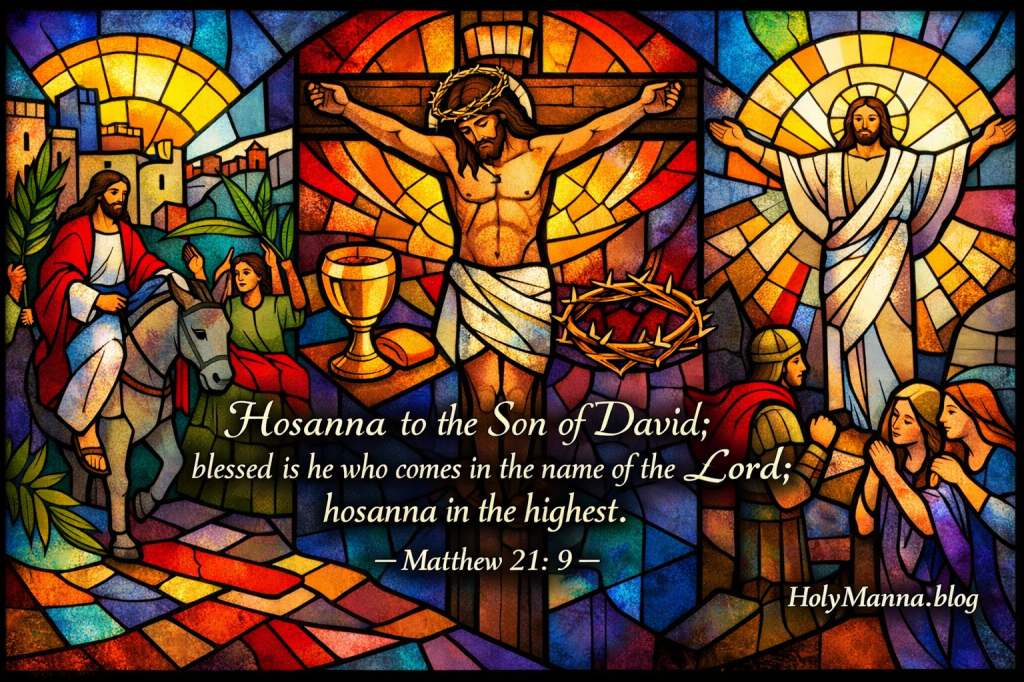
Palm Sunday of the Lord’s Passion – Lectionary: 37 and 38
The King Who Enters to Suffer and Save
There is something almost jarring about Palm Sunday. The Church begins with palms in hand, voices lifted, and the road to Jerusalem lined with hope. Then, before the heart has time to settle into that triumph, the liturgy turns and leads straight into betrayal, humiliation, crucifixion, and the silence of the tomb. That movement is not accidental. It is the point. The central theme tying all of today’s readings together is this: Jesus reveals His kingship through humble obedience and redemptive suffering. He does not come to save the world by force, spectacle, or political power. He comes to save it by offering Himself completely to the will of the Father.
That is what made this moment so powerful in its original setting. Jerusalem was filled with pilgrims for Passover, the feast that remembered Israel’s deliverance from slavery. The city carried both religious longing and political tension. Under Roman occupation, many hoped for a Messiah who would restore Israel’s glory with visible strength. Yet The Gospel of Matthew shows something very different. Jesus enters the holy city not on a war horse, but on a donkey, fulfilling prophecy and revealing Himself as the meek King of Zion. The crowds cry out “Hosanna to the Son of David”, but before long, that same world will reject Him. Palm Sunday forces the soul to face a hard truth: it is possible to welcome Jesus with excitement and still resist the kind of kingdom He actually brings.
The rest of the readings deepen that mystery. Isaiah gives the voice of the suffering servant, the one who listens to God, speaks to the weary, and does not turn away from insult and violence. Psalm 22 gives words to the agony of the righteous sufferer, words that will rise again from the lips of Christ on the Cross. Philippians opens the hidden glory of Jesus by showing that the eternal Son did not cling to status, but “emptied himself” and became obedient even to death on a cross. Then the Passion in The Gospel of Matthew gathers all of it into one terrible and beautiful story. The King is mocked, the Shepherd is struck, the Innocent One is condemned, and yet through it all the Son remains faithful.
This is why Palm Sunday stands at the gate of Holy Week like no other day in the year. It teaches that the road to resurrection passes through surrender. It teaches that divine glory shines most brightly in sacrificial love. It teaches that Christ is never more truly King than when He is giving Himself away for the salvation of the world. How often does the heart want the palms without the Passion, the victory without the Cross, the crown without the obedience? Today’s readings invite the soul to walk beside Jesus with clear eyes and a steady heart, ready to see that the One who enters Jerusalem in meekness is the same Lord who will conquer sin and death by love.
Holy Gospel at the Procession with Palms – Matthew 21:1-11
The King Who Comes in Humility, and Walks Toward the Cross
Palm Sunday begins with a scene that feels bright, hopeful, and almost royal. Jesus draws near to Jerusalem, the holy city of David, at the very time when pilgrims are streaming in for Passover. The city is charged with memory, expectation, and tension. Passover recalled Israel’s deliverance from slavery, and many longed for a Messiah who would deliver them again, this time from Roman rule. Yet The Gospel of Matthew shows that Jesus does not enter like an earthly conqueror. He comes as the promised King, but He comes in meekness, peace, and obedience to the Father. This reading fits perfectly within today’s central theme: Christ reveals His kingship not by worldly power, but by humble self-gift. The One praised with palms is already walking toward His Passion.
Bethphage, on the Mount of Olives, is not a random detail. The Mount of Olives carried deep messianic significance in Jewish expectation, and Matthew wants the reader to see that Jesus is consciously fulfilling prophecy, especially the promise of Zechariah 9:9, where the king comes humble and riding on a donkey. This is why the Church places this Gospel at the threshold of Holy Week. The palms are real, the joy is real, and yet the deeper truth is even greater: the King enters His city in order to save it by sacrifice.
Matthew 21:1-11 – New American Bible (Revised Edition)
The Entry into Jerusalem. 1 When they drew near Jerusalem and came to Bethphage on the Mount of Olives, Jesus sent two disciples, 2 saying to them, “Go into the village opposite you, and immediately you will find an ass tethered, and a colt with her. Untie them and bring them here to me. 3 And if anyone should say anything to you, reply, ‘The master has need of them.’ Then he will send them at once.” 4 This happened so that what had been spoken through the prophet might be fulfilled:
5 “Say to daughter Zion,
‘Behold, your king comes to you,
meek and riding on an ass,
and on a colt, the foal of a beast of burden.’”6 The disciples went and did as Jesus had ordered them. 7 They brought the ass and the colt and laid their cloaks over them, and he sat upon them. 8 The very large crowd spread their cloaks on the road, while others cut branches from the trees and strewed them on the road. 9 The crowds preceding him and those following kept crying out and saying:
“Hosanna to the Son of David;
blessed is he who comes in the name of the Lord;
hosanna in the highest.”10 And when he entered Jerusalem the whole city was shaken and asked, “Who is this?” 11 And the crowds replied, “This is Jesus the prophet, from Nazareth in Galilee.”
Detailed Exegesis
Verse 1 – “When they drew near Jerusalem and came to Bethphage on the Mount of Olives, Jesus sent two disciples.”
Jesus is not wandering into events blindly. He is approaching Jerusalem with purpose. The journey has been moving toward this hour, and now He reaches the place where prophecy, kingship, and sacrifice will meet. The Mount of Olives evokes expectation, judgment, and the hope of God’s saving intervention. Jesus is taking command of the moment, not being swept along by it.
Verse 2 – “saying to them, ‘Go into the village opposite you, and immediately you will find an ass tethered, and a colt with her. Untie them and bring them here to me.’”
This verse reveals both Jesus’ authority and His deliberate fulfillment of Scripture. He knows what awaits Him, and He orders the details of His entry with calm certainty. The donkey and colt are signs of peace, not war. A king riding a war horse would signal conquest by force, but Jesus chooses the beast of burden, the mount of humility. He comes not to shed the blood of others, but to pour out His own.
Verse 3 – “And if anyone should say anything to you, reply, ‘The master has need of them.’ Then he will send them at once.”
Even this simple instruction carries weight. Jesus identifies Himself as master, and the response assumes that His need has a rightful claim. There is a quiet majesty here. The Lord who owns all things still borrows a humble animal for His entrance. That is the pattern of the Incarnation itself. The eternal Son comes in poverty, not because He lacks power, but because He chooses the way of lowliness for the salvation of the world.
Verse 4 – “This happened so that what had been spoken through the prophet might be fulfilled.”
Matthew constantly draws attention to fulfillment, because Jesus is not one religious figure among many. He is the promised Messiah in whom the Scriptures find their meaning. Palm Sunday is not a sentimental pageant. It is the unveiling of God’s long-prepared plan. What Israel heard in prophecy now stands before her in the flesh.
Verse 5 – “Say to daughter Zion, ‘Behold, your king comes to you, meek and riding on an ass, and on a colt, the foal of a beast of burden.’”
This is the heart of the reading. Jesus is King, but His kingship is meek. In Catholic life, meekness does not mean weakness. It means strength under the rule of love, power governed by obedience, and authority purified of pride. Pope Saint John Paul II preached that this was not a triumphal entry in the worldly sense, but the coming of “a king meek and humble of heart.”
Verse 6 – “The disciples went and did as Jesus had ordered them.”
The disciples obey without resistance or debate. That quiet obedience matters. Before the crowds cry out, before the city is shaken, there is first this hidden fidelity. Holy Week always begins there. Grace is often carried forward by simple obedience. The kingdom advances not only in dramatic moments, but also in faithful response to the Lord’s word.
Verse 7 – “They brought the ass and the colt and laid their cloaks over them, and he sat upon them.”
The cloaks laid over the animals prepare a seat for Christ. In the ancient world, placing garments before a ruler was a sign of homage and submission. Matthew mentions both animals to highlight the fullness of prophetic fulfillment. The point is not confusion about what Jesus rode, but clarity about who Jesus is. The promised King is taking His place, and He does so clothed in the reverence of those who recognize something royal in Him.
Verse 8 – “The very large crowd spread their cloaks on the road, while others cut branches from the trees and strewed them on the road.”
Now the road itself becomes a place of welcome. Cloaks and branches form a kind of carpet before the Messiah. This is festal, public, and deeply symbolic. The crowd offers honor the only way it can, with what it has in hand. Palm Sunday still asks the same question of every Christian heart: what is being laid down before Christ? Pride, self-will, ambition, resentment, and cherished sin all need to be placed on the road if the King is truly to enter.
Verse 9 – “The crowds preceding him and those following kept crying out and saying: ‘Hosanna to the Son of David; blessed is he who comes in the name of the Lord; hosanna in the highest.’”
This cry is rich with biblical meaning. “Hosanna” originally carries the sense of “save us” or “save, we pray,” yet by this point it has also become a shout of praise and blessing. “Son of David” is openly messianic. The crowd is not merely admiring a teacher. It is recognizing in some measure the arrival of the promised heir. The Church never leaves this cry behind. At every Mass, just before the consecration, the faithful sing these words again in the Sanctus, because the same Lord still comes to His people. Pope Saint John Paul II beautifully noted, “We repeat these words at every Mass when the moment of transubstantiation approaches.”
Verse 10 – “And when he entered Jerusalem the whole city was shaken and asked, ‘Who is this?’”
That question still echoes through every age. Jerusalem is shaken because the true King has arrived, and His coming demands a response. The city is stirred, unsettled, confronted. Christ does not enter a life quietly if He is truly welcomed as Lord. He exposes false hopes, shallow religion, and worldly expectations. Palm Sunday is not only about what the crowd says to Jesus. It is also about what Jesus’ presence does to the city, and to the soul.
Verse 11 – “And the crowds replied, ‘This is Jesus the prophet, from Nazareth in Galilee.’”
The crowd speaks truly, but not fully. Jesus is indeed a prophet, yet He is far more than a prophet. He is the Christ, the Son of David, the Son of God, the Lord who comes to save. This verse reveals something searching about the human heart. It is possible to say something correct about Jesus and still not yet know Him deeply enough. Palm Sunday presses the question home: is Jesus merely admired, or is He adored? Is He merely interesting, or is He Lord?
Teachings
This Gospel reveals a kingship that overturns worldly instincts. Human beings often expect a savior who will dominate enemies, remove discomfort, and secure victory on visible terms. Jesus enters Jerusalem in an entirely different way. He is royal, but gentle. He is authoritative, but lowly. He is the Messiah, yet He comes already oriented toward sacrifice. The Catechism captures this inner logic of Christ’s whole mission with striking clarity in CCC 607: “The desire to embrace his Father’s plan of redeeming love inspired Jesus’ whole life, for his redemptive passion was the very reason for his Incarnation.” Palm Sunday makes that visible. Jesus does not drift toward the Cross. He advances toward it in freedom and love.
The Popes have repeatedly taught that this entrance into Jerusalem must be read together with the Passion. Pope Francis described the mystery of the day this way: “Joyful acclamations at Jesus’ entrance into Jerusalem, followed by his humiliation. Festive cries followed by brutal torture.” That is the deep rhythm of Palm Sunday. It does not allow the Christian to keep glory and suffering separate. The same Jesus who is welcomed with palms is the one who will be rejected, mocked, and crucified. There is no other Christ. Pope Francis said it even more directly in another Palm Sunday homily: “It is not some other Jesus, but the same Jesus who entered Jerusalem amid the waving of palm branches. It is the same Jesus who was nailed to the cross and died between two criminals. We have no other Lord but him: Jesus, the humble King of justice, mercy and peace.”
Pope Saint John Paul II also pressed the symbolism of the donkey with beautiful simplicity: “The animal chosen indicates that it was not a triumphal entry, but that of a king meek and humble of heart.” That insight matters because it protects the soul from reading Palm Sunday through worldly ambition. Jesus is not pretending to be weak. He is revealing divine strength in its purest form. His humility is not theater. It is the shape of redeeming love.
There is also a liturgical depth here that Catholics should never miss. The cry “Blessed is he who comes in the name of the Lord” does not remain in first-century Jerusalem. It lives in the Mass. The Church places those words on the lips of the faithful just before the Eucharistic mystery because Christ still comes to His people as King, still in humility, still for salvation. What happened on the road into Jerusalem is sacramentally echoed at the altar. The Lord comes, and the Church answers with praise, reverence, and expectation.
Historically, Palm Sunday developed as one of the great doorway liturgies of the Christian year, and the Church has long understood it as the beginning of Holy Week’s solemn passage with Christ. Pope Benedict XVI described it memorably: “Palm Sunday is the great doorway leading into Holy Week.” That is exactly how this Gospel functions. It is not a decorative prelude. It is the threshold where the Church begins to walk closely with the Lord toward Calvary, already knowing that the Cross is not the failure of His kingship, but its revelation.
Reflection
This Gospel asks whether Jesus is being welcomed as He truly is, or only as the heart wishes Him to be. The crowd wanted a king, but many still misunderstood the kingdom. That temptation has never disappeared. It is easy to want a Christ who blesses plans, removes crosses, and confirms expectations. It is harder to receive the Christ who comes in humility, asks for surrender, and leads the soul through obedience, sacrifice, and trust. Palm Sunday invites a more honest discipleship. It asks whether the heart can still say “Hosanna” when the road leads toward suffering, patience, and the Cross.
In daily life, this reading can be lived very concretely. One step is to let Jesus enter the ordinary places that are often kept guarded, the habits that need conversion, the wounds that have been hidden, the ambitions that have become too important. Another step is to practice visible humility. The King chose a donkey, not a war horse. The disciple should not be shocked when Christ asks for gentleness, restraint, forgiveness, and patience instead of self-assertion. A third step is to pray the words of the liturgy with greater attention at Mass. When the Church sings “Blessed is he who comes in the name of the Lord,” the soul should remember Palm Sunday and welcome Christ with reverence, not routine.
What is being spread before Christ right now: real surrender, or only religious enthusiasm? Has the heart welcomed Jesus as King, while quietly resisting the humility of His kingdom? What would it look like this week to let the Lord enter more deeply, not with noise, but with obedience?
Palm Sunday begins with branches in the hand, but it is really about making room in the heart. The humble King is coming. He comes not to flatter, but to save. He comes not to crush, but to redeem. He comes not to take a throne of gold, but to mount the wood of the Cross. And that is precisely why He is worthy of every palm, every cloak, every knee bent low, and every faithful cry of “Hosanna.”
First Reading – Isaiah 50:4-7
The Servant Who Listens, Suffers, and Does Not Turn Away
The first reading on Palm Sunday sounds quiet at first, almost hidden, but it carries the weight of the whole Passion. These verses come from one of the Servant Songs in Isaiah, passages the Church has long heard as prophetic windows into the mystery of Christ. In their original setting, these words spoke into the suffering and purification of God’s people, most likely in the long shadow of exile, when Israel had to learn again that the Lord saves not through pride or earthly triumph, but through fidelity, trust, and obedience. The servant in this reading is not merely a victim. He is a disciple. He listens before he speaks. He receives from God before he gives to others. He suffers, but he does not rebel. He is struck, but he does not turn away.
That is why this reading belongs so naturally on Palm Sunday. The Church has just seen Jesus enter Jerusalem as the humble King. Now she hears the inner music of His heart. Before the mocking, before the scourging, before the Cross, there is this deep obedience. The servant’s voice helps reveal what is happening inside Christ as He walks toward His Passion. He is not dragged there against His will. He goes as the obedient Son, the One whose ear is open to the Father, whose tongue is ready to strengthen the weary, and whose face is set like flint toward the sacrifice that will redeem the world.
Isaiah 50:4-7 – New American Bible (Revised Edition)
4 The Lord God has given me
a well-trained tongue,
That I might know how to answer the weary
a word that will waken them.
Morning after morning
he wakens my ear to hear as disciples do;
5 The Lord God opened my ear;
I did not refuse,
did not turn away.
6 I gave my back to those who beat me,
my cheeks to those who tore out my beard;
My face I did not hide
from insults and spitting.7 The Lord God is my help,
therefore I am not disgraced;
Therefore I have set my face like flint,
knowing that I shall not be put to shame.
Detailed Exegesis
Verse 4 – “The Lord God has given me a well-trained tongue, that I might know how to answer the weary a word that will waken them. Morning after morning he wakens my ear to hear as disciples do.”
This verse opens with a striking order. The servant does not begin with action, power, or public success. He begins with a gift from God. His tongue is “well-trained” because his ear has first been opened. That is the foundation of all true discipleship. A man cannot speak for God if he has not first listened to God. The servant is able to sustain the weary because he himself lives in daily dependence on the Lord. “Morning after morning” suggests steady formation, not a sudden burst of inspiration. This is the rhythm of one who belongs to God.
The Church hears in this verse the voice of Christ, the eternal Son who lives in perfect communion with the Father. Jesus speaks words that awaken the weary because He never ceases to receive from the Father. In daily Catholic life, this verse is a needed correction. There is a temptation to speak quickly, advise easily, and act boldly without first listening deeply. But the servant shows a better way. Holiness begins with a listening heart. The tongue that heals is formed in prayer.
Verse 5 – “The Lord God opened my ear; I did not refuse, did not turn away.”
Here the reading moves from formation to obedience. The servant’s ear is not merely instructed. It is opened. This is a grace, not a personal achievement. God makes the servant capable of hearing, and the servant responds with fidelity. He does not refuse. He does not turn away. These are simple words, but they cut straight to the heart of discipleship. The true servant does not negotiate with the will of God when it becomes costly.
The Church sees here a foreshadowing of Christ’s obedience. Palm Sunday is not simply about what Jesus suffers, but about how He embraces the Father’s will in the midst of suffering. This is the path that leads to Gethsemane, where the Son will pray in complete surrender. It is also the path laid before every Christian. The drama of holiness often comes down to this very point: whether the soul will refuse, or whether it will remain open when obedience becomes painful.
Verse 6 – “I gave my back to those who beat me, my cheeks to those who tore out my beard; my face I did not hide from insults and spitting.”
Now the reading becomes unmistakably a prophecy of redemptive suffering. The servant is not merely inconvenienced or misunderstood. He is humiliated. He is physically attacked. He is shamed in public. In the ancient world, such treatment was meant not only to inflict pain, but to strip a man of dignity. Yet the servant does not hide his face. He endures the blows and the mockery without turning away from the mission entrusted to him.
The Church has always recognized in this verse a luminous anticipation of the Passion of Christ. In Jesus, this suffering is not meaningless endurance. It is obedient love. He offers Himself freely. He accepts humiliation without surrendering truth. He does not answer violence with violence. He does not step back from His mission when it becomes brutal. This verse reveals something crucial about divine strength. The world often imagines strength as domination, retaliation, or visible control. But the servant shows another kind of strength entirely: the strength to remain faithful under suffering, the strength to endure shame without abandoning love, the strength to keep giving oneself to God when the cost becomes real.
Verse 7 – “The Lord God is my help, therefore I am not disgraced; therefore I have set my face like flint, knowing that I shall not be put to shame.”
This final verse gathers the whole reading into a stance of unshakable trust. The servant has just described violence and humiliation, but he does not end in defeat. He ends in confidence. God is his help. That is why disgrace will not have the last word. To “set my face like flint” is a vivid image of determination, firmness, and holy resolve. The servant is not hard because he is proud. He is steady because he trusts the Lord.
This line reaches straight into the mystery of Jesus entering His Passion. He knows what awaits Him, and still He goes forward. There is no panic in Him, no collapse of mission, no retreat from the Father’s will. The suffering servant stands in total confidence that fidelity to God is never wasted. For the Christian, this verse becomes a school of courage. A soul grounded in God does not need to be ruled by fear of rejection, shame, or loss. It can stand firm because the Lord is its help.
Teachings
This reading gives the Church one of her clearest Old Testament portraits of the suffering Messiah. The servant listens, obeys, suffers, and trusts. Those four movements are fulfilled perfectly in Christ. The Church teaches that the Passion was not a tragic interruption of Jesus’ mission, but the very center of the Father’s saving plan. The Catechism teaches in CCC 601 that Jesus’ redemptive death fulfills the prophecy of the suffering servant. That matters deeply on Palm Sunday, because it keeps the Passion from being reduced to sentiment. Christ’s suffering is not random pain. It is the obedient self-offering by which sinners are reconciled to God.
This reading also teaches something essential about discipleship. Before the servant gives a word to the weary, his ear is awakened. That pattern belongs to every Christian life. The soul must be taught before it can teach. It must be fed before it can feed others. It must be humbled before it can be useful. In that sense, this passage is not only about Christ in His uniqueness, but also about the shape of holiness in those who belong to Him. The saints have always understood that fruitful speech comes from deep listening, and strong witness comes from hidden obedience.
Saint Augustine saw this pattern clearly when reflecting on Christ’s humility and obedience. He wrote, “He became obedient for us unto death, even the death of the cross.” That short line captures the heart of this reading. The servant is not merely enduring hardship. He is living out obedience for the sake of others. That is why the Church does not read suffering here in a gloomy or fatalistic way. She reads it through love. The servant suffers because he remains faithful to the will of God, and that fidelity becomes the path of salvation.
There is also a deeply Catholic teaching here about perseverance under insult and opposition. Many believers imagine that if they are faithful, the Lord will make the road smooth and publicly vindicate them at once. Isaiah 50 says otherwise. The faithful servant may be mocked. He may be struck. He may be humiliated. But none of that means God has abandoned him. In fact, this reading shows the opposite. The servant can endure precisely because the Lord is near. This is one reason the Church places this reading before the faithful at the beginning of Holy Week. It prepares the heart to see that suffering in union with God is not defeat. In Christ, it becomes part of redemption.
Historically, the Church Fathers frequently read the Servant Songs as prophetic revelations of Jesus’ Passion. They saw in these lines the beard torn, the face struck, the insults endured, and the unwavering obedience that would lead to Calvary. This was not forced symbolism. It was the Church recognizing that the Old Testament was already whispering the form of Christ long before Bethlehem. On Palm Sunday, those whispers become unmistakable.
Reflection
This reading speaks with unusual force to modern life because it begins where so many people are weak. It begins with listening. The world rewards quick reactions, loud opinions, and constant self-expression. The servant of Isaiah begins in a different place. He receives before he speaks. He listens before he acts. He lets God awaken him “morning after morning.” That alone is a powerful examination of conscience. A soul that never grows quiet before God will struggle to carry His word with clarity and peace.
This reading also speaks to the weariness that so many carry. The servant has a word for the weary because he belongs to God. That should challenge every Catholic heart. The family, the workplace, the parish, and even ordinary conversation all become places where the weary are waiting for a word that heals instead of wounds, steadies instead of inflames, and encourages instead of crushes. That kind of speech does not come from personality alone. It comes from prayer, humility, and discipline.
There is also a hard but beautiful lesson here about suffering. The servant does not turn away when obedience becomes painful. That does not mean Christians should love pain for its own sake. It means they should not flee the will of God simply because it costs something. Sometimes fidelity means staying patient when misunderstood. Sometimes it means remaining gentle under criticism. Sometimes it means refusing revenge when insulted. Sometimes it means carrying responsibilities that feel heavy without becoming bitter. Palm Sunday reminds the faithful that Christ Himself walked this path first.
A few simple practices can help bring this reading into daily life. Begin the day with silence before speaking to anyone else, even briefly, so the ear can be awakened before the tongue is used. Ask the Lord each morning for one word to give the weary, whether that means encouragement, patience, truth, or mercy. When insult or frustration comes, resist the instinct to answer immediately, and instead place the moment before God. Most of all, when obedience feels costly, remember that the servant’s confidence did not come from comfort, but from the certainty that “The Lord God is my help.”
What would change if the day began with a disciple’s ear instead of a restless mind? Where has the soul been tempted to turn away from obedience because it became inconvenient or painful? Who nearby is weary and in need of a word that carries the strength of God instead of the noise of the world?
On Palm Sunday, the Church hears this reading and realizes that the road to Calvary is already alive in the heart of the servant. He listens. He obeys. He suffers. He trusts. That is the road Christ walks for the salvation of the world. And that is the road every disciple must learn to walk in union with Him.
Responsorial Psalm – Psalm 22:2, 8-9, 17-20, 23-24
The Cry of the Forsaken One Who Still Trusts the Father
The responsorial psalm on Palm Sunday sounds like a cry torn out of the heart. It is raw, wounded, and painfully honest. Yet the Church does not place this psalm here merely because it sounds sad. She places it here because it opens the inner world of the Passion. Long before Calvary, Psalm 22 gave Israel words for the suffering of the righteous man, the one mocked, surrounded, stripped, and brought low, yet still clinging to God. In the life of ancient Israel, this was a psalm of lament, the kind of prayer a faithful soul would pray when abandoned by men but not willing to abandon the Lord. In Jewish prayer, lament was never unbelief. It was faith wounded, faith stretched, faith refusing to let go.
That is why this psalm stands at the center of Palm Sunday so powerfully. The humble King who enters Jerusalem with palms will soon be the suffering righteous one who hangs upon the Cross. The Church hears this psalm and sees Christ everywhere in it. The mocking crowd, the physical torment, the dividing of garments, the plea for rescue, and finally the turn toward praise all lead the heart straight into the mystery of Jesus’ Passion. This psalm fits today’s theme perfectly because it shows that Christ saves not by escaping suffering, but by entering it fully and offering it to the Father in trust. What sounds at first like abandonment becomes, in the end, a doorway into redemption.
Psalm 22:2, 8-9, 17-20, 23-24 – New American Bible (Revised Edition)
2 My God, my God, why have you abandoned me?
Why so far from my call for help,
from my cries of anguish?8 All who see me mock me;
they curl their lips and jeer;
they shake their heads at me:
9 “He relied on the Lord—let him deliver him;
if he loves him, let him rescue him.”17 Dogs surround me;
a pack of evildoers closes in on me.
They have pierced my hands and my feet
18 I can count all my bones.
They stare at me and gloat;
19 they divide my garments among them;
for my clothing they cast lots.
20 But you, Lord, do not stay far off;
my strength, come quickly to help me.23 Then I will proclaim your name to my brethren;
in the assembly I will praise you:
24 “You who fear the Lord, give praise!
All descendants of Jacob, give honor;
show reverence, all descendants of Israel!
Detailed Exegesis
Verse 2 – “My God, my God, why have you abandoned me? Why so far from my call for help, from my cries of anguish?”
This verse is one of the most haunting lines in all of Scripture, and it is impossible to hear it on Palm Sunday without thinking of Christ on the Cross. In the original psalm, this is the prayer of a righteous sufferer who feels utterly desolate. He does not stop praying. He does not walk away from God. He cries out to God precisely because he still belongs to Him. Even in anguish, he says, “My God.” That matters deeply. The cry is not a rejection of faith. It is the voice of faith in darkness.
When Jesus takes these words upon His lips in the Passion, the Church understands that He is entering the full depth of human suffering. The Catechism teaches in CCC 603: “Jesus did not experience reprobation as if he himself had sinned. But in the redeeming love that always united him to the Father, he assumed us in the state of our waywardness of sin, to the point that he could say in our name from the cross: ‘My God, my God, why have you forsaken me?’” This means Christ is not speaking as one cut off from the Father in despair. He is speaking as the sinless Son who has entered the place of sinners and carried their desolation into redeeming love.
Verse 8 – “All who see me mock me; they curl their lips and jeer; they shake their heads at me:”
Now the suffering becomes public. The righteous one is not only hurting. He is being humiliated. The gestures described here are contemptuous. This is not accidental mockery. It is deliberate scorn. The sufferer is treated as ridiculous, weak, and abandoned.
The Church hears here an unmistakable echo of the Passion. In The Gospel of Matthew, the crowd, the chief priests, and the passersby mock Christ in language and posture that mirror this psalm. Palm Sunday forces the reader to see how quickly human praise can turn to ridicule. The same world that cries “Hosanna” can soon shake its head in contempt. This verse reveals not only the suffering of Christ, but also the instability of human loyalty when it is not rooted in conversion.
Verse 9 – “He relied on the Lord—let him deliver him; if he loves him, let him rescue him.”
This mockery cuts even deeper because it strikes at trust in God. The enemies do not merely insult the sufferer’s weakness. They mock his faith. They suggest that reliance on the Lord is foolish unless it produces immediate rescue. That temptation remains very modern. Many people are willing to believe in God as long as faith appears strong, useful, and victorious on worldly terms. But when suffering remains, they begin to wonder whether trust has been pointless.
This verse lands directly at the foot of the Cross. The mockers in the Passion say almost the same thing to Jesus. That is why the Church reads this psalm as more than a general lament. It becomes a prophetic portrait of the righteous Messiah. The enemies assume that suffering proves God’s absence. The Cross reveals the opposite. In Christ, suffering becomes the place where divine love is most powerfully revealed.
Verse 17 – “Dogs surround me; a pack of evildoers closes in on me. They have pierced my hands and my feet”
The images here are fierce and physical. “Dogs” in the ancient world often symbolized danger, uncleanness, and aggressive hostility. The sufferer is not merely troubled by inner pain. He is encircled by enemies. The line about hands and feet being pierced has long struck Christian readers with unusual force because of its profound correspondence to crucifixion.
The Church sees in this verse a startling anticipation of Christ’s bodily suffering. The Passion is not symbolic pain. It is real pain, inflicted on real flesh. Jesus’ redemption is not distant or abstract. It is accomplished through wounds. This verse reminds the faithful that the Lord did not save from a safe distance. He entered the full bodily cost of human violence and offered Himself there for sinners.
Verse 18 – “I can count all my bones. They stare at me and gloat;”
Here the suffering becomes almost unbearable in its exposure. The body has been so reduced, so stripped, so wasted that the bones stand out. The enemies do not turn away in pity. They stare. They gloat. There is something cold in this scene, something deeply familiar to every age that has ever treated another person’s pain as spectacle.
This too belongs to the Passion. Christ is stripped, displayed, and mocked in public. The Church sees in this verse the loneliness of the Crucified, but also the depth of His self-emptying. He allows Himself to be made an object of scorn so that sinners might be restored to dignity. The One through whom all things were made accepts humiliation in His own body in order to rescue those made in His image.
Verse 19 – “they divide my garments among them; for my clothing they cast lots.”
This is one of the most vivid prophetic details in the psalm. The sufferer is treated as already finished, already defeated, already reduced to spoil. His garments are parceled out before his cause is even fully ended. In the ancient world, clothing was valuable, and to strip a man of it was to strip him publicly of honor.
The Passion narratives record this same detail with striking clarity. At the Cross, Christ is not only wounded. He is dispossessed. Even His clothing is taken. The Church sees in this not a random cruelty, but a sign of how totally the Son empties Himself. The One who comes from the Father holding all things gives up everything, even the last covering of His body. Palm Sunday places this psalm on the lips of the Church so the faithful will understand that the Passion unfolds under the light of prophecy and divine purpose.
Verse 20 – “But you, Lord, do not stay far off; my strength, come quickly to help me.”
After the mockery and exposure, the psalm turns again toward direct prayer. That movement is important. The sufferer does not stay trapped in description. He addresses God. He calls the Lord his strength. Even now, even after all the humiliation, trust has not died.
This verse reveals the real heart of biblical lament. Lament is not complaining into emptiness. It is crying to Someone who can save. That is why this psalm belongs so naturally to Christ. Even in the depths of suffering, the Son remains turned toward the Father. The Passion is not the collapse of Jesus’ trust. It is its supreme expression.
Verse 23 – “Then I will proclaim your name to my brethren; in the assembly I will praise you:”
Now the psalm begins to widen. The man who was isolated and mocked now speaks of proclaiming God’s name among his brethren. The voice of suffering opens into the voice of praise. This does not erase the wounds. It transforms them. The righteous sufferer expects that God’s saving action will lead to public thanksgiving.
The Church hears in this a hint of Resurrection already glimmering within the Passion. Christ does not remain alone in death. He gathers brothers. He forms an assembly. The Crucified becomes the risen Lord who proclaims the Father’s name among His people. Palm Sunday does not yet celebrate Easter openly, but this verse reminds the soul that the Passion is already moving toward vindication and praise.
Verse 24 – “You who fear the Lord, give praise! All descendants of Jacob, give honor; show reverence, all descendants of Israel!”
The final selected verse makes the movement complete. Personal lament becomes communal worship. The one who suffered now calls the people of God into praise, honor, and reverence. The story is no longer only about one afflicted man. It has become a revelation for the whole covenant people.
This is where Palm Sunday quietly teaches one of its deepest truths. The Passion is not only the suffering of Jesus. It is the saving act that calls forth the worship of the Church. The Lord’s agony leads to the praise of His people. The Cross is not the end of reverence. It is the reason for it.
Teachings
The Church has always read Psalm 22 in a profoundly Christological way. This does not erase its original meaning as a lament of the righteous sufferer. Rather, it reveals that the psalm reaches its fullest meaning in Jesus. He is the innocent one mocked, pierced, stripped, and scorned. Yet He is also the Son who trusts perfectly, the One whose suffering opens into praise and whose death leads to the gathering of a redeemed people.
One of the most important Catholic teachings connected to this psalm is the mystery of Christ’s prayer in the Passion. The Catechism teaches in CCC 2605: “When the hour had come for him to fulfill the Father’s plan of love, Jesus lets us glimpse the bottomless depth of his filial prayer, not only before he freely delivered himself up but even in his last words on the Cross, where praying and giving himself are but one.” That is exactly what this psalm helps reveal. Jesus does not merely quote a line of Scripture while dying. He prays the suffering of Israel, the suffering of the righteous, and the suffering of fallen humanity in perfect union with the Father.
The Church also sees in this psalm an answer to the fear that suffering means God has abandoned the faithful. The Cross proves otherwise. Christ enters the deepest experience of desolation without losing communion with the Father. The feeling of abandonment is real, but it is not the same as actual separation from God. This is why CCC 603 is so important. It teaches that Jesus could speak this cry “in our name from the cross.” He goes where sinners deserve to go, but He goes there as the beloved Son, turning even desolation into an act of redemptive obedience.
Saint Augustine read the psalms with this same conviction that Christ speaks both as Head and as the One united to His Body, the Church. He wrote, “He prayed for us as our priest; he prayed in us as our head; he is prayed to by us as our God.” That line helps illuminate Psalm 22 beautifully. When the Church prays this psalm, she is not just remembering Jesus from a distance. She is praying in union with Him, the suffering and victorious Christ who gathers His people into His own prayer.
There is also an important historical dimension to this psalm’s use on Palm Sunday. The earliest Christians, shaped by the Passion narratives and the liturgy of Holy Week, heard Psalm 22 as one of the clearest Old Testament witnesses to the Crucifixion. The mockery, the pierced hands and feet, and the casting of lots for garments were not treated as accidental similarities. They were seen as part of God’s long preparation of His people to recognize the Messiah when He came. Palm Sunday therefore becomes not only a remembrance of events, but a school of recognition. The Church learns to see that the Cross was already written in the sacred pattern of Scripture.
Reflection
This psalm gives a great gift to the Christian life because it teaches how to pray when pain is sharp and answers seem far away. It does not pretend. It does not hide. It does not rush too quickly into easy consolation. It begins with anguish. That matters, because many souls quietly believe that holy prayer must always sound calm, polished, and strong. Psalm 22 says otherwise. A faithful heart can cry, tremble, and still belong entirely to God.
This reading also helps correct a very common spiritual mistake. Many people assume that if God truly loves them, suffering will quickly disappear. But Palm Sunday places this psalm on the lips of the Church to show that the beloved Son Himself walked through mockery, pain, and apparent abandonment. The presence of suffering is not proof that God is absent. Sometimes the Lord is doing His deepest work precisely there, in the place where the soul can no longer rely on appearances and must cling to Him in trust.
In daily life, this psalm can become a practical guide for prayer. When sorrow comes, speak honestly to God instead of withdrawing into silence. When mocked or misunderstood, resist the urge to define life by the opinions of others. When weakness feels public and humiliating, remember that Christ Himself accepted exposure and shame in order to redeem it. And when prayer feels dry or dark, keep using the language of the psalms, because the Church has always known that inspired words can carry the heart when personal words feel too small.
A simple way to live this psalm is to bring real suffering into prayer without editing it. Another is to stay close to the liturgy during Holy Week, because the Church teaches the soul how to suffer with Christ and how to hope in Him. It is also worth asking whether someone nearby is living inside a hidden Psalm 22 right now, feeling mocked, isolated, or forgotten. Compassion becomes more serious when the suffering face of Christ has been recognized in Scripture.
When the heart feels abandoned, does it still say, “My God”? Has suffering been treated as proof of God’s absence, or as a place where Christ may be drawing nearer than expected? What would change if painful moments were brought to prayer with the honesty of the psalms instead of buried under distraction?
Palm Sunday gives this psalm to the Church so the faithful can hear the voice of the suffering Christ before standing at Calvary. The cry is real. The wounds are real. The mockery is real. But so is the trust. And because the trust is real, the cry does not end in darkness. It opens toward praise. That is the strange and holy beauty of the Passion. The One who seems forsaken is the very One through whom the world is being saved.
Second Reading – Philippians 2:6-11
The King Who Stooped Down to Lift the World Up
If Palm Sunday shows the road Christ walks, the second reading reveals the heart with which He walks it. These verses from The Letter to the Philippians are among the most beautiful and profound lines in all of the New Testament. Saint Paul is writing to a Christian community in Philippi, a Roman colony shaped by status, honor, and public rank. In that kind of world, power was displayed, privilege was guarded, and weakness was hidden. Into that setting, Paul gives the Church a vision of Jesus that overturns every worldly instinct. Christ does not cling. Christ does not grasp. Christ does not protect Himself at all costs. He empties Himself, humbles Himself, and obeys the Father all the way to the Cross.
Many scholars and Fathers of the Church have recognized in this passage the shape of an early Christian hymn, a sacred confession already cherished by the first believers. That matters because it means the Church from the beginning sang about Jesus this way. She worshiped Him not merely as a wise teacher or heroic martyr, but as the eternal Son who descended in humility and was exalted in glory. On Palm Sunday, this reading fits perfectly into the day’s central theme. The One entering Jerusalem in meekness is not a failed king. He is the divine Son who reigns precisely through self-emptying love. His descent into suffering is not the loss of glory. It is the revelation of divine glory in its purest form.
Philippians 2:6-11 – New American Bible (Revised Edition)
6 Who, though he was in the form of God,
did not regard equality with God something to be grasped.
7 Rather, he emptied himself,
taking the form of a slave,
coming in human likeness;
and found human in appearance,
8 he humbled himself,
becoming obedient to death,
even death on a cross.
9 Because of this, God greatly exalted him
and bestowed on him the name
that is above every name,
10 that at the name of Jesus
every knee should bend,
of those in heaven and on earth and under the earth,
11 and every tongue confess that
Jesus Christ is Lord,
to the glory of God the Father.
Detailed Exegesis
Verse 6 – “Who, though he was in the form of God, did not regard equality with God something to be grasped.”
This verse begins at the highest possible point. Christ is not described as merely close to God, favored by God, or sent by God. He is in the form of God. The Church hears here a witness to His true divinity. This is why Palm Sunday cannot be reduced to the tragedy of a good man suffering unjustly. The one moving toward the Cross is the eternal Son.
The phrase about not regarding equality with God as something to be grasped does not mean that Christ lacked equality with the Father. It means He did not cling to divine privilege in a selfish way. He did not treat His glory as something to be exploited for His own comfort. In a fallen world, power is often used to shield the self. In Christ, divine majesty moves outward in love. The Catechism teaches in CCC 461: “Taking up St. John’s expression, ‘The Word became flesh’, the Church calls ‘Incarnation’ the fact that the Son of God assumed a human nature in order to accomplish our salvation in it.” This verse opens that mystery with breathtaking depth.
Verse 7 – “Rather, he emptied himself, taking the form of a slave, coming in human likeness; and found human in appearance,”
This is the great movement downward. Christ “emptied himself,” not by ceasing to be God, but by taking on the full condition of a servant. The divine Son does not lose divinity. He assumes humanity. He comes down into the ordinary, the vulnerable, and the poor. The One adored by angels takes the form of a slave.
This line stands at the center of Catholic contemplation of the Incarnation. The humility of Bethlehem, the hidden years at Nazareth, the weariness of the road, the hunger, the tears, the rejection, and finally the Cross are all contained in this self-emptying. The Catechism says in CCC 520: “In all of his life Jesus presents himself as our model. He is ‘the perfect man’, who invites us to become his disciples and follow him. In humbling himself, he has given us an example to imitate, through his prayer he draws us to pray, and by his poverty he calls us to accept freely the privation and persecutions that may come our way.” Palm Sunday is already carrying the reader toward that deepest humiliation.
Verse 8 – “he humbled himself, becoming obedient to death, even death on a cross.”
Now the reading reaches its most piercing line. Christ does not merely enter human life. He enters human death. More than that, He enters the most shameful and brutal form of death the Roman world knew. Crucifixion was not only painful. It was degrading, public, and meant to strip a man of dignity. Saint Paul does not soften the language. He wants the Church to feel the scandal of it. The Son of God embraced not just death, but death on a cross.
This is the center of Palm Sunday’s mystery. The King comes to reign from the wood of execution. His obedience is not partial. It is total. It reaches all the way down. The Catechism teaches in CCC 612: “The cup of the New Covenant, which Jesus anticipated when he offered himself at the Last Supper, is afterwards accepted by him from his Father’s hands in his agony in the garden at Gethsemani, making himself ‘obedient unto death’. Jesus prays: ‘My Father, if it be possible, let this cup pass from me.’ Thus he expresses the horror that death represented for his human nature. Like ours, his human nature is destined for eternal life; but unlike ours, it is perfectly exempt from sin, the cause of death. Above all, his human nature has been assumed by the divine person of the ‘Author of life’, the ‘Living One’. By accepting in his human will that the Father’s will be done, he accepts his death as redemptive, for ‘he himself bore our sins in his body on the tree.’” This verse is not simply about pain endured. It is about redemption accomplished through obedience.
Verse 9 – “Because of this, God greatly exalted him and bestowed on him the name that is above every name,”
After the descent comes the exaltation. The Cross is not the end of the story. The Father exalts the Son. This does not mean Jesus earns divinity after suffering, as though He were not divine before. Rather, the obedience of the Incarnate Son is publicly vindicated and glorified. The One who descended in humility is revealed in His lordship.
The “name above every name” points to the majesty of Jesus’ identity and mission. In biblical thought, a name is not a label only. It reveals something of the person. Here the Church recognizes that the crucified Jesus is truly Lord. Palm Sunday therefore holds humility and glory together. The humiliation is real, but it is not final. The Father does not abandon the obedient Son to shame.
Verse 10 – “that at the name of Jesus every knee should bend, of those in heaven and on earth and under the earth,”
This is royal language, liturgical language, cosmic language. The whole created order is summoned to acknowledge Jesus. Heaven, earth, and even the depths are named to show the totality of His lordship. The One who stooped low now receives universal homage.
For Catholics, this verse is not merely future hope. It already shapes worship. The holy name of Jesus is revered because it belongs to the Savior who descended and was exalted for the salvation of the world. The bending of the knee is not empty ceremony. It is the body confessing what the soul believes. The Church bows because Christ is Lord. Palm Sunday teaches that the true object of reverence is not worldly power, but crucified and exalted love.
Verse 11 – “and every tongue confess that Jesus Christ is Lord, to the glory of God the Father.”
The hymn ends not in silence, but in confession. Jesus Christ is Lord. This is one of the earliest and greatest declarations of Christian faith. It is not merely a devotional phrase. In the Roman world, to call Jesus “Lord” was to place Him above every earthly claim. It was a confession with cost, courage, and consequence.
Yet this confession does not compete with the Father. It glorifies the Father. That is the beauty of the Son’s obedience. Everything in Christ’s descent and exaltation leads back to the glory of God. Palm Sunday, then, is not simply about emotional sympathy with Jesus’ suffering. It is about adoration. The Church beholds the obedient Son and confesses that the crucified one is Lord of all.
Teachings
This passage stands at the heart of Catholic faith because it holds together the Incarnation, the Passion, and the exaltation of Christ in one sweeping movement. It teaches that Jesus is truly God, truly man, truly obedient, truly crucified, and truly exalted. Nothing essential to salvation is missing. Palm Sunday needs this reading because it keeps the faithful from seeing the Passion merely from the outside. The lashes, the thorns, the nails, and the mocking are all real, but this hymn reveals who it is that suffers and why His suffering saves.
The Church has always guarded this passage closely because it speaks so clearly about the mystery of Christ’s person. CCC 469 teaches: “The Church thus confesses that Jesus is inseparably true God and true man. He is truly the Son of God who, without ceasing to be God and Lord, became a man and our brother.” That truth is essential here. Christ’s humility is not a reduction of His divine identity. It is the astonishing expression of divine love. The Son does not become less glorious by humbling Himself. He reveals what divine glory really is.
This reading also teaches the Christian meaning of humility. The modern world often hears humility as low self-esteem, passivity, or weakness. The Gospel never means that. In Christ, humility is truth lived in love. It is the freedom not to cling to status. It is the strength to obey the Father without self-protection. Saint Augustine captured this beautifully when he wrote, “Pride changed angels into devils; humility makes men as angels.” That line reaches into this hymn with great force. Adam grasped. Christ did not grasp. Adam’s pride wounded the human race. Christ’s humility began its restoration.
Saint John Chrysostom also saw in this passage the model for Christian life, not just a doctrine to admire. He wrote, “Let the same mind be in you which was also in Christ Jesus. He emptied Himself. Do you then seek exaltation? He took the form of a servant. Do you refuse to be a servant?” That is the pastoral sting of this reading. The hymn is not given only for contemplation. It is given for imitation. If Christ chose the road of humility, the disciple cannot chase vanity and still claim to walk with Him.
Historically, this reading has always carried immense weight during Holy Week because it gives the Church language for the paradox at the center of the Passion. Jesus is most glorious where the world thinks Him most defeated. The Cross appears to be humiliation, but in truth it is the obedience that leads to exaltation. Palm Sunday is the day when the Church begins to follow Christ into that mystery with open eyes. The palms make sense only because the Cross is the road to the true enthronement of the King.
Reflection
This reading reaches deep into ordinary life because it challenges almost every instinct of fallen human nature. The world teaches people to protect image, hold position, win recognition, and avoid humiliation at all costs. Philippians 2 tells a different story. The Son of God did not cling. He gave. He did not insist on visible status. He emptied Himself. He did not avoid the cost of obedience. He embraced it. That means the Christian life cannot be built around self-preservation and still look like Jesus.
In daily life, this reading asks very practical questions. Does the heart cling to being right, being noticed, being admired, being thanked? Does it quietly resent hidden service, ordinary sacrifice, or the loss of control? Christ’s self-emptying does not mean a person has no dignity. It means dignity is no longer defended through pride. A husband, wife, parent, worker, friend, priest, or consecrated soul can live this reading by serving without needing applause, apologizing without delay, yielding without bitterness, and obeying God even when the path is costly.
This hymn also teaches how to endure seasons when faithfulness feels like loss. Christ’s road went downward before it went upward. That pattern repeats in Christian life. Sometimes obedience leads to misunderstanding. Sometimes fidelity closes doors instead of opening them. Sometimes doing the right thing costs reputation, comfort, or advancement. Palm Sunday teaches that such losses are not automatically signs of failure. In Christ, humble obedience is never wasted. The Father sees it. The Father receives it. The Father exalts in His own way and in His own time.
A few simple steps can help root this reading in the soul. Begin by praying slowly with the words “He humbled himself” and ask where pride still governs reactions. Choose one hidden act of service this week that no one is likely to notice. Resist the urge to defend image in every small conflict. At Mass, bow the heart more consciously at the holy name of Jesus, remembering that every knee bends before the Lord who stooped down to save. Let this Holy Week become not only a remembrance of Christ’s humility, but a real school of it.
Where has the soul been grasping instead of surrendering? What would it look like to imitate Christ’s humility in one concrete relationship this week? Is the heart willing to obey God even when obedience does not look impressive in the eyes of the world?
Palm Sunday gives this hymn to the Church so the faithful can see what kind of King is entering Jerusalem. He is the eternal Son. He is the humble servant. He is the obedient victim. He is the exalted Lord. And because He chose to go so low in love, the whole world is summoned to bow before His name and confess with awe and gratitude that Jesus Christ is Lord.
Holy Gospel – Matthew 26:14-27:66
The King Enthroned on the Cross, and the Love That Refused to Turn Back
By the time the Church reaches the Passion on Palm Sunday, the mood has already changed. The palms are still in hand, but the soul knows it is standing at the edge of something terrible and holy. The Gospel of Matthew tells the Passion with a kind of solemn clarity that makes every step matter. Jesus is betrayed, but never surprised. He is accused, but never false. He is mocked, but never emptied of majesty. He is condemned, but never defeated. This is not simply the story of a good man destroyed by cruel people. This is the story of the Son of God offering Himself in obedience to the Father for the salvation of the world.
Historically, this unfolds during Passover, when Jerusalem was filled with pilgrims remembering Israel’s deliverance from Egypt. That setting matters. The old Passover recalled lambs, blood, covenant, and deliverance. In this Gospel, Jesus reveals Himself as the true Passover Lamb. He gives His Body and Blood at the supper, accepts the cup in Gethsemane, and goes forward to the Cross where the new covenant is sealed. Everything in today’s theme comes to its summit here. The humble King who entered the city in peace now reveals the full truth of His kingship. He reigns by obedience. He conquers by sacrifice. He saves by love that goes all the way to the end.
Matthew 26:14-27:66 – New American Bible (Revised Edition)
The Betrayal by Judas. 26:14 Then one of the Twelve, who was called Judas Iscariot, went to the chief priests 15 and said, “What are you willing to give me if I hand him over to you?” They paid him thirty pieces of silver, 16 and from that time on he looked for an opportunity to hand him over.
Preparations for the Passover. 17 On the first day of the Feast of Unleavened Bread, the disciples approached Jesus and said, “Where do you want us to prepare for you to eat the Passover?” 18 He said, “Go into the city to a certain man and tell him, ‘The teacher says, “My appointed time draws near; in your house I shall celebrate the Passover with my disciples.”’” 19 The disciples then did as Jesus had ordered, and prepared the Passover.
The Betrayer. 20 When it was evening, he reclined at table with the Twelve. 21 And while they were eating, he said, “Amen, I say to you, one of you will betray me.” 22 Deeply distressed at this, they began to say to him one after another, “Surely it is not I, Lord?” 23 He said in reply, “He who has dipped his hand into the dish with me is the one who will betray me. 24 The Son of Man indeed goes, as it is written of him, but woe to that man by whom the Son of Man is betrayed. It would be better for that man if he had never been born.” 25 Then Judas, his betrayer, said in reply, “Surely it is not I, Rabbi?” He answered, “You have said so.”
The Lord’s Supper. 26 While they were eating, Jesus took bread, said the blessing, broke it, and giving it to his disciples said, “Take and eat; this is my body.” 27 Then he took a cup, gave thanks, and gave it to them, saying, “Drink from it, all of you, 28 for this is my blood of the covenant, which will be shed on behalf of many for the forgiveness of sins. 29 I tell you, from now on I shall not drink this fruit of the vine until the day when I drink it with you new in the kingdom of my Father.” 30 Then, after singing a hymn, they went out to the Mount of Olives.
Peter’s Denial Foretold. 31 Then Jesus said to them, “This night all of you will have your faith in me shaken, for it is written:
‘I will strike the shepherd,
and the sheep of the flock will be dispersed’;32 but after I have been raised up, I shall go before you to Galilee.” 33 Peter said to him in reply, “Though all may have their faith in you shaken, mine will never be.” 34 Jesus said to him, “Amen, I say to you, this very night before the cock crows, you will deny me three times.” 35 Peter said to him, “Even though I should have to die with you, I will not deny you.” And all the disciples spoke likewise.
The Agony in the Garden. 36 Then Jesus came with them to a place called Gethsemane, and he said to his disciples, “Sit here while I go over there and pray.” 37 He took along Peter and the two sons of Zebedee, and began to feel sorrow and distress. 38 Then he said to them, “My soul is sorrowful even to death. Remain here and keep watch with me.” 39 He advanced a little and fell prostrate in prayer, saying, “My Father, if it is possible, let this cup pass from me; yet, not as I will, but as you will.” 40 When he returned to his disciples he found them asleep. He said to Peter, “So you could not keep watch with me for one hour? 41 Watch and pray that you may not undergo the test. The spirit is willing, but the flesh is weak.” 42 Withdrawing a second time, he prayed again, “My Father, if it is not possible that this cup pass without my drinking it, your will be done!” 43 Then he returned once more and found them asleep, for they could not keep their eyes open. 44 He left them and withdrew again and prayed a third time, saying the same thing again. 45 Then he returned to his disciples and said to them, “Are you still sleeping and taking your rest? Behold, the hour is at hand when the Son of Man is to be handed over to sinners. 46 Get up, let us go. Look, my betrayer is at hand.”
The Betrayal and Arrest of Jesus. 47 While he was still speaking, Judas, one of the Twelve, arrived, accompanied by a large crowd, with swords and clubs, who had come from the chief priests and the elders of the people. 48 His betrayer had arranged a sign with them, saying, “The man I shall kiss is the one; arrest him.” 49 Immediately he went over to Jesus and said, “Hail, Rabbi!” and he kissed him. 50 Jesus answered him, “Friend, do what you have come for.” Then stepping forward they laid hands on Jesus and arrested him. 51 And behold, one of those who accompanied Jesus put his hand to his sword, drew it, and struck the high priest’s servant, cutting off his ear. 52 Then Jesus said to him, “Put your sword back into its sheath, for all who take the sword will perish by the sword. 53 Do you think that I cannot call upon my Father and he will not provide me at this moment with more than twelve legions of angels? 54 But then how would the scriptures be fulfilled which say that it must come to pass in this way?” 55 At that hour Jesus said to the crowds, “Have you come out as against a robber, with swords and clubs to seize me? Day after day I sat teaching in the temple area, yet you did not arrest me. 56 But all this has come to pass that the writings of the prophets may be fulfilled.” Then all the disciples left him and fled.
Jesus Before the Sanhedrin. 57 Those who had arrested Jesus led him away to Caiaphas the high priest, where the scribes and the elders were assembled. 58 Peter was following him at a distance as far as the high priest’s courtyard, and going inside he sat down with the servants to see the outcome. 59 The chief priests and the entire Sanhedrin kept trying to obtain false testimony against Jesus in order to put him to death, 60 but they found none, though many false witnesses came forward. Finally two came forward 61 who stated, “This man said, ‘I can destroy the temple of God and within three days rebuild it.’” 62 The high priest rose and addressed him, “Have you no answer? What are these men testifying against you?” 63 But Jesus was silent. Then the high priest said to him, “I order you to tell us under oath before the living God whether you are the Messiah, the Son of God.” 64 Jesus said to him in reply, “You have said so. But I tell you:
From now on you will see ‘the Son of Man
seated at the right hand of the Power’
and ‘coming on the clouds of heaven.’”65 Then the high priest tore his robes and said, “He has blasphemed! What further need have we of witnesses? You have now heard the blasphemy; 66 what is your opinion?” They said in reply, “He deserves to die!” 67 Then they spat in his face and struck him, while some slapped him, 68 saying, “Prophesy for us, Messiah: who is it that struck you?”
Peter’s Denial of Jesus. 69 Now Peter was sitting outside in the courtyard. One of the maids came over to him and said, “You too were with Jesus the Galilean.” 70 But he denied it in front of everyone, saying, “I do not know what you are talking about!” 71 As he went out to the gate, another girl saw him and said to those who were there, “This man was with Jesus the Nazorean.” 72 Again he denied it with an oath, “I do not know the man!” 73 A little later the bystanders came over and said to Peter, “Surely you too are one of them; even your speech gives you away.” 74 At that he began to curse and to swear, “I do not know the man.” And immediately a cock crowed. 75 Then Peter remembered the word that Jesus had spoken: “Before the cock crows you will deny me three times.” He went out and began to weep bitterly.
Chapter 27
Jesus Before Pilate. 1 When it was morning, all the chief priests and the elders of the people took counsel against Jesus to put him to death. 2 They bound him, led him away, and handed him over to Pilate, the governor.
The Death of Judas. 3 Then Judas, his betrayer, seeing that Jesus had been condemned, deeply regretted what he had done. He returned the thirty pieces of silver to the chief priests and elders, 4 saying, “I have sinned in betraying innocent blood.” They said, “What is that to us? Look to it yourself.” 5 Flinging the money into the temple, he departed and went off and hanged himself. 6 The chief priests gathered up the money, but said, “It is not lawful to deposit this in the temple treasury, for it is the price of blood.” 7 After consultation, they used it to buy the potter’s field as a burial place for foreigners. 8 That is why that field even today is called the Field of Blood. 9 Then was fulfilled what had been said through Jeremiah the prophet, “And they took the thirty pieces of silver, the value of a man with a price on his head, a price set by some of the Israelites, 10 and they paid it out for the potter’s field just as the Lord had commanded me.”
Jesus Questioned by Pilate. 11 Now Jesus stood before the governor, and he questioned him, “Are you the king of the Jews?” Jesus said, “You say so.” 12 And when he was accused by the chief priests and elders, he made no answer. 13 Then Pilate said to him, “Do you not hear how many things they are testifying against you?” 14 But he did not answer him one word, so that the governor was greatly amazed.
The Sentence of Death. 15 Now on the occasion of the feast the governor was accustomed to release to the crowd one prisoner whom they wished. 16 And at that time they had a notorious prisoner called [Jesus] Barabbas. 17 So when they had assembled, Pilate said to them, “Which one do you want me to release to you, [Jesus] Barabbas, or Jesus called Messiah?” 18 For he knew that it was out of envy that they had handed him over. 19 While he was still seated on the bench, his wife sent him a message, “Have nothing to do with that righteous man. I suffered much in a dream today because of him.” 20 The chief priests and the elders persuaded the crowds to ask for Barabbas but to destroy Jesus. 21 The governor said to them in reply, “Which of the two do you want me to release to you?” They answered, “Barabbas!” 22 Pilate said to them, “Then what shall I do with Jesus called Messiah?” They all said, “Let him be crucified!” 23 But he said, “Why? What evil has he done?” They only shouted the louder, “Let him be crucified!” 24 When Pilate saw that he was not succeeding at all, but that a riot was breaking out instead, he took water and washed his hands in the sight of the crowd, saying, “I am innocent of this man’s blood. Look to it yourselves.” 25 And the whole people said in reply, “His blood be upon us and upon our children.” 26 Then he released Barabbas to them, but after he had Jesus scourged, he handed him over to be crucified.
Mockery by the Soldiers. 27 Then the soldiers of the governor took Jesus inside the praetorium and gathered the whole cohort around him. 28 They stripped off his clothes and threw a scarlet military cloak about him. 29 Weaving a crown out of thorns, they placed it on his head, and a reed in his right hand. And kneeling before him, they mocked him, saying, “Hail, King of the Jews!” 30 They spat upon him and took the reed and kept striking him on the head. 31 And when they had mocked him, they stripped him of the cloak, dressed him in his own clothes, and led him off to crucify him.
The Way of the Cross. 32 As they were going out, they met a Cyrenian named Simon; this man they pressed into service to carry his cross.
The Crucifixion. 33 And when they came to a place called Golgotha (which means Place of the Skull), 34 they gave Jesus wine to drink mixed with gall. But when he had tasted it, he refused to drink. 35 After they had crucified him, they divided his garments by casting lots; 36 then they sat down and kept watch over him there. 37 And they placed over his head the written charge against him: This is Jesus, the King of the Jews. 38 Two revolutionaries were crucified with him, one on his right and the other on his left. 39 Those passing by reviled him, shaking their heads 40 and saying, “You who would destroy the temple and rebuild it in three days, save yourself, if you are the Son of God, [and] come down from the cross!” 41 Likewise the chief priests with the scribes and elders mocked him and said, 42 “He saved others; he cannot save himself. So he is the king of Israel! Let him come down from the cross now, and we will believe in him. 43 He trusted in God; let him deliver him now if he wants him. For he said, ‘I am the Son of God.’” 44 The revolutionaries who were crucified with him also kept abusing him in the same way.
The Death of Jesus. 45 From noon onward, darkness came over the whole land until three in the afternoon. 46 And about three o’clock Jesus cried out in a loud voice, “Eli, Eli, lema sabachthani?” which means, “My God, my God, why have you forsaken me?” 47 Some of the bystanders who heard it said, “This one is calling for Elijah.” 48 Immediately one of them ran to get a sponge; he soaked it in wine, and putting it on a reed, gave it to him to drink. 49 But the rest said, “Wait, let us see if Elijah comes to save him.” 50 But Jesus cried out again in a loud voice, and gave up his spirit. 51 And behold, the veil of the sanctuary was torn in two from top to bottom. The earth quaked, rocks were split, 52 tombs were opened, and the bodies of many saints who had fallen asleep were raised. 53 And coming forth from their tombs after his resurrection, they entered the holy city and appeared to many. 54 The centurion and the men with him who were keeping watch over Jesus feared greatly when they saw the earthquake and all that was happening, and they said, “Truly, this was the Son of God!” 55 There were many women there, looking on from a distance, who had followed Jesus from Galilee, ministering to him. 56 Among them were Mary Magdalene and Mary the mother of James and Joseph, and the mother of the sons of Zebedee.
The Burial of Jesus. 57 When it was evening, there came a rich man from Arimathea named Joseph, who was himself a disciple of Jesus. 58 He went to Pilate and asked for the body of Jesus; then Pilate ordered it to be handed over. 59 Taking the body, Joseph wrapped it [in] clean linen 60 and laid it in his new tomb that he had hewn in the rock. Then he rolled a huge stone across the entrance to the tomb and departed. 61 But Mary Magdalene and the other Mary remained sitting there, facing the tomb.
The Guard at the Tomb. 62 The next day, the one following the day of preparation, the chief priests and the Pharisees gathered before Pilate 63 and said, “Sir, we remember that this impostor while still alive said, ‘After three days I will be raised up.’ 64 Give orders, then, that the grave be secured until the third day, lest his disciples come and steal him and say to the people, ‘He has been raised from the dead.’ This last imposture would be worse than the first.” 65 Pilate said to them, “The guard is yours; go secure it as best you can.” 66 So they went and secured the tomb by fixing a seal to the stone and setting the guard.
Detailed Exegesis
Verse 26:14: “Then one of the Twelve, who was called Judas Iscariot, went to the chief priests”
The betrayal begins from within the circle of intimacy. That is part of the sorrow of the Passion. Jesus is not first rejected by strangers, but by one of the Twelve.
Verse 15: “and said, ‘What are you willing to give me if I hand him over to you?’ They paid him thirty pieces of silver,”
Judas treats the Lord as a thing to be exchanged. The thirty pieces of silver recall the price of a slave and reveal how cheaply fallen man can value divine love.
Verse 16: “and from that time on he looked for an opportunity to hand him over.”
Sin rarely stays still. Once Judas consents inwardly, he begins actively searching for the moment to complete the betrayal.
Verse 17: “On the first day of the Feast of Unleavened Bread, the disciples approached Jesus and said, ‘Where do you want us to prepare for you to eat the Passover?’”
The Passover setting places the whole Passion inside the memory of covenant and deliverance. The old feast is about to be fulfilled in Christ.
Verse 18: “He said, ‘Go into the city to a certain man and tell him, “The teacher says, ‘My appointed time draws near; in your house I shall celebrate the Passover with my disciples.’”’”
Jesus speaks with calm authority because He knows the hour. The Passion is not chaos overtaking Him. It is the appointed time He willingly enters.
Verse 19: “The disciples then did as Jesus had ordered, and prepared the Passover.”
Obedience quietly prepares the place where the new covenant will be given. The disciples do not yet understand the full meaning, but they help set the table for redemption.
Verse 20: “When it was evening, he reclined at table with the Twelve.”
This is a moment of intimacy before rupture. The Lord gathers His own close to Him before the night of abandonment unfolds.
Verse 21: “And while they were eating, he said, ‘Amen, I say to you, one of you will betray me.’”
Jesus unveils the wound before it lands. His foreknowledge shows both His divinity and the grief of a heart that loves to the end.
Verse 22: “Deeply distressed at this, they began to say to him one after another, ‘Surely it is not I, Lord?’”
The disciples are shaken, and the question is searching. It is one the Church should never stop asking with humility.
Verse 23: “He said in reply, ‘He who has dipped his hand into the dish with me is the one who will betray me.’”
The betrayer is one who has shared table fellowship with Jesus. The closeness of the image makes the betrayal even darker.
Verse 24: “The Son of Man indeed goes, as it is written of him, but woe to that man by whom the Son of Man is betrayed. It would be better for that man if he had never been born.’”
Divine providence does not excuse human sin. What is written will be fulfilled, yet Judas remains morally responsible for his choice.
Verse 25: “Then Judas, his betrayer, said in reply, ‘Surely it is not I, Rabbi?’ He answered, ‘You have said so.’”
Judas still hides behind words even while exposed by truth. Calling Jesus “Rabbi” instead of “Lord” subtly reveals the distance already formed in his heart.
Verse 26: “While they were eating, Jesus took bread, said the blessing, broke it, and giving it to his disciples said, ‘Take and eat; this is my body.’”
Here the Lord gives more than symbol and memory. He gives Himself. The Eucharist is born in the shadow of the Cross because it is the sacramental gift of His sacrifice.
Verse 27: “Then he took a cup, gave thanks, and gave it to them, saying, ‘Drink from it, all of you,’”
The cup is shared because the new covenant is not private. Christ’s saving self-offering is given to His Church.
Verse 28: “for this is my blood of the covenant, which will be shed on behalf of many for the forgiveness of sins.”
This verse stands at the center of Catholic faith. Jesus interprets His own death as sacrificial, covenantal, and redemptive.
Verse 29: “I tell you, from now on I shall not drink this fruit of the vine until the day when I drink it with you new in the kingdom of my Father.”
Even here Jesus points beyond suffering toward fulfillment. The Passion is real, but it is not the final word.
Verse 30: “Then, after singing a hymn, they went out to the Mount of Olives.”
The Lord walks from sacred meal to sacred agony. The hymn gives way to the night in which obedience will be tested in blood and prayer.
Verse 31: “Then Jesus said to them, ‘This night all of you will have your faith in me shaken, for it is written: “I will strike the shepherd, and the sheep of the flock will be dispersed”;’”
Jesus again interprets events in light of Scripture. The scattering of the disciples does not escape the divine pattern.
Verse 32: “but after I have been raised up, I shall go before you to Galilee.’”
Even before the betrayal is complete, Jesus speaks resurrection and reunion. Mercy is already waiting beyond failure.
Verse 33: “Peter said to him in reply, ‘Though all may have their faith in you shaken, mine will never be.’”
Peter is sincere, but sincerity alone is not strength. Confidence without humility often collapses under trial.
Verse 34: “Jesus said to him, ‘Amen, I say to you, this very night before the cock crows, you will deny me three times.’”
The prophecy is painful because it is personal. Jesus knows Peter’s weakness better than Peter does.
Verse 35: “Peter said to him, ‘Even though I should have to die with you, I will not deny you.’ And all the disciples spoke likewise.”
The disciples mean well, but the flesh is weaker than zeal imagines. Palm Sunday reminds the soul not to trust itself apart from grace.
Verse 36: “Then Jesus came with them to a place called Gethsemane, and he said to his disciples, ‘Sit here while I go over there and pray.’”
Gethsemane is the garden of obedience. Where Adam failed in a garden, the new Adam begins the decisive act of surrender.
Verse 37: “He took along Peter and the two sons of Zebedee, and began to feel sorrow and distress.”
Jesus does not fake humanity. He truly feels anguish. The Son of God enters the full emotional depth of the coming Passion.
Verse 38: “Then he said to them, ‘My soul is sorrowful even to death. Remain here and keep watch with me.’”
The Lord asks for companionship, which makes the disciples’ sleep even more tragic. Divine love desires human presence.
Verse 39: “He advanced a little and fell prostrate in prayer, saying, ‘My Father, if it is possible, let this cup pass from me; yet, not as I will, but as you will.’”
This is one of the holiest lines in the Gospel. Jesus reveals both the horror of suffering and the perfection of filial obedience.
Verse 40: “When he returned to his disciples he found them asleep. He said to Peter, ‘So you could not keep watch with me for one hour?’”
The contrast is painful. The Lord wrestles in prayer while His friends sleep through the hour of His agony.
Verse 41: “Watch and pray that you may not undergo the test. The spirit is willing, but the flesh is weak.’”
Jesus teaches the disciples, and the Church, that vigilance and prayer are the only safe path through temptation.
Verse 42: “Withdrawing a second time, he prayed again, ‘My Father, if it is not possible that this cup pass without my drinking it, your will be done!’”
The prayer deepens into full acceptance. Jesus does not merely endure the Father’s will. He embraces it.
Verse 43: “Then he returned once more and found them asleep, for they could not keep their eyes open.”
Human weakness appears in its most ordinary form. Even love can fail when it is not sustained by grace.
Verse 44: “He left them and withdrew again and prayed a third time, saying the same thing again.”
The repeated prayer shows perseverance, not hesitation. Jesus returns again and again to the Father until His obedience is fully expressed.
Verse 45: “Then he returned to his disciples and said to them, ‘Are you still sleeping and taking your rest? Behold, the hour is at hand when the Son of Man is to be handed over to sinners.’”
The hour has arrived. What was long foretold now moves into open fulfillment.
Verse 46: “Get up, let us go. Look, my betrayer is at hand.’”
Jesus rises to meet the betrayal. He does not flee. He goes forward with sovereign readiness.
Verse 47: “While he was still speaking, Judas, one of the Twelve, arrived, accompanied by a large crowd, with swords and clubs, who had come from the chief priests and the elders of the people.”
Judas comes not alone, but with the machinery of hostile power behind him. Yet the title “one of the Twelve” keeps the wound personal.
Verse 48: “His betrayer had arranged a sign with them, saying, ‘The man I shall kiss is the one; arrest him.’”
A sign of affection is twisted into a weapon. Sin often corrupts what is meant for love.
Verse 49: “Immediately he went over to Jesus and said, ‘Hail, Rabbi!’ and he kissed him.”
The betrayal is intimate and hypocritical at once. Judas greets with his lips the one he hands over with his heart.
Verse 50: “Jesus answered him, ‘Friend, do what you have come for.’ Then stepping forward they laid hands on Jesus and arrested him.”
Even here Jesus calls Judas “Friend.” The word carries both tenderness and judgment, because love is offered to the very end.
Verse 51: “And behold, one of those who accompanied Jesus put his hand to his sword, drew it, and struck the high priest’s servant, cutting off his ear.”
Human instinct reaches for violence when truth seems threatened. Peter, or whoever the disciple is in Matthew’s account, still does not understand Christ’s kingdom.
Verse 52: “Then Jesus said to him, ‘Put your sword back into its sheath, for all who take the sword will perish by the sword.’”
Jesus rejects salvation by force. His kingdom will not be established through the methods of worldly domination.
Verse 53: “Do you think that I cannot call upon my Father and he will not provide me at this moment with more than twelve legions of angels?”
Christ’s surrender is not helplessness. He remains fully able to summon divine power, yet freely chooses the path of sacrifice.
Verse 54: “But then how would the scriptures be fulfilled which say that it must come to pass in this way?”
The Passion is not a collapse of mission but the fulfillment of mission. Scripture interprets the necessity of the Cross.
Verse 55: “At that hour Jesus said to the crowds, ‘Have you come out as against a robber, with swords and clubs to seize me? Day after day I sat teaching in the temple area, yet you did not arrest me.’”
Their method exposes their dishonesty. They come in darkness against the one who taught openly in the light.
Verse 56: “But all this has come to pass that the writings of the prophets may be fulfilled.’ Then all the disciples left him and fled.”
The prophets are fulfilled, and the disciples fail. The loneliness of Jesus becomes complete.
Verse 57: “Those who had arrested Jesus led him away to Caiaphas the high priest, where the scribes and the elders were assembled.”
Religious authority, corrupted by fear and envy, becomes an instrument against the Holy One.
Verse 58: “Peter was following him at a distance as far as the high priest’s courtyard, and going inside he sat down with the servants to see the outcome.”
Peter still loves Jesus, but now from a distance. That distance is already spiritually dangerous.
Verse 59: “The chief priests and the entire Sanhedrin kept trying to obtain false testimony against Jesus in order to put him to death,”
The verdict is desired before the evidence is found. Justice has already been abandoned.
Verse 60: “but they found none, though many false witnesses came forward. Finally two came forward”
Falsehood multiplies, but truth remains stubborn. Even coordinated lies struggle to destroy the innocence of Christ.
Verse 61: “who stated, ‘This man said, “I can destroy the temple of God and within three days rebuild it.”’”
Jesus’ words are distorted because the mystery they point to is deeper than His accusers can grasp. He speaks of His Body, the new Temple.
Verse 62: “The high priest rose and addressed him, ‘Have you no answer? What are these men testifying against you?’”
The silence of Jesus is not weakness. It is the dignity of truth refusing to be dragged into falsehood’s theater.
Verse 63: “But Jesus was silent. Then the high priest said to him, ‘I order you to tell us under oath before the living God whether you are the Messiah, the Son of God.’”
The decisive question is finally spoken. The trial turns from accusation toward revelation.
Verse 64: “Jesus said to him in reply, ‘You have said so. But I tell you: From now on you will see “the Son of Man seated at the right hand of the Power” and “coming on the clouds of heaven.”’”
Jesus answers by revealing His identity in messianic and divine terms. The one judged now declares Himself the future judge.
Verse 65: “Then the high priest tore his robes and said, ‘He has blasphemed! What further need have we of witnesses? You have now heard the blasphemy;’”
The high priest reads truth as blasphemy because his heart cannot receive the revelation standing before him.
Verse 66: “what is your opinion?’ They said in reply, ‘He deserves to die!’”
The council answers revelation with death. Humanity’s sin reaches its ugliest form when it condemns holiness itself.
Verse 67: “Then they spat in his face and struck him, while some slapped him,”
The servant of Isaiah stands fulfilled here. The humiliation is physical, degrading, and deliberate.
Verse 68: “saying, ‘Prophesy for us, Messiah: who is it that struck you?’”
They mock His prophetic identity while proving the hardness of their own blindness.
Verse 69: “Now Peter was sitting outside in the courtyard. One of the maids came over to him and said, ‘You too were with Jesus the Galilean.’”
Peter’s trial begins in a seemingly small way. Great falls often start with moments that look ordinary.
Verse 70: “But he denied it in front of everyone, saying, ‘I do not know what you are talking about!’”
Fear drives Peter to deny what he knows. Public pressure reveals the weakness he had denied in himself.
Verse 71: “As he went out to the gate, another girl saw him and said to those who were there, ‘This man was with Jesus the Nazorean.’”
The accusation follows him because distance from Jesus does not actually create safety.
Verse 72: “Again he denied it with an oath, ‘I do not know the man!’”
The denial deepens. Sin grows when not checked by repentance.
Verse 73: “A little later the bystanders came over and said to Peter, ‘Surely you too are one of them; even your speech gives you away.’”
Peter cannot fully hide who he is. Identity leaves traces even when courage fails.
Verse 74: “At that he began to curse and to swear, ‘I do not know the man.’ And immediately a cock crowed.”
The collapse is complete, and then grace breaks in through the sound that awakens memory.
Verse 75: “Then Peter remembered the word that Jesus had spoken: ‘Before the cock crows you will deny me three times.’ He went out and began to weep bitterly.”
Peter’s tears open the door Judas never walks through. Repentance begins where pride finally breaks.
Verse 27:1: “When it was morning, all the chief priests and the elders of the people took counsel against Jesus to put him to death.”
Night-time hostility becomes morning resolve. The machinery of condemnation moves formally into place.
Verse 2: “They bound him, led him away, and handed him over to Pilate, the governor.”
The bound Christ is the free Redeemer. Though chained outwardly, He remains the one freely offering Himself.
Verse 3: “Then Judas, his betrayer, seeing that Jesus had been condemned, deeply regretted what he had done. He returned the thirty pieces of silver to the chief priests and elders,”
Judas feels remorse, but remorse alone is not yet repentance. Sorrow becomes saving only when it turns toward mercy.
Verse 4: “saying, ‘I have sinned in betraying innocent blood.’ They said, ‘What is that to us? Look to it yourself.’”
Judas finally names Jesus as innocent, but too late in human terms. The leaders reveal their coldness by refusing even the burden of shared guilt.
Verse 5: “Flinging the money into the temple, he departed and went off and hanged himself.”
Despair finishes what betrayal began. The tragedy of Judas is not only that he sinned, but that he did not return to Christ for mercy.
Verse 6: “The chief priests gathered up the money, but said, ‘It is not lawful to deposit this in the temple treasury, for it is the price of blood.’”
Their legal scruple exposes profound moral blindness. They worry about ritual propriety while condemning the Innocent One.
Verse 7: “After consultation, they used it to buy the potter’s field as a burial place for foreigners.”
Even in sin, prophecy is being woven through events. The field becomes a sign of blood, judgment, and strange providence.
Verse 8: “That is why that field even today is called the Field of Blood.”
The place itself becomes a memory of betrayal. Sin leaves marks that history remembers.
Verse 9: “Then was fulfilled what had been said through Jeremiah the prophet, ‘And they took the thirty pieces of silver, the value of a man with a price on his head, a price set by some of the Israelites,’”
Matthew again reads the Passion through the Scriptures. Nothing unfolds outside the horizon of God’s long-prepared word.
Verse 10: “and they paid it out for the potter’s field just as the Lord had commanded me.’”
What human beings intend in corruption is still drawn into the mysterious fulfillment of the divine plan.
Verse 11: “Now Jesus stood before the governor, and he questioned him, ‘Are you the king of the Jews?’ Jesus said, ‘You say so.’”
The political question cannot contain the truth of Christ’s kingship, yet it still points toward it.
Verse 12: “And when he was accused by the chief priests and elders, he made no answer.”
The silence continues. Jesus does not defend Himself according to the logic of worldly courts.
Verse 13: “Then Pilate said to him, ‘Do you not hear how many things they are testifying against you?’”
Pilate is unsettled by a prisoner who does not scramble for self-preservation.
Verse 14: “But he did not answer him one word, so that the governor was greatly amazed.”
Christ’s silence becomes its own testimony. Pilate senses that he stands before someone unlike any other accused man.
Verse 15: “Now on the occasion of the feast the governor was accustomed to release to the crowd one prisoner whom they wished.”
A custom meant to display political generosity becomes part of the drama of injustice.
Verse 16: “And at that time they had a notorious prisoner called Barabbas.”
The contrast is prepared. One is guilty and violent. The other is innocent and holy.
Verse 17: “So when they had assembled, Pilate said to them, ‘Which one do you want me to release to you, Barabbas, or Jesus called Messiah?’”
Humanity is put before a terrible choice, and left to itself, it chooses badly.
Verse 18: “For he knew that it was out of envy that they had handed him over.”
Pilate sees more clearly than the leaders in one sense. Envy is exposed as a driving force behind the condemnation.
Verse 19: “While he was still seated on the bench, his wife sent him a message, ‘Have nothing to do with that righteous man. I suffered much in a dream today because of him.’”
Even outside Israel, there is witness to Jesus’ innocence. The title “righteous man” prepares the soul for the injustice about to unfold.
Verse 20: “The chief priests and the elders persuaded the crowds to ask for Barabbas but to destroy Jesus.”
Crowds are easily shaped when hearts are not rooted in truth. Public opinion becomes a weapon against the Lord.
Verse 21: “The governor said to them in reply, ‘Which of the two do you want me to release to you?’ They answered, ‘Barabbas!’”
The guilty man is released while the innocent man is condemned. The exchange hints at the whole mystery of substitution.
Verse 22: “Pilate said to them, ‘Then what shall I do with Jesus called Messiah?’ They all said, ‘Let him be crucified!’”
The cry is chilling because it is collective and absolute. The crowd chooses the Cross for Christ.
Verse 23: “But he said, ‘Why? What evil has he done?’ They only shouted the louder, ‘Let him be crucified!’”
No real charge can be sustained, yet hatred does not need truth to grow louder.
Verse 24: “When Pilate saw that he was not succeeding at all, but that a riot was breaking out instead, he took water and washed his hands in the sight of the crowd, saying, ‘I am innocent of this man’s blood. Look to it yourselves.’”
Pilate tries to escape responsibility symbolically, but symbolic washing cannot cleanse moral cowardice.
Verse 25: “And the whole people said in reply, ‘His blood be upon us and upon our children.’”
This terrible line must never be used against the Jewish people as a whole. In the deeper Christian reading, it exposes humanity’s complicity in the death of Christ and points, by grace, to the very blood that redeems.
Verse 26: “Then he released Barabbas to them, but after he had Jesus scourged, he handed him over to be crucified.”
The innocence of Jesus does not spare Him from suffering. The scourging begins the bodily horrors of the Passion.
Verse 27: “Then the soldiers of the governor took Jesus inside the praetorium and gathered the whole cohort around him.”
Imperial power now closes in around the true King. The world’s false authority circles the Lord of glory.
Verse 28: “They stripped off his clothes and threw a scarlet military cloak about him.”
The mock robe turns ridicule into parody. Yet even in mockery, the signs of kingship cling strangely to Jesus.
Verse 29: “Weaving a crown out of thorns, they placed it on his head, and a reed in his right hand. And kneeling before him, they mocked him, saying, ‘Hail, King of the Jews!’”
The soldiers intend satire, but the Church sees revelation. The mocked King is still truly King.
Verse 30: “They spat upon him and took the reed and kept striking him on the head.”
The cruelty intensifies. The face of God made visible is struck by the creatures He came to save.
Verse 31: “And when they had mocked him, they stripped him of the cloak, dressed him in his own clothes, and led him off to crucify him.”
Mockery is complete, and now comes execution. The road from contempt to death is frighteningly short.
Verse 32: “As they were going out, they met a Cyrenian named Simon; this man they pressed into service to carry his cross.”
Simon enters unwillingly, yet becomes the image of every disciple called to share Christ’s burden.
Verse 33: “And when they came to a place called Golgotha (which means Place of the Skull),”
The place name is stark and grim. The hill of death becomes the mountain of salvation.
Verse 34: “they gave Jesus wine to drink mixed with gall. But when he had tasted it, he refused to drink.”
Jesus refuses anything that would dull the suffering. He will drink the cup fully and consciously.
Verse 35: “After they had crucified him, they divided his garments by casting lots;”
The prophecy of Psalm 22 is fulfilled in chilling detail. The crucified one is stripped to the last.
Verse 36: “then they sat down and kept watch over him there.”
The executioners settle in as though watching the end of another criminal. They do not know they are keeping watch beneath the world’s redemption.
Verse 37: “And they placed over his head the written charge against him: This is Jesus, the King of the Jews.”
The accusation becomes proclamation. What is meant as irony becomes truth nailed above the Cross.
Verse 38: “Two revolutionaries were crucified with him, one on his right and the other on his left.”
The King hangs among sinners. Even His place of death reveals solidarity with the guilty He came to save.
Verse 39: “Those passing by reviled him, shaking their heads”
The gestures of contempt echo the psalms and show how fully Scripture is fulfilled in the Passion.
Verse 40: “and saying, ‘You who would destroy the temple and rebuild it in three days, save yourself, if you are the Son of God, come down from the cross!’”
They mock what they do not understand. The temple will indeed be raised, but only through death and resurrection.
Verse 41: “Likewise the chief priests with the scribes and elders mocked him and said,”
Religious leadership joins public scorn. The tragedy deepens when those meant to shepherd become mockers.
Verse 42: “‘He saved others; he cannot save himself. So he is the king of Israel! Let him come down from the cross now, and we will believe in him.’”
They misunderstand the very heart of salvation. He does not save Himself precisely because He is saving others.
Verse 43: “He trusted in God; let him deliver him now if he wants him. For he said, “I am the Son of God.”’”
The mockery quotes the language of Psalm 22. The enemies become unwitting witnesses to prophecy.
Verse 44: “The revolutionaries who were crucified with him also kept abusing him in the same way.”
Even fellow sufferers heap scorn upon Him. The isolation of Jesus grows complete.
Verse 45: “From noon onward, darkness came over the whole land until three in the afternoon.”
Creation itself seems to mourn. The darkness is both cosmic sign and theological symbol.
Verse 46: “And about three o’clock Jesus cried out in a loud voice, ‘Eli, Eli, lema sabachthani?’ which means, ‘My God, my God, why have you forsaken me?’”
Jesus prays the opening of Psalm 22, entering the full desolation of suffering while still addressing the Father in faith.
Verse 47: “Some of the bystanders who heard it said, ‘This one is calling for Elijah.’”
Even now the crowd misunderstands. Human ears often hear mystery badly when the heart is closed.
Verse 48: “Immediately one of them ran to get a sponge; he soaked it in wine, and putting it on a reed, gave it to him to drink.”
There is a small act of response amid the cruelty, but it does not alter the movement toward death.
Verse 49: “But the rest said, ‘Wait, let us see if Elijah comes to save him.’”
Mocking curiosity remains stronger than compassion. They turn even the dying words of Christ into spectacle.
Verse 50: “But Jesus cried out again in a loud voice, and gave up his spirit.”
Jesus does not merely have life taken from Him. He gives up His spirit. Even in death, He remains the one offering Himself.
Verse 51: “And behold, the veil of the sanctuary was torn in two from top to bottom. The earth quaked, rocks were split,”
The torn veil reveals new access to God through Christ’s sacrifice. Heaven responds to the death of the Son.
Verse 52: “tombs were opened, and the bodies of many saints who had fallen asleep were raised.”
The death of Jesus shakes even the realm of death. Resurrection power is already breaking in.
Verse 53: “And coming forth from their tombs after his resurrection, they entered the holy city and appeared to many.”
Matthew hints that Christ’s victory radiates outward. His Passion is not private sorrow but cosmic turning point.
Verse 54: “The centurion and the men with him who were keeping watch over Jesus feared greatly when they saw the earthquake and all that was happening, and they said, ‘Truly, this was the Son of God!’”
A Gentile soldier becomes one of the first to confess what many in Israel refused to see. The Cross reveals Christ even to outsiders.
Verse 55: “There were many women there, looking on from a distance, who had followed Jesus from Galilee, ministering to him.”
Where many men have fled, the women remain. Quiet fidelity stands near the Cross.
Verse 56: “Among them were Mary Magdalene and Mary the mother of James and Joseph, and the mother of the sons of Zebedee.”
Matthew names the faithful witnesses. Their presence matters because love stays when spectacle is over.
Verse 57: “When it was evening, there came a rich man from Arimathea named Joseph, who was himself a disciple of Jesus.”
New courage appears after death. Joseph steps forward publicly when others have hidden.
Verse 58: “He went to Pilate and asked for the body of Jesus; then Pilate ordered it to be handed over.”
Joseph’s act is reverent and bold. Love for Christ extends even to His dead body.
Verse 59: “Taking the body, Joseph wrapped it in clean linen”
The body of the Lord is treated with care, honor, and tenderness. Even in death, Christ remains sacred.
Verse 60: “and laid it in his new tomb that he had hewn in the rock. Then he rolled a huge stone across the entrance to the tomb and departed.”
The stone closes the visible story, but not the divine one. The sealed tomb is only the pause before victory.
Verse 61: “But Mary Magdalene and the other Mary remained sitting there, facing the tomb.”
Love keeps vigil when action is over. These women remain near even in sorrow and silence.
Verse 62: “The next day, the one following the day of preparation, the chief priests and the Pharisees gathered before Pilate”
Even after Christ’s death, hostility continues. Fear cannot rest, because truth still troubles it.
Verse 63: “and said, ‘Sir, we remember that this impostor while still alive said, “After three days I will be raised up.”’”
Ironically, His enemies remember His words more carefully than His disciples seem able to do in this moment.
Verse 64: “Give orders, then, that the grave be secured until the third day, lest his disciples come and steal him and say to the people, “He has been raised from the dead.” This last imposture would be worse than the first.’”
Unbelief tries to secure the tomb against possibility. Human power attempts to lock down the mystery of God.
Verse 65: “Pilate said to them, ‘The guard is yours; go secure it as best you can.’”
The worldly authorities do all they can. Their precautions will only make the Resurrection more undeniable.
Verse 66: “So they went and secured the tomb by fixing a seal to the stone and setting the guard.”
The tomb is sealed, watched, and guarded. And still it will not hold the Lord of life.
Teachings
This Passion reveals the whole Catholic mystery of redemption in one sweeping movement. Jesus is not a victim caught in forces He cannot control. He is the obedient Son who freely offers Himself to the Father for sinners. That is why The Catechism teaches in CCC 599: “Jesus’ violent death was not the result of chance in an unfortunate coincidence of circumstances, but is part of the mystery of God’s plan, as St. Peter explains to the Jews of Jerusalem in his first sermon on Pentecost: ‘This Jesus [was] delivered up according to the definite plan and foreknowledge of God.’ This Biblical language does not mean that those who handed him over were merely passive players in a scenario written in advance by God.” The Church holds both truths together. God’s saving plan is real, and human responsibility is real.
The Last Supper also stands at the heart of this Gospel, because Christ interprets His own death before He suffers it. CCC 1337 says: “Jesus knew that the hour had come for him to leave this world and return to the Father. Having loved his own who were in the world, he loved them to the end. Knowing that the Father had put everything into his hands and that he had come from God and was returning to God, he took off his garments and took a towel and tied it around himself. Then he poured water into a basin and began to wash the disciples’ feet and to wipe them with the towel around his waist. This gesture was a sign of the same love to the end.” In Matthew, that love to the end appears in the institution of the Eucharist, where Jesus gives His Body and Blood sacramentally before giving them historically on Calvary.
The Church also teaches that the sacrifice of the Cross and the sacrifice of the Mass are one mystery. CCC 1366 states: “The Eucharist is thus a sacrifice because it re-presents (makes present) the sacrifice of the cross, because it is its memorial and because it applies its fruit.” That means Palm Sunday is not merely about remembering a past tragedy. It is about entering the mystery by which the Church still receives the saving fruits of Christ’s Passion.
Gethsemane reveals the interior obedience that gives the Passion its redemptive meaning. CCC 612 teaches: “The cup of the New Covenant, which Jesus anticipated when he offered himself at the Last Supper, is afterwards accepted by him from his Father’s hands in his agony in the garden at Gethsemani, making himself ‘obedient unto death’. Jesus prays: ‘My Father, if it be possible, let this cup pass from me. . . .’ Thus he expresses the horror that death represented for his human nature. Like ours, his human nature is destined for eternal life; but unlike ours, it is perfectly exempt from sin, the cause of death. Above all, his human nature has been assumed by the divine person of the ‘Author of life’, the ‘Living One’. By accepting in his human will that the Father’s will be done, he accepts his death as redemptive, for ‘he himself bore our sins in his body on the tree.’” The Cross saves because it is embraced in love and obedience.
The Passion also requires a clear Catholic word about blame. The Church rejects the idea of collective Jewish guilt for the death of Jesus. CCC 597 says: “The historical complexity of Jesus’ trial is apparent in the Gospel accounts. The personal sin of the participants in the trial (Judas, the Sanhedrin, Pilate) is known to God alone. Hence we cannot lay responsibility for the trial on the Jews in Jerusalem as a whole, despite the outcry of a manipulated crowd and the global reproaches contained in the apostles’ calls to conversion after Pentecost. Jesus himself, in forgiving them on the cross, and Peter in following his Master’s example, both accept ‘the ignorance’ of the Jews of Jerusalem and even of their leaders. Still less can we extend responsibility to other Jews of different times and places, based merely on the crowd’s cry: ‘His blood be on us and on our children!’” In the deepest sense, every sinner must look at the Cross and say with humility that sin put Christ there, and grace alone saves.
Reflection
This Gospel is long because love is patient enough to let the soul walk every step. The Church does not shorten the road to Calvary because Christians need to see what sin really does, and what Christ’s mercy is willing to endure. Judas betrays. Peter denies. Pilate compromises. The crowd turns. The soldiers mock. The leaders envy. The disciples flee. That means the Passion is not only about “them.” It reveals the patterns of every human heart when grace is resisted. There is a little Judas in calculated compromise, a little Peter in fearful silence, a little Pilate in moral hesitation, and a little crowd in the ease with which people are swayed by the loudest voice.
But the Gospel is not given so the soul will drown in shame. It is given so the soul will see Christ more clearly. He remains faithful when everyone else falters. He speaks truth when lies multiply. He loves in the very place where hatred appears to win. He gives Himself in the Eucharist before He gives Himself on the Cross. He weeps in Gethsemane, but still obeys. He is abandoned, but still forgives. He dies, but in dying opens the sanctuary and shakes the tombs. Palm Sunday teaches that the Christian life is not built on admiring Jesus from a distance. It is built on following Him into surrender.
In daily life, this Gospel can be lived in concrete ways. Return quickly to Christ after failure, like Peter, instead of sinking into the despair of Judas. Stay near the Eucharist, because the Passion and the Mass cannot be separated in Catholic life. Watch and pray before temptation grows strong, rather than trusting personal resolve alone. Refuse the crowd’s voice when it pressures conscience. Carry the cross given today instead of fantasizing about heroic fidelity tomorrow. Stay near the suffering Christ in prayer, especially when life feels silent, unfair, or humiliating. The Passion shows that God is often doing His deepest work precisely where worldly strength seems to have vanished.
Where has the soul been following Jesus only “at a distance”? Is there a sin to bring back to Him in repentance before it hardens into despair? What would it look like this Holy Week to stay awake with Christ instead of sleeping through the hour of grace?
Palm Sunday places the Passion before the Church so that no one will mistake Christ’s love for a vague sentiment. It is blood-deep. It is covenant-deep. It is obedience unto death. The King enters Jerusalem with palms, but He reigns from the Cross. And from that throne of wounded mercy, He still draws sinners, still feeds His Church, still opens heaven, and still waits for every heart willing to kneel and confess with faith that Jesus Christ is Lord.
Walk with the King All the Way
Palm Sunday gathers the whole mystery of Christ into one solemn and unforgettable procession. The crowds cry out with joy as the King enters Jerusalem, yet the Church does not let the heart stay only with palms and praise. She leads the faithful straight into the suffering servant of Isaiah, the anguished trust of Psalm 22, the self-emptying love of Philippians, and finally the full weight of the Passion in The Gospel of Matthew. Taken together, these readings reveal one radiant truth: Jesus saves the world not by force, spectacle, or earthly power, but by humble obedience, sacrificial love, and complete trust in the Father.
The King who rides into the holy city in meekness is the same Lord who gives His Body and Blood, prays in agony, stands silent before His accusers, carries the Cross, and dies for sinners. The servant who does not turn away in Isaiah is fulfilled in Christ. The cry of the righteous sufferer in Psalm 22 finds its deepest voice in Christ. The One who “emptied himself” in Philippians is the same Jesus who refuses to come down from the Cross because love will not abandon its mission. Every reading on this day points toward the same mystery. The Passion is not a tragic interruption. It is the very way the Lord reigns. The Cross is not the collapse of His kingship. It is its revelation.
That is why Palm Sunday asks for more than admiration. It asks for a decision. It asks whether the heart wants only the moments of praise, or whether it is willing to stay with Jesus when the road grows dark. It asks whether faith will remain steady when obedience becomes costly, when prayer feels heavy, when the crowd’s voice grows loud, and when love demands sacrifice. Holy Week begins by placing that choice gently but firmly in front of every soul.
This is the invitation now. Do not stand far off. Do not follow only when the road feels bright. Walk closely with Christ this Holy Week. Stay near Him in the Eucharist. Stay near Him in prayer. Stay near Him in repentance. Stay near Him in acts of humility, patience, and mercy. Let His Passion examine the heart, heal what is wounded, and strengthen what has grown weak. The King has entered the city, and He has entered it for love. The only fitting answer is to walk with Him all the way, with reverence, trust, and a heart ready to say again and again, “Blessed is he who comes in the name of the Lord.”
Engage with Us!
Share your reflections in the comments below. Palm Sunday places the whole heart of the Gospel before the Church, and sometimes the most fruitful way to receive it is to slow down, pray with it, and speak honestly about what the Lord is stirring in the soul. These readings are too rich to rush past, so take a moment to sit with them and let them speak.
- In the Holy Gospel at the Procession with Palms, what stands out most about the kind of King Jesus chooses to be? Has the heart been welcoming Christ with true surrender, or only with passing enthusiasm? What would it look like to let the humble King enter more deeply into everyday life this week?
- In the First Reading from Isaiah 50:4-7, where is the Lord asking for a more open ear and a more obedient heart? Has there been a temptation to turn away when faithfulness becomes uncomfortable? Who in daily life may need a word that strengthens the weary?
- In Psalm 22, how does the cry of the suffering righteous one speak to personal experiences of pain, confusion, or waiting? When life feels heavy, does the soul still turn toward God with honesty and trust? What would it mean to pray with greater honesty instead of hiding struggles from the Lord?
- In the Second Reading from Philippians 2:6-11, where has pride been shaping thoughts, reactions, or relationships? What does Christ’s self-emptying humility reveal about the kind of holiness He is asking for? How can His example of obedience be imitated in one concrete way this week?
- In the Holy Gospel of the Passion according to Matthew 26:14-27:66, which figure feels closest right now: Peter in weakness, Judas in regret, Simon in burden, the women in fidelity, or the centurion in awakening faith? Where has there been a tendency to follow Jesus at a distance? What would it look like to stay near Him through prayer, repentance, and the Eucharist during Holy Week?
Keep walking with Christ this Holy Week with courage and a soft heart. Stay close to His Cross, stay close to His Church, and do everything with the love, patience, and mercy that Jesus taught. The world has enough noise, anger, and hardness already. What it needs now are souls willing to love like Christ, forgive like Christ, and remain faithful like Christ.
Sacred Heart of Jesus, we trust in You!
Immaculate Heart of Mary, pray for us!
Saint Michael the Archangel, defend us in battle!
Follow us on YouTube, Instagram and Facebook for more insights and reflections on living a faith-filled life.

 Holy Manna!
Leave a comment