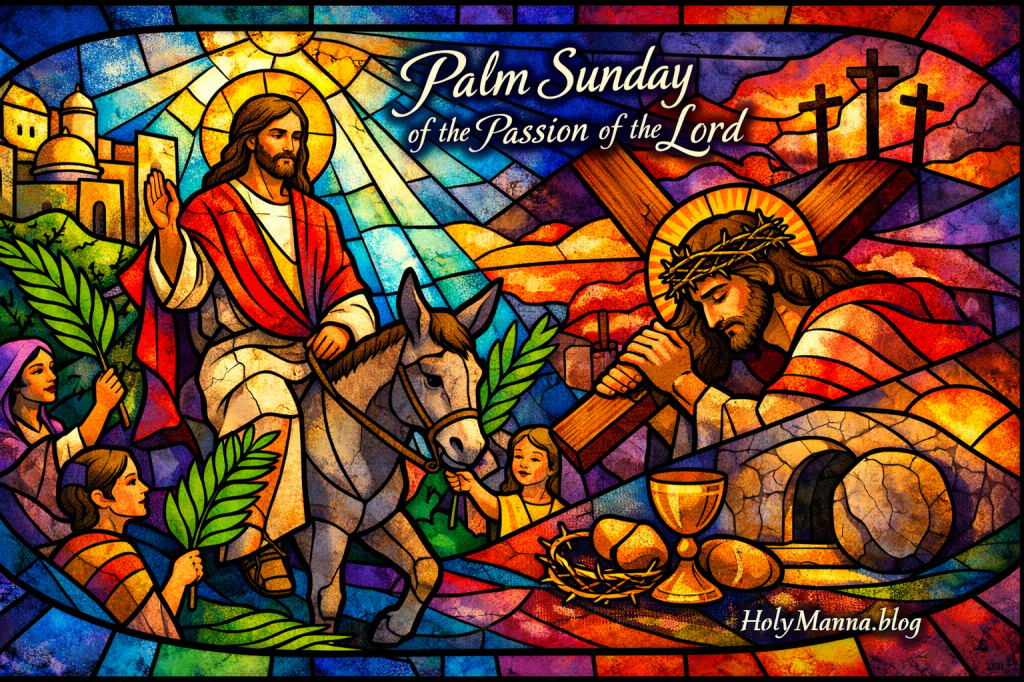
At the Gates of Holy Week
Palm Sunday of the Passion of the Lord stands at one of the most dramatic thresholds in the whole liturgical year. The Church begins this day with palms, procession, and praise, yet before the Mass is over she places the Passion of Christ before the faithful with solemn gravity. That is not an accident. It is one of the most important lessons of the feast. Jesus enters Jerusalem as King, but He does not come to claim an earthly throne. He comes to offer Himself.
In Catholic tradition, Palm Sunday opens Holy Week and sets the heart of the faithful on the road to Calvary. The Church does not let this day become a simple celebration of applause and waving branches. She joins Christ’s triumphal entry to His suffering and death so that the faithful can see what sort of Messiah Jesus truly is. He is the humble King foretold by the prophets, the obedient Servant who gives His life for the salvation of the world. The Compendium of the Catechism teaches that Jesus went up to Jerusalem in order to suffer His Passion, die, and rise from the dead, and the Church receives the crowd’s cry into her own worship when she sings “Blessed is he who comes in the name of the Lord! Hosanna in the highest!” during the Sanctus.
Branches in Hand, the Passion in View
The story behind Palm Sunday begins in the final approach of Jesus to Jerusalem. He enters the holy city not hidden and not hesitant, but deliberately, publicly, and in fulfillment of the Scriptures. The Gospels show Him mounted on a donkey, not on a warhorse. That detail matters. He is revealing His kingship, but He is also revealing its character. This is not the entrance of a worldly conqueror. This is the arrival of the Prince of Peace.
The people spread cloaks before Him and carry branches in joyful acclamation. They cry out with messianic hope, believing that the long-awaited Son of David has come. Yet the Church knows that this same city will soon echo with rejection, mockery, and violence. Palm Sunday therefore holds together two scenes that belong to one mystery. The One who is welcomed is the very One who will be betrayed. The One who is hailed as King is the very One who will wear a crown of thorns.
Historically, the Church’s liturgical commemoration of this event reaches back to ancient Christian worship in Jerusalem. Early pilgrims described Christians gathering on the Mount of Olives and processing into the city with branches while listening to the Gospel of the Lord’s entry. Over time, this observance took deep root in the Roman Catholic liturgical tradition. The Church preserved not only the memory of the event, but also its spiritual force. Palm Sunday became a living doorway into Holy Week, a day when Catholics do not simply remember what happened to Jesus, but begin walking with Him in a more intense way.
The broader context matters as well. Jerusalem at the time of Christ was filled with political tension, religious expectation, and longing for deliverance. Many hoped for a Messiah who would overthrow oppressors and restore visible national glory. But Jesus came to do something far deeper. He came to conquer sin, death, and hell. He came to establish a Kingdom not built by force, but by sacrificial love. Palm Sunday shows just how easy it is for the human heart to welcome Christ on its own terms while resisting Him on His.
The Crown, the Donkey, and the Cross
The theological meaning of Palm Sunday is rich and deeply Catholic. This feast teaches that Christ’s glory cannot be separated from His Passion. In the Roman liturgy, the same day that begins with the procession of palms also proclaims the Passion narrative in full. The Church is saying something unmistakable. Jesus is King precisely in the way He suffers. His triumph is not interrupted by the Cross. His triumph is revealed through the Cross.
Saint Paul gives the Church the language to understand this mystery in Philippians 2:6-11. Christ humbles Himself, taking the form of a servant, becoming obedient unto death, even death on a cross. Because of this, God highly exalts Him. Palm Sunday teaches the same truth through signs, Scripture, and prayer. The One who enters Jerusalem in humility is the One who will be lifted up in glory. The road of self-emptying leads to exaltation. The Catholic life follows the same pattern. There is no Resurrection without Good Friday. There is no crown without surrender.
The Catechism of the Catholic Church teaches that Jesus’ entrance into Jerusalem manifests the coming of the Kingdom that the Messiah-King will accomplish by the Passover of His Death and Resurrection, as the liturgy of Palm Sunday begins Holy Week by celebrating this entry. CCC 560 gives the feast its doctrinal heart. Palm Sunday is not theater. It is revelation. Christ shows the world that divine power looks like humility, obedience, mercy, and total love.
The Church also teaches something else that deserves to be heard with care. The Passion must never be read as an excuse for hatred or blame. The Catechism makes clear that the responsibility for Christ’s suffering cannot be laid upon all Jews of that time or of later generations. The deeper truth is far more personal and far more sobering. Sinners were the authors and ministers of all the sufferings that the divine Redeemer endured, and Christians must recognize their own sins in the Passion of Christ. CCC 598 cuts through every temptation to self-righteousness. Palm Sunday is not a day to point fingers at a crowd in ancient Jerusalem. It is a day to look honestly at the heart and ask where Christ is being resisted, ignored, or betrayed even now.
The Roman Missal also strengthens the theology of the feast through its structure. The Passion is proclaimed with a stripped solemnity. The Church does not surround it with the usual signs of festivity. She lets the words stand in their weight. This liturgical sobriety teaches reverence. It teaches that this mystery is not to be rushed past. It teaches that the King being welcomed with branches is the same Lord who will pour out His blood for the life of the world.
Palms, Processions, and the Long Road of Love
The devotions and practices associated with Palm Sunday are beautiful when they are understood rightly. The most important devotion is the liturgy itself. The blessing of palms, the procession, the Gospel of the Lord’s entry into Jerusalem, and the proclamation of the Passion form the heart of the day. Catholics do not honor Palm Sunday best by merely taking home a blessed branch. They honor it best by entering the mystery prayerfully and following Christ into the rest of Holy Week.
The Church has long taught that blessed palms should be kept reverently in the home as a sign of faith in Christ the King and in His Paschal victory. At the same time, Catholic teaching is careful here. Palms are not magic. They are not charms or superstitious tokens. They are sacramentals that point beyond themselves to the mystery of Christ. A palm tucked behind a crucifix or holy image can serve as a quiet reminder that the Christian life is meant to remain close to Jesus not only in joyful moments, but also in suffering, sacrifice, and repentance.
Palm Sunday also naturally opens the door to other devotions of Holy Week. The faithful are drawn toward meditation on the Passion, prayer before the crucifix, sorrow for sin, and deeper participation in the sacred liturgies that follow. Many Catholics pray the Stations of the Cross with greater attention after Palm Sunday because the Church has now placed the Passion directly before their eyes. Others spend more time with Psalm 22, Isaiah 50, or the Passion narratives from the Gospels. The feast invites the whole soul to slow down and stay near the suffering Christ.
Pilgrimage has a special place in the life of this feast. Jerusalem remains the most powerful place associated with Palm Sunday, especially the Mount of Olives, Bethphage, and the road that leads toward the Holy City. For centuries, pilgrims have desired to walk where Christ walked and pray where the Gospel scene unfolded. Yet the Church also understands pilgrimage in a deeper sense. Every parish procession on Palm Sunday becomes a kind of Jerusalem. Every faithful Catholic who carries a branch and follows the Gospel enters spiritually into the same mystery. The road to the church becomes an image of the road to Calvary, and the heart becomes the place where Christ asks to be received.
A Feast That Sings in Every Language
Palm Sunday has left a deep mark on Catholic culture around the world. In many places, the faithful gather outside the church for the blessing of palms and enter in solemn procession while singing hymns to Christ the King. In some countries, olive branches are used instead of palms. In others, local plants are woven into intricate designs that reflect both reverence and cultural beauty. Yet the meaning remains the same. The whole Church welcomes the Lord who comes to save.
In parts of the world shaped by strong Catholic tradition, Palm Sunday processions become major communal moments of prayer. Families arrive early, children carry branches with joy, and sacred music gives the day an atmosphere both festive and serious. In some places, the chanting of the Passion becomes one of the most memorable moments of the year. In others, communities prepare with special fasting, confession, and neighborhood devotions. The feast belongs to the universal Church, but it also finds a home in the living heart of local Catholic culture.
There is something especially moving about the worldwide character of this celebration. Whether in a grand basilica, a small rural parish, or a mission church with simple walls and humble music, the same Lord enters Jerusalem and the same Church receives Him. Palm Sunday reminds Catholics that they do not walk into Holy Week alone. They walk with the whole Body of Christ, across nations, centuries, and cultures, all under the kingship of the same crucified and risen Lord.
When the Hosannas Reach the Heart
Palm Sunday carries a lesson that remains painfully relevant in every generation. It is possible to praise Jesus with the lips and resist Him with the life. It is possible to admire Him as long as He seems to answer expectations, then pull away when He asks for surrender. That is why this feast is so spiritually searching. It exposes the instability of human enthusiasm and calls the faithful to something deeper than emotion.
A meaningful Catholic response to Palm Sunday begins with honesty. Christ must be welcomed not only as Savior, but as Lord. He must be received not only in moments of consolation, but also when obedience becomes costly. The feast teaches that discipleship is not proven by how loudly someone can sing Hosanna. It is proven by whether that same soul stays near Jesus when the way grows dark.
This feast also teaches courage. Jesus enters Jerusalem knowing exactly what awaits Him. He is not swept into the Passion by forces outside His control. He goes willingly. He offers Himself freely. That matters for daily life. It means love is not measured by comfort. It is measured by fidelity. In a culture that often prizes convenience, Palm Sunday reminds the faithful that real love perseveres, sacrifices, and remains.
The feast speaks powerfully to family life, work, suffering, and prayer. In family life, it teaches that love must be steady and sacrificial. In work, it teaches humility and quiet obedience. In suffering, it teaches that God’s power often appears hidden beneath weakness. In prayer, it teaches the need to remain close to Christ not only in bright moments but also in silence, sorrow, and trust. How often does the heart want the glory of Christ without the surrender that comes with following Him? Palm Sunday asks that question with great tenderness and great seriousness.
It also invites repentance. The palms that are waved in triumph are later burned to become ashes for Ash Wednesday in many places. That liturgical rhythm says something beautiful. The Church never lets triumph become pride. She folds victory back into repentance, and repentance back into hope. Palm Sunday therefore invites the faithful to examine where Christ is being welcomed only halfway. It is a day to seek confession, to forgive old wounds, to return to prayer, and to begin Holy Week with a heart ready to stay with Jesus.
Walk With the King
Share thoughts and reflections in the comments below. Palm Sunday always has a way of reaching people differently depending on the season of life they are in. For some, it feels like a call to courage. For others, it feels like a summons to repentance. For many, it is a reminder that Jesus is most glorious precisely when He is most self-giving.
- What part of Palm Sunday speaks most deeply right now: the procession, the praise, or the Passion?
- Where might Christ be asking for deeper trust instead of shallow enthusiasm?
- How can this Holy Week become more intentional, prayerful, and rooted in the Cross?
- What does it mean to welcome Jesus not only as a comforting Savior, but as a King who has the right to lead every part of life?
- How can love, mercy, patience, and sacrificial faith be lived more concretely at home, at work, and in daily relationships this week?
Palm Sunday is an invitation to walk with Christ all the way. The Church places the palm in the hand, but she also places the Passion before the eyes so that the faithful may learn what love really looks like. The King has come, and He comes in humility. He comes in mercy. He comes to save. May this feast lead every heart to follow Him with steadiness, reverence, and trust, and to live each day with the love and mercy Jesus taught.
Jesus Christ our Lord & King, we trust in You!
Follow us on YouTube, Instagram and Facebook for more insights and reflections on living a faith-filled life.

 Holy Manna!
Leave a comment