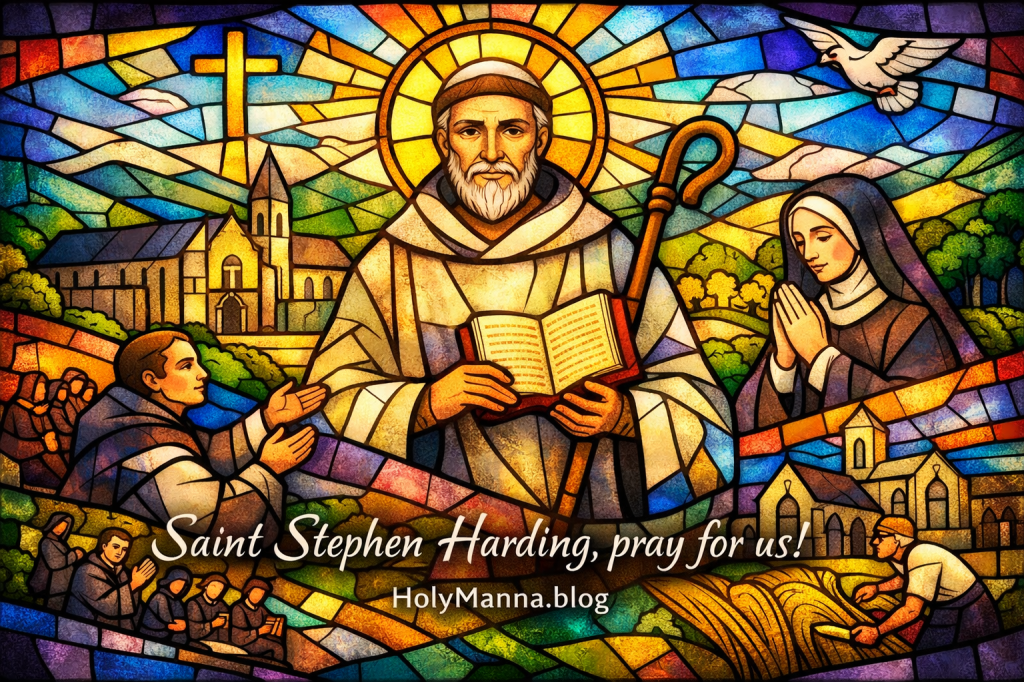
The Quiet Architect of Cistercian Renewal
Saint Stephen Harding is not one of those saints whose name fills every parish calendar or whose life is surrounded by a long list of dramatic miracle stories. Yet from a Roman Catholic perspective, he stands as one of the great builders of the spiritual life in the Western Church. He was an English monk, the third abbot of Cîteaux, and one of the principal founders of the Cistercian Order. Through his holiness, discipline, humility, and deep fidelity to The Rule of Saint Benedict, he helped shape a reform that would renew monastic life across Europe and influence generations of saints, especially Saint Bernard of Clairvaux.
He is revered because he helped preserve a life of prayer, poverty, obedience, and charity at a time when religious discipline had grown weak in many places. He is remembered not only for what he accomplished, but for the spirit in which he accomplished it. He did not seek fame. He sought faithfulness. He wanted monks to live as monks, to pray as sons of the Church, and to remain united in charity. That quiet fidelity is precisely why the Church still remembers him.
From England to the Cloister
Stephen was born around the year 1060 in Sherborne, in Dorset, England. Catholic tradition holds that he was educated in the monastery at Sherborne, where he first absorbed the world of prayer, sacred learning, and monastic order. His early formation gave him a love for study and a hunger for God that would mark the rest of his life.
Some Catholic accounts connect the turbulence of his early life to the disorder that followed the Norman Conquest. Whether fleeing political unrest or simply drawn by the search for truth, Stephen eventually left England and traveled through Scotland and France. He studied in Paris and later made his way to Rome. Older Catholic tradition preserves a beautiful detail from these years. It says that while traveling with a companion named Peter, the two men spent their time in prayer, silence, and the recitation of the Psalms. That image says a great deal about who Stephen was becoming. He was not merely a traveler. He was a pilgrim.
At some point along the way, his heart was drawn more deeply into the monastic life. He eventually arrived at Molesme in Burgundy and joined the reform-minded monastery led by Saint Robert of Molesme. There he found the kind of life he had been seeking, one rooted in seriousness, prayer, and authentic observance. Stephen’s vocation did not begin with a sudden dramatic conversion from unbelief. His was a deepening conversion, the kind that happens when a man keeps saying yes to grace, step by step, until the Lord leads him exactly where he must go.
This deepening of faith would define him. He was not known for restless novelty. He was known for stability, humility, and the courage to follow the truth wherever it led. That is part of what makes his life so powerful. He shows that sanctity is often formed quietly, through discipline, prayer, sacrifice, and fidelity over time.
The Man Who Helped Shape Cîteaux
In 1098, Stephen was among the small band of monks who left Molesme with Saint Robert to found the New Monastery at Cîteaux. Their goal was simple and demanding. They wanted to live The Rule of Saint Benedict with greater purity, poverty, and exactness. They were not trying to invent a new spirituality. They were trying to recover an old one.
After Saint Robert returned to Molesme, and after the death of Abbot Alberic, Stephen became the third abbot of Cîteaux, usually dated to 1109. He inherited not a flourishing institution, but a fragile one. The foundation was poor, vocations were few, and the whole reform stood on uncertain ground. Yet this was where Stephen’s greatness began to shine.
He is most known for giving the early Cistercian reform its lasting shape. He helped establish the regular General Chapters that would unite the monasteries. He promoted visitations between houses so that discipline and charity would remain alive. Most importantly, he is closely connected with the Charter of Charity, the foundational text that helped organize the life of the Cistercian Order. This document was not cold bureaucracy. It was spiritual wisdom in legal form. Its goal was to preserve unity without destroying the character of each monastery.
One line associated with this Cistercian tradition beautifully captures Stephen’s spirit: “So that there may be no discord in our conduct, but that we may live by one charity, one Rule and like usages.” That is the heart of his legacy. He believed that true order exists for love. He knew that discipline in the Church is not opposed to charity. Done rightly, it protects charity.
Another phrase preserved in the tradition of the Charter of Charity says that monasteries, though separated by distance, should be “indissolubly knit together in mind.” That sounds almost like a summary of Catholic communion itself. The saints are united in Christ, and the Church on earth is strongest when she is united in truth and love.
Stephen was also a man of learning. Catholic sources remember him as someone who worked carefully with biblical and liturgical texts. He sought accuracy in the Vulgate, care in hymnody, and simplicity in worship. Under his guidance, the early Cistercians became known for austerity, beauty, sobriety, and reverence. Their architecture, chant, and common life reflected a soul that loved God enough to strip away excess.
Then came one of the great turning points in monastic history. In 1112, or perhaps 1113 according to some sources, a young nobleman named Bernard arrived at Cîteaux with about thirty companions. Stephen received him. He formed him. He later sent him out to found Clairvaux. That one moment changed the course of the order and, in many ways, the course of medieval Catholic spirituality. Stephen Harding may not be as famous as Saint Bernard, but without Stephen, the history of Bernard’s mission would be impossible to imagine.
The Miracle of Fidelity
When speaking honestly from Catholic sources, it must be said that Saint Stephen Harding is not remembered for a large body of clearly documented miracle stories during his lifetime. There is no broad, well-attested miracle cycle surrounding him in the same way that one finds with some saints. That matters, because the truth matters. The Church does not need invented wonders to honor a real saint.
Still, his life bears the marks of divine providence in a striking way. The early years at Cîteaux were marked by severe poverty, political difficulty, and even the threat of collapse. Catholic sources recount that after Stephen enforced monastic enclosure with seriousness, the Duke of Burgundy became displeased, and support for the monastery suffered badly. Stephen and his monks endured such hardship that he was reduced to begging for alms from door to door. At times the future of the community seemed almost hopeless.
Yet the monastery endured. It did more than endure. It became one of the most influential monastic movements in Christendom. In that sense, many Catholic writers see in the survival and flourishing of Cîteaux a visible sign of God’s protection. This is not a formal miracle story in the strict sense, but it is certainly a remarkable testimony to grace.
Catholic tradition also emphasizes the spiritual fruit of Stephen’s life. He formed men for holiness. He preserved unity. He encouraged simplicity, scholarship, and reverence. He helped establish Tart as a daughter house for Cistercian nuns, showing that his vision shaped both men’s and women’s religious life. By the end of his life, the order had spread widely, and the reform that once seemed near death had become a living force in the Church.
This may be the deepest miracle associated with him. He helped build a way of life that kept producing saints.
A Death Marked by Humility
Saint Stephen Harding was not a martyr. He did not die by execution for the faith. But that does not mean his life was free from suffering. In many ways, his hardships were slow, hidden, and interior, which is often the harder road.
He endured poverty so severe that the monastery’s survival was uncertain. He endured misunderstanding and opposition from powerful people. He endured the burden of leadership in a fragile new reform. He watched brothers die. He carried the responsibility of preserving a great spiritual work when almost no one could have blamed him for giving up.
Then, after years of labor, age and infirmity came. Catholic sources say that by 1133 he was old, weak, and nearly blind. He resigned as abbot and prepared for death. There is a deeply moving line preserved in older Catholic tradition as one of his final sayings: “I go to God in fear and trembling.” Whether heard as a literal final quote or as a traditional summary of his spirit, it reveals the humility for which he is remembered. This was not a man who presumed upon holiness. He was a saint who remained small before God.
He died on March 28, 1134, at Cîteaux. Catholic tradition says he died in peace and was buried in the tomb of Alberic in the cloister. He finished his life the same way he had lived it: in obedience, humility, and trust.
A Saint Still Shaping the Church
There does not appear to be a broad, famous collection of posthumous miracle stories tied specifically to Saint Stephen Harding in the surviving Catholic sources. Some retellings speak more generally of divine favor surrounding the early Cistercian community, but they do not offer a large number of clearly verifiable healings or wonders at his tomb. Those stories cannot be verified as a formal miracle tradition attached directly to him.
But his impact after death is enormous and unmistakable.
His true legacy lives in the Church he helped strengthen. The Cistercian Order continued to grow after his death and shaped the prayer, culture, land stewardship, architecture, and contemplative life of Catholic Europe. The influence of Cistercian monasteries reached deep into agriculture, scholarship, sacred art, spirituality, and the renewal of ecclesial life. Above all, the order produced saints.
Saint Bernard of Clairvaux is the most famous among them, but Bernard’s flowering cannot be separated from the soil Stephen helped cultivate. Through Bernard and through the many abbeys founded from Cîteaux, Stephen’s quiet labor continued to bear fruit long after his death.
His memory also lives in the liturgical life of the Church. Older Catholic calendars remembered him on different feast days, including April 17 and, among Cistercians, July 15. In the modern Cistercian calendar, he is celebrated together with Saints Robert and Alberic on January 26 as one of the Founders of Cîteaux. That shared celebration says something important. Stephen is remembered not as an isolated religious hero, but as part of a communion of men who gave their lives to renew the Church.
From a Roman Catholic perspective, the saints are not just historical figures. They are living members of the Body of Christ who intercede for the faithful. The Catechism of the Catholic Church teaches that the saints in heaven continue to care for the Church on earth and intercede for us before the Father, as seen in CCC 956 and CCC 2683. That means Saint Stephen Harding is not only someone to admire. He is someone to ask for prayers.
What Saint Stephen Harding Teaches the Soul Today
Saint Stephen Harding speaks powerfully to modern Catholics, especially in an age that often confuses noise with fruitfulness and novelty with holiness. His life reminds the Church that reform does not begin with self-expression. It begins with repentance, humility, obedience, prayer, and the willingness to return to what is true.
He teaches the value of hidden faithfulness. Not every saint is called to public drama. Some are called to build structures that help others become saints. Some are called to strengthen communities, preserve truth, and endure long seasons of obscurity. Stephen shows that this hidden work matters immensely.
He also teaches that charity and order belong together. Modern people often think rules suffocate love. Stephen understood the opposite. Rightly lived, discipline protects love. Unity in worship, doctrine, and common life is not a burden when it is rooted in Christ. It is a gift.
His life also invites a deeper examination of one’s own heart. Is there an area of life where comfort has replaced fidelity? Is there a place where God is asking for greater simplicity, greater obedience, or greater trust? Is there a quiet work of faithfulness that has been overlooked simply because it is hidden?
A practical way to imitate Saint Stephen Harding is to return seriously to the foundations of Christian life. Pray with greater consistency. Read The Rule of Saint Benedict or spend time with the Psalms. Simplify what is cluttered. Be faithful in small duties. Support the life of the Church not only with words, but with perseverance and sacrifice. Build unity in the family, in the parish, and in friendships. Live in such a way that others are helped toward holiness.
Stephen Harding did not become great by chasing greatness. He became holy by choosing fidelity again and again. That path remains open.
Engage with Us!
Share your thoughts and reflections in the comments below. Saint Stephen Harding is a beautiful reminder that some of the greatest saints are the ones who quietly strengthen the Church from within.
- What stands out most about Saint Stephen Harding’s life: his humility, his leadership, or his perseverance through hardship?
- How does his example challenge the modern temptation to seek recognition instead of hidden faithfulness?
- Is there an area of personal or spiritual life where God may be calling for greater simplicity and discipline?
- What can families, parishes, and Catholic communities learn from his desire to keep people united in charity and truth?
- How can his life inspire a deeper trust that God is at work even when a good and holy work seems small, poor, or fragile?
May Saint Stephen Harding pray for all who seek to live with greater fidelity, humility, and peace. May his example encourage a life rooted in prayer, strengthened by discipline, and filled with the love of Christ. Let everything be done with the love and mercy Jesus taught us, and let that love shape every part of life.
Saint Stephen Harding, pray for us!
Follow us on YouTube, Instagram and Facebook for more insights and reflections on living a faith-filled life.

 Holy Manna!
Leave a comment