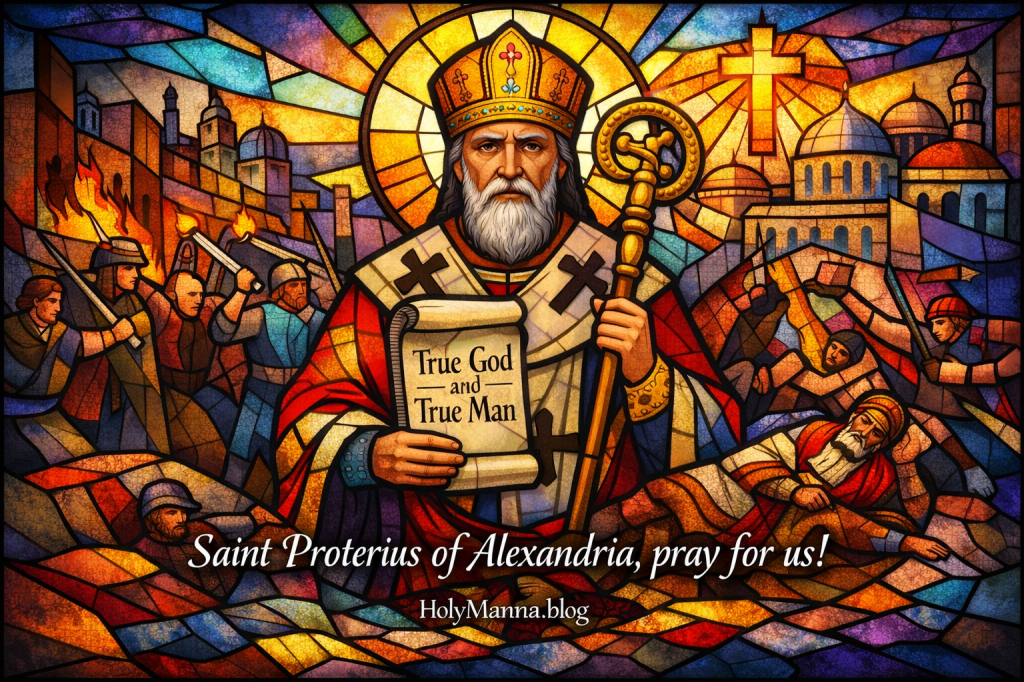
The Bishop Who Died for the Truth About Christ
Saint Proterius of Alexandria is one of those saints whose name is not always widely known, but whose witness matters deeply. He lived in the fifth century during one of the most painful and decisive moments in the life of the Church. He is revered as a Catholic patriarch, a defender of orthodox teaching, and a martyr who gave his life rather than abandon the truth about Jesus Christ.
What made his life so significant was not worldly power or dramatic public success. It was fidelity. Saint Proterius stood firm when the Church was torn by conflict over who Jesus truly is. In an age of confusion, violence, and political pressure, he remained loyal to the Catholic faith that Christ is truly God and truly man. That confession, taught clearly by the Council of Chalcedon and echoed in The Catechism in CCC 467, was worth everything to him.
He is remembered above all for defending the Catholic teaching on the two natures of Christ and for dying as a martyr in Alexandria during a bitter ecclesial struggle. His life is a reminder that truth is not an abstract thing. Truth is a Person. To defend the truth about Christ is to defend the heart of the Gospel itself.
Formed in the Service of the Church
Not much is known with certainty about Saint Proterius’s early childhood, birthplace, or family background. That silence itself says something important. Some saints are remembered for long biographies filled with personal details. Saint Proterius is remembered more for his office, his suffering, and his witness.
Catholic tradition holds that he was ordained a priest by Saint Cyril of Alexandria, one of the great defenders of the faith in the early Church. If that tradition is accurate, then Proterius was formed in a powerful theological and spiritual environment, one deeply shaped by reverence for the Incarnation and by zeal for the truth. He later became an archpriest and a prominent cleric in Alexandria.
There is no dramatic conversion story preserved about him in the way that there is for saints like Augustine or Mary of Egypt. Instead, his life seems to show a steady deepening of faith through service, fidelity, and perseverance within the life of the Church. He was not known for a sudden turning point from sin to sanctity. He was known for constancy.
That kind of holiness matters. Not every saint has a thunderclap conversion. Some saints become holy by remaining faithful in the place where God has planted them. Saint Proterius appears to have been one of those men. He served the Church patiently, rose in responsibility, and eventually found himself called to stand in the center of a doctrinal storm.
He is most known for becoming the Catholic Patriarch of Alexandria after the deposition of Dioscorus and for defending the faith of Chalcedon during one of the most dangerous periods in Alexandrian history.
Holding Fast to the Mystery of Christ
To understand why Saint Proterius matters so much, it helps to understand the crisis around him. The early Church was fighting to express faithfully what Scripture reveals about Jesus. The Church had to guard against false teachings that either divided Christ or confused His divine and human natures. In that struggle, the Council of Chalcedon taught that Jesus Christ is one divine Person in two natures, divine and human, without confusion and without division. This remains Catholic teaching, as reflected in CCC 464-469.
Saint Proterius was chosen as the Catholic patriarch in Alexandria after Dioscorus was deposed. That decision was not welcomed by much of the city. Alexandria was already divided, angry, and unstable. Proterius entered office not to applause, but to hostility. He became a bishop in a city where theology, politics, and mob violence had become terribly entangled.
Even so, he did not abandon his post. He remained in communion with Rome and stood with the Church’s orthodox confession. Pope Saint Leo the Great praised him for holding firmly to apostolic teaching. One of the most meaningful lines associated with Proterius comes not from his own surviving words, but from Pope Leo’s praise of him: “We commend you for holding fast that teaching which has come down to us from the blessed Apostles and the holy Fathers.”
That line captures the whole shape of his life. He held fast.
As for miracles during his lifetime, the Roman Catholic sources do not preserve a developed body of miracle stories connected to Saint Proterius. No well-attested healing narratives or dramatic wonders have come down in the ordinary Catholic accounts. That does not diminish him. Some saints are remembered for miraculous deeds. Others are remembered because their whole life became a witness. Saint Proterius belongs to that second group.
There is, however, something deeply moving in the way he governed. Catholic tradition says he even sought mercy for the people of Alexandria after riots and unrest. That matters. He was not simply a hard defender of doctrine. He was also a shepherd who did not stop caring for the souls around him, even when those same people were turning against him.
That is part of why he should still be remembered and imitated. He shows that fidelity to truth and charity toward enemies belong together. The saint does not choose between love and doctrine. The saint holds both.
Holy Thursday in a City Consumed by Hatred
Saint Proterius’s life reached its climax in suffering. After Emperor Marcian died, the already unstable situation in Alexandria grew worse. The anti-Chalcedonian faction rose up with renewed force. A rival claimant, Timothy Aelurus, was advanced by those opposed to Proterius and to the Council of Chalcedon. The city descended further into violence.
Saint Proterius did not escape into safety. He stayed.
His enemies eventually fell upon him in the church of Quirinus during Holy Week. According to the Catholic tradition, he was murdered on Holy Thursday in the year 457. The circumstances were brutal and shameful. His body was not treated with reverence, but with hatred. It was publicly desecrated and dishonored by the mob.
His martyrdom is significant not only because he died violently, but because of what he died for. He died because he would not surrender the truth about Jesus Christ and would not break communion with the Catholic Church. He was not killed for vague goodness. He was killed in the middle of a battle over the identity of Christ and the unity of the Church.
There are no accounts of miraculous escape in his story. There was no last-minute rescue. No angel opened a prison door. No earthquake shattered chains. Instead, there was something even harder and often even holier. There was endurance. There was steadfastness. There was the grace to remain faithful when no earthly deliverance came.
That is often how martyrdom works. God does not always remove suffering. Sometimes He gives the saint strength to walk straight through it.
A Memory the Church Refused to Lose
After his death, Saint Proterius continued to matter because the Church refused to forget him. In Catholic memory, he was honored as a martyr and as the lawful patriarch who had suffered for the orthodox faith. Bishops invoked his intercession after his death, which shows how quickly he was venerated as one who had finished the race in holiness.
The Roman Catholic sources do not preserve a large collection of posthumous miracles associated with him. There are no major, well-developed traditions of healings at his tomb or famous miracle cycles attached to his relics in the ordinary Catholic record. Just as with his life, his posthumous legacy is centered more on martyrdom and ecclesial witness than on miracle stories.
There are also no specific miracle stories from reliable Catholic sources that need to be repeated with caution here. Since the instruction is not to invent anything, it is more faithful to say plainly that the surviving Catholic tradition emphasizes his martyrdom, his intercession, and his role in Church history rather than unverifiable miracle legends.
His impact after death was nevertheless enormous. His murder became one of the great markers of the widening rupture in Egyptian Christianity. In many ways, his death symbolizes the tragic division that hardened between the Chalcedonian Catholics and those who rejected Chalcedon. Later opponents even worked to erase or diminish his memory. Yet the Church preserved it.
His feast is kept in the Roman Martyrology on March 28. In some Eastern traditions, he is remembered on other dates as well. His broader cultural impact has been stronger in Eastern Christian memory than in popular Western devotion, but his place in Church history is still very important. He stands as a witness to the cost of defending orthodox teaching in a world that does not want to hear it.
There may not be great pilgrimage traditions attached to his shrine in the same way there are for more popularly known saints. Still, the place of his witness remains spiritually important. Alexandria itself became one of the great battlegrounds of early Christian history, and Saint Proterius’s memory is tied forever to that city’s struggle over the truth of Christ.
What Saint Proterius Teaches the Church Today
Saint Proterius speaks powerfully to modern Catholics, especially in a time when confusion can wear the mask of compassion and compromise can pretend to be peace. His life teaches that unity without truth is fragile, and truth without charity is incomplete. The saint stands before the Church as a man who held both.
His witness invites reflection on whether faith is treated as something merely cultural, emotional, or convenient. For Saint Proterius, the identity of Christ was worth defending with his whole life. That should challenge every comfortable and half-awake form of Christianity.
Does the truth about Jesus matter enough to shape daily choices, conversations, loyalties, and courage?
He also teaches perseverance. Not every holy life looks outwardly successful. He did not preside over visible peace. He did not leave behind a golden age. He stood in a difficult place and remained faithful there. That kind of witness is deeply needed today. Many people want visible results, quick wins, and affirmation. Saint Proterius reminds the faithful that holiness is measured first by fidelity, not by applause.
His example also encourages courage in the face of hostility. There are moments when standing with the Church will cost something. It may cost reputation, comfort, friendships, or opportunities. In some times and places, it has cost life itself. Saint Proterius shows that the Christian does not need to win every argument or control every outcome. The Christian needs to remain with Christ.
Practically, his life can be applied in simple and demanding ways. Catholics can imitate him by learning the faith seriously, especially what the Church teaches about Jesus Christ in The Catechism. Catholics can imitate him by refusing to reduce doctrine to opinion. Catholics can imitate him by staying charitable even when confronted by anger or injustice. Catholics can imitate him by remaining faithful to prayer, sacramental life, and the Church even when the surrounding culture becomes hostile or confused.
His story is also a reminder to pray for unity. The divisions that surrounded his life were tragic. They wounded the Body of Christ deeply. That should stir up not pride, but sorrow and prayer. Saint Proterius defended truth, but his story also encourages prayer that all Christians may one day be fully united in the truth of Christ.
Engage With Us!
Readers are invited to share their thoughts and reflections in the comments below. Saint Proterius is not one of the most talked-about saints, but his witness has a lot to say to the modern Church. Reflection on his life can open up important conversations about courage, truth, unity, and perseverance.
- What stands out most about Saint Proterius’s witness to the truth of Jesus Christ?
- How can stronger faithfulness to Catholic teaching be lived out with both courage and charity in ordinary daily life?
- What does Saint Proterius’s martyrdom reveal about the cost of discipleship?
- Are there places in life where compromise has started to feel easier than fidelity?
- How can prayer for Christian unity become a more intentional part of spiritual life?
May Saint Proterius of Alexandria inspire a deeper love for Christ, a stronger fidelity to the truth, and a steadier courage in times of confusion. May his witness remind every heart that holiness is never wasted, even when the world does not recognize it. Live the faith with conviction, and do everything with the love and mercy Jesus taught us.
Saint Proterius of Alexandria, pray for us!
Follow us on YouTube, Instagram and Facebook for more insights and reflections on living a faith-filled life.

 Holy Manna!
Leave a comment