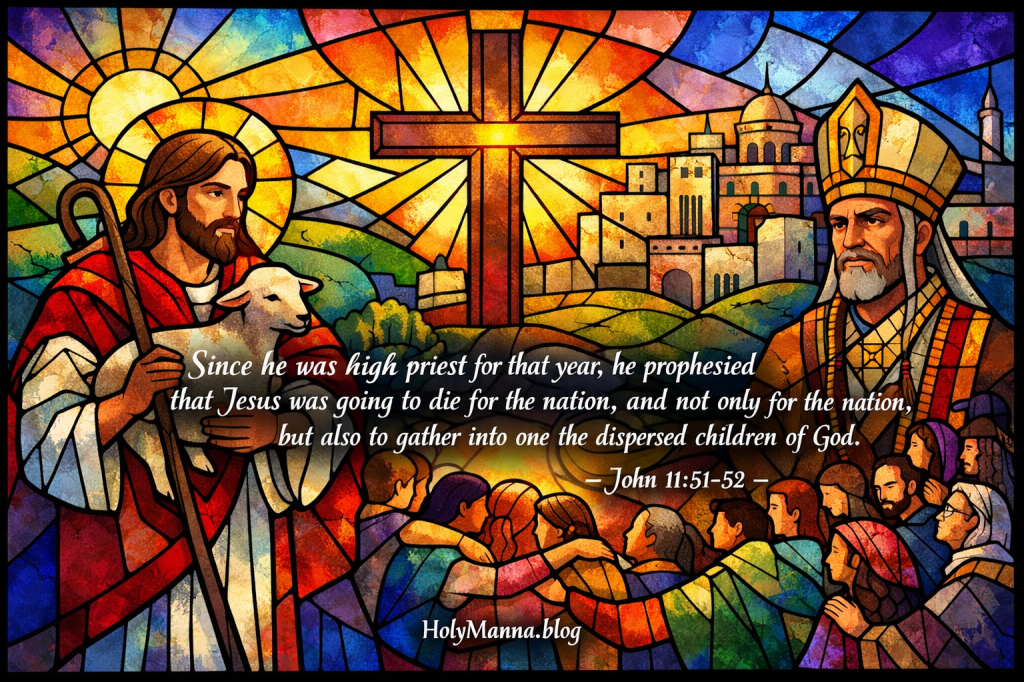
Saturday of the Fifth Week of Lent – Lectionary: 256
When God Gathers What Sin Has Scattered
There are moments in the spiritual life when everything feels fractured, when hearts are divided, families are wounded, nations are restless, and even faith can feel like it is hanging by a thread. Today’s readings step right into that ache and answer it with a promise that runs from exile to Passover: God gathers what sin has scattered.
That is the great theme tying these readings together. In Ezekiel 37:21-28, the Lord speaks to a people marked by division, idolatry, and displacement. The kingdom had been torn apart, the people had been scattered among the nations, and the wounds of covenant unfaithfulness ran deep. Yet God does not speak a word of abandonment. He promises reunion, cleansing, peace, and a shepherd-king from the line of David. In Jeremiah 31:10-13, that same promise takes on the warmth of consolation, as the Lord is revealed not only as ruler, but as shepherd, redeemer, and restorer, the One who turns mourning into joy. Then in John 11:45-56, the Gospel brings these promises to their decisive moment, as the leaders of Israel begin to plot the death of Jesus, not realizing that His sacrifice will become the very means by which God gathers His scattered children into one.
The timing of these readings matters. The Church places them just before Holy Week, when the shadow of the Cross is growing longer and the approach of Passover fills the air. Passover was the great memorial of Israel’s deliverance, the feast that recalled how God saved His people from slavery and formed them into a covenant nation. That setting gives today’s Gospel an almost painful irony. While many are preparing to purify themselves for the feast, the true Lamb of God is being marked out for sacrifice. What appears to be a political calculation by Caiaphas is, in the providence of God, a prophecy of redemption. The one Shepherd will save the flock by laying down His life.
There is also a deep religious thread running through all three readings: God is not interested in a merely outward restoration. He does not just want Israel back on the map. He wants His people purified, united, and living once again in covenant communion with Him. That is why Ezekiel speaks of cleansing from idols, of one shepherd, and of God’s sanctuary dwelling among His people forever. From a Roman Catholic perspective, these promises find their fullest meaning in Jesus Christ, the Son of David, who establishes the new and everlasting covenant and gathers His people into His Body, the Church. The scattered are not simply brought back to a place. They are brought back to a Person.
This makes today’s readings feel intensely personal. The Word is not only speaking about ancient Israel, hostile authorities, or a distant crowd preparing for Passover. It is speaking to every divided heart. It is speaking to every soul that has tried to live in pieces. It is speaking to everyone who knows what it is like to wander, to grieve, to fear, or to feel internally torn. The message is steady and deeply hopeful: Christ does not come merely to manage the damage. He comes to gather, to cleanse, to reconcile, and to dwell with His people. That is the mystery the Church invites us to enter today, as the road to Calvary comes clearly into view.
First Reading – Ezekiel 37:21-28
The Shepherd-King Who Rebuilds a Broken People
The prophet Ezekiel speaks into one of the darkest chapters in Israel’s history. The people of God had been shattered by conquest, dragged into exile, and humiliated before the nations. The old unity of the kingdom had been broken long before Babylon carried many away. After Solomon’s reign, the nation split into the northern kingdom of Israel and the southern kingdom of Judah. That political division soon became a spiritual wound, marked by idolatry, corruption, and covenant infidelity. By the time Ezekiel prophesied, the people were not only scattered geographically. They were fractured in heart, memory, worship, and identity.
That is what makes this reading so powerful within today’s theme. The Lord does not merely promise survival. He promises restoration. He will gather the scattered, cleanse the defiled, restore true worship, and place over His people one shepherd from the line of David. This is not just a political prediction. From a Catholic perspective, this reading points toward the coming of Christ, the true Son of David, who gathers into one the children of God who had been scattered. As Holy Week draws near, the Church places this prophecy before her children so they can see more clearly what Jesus came to do. He did not come only to comfort wounded people. He came to form one holy people, united under one Shepherd, living in an everlasting covenant of peace.
Ezekiel 37:21-28 – New American Bible (Revised Edition)
21 Say to them: Thus says the Lord God: I will soon take the Israelites from among the nations to which they have gone and gather them from all around to bring them back to their land. 22 I will make them one nation in the land, upon the mountains of Israel, and there shall be one king for them all. They shall never again be two nations, never again be divided into two kingdoms.
23 No longer shall they defile themselves with their idols, their abominations, and all their transgressions. I will deliver them from all their apostasy through which they sinned. I will cleanse them so that they will be my people, and I will be their God. 24 David my servant shall be king over them; they shall all have one shepherd. They shall walk in my ordinances, observe my statutes, and keep them. 25 They shall live on the land I gave to Jacob my servant, the land where their ancestors lived; they shall live on it always, they, their children, and their children’s children, with David my servant as their prince forever. 26 I will make a covenant of peace with them; it shall be an everlasting covenant with them. I will multiply them and put my sanctuary among them forever. 27 My dwelling shall be with them; I will be their God, and they will be my people. 28 Then the nations shall know that I, the Lord, make Israel holy, by putting my sanctuary among them forever.
Detailed Exegesis
Verse 21 – “Say to them: Thus says the Lord God: I will soon take the Israelites from among the nations to which they have gone and gather them from all around to bring them back to their land.”
The Lord begins with gathering. That matters. Sin scatters. Exile scatters. False worship scatters. But God gathers. In the immediate historical sense, this refers to the restoration of Israel from exile. Yet the promise stretches further than a mere return from Babylon. The language is wide, almost universal. God will gather them “from all around,” which hints at a restoration deeper than geography. The Lord is reclaiming His people as His own.
In Catholic understanding, this prepares the way for the mission of Christ, who gathers not only ethnic Israel, but all the dispersed children of God into the Church. The exile of the human race is even deeper than political displacement. Humanity is exiled by sin, alienated from God, and unable to heal itself. This verse begins the answer.
Verse 22 – “I will make them one nation in the land, upon the mountains of Israel, and there shall be one king for them all. They shall never again be two nations, never again be divided into two kingdoms.”
This verse speaks directly to the old split between Israel and Judah. What was torn apart by pride, rivalry, and disobedience will be made one again by God. The promise of “one king” is crucial. Unity will not come through negotiation alone. It will come through righteous rule under the king God appoints.
The Church reads this in the light of the Messiah. Jesus is the true King who unites what sin divides. This is one reason the Church treasures visible unity so deeply. Christ does not gather a vague spiritual crowd. He forms one people. Division is always a wound against the heart of God’s plan.
Verse 23 – “No longer shall they defile themselves with their idols, their abominations, and all their transgressions. I will deliver them from all their apostasy through which they sinned. I will cleanse them so that they will be my people, and I will be their God.”
The Lord goes straight to the deepest issue. Israel’s problem was never only military weakness or political failure. The deeper wound was idolatry and apostasy. The nation had broken covenant from within. That is why God’s promise includes cleansing. Restoration without purification would only repeat the old disaster.
This verse carries strong covenant language: “They will be my people, and I will be their God.” That phrase runs through salvation history like a golden thread. God does not save merely to improve behavior. He saves to restore communion. In Catholic life, this cleansing is fulfilled in Christ through grace, especially in Baptism and restored again through repentance and confession when the baptized fall into serious sin. God does not only call His people back. He washes them.
Verse 24 – “David my servant shall be king over them; they shall all have one shepherd. They shall walk in my ordinances, observe my statutes, and keep them.”
David had long been dead when Ezekiel spoke, so this is clearly messianic language. The prophet is not saying that the historical King David will simply reappear to resume political rule. He is pointing to a future Davidic ruler, the promised shepherd-king. This is fulfilled in Jesus Christ, who openly identifies Himself as the Good Shepherd.
The line about “one shepherd” is deeply important. God’s people are not meant to wander through history as a flock without direction. The shepherd imagery recalls both royal leadership and tender care. The Messiah will govern, protect, feed, and guide. Notice also that true unity is connected with obedience. The people will “walk in my ordinances.” Biblical unity is not built on vague sentiment. It is built on truth and covenant faithfulness.
Verse 25 – “They shall live on the land I gave to Jacob my servant, the land where their ancestors lived; they shall live on it always, they, their children, and their children’s children, with David my servant as their prince forever.”
The promise of land would have sounded like impossible music to exiles. Yet this verse goes even further with the word “forever.” That signals that the prophecy reaches beyond a temporary political restoration. No earthly kingdom of the Old Covenant lasted forever in a literal political sense. The promise finds its fullest meaning in the Kingdom of Christ, which endures forever.
The phrase “David my servant as their prince forever” strengthens the messianic reading. Jesus is the everlasting Son of David, whose kingdom cannot be destroyed. The Church also sees here the widening of the promise. The inheritance of God’s people is no longer just a strip of territory. In Christ, the faithful receive a share in the Kingdom of Heaven and the hope of the new creation.
Verse 26 – “I will make a covenant of peace with them; it shall be an everlasting covenant with them. I will multiply them and put my sanctuary among them forever.”
This is one of the richest verses in the passage. God promises a “covenant of peace,” and not a temporary truce. It is everlasting. In the Old Testament, peace means more than the absence of conflict. It means wholeness, right order, blessing, communion, and life under God’s favor. This promise looks forward to the New Covenant established by Christ.
The sanctuary language is equally striking. God promises to dwell among His people forever. Under the Old Covenant, the Temple represented God’s presence in a special way. But this verse points forward to something greater. In Jesus, God literally dwells among His people. In the Church, His presence remains sacramentally and truly. This is why Catholic life is so centered on the Eucharistic presence of Christ. God has not abandoned His people to spiritual distance. He dwells among them.
Verse 27 – “My dwelling shall be with them; I will be their God, and they will be my people.”
This verse intensifies the covenant formula from verse 23. The relationship is no longer described only in legal or national terms. It is intimate. God’s dwelling is with His people. This anticipates the great biblical theme of divine indwelling, which reaches a new depth in the Incarnation and continues in the Church.
For Catholics, this verse resonates deeply with the mystery of Emmanuel, “God with us,” and with the Church as the dwelling place of God by the Holy Spirit. The whole movement of salvation history is here in miniature. God creates, man falls, history fractures, and then God Himself moves toward His people again to dwell with them and restore communion.
Verse 28 – “Then the nations shall know that I, the Lord, make Israel holy, by putting my sanctuary among them forever.”
The restoration of Israel is not only for Israel. The nations are meant to see the holiness of God through what He does for His people. This is missionary language. God sanctifies His people so that His name may be known among the nations.
This also points toward the Church’s vocation. The people of God are meant to be a visible sign in the world, not because they are naturally superior, but because God has acted in mercy. Holiness is not self-manufactured. It is God’s work in His people. The Church exists to manifest that sanctifying presence of God to the world.
Teachings
This reading opens a window into the heart of God’s plan. He desires one people, one shepherd, one covenant, and one holy dwelling among men. The promise begins with Israel, but it flowers fully in Christ and His Church.
The Catechism teaches this clearly in CCC 781: “At all times and in every race, anyone who fears God and does what is right has been acceptable to him. He has willed, however, to make men holy and save them, not merely as individuals, without any mutual bond, but by making them into a single people.” That is the deep rhythm of Ezekiel 37. God is not rescuing isolated souls one by one with no shared life. He is forming a people.
That people is gathered under Christ, the promised Son of David. CCC 762 says: “The Church was prepared for in marvelous fashion in the history of the people of Israel and in the Old Alliance. Established in this last age of the world and made manifest in the outpouring of the Spirit, it will be brought to glorious completion at the end of time.” This means Ezekiel’s prophecy is not just background material. It is part of the Church’s own family history. The old promise of restoration prepares the new and everlasting covenant.
The shepherd theme also finds its fulfillment in Christ. St. Augustine, reflecting on the Lord as shepherd, saw the great comfort of belonging to Christ’s flock, not because sheep are naturally strong, but because the Shepherd is faithful. That matters in a world of confusion. God does not ask His people to find their own way through exile. He sends a Shepherd who knows the path home.
The sanctuary promise is equally important. In CCC 756, the Church is described with temple imagery: “The Church is the cultivated field, the tillage of God. On that land the ancient olive tree grows whose holy roots were the patriarchs and in which the reconciliation of Jews and Gentiles has been brought about and will be brought about again. That land, like a choice vineyard, has been planted by the heavenly cultivator. Yet the true vine is Christ who gives life and fruitfulness to the branches, that is, to us, who through the Church remain in Christ, without whom we can do nothing.” The Church is not an afterthought. She is the living place where God’s covenant life continues in the world through Christ.
There is also a strong sacramental dimension here. The cleansing from defilement anticipates the grace of Baptism. The covenant of peace anticipates the sacrifice of Christ. The sanctuary among the people anticipates the Eucharistic life of the Church. St. Cyril of Alexandria saw prophecies like this as fulfilled in the Messiah who makes Jews and Gentiles one in Himself. That teaching fits beautifully with today’s Gospel, where Christ will die to gather into one the dispersed children of God.
Historically, this prophecy would have brought hope to a people who felt that the covenant story had collapsed. Yet God had not abandoned His plan. Even national ruin became a place where divine mercy could speak. That pattern still holds. God often begins His greatest restorations where human pride has finally failed.
Reflection
This reading speaks with unusual tenderness to a divided age. There are many people living outwardly productive lives while inwardly scattered. The heart gets split between God and idols, truth and convenience, prayer and distraction, charity and resentment. Families carry old fractures. Friendships break under politics, envy, or pride. Even inside the Church, division can become so familiar that it begins to feel normal.
But today’s reading refuses to accept division as the last word. God gathers. God cleanses. God restores. God gives one Shepherd. That means no one is too scattered for grace. No family wound is too tangled for the Lord to enter. No soul is too compromised for cleansing. Lent is precisely the season to stop calling bondage “normal” and let God begin putting the pieces back together.
A good first step is honest naming. What has become an idol? For one person it may be control. For another it may be lust, comfort, politics, resentment, money, or the approval of others. The Lord names Israel’s idolatry because He intends to heal it. Hidden idols cannot be surrendered. Brought into the light, they can be broken.
A second step is returning to the Shepherd through concrete acts of grace. Daily prayer matters. Examination of conscience matters. Confession matters. Reverent participation in the Mass matters. These are not religious extras. They are the ordinary ways the Lord gathers and cleanses His people.
A third step is to take unity seriously. That begins at home. It means refusing to feed contempt, gossip, or spiritual pride. It means learning again how to forgive, how to speak truth without cruelty, and how to seek peace without surrendering conviction. Christian unity is never built by pretending nothing matters. It is built by surrendering everything to Christ.
Where has life become scattered instead of centered on Christ? What false attachment keeps pulling the heart away from the one Shepherd? What part of life needs not mere improvement, but cleansing? Is there a relationship, habit, or wound that the Lord is asking to gather back into His peace?
This is the hope of the reading. The Lord who once promised to gather Israel has not stopped gathering His people. He still rebuilds what sin breaks. He still cleanses what the world calls unfixable. He still places His presence among His people. And He still leads His flock home under the care of the one Shepherd who reigns forever.
Responsorial Psalm – Jeremiah 31:10-13
The Lord Who Finds His Scattered Flock and Leads Them Home Singing
At first glance, today’s responsorial psalm sounds like a song of return. But it is even more than that. Though the Church gives it to us as the responsorial psalm, the text actually comes from Jeremiah, from the part often called the Book of Consolation. That matters, because Jeremiah usually speaks through tears, warnings, and the ache of judgment. Here, however, the prophet lifts his eyes and sees what only God can do after sin has done its damage. He sees the Lord gathering the scattered, redeeming the weak, feeding His flock, and turning grief into rejoicing.
That makes this canticle a perfect companion to today’s other readings. In Ezekiel, God promises to gather His divided people and place over them one shepherd. In the Gospel, Caiaphas unknowingly prophesies that Jesus will die to gather into one the dispersed children of God. Jeremiah gives the music of that promise. He lets the reader hear what restoration sounds like when grace begins to undo exile. The Lord is no distant ruler here. He is a shepherd, a redeemer, and a Father who refuses to leave His people in ruin.
Jeremiah 31:10-13 – New American Bible (Revised Edition)
10 Hear the word of the Lord, you nations,
proclaim it on distant coasts, and say:
The One who scattered Israel, now gathers them;
he guards them as a shepherd his flock.
11 The Lord shall ransom Jacob,
he shall redeem him from a hand too strong for him.
12 Shouting, they shall mount the heights of Zion,
they shall come streaming to the Lord’s blessings:
The grain, the wine, and the oil,
flocks of sheep and cattle;
They themselves shall be like watered gardens,
never again neglected.
13 Then young women shall make merry and dance,
young men and old as well.
I will turn their mourning into joy,
I will show them compassion and have them rejoice after their sorrows.
Detailed Exegesis
Verse 10 – “Hear the word of the Lord, you nations, proclaim it on distant coasts, and say: The One who scattered Israel, now gathers them; he guards them as a shepherd his flock.”
This verse opens with a striking command. The nations themselves are told to listen and proclaim what God is doing. Israel’s restoration is not meant to remain a private family matter. It is meant to become a public witness to the glory and fidelity of God. Even the distant coasts, a biblical way of speaking about far-off lands, are summoned to watch the Lord act.
There is also a sobering honesty here. The text says that the One who scattered Israel now gathers them. Scripture is not embarrassed by divine judgment. The exile did not happen by accident. It came as the bitter fruit of covenant infidelity. Yet judgment was never God’s final word. The same Lord who permitted the scattering in justice now acts in mercy to gather His people again.
The shepherd image brings warmth into the verse. God is not gathering stones or collecting trophies. He is guarding a flock. In the ancient world, a shepherd was not a sentimental figure. He protected, guided, searched, and risked himself for the sheep. This prepares the heart to recognize Christ, the Good Shepherd, who does not merely point the flock toward home but carries them there through His saving work.
Verse 11 – “The Lord shall ransom Jacob, he shall redeem him from a hand too strong for him.”
This verse speaks the language of rescue. Israel is helpless before a power too strong for him. That is the human condition in miniature. Sin, death, the world, and the devil are all stronger than fallen man. Left to himself, man cannot buy back his freedom.
The words “ransom” and “redeem” are deeply covenantal. They echo the memory of the Exodus, when God freed His people from bondage in Egypt. They also point forward to the greater redemption accomplished by Christ. The Church hears this verse with Paschal ears. Jesus does not merely inspire the trapped. He ransoms them. He enters the place of bondage and breaks its hold.
There is something very consoling here for daily life. Many people carry burdens that feel stronger than they are. Old wounds, patterns of sin, fear, grief, shame, addiction, resentment, and despair can feel like a hand too strong to escape. This verse reminds the reader that redemption begins with God’s strength, not human bravado.
Verse 12 – “Shouting, they shall mount the heights of Zion, they shall come streaming to the Lord’s blessings: The grain, the wine, and the oil, flocks of sheep and cattle; They themselves shall be like watered gardens, never again neglected.”
The mood changes here from rescue to abundance. The gathered people do not drag themselves back in silence. They come shouting. Zion, the holy mountain of Jerusalem, stands for restored worship, restored communion, and restored covenant life. The people stream upward because God is drawing them again into His presence.
The mention of grain, wine, oil, flocks, and cattle reflects the concrete language of covenant blessing in ancient Israel. God’s mercy is not abstract. He feeds, restores, and provides. These are the signs of life flourishing again under His care. Yet the image grows even more intimate when the people themselves are compared to watered gardens. A garden that is watered is alive, tended, fruitful, and protected from desolation.
From a Catholic perspective, this verse also has a beautiful spiritual resonance. Christians cannot hear of grain and wine flowing from the Lord’s blessing without thinking of the Eucharistic fulfillment in Christ. The Good Shepherd not only rescues His flock. He feeds them. He brings them into worship and sustains them with heavenly food. The soul that was once dry becomes like a watered garden under grace.
Verse 13 – “Then young women shall make merry and dance, young men and old as well. I will turn their mourning into joy, I will show them compassion and have them rejoice after their sorrows.”
This verse reveals the emotional heart of the canticle. God does not merely change Israel’s location. He changes Israel’s condition. Mourning becomes joy. Sorrow gives way to rejoicing. The whole community is included, young and old alike. Restoration is communal, visible, and overflowing.
This is not shallow optimism. Jeremiah knows too much about suffering for that. The joy here comes after real sorrow. It is the joy of a people who have passed through judgment and discovered that mercy still stands on the other side. In Catholic life, this becomes a deep pattern of the Paschal Mystery. The Cross is not denied, but it is not the end. God turns mourning into joy through redemptive love.
This final verse also reminds the reader that divine compassion is not weak pity. It is powerful mercy. God sees the tears of His people and answers them with restoration. That promise reaches its fullest fulfillment in Christ, whose death and Resurrection open the way from grief to glory.
Teachings
This canticle reveals the heart of God as both just and merciful. He allows His people to feel the bitter consequences of infidelity, yet He never abandons His covenant plan. He gathers, redeems, feeds, and restores. That pattern is essential to understanding salvation history.
The Catechism speaks directly to this moment in Israel’s story in CCC 710: “The forgetting of the Law and the infidelity to the covenant end in death; the Exile, apparent failure of the promises, in fact the mysterious fidelity of the Savior God and the beginning of a promised restoration, but according to the Spirit. The People of God had to suffer this purification. In God’s plan, the Exile already bears the shadow of the Cross, and the remnant of the poor that returns is one of the most transparent prefigurations of the Church.” That is exactly the world of this canticle. Exile is not the collapse of God’s plan. It is the painful passage through which God prepares a deeper restoration.
The prophets do not merely comfort Israel with nostalgia. They announce a future shaped by grace. The Catechism says in CCC 64: “Through the prophets, God forms his people in the hope of salvation, in the expectation of a new and everlasting Covenant intended for all, to be written on their hearts. The prophets proclaim a radical redemption of the People of God, purification from all their infidelities, a salvation which will include all the nations. Above all, the poor and humble of the Lord will bear this hope.” That quotation fits this reading beautifully. The nations are called to hear, the scattered are gathered, and the sorrowing are made glad. The promise is already stretching beyond old boundaries toward the universal mission of Christ and His Church.
There is also a tender insight in CCC 218: “In the course of its history, Israel was able to discover that God had only one reason to reveal himself to them, a single motive for choosing them from among all peoples as his special possession: his sheer gratuitous love.” That line helps explain why this canticle sounds so warm. God gathers His people not because they have earned rescue, but because His love remains faithful even when theirs has failed.
The Fathers of the Church often saw Zion and the restored people as a figure of the Church, where the scattered are brought home in Christ. That is especially fitting in light of today’s Gospel. What Jeremiah sings, Jesus fulfills. He ransoms His people from the enemy too strong for them. He gathers them into one flock. He feeds them with the blessings of the new covenant. He turns mourning into joy, not by avoiding suffering, but by conquering it through His Passion and Resurrection.
Historically, this passage would have been heard by a people who knew national humiliation, grief, and uncertainty. That is why its joy feels earned rather than cheap. It speaks to real ruins. The same is true in the Christian life. Grace does not pretend the wound never happened. Grace heals what was truly broken.
Reflection
This responsorial psalm speaks gently but directly to the weary heart. There are seasons when life feels scattered, dry, and inwardly exiled. Prayer becomes thin. Joy feels distant. Old griefs keep resurfacing. The soul can begin to live as though neglect is normal. But this canticle says otherwise. The Lord does not forget His flock. He knows how to find what has been scattered.
That truth matters in ordinary life. Many people are not exiled by armies, but they are exiled by distraction, bitterness, impurity, anxiety, overwork, and quiet compromise. The heart drifts. Worship becomes mechanical. Hope grows small. In moments like that, this reading offers both comfort and correction. The comfort is that the Lord still gathers. The correction is that the soul must let itself be gathered.
One practical step is to name the place of exile honestly before God. Is the heart dry because prayer has become sporadic? Is peace missing because resentment has been allowed to grow? Is joy fading because life has become too centered on control, comfort, or endless noise? Grace works best in the truth.
Another step is to return deliberately to the places where God feeds His people. Sacred Scripture, daily prayer, confession, Eucharistic worship, and faithful participation at Mass are not empty routines. They are the heights of Zion in the Christian life, the places where the scattered are gathered and the dry are watered again.
This reading also invites the reader to trust that joy can return after sorrow. Not instantly, and not cheaply, but truly. God’s compassion is not poetic decoration. It is an active force in the life of the faithful. He knows how to bring life back to the neglected garden.
Where has the heart begun to live like an exile instead of a child of God? What burden feels like a hand too strong to escape without grace? Has the soul been returning to the places where the Good Shepherd feeds His flock? What sorrow needs to be surrendered so that the Lord can begin turning it into joy?
The beauty of this canticle is that it does not end in mourning. It ends in movement, music, abundance, and compassion. That is the kind of God being revealed here. He is not content to leave His people scattered across the dust of their own failures. He gathers them, guards them, feeds them, and leads them home rejoicing.
Holy Gospel – John 11:45-56
The Plot Against Jesus Becomes the Plan of God
By the time this Gospel begins, the air around Jesus is already heavy with tension. He has just raised Lazarus from the dead, and that sign was too great to ignore. In The Gospel of John, miracles are not treated as random wonders. They are signs. They reveal who Jesus is. That is why the raising of Lazarus becomes such a turning point. Some who witnessed it believed. Others hardened themselves and carried the news to the Pharisees. What should have led to worship instead became the occasion for conspiracy.
The historical setting matters. The Sanhedrin was the leading council among the Jews, made up of chief priests, elders, and scribes, functioning with real religious authority under the heavy shadow of Roman occupation. The people lived with constant political pressure. Any movement that looked messianic could trigger Roman suspicion and violent crackdowns. That is why fear runs beneath the whole scene. The leaders are not only reacting to Jesus’ miracles. They are reacting to what His growing influence might cost them. Yet in one of the great ironies of salvation history, the very council that plots His death becomes the place where His mission is unwittingly announced. Caiaphas speaks more truth than he understands. Jesus will indeed die for the people, but not in the small political sense Caiaphas intends. He will die to gather into one the scattered children of God.
That is why this Gospel fits today’s theme so perfectly. Ezekiel promised one people, one shepherd, and an everlasting covenant of peace. Jeremiah sang of the Lord gathering His scattered flock and turning mourning into joy. Here, in the shadow of Passover, John shows how that gathering will happen. It will happen through the death of Christ. The Shepherd will unite the flock by laying down His life.
John 11:45-56 – New American Bible (Revised Edition)
Session of the Sanhedrin. 45 Now many of the Jews who had come to Mary and seen what he had done began to believe in him. 46 But some of them went to the Pharisees and told them what Jesus had done. 47 So the chief priests and the Pharisees convened the Sanhedrin and said, “What are we going to do? This man is performing many signs. 48 If we leave him alone, all will believe in him, and the Romans will come and take away both our land and our nation.” 49 But one of them, Caiaphas, who was high priest that year, said to them, “You know nothing, 50 nor do you consider that it is better for you that one man should die instead of the people, so that the whole nation may not perish.” 51 He did not say this on his own, but since he was high priest for that year, he prophesied that Jesus was going to die for the nation, 52 and not only for the nation, but also to gather into one the dispersed children of God. 53 So from that day on they planned to kill him.
54 So Jesus no longer walked about in public among the Jews, but he left for the region near the desert, to a town called Ephraim, and there he remained with his disciples.
The Last Passover. 55 Now the Passover of the Jews was near, and many went up from the country to Jerusalem before Passover to purify themselves. 56 They looked for Jesus and said to one another as they were in the temple area, “What do you think? That he will not come to the feast?”
Detailed Exegesis
Verse 45 – “Now many of the Jews who had come to Mary and seen what he had done began to believe in him.”
The miracle of Lazarus does what signs are meant to do. It opens hearts to faith. These witnesses do not merely admire Jesus. They begin to believe in Him. This verse shows that grace is already at work even as darkness gathers. Christ’s signs always demand a response. No one leaves untouched. The same act of divine power that leads some to faith becomes, for others, a reason to resist.
This also reminds the reader that faith is not irrational. These people believe because they have seen what He has done. In John’s Gospel, belief is not blind sentiment. It is a response to revelation.
Verse 46 – “But some of them went to the Pharisees and told them what Jesus had done.”
Not everyone who sees grace welcomes it. Some become informants instead of disciples. This verse shows the divided human heart. The same miracle produces faith in one group and opposition in another. Sin is not always moved by truth. Sometimes it becomes more determined when truth stands too close.
There is a warning here for every age. It is possible to stand near holy things and still remain closed. Mere exposure to grace does not save. The heart must consent.
Verse 47 – “So the chief priests and the Pharisees convened the Sanhedrin and said, ‘What are we going to do? This man is performing many signs.’”
This is a remarkable admission. The leaders do not deny that Jesus is performing signs. The problem is not lack of evidence. The problem is what they are willing to do with that evidence. Instead of asking whether God is present in Jesus, they ask how to stop Him.
This is one of the most sobering parts of the passage. It shows how religious authority can become defensive when grace threatens comfort, influence, or control. Their question is practical, not spiritual. They are already thinking like managers of a crisis, not servants of the truth.
Verse 48 – “If we leave him alone, all will believe in him, and the Romans will come and take away both our land and our nation.”
Now the fear is named. The concern is political survival. Roman occupation made this fear understandable at one level. The leaders knew how quickly unrest could bring brutal consequences. Yet their fear distorts their vision. They begin to treat Jesus not as the fulfillment of God’s promises, but as a threat to the fragile order they are trying to preserve.
This verse reveals how often fear becomes the doorway to compromise. When fear rules, truth gets pushed aside. People begin protecting what is temporary at the expense of what is eternal. In this case, the leaders fear losing land and nation, while failing to see the Messiah standing before them.
Verse 49 – “But one of them, Caiaphas, who was high priest that year, said to them, ‘You know nothing.’”
Caiaphas enters with the confidence of a man used to command. His tone is sharp and dismissive. He does not begin with discernment, reverence, or prayer. He begins with contempt. That matters because spiritual blindness often travels with arrogance. He assumes clarity while standing at the edge of the greatest injustice in history.
John’s mention that Caiaphas was high priest “that year” also gives the line a certain gravity. The office is real. The man occupying it is morally compromised. Yet God will still make use of that office in a mysterious way.
Verse 50 – “Nor do you consider that it is better for you that one man should die instead of the people, so that the whole nation may not perish.”
Caiaphas speaks in the cold language of political calculation. To him, Jesus is expendable. Better that one troublesome figure die than the nation suffer. This is the logic of expediency, where innocence becomes negotiable in the name of preserving order.
But this is also where the Gospel begins to blaze with irony. Caiaphas means something deeply unjust. God will turn his words into a prophecy of salvation. Yes, one man will die for the people, but not as a political scapegoat. He will die as the true Lamb, offering Himself for the life of the world.
Verse 51 – “He did not say this on his own, but since he was high priest for that year, he prophesied that Jesus was going to die for the nation.”
John now interprets the scene for the reader. Caiaphas is not simply making a shrewd political statement. Without intending it, he is prophesying. God uses the office of the high priest to announce the saving death of Christ, even through the mouth of a man whose heart is not aligned with God.
This is one of the most powerful examples in Scripture of divine providence overruling human sin. Evil men can plot, calculate, and scheme, yet God remains Lord of history. Their intentions remain evil, but God bends even their words toward His saving purpose.
Verse 52 – “And not only for the nation, but also to gather into one the dispersed children of God.”
This is the theological center of the passage. Jesus will die not only for Israel, but to gather into one the scattered children of God. Here the promises of the prophets come into focus. What Ezekiel promised about one shepherd and one people, John now shows being fulfilled in Christ.
The phrase “gather into one” matters deeply in Catholic theology. Christ does not save in a purely private or isolated way. He forms a people. His death creates communion. The Cross forgives sin, but it also reunites what sin scattered. This is why the Church is not optional to the Christian mystery. The saving work of Christ gathers believers into one Body.
Verse 53 – “So from that day on they planned to kill him.”
The decision is now settled. Opposition has hardened into a death plot. There is no longer only suspicion or irritation. There is resolve. This verse marks a real turning point as the road to Calvary becomes unmistakably clear.
Yet even here, evil is not in control. The leaders believe they are choosing Jesus’ end. In truth, they are moving toward the hour in which He will freely offer Himself. Their malice is real, but Christ’s mission is deeper.
Verse 54 – “So Jesus no longer walked about in public among the Jews, but he left for the region near the desert, to a town called Ephraim, and there he remained with his disciples.”
Jesus withdraws, not from fear in the ordinary sense, but because His hour has not yet fully come. Throughout John’s Gospel, Jesus moves according to the Father’s timing. No one takes His life from Him by surprise. His withdrawal shows restraint, sovereignty, and obedience.
The mention of Ephraim, near the desert, also gives the scene a quieter tone. Before the storm breaks fully over Jerusalem, there is a pause. Christ remains with His disciples. The Shepherd gathers His own close before the final Passover unfolds.
Verse 55 – “Now the Passover of the Jews was near, and many went up from the country to Jerusalem before Passover to purify themselves.”
John now places the coming Passion in unmistakable liturgical context. Passover is near. That changes everything. The feast recalled Israel’s deliverance from Egypt, the blood of the lamb, and the mercy of God toward His people. By mentioning purification, John shows a people preparing themselves ritually for the feast.
The irony is sharp and holy. While many are preparing externally for Passover, the true Paschal Lamb is approaching His sacrifice. The old feast is about to reach its fulfillment in Jesus.
Verse 56 – “They looked for Jesus and said to one another as they were in the temple area, ‘What do you think? That he will not come to the feast?’”
The Gospel ends with tension hanging in the air. The people are looking for Jesus. The question is filled with suspense. Will He come? The reader already knows that He will. He will not stay away from the feast because this Passover is the hour for which He came into the world.
This final verse leaves the heart waiting. The temple is full, the feast is near, the leaders are plotting, and the Lamb is on His way. The question hanging on the lips of the crowd becomes a question for every reader as well. Will the heart recognize Him when He comes?
Teachings
This Gospel reveals both the ugliness of sin and the majesty of divine providence. Human fear, jealousy, and political calculation gather around Jesus, yet God is not outmaneuvered. The Passion is not a tragic accident. It is the saving mission of the Son carried out within history.
The Catechism speaks clearly about the gathering accomplished by Christ. In CCC 781, it says: “At all times and in every race, anyone who fears God and does what is right has been acceptable to him. He has willed, however, to make men holy and save them, not merely as individuals, without any mutual bond, but by making them into a single people.” That is the heart of verse 52. Jesus dies to gather into one the dispersed children of God. Salvation is personal, but it is never isolated. Christ creates communion.
This passage also has to be read with great care and justice. The Church does not allow the Passion narratives to be twisted into collective blame against the Jewish people. The Catechism states in CCC 597: “The historical complexity of Jesus’ trial is apparent in the Gospel accounts. The personal sin of the participants in the trial, Judas, the Sanhedrin, Pilate, is known to God alone. Hence we cannot lay responsibility for the trial on the Jews in Jerusalem as a whole, despite the outcry of a manipulated crowd and the global reproaches contained in the apostles’ calls to conversion after Pentecost. Jesus himself, in forgiving them on the cross, and Peter in following his example, both accept the ignorance of the Jews of Jerusalem and even of their leaders. Still less can we extend responsibility to other Jews of different times and places.”
The Church then turns the mirror toward every sinner. CCC 598 says: “In her Magisterial teaching of the faith and in the witness of her saints, the Church has never forgotten that sinners were the authors and the ministers of all the sufferings that the divine Redeemer endured.” That line is hard, but it is purifying. The Gospel is not given so readers can assign blame at a distance. It is given so hearts can repent.
The Fathers of the Church saw Caiaphas as an unwilling prophet. St. Augustine reads this moment as proof that God can speak a truth greater than the speaker understands. Caiaphas intends murder. God announces redemption. St. John Chrysostom likewise sees the prophecy as an example of grace making use of a man’s office without approving his heart. Their insight matters because it keeps the reader from treating the scene as mere politics. Heaven is at work in the middle of the conspiracy.
There is also a profound Passover theology here. The setting is not incidental. Jesus approaches His death as the true Paschal Lamb. The old deliverance from Egypt was real, but it pointed beyond itself. Christ’s death will bring the deeper Exodus, liberation from sin and death. This is why the Church hears this Gospel so intensely as Holy Week draws near. The Lamb is already moving toward the altar of the Cross.
Historically, the Sanhedrin’s concern about Roman retaliation was not invented drama. Judea lived under real political pressure, and the memory of unrest and crackdown was never far away. Yet that real historical fear becomes the setting for an eternal mystery. The leaders try to save the nation on their own terms. God saves His people through the sacrificial obedience of His Son.
Reflection
This Gospel speaks directly to hearts that are tempted to choose control over surrender. That is the deeper drama beneath the surface. The leaders see the signs of Jesus, but instead of yielding to truth, they tighten their grip. They are afraid of what faith in Him might cost. That same temptation still shows up in ordinary life. Christ comes close, reveals Himself, and asks for trust. The heart then has to decide whether it will worship Him or manage Him.
There is also a warning about fear. Fear can make people rationalize almost anything. It can dress itself up as prudence, realism, or responsibility while quietly pushing God aside. The leaders tell themselves they are protecting the nation, but in truth they are resisting the Messiah. That is why fear has to be brought into prayer. Unexamined fear can become a doorway to serious spiritual compromise.
At the same time, this Gospel offers deep peace. Even in the middle of betrayal and plotting, the Father’s plan is moving forward. Jesus is not cornered. He is not trapped. He is not scrambling. He is walking toward the hour for which He came. That means the faithful can trust Him in their own dark moments as well. Human sin is real, but it never outruns divine providence.
A practical way to live this Gospel is to ask where resistance to Jesus is still hiding. Is there an area of life where truth is known, but surrender is delayed? Is there a fear of losing comfort, reputation, control, or approval? Is there a habit of treating Christ as important, but not truly Lord? Lent is the season to stop bargaining with grace and let the Shepherd gather every scattered part of the heart.
This Gospel also invites a renewed love for the Church. Jesus dies to gather into one the dispersed children of God. That means Christian faith is not meant to remain private, detached, or self-defined. Christ gathers His people into a real communion, a visible Body, a sacramental life. To belong to Him is to be gathered with others under His saving lordship.
What signs of Christ’s presence have been seen, but not fully obeyed? What fear is making surrender feel costly right now? Is there a hidden habit of managing Jesus instead of worshiping Him? How is Christ asking the heart to move from scattered private religion into deeper communion with His people?
The beauty of this Gospel is that it shows both the darkness of the plot and the brilliance of God’s mercy. Men decide that one man should die. God decides that through that death the scattered children will be gathered home. That is the mystery standing on the edge of Holy Week. The Shepherd goes forward willingly. The Lamb approaches Passover. And through His sacrifice, the broken family of God begins to be made one.
Gathered Home by the Shepherd
Today’s readings leave the soul with one clear and steady truth: God is still gathering what sin has scattered. In Ezekiel, the Lord promises to reunite a broken people, cleanse them of their idols, and place over them one shepherd from the line of David. In Jeremiah, that promise begins to sing, as the scattered flock is led home with tenderness, abundance, and joy. In John, the mystery comes into full view. Jesus will gather the dispersed children of God not by avoiding death, but by passing through it. What the leaders intend for destruction, God transforms into redemption.
That is the heart of the day. The Lord does not abandon His people in exile, confusion, or sorrow. He does not leave the heart divided forever. He comes near. He cleanses. He restores. He gathers. And He does all of this through Jesus Christ, the true Shepherd-King, who lays down His life so that the children of God may become one.
This is why these readings matter so much as Holy Week draws near. They remind the faithful that the Cross is not simply the story of suffering. It is the story of God bringing His family back together. It is the story of the lost being found, the wounded being healed, and the scattered being called home. The Lord still says to His people, “I will be their God, and they will be my people.” That promise has not grown old. It is alive in the Church, alive in the sacraments, and alive in every soul willing to be gathered by grace.
So this is the invitation for today. Let Christ gather every scattered part of life. Let Him into the places that still feel divided, dry, ashamed, fearful, or far from peace. Let Him tear down the idols that cannot save. Let Him lead the heart back into prayer, back into truth, back into reverence, back into communion. This is a beautiful day to return with honesty, to pray with greater trust, to seek confession with humility, and to approach the Lord with the quiet confidence that His mercy is stronger than exile.
What part of life still needs to be gathered under the care of the Good Shepherd? What sorrow has been carried alone that should now be placed before Christ? What would it look like to stop living spiritually scattered and start living as someone truly brought home?
The road to Calvary is getting close now. The Shepherd is moving toward His hour. The Lamb is preparing for sacrifice. And the faithful are invited to follow Him with steady hearts. Stay close to Him. Stay close to His Church. Stay close to the Cross. The One who gathers the scattered is already at work, and He knows exactly how to lead His people home.
Engage with Us!
Readers are invited to share their reflections in the comments below. What stood out most in today’s readings? What challenged the heart, stirred hope, or called for a deeper surrender to God’s will? This is a beautiful place to prayerfully reflect together and encourage one another as the Church draws closer to Holy Week.
- In the First Reading from Ezekiel 37:21-28, where in life does God seem to be calling for greater unity, cleansing, and surrender under the care of the one Shepherd? What idols, distractions, or divided loyalties might still need to be placed before Him?
- In the Responsorial Psalm from Jeremiah 31:10-13, how has the Lord gathered, protected, or restored the soul in past seasons of sorrow? Where is there still a need to trust that He can turn mourning into joy?
- In the Holy Gospel from John 11:45-56, what fears might be making it harder to fully trust Jesus? Is there any part of life where His truth is being resisted instead of welcomed with faith?
- Looking at all three readings together, how is Christ trying to gather what has been scattered in the heart, family, or daily life? What concrete step can be taken today to live more faithfully in His peace, truth, and communion?
May today’s readings not remain only words on a page, but become a real invitation to live with greater trust, deeper repentance, and stronger hope. Let every thought, word, and action be shaped by the love and mercy Jesus taught, so that daily life may reflect the heart of the Good Shepherd who still gathers His people home.
Sacred Heart of Jesus, we trust in You!
Immaculate Heart of Mary, pray for us!
Saint Michael the Archangel, defend us in battle!
Follow us on YouTube, Instagram and Facebook for more insights and reflections on living a faith-filled life.

 Holy Manna!
Leave a comment