Salt, Stone, and the Light of the Gospel
Saint Rupert of Salzburg stands at the beginning of Catholic Salzburg like a father standing at the door of a home he helped build. He is remembered as a missionary bishop, a founder of monasteries, a restorer of Christian life, and the saint who helped turn a broken Roman settlement into one of the great Catholic centers of Europe. In the Church’s memory, he is not just the man who gave Salzburg structure. He is the man who gave it a soul.
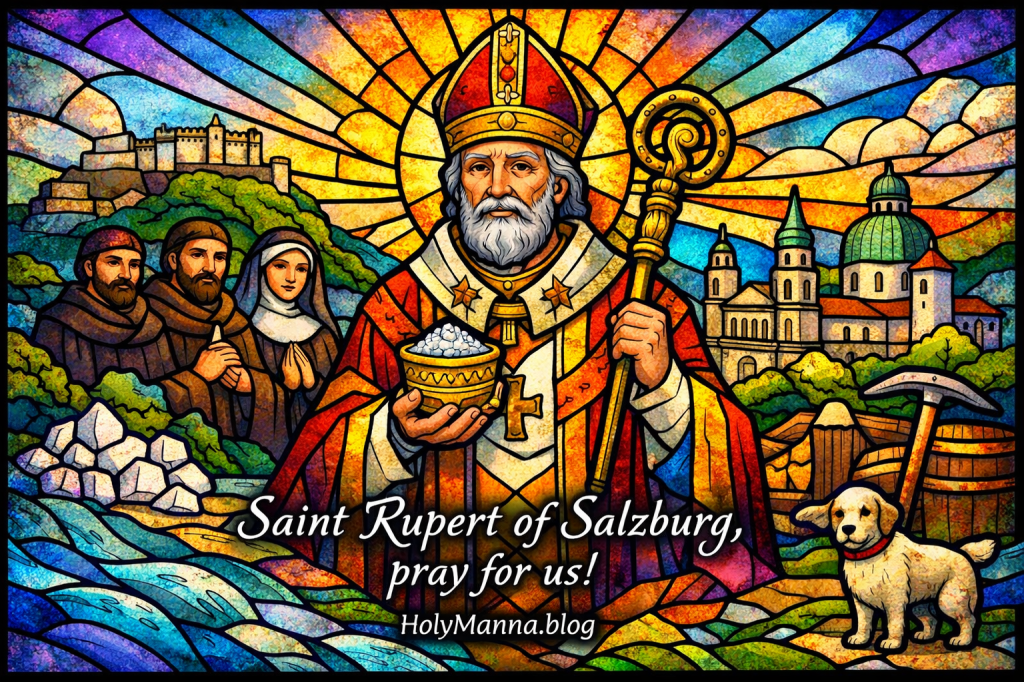
He is especially revered as the founder-saint of Salzburg, the Apostle of Bavaria, and a shepherd whose work shaped the faith of an entire region. Catholic tradition remembers him with a bishop’s staff in one hand and a vessel of salt in the other, a fitting image for a man who brought both the Gospel and practical renewal to the people he served. His life reminds the Church that holiness is not only found in dramatic martyrdom. Sometimes holiness looks like building, teaching, organizing, praying, and patiently planting seeds that will bear fruit for centuries.
From Frankish Roots to a Missionary Calling
Rupert was born into Frankish nobility, most likely in the Merovingian world, and he eventually became bishop of Worms. The early Catholic descriptions of him are striking. He was remembered as prudent, truthful, charitable, and deeply God-fearing. Before he was known as the founder of Salzburg, he was already known as a man whose inner life matched his public office.
There is no dramatic conversion story attached to Saint Rupert in the way there is for some saints. His path was not one of turning from a sinful life to Christ in a sudden moment. His story is the quieter and no less powerful story of a man whose faith deepened into mission. Duke Theodo of Bavaria invited Rupert to come east and strengthen Christianity in a land where the faith had grown weak, mixed with lingering pagan customs and confusion. Rupert accepted that call, and that decision changed the history of the region.
Around the year 696, he arrived in Bavaria and began preaching and organizing Christian life. He worked in places like Regensburg and Seekirchen before turning toward the old Roman city of Juvavum, the future Salzburg. There he saw more than ruins. He saw possibility. He saw a place where Christ could be honored, monasteries could flourish, the poor could be served, and the Church could take deep root.
Rupert is most known for founding the church of Saint Peter and the monastery beside it in Salzburg. He also founded the women’s convent at Nonnberg and placed it under the Rule of St. Benedict. His niece, Saint Erentrudis, became its first abbess. These were not small accomplishments. They were the kind of foundations that shape not just a generation, but an entire civilization.
Building a Christian City
Saint Rupert’s life is a reminder that evangelization is never only about words. He preached, yes, but he also built. He organized. He formed communities. He established places where the liturgy could be offered, where monks and nuns could pray, where the poor could be served, and where children and adults could be formed in the faith.
That is one reason his memory has endured so strongly. He did not simply pass through Bavaria as a traveling preacher. He left behind stable Catholic life. St. Peter’s Abbey still traces its foundation back to Rupert, and Nonnberg remains one of the oldest continuously existing Christian women’s monasteries in the world. That alone says a great deal about the strength of his work.
Rupert also understood that grace does not destroy nature but heals and elevates it. He took interest in the salt resources of the region, especially around Reichenhall, and helped support their development for the good of the people. This was not a worldly distraction from spiritual work. It was part of his pastoral care. He knew that Christian life grows more steadily where there is order, livelihood, and the chance for a community to flourish. In this sense, Rupert helped build not just a church, but a Christian culture.
Catholic tradition also remembers him as traveling with companions, including the priests Chuniald and Gislar, and relying on the help of Saint Erentrudis in founding women’s religious life. His mission was deeply ecclesial. He did not act as a lone religious hero. He planted the Church as a family, a body, a living communion.
The Quiet Power of Holiness
The miracle tradition surrounding Saint Rupert is real, but it is also humble in the way many early saints are humble. Catholic sources remember that his missionary preaching was accompanied by numerous healings, especially healings of the sick, and that these signs helped move hearts toward conversion. The sources do not preserve many detailed case-by-case miracle accounts in the way later canonization records sometimes do, but they consistently remember his ministry as one marked by divine favor.
That matters. The Church has always understood miracles not as spectacles for their own sake, but as signs that point back to God. Rupert’s remembered healings fit that pattern. They were not about drawing attention to Rupert. They were about confirming the truth of the Gospel he preached and the mercy of Christ he carried into wounded places.
Another long-cherished tradition says that Rupert knew the day of his death in advance, gathered his disciples, strengthened them, and prepared himself peacefully for the end. It is a beautiful tradition because it reflects the kind of man the Church remembers him to be: calm, prayerful, fatherly, and ready to meet the Lord. This tradition has been preserved in Catholic devotion, but it cannot be verified.
What makes Rupert important is not only the miracles associated with him, but the way those miracles fit the pattern of his whole life. He was a bishop whose holiness was practical. He healed bodies, but he also healed a region. He strengthened souls, and he also built the places where generations of souls would be formed.
The Weight of Mission and the Cost of Fidelity
Saint Rupert was not a martyr, and the Church does not remember him for dying in a bloody persecution. His hardships were of a different kind. He stepped into lands where the faith was weak, customs were mixed, and Christian order had to be patiently rebuilt. That kind of work requires endurance, humility, and a willingness to labor without immediate results.
He also bore the burden of founding. Founders carry a particular cross. They must see what others do not yet see. They must build when others still doubt. They must work through uncertainty, scarcity, and the sheer difficulty of beginning. Rupert did that. He established churches, monasteries, and communities in places where the future was not obvious.
There is also some uncertainty in the historical record about the end of his life. Catholic tradition broadly places his death on March 27, most likely around the year 718. Some traditions place his death in Salzburg, while others hold that he probably died in Worms after returning there. What remains clear is that his life ended as it had been lived: in service to the Church, in fidelity to his vocation, and in the peace of a shepherd who had given himself away.
His witness is important precisely because it shows that sanctity is not reserved to the spectacular. Some saints conquer by dying publicly for Christ. Others conquer by spending years of hidden effort building the conditions in which Christian life can endure. Rupert belongs to that second group, and the Church is richer because of it.
A Legacy That Never Died
After Rupert’s death, his influence only deepened. His relics were later translated to Salzburg by Saint Virgil in the year 774 at the dedication of the new cathedral, and that event became one of the great markers of his public cult. In time, his relics came to be placed beneath the altar of Salzburg Cathedral, and his memory became inseparable from the city itself.
His posthumous legacy is less a matter of one famous miracle story and more a matter of a living Catholic inheritance that refuses to fade. The surviving Catholic sources focus more on his relics, his intercession, and the enduring fruit of his foundations than on a long catalog of individually narrated miracles after death. What can be said with confidence is that his tomb, his relics, and his name continued to inspire devotion, prayer, and liturgical honor for centuries.
The city of Salzburg still bears his stamp. Its cathedral is dedicated to Saints Rupert and Virgil. St. Peter’s and Nonnberg still stand as living witnesses to his foundations. His feast is celebrated on March 27, while Salzburg especially honors him on September 24, the day connected to the translation of his relics. That September observance became so important that it is a state holiday in Salzburg.
His cultural impact reaches beyond liturgy. The famous Rupertikirtag festival, celebrated around Salzburg Cathedral, keeps his memory alive in both religious and civic life. Pilgrims still walk the Rupertusweg. Sacred art continues to portray him with salt, a bishop’s mitre, and a crosier. He is honored as a patron of Salzburg, of Carinthia, of salt workers, and even of dogs, one of those surprising details that reminds the faithful how richly local Catholic devotion can develop over time.
A later liturgical text celebrating Rupert’s work captures his impact beautifully: “Rejoice, Juvavum, because on the banks of your waters the Lord has planted trees…” That image says it well. Rupert planted where others saw ruin. And because he planted faithfully, whole generations found shade, shelter, and spiritual nourishment.
What Saint Rupert Teaches the Church Today
Saint Rupert has a very timely lesson for modern Catholics. He shows that holiness is not only about private devotion, though private devotion matters deeply. Holiness also means building. It means strengthening families, parishes, schools, communities, and habits that make faith possible for others. Rupert did not merely preach about Christ. He made room for Christ to dwell among the people.
That vision fits beautifully with the Church’s teaching on holiness. CCC 2013 teaches that all Christians are called to the fullness of Christian life and the perfection of charity. Rupert lived that call not through dramatic public speeches or emotional gestures, but through steady fidelity. He prayed, taught, built, served, and endured.
His life also reflects what the Church says about the saints in CCC 828. The canonized saints show that holiness is possible in every age and every state of life when a person gives himself completely to God. Rupert’s path was episcopal, missionary, and monastic in its fruit. Yet the principle remains the same for ordinary believers now. The Christian life is about letting grace shape daily work, daily responsibilities, and daily love.
There is also something deeply encouraging in Rupert’s patience. He entered a land that was spiritually mixed and culturally unstable. That sounds familiar. Many Catholics today feel as though they are living in a time of confusion, fragmentation, and fading memory. Rupert’s answer was not despair. His answer was prayer, clarity, institutions, charity, and long obedience. He did not panic. He built.
That is a lesson worth receiving. A Catholic father builds by leading his family in prayer. A Catholic mother builds by teaching children to love Jesus and His Church. A priest builds by preaching clearly and reverently offering the sacraments. A layperson builds by bringing honesty, order, mercy, and courage into the world. Rupert’s life says that such work matters more than many people realize.
Where in life is Christ asking for patient rebuilding instead of quick results? What part of daily life has been treated as merely practical, when it could become an offering to God? How might the example of Saint Rupert help a tired heart choose faithful work over discouragement?
Engage With Us!
Share your thoughts and reflections in the comments below. Saint Rupert’s life has a way of speaking quietly but powerfully to anyone who has ever tried to build something for God while living in a confusing world.
- What part of Saint Rupert’s life speaks most strongly to the heart right now?
- Does his example of building churches, monasteries, and communities change the way daily responsibilities are viewed?
- How can the same patience and steadiness be brought into family life, parish life, or personal prayer?
- What is one concrete way to help strengthen Catholic life in the home or community this week?
- How does Saint Rupert’s witness encourage deeper trust in the fact that God can bring new life out of ruins?
Saint Rupert of Salzburg reminds the faithful that a holy life is never wasted, even when its fruits take generations to appear. May his example inspire a stronger love for the Church, a steadier heart in times of confusion, and a deeper commitment to build whatever God has placed in front of each soul. Live with faith, persevere with courage, and do everything with the love and mercy Jesus taught us.
Saint Rupert of Salzburg, pray for us!
Follow us on YouTube, Instagram and Facebook for more insights and reflections on living a faith-filled life.

 Holy Manna!
Leave a comment