The Hidden Prophet of the Desert Mountain
Saint John of Egypt, also known as Saint John of Lycopolis, John the Hermit, and John the Anchorite, stands among the great holy men of the early desert. He did not become famous by preaching in crowded cities, founding a great religious order, or leaving behind books and letters. He became known because he disappeared into God.
That alone makes him unforgettable.
In the early centuries of the Church, when the blood of the martyrs had already watered the earth, the Holy Spirit raised up another kind of witness: the desert saints. These men and women did not die under public execution. Instead, they died daily to themselves through prayer, fasting, silence, poverty, and obedience. Saint John of Egypt was one of the most remarkable among them. Catholic tradition remembers him as a carpenter who became a hermit, a hidden ascetic who became known as a prophet, and a man so filled with grace that even emperors sought his counsel.
He is revered because his life shows that a soul does not need earthly power to change history. A man in a cell can influence a kingdom when he belongs entirely to God. His life gives flesh to what the Church later teaches about the eremitical life in CCC 920-921. The hermit withdraws from the noise of the world, not because he hates the world, but because he loves God so completely that his hidden prayer becomes a gift for the salvation of others.
Saint John matters because he reminds the Church that holiness is not measured by visibility. It is measured by fidelity.
From Carpenter’s Bench to Desert Silence
Saint John was born at Lycopolis in Egypt, likely around the beginning of the fourth century, around the year 300 to 305. Catholic tradition says he came from a poor family and learned the trade of carpentry. His early life was simple, ordinary, and outwardly unremarkable. He was not born into nobility. He was not trained as a scholar. He was formed in labor, humility, and the plain work of daily life.
That quiet beginning is part of his beauty.
At some point in young adulthood, John sensed a deeper call from God and left the world behind. He placed himself under the direction of an elderly holy man, an anchorite who would test him severely. This part of his life is essential because it reveals what made him a saint. He did not begin with visions or miracles. He began with obedience.
Catholic tradition preserves stories of the strange tasks his spiritual father gave him. John was told to water a dry stick as though it were alive. He was told to carry out difficult and seemingly meaningless commands. He obeyed without argument. He did not demand explanations. He did not insist on being treated according to his own ideas. He trusted that obedience would purify his soul.
That kind of humility is often harder than suffering.
In time, after years of formation, prayer, and discipline, John withdrew further into solitude near Mount Lykos, close to Lycopolis. There he embraced the hidden life more completely. He built or occupied a small enclosed place of prayer and lived there for decades, speaking to visitors only through a little opening. He did not pursue fame. Fame came looking for him.
What he became known for was not merely being a hermit, but being a man of extraordinary discernment and prophecy. He was a desert father who saw deeply because he had spent so long gazing toward heaven.
The Seer of Lycopolis
Saint John of Egypt became known throughout Christian Egypt as a holy man gifted with discernment, healing, and prophecy. Catholic tradition even remembers him as “the Seer.” That title says a great deal. John saw more than appearances. He saw hearts, motives, dangers, and the providence of God at work.
His life as a hermit was severe. He fasted intensely, lived with remarkable austerity, and gave himself over to prayer with great constancy. Visitors came to him for spiritual direction, for healing, and for counsel. They came because they believed that a man who had renounced the world so completely could see clearly what others, buried in distraction, could not.
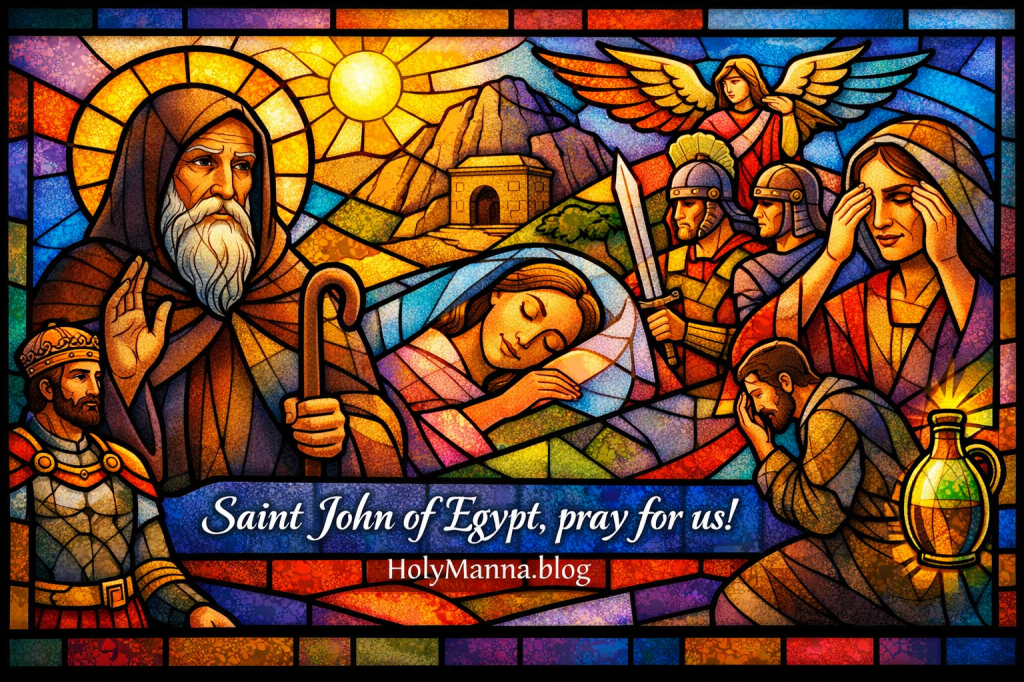
Among the most famous events of his life is his connection to Emperor Theodosius I. Catholic tradition holds that Theodosius, anxious about war and political danger, sought Saint John’s counsel. John foretold victory over the usurper Maximus and later over Eugenius. He also foretold sorrow and loss connected with those struggles, and tradition further says he foretold the emperor’s death. There is something almost shocking about that contrast. An emperor surrounded by soldiers, advisors, and wealth needed the words of a poor hermit hidden on a mountain.
This is how God loves to work.
Saint John also became known for miraculous healings. Catholic tradition says he blessed oil and sent it to the sick, and many were helped through his prayers. One story tells of the healing of a woman’s eyesight. Another tells of a monk delivered from fever. These stories present him not as a wonder-worker seeking attention, but as a father of souls moved by compassion.
He also had a startling gift for reading hearts. Visitors sometimes came to test him, or to hide the truth about themselves, but tradition says Saint John often knew what they were concealing. One account tells of a deacon who tried to hide his ordination out of a false humility, and John recognized it immediately. He saw grace where others tried to cover it.
Unlike some saints, Saint John did not leave behind a large body of writings or famous quotations. Still, one saying preserved in Catholic tradition has echoed through the centuries. When a woman longed to see him but could not, because he kept strict enclosure and would not receive women in person, he said to her husband: “Go, tell your wife, she shall see me this night, but in her sleep.”
That is one of the best-known words associated with him, and it leads directly into one of the most memorable miracle stories of his life.
The Trials of Hidden Holiness
Saint John was not a martyr in the strict sense. He did not shed his blood under persecution. Yet that does not mean his life was easy. The desert itself was his battlefield.
He embraced a life that most people would find unbearable. He accepted silence, hunger, solitude, physical hardship, and the painful discipline of being cut off from ordinary comforts. He endured the spiritual warfare that comes when a person stops running from himself and stands naked before God. The desert fathers knew that once the noise of the world grows quiet, the soul begins to hear both grace and temptation more clearly. Saint John fought that battle faithfully.
There was also the hardship of reputation. When holiness becomes known, people come with demands, needs, fears, and expectations. John sought hiddenness, yet he became sought after by crowds. That itself became a trial. He had to remain detached from the admiration of others. He had to keep his eyes fixed on God even while people treated him like a living oracle.
His earlier years of obedience also count among his great hardships. To be told to perform humiliating, apparently senseless tasks is hard for any human heart. Pride hates obedience. Self-will hates surrender. But Saint John endured this purification, and because he endured it, he became spiritually free.
His life teaches something deeply Catholic and deeply needed. Not every saint is called to a public martyrdom. Some saints are martyred slowly through renunciation, hidden sacrifice, self-denial, and persevering charity. Saint John’s witness fits closely with the Lord’s call to lose one’s life in order to find it, as seen in The Gospel of Matthew 16:25. His was the martyrdom of the hidden will.
After Death, a Voice That Still Speaks
Saint John of Egypt died near Lycopolis around the year 394, likely at an advanced age. Catholic tradition says he knew his death was approaching and spent his final days withdrawn in even deeper prayer. He was said to have died on his knees, as though still speaking with God. That ending feels fitting. He had spent his life turned toward heaven, and he seems to have died in the same posture.
After his death, his influence did not disappear. In some ways, it widened.
His legacy lived on first through the testimony of those who had known him or heard of him, including early Christian writers who preserved his reputation for prophecy and holiness. He entered the memory of the Church as one of the great Egyptian solitaries, one of the holy men who shaped Christian understanding of the contemplative life. Later generations of Catholics remembered him through the Roman Martyrology, through monastic history, and through collections of saints’ lives.
His feast is kept on March 27 in the Roman tradition, and the Coptic commemoration is associated with October 17. His continuing remembrance in Christian tradition shows that the Church did not forget the desert. It recognized in men like John a witness to the radical demands of the Gospel.
As for miracles after death, Catholic sources do not preserve a large, widely verified collection of posthumous miracles in the way they do for some later saints. His posthumous impact is felt more through veneration, memory, and the enduring spiritual authority of his example than through a long catalog of shrine miracles. Still, some traditional accounts and later retellings keep alive stories connected to his sanctity, and the discovery of his cell in modern times gave renewed interest to his memory. That discovery is historically noted, but any devotional claims attached to it are not easily verified.
There is also a tradition that Lycopolis itself was spared through his intervention during the reign of Theodosius. That intervention belongs to the story of his life rather than after his death, but it shows the scale of his influence. He was not only a private mystic. He was a guardian of souls and, in some sense, a defender of a city.
His cultural impact is not loud, but it is deep. He helped shape the Catholic imagination regarding hermits, prophecy, asceticism, and spiritual fatherhood. When the Church thinks of the desert saints, of men hidden from the world yet ablaze with divine wisdom, Saint John stands among them.
What Saint John of Egypt Teaches the Soul Today
Saint John of Egypt is a saint for a noisy age.
The modern world teaches people to be seen, to be heard, to be noticed, to build a platform, to prove importance. Saint John teaches the opposite path. He says, with the witness of his life, that the soul becomes fruitful when it learns silence before God. He shows that hidden faithfulness matters. He proves that prayer is never wasted.
He also teaches obedience. That lesson is not popular, but it is holy. Obedience cuts against pride and trains the heart to trust God instead of self. His life shows that before great graces often comes great surrender. Before prophecy came submission. Before spiritual authority came humility.
There is also a lesson here about discernment. Saint John could read hearts not because he was curious about people, but because he had spent so much time with God. That matters. A soul does not become wise by collecting endless information. A soul becomes wise by becoming pure, prayerful, and detached. The Catechism teaches that prayer is a covenant relationship and a communion with God in Christ, as seen in CCC 2558-2565. Saint John lived that communion so deeply that his whole life became luminous.
His life invites a serious question for the heart. What would change if more time were given to prayer than to distraction? What might God reveal if silence were no longer feared? What false self might die if obedience were embraced with love?
There are practical ways to live this. Make room for silence each day, even if only for a few minutes. Guard the morning from immediate noise. Practice obedience in ordinary duties. Accept hidden acts of charity that no one else will praise. Fast from some comfort that has become spiritually dulling. Seek counsel from holy people. Learn to desire God more than attention.
Saint John of Egypt will not teach how to become impressive. He will teach how to become free.
Engage With Us!
Share thoughts and reflections in the comments below. Saint John of Egypt speaks powerfully to anyone trying to live faithfully in a distracted world, and his witness can open deep conversations about prayer, silence, sacrifice, and trust in God.
- What part of Saint John of Egypt’s hidden life speaks most strongly to the heart right now?
- Is there an area of life where God may be asking for deeper obedience, even without full explanation?
- How much room is currently being made for silence, prayer, and listening to God?
- What distractions may be keeping the soul from the kind of clarity Saint John found in the desert?
- How can hidden acts of faith, penance, and charity become more intentional this week?
Saint John of Egypt reminds the Church that a life surrendered to God is never small. Even a hidden life can shine across centuries. May his prayers help every soul grow in silence, humility, courage, and trust. Live the faith with conviction, and do everything with the love and mercy Jesus taught us.
Saint John of Egypt, pray for us!
Follow us on YouTube, Instagram and Facebook for more insights and reflections on living a faith-filled life.

 Holy Manna!
Leave a comment