Friday of the Fifth Week of Lent – Lectionary: 255
Under the Shadow of Stones, the Light of Trust
There are days in Lent when the Church lets the tension rise, and today is one of them. The air in these readings feels heavy. Enemies whisper. Friends turn suspicious. Accusations sharpen. Stones are lifted. Yet right in the middle of that darkness, a deeper truth stands firm: God does not abandon the righteous, and the faithful heart must learn to trust him even when surrounded by fear, hostility, and misunderstanding.
That is the thread binding today’s readings together. In Jer 20:10-13, the prophet Jeremiah sounds like a man cornered by betrayal and public shame, but he still cries out with confidence that the Lord is with him like a mighty champion. In Ps 18:2-7, that same anguish becomes prayer, as the soul hemmed in by death calls upon God and is heard. Then in Jn 10:31-42, that pattern reaches its fullest meaning in Christ himself. Jesus stands before those who reject him, not as a defeated victim, but as the eternal Son who remains perfectly united to the Father. The world threatens violence, but heaven’s truth does not bend.
The Church places these readings before the faithful in the final stretch of Lent for a reason. As Holy Week draws near, the liturgy begins to sound more clearly like the road to Calvary. Jeremiah, long seen by the Church as a figure who foreshadows Christ, suffers rejection from his own people. The Psalm gives voice to the cry of every just soul under pressure. The Gospel reveals that the suffering of the righteous is not merely a human tragedy. In Jesus, it becomes the place where divine identity and divine mission shine most clearly. He is not only a prophet under attack. He is the one consecrated and sent by the Father.
There is also an important religious backdrop in the Gospel. Jesus is speaking during a season charged with expectation and controversy, in a world where blasphemy was no small accusation and where claims about God carried life or death consequences. The crowd understands that Jesus is saying something extraordinary about himself. That is why they reach for stones. Lent asks the same question of every heart today: who is Jesus, really? A good teacher? A brave martyr? Or truly the Son of God, one with the Father? These readings prepare the soul to answer that question with courage. They remind the faithful that when pressure mounts and truth becomes costly, the safest place to stand is still with the Lord.
First Reading – Jeremiah 20:10-13
When the Prophet Stands Alone but Never Abandoned
Jeremiah’s voice comes from one of the darkest and most personal moments in his prophetic mission. He preached during the final years of the Kingdom of Judah, when the nation was drifting toward disaster, ignoring God’s warnings, and rushing toward the Babylonian exile. He was sent to speak hard truths to a people who did not want to hear them. Because of that, Jeremiah was mocked, threatened, isolated, and treated like a traitor by many of his own countrymen. This passage belongs to what are often called the “confessions” of Jeremiah, where the prophet opens his wounded heart before God with stunning honesty.
That matters for today’s theme because this reading shows what faithful endurance looks like when truth becomes costly. Jeremiah is not calm because life is easy. He is steady because the Lord is near. In these verses, the Church lets readers see the heart of a righteous sufferer, a man surrounded by fear and betrayal who still entrusts his cause to God. In that way, Jeremiah becomes a powerful foreshadowing of Christ, who will also be rejected, hunted, falsely judged, and yet perfectly faithful to the Father.
Jeremiah 20:10-13 – New American Bible (Revised Edition)
10 Yes, I hear the whisperings of many:
“Terror on every side!
Denounce! let us denounce him!”
All those who were my friends
are on the watch for any misstep of mine.
“Perhaps he can be tricked; then we will prevail,
and take our revenge on him.”
11 But the Lord is with me, like a mighty champion:
my persecutors will stumble, they will not prevail.
In their failure they will be put to utter shame,
to lasting, unforgettable confusion.
12 Lord of hosts, you test the just,
you see mind and heart,
Let me see the vengeance you take on them,
for to you I have entrusted my cause.
13 Sing to the Lord,
praise the Lord,
For he has rescued the life of the poor
from the power of the evildoers!
Detailed Exegesis
Verse 10 – “Yes, I hear the whisperings of many: ‘Terror on every side! Denounce! let us denounce him!’ All those who were my friends are on the watch for any misstep of mine. ‘Perhaps he can be tricked; then we will prevail, and take our revenge on him.’”
This verse reveals the suffocating atmosphere around Jeremiah. The danger is not only public hostility. It is also personal betrayal. The prophet hears whispering, plotting, and calculated surveillance. Even former friends are waiting for him to fail. The phrase “Terror on every side” captures the emotional world of persecution. It is the feeling of being surrounded, watched, and cornered.
There is something painfully human here. Jeremiah is not speaking like a distant hero from a stained-glass window. He is speaking like a real servant of God who knows what it feels like to be talked about, misrepresented, and hunted by people who would rather silence truth than repent. This is why the passage is so powerful. It speaks not only to ancient Judah, but to every age in which fidelity to God brings resistance. The reading also prepares the heart for Christ, who will soon face false witnesses, hidden schemes, and the shifting loyalty of those around him.
Verse 11 – “But the Lord is with me, like a mighty champion: my persecutors will stumble, they will not prevail. In their failure they will be put to utter shame, to lasting, unforgettable confusion.”
This verse is the turning point. Jeremiah moves from fear to faith. The threat is still real, but the prophet suddenly looks past his enemies and fixes his attention on the Lord. The image of God as a “mighty champion” is strong, masculine, and full of covenant confidence. Jeremiah does not imagine that he himself is powerful. He knows that his strength is borrowed. God is the warrior who stands beside him.
This verse teaches something essential about biblical courage. Courage is not pretending that the enemy is weak. Courage is knowing that God is stronger. The prophet’s confidence does not rest on strategy, popularity, or self-defense. It rests on divine presence. That is why the Church reads this passage in Lent. The faithful are being taught that perseverance is born not from self-assurance, but from closeness to the Lord.
Verse 12 – “Lord of hosts, you test the just, you see mind and heart, Let me see the vengeance you take on them, for to you I have entrusted my cause.”
Here Jeremiah addresses God as the one who knows everything hidden within man. The Lord sees mind and heart, which means he judges beyond appearances. Human beings can twist words, spread false narratives, and manipulate public opinion. God cannot be deceived. He sees the inner truth.
The line about vengeance can sound jarring at first, but it must be read carefully and in a Catholic way. Jeremiah is not being taught to nourish hatred. He is refusing to take justice into his own hands. He entrusts his cause to God. That is the key. The prophet is surrendering judgment to the Lord, who alone sees perfectly and judges justly. This is not the cry of petty revenge. It is the cry of a man who knows that moral order belongs to God, not to the mob.
There is also a spiritual lesson here about being tested. The just are not spared every trial. In Scripture, testing often reveals fidelity, purifies motives, and deepens trust. Jeremiah is being refined in the furnace of opposition. That same mystery appears throughout salvation history and reaches its fullness in Christ’s Passion.
Verse 13 – “Sing to the Lord, praise the Lord, For he has rescued the life of the poor from the power of the evildoers!”
The reading ends in praise, and that is one of its most beautiful surprises. Jeremiah begins with whispering, traps, and fear. He ends with worship. That movement is not accidental. It shows the logic of biblical faith. The heart that truly entrusts itself to God does not stay trapped in anxiety forever. It rises into praise.
The word “poor” is important. In Scripture, the poor are often those who have no worldly protection and must rely completely on God. Jeremiah is one of them here. He is poor in the sense that he is exposed, vulnerable, and dependent. Yet that is precisely where the Lord’s rescue becomes visible. God’s saving power is often revealed most clearly in those who cannot save themselves.
Teachings
This reading teaches that fidelity to God does not remove the possibility of suffering. In fact, at times it provokes it. Jeremiah is persecuted not because he is unfaithful, but because he is faithful. That pattern runs through the whole Bible and reaches its summit in Jesus Christ. The righteous man is opposed by those who resist the truth. Yet God remains near, sees the heart, and vindicates those who entrust themselves to him.
The Catechism of the Catholic Church speaks directly to the kind of strength Jeremiah displays: “Fortitude is the moral virtue that ensures firmness in difficulties and constancy in the pursuit of the good. It strengthens the resolve to resist temptations and to overcome obstacles in the moral life. The virtue of fortitude enables one to conquer fear, even fear of death, and to face trials and persecutions.” This is not abstract theology. It is exactly what Jeremiah is living in real time. He is afraid, but he does not fold. He is wounded, but he does not abandon the mission God gave him.
The reading also speaks to the mystery of tested faith. The Catechism teaches: “Faith is often lived in darkness and can be put to the test. The world we live in often seems very far from the one promised us by faith. Our experiences of evil and suffering, injustice and death, seem to contradict the Good News.” Jeremiah lives inside that tension. He knows the Lord, yet he suffers. He speaks truth, yet he is hated. Still, he clings to God. That is biblical faith in its mature form.
The Church has long seen Jeremiah as a figure who foreshadows Christ. His tears, his loneliness, his rejection by his own people, and his obedience in suffering all point forward to the Passion. Historically, Jeremiah preached as Judah moved toward collapse, warning that covenant infidelity would bring judgment. Religiously, he stands as a prophet who would rather suffer with the truth than prosper with a lie. That is why this reading belongs so naturally in the last days of Lent. The Church is already training the eye to recognize Christ in the suffering righteous one.
There is also a lesson here about justice. Jeremiah entrusts his cause to God because divine judgment is never blind or impulsive. The Lord sees what man cannot see. He knows hidden motives, hidden sins, hidden fidelity, and hidden wounds. That truth should sober the proud and strengthen the faithful. It means that no slander has the final word. No false judgment is ultimate. No suffering offered to God is wasted.
Reflection
Jeremiah speaks with a voice that still sounds familiar. There are still seasons when faithful people feel surrounded by whispering, suspicion, and pressure. Sometimes that happens in the workplace. Sometimes it happens in families. Sometimes it happens online. Sometimes it even happens in the Church. A person tries to remain faithful, and suddenly he is misunderstood, criticized, or treated like the problem. Jeremiah shows what to do in that hour.
The first step is to bring the pain to God honestly. Jeremiah does not pretend that betrayal does not hurt. He names it. The second step is to remember who stands with the faithful soul. The Lord is still a mighty champion. The third step is to surrender judgment to God instead of feeding bitterness. That means resisting the urge to retaliate, gossip back, or turn wounded pride into self-justification. The final step is praise. That may seem impossible at first, but praise breaks the spell of fear because it shifts the heart back toward the Lord’s sovereignty.
This reading also invites a serious examination of conscience. It is easy to identify with Jeremiah. It is harder to ask whether there has ever been a role in the whispering crowd. Have there been moments of joining suspicion, enjoying another person’s failure, or waiting for someone to slip? The reading calls not only for endurance under persecution, but also for repentance from the sins that create it.
A practical way to live this reading is simple and demanding. When feeling attacked, slow down before speaking. Pray Psalm 18. Entrust the situation to God by name. Refuse to magnify the voices of fear. Stay close to confession and the Eucharist. Keep doing the next faithful thing. That is how the soul learns to stand.
When misunderstood or criticized, is the first instinct to defend personal pride, or to entrust the cause to God? Is there confidence that the Lord really sees mind and heart, even when others do not? Has there been any participation in whispering, suspicion, or quiet delight in another person’s fall? What would it look like today to move, like Jeremiah, from fear into praise?
Responsorial Psalm – Psalm 18:2-7
A Cry from the Edge That Turns into Confidence
This psalm sounds like the prayer of a man who has been pushed to the edge and has learned exactly where true safety is found. Psalm 18 is traditionally connected to David, the anointed king who knew what it meant to be hunted, opposed, and delivered by the hand of God. It is also closely related to the great song of thanksgiving in 2 Samuel 22, where David blesses the Lord after being rescued from his enemies. That background matters, because this is not the prayer of someone who has only studied suffering from a distance. It is the prayer of someone who has walked through danger and discovered that God is stronger than death, stronger than fear, and stronger than every enemy.
That is why this psalm fits today’s theme so beautifully. Jeremiah cries out from the loneliness of persecution. Jesus stands firm while stones are raised against him. Between those two moments, the Church gives the faithful this psalm, almost like a bridge of prayer. It teaches the soul what to do when pressure rises. It teaches the heart to move from fear into trust, from danger into praise, and from distress into a deeper awareness that God hears every cry that rises to him.
Psalm 18:2-7 – New American Bible (Revised Edition)
2 He said:
I love you, Lord, my strength,
3 Lord, my rock, my fortress, my deliverer,
My God, my rock of refuge,
my shield, my saving horn, my stronghold!
4 Praised be the Lord, I exclaim!
I have been delivered from my enemies.5 The cords of death encompassed me;
the torrents of destruction terrified me.
6 The cords of Sheol encircled me;
the snares of death lay in wait for me.
7 In my distress I called out: Lord!
I cried out to my God.
From his temple he heard my voice;
my cry to him reached his ears.
Detailed Exegesis
Verse 2 – “I love you, Lord, my strength,”
The opening line is simple, but it is full of spiritual force. The psalm does not begin with the enemy. It begins with love. Before naming danger, David names God. Before speaking of fear, he speaks of relationship. That matters. In biblical prayer, trust is not built on vague optimism. It is built on love for the God who has already shown himself faithful.
Calling the Lord “my strength” means that strength is not treated as something self-generated. The believer is not invited to become hard, independent, or emotionally numb. The believer is invited to lean on God. This is the kind of strength the Church treasures. It is not swagger. It is dependence rooted in confidence.
Verse 3 – “Lord, my rock, my fortress, my deliverer, My God, my rock of refuge, my shield, my saving horn, my stronghold!”
This verse unfolds like a chain of holy names, each one revealing another aspect of God’s protection. He is a rock, which means he is stable when everything else feels unstable. He is a fortress and stronghold, which means he shelters his people in the middle of attack. He is a deliverer, which means he does not merely watch suffering from afar. He acts. He rescues. He intervenes.
The phrase “saving horn” carries royal and biblical imagery. In the world of Scripture, the horn was a sign of strength, power, and victorious defense. So the psalm is not just saying that God offers comfort. It is saying that God is mighty to save. This verse also teaches the faithful how to pray when words are hard to find. Sometimes the best prayer is simply to name who God is and let those names steady the heart.
Verse 4 – “Praised be the Lord, I exclaim! I have been delivered from my enemies.”
This verse joins praise and rescue together. David does not speak as though thanksgiving is an optional extra once the crisis passes. Praise is part of deliverance itself. To bless the Lord is to recognize that salvation comes from him and not from luck, skill, or human control.
There is also something deeply liturgical about this verse. It sounds like the kind of proclamation Israel would sing publicly after experiencing God’s help. That fits the role of the responsorial psalm in the Mass. The Church does not place this text on the lips of the faithful merely to admire it. She gives it to be prayed aloud, so that the whole assembly learns to answer suffering with praise.
Verse 5 – “The cords of death encompassed me; the torrents of destruction terrified me.”
Now the psalm turns directly into the experience of danger. The imagery becomes intense and almost overwhelming. Death is pictured like cords tightening around the body, while destruction rushes in like a violent flood. This is not mild discomfort. This is mortal pressure. This is the feeling of being surrounded by forces greater than oneself.
Spiritually, this verse captures the moments when life feels like it is closing in. It can describe literal danger, but it also speaks to interior battles. Fear, despair, temptation, slander, and grief can all feel like rising waters. The psalm gives the faithful permission to say that honestly. Catholic prayer is never fake serenity. It does not deny the flood. It brings the flood before God.
Verse 6 – “The cords of Sheol encircled me; the snares of death lay in wait for me.”
The imagery deepens. Sheol in the Old Testament refers to the realm of the dead, the shadowy place where human weakness and mortality are laid bare. David speaks as though death itself is stalking him, setting traps, waiting to seize him. The language is vivid because sin, suffering, and death are never small things in the biblical imagination. They are enemies.
From a Christian perspective, this verse also prepares the heart to see Christ. The Church reads the Psalms in the light of Jesus, and here the words begin to resonate with the Passion. The righteous one is hemmed in by death, yet not abandoned by God. What David experiences in figure, Christ enters fully in reality. He descends into the depths, not as one conquered forever, but as the victorious Lord who shatters death from within.
Verse 7 – “In my distress I called out: Lord! I cried out to my God. From his temple he heard my voice; my cry to him reached his ears.”
This verse is the heart of the psalm. Everything has been moving toward this moment. Fear is real. Death is near. But the decisive action is not taken by the enemy. It is taken by the sufferer who cries out to God. That is the turning point.
The image of God hearing from his temple is deeply religious and covenantal. It reminds Israel that the Lord is not deaf to the prayers of his people. He is enthroned in majesty, yet attentive to the cry of the lowly. That is the great consolation of the verse. The believer may feel forgotten by men, but he is not forgotten by God. This line also fits today’s readings perfectly. Jeremiah entrusts his cause to the Lord. Jesus remains in union with the Father. The psalm teaches the faithful to do the same in every moment of distress.
Teachings
This psalm teaches that prayer is not the last resort of the weak. It is the first refuge of the faithful. The soul surrounded by danger is not meant to collapse inward. It is meant to cry upward. That is one of the great lessons of the Psalms in the life of the Church. They teach believers how to speak to God with truth, reverence, and trust, especially when life feels heavy.
The Catechism of the Catholic Church teaches that the Psalms are not merely ancient religious poetry. They are living prayer for the People of God. The Church teaches that the Psalms shape the prayer of Israel, are prayed by Christ, and remain the prayer of his Body, the Church. That is why this psalm can be both David’s prayer and the prayer of the Christian at Mass. It belongs to the whole family of God.
Saint Augustine saw this very clearly when he wrote, “He prays for us as our priest; he prays in us as our head; he is prayed to by us as our God. Let us therefore recognize our voice in him and his voice in us.” That line opens up the deepest meaning of this psalm. The Church does not pray it alone. Christ prays it in his members. When the faithful cry out in distress, they are not speaking into emptiness. They are being drawn into the prayer of the Son himself.
There is also a rich theological lesson in the repeated titles for God in verse 3. Scripture piles up these images because no single title is enough to contain the security God gives. He is rock, fortress, refuge, shield, and deliverer. In a world where people often place security in wealth, influence, health, or control, the psalm reorders the soul. It reminds the faithful that real safety is not found in changing circumstances but in the unchanging God.
Historically, this psalm would have been heard by Israel as a royal song of deliverance, but the Church hears even more. She hears the voice of Christ, the true Son of David, moving through trial toward victory. The suffering of the righteous in Jeremiah 20 and the hostility faced by Jesus in John 10 find a prayerful echo here. The pattern is the same. Threat rises. The just man cries out. God hears. God saves. That is not a sentimental pattern. It is the grammar of salvation history.
Reflection
This psalm is a gift for days when the heart feels cornered. There are moments when a person feels pulled in too many directions, pressed by anxiety, wounded by betrayal, or quietly afraid of what may be coming next. In those moments, the world usually offers one of two bad options. It says to numb out or panic. The psalm offers a better path. It teaches the soul to pray with honesty and strength.
One practical lesson from this reading is that prayer should begin by naming who God is. Before replaying the problem a hundred times, the heart can say, “Lord, my rock, my fortress, my deliverer.” That changes something. It does not always remove the trial immediately, but it puts the trial back into proper proportion. Another lesson is that fear should not be hidden from God. The psalm is unashamed to speak of terror, cords, snares, and distress. Real prayer is honest prayer.
There is also a call here to build a habit of praise before the crisis comes. A soul that regularly blesses God is more ready to trust him when the waters rise. That is one reason the Church gives the Psalms such an important place in her worship. They train the heart over time. They teach Catholics how to think, feel, and pray in a biblical way.
This psalm also invites a serious question about where security is actually being sought. Many people say that God is their refuge, but in practice they run first to distraction, anger, control, or comfort. The psalm gently exposes that. It asks the faithful to come back to the Lord as the true stronghold.
When distress comes, what is the first refuge that the heart seeks? Is God truly being treated as rock, fortress, and deliverer, or only as a last option after everything else fails? What fear needs to be named honestly before the Lord today? How might daily prayer with the Psalms reshape the heart into one that turns toward God more quickly and trusts him more deeply?
Holy Gospel – John 10:31-42
When the Truth Stands Still and the Stones Begin to Rise
This Gospel unfolds in a tense and holy moment near the end of Jesus’ public ministry. The wider setting in John 10 is the Feast of Dedication in Jerusalem, the celebration later known as Hanukkah, which remembered the purification and rededication of the Temple after its desecration in the time of the Maccabees. That background matters. Israel is celebrating a sanctified temple, and in the middle of that feast Jesus speaks of himself as the one whom the Father has consecrated and sent into the world. The irony is powerful. The true Holy One is standing before them, and many still refuse to see him.
That makes this reading a perfect match for today’s theme. Jeremiah was surrounded by whispering, suspicion, and betrayal. The Psalm taught the faithful to cry out to God in distress. Now the Gospel brings that pattern to its fulfillment in Christ. Jesus is not simply another righteous sufferer. He is the eternal Son, perfectly one with the Father, standing calmly in the face of rejection. The danger is real. The hostility is real. The stones are real. But so is the truth. And the truth does not retreat.
John 10:31-42 – New American Bible (Revised Edition)
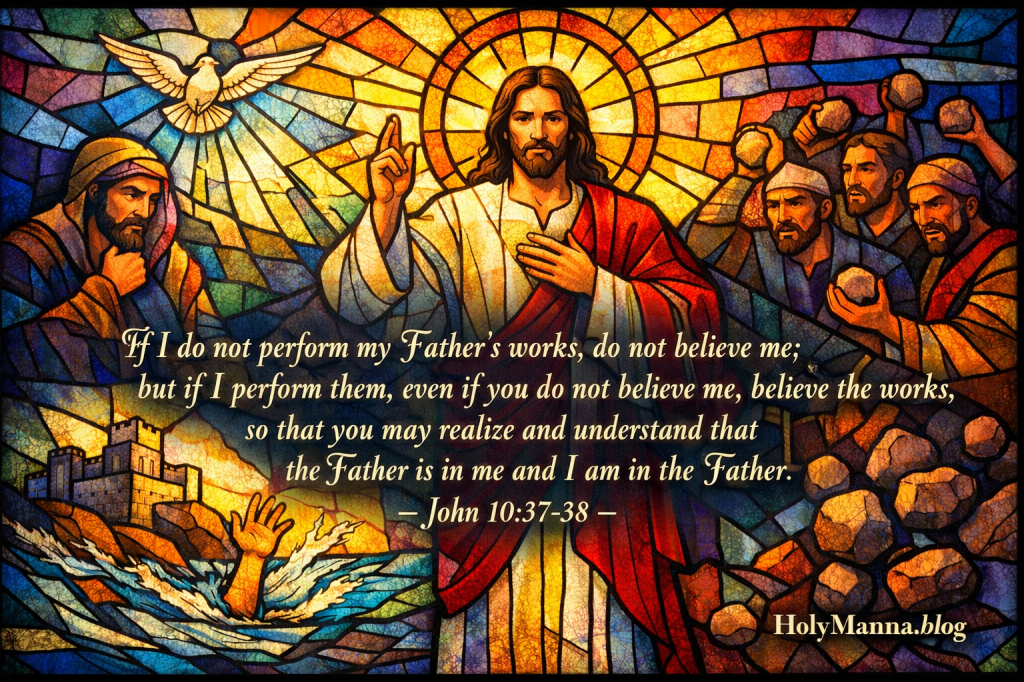
31 The Jews again picked up rocks to stone him. 32 Jesus answered them, “I have shown you many good works from my Father. For which of these are you trying to stone me?” 33 The Jews answered him, “We are not stoning you for a good work but for blasphemy. You, a man, are making yourself God.” 34 Jesus answered them, “Is it not written in your law, ‘I said, “You are gods”’? 35 If it calls them gods to whom the word of God came, and scripture cannot be set aside, 36 can you say that the one whom the Father has consecrated and sent into the world blasphemes because I said, ‘I am the Son of God’? 37 If I do not perform my Father’s works, do not believe me; 38 but if I perform them, even if you do not believe me, believe the works, so that you may realize [and understand] that the Father is in me and I am in the Father.” 39 [Then] they tried again to arrest him; but he escaped from their power.
40 He went back across the Jordan to the place where John first baptized, and there he remained. 41 Many came to him and said, “John performed no sign, but everything John said about this man was true.” 42 And many there began to believe in him.
Detailed Exegesis
Verse 31 – “The Jews again picked up rocks to stone him.”
The word “again” matters. This is not the first time hostility has risen against Jesus in John’s Gospel. The opposition has been building because Jesus does not merely teach morality or offer vague spiritual comfort. He reveals divine authority. The crowd reaches for stones because they understand that something enormous is being claimed. This is not a misunderstanding created by careless language. It is a reaction to Jesus’ revelation of who he is.
In the Old Testament world, stoning was connected to grave offenses, especially blasphemy. So the action of the crowd shows that this moment is not about irritation or debate alone. It is about judgment. Men believe they are defending God, while standing in violent resistance against God’s own Son. That is one of the great tragedies of the Passion narratives. Religious zeal, when cut off from humility and truth, can become blind.
Verse 32 – “Jesus answered them, ‘I have shown you many good works from my Father. For which of these are you trying to stone me?’”
Jesus answers with calm clarity. He does not panic, run into confusion, or retaliate in anger. He directs attention to his “good works”, meaning the signs and deeds that reveal the Father’s action in him. In John’s Gospel, works are never just miracles for spectacle. They are signs. They disclose identity. They reveal mission.
This question also exposes the irrationality of unbelief. Jesus has healed, restored, and revealed divine mercy, yet those works do not soften every heart. That is a warning for every age. Miracles alone do not force faith. A hard heart can look directly at the works of God and still refuse to bow. Jesus invites them to judge honestly, but their judgment has already been twisted by resistance.
Verse 33 – “The Jews answered him, ‘We are not stoning you for a good work but for blasphemy. You, a man, are making yourself God.’”
This verse is crucial because it shows that Jesus’ opponents understand the weight of his claim. They do not accuse him of being merely confusing, reckless, or politically dangerous. They accuse him of blasphemy because they recognize that he is placing himself on the divine side of the line. In other words, the crowd hears what many modern readers try to soften. Jesus is speaking in a way that claims unique divine sonship and unity with the Father.
This accusation also brings the mystery of the Incarnation into sharp focus. Jesus truly is a man. He stands before them in visible human flesh. Yet he is not only man. The scandal of Christianity has always been this union of divine majesty and human humility. God has come near, and many stumble precisely because he comes near in a form they think they can manage or judge.
Verse 34 – “Jesus answered them, ‘Is it not written in your law, “I said, “You are gods””?’”
Jesus quotes Psalm 82. In that psalm, human judges are called “gods” in a limited sense because they exercise authority under God and receive his word. Jesus is not lowering his claim here. He is using a rabbinic argument from the lesser to the greater. If Scripture can use that language in a secondary and analogical way for those who received a divine commission, how much more fitting is divine language for the one who has been consecrated and sent by the Father himself.
This verse is often misunderstood, so it needs careful Catholic reading. Jesus is not saying that all divine claims are interchangeable or that his sonship is merely symbolic. He is defending the legitimacy of his words by showing that Scripture itself allows elevated language in certain contexts. Then he goes further than the Psalm ever did. He points to his consecration, his mission, and his works as evidence of a far greater reality.
Verse 35 – “If it calls them gods to whom the word of God came, and scripture cannot be set aside,”
Here Jesus emphasizes the abiding authority of Scripture. The phrase “scripture cannot be set aside” shows his complete confidence in the truth and permanence of God’s word. He is not dismissing the Scriptures of Israel. He is interpreting them rightly and revealing their deeper fulfillment in himself.
This verse also teaches that revelation is coherent. God does not contradict himself. The same God who spoke in the Law and the Psalms now speaks in the Son. That means the proper reading of Scripture leads toward Christ, not away from him. Jesus is not inventing a new religion detached from Israel. He is bringing Israel’s Scriptures to their fullness.
Verse 36 – “can you say that the one whom the Father has consecrated and sent into the world blasphemes because I said, ‘I am the Son of God’?”
This is one of the great Christological verses in John’s Gospel. Jesus describes himself as the one “whom the Father has consecrated and sent into the world.” The language is rich. To be consecrated is to be set apart for God in a holy mission. To be sent is to come with the authority of the sender. In the Gospel of John, Jesus is never merely self-appointed. He is the One from the Father, sent into the world for the salvation of the world.
The title “Son of God” here is not an honorific borrowed from kings or prophets in a loose sense. In this context it expresses Jesus’ unique relation to the Father. The crowd hears it as a divine claim because, in context, that is exactly what it is. Jesus is not one messenger among many. He is the eternal Son who has entered history.
Verse 37 – “If I do not perform my Father’s works, do not believe me;”
This verse reveals the seriousness and honesty of Jesus. He does not ask for blind acceptance disconnected from reality. He points to his works as public signs that validate his words. The faithful are not asked to believe in a vacuum. They are asked to see the coherence between who Jesus says he is and what he does.
There is also a moral challenge here. If Jesus’ works truly bear the mark of the Father, then unbelief cannot remain neutral forever. A person must either yield to what the works reveal or harden himself against it. This is part of the drama of the Gospel. Revelation demands response.
Verse 38 – “but if I perform them, even if you do not believe me, believe the works, so that you may realize [and understand] that the Father is in me and I am in the Father.”
This verse brings the heart of the matter into the open. Jesus speaks of a mutual indwelling between himself and the Father. This is not merely moral harmony or shared purpose. It is a profound expression of divine communion. Jesus is revealing a truth that reaches toward the mystery of the Trinity. The Father is in the Son, and the Son is in the Father.
Even here, Jesus is still inviting faith. He is not closing the door. He is giving his opponents one more path toward belief. If they stumble over his words, let them consider his works. Let the signs lead them to the mystery. There is something deeply merciful in that. Even under threat, Jesus continues to call sinners toward truth.
Verse 39 – “[Then] they tried again to arrest him; but he escaped from their power.”
The hostility intensifies. Stones are not enough. Now they try to seize him. Yet Jesus escapes, not because events are out of control, but because his hour has not yet come. In John’s Gospel, the Passion is never portrayed as chaotic fate. It unfolds according to divine timing.
This verse also reminds the faithful that opposition cannot overtake Christ until the Father permits the hour of sacrifice. His life is not taken from him by surprise. It will be laid down freely. That truth gives deep peace to the believer. Even in moments of apparent danger, Christ remains sovereign.
Verse 40 – “He went back across the Jordan to the place where John first baptized, and there he remained.”
There is something beautiful and almost contemplative in this movement. Jesus returns across the Jordan, back to the place where the ministry of public witness had begun. That place carries memory. It was there that John pointed away from himself and toward the Lamb of God.
Spiritually, this return feels like a pause before the storm deepens. Jesus withdraws from immediate violence, but not from mission. He steps into a place marked by testimony, repentance, and preparation. It is as though the Gospel invites readers to remember the beginning before the Cross arrives in full.
Verse 41 – “Many came to him and said, ‘John performed no sign, but everything John said about this man was true.’”
This verse honors the mission of John the Baptist. John did no great public miracle, but he fulfilled something even greater than spectacle. He told the truth about Jesus. That is what made his witness fruitful. He prepared hearts to recognize the Messiah when he appeared.
There is a lesson here about holiness and mission. Not every faithful life will be marked by dramatic signs. Many saints change the world simply by truthful witness, humble fidelity, and pointing clearly toward Christ. John’s greatness lies in his accuracy and humility. He decreased so that Christ might increase.
Verse 42 – “And many there began to believe in him.”
The Gospel ends with faith. After rejection, accusation, and attempted violence, the final note is not defeat but belief. That is deeply fitting. The truth may be resisted, but it is not sterile. Christ still draws souls. Testimony still bears fruit. Grace still opens hearts.
This closing verse also ties beautifully into today’s theme. Jeremiah was not abandoned. The Psalm’s cry was heard. Jesus is opposed, but not overcome. Even when stones are raised, faith is still born. That is how God works in salvation history. He brings fruit out of conflict and faith out of witness.
Teachings
This Gospel stands at the center of Catholic faith because it reveals who Jesus truly is. He is not merely a moral teacher, a miracle worker, or a misunderstood prophet. He is the Son of God in the full and unique sense. That is why the accusation of blasphemy appears. The crowd understands that Jesus is speaking beyond the categories of ordinary human mission. The Church has always read this passage as a witness to Christ’s divine identity.
The Catechism states this with clarity in CCC 454: “The title ‘Son of God’ signifies the unique and eternal relationship of Jesus Christ to God his Father: he is the only Son of the Father and is himself God. To be a Christian, one must believe that Jesus Christ is the Son of God.” That teaching is essential here. Jesus is not “son of God” in the same way that a king, a prophet, or the just man might be called a son in a broad biblical sense. He is the eternal Son, one in being with the Father.
The context leading into this Gospel makes that even clearer. Just before this passage, Jesus has declared that he and the Father are one. The Catechism speaks directly to claims of that magnitude in CCC 590: “Only the divine identity of Jesus’ person can justify so absolute a claim as this: ‘He who is not with me is against me’; and his saying that there was in him ‘something greater than Jonah,… greater than Solomon’, something ‘greater than the Temple’; his reminding them that David had called the Messiah his Lord, and his affirmations, ‘Before Abraham was, I AM’, and even ‘I and the Father are one.’” The Church does not water down those words. She receives them with awe.
This passage also helps explain the line from Psalm 82 about human beings being called “gods.” Saint Augustine taught that men may be called gods by grace and participation, but Christ is God by nature. That distinction protects both divine transcendence and the dignity of grace. Human beings do not become divine by essence. They are lifted into communion with God by his gift. That is why the Church can speak so boldly about divinization without ever confusing the creature with the Creator. CCC 460, drawing on Saint Athanasius, expresses it this way: “For the Son of God became man so that we might become God.” The meaning is not that man becomes God by nature, but that, through Christ, man is given a real share in divine life.
There is also an important lesson here about the works of Christ. Jesus points repeatedly to what he does because his works reveal the Father. Saint Thomas Aquinas explains that Christ’s signs are fitting witnesses to his divine mission because they manifest power proper to God and mercy worthy of God. In the Gospel of John, works and words belong together. The works interpret the words, and the words unveil the works. When the crowd refuses both, the problem is no longer lack of evidence. It is resistance of heart.
Historically, this Gospel stands close to the Lord’s Passion. The conflict has sharpened, the lines are clearer, and the rejection is more explicit. Yet the final movement across the Jordan is not accidental. Jesus returns to the place associated with John’s first witness, and many believe there. It is almost like a quiet confirmation that authentic testimony never dies. John’s voice still bears fruit because it told the truth about Jesus.
Reflection
This Gospel presses a question that every soul eventually has to answer. Not what others say about Jesus. Not what the culture finds acceptable to say about Jesus. Not what makes religion feel manageable. The real question is who Jesus actually is. This passage does not allow a shallow answer. He is either blaspheming, as his enemies claim, or he is truly the consecrated Son sent by the Father. There is no safe middle ground left open here.
That matters in daily life more than many people realize. A great deal of spiritual confusion comes from trying to keep Jesus respectable while avoiding his divine authority. It is easy to admire him as a teacher and still resist him as Lord. It is easy to appreciate his kindness and still refuse his claims. But this Gospel will not let that stand. The works, the words, and the witness all point in one direction. Jesus is the Son of God, and the heart must respond.
There is also a practical lesson in the way Jesus bears hostility. He does not become theatrical. He does not bend the truth to reduce the tension. He speaks clearly, points to the Father, and continues the mission. That is a model for Christian witness in a hostile age. The faithful are not called to be reckless, but they are called to be steady. Truth must not be traded away just because stones are near.
The witness of John the Baptist offers another concrete lesson. Not every Christian is called to dramatic public signs, but every Christian is called to truthful testimony. Families need it. Friendships need it. Parishes need it. A faithful life that quietly points to Christ can bear fruit long after the moment seems to pass. John performed no sign, but many believed because he told the truth.
One beautiful way to pray with this Gospel is to return spiritually to the place across the Jordan. That means going back to the foundations. Remembering baptism. Remembering who Jesus is. Remembering that faith was never meant to rest on passing emotions or public approval. When the world grows loud, it helps to return to the beginning and hear again the testimony that leads to Christ.
Who is Jesus in the deepest part of the heart: a source of inspiration, or truly the eternal Son of God? When the truth of Christ becomes costly, is there a tendency to soften it, hide it, or stand with it? Do his works still command belief, wonder, and surrender? What kind of witness is being given to others: one that draws attention to self, or one that quietly helps them believe in him?
When the Faithful Stand Firm, God Draws Near
Today’s readings move like one steady path through fear, conflict, and grace. Jeremiah 20:10-13 shows the lonely cost of speaking the truth in a world that would rather silence it. Psalm 18:2-7 gives the faithful a voice for that moment of pressure, teaching the heart to cry out to God instead of surrendering to fear. Then John 10:31-42 reveals the deepest meaning of it all in Christ, the eternal Son who stands in the face of rejection without wavering, because he is perfectly one with the Father.
Together, these readings remind the Church that suffering for truth is not a sign of God’s absence. Very often, it is the place where his presence becomes clearest. Jeremiah is surrounded, but not abandoned. The psalmist is distressed, but heard. Jesus is opposed, but never overcome. That is the great hope running through the whole day. Evil may threaten, accuse, and intimidate, but it does not have the final word. The Lord still sees mind and heart. The Lord still hears the cry of the just. The Lord still reveals his glory through faithful endurance.
That message lands with real force in the final days of Lent. This is the season when the Church teaches her children not to be surprised by spiritual battle. The closer the soul draws to Christ, the more clearly the line between truth and falsehood appears. Yet these readings do not leave the faithful in tension alone. They call for confidence. They invite deeper trust. They remind every believer that courage is not found in winning every argument or escaping every hardship. Courage is found in staying close to the Lord, speaking the truth with charity, and entrusting every wound to the Father who judges justly.
So this is the invitation for today. Stay with Christ when the pressure rises. Pray instead of panicking. Praise instead of giving bitterness the final say. Trust that no act of fidelity is wasted, even when misunderstood by the world. The Lord who carried Jeremiah, heard the psalmist, and upheld his Son in the hour of conflict is the same Lord who remains near now. Lent is not only a season to give things up. It is a season to go deeper, to stand firmer, and to love Christ more completely.
Where is the Lord asking for greater trust today? What fear needs to be surrendered to him? What truth needs to be lived with more courage and peace? The path forward is simple, even if it is not always easy. Keep close to prayer. Stay near the sacraments. Refuse the voice of fear. Believe the works of Christ. And walk into the rest of Lent with the steady confidence that the Lord is with his people like a mighty champion.
Engage with Us!
Readers are invited to share their reflections in the comments below. What stood out most in today’s readings? What challenged the heart, brought comfort, or stirred a deeper desire to trust the Lord more completely?
- In Jeremiah 20:10-13, where does the struggle of Jeremiah feel familiar in daily life? When facing criticism, betrayal, or misunderstanding, is there a deeper tendency to fear people more than to trust God as a mighty champion?
- In Psalm 18:2-7, what title for God speaks most powerfully to the heart today: rock, fortress, deliverer, shield, or stronghold? When distress rises, what does it look like in real life to cry out to the Lord first instead of turning to anxiety, distraction, or self-reliance?
- In John 10:31-42, what does this Gospel reveal about who Jesus truly is? Is he being loved and followed as the eternal Son of God, or only admired from a safe distance? What would it look like to believe his works more fully and witness to him with greater courage?
May today’s readings strengthen every heart to stand firm in truth, pray with greater trust, and follow Christ with steady faith. Let every word, decision, and act of love be shaped by the mercy of Jesus, so that daily life becomes a quiet witness to the hope, courage, and holiness he teaches.
Sacred Heart of Jesus, we trust in You!
Immaculate Heart of Mary, pray for us!
Saint Michael the Archangel, defend us in battle!
Follow us on YouTube, Instagram and Facebook for more insights and reflections on living a faith-filled life.

 Holy Manna!
Leave a comment