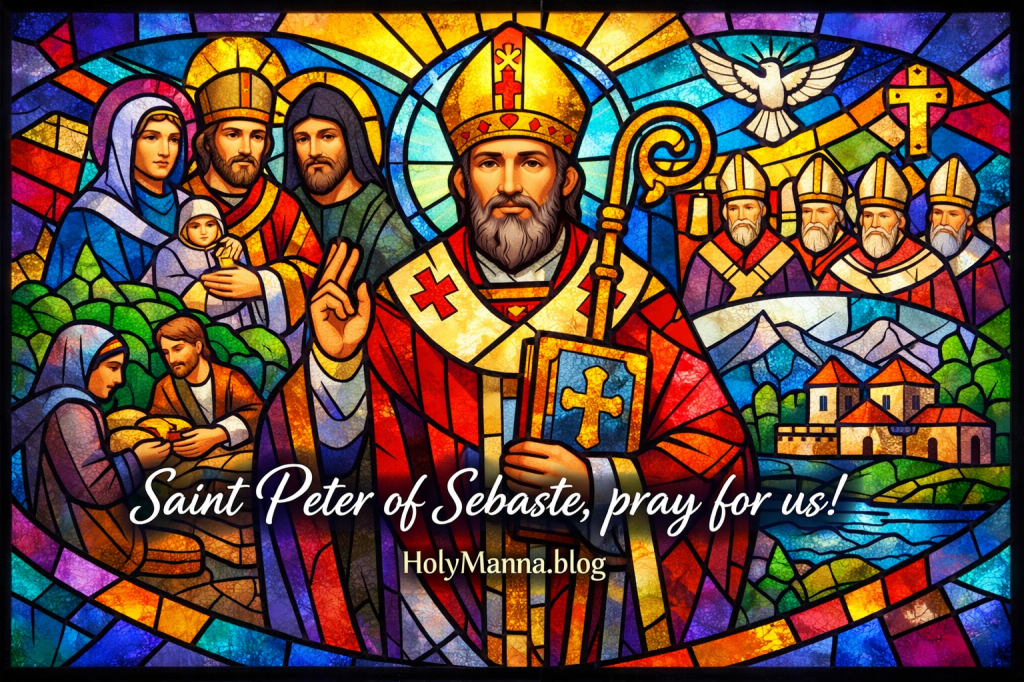
The Hidden Brother Who Helped Shape the Church
Some saints seem to stand in the middle of history with a torch in their hands. Others stand just behind them, quietly feeding the flame. Saint Peter of Sebaste belongs to that second kind of greatness.
He lived in the fourth century, in one of the most remarkable Christian families the Church has ever known. He was the son of Saints Basil and Emmelia. He was the brother of Saint Basil the Great, Saint Gregory of Nyssa, and Saint Macrina the Younger. In a household already overflowing with holiness, Saint Peter still became a saint in his own right. That alone says something important. Grace does not make people into copies. It makes each soul radiant in its own way.
Saint Peter is remembered as a bishop, a monk, a defender of the true faith, and a man of deep charity. He did not become as famous as his brothers and sister, but the Church has never measured holiness by publicity. In many ways, his life is a lesson in the kind of sanctity that does not chase attention. He helped uphold Nicene orthodoxy during a dangerous time in the Church. He cared for the poor during famine. He guided souls. He encouraged theological work that would strengthen the Church for centuries.
That is why he is revered. He shows that a life can be quiet and still be immense in the eyes of God.
Raised in a House Filled With Heaven
Saint Peter was born around the year 340 in Cappadocia, in what is now part of modern-day Turkey. He came from a family where the faith was not a side interest. It was the air they breathed. Catholic tradition remembers him as the youngest son of Saints Basil and Emmelia, and his upbringing was shaped by prayer, discipline, and fidelity to Christ.
One of the most important influences in his early life was his sister, Saint Macrina the Younger. Catholic sources speak of her almost like a spiritual mother to him. She directed him away from worldly ambition and toward Sacred Scripture, ascetic discipline, and the pursuit of holiness. That matters, because Peter did not simply drift into sanctity. He was formed in it. He learned early that the Christian life is not about status, comfort, or applause. It is about union with God.
In a world that admired rhetoric, influence, and the so-called higher learning of the age, Peter chose a different road. Catholic tradition says that under Macrina’s guidance, he turned from the “profane sciences” and devoted himself to the things of God. That does not mean he despised learning. It means he understood that wisdom without holiness is never enough.
This early formation explains what he is most known for. Saint Peter of Sebaste is remembered above all as a holy bishop formed by monastic discipline, a defender of the faith in the age of Arianism, and a quiet but real influence on the theological mission of the Cappadocian Fathers.
A Life of Quiet Strength and Living Mercy
After Saint Basil became bishop of Caesarea, Peter was ordained to the priesthood by his brother. Even then, he did not use ministry as a path to prominence. He returned gladly to the ascetical life and helped support the monastic communities associated with Macrina and their mother, Saint Emmelia.
Older Catholic tradition holds that he governed a monastery near the River Iris. There, his holiness was not merely interior. It became visible in charity. During a severe famine in Pontus and Cappadocia, Peter is remembered for giving away the resources of the monastery and gathering what he could for those in need. Crowds came in distress, and he responded not with pious words alone, but with concrete love.
That is one of the most beautiful parts of his story. The saint who lived a hidden, disciplined life also knew how to pour himself out when others were hungry. This is the Gospel made visible. The Church teaches in CCC 2447 that works of mercy are concrete acts by which we come to the aid of our neighbor in spiritual and bodily necessities. Saint Peter lived that truth.
Around 380 or 381, he was made bishop of Sebaste in Armenia. This was not an easy appointment. The region had been deeply troubled by doctrinal confusion, especially the spread of Arianism and related errors. Peter stepped into that world not as a celebrity bishop, but as a steady shepherd. Catholic sources remember him as a defender of Nicene orthodoxy and as one who stood with his brothers in protecting the truth about Christ and the Holy Trinity.
He was also present at the First Council of Constantinople in 381, one of the great councils of the early Church. That alone places him at a defining moment in Christian history. He was not merely a holy monk who stayed on the sidelines. He was involved in the Church’s struggle to safeguard the true faith.
Another surprising and important part of his life is the influence he had on Saint Gregory of Nyssa. Catholic sources say Gregory wrote major theological works at Peter’s urging or desire, including works connected to the refutation of heresy and the interpretation of creation and man. That means Peter’s legacy was not only pastoral. It was theological. He helped strengthen the Church’s mind as well as her heart.
A verified saying survives from Peter himself in a prefatory letter associated with Gregory’s work against Eunomius. He exhorts his brother with these words: “faint not in furthering the Spirit’s power, nor leave half-won the victory.” That line sounds exactly like the man his life reveals. He was not interested in half measures. He wanted truth defended, the Church strengthened, and the work of God carried through to the end.
When speaking of miracles during his lifetime, honesty matters. The Roman Catholic sources do not preserve famous miracle stories clearly attached to Saint Peter in the way they do for many other saints. No well-attested cycle of healings, visions, or wonders stands at the center of his cult. His greatness is found more in fidelity, charity, and holiness than in dramatic supernatural reports. That does not make his life any less powerful. In some ways, it makes it more approachable.
The Burdens He Carried for Christ
Saint Peter was not a martyr, and Catholic tradition does not record a martyrdom for him. Still, his life was not free from hardship. In fact, much of his sanctity appears in the way he endured burdens that were less dramatic, but deeply demanding.
He lived in a time when the Church was still fighting for clarity against heresy. Arianism was not some distant theological argument. It wounded dioceses, divided believers, and clouded the truth about who Jesus Christ is. To stand firmly with the Nicene faith required courage, patience, and conviction. Peter bore that burden as bishop of Sebaste.
He also lived the hardship of hiddenness. That may not sound severe at first, but it is a real cross. He belonged to a family of brilliant and celebrated saints. Basil the Great towers over Church history. Gregory of Nyssa is one of the most profound theologians of the Fathers. Macrina is honored as a spiritual giant. Peter had every chance to be overshadowed, and yet he remained faithful without bitterness or self-promotion.
That is a hardship many souls understand. Not every servant of God will be seen. Not every faithful life will be widely remembered. Saint Peter shows that holiness does not depend on visibility. The Church teaches in CCC 2013 that all Christians are called to the fullness of Christian life and the perfection of charity. That call reaches the hidden soul just as surely as the famous one.
He also endured the burden of pastoral responsibility in difficult times. To be a bishop in a troubled see meant carrying the wounds of others, guarding the truth, and persevering through confusion. His life shows no sign of theatrical suffering, but it does show the steady suffering of a man who remained faithful to Christ when faithfulness was costly.
The Memory He Left Behind
After his death, which Catholic sources place in the late fourth century, Saint Peter was honored as a saint. Some sources give the year 391, while older traditions place his death slightly earlier. What matters most is that his holiness was recognized early, and his memory was kept alive by the Church.
His legacy after death is not centered on a famous shrine, a large devotional movement, or a long list of miracle stories. The Roman Catholic sources simply do not preserve that kind of tradition around him in any strong or widely attested form. No major verified posthumous miracles stand at the center of his remembrance. No dramatic relic tradition dominates his story. That should be said plainly.
There is, however, a powerful form of legacy that belongs to him. He continued to live in the memory of the Church as part of one of the greatest saintly families in Christian history, and as a bishop whose influence helped shape orthodox theology. His memory was honored at Sebaste with an anniversary solemnity in older tradition, which shows that his sanctity was not a later invention. He was remembered by the local Church as a holy shepherd.
His feast is commonly observed on March 26 in current Catholic reference tradition, though older Catholic sources also associate him with January 8 or January 9. Even that detail says something interesting. Though he is not one of the most publicly celebrated saints, the Church has not forgotten him.
His cultural impact is also real, even if indirect. He belongs to the Cappadocian world that helped articulate the Church’s Trinitarian faith with extraordinary clarity. He strengthened the life of monasticism. He stood in the line of bishops who preserved truth in a turbulent age. He also reminds Catholics that family can be a school of sanctity. In a time when the family is often under attack, the household of Basil, Emmelia, Macrina, Basil the Great, Gregory, and Peter stands like a monument to what grace can do.
A beautiful testimony to Peter’s holiness comes not from his own pen, but from his brother Gregory of Nyssa, who praised his virtue in language of deep reverence. Gregory’s witness helps show how greatly Peter was loved and esteemed by those who knew him best.
As for miracles after death, no specific miracle stories from reliable Roman Catholic sources have emerged in the research used for this post. If other local legends once circulated, they are not clearly preserved in the Catholic sources reviewed here, so they cannot be responsibly repeated as established tradition.
The Lesson of a Saint Who Did Not Need the Spotlight
Saint Peter of Sebaste has a way of speaking to the modern heart precisely because his life was not loud. He did not build his identity on attention. He did not need to dominate the room. He simply belonged to Christ with steadiness.
That is a word many people need. The world trains souls to ask whether they are being noticed. The saints ask whether they are being faithful.
Peter teaches the beauty of quiet obedience. He teaches that charity matters more than image. He teaches that truth is worth defending even when others receive the credit. He teaches that a hidden life can still help hold up the Church.
There is also something deeply encouraging in the way God used his family. Peter’s story reminds readers that sanctity is contagious in the best way. A holy home can produce generations of courage, wisdom, and love. One person’s fidelity strengthens another. One soul’s surrender opens the door for another soul’s vocation.
Where might God be asking for faithfulness without applause? Where has pride made hidden holiness seem too small? How might greater love for Scripture, prayer, mercy, and truth reshape daily life?
A practical way to live Saint Peter’s example is to begin with the ordinary. Be faithful in prayer even when no emotion comes. Defend the truth calmly when confusion spreads. Practice works of mercy when others are in need. Read the faith seriously. Love the Church enough to serve her without needing recognition. These are not small things. These are the building blocks of sanctity.
Saint Peter of Sebaste also invites readers to take family holiness seriously. Parents, siblings, spiritual mentors, and friends can all help one another toward heaven. His life is proof that God can raise saints in clusters when a home is rooted in Christ.
Engage With Us!
Share thoughts and reflections in the comments below. Saint Peter of Sebaste may not be one of the most famous saints on the calendar, but his life carries a powerful message for anyone trying to be faithful in ordinary, hidden, demanding circumstances.
- What part of Saint Peter of Sebaste’s life speaks most deeply to the heart right now?
- Does his hidden holiness challenge the way success or importance is usually measured?
- How can greater fidelity to prayer, truth, and the works of mercy become more concrete this week?
- What can families learn from the household that formed Saint Peter of Sebaste?
- In what area of life is God asking for perseverance so that the victory is not left half-won?
May Saint Peter of Sebaste inspire a life of steady faith, quiet strength, and generous love. May every hidden act of fidelity be offered to Jesus Christ, and may everything be done with the love and mercy He taught.
Saint Peter of Sebaste, pray for us!
Follow us on YouTube, Instagram and Facebook for more insights and reflections on living a faith-filled life.

 Holy Manna!
Leave a comment