The Bishop Who Carried Christ to the Edges of Europe
Saint Ludger of Münster, also called Liudger or Ludgerus, is one of those saints who helped shape the map of Catholic Europe by sheer fidelity. He is remembered as the first Bishop of Münster, a great missionary to the Frisians and Saxons, a founder of churches and monasteries, and a patient shepherd who brought the Gospel to lands where paganism, violence, and political unrest had made Christian life difficult. His feast day is celebrated on March 26.
He is revered because he did not merely pass through a region preaching a few sermons and moving on. He planted the Church. He built communities, formed clergy, founded religious houses, and gave stability to places that needed more than a quick burst of zeal. In Saint Ludger, the faithful can see what the Church means when she teaches that the saints show forth her holiness and continue to strengthen her on earth by their witness and intercession, as taught in CCC 828.
His life also reflects the missionary heart of the Church herself. The Church is missionary by her very nature, as The Catechism teaches in CCC 849, and Ludger lived that truth in a hard land with remarkable steadiness. He was not known for spectacle. He was known for endurance, wisdom, and a deep love for Christ and His people. That makes him especially important in an age that often confuses noise with fruitfulness. Ludger reminds the faithful that real evangelization usually looks like patient holiness.
A Boy Marked by the Saints
Saint Ludger was born around 743 or 744 near Utrecht, in a noble and wealthy Christian Frisian family. His parents are traditionally named Thiadgrim and Liafburg. He did not come from a pagan household that stumbled into Christianity late in life. He was raised inside the life of the Church, and that matters. Grace often begins its work quietly, through family, formation, prayer, and the witness of holy elders.
One of the most memorable moments of his youth was seeing Saint Boniface as a child. That encounter left a lasting impression on him, and the later martyrdom of Boniface only deepened that influence. Ludger grew up watching what missionary sanctity looked like. He saw that the Gospel was worth everything.
His formal education also helped prepare him for the work God would entrust to him. He studied at Utrecht under Saint Gregory of Utrecht, and later went to York, where he learned under the famous Alcuin. This was no small formation. Ludger received a deeply Catholic education rooted in Scripture, discipline, learning, and the life of the Church. He was not simply enthusiastic. He was formed.
That early training helps explain what he is most known for. Saint Ludger became one of the great evangelizers of northwestern Europe. He is remembered above all as the Apostle of the Saxons and Frisians, the founder of the Church in Münster, and a man who chose missionary hardship over prestige. When Charlemagne wanted to place him in the more prominent see of Trier, Ludger declined. He preferred the harder field. He wanted souls more than honors.
The Man Who Built More Than Buildings
Ludger’s life was marked by both preaching and building. He restored the chapel at Deventer after pagan destruction and recovered the relics of Saint Lebwin. After his ordination in Cologne in 777, he was sent to labor in Friesland, especially around Dokkum, the place linked to the martyrdom of Saint Boniface. He taught, preached, and worked to strengthen the faith among people who had seen both missionary witness and fierce resistance.
His mission was interrupted by the Saxon unrest associated with Widukind. Churches were attacked. The work became dangerous. Ludger was driven out and made his way to Rome, where he sought counsel from Pope Adrian I. After that, he spent time at Monte Cassino, living according to the Benedictine Rule, though he did not formally take vows there. That part of his story is beautiful because it shows something essential about Catholic holiness. Before returning to labor in a difficult mission field, he stepped more deeply into prayer, order, and spiritual discipline.
When he returned, he went back with renewed strength. He evangelized Frisia, the region around the Ems, and Westphalia. He founded the monastery that became the heart of Münster. In time, the city itself drew its later identity from that monastic foundation. He also founded Werden Abbey, which became one of the most important centers tied to his memory and relics.
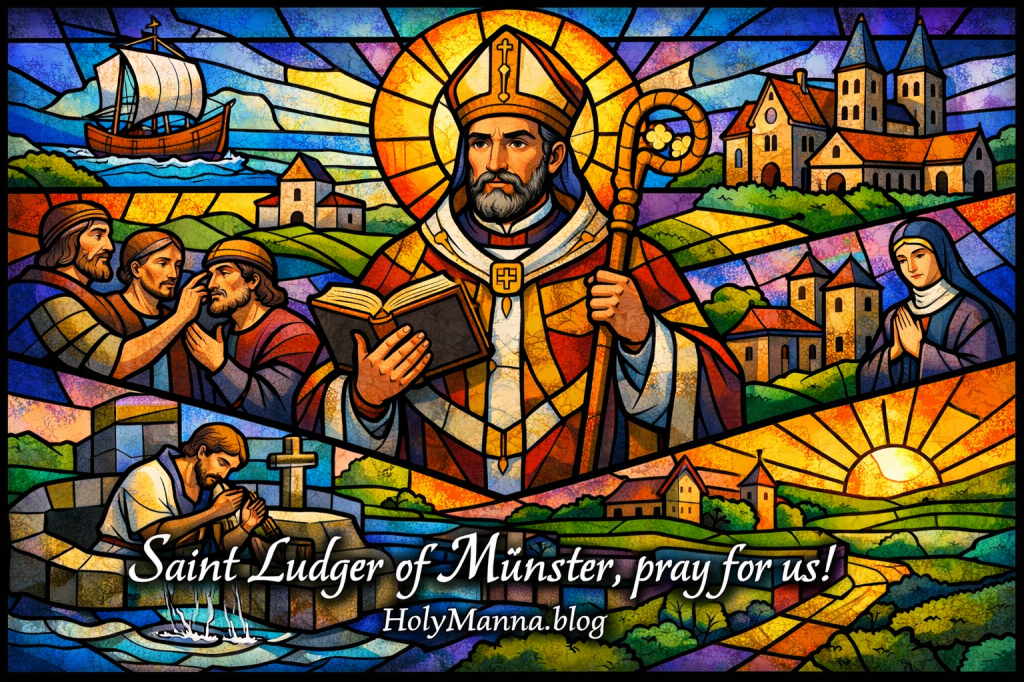
He built churches in places such as Billerbeck, Coesfeld, Herzfeld, and Nottuln. He also provided for religious life among women by establishing a house near Nottuln for his sister, Saint Gerburgis. Catholic tradition remembers this as the beginning of the first convent in Westphalia. Ludger understood that the Church grows through sacramental life, prayer, education, and community. He was building an entire Catholic culture, not merely winning arguments.
His importance lies here. He did not just convert individuals. He helped form a people.
Signs of Grace Along the Way
Saint Ludger is associated with miracles during his lifetime, though the surviving accounts come through early Catholic tradition rather than modern investigative methods. The most famous miracle connected to him is the healing of the blind bard Bernlef, also called Berulef. According to tradition, Ludger restored the man’s sight, and Bernlef afterward became a devoted Christian. This story reveals much about the saint’s mission. He did not only preach to crowds. He encountered persons. He brought Christ into individual human suffering.
Catholic tradition also remembers him as having the gift of prophecy. Some accounts say he foretold destructive northern invasions that would come later. Whether one focuses on the healing of the blind or the gift of prophetic insight, the larger point is the same. Ludger’s life was marked by the kind of supernatural fruit that often follows deep union with God.
There is another striking story from his missionary work on Heligoland. He is said to have confronted lingering pagan worship there, built up Christian worship in its place, and even turned a well connected to pagan cult into a baptismal font. That may not be a miracle in the strict sense, but it is a powerful sign of what Christian mission does. Christ does not merely add Himself to the old world. He converts it. He claims it. He sanctifies what has been misused and turns it toward grace.
The importance of Saint Ludger is not only that wonders surrounded him. It is that he showed how grace works through steady obedience. He preached, taught Scripture daily, formed students, cared for clergy, fasted, kept vigils, and gave generously to the poor. That is why his memory deserves to be preserved. He proves that holiness is not abstract. It becomes visible in habits, decisions, institutions, and love.
Exile, Opposition, and the Long Offering of a Bishop
Saint Ludger was not a martyr, but he absolutely suffered for the faith. His work unfolded in a land of instability, lingering paganism, violent resistance, and political pressure. When the Saxons rebelled and Christian foundations were attacked, he had to flee. That exile was not a failure. It was part of his purification. Like many saints, he learned that God sometimes deepens a mission by first emptying the missionary.
Another tradition shows the seriousness of his spiritual life. Charlemagne once summoned him while he was at prayer. Ludger did not rush away from prayer to answer earthly power. The tradition says he finished his prayer first, and when challenged, he made clear that God had to come first. That story captures his soul. He respected authority, but he knew the hierarchy of loves.
His hardships were not only external. They were also interior. Missionary life requires patience with slow results, courage when danger rises, and humility when the work belongs more to God than to the worker. Ludger endured all of that.
His death came peacefully, but it came at the end of tireless labor. On Passion Sunday in 809, he preached at Coesfeld, then traveled to Billerbeck, where he preached again and celebrated what tradition remembers as his last Mass. That final image says everything. He died as he had lived, giving Christ to others. There was no martyr’s execution, but there was a life poured out. In the deepest Christian sense, that too is a kind of offering.
The Saint Who Kept Shepherding After Death
After Saint Ludger died, both Münster and Werden wanted custody of his body. That dispute alone shows how beloved he was. In the end, his remains were taken to Werden, though portions of his relics were also honored later in Münster and Billerbeck. His relics became a lasting sign that the shepherd had not ceased to belong to the flock.
His cult endured strongly in Catholic lands connected to his mission. His tomb in Werden became a center of veneration, and his memory remained alive not as a dead historical chapter but as a living Catholic devotion. That kind of continuity matters. The Church does not keep saints around as decoration. She keeps them near because they still help the faithful.
One of the most notable posthumous traditions associated with Saint Ludger is the great procession of his relics in Werden. This observance grew out of a vow of thanksgiving after deliverance from famine. Catholics there long connected that relief with the saint’s intercession, and the annual procession became an enduring expression of gratitude and devotion. The tradition is real and longstanding, though the famine story is preserved as devotional history rather than as a miracle account verified by modern standards. It cannot be verified in the way later canonization records sometimes can be verified.
His shrine and memory also shaped pilgrimage and regional identity. Billerbeck, the place of his death, remains deeply tied to his memory. The pilgrimage path associated with his final journey continues to keep his presence alive in the land he served. He is honored as a patron in Münster, Werden, and other regions linked to his missionary life. His cultural impact is not small. Entire places were shaped by his foundations, his relics, and his witness.
As for other individual miracle stories after his death, the major Catholic sources commonly cited today preserve strong evidence of continuing devotion, answered prayers, relic veneration, and processions of thanksgiving, but they do not preserve a large set of detailed posthumous miracle narratives in the way later saints sometimes have them recorded. Because of that, many supposed individual stories cannot be verified.
Still, even that fact says something important. Saint Ludger’s legacy does not rest on a collection of dramatic legends alone. It rests on the visible, historical endurance of Christian life where he labored. Sometimes the greatest miracle is that the faith remained, matured, and bore fruit for centuries.
What Saint Ludger Teaches the Church Today
Saint Ludger speaks with surprising clarity to the modern world. He teaches that the faith must be handed on with patience, structure, and love. He teaches that Christian mission is not accomplished merely by emotion or argument. It requires prayer, learning, sacrifice, and the willingness to stay in a difficult field for the long haul.
He also teaches that fidelity is more important than visibility. He turned down greater status in order to serve where he was most needed. That is a word many Catholics need to hear. The world often asks, “How much influence can this bring?” The saint asks something better. Where is Christ asking for faithfulness?
His life also invites reflection on the ordinary means of sanctity. He taught. He built. He prayed. He fasted. He formed others. He gave alms. He stayed close to the Church. There is nothing flashy about that, but there is something deeply Catholic about it. Grace usually enters a place through the steady work of faithful people who refuse to quit.
For readers today, Saint Ludger offers a very practical pattern. Stay rooted in prayer. Love the Church enough to serve her patiently. Build what helps other people remain close to Christ. Raise families in the faith. Support priests and religious life. Teach the young. Keep going when the culture turns hostile. Do not measure success too quickly. God often plants oak trees through the labor of men and women who never live to sit in the shade.
Where has God placed a mission field in daily life right now? Is it in the home, the parish, the workplace, or the quiet burdens no one else sees? What would it look like to stop chasing recognition and start building something that helps souls belong to Christ?
Saint Ludger’s life reminds the faithful that holiness is not just about dramatic sacrifice. It is also about durable love.
Engage With Us!
Share your thoughts and reflections in the comments below. Saint Ludger’s story is a beautiful reminder that the Gospel often grows through patient work, hidden sacrifice, and a life quietly offered to Christ.
- What part of Saint Ludger’s life stands out the most: his missionary courage, his patience in hardship, or his commitment to building lasting Christian communities?
- Have there been moments when God seemed to be asking for faithfulness instead of visible success? What did that look like?
- What is one practical way to build up the Catholic faith in daily life this week through prayer, teaching, service, or perseverance?
May Saint Ludger pray for every soul trying to remain faithful in a difficult age. May his example encourage a life of steady courage, deep prayer, and real love for the Church. Live the faith with conviction, stay close to Christ in the sacraments, and do everything with the love and mercy Jesus taught us.
Saint Ludger of Münster, pray for us!
Follow us on YouTube, Instagram and Facebook for more insights and reflections on living a faith-filled life.

 Holy Manna!
Leave a comment