Thursday of the Fifth Week of Lent – Lectionary: 254
When the Promise Stands in the Temple
There are moments in Lent when the Church stops speaking softly and lets the full weight of the mystery fall on the heart. Today is one of those days. These readings draw the soul into a single, blazing truth: the God who made an everlasting covenant with Abraham is the same God now speaking in the person of Jesus Christ. The central theme running through the day is covenant fidelity fulfilled in Christ. What God promised in the beginning, He does not abandon. What He swore to Abraham, He brings to completion in His Son.
That is why Abraham stands at the beginning of today’s Mass. In the world of the Old Testament, covenant was not a casual agreement or a passing religious sentiment. It was a sacred bond, solemn, enduring, and life-defining. When God changes Abram’s name to Abraham, He is not simply giving him a title. He is revealing a mission, a future, and a place within the history of salvation. Abraham becomes the father of a people set apart for God, and through that people the nations of the earth will one day be blessed. The psalm then teaches Israel, and now the Church, how to live inside that promise: remember, seek, recall, trust. God does not forget His word, even when generations pass and the fulfillment seems far away.
By the time the Gospel is proclaimed, that ancient promise is no longer only remembered. It is standing in the Temple, speaking with divine authority. This passage from The Gospel of John comes during the final stretch before Holy Week, when opposition to Jesus grows sharper and His words become even more direct. The religious tension is intense, because Jesus is not merely offering a new interpretation of Abraham. He is revealing Himself as the One before Abraham, the One in whom Abraham’s hope finds its meaning. For a Jewish listener, Abraham was the great father of the covenant, the friend of God, the beginning of the chosen people. So when Jesus speaks of Abraham rejoicing to see His day, and then declares “before Abraham came to be, I AM”, He is not making a poetic statement. He is unveiling the deepest truth of His identity.
That is what makes today’s readings so powerful together. Genesis gives the promise. Psalm 105 gives the memory of the promise. The Gospel of John reveals the fulfillment of the promise. The Church places them side by side so the heart can see that salvation history is one great story of divine faithfulness. The God who called Abraham is not distant, silent, or changed. He has come near. He speaks. He calls for faith. He invites His people not only to admire the covenant from afar, but to enter it fully by keeping the word of Christ.
What does it mean to stand before a God who always keeps His promises, even when the world cannot yet see where those promises are leading? That question opens the door into every reading today. Lent asks the soul to remember that God’s plan has never been random, never rushed, and never uncertain. The covenant made long ago is reaching its fulfillment, and the One who now speaks is not only Abraham’s descendant according to the flesh. He is Abraham’s Lord.
First Reading – Genesis 17:3-9
The God Who Gives a New Name and an Everlasting Promise
The first reading opens in a moment of holy gravity. Abram falls face down before God, and the silence is broken by covenant language that will shape the whole history of salvation. This passage belongs to the great patriarchal cycle in Genesis, where God gradually reveals His plan not only for one family, but for all nations through that family. In the ancient world, a covenant was not a casual arrangement. It was a binding relationship marked by loyalty, promise, and identity. Here, God is not merely blessing Abram with private comfort. He is setting apart a man through whom He will gather a people, preserve His promises, and prepare the world for the coming of Christ. The Catechism teaches, “In order to gather together scattered humanity God calls Abram from his country, his kindred and his father’s house, and makes him Abraham, that is, ‘the father of a multitude of nations’. ‘In you all the nations of the earth shall be blessed.’” CCC 59
This reading fits today’s larger theme with remarkable force. In Genesis, God establishes the covenant and gives Abram a new name. In the Gospel, Jesus reveals Himself as the One who existed before Abraham and who brings that covenant to its fulfillment. So this reading is not just about the beginning of Israel’s story. It is about the beginning of a promise that reaches all the way to the Church. Abraham stands here as the father of faith, receiving from God a mission bigger than he can yet understand, and Lent invites the soul to stand beside him in reverence, trust, and obedience. The Catechism summarizes the movement beautifully: “God chose Abraham and made a covenant with him and his descendants. By the covenant God formed his people and revealed his law to them through Moses. Through the prophets, he prepared them to accept the salvation destined for all humanity.” CCC 72
Genesis 17:3-9 – New American Bible (Revised Edition)
3 Abram fell face down and God said to him: 4 For my part, here is my covenant with you: you are to become the father of a multitude of nations. 5 No longer will you be called Abram; your name will be Abraham, for I am making you the father of a multitude of nations. 6 I will make you exceedingly fertile; I will make nations of you; kings will stem from you. 7 I will maintain my covenant between me and you and your descendants after you throughout the ages as an everlasting covenant, to be your God and the God of your descendants after you. 8 I will give to you and to your descendants after you the land in which you are now residing as aliens, the whole land of Canaan, as a permanent possession; and I will be their God. 9 God said to Abraham: For your part, you and your descendants after you must keep my covenant throughout the ages.
Detailed Exegesis
Verse 3: “Abram fell face down and God said to him:”
The first movement in the passage is not speech but surrender. Abram falls face down because he is in the presence of the living God. This posture expresses worship, humility, and receptivity. Before Abraham becomes the father of many nations, he must first become small before the Lord. That is always the pattern of grace. God’s greatest works usually begin where human pride ends.
Verse 4: “For my part, here is my covenant with you: you are to become the father of a multitude of nations.”
God speaks with clarity and authority. “For my part” shows that the initiative belongs to Him. This covenant begins in divine generosity, not human achievement. Abraham is promised fruitfulness far beyond his natural circumstances, and the promise stretches beyond one tribe or one generation. The phrase “a multitude of nations” already hints that God’s plan is wider than ethnic Israel alone. From a Catholic perspective, this prepares the way for the universality of the Church, in which the children of Abraham are gathered by faith.
Verse 5: “No longer will you be called Abram; you are to become Abraham, for I am making you the father of a multitude of nations.”
A new name signals a new vocation. In Scripture, God changes names when He draws someone into a deeper role within salvation history. Abram becomes Abraham because his identity is being reshaped by promise. He will no longer be defined by his past, his limitations, or the visible facts of old age and barrenness. He will be defined by what God says. The soul can linger here for a long time, because this is how grace still works. God does not simply improve a person’s résumé. He gives a new identity rooted in His call.
Verse 6: “I will make you exceedingly fertile; I will make nations of you; kings will stem from you.”
The promise grows larger. Abraham will not only have descendants. He will become the source of nations and kings. This verse points toward the royal history of Israel, but it also points beyond that history. The line of promise will eventually lead to Christ, the King whose reign does not pass away. What seems, at first glance, like a promise of biological fruitfulness unfolds into a messianic horizon. God’s words are never small, even when they begin in the hidden life of one household.
Verse 7: “I will maintain my covenant between me and you and your descendants after you throughout the ages as an everlasting covenant, to be your God and the God of your descendants after you.”
This is the heart of the passage. The deepest promise is not land, descendants, or even kingship. The deepest promise is relationship: “to be your God.” That is covenant in its richest biblical sense. God binds Himself to His people and claims them as His own. The covenant is called everlasting because it belongs to the long, unfolding design of salvation that reaches its perfection in Christ. This is why the Church reads Abraham not as an isolated ancient figure, but as a father whose faith opens toward the New Covenant.
Verse 8: “I will give to you and to your descendants after you the land in which you are now residing as aliens, the whole land of Canaan, as a permanent possession; and I will be their God.”
There is a striking tension here. Abraham is still an alien in the land even while God speaks of permanent possession. That tension teaches the logic of faith. God’s promises are often given before they are seen. The land matters because it is the stage on which salvation history will unfold, but once again the final line carries the deepest weight: “I will be their God.” The external gift serves the greater gift of communion. In the fullness of revelation, the promise of land opens toward the deeper inheritance of the Kingdom of God.
Verse 9: “God said to Abraham: For your part, you and your descendants after you must keep my covenant throughout the ages.”
Grace comes first, but grace calls for a response. God’s covenant is a gift, yet it is never a permission slip for indifference. Abraham and his descendants must keep the covenant. Faith, in biblical language, is not vague interior sentiment. It is lived fidelity. The next verses, just beyond today’s reading, will introduce circumcision as the covenant sign, but even here the central truth is clear: divine promise and human obedience belong together. Love invites loyalty.
Teachings
This reading reveals the pattern of salvation history in seed form. God chooses one man so that, through him, blessing may reach the nations. The Catechism places Abraham at the beginning of the gathering of fallen humanity and teaches that his call is part of God’s answer to the scattering caused by sin. “In order to gather together scattered humanity God calls Abram from his country, his kindred and his father’s house, and makes him Abraham, that is, ‘the father of a multitude of nations’. ‘In you all the nations of the earth shall be blessed.’” CCC 59
The Church also teaches that this covenant is not a dead relic of ancient religion, but a living stage in the one plan of God that leads to Christ. “God chose Abraham and made a covenant with him and his descendants. By the covenant God formed his people and revealed his law to them through Moses. Through the prophets, he prepared them to accept the salvation destined for all humanity.” CCC 72 This matters because today’s reading is not complete in itself. It leans forward. It is fulfilled when Christ comes, not to erase Abraham, but to bring Abraham’s promise to its full flowering. The Catechism says this plainly: “God has revealed himself fully by sending his own Son, in whom he has established his covenant for ever.” CCC 73
Saint John Paul II spoke about Abraham with language that makes this reading feel alive and urgent. He said, “With him God’s salvation began to travel the paths of human history.” That line is worth sitting with. Salvation history is not mythology and it is not abstraction. It is God entering real history, calling real people, and moving His promise through generations toward redemption. In another reflection, John Paul II said, “In the faith of Abraham almighty God truly made an eternal covenant with the human race, and its definitive fulfilment is Jesus Christ.” That is the Catholic key to reading this passage well. Abraham is not the endpoint. He is the father in faith whose yes opens the road toward Christ.
There is also a deeply personal teaching here about identity. Abraham’s new name comes from God. He receives his mission before he sees its fulfillment. That remains true for every Christian soul. God does not wait until everything looks impressive on the outside. He calls, names, and forms His people by grace. The covenant always begins with God’s initiative, but it also calls forth obedience. That is why verse 9 matters so much. The God who promises is also the God who commands fidelity. Catholic life is never about choosing between grace and obedience. It is about learning that obedience is the shape love takes when it trusts God.
Reflection
This reading speaks directly to the ordinary battles of daily life. Abraham receives impossible promises while still standing in an unresolved life. He is old. The future is unclear. The fulfillment is not visible. Yet God speaks as if the promise is already secure. That is often how faith feels. The soul hears God’s truth long before the eyes can see its outcome.
There is a lesson here for anyone carrying unanswered prayers, family burdens, hidden grief, or the slow ache of waiting. God’s covenant faithfulness does not depend on human timelines. He is still the God who gives a new name, a new future, and a deeper belonging. The world teaches people to define themselves by failure, past wounds, status, or fear. This reading teaches something far more solid. Identity begins with what God says.
Daily life becomes different when this truth sinks in. Prayer becomes less like panic and more like surrender. Obedience becomes less like duty and more like trust. Even repentance begins to feel different, because returning to God is not returning to a stranger. It is returning to the One who has already claimed His people in covenant love.
A practical way to live this reading is to begin with reverence, like Abraham falling face down. A Christian may not literally lie prostrate on the floor each morning, but the heart can still bow. That means starting the day with prayer before noise, receiving God’s word before reacting to the world, and remembering that life is not self-created. Another step is to ask where God may be giving a new name to an old wound. A person may still think of himself as weak, forgotten, ashamed, or stuck, while God is calling him toward faithfulness, fatherhood, spiritual maturity, or holiness.
Where has the heart been living more by visible circumstances than by God’s promise?
What old name has been allowed to define the soul more than the identity God gives?
How is the Lord asking for greater fidelity to His covenant in daily habits, prayer, speech, or family life?
Abraham’s story begins with a face to the ground and a promise from heaven. That is still how holiness begins. The soul kneels, God speaks, and a new future starts to unfold.
Responsorial Psalm – Psalm 105:4-9
Remembering the God Who Never Forgets His Promise
The Responsorial Psalm today sounds like a call shouted across generations. After the first reading reveals God’s covenant with Abraham, Psalm 105 teaches the proper response of God’s people: seek, remember, recall, and trust. This psalm belongs to that rich stream of Israel’s prayer that does more than express emotion. It retells the mighty works of God so that the people do not lose their identity. In the religious life of ancient Israel, memory was never meant to be sentimental. It was covenant memory. The people remembered what God had done because they belonged to Him, and because forgetting His deeds always led to fear, idolatry, and spiritual drift.
That is what makes this psalm so fitting for today’s theme. The first reading gives the covenant promise to Abraham. The Gospel will reveal that Christ is the eternal Son who stands before Abraham and fulfills that promise. Between those two readings, the psalm trains the heart to live properly inside salvation history. It reminds the faithful that God’s promises are not vague religious ideas. They are real acts in time, remembered in worship, handed down through generations, and fulfilled in the Lord’s perfect faithfulness. This psalm invites the soul to stop living like an orphan and start praying like one who belongs to the covenant.
Psalm 105:4-9 – New American Bible (Revised Edition)
4 Seek out the Lord and his might;
constantly seek his face.
5 Recall the wondrous deeds he has done,
his wonders and words of judgment,
6 You descendants of Abraham his servant,
offspring of Jacob the chosen one!7 He the Lord, is our God
whose judgments reach through all the earth.
8 He remembers forever his covenant,
the word he commanded for a thousand generations,
9 Which he made with Abraham,
and swore to Isaac,
Detailed Exegesis
Verse 4: “Seek out the Lord and his might; constantly seek his face.”
This verse opens with movement. The psalm does not tell the people merely to think about God once in a while. It commands them to seek Him. In biblical language, seeking the Lord means turning the whole heart toward Him in trust, worship, and dependence. To seek His might is to remember that salvation does not come from human strength, political power, or self-confidence. To seek His face is even more intimate. This is not just a search for blessings. It is a longing for God Himself. In Catholic life, this verse speaks directly to prayer. The soul was not made merely to solve problems, manage responsibilities, and survive the week. It was made to seek the face of God.
Verse 5: “Recall the wondrous deeds he has done, his wonders and words of judgment,”
The psalm immediately joins prayer to memory. Israel is told to recall the wondrous deeds of God because forgetfulness is deadly to faith. The wonders of God include His acts of deliverance, His providence, and His covenant faithfulness. His judgments are not random outbursts. They are His holy actions in history, revealing both justice and mercy. This verse teaches that faith is strengthened by remembrance. The believer who regularly recalls what God has done becomes steadier in trial. The believer who forgets begins to live only by the pressure of the present moment.
Verse 6: “You descendants of Abraham his servant, offspring of Jacob the chosen one!”
Now the psalm names the people directly. They are not a crowd without roots. They are descendants of Abraham and offspring of Jacob. This matters deeply. Their identity comes from God’s call and covenant, not merely from bloodline, politics, or land. Abraham is called God’s servant because he responded in obedience, and Jacob is called chosen because the people exist by divine election, not by self-creation. For the Church, this verse has an even deeper resonance. Through faith in Christ, the faithful are brought into the family of Abraham, not by biology, but by grace. The covenant story becomes the Christian’s family history.
Verse 7: “He, the Lord, is our God whose judgments reach through all the earth.”
This verse lifts the heart from family memory to divine majesty. The God of Abraham is not a local tribal deity. He is the Lord of all the earth. His judgments reach everywhere because His sovereignty reaches everywhere. This is an important correction to every small view of God. The One who made covenant with Abraham is not limited, fragile, or distant. He rules history itself. In the context of today’s readings, this prepares the way for the Gospel. The God who made the covenant is not absent from history. He has entered it fully in Jesus Christ.
Verse 8: “He remembers forever his covenant, the word he commanded for a thousand generations,”
This is one of the most comforting lines in the psalm. God remembers forever. In Scripture, when God remembers, it does not mean that something slipped His mind and later came back to Him. It means that He remains faithful to His promise and acts according to it. Human beings forget constantly. They forget graces, promises, vows, and mercies. God does not. His covenant fidelity does not weaken with time. The phrase “for a thousand generations” is not meant as a mathematical limit. It is a poetic way of proclaiming enduring faithfulness beyond human counting.
Verse 9: “Which he made with Abraham, and swore to Isaac,”
The psalm ends today by returning to the patriarchs. The covenant made with Abraham did not disappear with Abraham’s death. It continued through Isaac and the generations that followed. That continuity matters because salvation history is not built on momentary spiritual experiences. It is built on God’s enduring faithfulness across centuries. This final verse also deepens the connection to today’s Gospel. The covenant sworn to Abraham and Isaac is not abandoned when Christ comes. It reaches its fulfillment in Him. What was sworn in promise is completed in the Son.
Teachings
This psalm teaches that prayer and memory belong together. The Church has always understood the psalms as a school of prayer, because they form the heart to speak to God using the language of faith, struggle, praise, repentance, and covenant remembrance. The Catechism says, “The Psalms constitute the masterwork of prayer in the Old Testament. The Word of God becomes man’s prayer.” CCC 2585 That is exactly what is happening here. God’s mighty deeds are not only recorded in history. They are taken up into worship. The people pray their memory, and in praying it they learn again who God is.
This psalm also opens a deep truth about prayer itself. The command to seek the Lord is not rooted in human initiative alone. God draws the heart before the heart responds. The Catechism says, “God calls man first. Man may forget his Creator or hide far from his face; he may run after idols or accuse the deity of having abandoned him; yet the living and true God tirelessly calls each person to that mysterious encounter known as prayer.” CCC 2567 That teaching shines light on verse 4. The reason the soul can seek God’s face is because God has already turned His face toward the soul in covenant love.
Saint Augustine offers a beautiful spiritual key for this psalm when he says, “Let your desire be your prayer. If your desire is continual, your prayer is continual too.” That line fits this refrain of seeking the Lord constantly. The Christian life is not sustained by occasional emotional intensity. It is sustained by a heart whose desire has been trained toward God. The psalm is doing exactly that. It is not merely informing the mind. It is aiming the desire.
There is also a profoundly Catholic liturgical instinct in this passage. Israel remembered the covenant by praying and singing the mighty deeds of God. The Church does the same, but in a fuller way. At every Mass, God’s saving works are not merely discussed. They are proclaimed, remembered, and sacramentally made present through Christ’s Paschal Mystery. That is why covenant memory matters so much. The Church is not a community built on vague inspiration. She is a people formed by remembrance of what God has truly done in history.
Reflection
This psalm lands right in the middle of daily life because forgetfulness is still one of the soul’s great enemies. Most people do not wake up one morning and consciously decide to stop trusting God. More often, they simply stop remembering. They get buried in stress, disappointment, temptation, deadlines, family tension, financial pressure, and noise. Little by little, the mighty deeds of God begin to feel distant, and the heart starts living as though everything depends on human strength. That is why this psalm is such a gift during Lent. It calls the soul back to reality.
To live this psalm well, it helps to begin by restoring memory. One practical step is to recall, every day, one concrete way God has been faithful. That might be a prayer answered, a sin forgiven, a door opened, a sorrow sustained, or a season survived by grace. Another step is to seek the Lord’s face before seeking solutions. That changes the day immediately. It means prayer before panic, Scripture before distraction, and trust before self-reliance. It also means teaching the family, children, or friends to speak about the deeds of God, not only about the problems of the week.
There is also a quiet challenge here for anyone who prays mechanically. The psalm does not say merely to say prayers. It says to seek His face. That means prayer must become personal, reverent, and real. It is possible to know religious language and still live spiritually distracted. This psalm pushes the heart deeper. It asks whether prayer has become an encounter or only a habit.
What mighty deeds of God has the heart forgotten in this season of life?
Has prayer become mostly a search for relief, or is it still a seeking of the Lord Himself?
What would change this week if the soul truly lived as though God remembers His covenant forever?
The beauty of this psalm is that it does not leave the faithful trapped inside their own weakness. It lifts their gaze. God remembers. God reigns. God remains faithful across generations. And because that is true, the soul can seek Him again with confidence.
Holy Gospel – John 8:51-59
The One Who Spoke to Abraham Is Standing in the Temple
Today’s Gospel unfolds in a charged and dangerous moment in The Gospel of John. Jesus is in Jerusalem, teaching in the Temple during a season of mounting hostility. The religious leaders are no longer merely puzzled by Him. They are offended, threatened, and closing in. The debate has moved beyond questions of interpretation and into the deepest possible question: Who is Jesus really? That is why this passage matters so much during the final stretch of Lent. The Church is drawing the faithful closer to the Passion, and before the Cross comes fully into view, Christ speaks with unmistakable clarity about His identity.
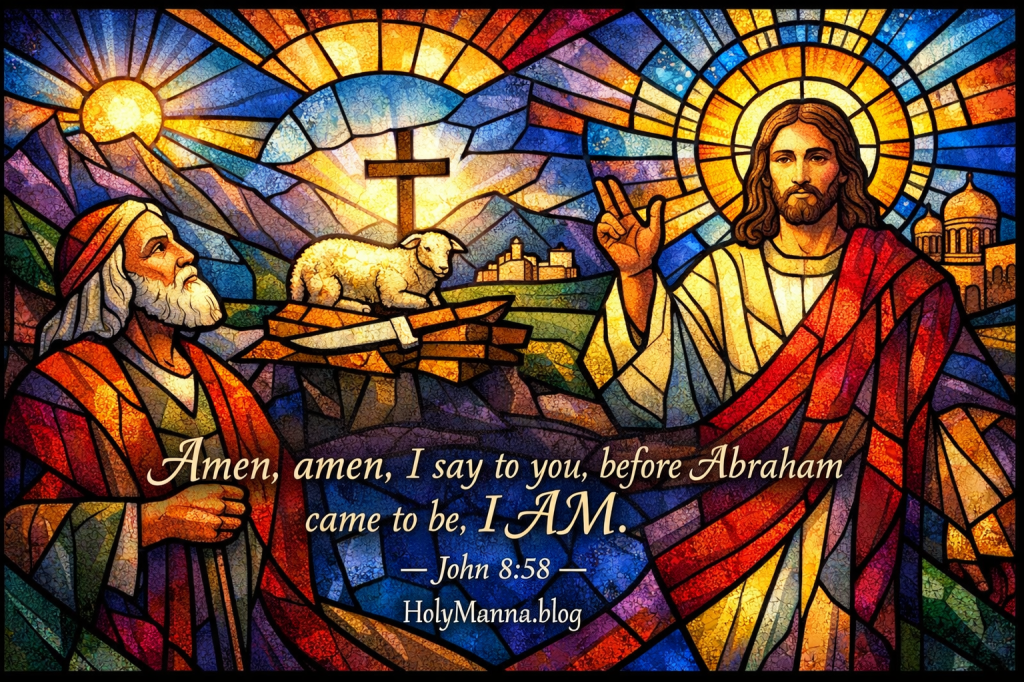
The background is intensely Jewish, deeply covenantal, and full of tension. Abraham was not just a respected ancestor. He was the father of the covenant people, the great patriarch to whom God had spoken promise and blessing. To speak about Abraham was to speak about Israel’s very identity. So when Jesus says that whoever keeps His word will never see death, and then dares to say that Abraham rejoiced to see His day, the conversation becomes explosive. When He finally declares “before Abraham came to be, I AM”, He is not offering a poetic line or a mystical slogan. He is speaking with the force of the divine name itself, echoing God’s revelation to Moses. That is why the crowd reaches for stones. They understand that Jesus is claiming far more than prophetic authority. He is revealing Himself as the eternal Son, the Lord of the covenant, the One who existed before Abraham and who now stands before them in the flesh.
This fits today’s theme with stunning precision. In the first reading, God establishes His covenant with Abraham. In the psalm, the people are called to remember that covenant. In the Gospel, Christ reveals that He is the fulfillment of that covenant and the Lord who stands behind it. The promises made in Genesis are not abandoned. They are fulfilled in the person of Jesus Christ.
John 8:51-59 – New American Bible (Revised Edition)
51 Amen, amen, I say to you, whoever keeps my word will never see death.” 52 [So] the Jews said to him, “Now we are sure that you are possessed. Abraham died, as did the prophets, yet you say, ‘Whoever keeps my word will never taste death.’ 53 Are you greater than our father Abraham, who died? Or the prophets, who died? Who do you make yourself out to be?” 54 Jesus answered, “If I glorify myself, my glory is worth nothing; but it is my Father who glorifies me, of whom you say, ‘He is our God.’ 55 You do not know him, but I know him. And if I should say that I do not know him, I would be like you a liar. But I do know him and I keep his word. 56 Abraham your father rejoiced to see my day; he saw it and was glad. 57 So the Jews said to him, “You are not yet fifty years old and you have seen Abraham?” 58 Jesus said to them, “Amen, amen, I say to you, before Abraham came to be, I AM.” 59 So they picked up stones to throw at him; but Jesus hid and went out of the temple area.
Detailed Exegesis
Verse 51: “Amen, amen, I say to you, whoever keeps my word will never see death.”
Jesus begins with a solemn formula that signals absolute authority. “Amen, amen” in John introduces words of extraordinary weight. This is not casual teaching. It is revelation. The phrase “keeps my word” does not mean merely hearing Jesus, admiring Jesus, or quoting Jesus when convenient. It means guarding His word, obeying it, remaining in it, and letting it govern one’s life. Then comes the promise: “will never see death.” Jesus is not denying bodily death, since even His friends die physically. He is speaking of the deeper death, eternal separation from God. The one who remains in Christ will not be conquered by death in its ultimate form, because divine life has already begun in him.
Verse 52: “[So] the Jews said to him, ‘Now we are sure that you are possessed. Abraham died, as did the prophets, yet you say, “Whoever keeps my word will never taste death.”’”
The response shows how completely Jesus’ listeners are reading Him on a merely earthly level. They take His words in the most literal and external sense possible. Since Abraham and the prophets physically died, they assume Jesus must be mad or possessed. Their accusation is not simply intellectual disagreement. It is spiritual resistance. This is one of the recurring tragedies in John: Christ speaks from above, but hardened hearts only hear from below.
Verse 53: “Are you greater than our father Abraham, who died? Or the prophets, who died? Who do you make yourself out to be?”
This question cuts to the heart of the whole Gospel. “Who do you make yourself out to be?” On one level, it is a challenge. On another level, it is the question every soul must answer. Their appeal to Abraham shows how central covenant ancestry was to their identity. In their minds, no one could stand above Abraham except God Himself. Without fully realizing it, they have spoken the exact doorway into the truth. Yes, Jesus is greater than Abraham, because Abraham received the promise, while Jesus is the fulfillment of the promise.
Verse 54: “Jesus answered, ‘If I glorify myself, my glory is worth nothing; but it is my Father who glorifies me, of whom you say, “He is our God.”’”
Jesus refuses any charge of self-exaltation. His identity is not self-invented and His glory is not self-assigned. The Father glorifies Him. This matters because Christ’s words are not the boasts of a religious innovator. They are the testimony of the Son sent by the Father. There is also a quiet exposure here: the very God these opponents claim to worship is the One glorifying Jesus. Their rejection of Christ reveals a deeper failure to know the Father truly.
Verse 55: “You do not know him, but I know him. And if I should say that I do not know him, I would be like you a liar. But I do know him and I keep his word.”
These words are severe, but their severity is medicinal. Jesus exposes the difference between religious familiarity and real communion with God. It is possible to speak about God, defend traditions, and even hold positions of religious authority while still not truly knowing Him. Jesus alone knows the Father perfectly, because He is the eternal Son. He also “keeps his word”, showing the perfect obedience that belongs to divine Sonship. Christ is not only the revealer of the Father. He is the obedient Son who lives in perfect union with Him.
Verse 56: “Abraham your father rejoiced to see my day; he saw it and was glad.”
This verse is one of the most beautiful in the whole passage. Abraham, the great patriarch, is presented as a man of faith whose hope stretched forward toward the day of Christ. The Church has long seen several layers here. Abraham saw Christ’s day in the promise that all nations would be blessed through his line. He saw it in the miraculous gift of Isaac. He saw it with particular mystery on Mount Moriah, where the beloved son was offered and yet spared, a scene that foreshadows the Father offering His own Son. Abraham’s joy was not the joy of full possession, but the joy of faith. He believed the promise and, in believing, he already rejoiced in the coming Messiah.
Verse 57: “So the Jews said to him, ‘You are not yet fifty years old and you have seen Abraham?’”
Once again, Jesus’ listeners stay trapped in earthly categories. They measure Him by visible age, visible appearance, and ordinary chronology. Their problem is not lack of intelligence. Their problem is refusal of faith. They cannot imagine that the man before them belongs to a mode of existence beyond ordinary human limits. This verse reveals how easily the human heart reduces Christ to what it can comfortably explain.
Verse 58: “Jesus said to them, ‘Amen, amen, I say to you, before Abraham came to be, I AM.’”
This is the summit of the passage. The language is deliberate and astonishing. Jesus does not say, “Before Abraham was, I was.” He says, “before Abraham came to be, I AM.” Abraham is described as one who came into existence. Jesus speaks in the present tense of eternal being. The echo of God’s revelation in Exodus is unmistakable. This is not only a claim to preexistence. It is a revelation of divine identity. The one speaking in the Temple is not merely older than Abraham. He is the eternal Son, sharing the very being and name of God.
Verse 59: “So they picked up stones to throw at him; but Jesus hid and went out of the temple area.”
Their reaction confirms that they understood the seriousness of what He had said. They do not treat His words as harmless metaphor. They see them as blasphemy. Under the religious law of the time, blasphemy deserved stoning. Yet Jesus is not seized here, because His hour has not yet come. He leaves the Temple area, and there is something deeply symbolic in that movement. The Lord of the Temple is rejected within the Temple. The One who is the true dwelling of God among men is pushed aside by those who claim to defend God’s honor.
Teachings
This Gospel stands at the center of Catholic faith because it reveals the divinity of Christ with extraordinary directness. The Church does not read “I AM” as vague symbolism. She hears in it the echo of God’s own self-revelation. The Catechism teaches, “In revealing his mysterious name YHWH, ‘I AM HE WHO IS’ or ‘I AM WHO AM’ or also ‘I AM WHAT I AM’, God says who he is and by what name he is to be called.” CCC 206 When Jesus uses this language in relation to Abraham, He is not simply claiming importance. He is unveiling His divine identity.
The Church also teaches that Christ’s words in this very chapter were understood by His opponents as a claim to be God. The Catechism says, “Jesus’ claim that ‘before Abraham was, I AM’, and even ‘I and the Father are one’, was understood by his Jewish listeners as a claim that he was God.” CCC 590 This is essential, because modern readers are sometimes tempted to soften the passage into a statement about mission, symbolism, or spiritual insight. The Gospel does not allow that. Jesus is not presented here as merely enlightened, inspired, or morally heroic. He is presented as divine.
The eternal Sonship of Christ also shines through this passage. The Catechism teaches, “The Gospels report that at two solemn moments, the Baptism and Transfiguration of Christ, the voice of the Father designates Jesus his ‘beloved Son’. Jesus calls himself the ‘only Son of God’, and by this title affirms his eternal pre existence.” CCC 444 That truth is living and active in today’s Gospel. Jesus knows the Father because He comes from the Father. He keeps the Father’s word because His whole earthly life is the perfect expression of filial obedience. He can promise victory over death because He is Himself the author of life.
Saint Augustine saw the force of verse 58 with remarkable clarity. He wrote, “He did not say, Before Abraham was made, I was made; but, Before Abraham was made, I am.” Augustine’s point is simple and brilliant. Abraham belongs to created history. Jesus speaks from eternal being. One came to be. The other simply is. That is why the Church hears in this Gospel not merely a profound saying, but a revelation of the mystery of Christ.
There is also a deeply practical teaching here about spiritual death. Jesus says that the one who keeps His word will never see death. The Church has always understood that bodily death remains, but its sting is transformed by Christ. The greater danger is the death of the soul through sin and final separation from God. That is why Lent presses so urgently on repentance. Christ does not come merely to improve religious feeling. He comes to save from death in its deepest sense.
Historically, this Gospel also helps explain why opposition to Jesus intensifies so sharply as Holy Week approaches. The conflict is not only about morals or influence. It is about identity. Once Jesus reveals Himself this openly, the divide becomes unavoidable. Either He is speaking the truth as the eternal Son, or He is guilty of blasphemy. There is no comfortable middle ground.
Reflection
This Gospel confronts every generation with a choice that cannot be postponed. It is tempting to admire Jesus from a safe distance. It is tempting to speak of Him as teacher, prophet, healer, or moral guide. But this passage does not let the soul stay comfortable there. Jesus identifies Himself with the divine name. He places Himself before Abraham. He speaks as the Lord of life and death. That means faith cannot remain vague. Sooner or later, every heart must decide whether Christ is truly who He says He is.
That decision shapes daily life far more than many people realize. If Jesus is only a religious figure, then His words can be adjusted, softened, or used selectively. But if He is I AM, then His word is not one opinion among many. It becomes the measure of truth, the voice that judges every compromise, the light that exposes every hidden corner of the soul. To keep His word then means more than being religious on the surface. It means surrendering the mind, the habits, the desires, the wounds, and the future to Him.
This Gospel also speaks powerfully to fear. Most people fear bodily suffering, loss, aging, and death. Christ does not mock those fears. He enters the human condition fully and will soon walk toward His Passion. But He teaches that an even deeper issue is at stake. The real tragedy is not merely that the body dies. The real tragedy is to live separated from God. That is why the soul must care more about holiness than comfort, more about repentance than image, and more about communion with Christ than worldly approval.
A concrete way to live this Gospel is to begin by asking whether Christ’s word is actually being kept. Are there areas of life where His word is admired but not obeyed? Is there a habitual sin being defended instead of confessed? Is there resentment being nursed instead of surrendered? Is prayer becoming a real seeking of the Lord, or is it shrinking into occasional emergency language? Another practical response is Eucharistic adoration or silent prayer before the Blessed Sacrament. The Gospel reveals the divine identity of Christ. Adoration is one of the clearest ways the heart learns to answer that revelation with reverence.
Is Jesus being treated as a helpful religious figure, or worshiped as the eternal Son of God?
What part of life is still resisting His word instead of keeping it?
What would change today if the heart truly believed that the One speaking in this Gospel is the great I AM?
This passage leaves the Temple in tension, but it does not leave the faithful without hope. The One rejected here will soon be lifted up on the Cross. The One accused of blasphemy is the true Son. The One who says “I AM” will pass through death and destroy its power from within. That is why His words are not only sharp. They are merciful. He speaks plainly because He wants souls to live.
When the Covenant Leads to Christ
Today’s readings come together like one great road finally reaching its destination. In Genesis, God makes a covenant with Abraham and gives him a new name, a new future, and a promise bigger than one man’s life. In Psalm 105, the faithful are told to seek the Lord, remember His mighty deeds, and live as people who know that God never forgets what He has spoken. Then in The Gospel of John, the mystery breaks open. The One who made the promise to Abraham is not absent from the story. He is standing in the Temple. He is speaking with divine authority. He is revealing Himself as “I AM.”
That is the key message of the day. God is faithful across generations, and every promise finds its fulfillment in Jesus Christ. Abraham received the covenant in hope. Israel remembered the covenant in prayer. The Church beholds the covenant fulfilled in the Son. What began as promise has become presence. What was once spoken in figure now stands before the world in flesh and blood.
There is also a second message that presses gently but firmly on the heart. God’s covenant is not meant to be admired from a distance. It is meant to be lived. Abraham fell face down in reverence. The psalm calls the people to seek the face of the Lord. Jesus says that whoever keeps His word will never see death. That means the day’s readings are not simply offering beautiful ideas. They are calling for a response. Faith must become trust. Trust must become obedience. Obedience must become a daily way of walking with God.
Lent is a fitting time to hear all of this clearly. The world teaches people to build their identity on feelings, circumstances, success, and control. Today’s readings tell a better story. Identity comes from the God who calls. Hope comes from the God who remembers. Life comes from the Christ who speaks as Lord even over death. The soul does not need a new trend, a better mask, or a more comfortable compromise. The soul needs the living God.
So this is the invitation at the end of today’s Mass. Seek His face. Remember His faithfulness. Keep Christ’s word. Let the Lord rename what sin, fear, or disappointment has tried to define. Let prayer become more real, repentance more honest, and trust more steady. The covenant has not failed. The promise has not faded. Jesus Christ is still the fulfillment of everything God has spoken.
What would change if this day were lived as though God truly keeps His promises?
What would change if Christ were trusted not as an inspiring figure, but as the eternal Son who is truly Lord?
May this day lead the heart back to reverence like Abraham, to remembrance like Israel, and to faith in Jesus Christ, the One who was before Abraham, who is now, and who will remain forever.
Engage with Us!
Readers are invited to share their reflections in the comments below. What stood out most in today’s readings? What line stayed in the heart, challenged the conscience, or brought a new sense of hope? A thoughtful conversation around God’s word can encourage others, strengthen faith, and help the truth of Scripture take deeper root in daily life.
- In the First Reading from Genesis, where is God asking for deeper trust in His promises, even if the outcome cannot yet be seen? What old fears, labels, or wounds need to be surrendered so His voice can shape a new identity?
- In the Responsorial Psalm, what mighty deeds of God need to be remembered more intentionally in this season of life? How can the heart seek the face of the Lord more faithfully each day through prayer, gratitude, and trust?
- In the Holy Gospel from John, is Jesus being treated as a wise teacher from the past, or truly worshiped as the eternal Son of God? What part of life needs to come into deeper obedience to His word so that His life may reign more fully in the soul?
May today’s readings stir a deeper love for the Lord, a steadier faith in His promises, and a more courageous desire to follow Christ wholeheartedly. Let every thought, every choice, and every act be shaped by the love and mercy Jesus taught, so that daily life becomes a witness to His truth, His compassion, and His saving presence.
Sacred Heart of Jesus, we trust in You!
Immaculate Heart of Mary, pray for us!
Saint Michael the Archangel, defend us in battle!
Follow us on YouTube, Instagram and Facebook for more insights and reflections on living a faith-filled life.

 Holy Manna!
Leave a comment