A Yes That Changed Everything
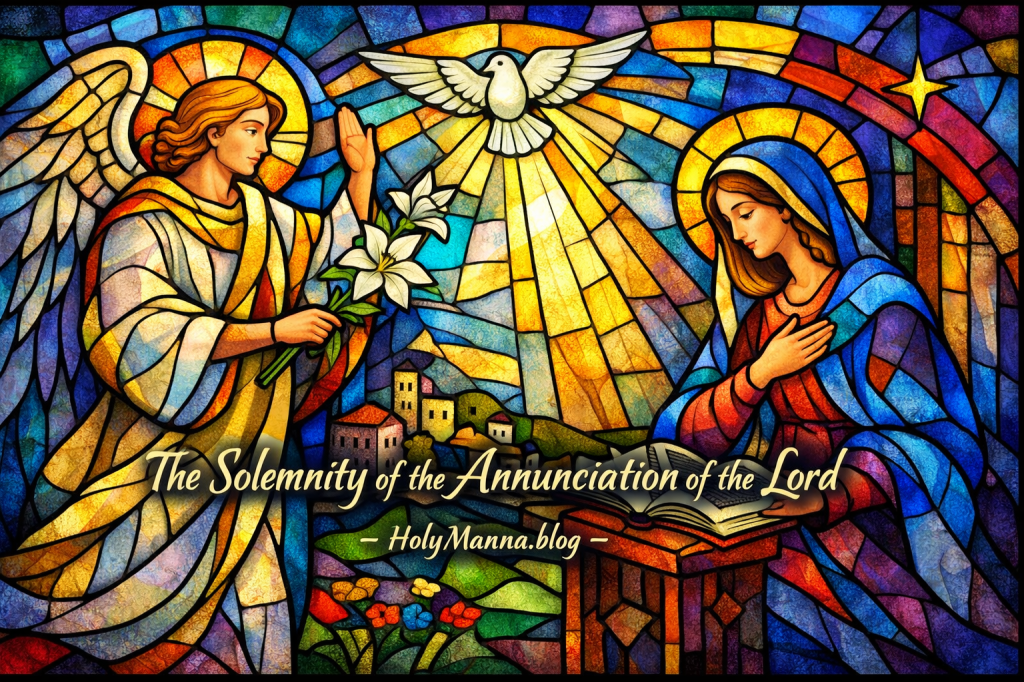
The Solemnity of the Annunciation of the Lord is one of the most beautiful and astonishing feasts in the whole Catholic year. It celebrates the moment when the angel Gabriel was sent to the Virgin Mary in Nazareth, and the eternal Son of God took flesh in her womb by the power of the Holy Spirit. This is not simply the story of an angel appearing to a holy young woman. This is the mystery of the Incarnation, the moment when God stepped into human history in a new and definitive way.
That is why this solemnity holds such an important place in Catholic tradition. The Church does not remember the Annunciation as a sweet scene meant only to inspire admiration for Mary. The Church celebrates it as the beginning of salvation unfolding in the flesh. The Catechism teaches, “The Annunciation to Mary inaugurates ‘the fullness of time’” (CCC 484). On this day, the promises of the Old Testament begin to blossom into fulfillment. On this day, the Word becomes flesh. On this day, heaven touches earth in the quiet of a poor home in Nazareth.
The feast is celebrated on March 25, exactly nine months before Christmas. That date matters because it reminds the faithful that Christ did not merely appear among men. He was conceived in the womb of the Blessed Virgin Mary. From the very first moment of his human life, Jesus was fully present, fully alive, and fully the Son of God made man. That truth alone gives this feast a deep and lasting importance for every Catholic heart.
The Quiet Room in Nazareth
The story behind this feast comes straight from The Gospel of Luke 1:26-38. Saint Luke tells how the angel Gabriel was sent by God to a virgin betrothed to a man named Joseph, of the house of David, and the virgin’s name was Mary. Gabriel greeted her with words that Catholics have repeated for centuries in the Hail Mary: “Hail, full of grace! The Lord is with you.”
Mary was troubled at the greeting, yet she listened. Gabriel told her not to be afraid and announced that she would conceive and bear a son, and that his name would be Jesus. He would be great. He would be called Son of the Most High. He would inherit the throne of David. His kingdom would have no end.
Mary then asked how this could be, since she had no relations with man. Gabriel answered that the Holy Spirit would come upon her, and the power of the Most High would overshadow her. He also pointed to Elizabeth’s miraculous pregnancy as a sign that nothing is impossible for God. Then came Mary’s answer, one of the most powerful lines in all of Scripture: “Behold, I am the handmaid of the Lord. May it be done to me according to your word.”
That brief exchange changed the world.
The broader historical setting matters too. Israel had long been waiting for the Messiah. The people knew the promises made through the prophets. They knew the longing for deliverance, the ache of exile, the burden of foreign rule, and the deep hope that God would remember his covenant. Into that long expectation, God sent not an army, not a king in worldly splendor, and not a public spectacle. He sent an angel to a virgin in a hidden village. Catholic tradition never gets tired of that contrast. God loves humility. God loves hiddenness. God loves to begin the greatest works in ways the world would easily overlook.
This is why Nazareth matters so much. It is not merely the backdrop of the story. It is the place where the eternal plan of God entered time in silence. Saint John Paul II called Nazareth a kind of school, a place where the Church learns again how God works, how grace comes quietly, and how the faithful are called to answer.
The Mystery at the Heart of the Feast
The theological significance of the Annunciation is immense. This feast is Marian, yes, but it is first and foremost Christological. It is about Jesus Christ, true God and true man. At the Annunciation, the Second Person of the Blessed Trinity assumed a human nature in the womb of Mary. This is the mystery of the Incarnation.
The Catechism teaches that the Son whom Mary conceived as man by the Holy Spirit is the Father’s eternal Son in a human nature, “one person of the divine Trinity” (CCC 495). That means the child in Mary’s womb is not a human person later joined to divinity. He is the divine Person of the Son from the very first moment of conception. This truth is at the center of Catholic faith.
The Annunciation also reveals the mystery of Mary herself. Because the one she conceived is truly God the Son, the Church rightly calls her Mother of God. This teaching was solemnly defended at the Council of Ephesus in 431, when the Church upheld the title Theotokos. That title protects the truth about Jesus as much as it honors Mary. If Mary is Mother of God, it is because the one born of her is truly God in the flesh.
The feast also shows the beauty of grace and freedom working together. God took the initiative. Mary did not invent the plan. She received it. Yet God did not force her. He invited her. The Fathers of the Church and great theologians like Saint Thomas Aquinas saw Mary’s fiat as a moment of real human cooperation with divine grace. Her yes was not reluctant. It was not half-hearted. It was not careless. It was the obedience of faith.
That is why Catholic tradition often speaks of Mary as the New Eve. Where Eve listened to the fallen angel and disobeyed, Mary listened to the holy angel and obeyed. Where Eve’s yes to temptation helped deepen the wound of sin, Mary’s yes to God opened the way for the Savior to come and heal it. The Catechism beautifully echoes this by teaching that what Eve bound through disbelief, Mary loosened by faith (CCC 494).
This solemnity also sheds light on the dignity of human life. Christ began his earthly life not at birth in Bethlehem, but at conception in Nazareth. The Church therefore sees in this feast a powerful witness to the sanctity of every human life in the womb. This is one reason the Annunciation has become deeply associated in Catholic life with prayer for the unborn and with renewed gratitude for the gift of life itself.
Where the Church Keeps This Mystery Alive
The Annunciation is not only remembered in the liturgy. It lives in Catholic devotion.
The most familiar devotion connected to this feast is the Angelus. Morning, noon, and evening, Catholics pause to remember the Incarnation with those words that echo Gabriel, Mary, and Saint John’s Gospel. In this simple prayer, daily life is interrupted by wonder. The faithful stop and remember that God became man. Work, noise, errands, and fatigue are all pierced by the truth that the Word was made flesh and dwelt among us.
The first Joyful Mystery of the Rosary is also the Annunciation. Every time the Rosary is prayed, the Church returns spiritually to Nazareth. The faithful are invited to contemplate Mary’s humility, her trust, and her total surrender to God’s will. In that sense, the feast never really ends. It is woven into the Church’s regular prayer.
Pilgrimage has also grown around this mystery in powerful ways. The Basilica of the Annunciation in Nazareth stands as the most important holy site connected with the feast. Pilgrims travel there to pray where Catholic tradition holds that Gabriel came to Mary and where the Word became flesh. It is one thing to read the Gospel. It is another thing to stand in the place where the mystery unfolded and let the silence of Nazareth preach.
Loreto also holds a special place in Catholic devotion. The Holy House of Loreto has long been venerated in the Roman Catholic tradition as the house associated with Mary and the Annunciation. Whether one reflects on the ancient devotional traditions surrounding it or simply on the centuries of prayer offered there, Loreto has become a privileged place for contemplating the humility and hiddenness of the Incarnation.
Lourdes, too, has a meaningful connection to March 25. On that date in 1858, the Blessed Virgin revealed to Saint Bernadette the words “I am the Immaculate Conception.” That apparition does not found the solemnity, but it gives the feast an added Marian resonance in Catholic memory. It reminds the faithful that Mary’s sinlessness was not for herself alone, but for her unique mission in bearing the Son of God.
In parish life, this solemnity is often marked by special Masses, Eucharistic adoration, the praying of the Rosary, and blessings for expectant mothers and children in the womb. These devotions help the faithful enter the mystery not as spectators, but as grateful participants in the life of the Church.
How the World Has Learned to Celebrate It
The cultural impact of the Annunciation has been broad and lasting. In older Christian societies, March 25 was sometimes treated as the beginning of the new year, especially in England, where it was known as Lady Day. That custom says something beautiful about the Christian imagination. Time itself was once measured not only by political events or harvest cycles, but by the mysteries of salvation.
Across the Catholic world, the feast has inspired art, music, poetry, architecture, and local traditions. Some of the most beloved paintings in Christian history depict Gabriel and Mary in that sacred moment of announcement and surrender. Hymns on this feast often dwell on Mary’s humility, Christ’s coming in the flesh, and the joy of redemption dawning in silence.
In some places, the feast is marked with processions or special Marian prayers. In others, it is celebrated more quietly with reverent liturgy and reflection. Wherever it is kept well, the central note is the same: awe before the mystery of the Incarnation.
The liturgy itself highlights the feast in a special way. During the Creed at Mass, Catholics ordinarily make a bow at the words that recall the Incarnation. But on the Annunciation and on Christmas, the faithful genuflect. The body itself is drawn into worship. The Church bends the knee because this mystery is too great to treat casually. The eternal Son of God became flesh. That truth calls not only for thought, but for adoration.
In modern Catholic life, the Annunciation has also taken on renewed importance in pro-life witness. Saint John Paul II dated Evangelium Vitae to March 25, linking the Gospel of Life to the mystery of the Word made flesh in the womb of Mary. In a world confused about the value of life, this feast quietly but clearly proclaims that human life is sacred from its very beginning.
Learning to Say Yes with Mary
The Annunciation is not only something to admire. It is something to imitate.
Mary teaches what it means to trust God when his plan is larger than human understanding. She did not receive every detail. She did not see every future sorrow. She did not ask for guarantees of comfort. She listened, asked a sincere question, and then surrendered herself completely to the will of God.
That is why this feast speaks so directly to ordinary Christian life. Most people will never stand in a moment that looks dramatic to the world. Most vocations unfold in hidden places, through quiet fidelity, ordinary duties, and difficult acts of trust. That is exactly why Nazareth matters. God still comes into hidden places. He still asks for faith. He still works through humble yeses that may never make headlines.
This feast also teaches the dignity of the body and the sacredness of life. The Son of God did not despise human flesh. He took it. He did not skip the womb. He sanctified it. He did not redeem humanity from a distance. He entered into human life fully. That truth should deepen reverence for every person, especially the weak, the poor, the elderly, the forgotten, and the unborn.
There is also a lesson here about silence. The Annunciation happened away from crowds, applause, and public recognition. The modern world often teaches that only loud things matter. The Gospel says otherwise. Some of God’s greatest works begin in silence, prayer, and hidden obedience.
How often does the heart resist God simply because his plan does not arrive in a dramatic or comfortable way?
How often does fear keep a soul from saying yes to the good that God is offering?
How often does the noise of life drown out the quiet invitation of grace?
The Solemnity of the Annunciation invites the faithful to slow down and to listen again. It invites homes to become little Nazareths, places where prayer is real, obedience is sincere, and Christ is welcomed. It invites Christians to receive the will of God not as a burden, but as the place where true life begins.
Engage with Us!
Share your thoughts and reflections in the comments below. This feast carries so much beauty, and it is always a gift to hear how the Lord is speaking through it in the lives of others.
- What stands out most in Mary’s response to the angel Gabriel, and why does that matter personally?
- How does the mystery of the Incarnation change the way daily life, suffering, and the human body are understood?
- What can be learned from the hiddenness of Nazareth in a world that constantly chases noise and attention?
- How can Mary’s fiat become a model for responding to uncertainty, fear, or a difficult vocation?
- What practical step can be taken this week to live with greater trust in God’s will and greater reverence for human life?
May this feast stir the heart to love Christ more deeply, honor his Blessed Mother more tenderly, and embrace God’s will more generously. May every yes to grace become a small echo of Mary’s yes in Nazareth. May every home grow in faith, peace, and obedience. And may every soul learn to live with the love and mercy Jesus taught, carrying that love into every duty, every trial, and every ordinary day.
Lord Jesus Christ, we trust in You!
Blessed Virgin Mary, pray for us!
Saint Gabriel the Archangel, pray for us!
Follow us on YouTube, Instagram and Facebook for more insights and reflections on living a faith-filled life.

 Holy Manna!
Leave a comment