The Woman Who Taught a Generation to Love God
Saint Lucy Filippini stands in Catholic memory as a woman who helped change the lives of countless souls by doing something that can sound almost ordinary at first: she taught. But in her hands, teaching was never ordinary. It was an act of mercy, a form of evangelization, and a way of rebuilding Christian family life from the inside out.
She is revered as the foundress of the Religious Teachers Filippini, also known as the Maestre Pie Filippini, and she is remembered especially for the Christian education of girls and women, particularly the poor. In a time when many girls had little access to education, Lucy helped open doors that society had left shut. She taught Christian doctrine, encouraged moral formation, strengthened mothers, served the sick, and helped shape souls for heaven. That is why the Church honors her not only as an educator, but as a true apostle.
Her feast is celebrated on March 25, a fitting date for a saint whose life was marked by love for the mystery of the Incarnation and deep devotion to Our Lady. She remains a powerful model for catechists, teachers, women in apostolic life, and anyone who wants to serve Christ by forming others in truth and love.
An Orphaned Child Who Learned to Lean on Heaven
Lucy Filippini was born on January 13, 1672, in Corneto, now Tarquinia, in Italy. She came into the world in a Catholic family, but sorrow arrived early. Her mother died when Lucy was still an infant, and her father died when she was only seven years old. She was the youngest of five children, and from a young age she knew the kind of grief that can either harden a soul or deepen it.
In Lucy, suffering became fertile ground for grace. Catholic tradition remembers her as a child of unusual piety, already drawn to prayer, recollection, and love for the Blessed Virgin Mary. She would make little altars and show signs of an interior life that ran deeper than her years. Some accounts say that even as a girl she was already helping teach younger children the things of God.
Her life took a decisive turn when, as a teenager, she met Cardinal Marcantonio Barbarigo, the bishop of Montefiascone and Corneto. She expressed to him her desire to belong wholly to God. Recognizing both her character and her gifts, he placed her for a time under the care of the Poor Clares in Montefiascone for formation. That season helped shape the soul that would later help shape thousands of others.
Lucy is most known for the work that sprang from this calling. She became one of the great Catholic pioneers of Christian education for girls. At a time when many families were poor, many women were overlooked, and moral formation was often weak, she helped build schools that formed the mind, the heart, and the soul.
A Schoolroom Turned Into a Mission Field
The story of Saint Lucy Filippini is closely tied to Cardinal Barbarigo and to Saint Rose Venerini. Rose had already begun schools for girls in the region, and when circumstances required her return to Viterbo, the work in Montefiascone was entrusted to Lucy. She was still very young, but God had already been preparing her.
This was no small assignment. Lucy did not simply step into a classroom. She stepped into a mission. She helped build and guide schools meant to restore Christian life in families and in society. These schools taught girls reading, religious instruction, prayer, and practical skills. They also formed mothers and future mothers, which meant they touched the home, and therefore the whole culture.
That was Lucy’s genius. She understood, along with her spiritual collaborators, that if girls were formed in truth, virtue, prayer, and dignity, then families would be strengthened and society would begin to heal. This vision harmonizes beautifully with the Church’s teaching that parents are the first educators of their children and that catechesis is meant to lead the faithful into the fullness of Christian life, not merely into the memorization of religious facts, as taught in CCC 2223 and CCC 5.
Lucy’s work spread widely. During her lifetime, she is traditionally credited with the founding of fifty-two schools. Pope Clement XI recognized the importance of her mission and called her to Rome in 1707, placing the schools there under papal protection. That moment says a great deal. The Church saw in Lucy’s work not just private generosity, but a genuine ecclesial charism.
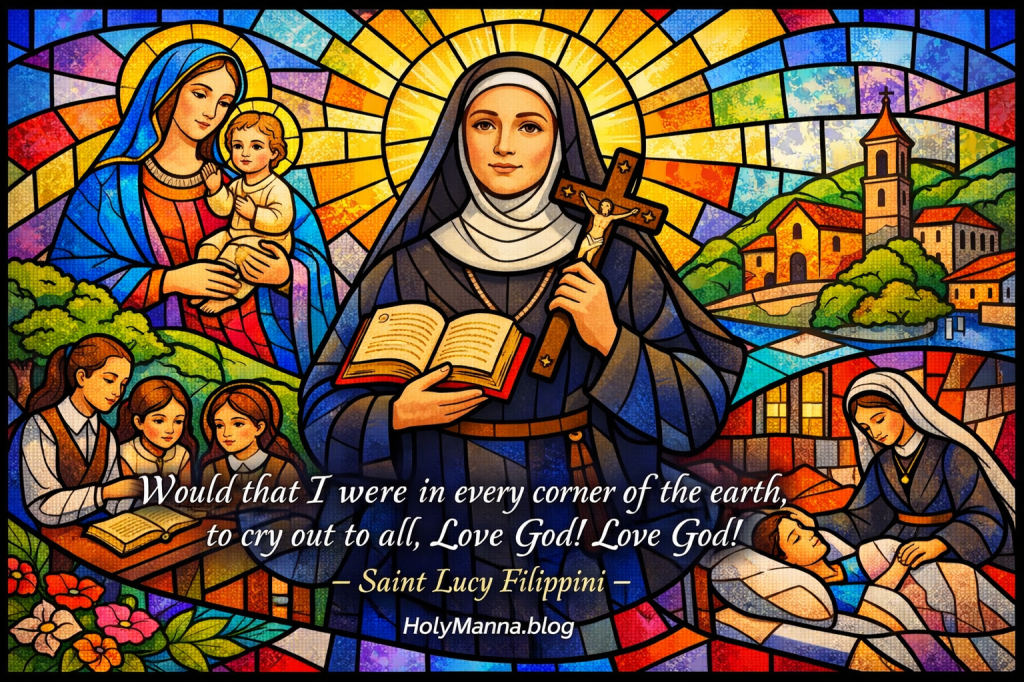
Her spirituality was intensely Christ-centered. She is often associated with the striking phrase “The Crucifix was her only book.” That line captures her whole interior life. She did not teach abstractions. She taught from prayer, from contemplation, and from love of the Crucified Lord. A saying attributed to her and preserved in Filippini tradition reveals the burning simplicity of her heart: “Would that I were in every corner of the earth… to cry out to all… Love God! Love God!” That was the center of everything.
Wonders Along the Way and the Quiet Power of Grace
Saint Lucy Filippini is remembered first for the miracle of transformed lives. Girls who might have remained neglected were taught. Souls were instructed. Women were strengthened. Homes were touched by the Gospel. In many ways, her greatest miracles were the ordinary miracles of grace working through fidelity.
There is also a devotional story associated with her life that Catholic tradition has preserved. One account says that while Lucy was on her way to oversee one of her schools, a fragment of the Sacred Host flew from the priest’s hand and came to rest on her tongue. The story is cherished in devotional tradition as a sign of her deep Eucharistic intimacy. This story has been handed on in Catholic devotional sources, but it cannot be independently verified from the concise official summaries commonly available.
What can be said with confidence is that Lucy’s whole life bore the marks of Eucharistic devotion, Marian trust, and apostolic zeal. She gathered mothers for prayer and reflection. She led women in spiritual exercises. She cared for the sick and visited hospitals. She traveled with crucifix in hand, seeking the lost and trying to awaken souls to the love of God. She was not content with building institutions alone. She wanted hearts converted.
A beautiful prayer attributed to her reveals the tenderness of her spirituality. In addressing the Christ Child, she prayed with the kind of warmth that belongs to a soul deeply in love with the mystery of God made flesh. Even without repeating every word, the spirit of that prayer shows what animated her whole life: Christ was not an idea to be studied from afar. He was a Person to be adored, loved, served, and given to others.
Trials, Opposition, and the Cross She Refused to Drop
The life of Saint Lucy Filippini was not protected from sorrow simply because it was holy. Like many saints, she discovered that doing God’s work does not spare a person from misunderstanding, loneliness, or opposition. In fact, it often invites them.
After the death of Cardinal Barbarigo, Lucy faced serious hardships. Sources from within her institute describe a period marked by persecution, abandonment, and disloyalty from those who should have supported the mission. Administrative difficulties and human weakness threatened the schools she loved. The work could easily have collapsed.
But Lucy did not collapse with it. She remained steady, faithful, and surrendered. Another saying attributed to her captures this spirit beautifully: “If a work is of God that same God will maintain it.” That is not sentimental optimism. That is hard-won trust. It is the confidence of a soul that has passed through fire and learned that God remains Father even when earthly support gives way.
She also lived detachment in a radical way. A treasured line preserved in her tradition tells of her response after giving things away to those in need: “My good sister, I have sent all to Paradise.” That sentence says much about her heart. She did not cling. She gave. She saw earthly goods as tools for heavenly charity.
Saint Lucy Filippini was not a martyr in the strict sense. She did not die by execution for the faith. But she did live a kind of white martyrdom through suffering, perseverance, sacrifice, and fidelity. She bore hardship for Christ and for the souls entrusted to her. That kind of witness still matters. Many Catholics today are not asked to die in a coliseum or on a scaffold, but they are asked to endure misunderstanding, exhaustion, and discouragement without losing charity. Lucy shows how to do that.
She died on March 25, 1732, on the Feast of the Annunciation, after suffering from a malignant illness. Tradition holds that she died as the bells of Montefiascone Cathedral rang out the Ave Maris Stella. It is hard not to see providence in that ending. A daughter of Mary, a lover of the Incarnation, and a teacher of souls departed this life on one of the most Marian and Christ-centered feasts of the Church year.
The Saint Who Kept Teaching After Death
The impact of Saint Lucy Filippini did not end with her earthly life. Her institute continued and spread, carrying her educational and spiritual vision far beyond the towns where she first labored. The mission eventually reached other parts of Italy and then other nations, including the United States, where her spiritual daughters continued to educate, catechize, and serve.
Her cause for canonization advanced in the Church, and she was declared Venerable in the early twentieth century, beatified in 1926, and canonized in 1930 by Pope Pius XI. These milestones testify that the Church saw in her life heroic virtue worthy of imitation by the universal faithful.
As for miracles after her death, the accessible Catholic materials most readily available do not provide a detailed catalog of the officially approved miracles attached to her cause. What is clear is that her beatification and canonization took place within the Church’s traditional process, in which miracles held a significant role. The individual miracle stories connected to those stages are not clearly identified in the concise summaries reviewed for this profile.
There are, however, posthumous devotional traditions surrounding her relics and bodily remains. Her sacred body is associated with Montefiascone, where devotion to her continues. Some institute materials describe her body as remaining incorrupt, and her relics have been honored publicly with great devotion. This claim is preserved in Catholic institutional and devotional tradition, but it cannot be verified here as a separately defined miracle from the brief official summaries.
Her cultural impact is real and lasting. She is honored especially in Tarquinia and Montefiascone. Jubilee celebrations marking the 350th anniversary of her birth drew large Catholic participation, including public acts of veneration and papal recognition. Her memory lives on not only in shrines, relics, and feast days, but in schools, classrooms, catechetical work, and the lives of women religious who still carry her charism.
That may be one of the most beautiful things about her legacy. Saint Lucy Filippini did not leave behind a legend floating in the clouds. She left behind a living mission.
What Saint Lucy Teaches a Restless Age
Saint Lucy Filippini has a word for the modern Catholic soul, especially in an age of distraction, confusion, and shallow formation. She reminds the Church that education matters because souls matter. She reminds families that faith must be taught, practiced, and lived. She reminds teachers and catechists that truth without charity dries out, but charity without truth loses its way.
She also speaks powerfully to anyone who feels hidden. Her work was not flashy. She did not build her life around attention. She built it around fidelity. She loved Christ, loved souls, and kept going. That is deeply countercultural. The world says to chase visibility. Lucy says to chase holiness.
Her life echoes the works of mercy described in CCC 2447, especially instructing the ignorant, consoling the sorrowful, and caring for the poor and sick. She also reflects the Church’s teaching on the dignity of Christian education and formation in the home. Her mission was not a side project. It was part of the Church’s maternal work of forming souls for eternal life.
How seriously is the faith being taught and lived in daily life?
Is there patience enough to form others slowly, lovingly, and faithfully?
Is there trust that even hidden labor, offered to Christ, can bear fruit for generations?
For ordinary Catholics, her example can be lived in practical ways. Parents can teach the faith more intentionally at home. Teachers can see their work as a vocation, not just a job. Catechists can prepare more prayerfully. Young women can look to her as proof that strength and tenderness belong together in the life of grace. Anyone burdened by opposition can learn from her quiet perseverance.
Saint Lucy Filippini shows that holiness is not only found in dramatic martyrdom. It is also found in classrooms, sickrooms, chapels, and daily acts of patient love.
Engage With Us!
Share thoughts and reflections in the comments below. Saint Lucy Filippini’s life raises beautiful questions about faith, formation, sacrifice, and the quiet ways God changes the world through ordinary fidelity.
- What stands out most in Saint Lucy Filippini’s life: her trust in God, her love for education, or her perseverance through suffering?
- How can the faith be taught more intentionally and lovingly within the home?
- What is one practical way to help form the minds and hearts of children, teenagers, or other adults in the truth of Christ?
- When life becomes difficult, is there trust like Saint Lucy’s that if a work is truly of God, God Himself will sustain it?
- How can the example of Saint Lucy inspire greater love for the Crucifix, the Eucharist, and Our Lady in daily life?
May Saint Lucy Filippini inspire a deeper love for truth, a stronger commitment to forming souls, and a steadier trust in God’s providence. May her example help every Catholic live with courage, teach with charity, and do everything with the love and mercy Jesus taught us.
Saint Lucy Filippini, pray for us!
Follow us on YouTube, Instagram and Facebook for more insights and reflections on living a faith-filled life.

 Holy Manna!
Leave a comment