The Man Who Asked for Mercy and Found Paradise
Saint Dismas is one of the most moving saints in all of Christian tradition because his whole story seems to unfold in a single blazing moment of grace. He is traditionally known as the Good Thief, or the Penitent Thief, the criminal crucified beside Jesus who turned to Him in faith at the very end of his life. Unlike many saints, Dismas did not found a religious order, preach to crowds, or leave behind a long written legacy. His greatness came in something far more startling. He recognized the King hanging beside him when almost everyone else had turned away.
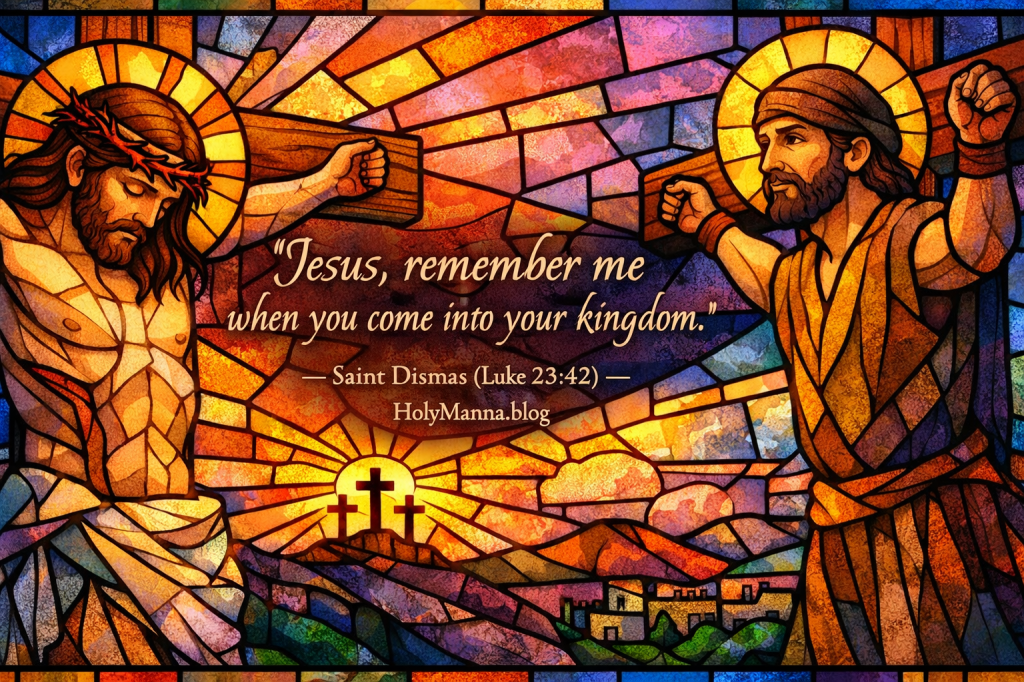
The Church reveres Saint Dismas because he stands as one of the clearest witnesses to the mercy of Christ. In him, Catholics see the truth that no sinner is beyond the reach of grace, no life is too broken for redemption, and no final hour is too late for a heart to turn back to God. His story is brief in The Gospel of Luke, but its meaning is immense. There on Calvary, while blood ran down the wood and the world mocked the Son of God, Dismas made one of the most beautiful prayers in all of Scripture: “Jesus, remember me when you come into your kingdom.” Then he received one of the most astonishing promises ever spoken to a human soul: “Amen, I say to you, today you will be with me in Paradise.” Lk 23:42-43
That is why Saint Dismas is remembered with such love. He is the saint of repentant sinners, the patron for those in prison, the comfort of the dying, and a living reminder that Christ’s mercy is stronger than the wreckage of a wasted life.
A Life Hidden Until the Final Hour
The honest truth is that very little can be said with certainty about Saint Dismas’s early life. Scripture does not tell his birthplace, his family background, his age, or the events that led him into crime. In the inspired Gospel account, he appears only at the Cross. That silence matters. It means the Church does not build his story on fantasy. The certain history begins with the man hanging beside Jesus.
Later Christian tradition gave him the name Dismas. That name does not come from the canonical Gospels but from ancient Christian writings outside Scripture. Because of that, it should be treated as tradition rather than historical certainty in the same way as The Gospel of Luke. Still, the name Dismas has been received for centuries in Christian devotion, and it has become the name by which the Church commonly remembers him.
Some later traditions tried to fill in the hidden years of his life. One old legend says that he encountered the Holy Family during the flight into Egypt and showed them mercy. Another tradition gives details about his identity as a robber. These stories have circulated in Christian memory for a long time, and they can be mentioned as pious tradition, but they cannot be verified. The most important thing is not the hidden road that led him to Calvary, but the grace that met him there.
What can be said with confidence is that Dismas had lived a gravely disordered life. He himself admits that he is suffering justly. He does not excuse himself. He does not blame society, fate, or other people. In that one humble confession, he becomes a model of true repentance. The beginning of his holiness is not self-justification. It is honesty.
The Thief Who Saw a King
Saint Dismas is most known for what happened in the last hours of his life. As Jesus hung on the Cross, one criminal joined the mockery around him. Saint Luke records that the other rebuked him, saying in effect that both of them deserved punishment, but Jesus did not. In a place filled with cruelty, Dismas suddenly became the voice of truth.
This is part of what makes his story so powerful. He saw what others did not see. The religious authorities saw a blasphemer. The soldiers saw a condemned man. The crowd saw a spectacle. Even many disciples had scattered in fear. But Dismas, a dying criminal, saw innocence in Jesus. More than that, he saw kingship. He did not say, if you come into your kingdom. He said, “when you come into your kingdom.” Lk 23:42 That is astonishing faith.
In that moment, Dismas showed the shape of a true conversion. He feared God. He admitted his guilt. He defended Christ’s innocence. He entrusted himself to Jesus. Catholic tradition has long seen in him a profound image of contrition. His prayer is simple, but it contains the whole heart of repentance. It is not polished. It is not complicated. It is not a speech meant to impress. It is the cry of a sinner who knows he deserves judgment and yet dares to hope in mercy.
There are no verified quotations from Saint Dismas outside the words preserved in Luke 23:39-43. Those words are enough. In fact, they are more than enough. They have echoed through centuries of Catholic preaching because they show what faith looks like when a soul has nothing left to hide behind.
The Miracle That Happened Before Death
When people think of saints and miracles, they often think of healings, wonders, visions, or dramatic signs. With Saint Dismas, the greatest miracle during his life was his conversion. That may sound simple at first, but it is not simple at all. A hardened criminal, nailed to a cross, in agony, at the edge of death, turned to the crucified Christ and received the promise of heaven. That is not ordinary. That is grace breaking into a ruined life with divine power.
No verified Catholic source attributes public miracle stories to Dismas before his death in the way that later saints often have miracles attached to their earthly ministry. He was not known for miracle-working during a long apostolic life. His whole witness is centered on one great miracle of the soul. He became, in his final hours, a living sign that God’s mercy can triumph even at the end.
This is one reason the Church never treats him lightly. Saint Dismas is not an excuse for delaying conversion. He is not a permission slip for a reckless life. He is a warning against presumption and a promise against despair. The lesson is not that a person should wait until death to repent. The lesson is that no one should ever believe repentance is impossible.
The beauty of Dismas is that he had no time left to repair his life outwardly. He could not return stolen goods. He could not rebuild his reputation. He could not live for decades in public holiness. All he could do was surrender himself to Christ. And that surrender was enough because the mercy of Jesus is not small, weak, or reluctant. It is sovereign.
From Criminal Shame to Holy Death
The hardships of Saint Dismas’s life cannot be told in detail, because the earlier parts of his story remain hidden. Yet the last hardship is fully visible. He suffered execution by crucifixion, one of the most brutal deaths in the ancient world. He died in public shame, nailed to wood, exposed before the crowd, and counted among criminals.
Strictly speaking, Saint Dismas is not usually presented in Catholic tradition as a martyr in the same way as those who were killed directly for confessing the Christian faith. He was executed for crimes, by his own admission. Still, his death became something holy because it was united to Christ through repentance and faith. He died not as a defiant sinner cursing God, but as a penitent soul clinging to the Savior.
That distinction matters. Dismas shows that holiness can begin even in disgrace. He was not made a saint by having a spotless biography. He was made holy by grace, humility, and trust in Jesus. That is deeply Catholic. Sanctity is not built on image management. It is built on conversion.
There is also something deeply consoling in the way his death unfolded. Dismas did not die alone. He died beside Jesus. He died hearing the voice of the Lord. He died with a promise in his ears. There are saints whose deaths are surrounded by visions, candles, and miracles. Dismas died in torture, yet his death was more blessed than the deathbeds of kings because Paradise had already been opened to him.
The Saint Whose Legacy Grew After the Cross
After his death, Saint Dismas entered Christian memory as one of the clearest signs of divine mercy. His legacy after death is not built mainly on a large collection of verified miracle stories, but on something even more fundamental. He became a permanent witness in the Church’s preaching, prayer, and theology.
Catholic teaching often turns to Dismas when speaking about judgment, repentance, and hope at the hour of death. The Catechism points to Christ’s word to the good thief when teaching about the soul’s immediate encounter with God after death. CCC 1022 uses that scene to show that each person receives particular judgment and that Christ has authority to open Paradise. In this way, Dismas has influenced Catholic understanding far beyond his few lines in Scripture.
His feast is traditionally commemorated on March 25 in the Roman Martyrology. That is a striking date, because it is also the day of the Annunciation. There is something beautiful about that connection. On the day the Church remembers the Word made flesh entering the world, she also remembers the sinner who heard from that same Incarnate Lord the promise of heaven.
Saint Dismas also left a cultural mark through Catholic prison ministry. Ministries dedicated to prisoners, former inmates, and those on death row have often taken his name. That is fitting. He is the saint who speaks most directly to the person who believes his past has disqualified him from grace. He reminds the imprisoned that their dignity has not been erased. He reminds the Church that Christ did not despise the condemned man who asked for mercy.
There is also a long devotional tradition surrounding Saint Dismas in Christian art. He is often shown on the right side of Christ, sometimes with a repentant expression, sometimes with a cross, and sometimes with a gesture of humility. His place at Christ’s right hand is not accidental in the imagination of the faithful. It reflects the ancient tradition that he was the thief to whom Jesus promised the kingdom.
A relic tradition in Rome also associates a portion of the good thief’s cross with the basilica of Santa Croce in Gerusalemme. This relic tradition has been part of Catholic devotional memory, though the full historical verification cannot be established with certainty in the modern sense. It remains part of the saint’s venerated legacy.
As for miracle stories after death, Catholic sources do not preserve a large universally accepted catalog of posthumous miracles tied to Saint Dismas the way one finds with many later canonized saints. The most important miracle associated with him remains the miracle of his salvation. Some devotional traditions and later retellings have expanded his legacy with pious details, but these cannot be verified. That should not disappoint anyone. In a way, it fits him perfectly. Saint Dismas does not need a mountain of legends to shine. His one encounter with Christ has carried his memory through the ages.
Why the Church Still Needs Saint Dismas
There is something about Saint Dismas that cuts straight through modern confusion. The world often swings between two false ideas. One says sin is not serious. The other says sinners are beyond hope. Dismas destroys both lies at once. He admits that sin is real and deserves judgment. Then he throws himself upon the mercy of Jesus and is saved.
That is why his story still matters so much. He teaches that repentance is not vague regret. It is truthful sorrow joined to hope. He teaches that faith is not sentimental optimism. It is confidence that Jesus really is King, even when all visible signs seem to deny it. He teaches that holiness begins when a person stops defending sin and starts begging for mercy.
For Catholics trying to live faithfully in an age of confusion, Saint Dismas is a needed friend. He reminds parents to pray for wandering children. He reminds those trapped in addiction that grace is stronger than habit. He reminds those ashamed of past sins that Jesus is not frightened by wreckage. He reminds the dying that the final word belongs to Christ, not to fear.
He also teaches something important about how to look at other people. The crowd saw a criminal. Jesus saw a soul. That should shake the heart a little. It is easy to label people by their worst action, their prison record, their scandal, or their public disgrace. Dismas stands in the Gospel forever as proof that a man may be a wreck in the eyes of the world and still be one honest prayer away from mercy.
Learning to Pray Like the Good Thief
The lesson of Saint Dismas is not complicated, but it is demanding. His life invites readers to stop hiding from God. It invites a serious examination of conscience. It calls for the humility to say, without excuses, that sin has done real damage. Then it points straight toward Jesus.
A practical way to live his example is to make his prayer part of daily life. “Jesus, remember me when you come into your kingdom.” That prayer belongs in times of temptation, discouragement, suffering, and shame. It belongs in the confessional line. It belongs in hospital rooms. It belongs in quiet moments before bed, when the heart finally becomes honest.
His example also encourages Catholics to practice mercy toward those society forgets. Prison ministry, outreach to the dying, patience with those trapped in cycles of sin, and serious prayer for conversions all fit naturally under his patronage. Saint Dismas reminds the faithful that no one should be treated as spiritually disposable.
It is also worth asking some hard and holy questions. Is there any sin still being defended instead of confessed? Is there any person being judged as if grace cannot reach them? Is there trust in Christ’s mercy, or only fear of His justice? Saint Dismas teaches that the right response is neither denial nor despair. It is repentance filled with hope.
In daily life, that may look like making a good confession after a long time away, refusing the temptation to label a sinner as hopeless, praying for prisoners and the dying, or simply learning to speak to Jesus with the plain honesty of a man who knows he needs saving. Dismas had no polished spiritual résumé. He had a broken life and a truthful prayer. That is why his story still pierces the heart.
Engage With Us!
Share your thoughts and reflections in the comments below. Saint Dismas speaks to anyone who has ever felt ashamed, afraid, or painfully aware of personal sin. His story is short, but it reaches deep into the heart.
- What stands out most in Saint Dismas’s prayer to Jesus from the Cross?
- How does his repentance challenge the way sin and mercy are usually viewed today?
- Is there an area of life where the heart needs to stop making excuses and start asking Christ for mercy?
- How can Saint Dismas inspire a more compassionate attitude toward prisoners, the dying, and those with painful pasts?
- What would change if Christ’s mercy were trusted as deeply as Saint Dismas trusted it in his final hour?
Saint Dismas proves that it is never too late to turn toward Jesus with sincerity. His story is not only about a dying thief. It is about the heart of the Gospel itself. Christ still listens to the repentant sinner. Christ still opens Paradise. Christ still answers the soul that calls on Him with humility and faith. Live with that hope, walk in that mercy, and do everything with the love and compassion Jesus taught us.
Saint Dismas, pray for us!
Follow us on YouTube, Instagram and Facebook for more insights and reflections on living a faith-filled life.

 Holy Manna!
Leave a comment