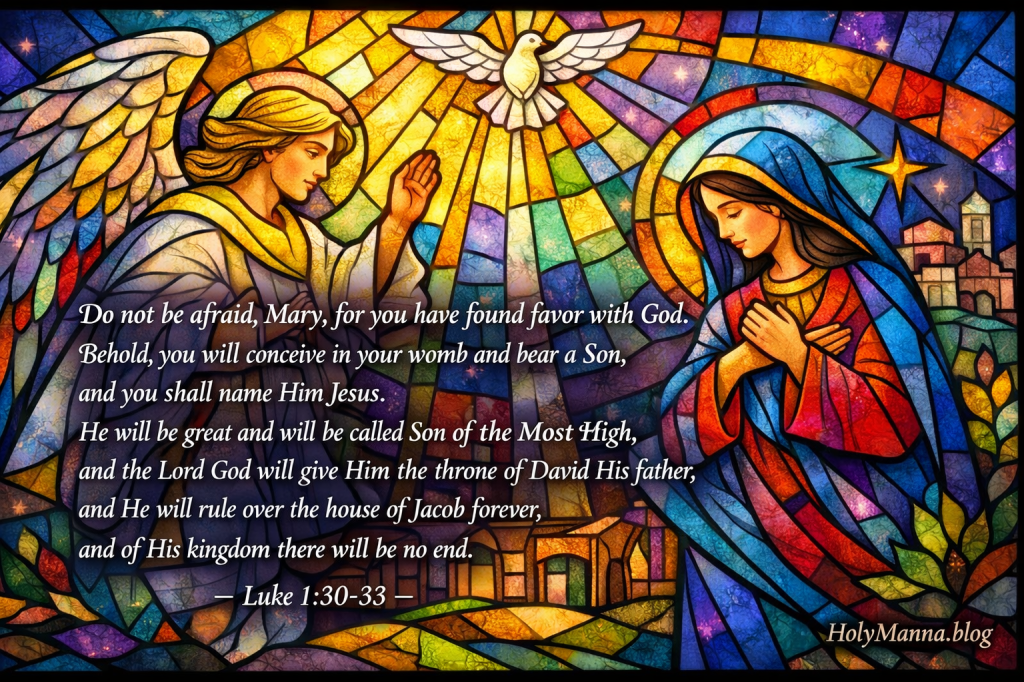
Solemnity of the Annunciation of the Lord – Lectionary: 545
When Heaven Waited for a Human Yes
Some days in the Church’s calendar feel like standing on holy ground, and the Solemnity of the Annunciation of the Lord is one of them. Today’s readings draw the heart into the very moment when God’s promise moved from prophecy into flesh, when centuries of longing met a young virgin in Nazareth, and when salvation history turned on a humble, fearless yes.
The central theme tying these readings together is obedient faith in the face of God’s saving plan. In Isaiah, King Ahaz is offered a sign from the Lord but refuses to trust. Even so, God remains faithful and promises Emmanuel, “God with us.” In Psalm 40, the soul of the faithful servant speaks with ready surrender: “Here I am, Lord; I come to do your will.” In Hebrews, that obedience is revealed in its fullest meaning, as the eternal Son enters the world saying, “Behold, I come to do your will, O God.” Then in The Gospel of Luke, that divine will reaches its hidden and glorious beginning in the womb of the Blessed Virgin Mary, who answers with the words that changed the world: “May it be done to me according to your word.”
This feast is not only about Mary, though her fiat stands at its center in a unique and beautiful way. It is also about the Incarnation itself, the mystery of the Son of God taking on a human body for the salvation of the world. The Church places this solemnity nine months before Christmas because this is the beginning of Christ’s earthly life. The Child announced by Gabriel is already the promised Son of David, already the fulfillment of the covenant, already the one whose body has been prepared for sacrifice and redemption. The cradle and the Cross are already bound together in seed form.
There is also a deep contrast running through the readings. Ahaz shrinks back. Mary leans in with faith. One refuses the sign. The other receives the impossible promise with trust. That contrast gives today’s liturgy its piercing relevance. God still speaks. God still invites. God still asks for trust before all the answers are visible. What happens when the Lord places His will before a soul and waits for an answer?
Today’s readings invite readers to step into that silence, that promise, and that surrender. They reveal a God who does not abandon His people, a Son who comes to do the Father’s will, and a Mother whose obedience opens the door for Emmanuel to dwell among us.
First Reading – Isaiah 7:10-14; 8:10
When a Refused Sign Became the World’s Hope
This reading comes from a tense and trembling moment in the history of Judah. King Ahaz sat on David’s throne, but his heart was not resting in David’s God. Jerusalem was under threat during the Syro-Ephraimite crisis, when neighboring kingdoms pressed in and fear spread through the royal house. Into that political panic, the Lord sent the prophet Isaiah with an offer that should have shattered every excuse for unbelief. God invited Ahaz to ask for a sign, not because the king deserved one, but because the Lord was determined to remain faithful to His covenant with the house of David.
That is what makes this reading so fitting for the Solemnity of the Annunciation. Today’s theme is the obedience of faith. Ahaz stands in the line of David and refuses to trust. Mary, also within the story of David’s promised kingdom through Joseph, receives God’s word in faith. Isaiah’s prophecy first speaks into a crisis in Judah, but the Church hears in it the deeper promise that reaches its fullness in Christ. The child called Emmanuel is the great sign that God does not abandon His people. On this feast, the Church sees that promise come alive in the womb of the Blessed Virgin Mary, where God truly becomes “with us.”
Isaiah 7:10-14; 8:10 – New American Bible (Revised Edition)
Emmanuel. 7:10 Again the Lord spoke to Ahaz: 11 Ask for a sign from the Lord, your God; let it be deep as Sheol, or high as the sky! 12 But Ahaz answered, “I will not ask! I will not tempt the Lord!” 13 Then he said: Listen, house of David! Is it not enough that you weary human beings? Must you also weary my God? 14 Therefore the Lord himself will give you a sign; the young woman, pregnant and about to bear a son, shall name him Emmanuel.
8:10 Form a plan, it shall be thwarted;
make a resolve, it shall not be carried out,
for “With us is God!”
Detailed Exegesis
Verse 10 “Again the Lord spoke to Ahaz:”
The reading begins with divine initiative. Ahaz is not searching for God. God is searching for Ahaz. That alone reveals the mercy of the Lord. Even when the king is wavering, even when fear has already begun to cloud judgment, the Lord still speaks. Grace comes first. In salvation history, God does not wait for man to climb up to Him. He comes down, He speaks, and He offers help.
This verse also reminds readers that revelation is not impersonal. The Lord addresses a real king in a real political crisis. Catholic faith is never detached from history. God acts within time, within dynasties, within family lines, and within the messiness of public life.
Verse 11 “Ask for a sign from the Lord, your God; let it be deep as Sheol, or high as the sky!”
This is an astonishing invitation. God places no small limit on the sign. Ahaz may ask for something from the depths or from the heavens. The point is clear. The Lord is fully able to confirm His word. Faith is not irrational guessing. It rests on the God who can act beyond every human boundary.
There is also a quiet tenderness here. The Lord says, “the Lord, your God.” Even in Ahaz’s weakness, God still speaks in covenant language. He has not yet abandoned the king, though the king is already drifting toward worldly alliances. The offered sign is an invitation back into trust.
Verse 12 “But Ahaz answered, ‘I will not ask! I will not tempt the Lord!’”
At first glance, Ahaz sounds devout. His words appear reverent, even biblical. But this is false piety. He is not refusing because he trusts God too much. He is refusing because he trusts God too little. Ahaz has already set his heart on political maneuvering and foreign power. He hides unbelief behind religious language.
That pattern has not disappeared. Souls still do this. Fear dresses itself in respectable words. Control pretends to be prudence. Resistance to grace often sounds polished before it sounds honest. Ahaz becomes a warning for every age. It is possible to use holy language while keeping the heart closed.
Verse 13 “Then he said: Listen, house of David! Is it not enough that you weary human beings? Must you also weary my God?”
Isaiah’s rebuke widens from Ahaz alone to the whole house of David. This matters because the promise at stake is larger than one king. God made a covenant with David, and the destiny of that royal line touches the future of Israel itself. The prophet exposes the deeper wound. The problem is not simply bad policy. It is covenant fatigue, a house grown dull toward the God who established it.
The phrase “my God” is striking. It suggests a painful distance between Isaiah’s fidelity and Ahaz’s wavering. The king who should have been leading the people in trust has become a source of weariness. Yet even here, judgment is not the last word. God is about to speak a promise greater than the king’s failure.
Verse 14 “Therefore the Lord himself will give you a sign; the young woman, pregnant and about to bear a son, shall name him Emmanuel.”
Since Ahaz will not ask for a sign, the Lord gives one anyway. That is pure grace. The sign is not wrung out of human faithfulness. It is born from divine fidelity. In the immediate historical setting, this prophecy assures Judah that God has not abandoned the Davidic line. But the Church, reading this text in the light of Christ, sees its fullest meaning in the virginal conception of Jesus.
The name Emmanuel means “God with us.” That is the heart of the verse. God does not save from a distance. He comes near. He enters history. He binds Himself to His people. On the Annunciation, the Church hears this prophecy not as a distant echo, but as a living promise fulfilled in Mary. The one conceived in her womb is not merely a symbol of God’s favor. He is God the Son in the flesh.
The wording about the mother has long mattered in Christian tradition. In its original setting, the text points to a young woman bearing a child. In the fuller light of the Gospel, and especially through the Greek translation received by the early Church, this prophecy is recognized in its deepest fulfillment in the Virgin Mary. The Church does not force Christ into Isaiah. The Church sees Christ as the fullness of what Isaiah, under the Holy Spirit, was already preparing.
Verse 10 of chapter 8 “Form a plan, it shall be thwarted; make a resolve, it shall not be carried out, for ‘With us is God!’”
This final line sounds like a trumpet blast over all human pride. Nations can scheme. Kings can calculate. Enemies can threaten. But no plan can overthrow the purpose of God. The reason is simple and overwhelming: “With us is God!” What was first promised as a name becomes the logic of salvation history itself.
On this solemnity, the line lands with even greater force. The world’s salvation does not begin in a war room or a palace. It begins in Nazareth, in hiddenness, in surrender, in a virgin’s yes. The plans of men fail. The Word of God stands. Emmanuel is not an idea. Emmanuel is a Person.
Teachings
This reading opens one of the great roads that leads to the mystery of the Incarnation. The Church reads Isaiah 7:14 not only in its historical setting, but also in its fullness in Christ. The Catechism of the Catholic Church teaches: “The Gospel accounts understand the virginal conception of Jesus as a divine work that surpasses all human understanding and possibility: ‘That which is conceived in her is of the Holy Spirit’, said the angel to Joseph about Mary his fiancée. The Church sees here the fulfillment of the divine promise given through the prophet Isaiah: ‘Behold, a virgin shall conceive and bear a son.’” CCC 497
That teaching matters because it protects both the realism and the wonder of the faith. God’s promise to David was not poetic decoration. It moved through history toward fulfillment. The child promised in Isaiah is brought to fullness in Jesus Christ, true God and true man. The sign becomes greater than Ahaz could have imagined. The king was offered reassurance for a political crisis. The world received a Savior for the crisis of sin and death.
This reading also prepares the soul to understand Mary’s role in salvation history. Ahaz represents fearful resistance. Mary represents faithful surrender. The contrast is not accidental. The Fathers of the Church loved to show how God unties old knots through new obedience. Saint Irenaeus wrote: “The knot of Eve’s disobedience was untied by Mary’s obedience; what the virgin Eve bound through her unbelief, the Virgin Mary loosened by her faith.” That insight helps explain why the Annunciation is so central. God’s promise is fulfilled through grace, but grace does not crush human freedom. It invites a real yes.
The Catechism also says of Mary: “By her complete adherence to the Father’s will, to his Son’s redemptive work, and to every prompting of the Holy Spirit, the Virgin Mary is the Church’s model of faith and charity.” CCC 967 That line shines light back onto Isaiah. Ahaz is a king who refuses the sign. Mary is the lowly handmaid who receives the Word. The old royal house trembles in unbelief. A virgin in Nazareth becomes, by grace, the place where the promise flowers.
Historically, this prophecy also stands in the long drama of the Davidic covenant. The throne of David seemed fragile, threatened, and often compromised by weak rulers. Yet God did not forget what He had promised. The Annunciation reveals that the covenant was not dying. It was ripening. The true Son of David would come, not merely to preserve one kingdom in the ancient Near East, but to establish an everlasting kingdom that no enemy could destroy.
Reflection
This reading presses on the heart with uncomfortable honesty. Ahaz is not a villain from a distant century who has nothing to do with modern life. He is the picture of what happens when fear begins to sound more reasonable than faith. He keeps the language of religion, but he does not want the risk of trusting God. That temptation still follows believers into marriages, family struggles, financial worries, vocational uncertainty, and the hidden battles of conscience. It is possible to say all the right things while still refusing the sign God places in front of the soul.
A good way to live this reading is to begin by naming fear truthfully before God. Ahaz hid behind pious language. A faithful soul learns to speak plainly in prayer. The next step is to stop treating surrender as recklessness. Trust in God is not passivity. It is the refusal to make fear into a master. Then comes the harder and holier work of receiving the signs God has already given: Sacred Scripture, the sacraments, the teaching of the Church, the witness of the saints, and the quiet prompting of grace in daily life.
The reading also invites a serious examination of whether the heart lives more like Ahaz or more like Mary. One clings to control. The other receives the Word. One refuses the sign. The other becomes the dwelling place of the promise. That contrast gives this prophecy its edge and its beauty. God still offers His word. The question is whether it will be met with resistance or with surrender.
Where has fear been disguising itself as prudence in daily life? What sign of God’s faithfulness has been quietly ignored because trust feels too costly? How might the heart change if it truly believed that Emmanuel means God is not distant, but present in the middle of the struggle?
The soul that receives this reading well will not leave it as ancient history. It will hear in it a call to trust that God’s promises do not fail, even when circumstances shake, even when rulers falter, and even when the future seems unclear. The house of David trembled, but God remained faithful. That same faithfulness stands at the center of Christian life now. When the world feels unstable, this prophecy still speaks with steady strength: “With us is God!”
Responsorial Psalm – Psalm 40:7-11
The Heart That Finally Says Yes
After the royal tension and trembling prophecy of Isaiah, the liturgy turns inward. The Responsorial Psalm does not speak from a throne room or a battlefield. It speaks from the sanctuary of the heart, where true worship is tested. Psalm 40 rises out of Israel’s prayer tradition as a song of thanksgiving, fidelity, and surrender. In the religious life of ancient Israel, sacrifice and offering were real acts of covenant worship, but the psalm makes clear that God desires something deeper than ritual performed without the heart. He desires a person whose ears are open, whose will is yielded, and whose life is shaped by obedience.
That is why this psalm fits the Solemnity of the Annunciation so beautifully. The central theme of today’s readings is obedient faith before the saving will of God. In Isaiah, Ahaz resists trust. In Hebrews, Christ enters the world saying, “Behold, I come to do your will, O God.” In The Gospel of Luke, Mary answers the angel with a surrender that changes history. Psalm 40 stands between those mysteries like the voice of the soul God desires, the soul that can say with sincerity, “See; I come… I delight to do your will, my God.” It is the prayer of Israel, the prayer of the Messiah in fulfillment, and in a real way, the prayer every faithful Christian must learn.
Psalm 40:7-11 – New American Bible (Revised Edition)
7 Sacrifice and offering you do not want;
you opened my ears.
Holocaust and sin-offering you do not request;
8 so I said, “See; I come
with an inscribed scroll written upon me.
9 I delight to do your will, my God;
your law is in my inner being!”
10 When I sing of your righteousness
in a great assembly,
See, I do not restrain my lips;
as you, Lord, know.
11 I do not conceal your righteousness
within my heart;
I speak of your loyalty and your salvation.
I do not hide your mercy or faithfulness from a great assembly.
Detailed Exegesis
Verse 7 “Sacrifice and offering you do not want; you opened my ears. Holocaust and sin-offering you do not request;”
This verse does not reject sacrifice as though the worship of Israel were meaningless. Rather, it reveals that sacrifice without obedience is empty. God had indeed commanded sacrifice under the old covenant, but He never intended ritual to become a substitute for conversion of heart. The phrase “you opened my ears” is especially important. It suggests a servant made ready to listen, a soul awakened to hear and obey the voice of God.
This fits the day’s theme with striking clarity. Before there can be a faithful yes, there must be a listening heart. Ahaz would not listen. Mary listened. Christ comes into the world in perfect receptivity to the Father’s will. The opened ear becomes the sign of interior worship. God does not want hollow religion. He wants a heart alert to His word.
Verse 8 “so I said, ‘See; I come with an inscribed scroll written upon me.’”
The response to God’s initiative is personal. The psalmist does not merely admire the divine will from a distance. He steps forward and says, “See; I come.” This is the language of readiness, availability, and covenant identity. The mention of the scroll suggests that the one praying understands himself in light of God’s revealed law. His life is not self-invented. It is received and ordered by the word of God.
In the liturgy of this solemnity, the Church hears this line with more than one resonance. It is the voice of the faithful servant in Israel, but it is also taken up in Hebrews as the very voice of Christ entering the world. That gives the verse tremendous depth. The psalm is not only teaching about obedience in general. It is opening toward the Incarnation, where the eternal Son comes in full readiness to fulfill the Father’s saving plan.
Verse 9 “I delight to do your will, my God; your law is in my inner being!”
This is one of the most beautiful lines in the psalter because it moves beyond duty into love. Obedience here is not grim compliance. It is delight. God’s law is no longer something merely external, written on stone or imposed from outside. It has entered the inner being. The faithful soul begins to want what God wants.
That is where Christian discipleship must always mature. It is not enough to obey outwardly while inwardly resisting. Grace aims deeper. It reshapes desire itself. In Mary, this line shines almost effortlessly. Her fiat is not the surrender of a crushed will, but the offering of a heart fully disposed toward God. In Christ, it reaches absolute perfection. He does not merely carry out the Father’s will. He delights in it.
Verse 10 “When I sing of your righteousness in a great assembly, See, I do not restrain my lips; as you, Lord, know.”
The psalm now moves from interior surrender to public witness. The one who has received God’s law inwardly cannot remain silent outwardly. He proclaims God’s righteousness in the assembly. True obedience is never merely private. It becomes praise, testimony, and witness before others.
This matters for the solemnity because the mystery of the Annunciation is hidden, but it is not meant to remain hidden forever. What begins in silence in Nazareth will become the Gospel proclaimed to the nations. The same pattern holds in Christian life. God’s work begins in the interior life, but it bears fruit in confession, witness, and visible fidelity. The opened ear leads to opened lips.
Verse 11 “I do not conceal your righteousness within my heart; I speak of your loyalty and your salvation. I do not hide your mercy or faithfulness from a great assembly.”
This final verse gathers the whole psalm into proclamation. The soul who has encountered God’s righteousness, mercy, faithfulness, and salvation does not bury those gifts. He speaks of them. The movement is beautiful and complete. God opens the ear. The heart receives the law. The will delights in obedience. Then the mouth proclaims the works of God.
This line also carries a missionary note that belongs deeply to the feast. The Incarnation is not a secret meant for a few. Emmanuel comes for the salvation of the world. Mary’s yes begins a mystery that will be announced by apostles, preached by martyrs, sung by the Church, and carried into every age. The psalm teaches that authentic encounter with God always moves toward testimony.
Teachings
This psalm reveals a truth that runs through all of Sacred Scripture: God desires not empty religious performance, but the obedience of a loving heart. The Catechism of the Catholic Church teaches, “Where your treasure is, there will your heart be also. The desire for God is written in the human heart, because man is created by God and for God.” CCC 27 That desire finds one of its clearest expressions here in Psalm 40. The soul was made not merely to perform obligations, but to delight in the will of God.
The Church also teaches that prayer itself is the place where this surrender matures. The Catechism says, “Prayer is the raising of one’s mind and heart to God or the requesting of good things from God.” CCC 2559 In this psalm, prayer is not only asking. It is offering. It is the heart lifted toward God and made ready for obedience. That is why this text fits so naturally with the Annunciation. Mary’s fiat is not isolated from prayer. It is the flowering of a heart already open to God.
The Letter to the Hebrews gives this psalm a profoundly Christological reading. The Church hears these words fulfilled perfectly in Christ, who comes into the world to offer Himself in obedience to the Father. The Catechism teaches, “Jesus’ human will ‘does not resist or oppose but rather submits to his divine and almighty will.’” CCC 475 That line sheds light on why the Church places Psalm 40 here. The psalm is not only moral instruction. It is a window into the heart of the Son.
The saints and Fathers saw the same mystery. Saint Augustine, reflecting on the psalms and the voice of Christ within them, often taught that the Psalter is prayed by Christ and by His Body, the Church. One of his most famous lines captures the movement well: “He prays for us as our priest; he prays in us as our head; he is prayed to by us as our God.” In this light, Psalm 40 becomes the prayer of Christ, the prayer of Mary in her obedient faith, and the prayer the Church learns from both.
There is also a Marian dimension worth noticing. The Church’s tradition has long seen Mary as the supreme human example of hearing the word and keeping it. The Catechism says, “The Virgin Mary most perfectly embodies the obedience of faith. By faith Mary welcomes the tidings and promise brought by the angel Gabriel, believing that ‘with God nothing will be impossible’ and so giving her assent: ‘Behold I am the handmaid of the Lord; let it be [done] to me according to your word.’” CCC 148 That teaching sounds almost like the living fulfillment of Psalm 40. Her ears are open. Her heart delights in God’s will. Her life becomes a witness to His mercy and faithfulness.
Historically, this psalm also marks an important line in the spiritual development of biblical religion. Again and again, the prophets and psalmists called Israel back from ritualism to covenant fidelity. God never despised worship. He despised worship emptied of justice, humility, and obedience. This psalm stands in that stream and points forward to the new covenant, where the law is not merely imposed from outside but written more deeply within the heart.
Reflection
There is something quietly piercing about this psalm because it asks whether worship has reached the heart yet. It is possible to attend Mass, say prayers, keep devotions, and still remain inwardly guarded. It is possible to speak like a believer while resisting the places where God is asking for surrender. Psalm 40 does not condemn worship. It purifies it. It asks whether the soul has become available to God.
A good way to live this reading begins with listening. The psalm says, “you opened my ears.” That means setting aside noise long enough to hear God’s word with seriousness. It means reading Scripture prayerfully, examining the conscience honestly, and letting the teaching of the Church shape the inner life rather than merely decorate it. Then comes the harder step, saying not only that God’s will is right, but that it is desirable. That is where real conversion deepens. The soul moves from reluctant duty toward trust, and from trust toward delight.
This psalm also calls for visible witness. The one who has received God’s mercy is not meant to hide it. Daily life offers countless small places for this. A father can lead his family in prayer with steadiness. A mother can speak of God’s faithfulness in the middle of fatigue. A Catholic at work can refuse dishonesty without becoming self-righteous. A believer carrying quiet sorrow can still reveal hope by remaining faithful. The psalm does not ask for drama. It asks for a life that says, with sincerity, “See; I come.”
Is worship still remaining mostly on the surface, or is it beginning to shape the inner being? What part of God’s will is being acknowledged outwardly but resisted inwardly? What would it look like this week to speak openly of His mercy and faithfulness without fear or embarrassment?
The beauty of this reading is that it does not leave the soul trapped in self-examination. It lifts the eyes toward Christ, who fulfills this psalm perfectly, and toward Mary, whose obedience reflects its deepest spirit. The same God who opened their path opens the heart of every believer through grace. When that grace is welcomed, religion stops being a performance and becomes what it was always meant to be: a life that delights to do the will of God.
Second Reading – Hebrews 10:4-10
The Eternal Son Steps Into the World to Offer Himself
If the first reading gives the promise and the psalm gives the language of surrender, the second reading lets readers glimpse the hidden mystery unfolding at the Annunciation itself. The Letter to the Hebrews was written to Christians who needed to understand that Jesus Christ is not one more priest in a long line of priests, nor one more sacrifice added to the old order. He is the fulfillment of everything the old covenant anticipated. The sacrifices of the Temple were holy and commanded for a time, but they were never the final answer to sin. They pointed beyond themselves toward the one perfect offering that would truly reconcile man to God.
That is why this reading belongs so beautifully on the Solemnity of the Annunciation. The Church is not merely celebrating a message from an angel or a moving moment in Mary’s life. The Church is celebrating the instant when the Son of God took flesh in the womb of the Virgin Mary. Hebrews pulls back the veil and reveals what is happening at that very moment. Christ enters the world saying, “Behold, I come to do your will, O God.” The Annunciation is therefore already ordered toward Calvary. The body formed in Mary’s womb is the body that will be offered for the salvation of the world. Today’s central theme of obedient faith reaches its deepest center here, because the obedience of Mary is radiant and real, but the obedience of Christ is the saving obedience that redeems mankind.
Hebrews 10:4-10 – New American Bible (Revised Edition)
4 for it is impossible that the blood of bulls and goats take away sins. 5 For this reason, when he came into the world, he said:
“Sacrifice and offering you did not desire,
but a body you prepared for me;
6 holocausts and sin offerings you took no delight in.
7 Then I said, ‘As is written of me in the scroll,
Behold, I come to do your will, O God.’”8 First he says, “Sacrifices and offerings, holocausts and sin offerings, you neither desired nor delighted in.” These are offered according to the law. 9 Then he says, “Behold, I come to do your will.” He takes away the first to establish the second. 10 By this “will,” we have been consecrated through the offering of the body of Jesus Christ once for all.
Detailed Exegesis
Verse 4 “for it is impossible that the blood of bulls and goats take away sins.”
This verse begins with a blunt and necessary truth. The sacrifices of the old covenant could not, by themselves, remove sin in the full and final sense. They were true acts of worship, and they had meaning within the covenant life of Israel, but they did not possess the power to cleanse the human person at the deepest level. They were signs, shadows, and anticipations.
That is important because it protects readers from misunderstanding the old covenant. God was not playing games with Israel. The sacrificial system had a real purpose. It taught the seriousness of sin, the need for atonement, and the necessity of approaching God through worship. But it also taught, by its very repetition, that something greater was still needed. Year after year, sacrifice after sacrifice, the conscience of Israel was being prepared to long for the Lamb who would truly take away the sins of the world.
Verse 5 “For this reason, when he came into the world, he said: ‘Sacrifice and offering you did not desire, but a body you prepared for me;’”
Here the reading becomes breathtaking. The sacred author places the words of Psalm 40 on the lips of Christ at the moment He comes into the world. This is why the reading is so perfect for the Annunciation. It shows what the Son says, as it were, at the threshold of the Incarnation. The Father has prepared a body for Him. The Son does not merely appear. He truly takes on human flesh.
This line also reveals something profoundly Catholic about salvation. Redemption is not abstract. It is bodily. The Son saves the world not by sending advice, nor by remaining at a distance, but by assuming human nature. The body prepared for Him is not incidental. It is central. The flesh received from Mary becomes the instrument of obedience, suffering, sacrifice, resurrection, and glory.
Verse 6 “holocausts and sin offerings you took no delight in.”
Again, this does not mean God despised the sacrificial worship He had once commanded. It means He did not delight in such offerings as ends in themselves. Detached from the perfect obedience and love that Christ alone would bring, they remained incomplete. God’s true delight is in the Son who offers Himself in loving obedience.
This verse also speaks to the human tendency to settle for externals. It is always easier to perform a ritual than to surrender the heart. It is always easier to give God a gesture than to give Him the self. The reading presses beyond surface religion and insists that real worship culminates in the obedient self-offering of Christ.
Verse 7 “Then I said, ‘As is written of me in the scroll, Behold, I come to do your will, O God.’”
This is the beating heart of the passage. The Son enters the world with a mission, and that mission is obedience to the Father. He does not arrive reluctantly. He comes willingly. He comes knowingly. He comes as the one in whom all Scripture reaches fulfillment.
The phrase “Behold, I come” carries both majesty and humility. It is majestic because the eternal Son is speaking. It is humble because He comes as servant, in flesh, for sacrifice. The Annunciation is therefore not merely a sweet beginning. It is the solemn beginning of the Son’s earthly obedience. In Mary’s womb, the whole life of Christ is already oriented toward doing the Father’s will.
Verse 8 “First he says, ‘Sacrifices and offerings, holocausts and sin offerings, you neither desired nor delighted in.’ These are offered according to the law.”
This verse clarifies the argument. The old sacrifices belong to the law and had their rightful place within it, but they cannot accomplish what Christ comes to accomplish. The sacred author is not insulting the law. He is showing its limit and its purpose. The law prepared the people for fulfillment, but fulfillment had to come from beyond the law, from the Son Himself.
This is an important Catholic principle. The old covenant is not rejected as evil. It is brought to completion in Christ. The promises, priesthood, sacrifices, and temple worship were all part of a divine pedagogy. They were preparing the world for Jesus.
Verse 9 “Then he says, ‘Behold, I come to do your will.’ He takes away the first to establish the second.”
Here the transition becomes explicit. Christ does not simply add His sacrifice to the old system. He establishes a new and definitive order by fulfilling and surpassing the old one. The first arrangement gives way because the reality has arrived. Shadows yield to substance. Figures yield to fulfillment.
The phrase “to do your will” remains central. The new covenant is established not by force, not by mere ritual replacement, but by the obedient self-offering of the Son. The Father’s will and the Son’s loving obedience meet perfectly. That perfect union is the foundation of the new covenant.
Verse 10 “By this ‘will,’ we have been consecrated through the offering of the body of Jesus Christ once for all.”
The reading ends with the fruit of Christ’s obedience. By the Father’s will, embraced and fulfilled by the Son, believers are consecrated. They are made holy. The offering of Christ’s body is not symbolic theater. It sanctifies. It saves. It accomplishes what the old sacrifices could only foreshadow.
The phrase “once for all” is crucial. Christ’s sacrifice is unique, definitive, and unrepeatable. The Church does not teach repeated sacrifices of Christ, but the sacramental making present of the one sacrifice of Calvary in the Holy Eucharist. This verse is therefore a cornerstone of Catholic teaching on redemption and worship. The body first prepared at the Annunciation becomes the body offered on the Cross and given sacramentally to the Church.
Teachings
This reading stands at the center of the Church’s understanding of the Incarnation and redemption. The Son took flesh not merely to dwell among men for a time, but to offer that very flesh for their salvation. The Catechism says, “The Son of God came down from heaven for us men and for our salvation. He became flesh in order to save us by reconciling us with God.” CCC 457 That line helps readers see why Hebrews 10 belongs on this feast. The Annunciation is not a side note to salvation history. It is the beginning of the saving offering.
The Church also teaches that Christ’s entire earthly life is marked by this filial obedience. The Catechism says, “The Son of God who came down from heaven not to do his own will but the will of him who sent him, said on coming into the world, ‘Lo, I have come to do your will, O God.’ ‘By that will we have been sanctified through the offering of the body of Jesus Christ once for all.’ From the first moment of his Incarnation the Son embraces the Father’s plan of divine salvation in his redemptive mission.” CCC 606 That is one of the most important teachings for this reading. From the first instant of His human existence, Christ is already offering Himself in obedient love.
The mystery is not only sacrificial. It is also profoundly incarnational. The Catechism teaches, “The Word became flesh to make us ‘partakers of the divine nature’: ‘For this is why the Word became man, and the Son of God became the Son of man: so that man, by entering into communion with the Word and thus receiving divine sonship, might become a son of God.’” CCC 460 This means that the body prepared for Christ is the beginning of man’s restoration. He takes what is ours so that we may share in what is His.
The Fathers of the Church loved this mystery. Saint Athanasius expressed it with unforgettable clarity: “For the Son of God became man so that we might become God.” This does not mean that creatures become divine by nature. It means that through grace, union with Christ, and adoption, human beings are brought into the life of God. The Incarnation is therefore not only about Christ coming near. It is about man being lifted up.
This reading also sheds light on the Blessed Virgin Mary’s role. Her yes does not replace Christ’s obedience, but it serves it. The Church teaches, “The Virgin Mary most perfectly embodies the obedience of faith. By faith Mary welcomes the tidings and promise brought by the angel Gabriel, believing that ‘with God nothing will be impossible’ and so giving her assent: ‘Behold I am the handmaid of the Lord; let it be [done] to me according to your word.’” CCC 148 Mary’s fiat and Christ’s “Behold, I come” belong together on this feast. Her obedience is receptive and maternal. His obedience is redemptive and priestly.
Historically, this passage also helped shape the Church’s deep reflection on Christ’s priesthood and sacrifice, especially in response to any view that treated the Incarnation as something merely symbolic or the Cross as merely exemplary. The Church has always confessed that Jesus truly took a body, truly suffered, and truly offered Himself. The Annunciation matters precisely because the flesh assumed in Mary’s womb is the same flesh raised in glory.
Reflection
This reading invites the soul to stand in awe before the seriousness of salvation. Christ did not enter the world casually. He came with a mission, a body, and a will wholly united to the Father. Modern life can make everything feel temporary, negotiable, and half-hearted, but this reading cuts through that fog. The Son of God came with total purpose. He came to save.
That truth changes the way daily life is seen. If Christ came to do the Father’s will from the first instant of His Incarnation, then holiness cannot be built on drifting. A Christian life cannot be sustained by vague intentions and occasional religious gestures. It must be shaped by surrender, consistency, and a growing desire to unite personal will to God’s will. That does not mean a life without struggle. It means a life that keeps returning to the Father with trust.
One practical way to live this reading is to begin each day with a simple offering of self to God. Another is to receive the Eucharist with deeper awareness, remembering that the body offered “once for all” is the same body first prepared in the mystery celebrated today. It also means learning to stop treating suffering, duty, and sacrifice as interruptions to the spiritual life. Very often they are the place where obedience becomes concrete and love becomes real.
This passage also asks a piercing question about what is being offered to God. Is it only leftover time, surface-level religious routine, and occasional sentiment, or is it the heart, the body, the plans, and the future? Christ did not offer something external to Himself. He offered Himself. That is the pattern He gives to His disciples.
What would change in daily life if each morning began with the words, “Behold, I come to do your will”? Where has faith become mostly external instead of deeply surrendered? How is Christ inviting the heart to move from religious habit into real self-offering?
The beauty of this reading is that it does not leave the believer alone with a crushing demand. It first reveals what Christ has already done. He came. He obeyed. He offered. He sanctified. The Christian life begins there, not in self-generated effort, but in gratitude for the obedience of the Son. From that grace, the soul slowly learns to echo Him, and in echoing Him, it learns at last what freedom really is.
Holy Gospel – Luke 1:26-38
The Yes That Let Heaven Enter the World
If the first reading gives the promise and the second reading reveals the eternal Son’s readiness to do the Father’s will, the Holy Gospel brings readers to the sacred moment where that will enters history in the most hidden and astonishing way. Saint Luke places this mystery not in Jerusalem’s center of power, but in Nazareth, a small town in Galilee, far from the grand expectations many would have imagined for the arrival of the Messiah. In a world shaped by covenant promises, Davidic hopes, temple worship, and longing for deliverance, God sends the angel Gabriel not to a king, not to a priest, but to a virgin.
This is why the Annunciation stands so beautifully at the center of today’s theme. The readings have been moving toward one great truth: God saves through obedient faith. Ahaz refused the sign. The psalm taught the language of surrender. Hebrews revealed Christ entering the world to do the Father’s will. Now, in The Gospel of Luke, that divine plan reaches the moment where grace meets human freedom in the heart of Mary. Her fiat does not compete with Christ’s mission. It receives it. Her yes becomes the humble doorway through which Emmanuel enters the world. The Church has always seen this passage as one of the most important in all of salvation history, because this is the moment when the Word became flesh and dwelt among us.
Luke 1:26-38 – New American Bible (Revised Edition)
26 In the sixth month, the angel Gabriel was sent from God to a town of Galilee called Nazareth, 27 to a virgin betrothed to a man named Joseph, of the house of David, and the virgin’s name was Mary. 28 And coming to her, he said, “Hail, favored one! The Lord is with you.” 29 But she was greatly troubled at what was said and pondered what sort of greeting this might be. 30 Then the angel said to her, “Do not be afraid, Mary, for you have found favor with God. 31 Behold, you will conceive in your womb and bear a son, and you shall name him Jesus. 32 He will be great and will be called Son of the Most High, and the Lord God will give him the throne of David his father, 33 and he will rule over the house of Jacob forever, and of his kingdom there will be no end.” 34 But Mary said to the angel, “How can this be, since I have no relations with a man?” 35 And the angel said to her in reply, “The holy Spirit will come upon you, and the power of the Most High will overshadow you. Therefore the child to be born will be called holy, the Son of God. 36 And behold, Elizabeth, your relative, has also conceived a son in her old age, and this is the sixth month for her who was called barren; 37 for nothing will be impossible for God.” 38 Mary said, “Behold, I am the handmaid of the Lord. May it be done to me according to your word.” Then the angel departed from her.
Detailed Exegesis
Verse 26 “In the sixth month, the angel Gabriel was sent from God to a town of Galilee called Nazareth,”
Luke begins with precision. The phrase “in the sixth month” ties this event to Elizabeth’s pregnancy and reminds readers that God’s work is already unfolding in history. The Lord is not acting randomly. He is weaving together promises, persons, and providence. Gabriel, whose name is associated with divine strength, comes as God’s messenger. Nazareth is important precisely because it seems unimportant. The Incarnation begins in obscurity, showing that God loves to work through what the world overlooks.
Verse 27 “to a virgin betrothed to a man named Joseph, of the house of David, and the virgin’s name was Mary.”
This verse carries immense theological weight. Mary is called a virgin, and that detail is not decorative. It belongs to the Church’s confession of the virginal conception. Joseph’s Davidic lineage also matters deeply, because the Messiah must fulfill the promises made to David. Mary stands at the meeting point of humility and destiny. She is lowly in the eyes of the world, but chosen from all eternity for an unparalleled vocation.
Verse 28 “And coming to her, he said, ‘Hail, favored one! The Lord is with you.’”
Gabriel’s greeting is unlike any ordinary greeting. Mary is addressed as one specially graced by God. The phrase “The Lord is with you” echoes the language of divine calling found throughout salvation history, where God strengthens those He appoints for a mission. Here that presence is not only moral support. It announces a mystery already underway by grace. The Church hears in this verse the beginning of the revelation of Mary’s singular holiness and election.
Verse 29 “But she was greatly troubled at what was said and pondered what sort of greeting this might be.”
Mary’s disturbance is not unbelief. It is reverent wonder. She does not react with vanity, presumption, or self-congratulation. She ponders. That is deeply Marian. She receives words in the heart and considers them before God. Her humility makes her attentive. The soul most open to grace is often the soul least impressed with itself.
Verse 30 “Then the angel said to her, ‘Do not be afraid, Mary, for you have found favor with God.’”
The command not to fear is one of the tender refrains of Scripture. God often begins by calming the heart before unfolding His plan. Mary is named personally, and she is told she has found favor with God. This does not mean she earned grace by her own power. It means she has been chosen and blessed by divine initiative. Grace precedes mission.
Verse 31 “Behold, you will conceive in your womb and bear a son, and you shall name him Jesus.”
The angel’s message becomes concrete. Mary will truly conceive, truly bear a son, and truly name Him Jesus. This is no abstract spiritual event. The Incarnation is bodily, historical, and real. The name Jesus means the Lord saves. Even in the naming, His mission is revealed. The child is not merely a gift to Mary. He is the Savior of the world.
Verse 32 “He will be great and will be called Son of the Most High, and the Lord God will give him the throne of David his father,”
This verse ties the Annunciation directly to the promises made to David. The child will inherit the royal promise, but Luke immediately goes beyond earthly kingship. He will be called “Son of the Most High.” The Gospel is revealing both royal and divine identity. Jesus is not simply another Davidic ruler. He is the eternal Son entering human history.
Verse 33 “and he will rule over the house of Jacob forever, and of his kingdom there will be no end.”
Here the angel makes clear that Jesus fulfills the covenant in a way no merely human king could. Earthly kingdoms rise and fall. Dynasties fracture. Thrones pass away. But this child’s reign will be forever. The promise made in 2 Samuel finds its true and everlasting fulfillment in Him. The kingdom announced here is not temporary political success. It is the everlasting reign of the Messiah.
Verse 34 “But Mary said to the angel, ‘How can this be, since I have no relations with a man?’”
Mary’s question is important. She does not ask for proof out of disbelief, as Zechariah had earlier. She asks how this will happen. The question comes from faith seeking understanding. The Church has long seen in this verse evidence of her virginal disposition and her sincere openness to God’s plan. She believes the word, but she seeks to understand the manner of its fulfillment.
Verse 35 “And the angel said to her in reply, ‘The holy Spirit will come upon you, and the power of the Most High will overshadow you. Therefore the child to be born will be called holy, the Son of God.’”
This is one of the great Christological verses of the New Testament. Jesus is conceived not by human generation, but by the power of the Holy Spirit. The language of overshadowing recalls the cloud of God’s glory over the tabernacle, suggesting that Mary becomes in a profound way the dwelling place of the divine presence. The child is holy from conception because He is the Son of God. The Annunciation is therefore not merely about Mary’s motherhood. It is about the identity of Christ.
Verse 36 “And behold, Elizabeth, your relative, has also conceived a son in her old age, and this is the sixth month for her who was called barren;”
Gabriel now gives Mary a confirming sign. Elizabeth’s miraculous pregnancy does not equal the virginal conception, but it demonstrates that God is already doing what human limitation cannot explain. The barren conceives. The virgin will conceive. God is preparing Mary not only with revelation, but with encouragement.
Verse 37 “for nothing will be impossible for God.”
This is one of the defining lines of the entire passage. It does not mean that God acts irrationally or contradicts His own nature. It means that no created limitation can prevent the fulfillment of His will. This verse stands at the heart of the Annunciation and at the heart of Christian faith. Where human strength reaches its limit, divine omnipotence remains serene and sovereign.
Verse 38 “Mary said, ‘Behold, I am the handmaid of the Lord. May it be done to me according to your word.’ Then the angel departed from her.”
Here the whole scene reaches its summit. Mary names herself the handmaid of the Lord. This is not humiliation. It is freedom. She places herself wholly at God’s disposal. Her words are among the most consequential ever spoken by a human creature. She does not demand guarantees, explanations for every future sorrow, or protection from suffering. She entrusts herself to the word of God. Then the angel departs, because the message has been received and salvation history has entered a new and irrevocable stage. The fiat of Mary is the human yes through which the divine Yes enters the world in flesh.
Teachings
The Church sees this Gospel as the moment when the mystery of the Incarnation begins in time. The Catechism of the Catholic Church teaches, “The Annunciation to Mary inaugurates ‘the fullness of time,’ the time of the fulfillment of God’s promises and preparations. Mary was invited to conceive him in whom the ‘whole fullness of deity’ would dwell ‘bodily.’ The divine response to her question, ‘How can this be, since I know not man?’ was given by the power of the Spirit: ‘The Holy Spirit will come upon you.’” CCC 484
Mary’s role in this mystery is inseparable from her faith. The Church does not present her as passive, but as freely consenting under grace. The Catechism says, “The Father of mercies willed that the Incarnation should be preceded by assent on the part of the predestined mother, so that just as a woman had a share in the coming of death, so also a woman should contribute to the coming of life.” CCC 488 This is one of the reasons the Fathers loved to speak of Mary as the New Eve. Where Eve listened to a fallen angel and opened the door to disobedience, Mary listens to the holy angel and opens the door to the Redeemer.
The Church also gives one of its most beautiful descriptions of Mary’s fiat in these words: “Thus, giving her consent to God’s word, Mary becomes the mother of Jesus. Espousing the divine will for salvation wholeheartedly, without a single sin to restrain her, she gave herself entirely to the person and work of her Son; she did so in order to serve the mystery of redemption with him and dependent on him, by God’s grace.” CCC 494 That teaching preserves the full Catholic balance. Mary’s cooperation is real, personal, and extraordinary, but always dependent on Christ and on grace.
This passage is also essential for the Church’s confession of Christ’s identity. The child conceived in Mary is not a human person later adopted by God. He is the eternal Son of God who assumes a human nature. The Catechism teaches, “Called in the Gospels ‘the mother of Jesus,’ Mary is acclaimed by Elizabeth, at the prompting of the Spirit and even before the birth of her son, as ‘the mother of my Lord.’ In fact, the One whom she conceived as man by the Holy Spirit, who truly became her Son according to the flesh, was none other than the Father’s eternal Son, the second person of the Holy Trinity. Hence the Church confesses that Mary is truly ‘Mother of God’.” CCC 495
The saints have contemplated this mystery with wonder for centuries. Saint Bernard of Clairvaux, in one of the most beloved reflections on the Annunciation, speaks as though all creation waits for Mary’s answer: “The angel awaits an answer; it is time for him to return to God who sent him. We too are waiting, O Lady, for your word of compassion. Answer quickly, O Virgin. Reply in haste to the angel, or rather through the angel to the Lord.” That meditation has endured because it captures how momentous this humble scene truly is. Heaven bends low. Earth waits. A virgin answers.
Saint Irenaeus also saw the deep reversal taking place here. He wrote, “The knot of Eve’s disobedience was untied by Mary’s obedience; what the virgin Eve bound through her unbelief, the Virgin Mary loosened by her faith.” This is not sentimental poetry. It is profound theology. Mary’s obedience does not replace Christ’s redemption, but it fittingly participates in the restoration of what sin had disfigured.
Historically, this Gospel has stood at the center of Marian devotion, Christological doctrine, and the Church’s defense of the true Incarnation. The Angelus, prayed by generations of Catholics, keeps this mystery before the faithful day after day. The feast itself reminds the Church every year that the Son of God truly took flesh, and that salvation began not with noise and spectacle, but with a word, a virgin, and a yes.
Reflection
This Gospel reaches into daily life with surprising force because it reveals how God often works. He does not always begin with public greatness. He begins in hiddenness, silence, and receptivity. Nazareth was small. Mary was unknown to the world. The scene was quiet. Yet history turned there. That matters for ordinary Christian life. Much of holiness is formed in hidden places, in prayer corners, kitchens, carpools, hospital rooms, workplaces, confession lines, and the quiet interior decisions no one else sees.
Mary’s example also exposes one of the deepest struggles in every age. The heart wants clarity before surrender. It wants a map before obedience. It wants guarantees before trust. Mary receives none of those comforts in full. She is told the truth, but not every detail. She is given grace, but not exemption from future suffering. She is invited into mystery, and she says yes. That is why her fiat remains so powerful. It is not naive. It is brave.
To live this Gospel well means learning to imitate Mary’s posture before God. That begins with prayerful attentiveness. She pondered before she answered. It also means receiving God’s will as a calling, not as an intrusion. In practical terms, that can look like making time each day for silence before Scripture, responding to difficult duties with trust instead of resentment, bringing confusion to prayer instead of burying it in distraction, and asking for the grace to say yes before every detail feels manageable.
This Gospel also invites a more serious trust in divine power. Gabriel says, “for nothing will be impossible for God.” That line is not meant only for Marian devotion. It belongs in every Christian struggle. It belongs in broken families, entrenched sins, vocational uncertainty, illnesses, disappointments, and the long battles that seem beyond repair. God is not trapped by what traps man.
What part of God’s will has been treated as too disruptive, too costly, or too mysterious to embrace? Where is the heart still asking for control when God is asking for trust? What would it look like to say, with sincerity and courage, “May it be done to me according to your word” in daily life this week?
The beauty of the Annunciation is that it does not only give the Church a doctrine to admire. It gives a pattern for Christian living. Christ comes to do the Father’s will. Mary receives that will with obedient faith. The faithful soul is called to enter that same rhythm of surrender. In a noisy and anxious age, this Gospel still speaks with quiet strength. God still comes. God still speaks. Grace still asks for a yes.
When God Asks for a Yes
The readings for the Solemnity of the Annunciation come together like a single great story of promise, obedience, and salvation. In Isaiah, a fearful king is offered a sign and refuses to trust, yet God remains faithful and promises Emmanuel, “God with us.” In Psalm 40, the heart of true worship is revealed, not empty outward religion, but a soul ready to say, “I delight to do your will, my God.” In Hebrews, that surrender is lifted to its highest meaning, as the eternal Son enters the world saying, “Behold, I come to do your will, O God.” Then in The Gospel of Luke, that divine will takes flesh when Mary answers with her humble and world-changing fiat: “May it be done to me according to your word.”
That is the great message of today. God’s saving plan moves forward through obedient faith. Ahaz resists. Mary receives. The old sacrifices point forward. Christ fulfills them. The promise of Emmanuel is no longer a distant hope. It becomes a living reality in the womb of the Blessed Virgin Mary. The Annunciation is the hidden beginning of the redemption of the world, the moment when heaven touches earth not with noise and spectacle, but with trust, surrender, and grace.
There is something deeply comforting in that. God does not wait for perfect circumstances, powerful people, or human certainty. He enters weakness. He enters history. He enters ordinary life. He comes where He is welcomed. That means these readings are not only about what happened in ancient Judah or in a quiet home in Nazareth. They are also about the daily choice placed before every Christian heart. Will fear rule the soul, like Ahaz, or will faith answer, like Mary? Will religion stay on the surface, or will it become a real offering of life to God?
The call today is simple, but it is not small. Listen for the Lord’s voice with greater seriousness. Trust His promises more than personal fears. Let prayer become more honest, more surrendered, and more attentive. Receive Christ not as an idea, but as Emmanuel, the God who truly comes near. And when the will of God feels costly, hidden, or hard to understand, ask for the grace to answer with the courage of the Virgin Mary and the obedience of the Son.
What would change if the heart truly believed that God’s will is not a threat, but the place where grace bears its greatest fruit? What fear needs to be surrendered so that faith can finally speak? What might happen if this day began and ended with one simple prayer: Lord, let it be done according to Your word?
That is how today’s solemnity lingers after the readings are finished. It leaves the soul standing at the threshold of Nazareth, listening as heaven speaks and waiting to answer. And in that silence, the Church remembers that salvation began with a promise, was welcomed by a virgin, and was fulfilled in the Son who came to dwell among His people.
Engage with Us!
Readers are warmly invited to share their reflections in the comments below. What stood out most in today’s readings? What challenged the heart, stirred deeper trust, or opened a new way of seeing God’s will at work? The beauty of the Word is that it speaks personally, but it also draws the Church together, so the reflections shared may help strengthen someone else’s faith too.
- In the First Reading from Isaiah 7:10-14; 8:10, where does the heart relate most to Ahaz’s fear or resistance? How is God asking for greater trust in the promise that He is truly Emmanuel, God with us?
- In the Responsorial Psalm, Psalm 40:7-11, what does it mean in daily life to say with sincerity, “I delight to do your will, my God”? Is worship becoming more deeply rooted in the heart, or is it still remaining mostly on the surface?
- In the Second Reading from Hebrews 10:4-10, what does Christ’s total self-offering reveal about the way daily duties, sacrifices, and sufferings can be united to God’s will? How might life change by beginning each day with a more intentional yes to the Lord?
- In the Holy Gospel from Luke 1:26-38, what part of Mary’s fiat speaks most powerfully right now? Where is God inviting a more trusting response to His word, even without having every answer or every detail in place?
May today’s readings remain in the heart long after the page is closed. May the example of the Blessed Virgin Mary inspire a deeper yes to God, and may the obedience of Christ teach every soul how to walk in true freedom. Live this day with faith, with courage, and with the love and mercy that Jesus taught, so that every word, decision, and act of charity may reflect His presence in the world.
Sacred Heart of Jesus, we trust in You!
Immaculate Heart of Mary, pray for us!
Saint Michael the Archangel, defend us in battle!
Follow us on YouTube, Instagram and Facebook for more insights and reflections on living a faith-filled life.

 Holy Manna!
Leave a comment