A Quiet Giant in the Dawn of Irish Christianity
Saint Macartan of Clogher stands near the beginning of the Church’s story in Ireland. He is remembered in Catholic tradition as the first Bishop of Clogher, one of Saint Patrick’s closest companions, and the patron saint of the Diocese of Clogher. While some saints are remembered for volumes of writings or dramatic public confrontations, Saint Macartan is remembered for something just as beautiful. He was faithful. He was strong. He was trusted.
Catholic tradition has long honored him as Patrick’s trean-fhear, or “strong man.” That title says a great deal about why he is still revered. He was the kind of disciple who stayed close to the mission, carried burdens that were not easy, and helped lay the foundations of the Church in a land still being drawn out of paganism and into the light of Christ. The Church honors saints because God’s grace bears fruit in real lives, and Saint Macartan is one of those early witnesses who shows what it looks like to give strength, loyalty, and perseverance to the service of the Gospel. In that sense, his life reflects what The Catechism teaches about the saints, that they are men and women who lived for Christ and now encourage the Church by their example and intercession, as seen in CCC 828 and CCC 957.
From Pagan Ireland to Patrick’s Missionary Band
The oldest traditions identify Saint Macartan as one of the early converts won over during Saint Patrick’s preaching in Ireland. Some traditions say his earlier name was Aedh or Aidus, son of Caerthen, and later memory associates his name with the rowan tree. The historical details of his family background are not as clear as they are for later saints, but Catholic tradition consistently places him among the first generation of Irish Christians formed directly by Patrick’s mission.
That matters. Saint Macartan was not simply a Christian living in a Christian culture. He belonged to a time when Ireland was still being evangelized, when the faith was costly, unfamiliar, and deeply tied to personal conversion. He seems to have encountered Patrick’s preaching, embraced the faith, and then attached himself to Patrick’s missionary work with unusual devotion.
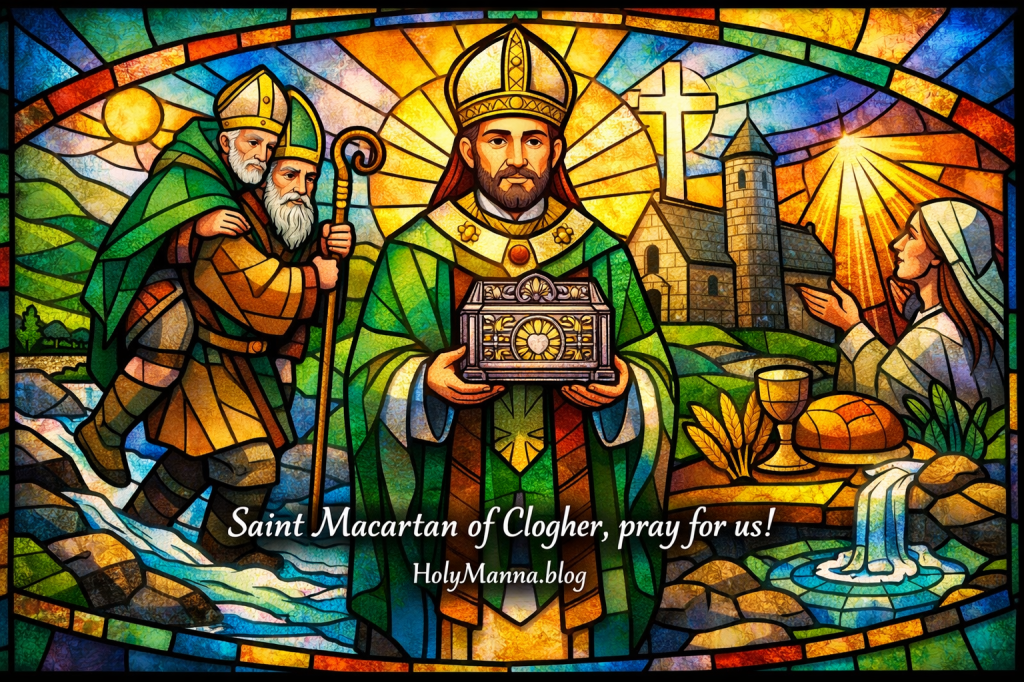
What he became most known for is deeply striking. He did not become famous because he pushed himself into the spotlight. He became known because Saint Patrick trusted him. Tradition says he helped Patrick physically in the rigors of travel, sometimes even carrying him across difficult ground, rivers, and rough country. That image has stayed with the Church because it reveals something deeply Christian. Holiness is not only found in preaching sermons or working public wonders. It is also found in carrying the weight of another person’s mission with love.
As the years passed, Macartan is said to have grown older and wearier from the demands of missionary life. Tradition remembers that he expressed his weakness to Patrick, and Patrick directed him to settle at Clogher and establish the Church there. This became the central work of his life. He was entrusted with Clogher, and Catholic tradition reveres him as its first bishop. In that role he helped root the Catholic faith in a particular place, turning missionary labor into lasting ecclesial life.
The Bishop Who Served with Strength and Mercy
Saint Macartan’s life shows why the Church remembers bishops not merely as administrators, but as spiritual fathers and guardians of a local flock. In Clogher he was remembered not simply as a founder, but as a shepherd. He helped anchor the Church in a region that would carry the memory of Patrick and the Gospel for centuries.
Several miracle stories from Catholic tradition are associated with his lifetime. Because Saint Macartan lived in the fifth century, these accounts come through later hagiographical tradition rather than modern historical reporting, but they remain part of the Catholic memory surrounding his holiness.
One tradition says that a local ruler named Eochad opposed Saint Macartan and attempted to move against him. The ruler was struck with paralysis, and Macartan later healed him with holy water. Afterward, the ruler is said to have submitted and granted land to the saint’s monastery. This story cannot be historically verified.
Another story says that a woman afflicted by an evil spirit received a radiant appearance of Saint Macartan, who foretold that she would be healed the next day. She was then delivered from her affliction. This story cannot be historically verified.
Another tradition says that Saint Macartan, devoted to the reading of Sacred Scripture, was once given supernatural light so that he could continue reading through the night. This story cannot be historically verified.
A particularly vivid tradition says that when guests arrived unexpectedly and there was not enough to feed them, grain came down from heaven, a spring appeared, bread was provided, and the water tasted like wine. The story highlights his hospitality, faith, and trust in divine providence. This story cannot be historically verified.
These stories matter even when they cannot be verified in the modern critical sense, because they show how the Catholic faithful remembered him. He was remembered as a man of healing, hospitality, prayer, and supernatural dependence on God. He was not just strong in body. He was strong in faith.
That is one reason he remains important. He reminds Catholics that strength in the Christian life is not harshness, pride, or domination. Real strength is faithful service. Real strength lifts others up. Real strength stays close to Christ’s mission. In Saint Macartan, the Church sees a man who gave his whole life to supporting the work of grace.
Weariness, Labor, and the Long Martyrdom of Fidelity
Saint Macartan was not a martyr in the strict sense. Catholic tradition does not remember him as one who died by violent persecution for the faith. Instead, his hardships appear in a different form. He lived through the exhausting labor of evangelization in early Christian Ireland. He traveled with Patrick across difficult country. He endured the weakness of age. He carried responsibilities that came with helping establish the Church where it had not yet taken deep root.
That kind of suffering should not be dismissed. There is a hidden martyrdom in long obedience. There is a real cost to building up the Church day after day, year after year, without applause, without comfort, and often without certainty. Saint Macartan’s life seems to reflect that quieter kind of sacrifice.
Tradition remembers him as a man who became tired, who felt the weight of the years, and who nevertheless remained faithful to the end. That alone makes him deeply relatable. Many Catholics know what it means to grow weary in prayer, weary in family duties, weary in service, or weary in trying to stay faithful in a culture that does not always support the Gospel. Saint Macartan shows that fidelity in weakness is still holy. In fact, it can be especially holy.
His witness harmonizes beautifully with Saint Paul’s teaching that God’s power is made perfect in weakness, and with the Church’s constant reminder that grace does not erase human frailty but transforms it. That is the logic of the Cross. That is the path of sanctity.
The Saint Who Never Left Clogher
Saint Macartan’s impact after death has been remarkable. He did not disappear into the mist of early Irish history. The Church kept remembering him. The Diocese of Clogher still honors him as its patron. His feast is celebrated on March 24. His name lives on in churches, schools, diocesan memory, sacred art, and Catholic devotion.
The cathedral of the Diocese of Clogher in Monaghan bears his name, and generations of Catholics in that region have looked to him as one of the fathers of their local Church. That kind of legacy is not accidental. It shows that the faithful saw in him a real spiritual father whose presence still mattered.
Catholic tradition also links Saint Macartan with notable sacred objects. One is the Domhnach Airgid, often called the Silver Shrine, which tradition says Saint Patrick entrusted to him and which later came to be associated closely with Saint Macartan. Another is the Cloch Ór, or Golden Stone, which later tradition connected with Clogher and with the saint’s story. These traditions show how strongly his memory shaped the devotional life of the region.
There are also miracle traditions attached to his memory after death, though these too come through later tradition rather than modern verification. His enduring reputation as a healer, a protector, and a holy bishop continued to surround his shrine and relics in local Catholic memory. The continued veneration of his name, his feast, and the sacred places associated with him reflects the Church’s living belief in the communion of saints, as taught in CCC 956, CCC 957, and CCC 2683.
His cultural impact is especially visible in the Diocese of Clogher. Catholic institutions have carried his name forward, and the Church in that region has treated him not simply as a historical figure, but as a continuing patron. That kind of memory is powerful. It means that fifteen centuries later, Catholics still see in Saint Macartan a model of what it means to receive the faith, guard it, and pass it on.
As for famous quotations, no verified personal quotation from Saint Macartan appears to survive in a secure historical sense. That is not unusual for a saint of his time. His life speaks more loudly than a surviving sentence. He is remembered less for a line he wrote and more for the kind of man he was.
What Saint Macartan Teaches the Church Today
Saint Macartan is a saint for people who do a lot of hidden work. He is a saint for those who support others, carry burdens quietly, and keep serving when they are tired. He is a saint for Catholics who sometimes feel that faithfulness is less dramatic than they expected. His life says otherwise. Faithfulness is dramatic in heaven. Quiet service matters to God.
There is also something deeply needed in his example for the modern world. So many people want influence without responsibility, visibility without sacrifice, and recognition without obedience. Saint Macartan stands as a rebuke to that mindset. He was strong, but not self-important. He was close to greatness, but did not try to replace it. He served the mission of the Church with humility, and because of that, the Church still remembers him.
His witness invites Catholics to examine how they carry the people and responsibilities God has placed before them. Do the burdens of family life, parish life, work, or vocation get carried with love or with resentment? Is there a willingness to support the mission of Christ even when the role is hidden and the credit goes elsewhere? Is there trust that holiness can grow in ordinary perseverance?
A practical way to live Saint Macartan’s example is to serve the Church where the Lord has planted you. Show up for Mass faithfully. Support priests with prayer. Help strengthen parish life. Practice patience when duties feel repetitive. Carry the weak instead of complaining about them. Stay close to Christ even when the road is muddy, slow, and tiring. That is not glamorous, but it is holy.
Saint Macartan also reminds the faithful that local churches matter. Christianity is not an abstract idea floating above history. It takes root in dioceses, parishes, families, and places. He helped build up a local church that lasted across centuries. That is a powerful reminder that the daily labor of Catholic life really does leave a legacy.
Engage with Us!
Share your thoughts and reflections in the comments below. Saint Macartan may not be as widely known as some other saints, but his life carries a deep and timely message for the Church today.
- What stands out most about Saint Macartan’s quiet strength and faithful service?
- Have you ever felt called to carry someone else’s burden in a hidden way? What did that teach you?
- How can Catholics today become stronger and more faithful in ordinary duties rather than only in dramatic moments?
- What part of Saint Macartan’s life challenges your own attitude toward service, humility, or perseverance?
- How can your parish, family, or daily routine become a place where the faith is strengthened and passed on, just as Macartan helped root the faith in Clogher?
Saint Macartan’s story is a reminder that holiness is not reserved for the loud, the famous, or the spectacular. Sometimes holiness looks like carrying the mission of the Church one faithful step at a time. Stay close to Christ. Love His Church. Serve with strength. Live with mercy. And do everything with the love and compassion Jesus taught us.
Saint Macartan of Clogher, pray for us!
Follow us on YouTube, Instagram and Facebook for more insights and reflections on living a faith-filled life.

 Holy Manna!
Leave a comment