The Daughter Who Kept the Lamp Burning
Saint Catherine of Sweden is one of those saints whose greatness does not come from dramatic preaching, military courage, or a martyr’s bloody crown. Her greatness comes from fidelity. She was the daughter of Saint Bridget of Sweden, yet she did not live in her mother’s shadow. She received a holy inheritance, guarded it, and handed it on to the Church.
She is revered in Catholic tradition for her purity, her obedience, her deep love for Christ, and her faithful service to the Bridgettine family at a crucial moment in history. She is remembered as a noblewoman, a wife who lived in continence, a widow who refused worldly ambition, a pilgrim, a religious superior, and a defender of the true Pope during the confusion of the Western Schism. Her life may look quiet on the surface, but it carries the steady fire of a soul completely given to God.
What makes Saint Catherine of Sweden especially moving is that she shows how holiness is often built through perseverance. She did not found the great movement associated with her family, but she preserved it. She did not leave behind a collection of famous sayings repeated across centuries, but she left something even more convincing: a life of chastity, humility, courage, and love for the Church.
A Noble Daughter Formed by Grace
Saint Catherine of Sweden was born around 1331 or 1332 into one of the most remarkable Catholic families of medieval Europe. She was the daughter of Saint Bridget of Sweden and Ulf Gudmarsson. From the beginning, she was raised in a household where Christian devotion was taken seriously. This mattered. Grace builds on nature, and Catherine’s early formation helped shape the soul the Church would later honor.
As a young girl, she was sent to the convent of Riseberg for her education. There she received the kind of religious formation that helped deepen her love for prayer, modesty, discipline, and the things of God. She was not a convert from paganism or unbelief. Her story is more subtle and, in many ways, more relatable. Her life was one of deepening fidelity. She was formed in the faith, and then she chose to live it with increasing seriousness.
While still young, she was married to Eggart von Kürnen. Catholic tradition holds that this marriage was lived in continence by mutual agreement. That fact often surprises people. In a world that constantly reduces love to desire, Catherine’s life reminds the faithful that Christian love is ordered first to God. Her marriage became a witness to purity, self-mastery, and a love rooted in sacrifice rather than possession.
This is one of the reasons she is so important. Saint Catherine of Sweden shows that chastity is not just a rule for the unmarried. It is a way of loving rightly in every state of life. The Catechism teaches, in CCC 2337, that “Chastity means the successful integration of sexuality within the person and thus the inner unity of man in his bodily and spiritual being.” Her life gave that teaching a human face.
The Woman Who Carried a Holy Mission
In 1349, Catherine traveled with her mother to Rome. Soon after arriving, she learned that her husband had died in Sweden. From that point on, her life took on a more openly religious character. She remained with Saint Bridget and became one of her closest companions and collaborators. She shared in her mother’s life of prayer, service, sacrifice, and ecclesial mission.
She also traveled with Saint Bridget and her brother Birger on pilgrimage to the Holy Land in 1372. That journey matters because it reveals Catherine as more than a sheltered holy woman. She was part of a living Catholic mission that stretched from Sweden to Rome to the places sanctified by the earthly life of Christ. She walked through a hard century with courage, and she did so with her heart fixed on heaven.
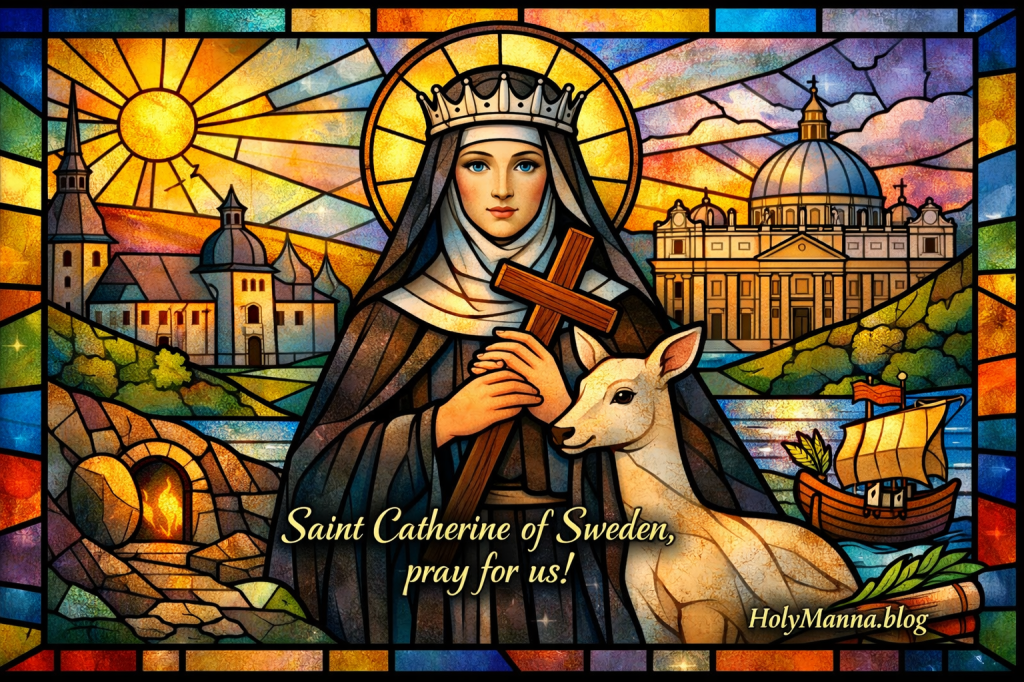
During her lifetime, the miracle most commonly associated with her in Catholic tradition is the story of the hind. Tradition says that when evil men sought to trap or violate her, a hind came to her aid and protected her. That is why sacred art often shows Saint Catherine of Sweden with a deer at her side. Whether one focuses on the literal event or the spiritual symbolism, the meaning is clear. God watches over those who belong to Him. Her purity was not weakness. It was strength defended by grace.
Catherine is important not only because of what happened around her, but because of what she chose to do with what she had received. After Saint Bridget’s death in 1373, Catherine brought her mother’s body back to Vadstena in Sweden. That was no small task. It was an act of love, duty, reverence, and spiritual intelligence. She understood that the mission entrusted to her mother was not supposed to die with her.
At Vadstena, Catherine took on leadership within the Bridgettine foundation. She helped stabilize the life of the community and preserve the rule and spirit of the order. She then returned to Rome to work for the approval of the Bridgettine Rule and for the canonization of Saint Bridget. This is what Saint Catherine of Sweden is most known for. She was the guardian of a charism. She made sure that what God had begun through Saint Bridget would continue to bear fruit in the Church.
Trials Without Martyrdom
Saint Catherine of Sweden was not martyred, but that does not mean her life was free from suffering. In some ways, her hardships are the kind that cut even more quietly and deeply. She knew loss. She knew the burden of widowhood. She knew the pain of watching her mother suffer and die. She knew the pressure of leadership. She knew the strain of travel in an age when travel was exhausting and dangerous. She also knew what it meant to live during a time of confusion in the Church.
One of the most significant trials of her later life came during the Western Schism. At a time when many were divided over the papacy, Catholic tradition remembers Saint Catherine of Sweden as loyal to Pope Urban VI, the Roman Pontiff. That fidelity was not political convenience. It was an act of ecclesial obedience. She stood with the Roman obedience when the unity of the Church was wounded by competing claims.
This matters spiritually. Love for Christ is never separate from love for His Church. Saint Catherine of Sweden understood that holiness does not consist in private religious feeling alone. It includes faithfulness to the visible Church established by Christ. Her example speaks clearly in an age when many are tempted to remake Catholicism according to personal taste.
She also carried personal sorrow within her family. Tradition preserves an episode in which she almost accompanied Saint Catherine of Siena on a mission connected to Queen Joanna of Naples, but did not go because of Joanna’s connection to the moral ruin of Catherine’s brother Charles. That detail reveals a saint who understood the gravity of sin, the heartbreak of family wounds, and the cost of moral collapse.
In all of this, Catherine remained steady. She did not respond to suffering with drama. She endured it with prayer, restraint, and fidelity. There is something deeply Catholic in that. Holiness is not always loud. Sometimes it is the grace to remain faithful when there is every excuse to grow bitter.
A Legacy That Continued to Speak
Saint Catherine of Sweden died at Vadstena on March 24, 1381. Her earthly life ended, but her impact did not. Catholic veneration of her continued and was later officially approved. Her feast came to be kept in Sweden and in the Bridgettine tradition, and her memory remained tied to Vadstena, the great center of Bridgettine life that she helped preserve.
Her posthumous legacy is most strongly seen in the survival and growth of the Bridgettine spirit. This is not a small thing. Entire spiritual families in the Church have disappeared because no one remained faithful enough to protect them after the founder died. Catherine did protect hers. Because of her work, the life of prayer, penance, and devotion associated with Saint Bridget continued to shape souls.
Vadstena itself became a place of memory and veneration. It stood not merely as a building, but as a sign that sanctity can form a culture. Saint Catherine of Sweden helped secure a religious inheritance that became part of the Christian identity of Sweden. Even centuries later, her name remained woven into the memory of Catholic Scandinavia.
There are also devotional traditions that associate her intercession with healing and with protection for women, especially in connection with pregnancy and miscarriage. These traditions exist in Catholic devotional life, but the specific miracle stories attached to them are not easily verified in the surviving historical record. They should therefore be received with reverence and caution. They cannot be fully verified.
The same is true of more expansive miracle stories sometimes repeated outside the strongest Catholic historical sources. Some of these may preserve genuine local memory, but they cannot be firmly verified today. What can be said with confidence is that the faithful continued to invoke her, honor her, and remember her as a saintly intercessor.
Her cultural impact also endured through the life of the Bridgettine Order and through the Church’s continuing memory of Christian Sweden. She remains one of those saints whose influence is larger than many people first realize. She did not dominate the stage of history, but she helped preserve one of the Church’s great lights.
What Saint Catherine Still Teaches the Church
Saint Catherine of Sweden has a message that feels unusually timely. She teaches that holiness is not always flashy. It is often hidden in purity, duty, sorrow, and perseverance. She teaches that family can be a school of sanctity. She teaches that chastity is beautiful, not oppressive. She teaches that loyalty to the Church matters, especially in times of confusion. She teaches that receiving a gift from God also means protecting it.
For Catholics today, her life offers practical lessons. Purity is not old-fashioned. It is freedom. Fidelity to prayer is not weakness. It is strength. Reverence for the Church is not blind traditionalism. It is love for the Bride of Christ. Saint Catherine of Sweden shows that even when the world is unstable, the soul can remain anchored in Christ.
Her life also invites a deeper examination of vocation. Some people are called to public works. Others are called to hidden faithfulness that protects the Church from collapse. Both matter. Catherine’s sanctity grew not from chasing importance, but from receiving the task God placed before her and carrying it with love.
This is where her witness becomes especially fruitful for modern readers. Many people want a dramatic mission, but they neglect the duty already in front of them. Catherine did not. She lived the vocation that was given to her. She preserved what was entrusted to her. She remained pure in a corrupted world. She stayed loyal when the Church was wounded. She loved without making herself the center.
The Church’s teaching on the communion of saints helps explain why her example still matters. The Catechism teaches in CCC 956 that the saints in heaven continue to care for the Church on earth. Saint Catherine of Sweden is not a figure trapped in the past. She is part of that living cloud of witnesses who still point the faithful toward Christ.
What has God placed in your hands that needs to be guarded with love instead of neglected through distraction?
Where is Christ asking for purity, steadiness, and obedience in daily life?
What would change if faithfulness became more important than recognition?
Engage with Us!
Share your thoughts and reflections in the comments below. Saint Catherine of Sweden has a quiet kind of holiness, but that kind of holiness often reaches the deepest places in the heart.
- What part of Saint Catherine of Sweden’s life speaks most strongly to your own walk with God right now?
- How does her example challenge modern ideas about love, purity, and freedom?
- Have there been moments in life when God asked for quiet fidelity instead of visible success?
- What gift, responsibility, or relationship might the Lord be asking you to protect more faithfully?
- How can devotion to the saints help strengthen trust in Christ and love for His Church?
Saint Catherine of Sweden reminds the faithful that a life of holiness does not need to be loud to be powerful. Live with faith. Stay close to Christ and His Church. Guard what is holy. Do everything with the love and mercy Jesus taught us.
Saint Catherine of Sweden, pray for us!
Follow us on YouTube, Instagram and Facebook for more insights and reflections on living a faith-filled life.

 Holy Manna!
Leave a comment