Tuesday of the Fifth Week of Lent – Lectionary: 252
When the Wounded Heart Looks Up
There are days in Lent when the Church stops letting the soul hide. Today is one of them. These readings gather around one central theme: when sin wounds and pride poisons the heart, God does not abandon His people, but calls them to look up in faith so they may be healed. In the wilderness of Numbers, Israel grumbles and is bitten. In Psalm 102, the afflicted cry rises to heaven and the Lord bends down to hear. In The Gospel of John, Jesus declares that those who refuse to believe will die in their sins, yet He also reveals that when He is lifted up, the truth of who He is will be made known. The pattern is unmistakable. Human beings fall, suffer, and wander, but God still provides a way back through repentance, faith, and the saving power of the One He sends.
The historical setting deepens the message. Israel’s journey through the desert was not only a physical trek through hostile land. It was a spiritual testing ground where a newly freed people had to learn trust, obedience, and dependence on God. Their complaint against the manna was more than frustration with food. It was a rejection of divine providence. By the time of John 8, that same deeper struggle is still at work. Jesus stands before a people formed by covenant, prophecy, sacrifice, and longing for redemption, yet many still cannot recognize the Messiah in front of them. The tragedy in both readings is not simply suffering. It is resistance to God when He comes near. The mercy in both readings is that the Lord still gives a remedy.
That is why these passages belong together so beautifully in the Fifth Week of Lent. The Church is already turning the eyes of the faithful toward Calvary. The bronze serpent lifted in the desert prepares the heart to understand Christ lifted on the Cross. The cry of the lowly in Psalm 102 prepares the heart to beg for mercy instead of defending sin. And Jesus’ solemn words force a decision. Either the heart remains below, trapped in unbelief and self-will, or it looks to the One from above and lives. This is not only an ancient story about Israel or a tense exchange in Jerusalem. It is the story of every soul that has ever been wounded by sin and invited to healing by grace.
What happens when the heart finally stops arguing, stops hiding, and simply looks up at Christ? That is the question waiting beneath all of today’s readings, and it is the question that makes this day so searching, so honest, and so full of hope.
First Reading – Numbers 21:4-9
When God Turns Judgment into Healing
The story in today’s First Reading comes from one of the hardest stretches of Israel’s wilderness journey. The people have left Mount Hor after the death of Aaron, and instead of moving straight into relief, they are forced to take the longer road around Edom. That matters. Israel is tired, frustrated, and spiritually worn thin. In that exhausted state, what is hidden in the heart begins to come out. The wilderness in Numbers is never just a backdrop. It is a place of testing, purification, and decision. There, the Lord forms His people by exposing the difference between trust and complaint, faith and rebellion.
This reading fits today’s theme with striking force. The people are wounded by the very sin they choose. They complain against God, reject His provision, and then feel the deadly consequences of their rebellion. Yet the Lord does not abandon them. He gives them a strange and merciful remedy, a sign lifted up before their eyes. The Church has always seen in this moment a foreshadowing of Christ lifted up on the Cross. The people in the desert are healed when they look with faith. The sinner is healed when he turns toward Jesus.
Numbers 21:4-9 – New American Bible (Revised Edition)
The Bronze Serpent. 4 From Mount Hor they set out by way of the Red Sea, to bypass the land of Edom, but the people’s patience was worn out by the journey; 5 so the people complained against God and Moses, “Why have you brought us up from Egypt to die in the wilderness, where there is no food or water? We are disgusted with this wretched food!”
6 So the Lord sent among the people seraph serpents, which bit the people so that many of the Israelites died. 7 Then the people came to Moses and said, “We have sinned in complaining against the Lord and you. Pray to the Lord to take the serpents from us.” So Moses prayed for the people, 8 and the Lord said to Moses: Make a seraph and mount it on a pole, and everyone who has been bitten will look at it and recover. 9 Accordingly Moses made a bronze serpent and mounted it on a pole, and whenever the serpent bit someone, the person looked at the bronze serpent and recovered.
Detailed Exegesis
Verse 4: “From Mount Hor they set out by way of the Red Sea, to bypass the land of Edom, but the people’s patience was worn out by the journey.”
This verse sets the emotional and spiritual atmosphere for everything that follows. Israel is not simply traveling. Israel is being tested. The detour around Edom would have felt humiliating and discouraging, especially for a people already longing for rest. Their patience wears out, but beneath that impatience is a deeper problem. They have not yet learned to trust God when the road becomes longer than expected. This is often how temptation works in daily life. A soul can endure much when hope is fresh, but when the path feels delayed, frustration can quickly become rebellion.
Verse 5: “So the people complained against God and Moses, ‘Why have you brought us up from Egypt to die in the wilderness, where there is no food or water? We are disgusted with this wretched food!’”
The complaint reveals how distorted the human heart becomes in sin. The people speak as if God has done nothing for them. They forget the Exodus, forget the covenant, and forget the manna. In fact, they speak with contempt about the very food by which God has sustained them. That is the poison of ingratitude. When the heart is turned inward, even grace can begin to look burdensome. Spiritually, this is a warning against despising God’s ordinary gifts. The manna also points forward to the Eucharist. A soul that grows cold can begin to treat holy things as common, routine, or tiresome. That is never a small danger.
Verse 6: “So the Lord sent among the people seraph serpents, which bit the people so that many of the Israelites died.”
The fiery serpents are not random cruelty. They are a severe mercy that reveals what sin really does. The people have chosen rebellion, and now the hidden venom of that rebellion becomes visible. The punishment fits the spiritual sickness. Sin is never merely a bad mood or a private mistake. Sin bites, burns, spreads, and kills. The word translated as “seraph” carries the sense of fiery burning, which suggests the painful effect of the venom. In the logic of covenant, God’s judgment is medicinal as well as just. He permits suffering here so that the people may awaken to the seriousness of their offense and return to Him.
Verse 7: “Then the people came to Moses and said, ‘We have sinned in complaining against the Lord and you. Pray to the Lord to take the serpents from us.’ So Moses prayed for the people.”
This is the turning point. The people finally name their sin plainly. They do not excuse it. They do not soften it. They say, “We have sinned.” That is where healing always begins. Repentance starts when the sinner stops defending himself and begins telling the truth before God. Moses also appears here as an intercessor. He stands between a guilty people and a merciful God, praying for them. In this, Moses foreshadows Christ, the true mediator who intercedes perfectly for His people. The verse also teaches that the prayer of the righteous matters. God invites His people into communion, and part of that communion is intercessory prayer.
Verse 8: “And the Lord said to Moses: Make a seraph and mount it on a pole, and everyone who has been bitten will look at it and recover.”
This is one of the most important verses in the reading because it reveals God’s strange and beautiful way of healing. The Lord does not remove the people from the reality of their sin without asking anything of them. He calls them to look. They must turn their eyes toward the very sign that reminds them of the wound. This is already a preparation for the mystery of the Cross. God takes what symbolizes death and makes it the place where healing is given. The cure requires faith and obedience. The bitten person must believe that God’s word is true enough to act on it. Looking becomes an act of trust.
Verse 9: “Accordingly Moses made a bronze serpent and mounted it on a pole, and whenever the serpent bit someone, the person looked at the bronze serpent and recovered.”
The final verse confirms that healing comes exactly as God promised. The bronze serpent has no power in itself. It is not magic, and it is not a rival to God. It is a God-given sign through which the Lord grants healing to those who trust Him. This is deeply sacramental in shape. God often uses visible signs to communicate invisible grace. The person still has to look. The wound is real, but so is the remedy. The Church sees here a prophetic image of Christ crucified. Humanity, bitten by sin and doomed to death, is saved not by self-repair, but by turning in faith to the One lifted up for our salvation.
Teachings
The deepest meaning of this passage becomes clearer when Scripture itself reflects on it. Wisdom 16:6-7 explains the event with remarkable precision: “They were troubled for a little while as a warning, and had a sign of salvation to remind them of the commandment of your law. For the one who turned toward it was saved, not by what he saw, but by you, the savior of all.” That line guards the whole reading from confusion. Israel was not healed by bronze. Israel was healed by God. The sign mattered, but only because God appointed it.
The Church teaches the same principle when speaking about sacred images. The Catechism says, “Already in the Old Testament, God ordained or permitted the making of images that pointed symbolically toward salvation by the incarnate Word: so it was with the bronze serpent, the ark of the covenant, and the cherubim.” CCC 2130 This is an important Catholic point. A holy sign can lead the heart toward God when God Himself gives it. The problem is never a sacred sign rightly used. The problem is idolatry, when a creature is treated as though it were God. That is why the later destruction of the bronze serpent in the days of King Hezekiah matters. What had once been a sign of healing had become an idol for some of the people. The lesson is timeless. Holy things must always lead upward to God, never become substitutes for Him.
The Fathers of the Church saw this reading as one of the clearest Old Testament figures of Christ. Saint Augustine taught that the serpent lifted up in the wilderness foreshadowed Christ lifted up on the Cross. The serpent represented the deadly wound of sin, yet Christ, though sinless, took on our mortal condition so that by His Passion He might heal what sin had poisoned. That is why this reading belongs so naturally beside the Gospel in Lent. The bronze serpent is not the fulfillment. It is the shadow. Christ crucified is the reality.
This reading also teaches something vital about repentance. The people are not healed until they confess, ask for prayer, and obey the Lord’s remedy. That pattern still shapes the spiritual life. Sin must be acknowledged. Mercy must be sought. God’s remedy must be accepted on His terms, not ours. The whole passage quietly prepares the heart for the Catholic life of conversion, especially for confession, penance, and faith in the saving power of the Cross.
Reflection
This reading speaks with real honesty to daily life because most souls know what it is like to grow tired on the road. Fatigue, disappointment, delay, and repeated struggle can wear a person down until complaint starts to sound reasonable. That is often when the heart becomes vulnerable. Grumbling can become bitterness. Bitterness can become contempt. Contempt can become open resistance to God. The wilderness is not only a place on a map. It is every season when the soul feels stretched, dry, or restless.
The first practical lesson is to catch complaint early. Israel did not fall in a single moment. The people let impatience ripen into rebellion. A Christian has to learn to bring frustration to God as prayer, not turn it into accusation. That means speaking honestly to the Lord, but with humility. The second lesson is to name sin clearly. The people finally say, “We have sinned.” That is the language of conversion. Excuses keep venom in the system. Confession draws it out into the light. The third lesson is to look where God tells the soul to look. For Christians, that means looking to Christ crucified, especially in moments of temptation, shame, fear, or discouragement. A crucifix in the home, time before the Blessed Sacrament, and regular confession are not small habits. They train the heart to look up and live.
There is also a tender warning here for anyone who has grown spiritually dull. Israel called manna “wretched food.” A soul can do the same with grace. Prayer can feel repetitive. Mass can feel ordinary. Scripture can feel familiar. But the problem is not with the gift. The problem is with the heart that has stopped receiving it with gratitude. Lent is the season for asking God to restore holy hunger.
Where has impatience started to harden into complaint in daily life?
What gift from God has been treated as ordinary, inconvenient, or not enough?
When sin bites, does the heart hide in shame, or does it look quickly to Christ for healing?
Today’s reading does not leave the sinner in despair. It tells a better story. The wound is real, the poison is real, and the consequences are real. But the mercy of God is just as real. He still gives the remedy. He still calls the wounded to look up. And those who look in faith do not remain where they were. They begin to live.
Responsorial Psalm – Psalm 102:2-3, 16-21
When the Lowly Finally Cry Out
The Responsorial Psalm enters today’s liturgy like the voice of a wounded soul that has stopped pretending to be strong. After the rebellion and serpent bites in Numbers, the Church gives words to the heart that has finally learned to pray. Psalm 102 is a psalm of affliction, a cry from weakness, isolation, and distress. The psalms were formed for the worship of Israel and became the prayer book of the Temple and of God’s people, but they were never cold liturgical formulas. They came from lived suffering, covenant hope, and the stubborn belief that the Lord still hears the poor. That is why this psalm fits today’s theme so well. The poisoned soul is not healed by pride, denial, or self-reliance. It is healed when it cries to God and waits for Him to look down in mercy. The Catechism teaches that the Psalms are both deeply personal and communal, and that they remain an essential element of the prayer of the Church.
The movement of the psalm is especially important. It begins in distress, but it does not end there. It rises from personal anguish into confidence that the Lord rebuilds, appears in glory, listens to the lowly, and releases those doomed to die. That is exactly the shape of Lent. The sinner begins in misery, but grace teaches him to lift his eyes toward mercy. Pope Francis said of the psalms that they are “invocations, often dramatic, that spring from lived existence” and that to pray them well, the soul must come as it really is. That is the spirit of this reading. It is not polished spirituality. It is honest prayer offered from the depths.
Psalm 102:2-3, 16-21 – New American Bible (Revised Edition)
2 Lord, hear my prayer;
let my cry come to you.
3 Do not hide your face from me
in the day of my distress.
Turn your ear to me;
when I call, answer me quickly.16 The nations shall fear your name, Lord,
all the kings of the earth, your glory,
17 Once the Lord has rebuilt Zion
and appeared in glory,
18 Heeding the plea of the lowly,
not scorning their prayer.
19 Let this be written for the next generation,
for a people not yet born,
that they may praise the Lord:
20 “The Lord looked down from the holy heights,
viewed the earth from heaven,
21 To attend to the groaning of the prisoners,
to release those doomed to die.”
Detailed Exegesis
Verse 2: “Lord, hear my prayer; let my cry come to you.”
The psalm begins with directness. There is no pretense here, no religious performance, and no attempt to sound impressive. The afflicted person simply cries out. This is the heart of biblical prayer. Prayer is not first about elegant language. It is about turning toward God in truth. The soul does not begin by solving its own misery. It begins by asking to be heard. The Catechism teaches that prayer rises from the recognition of need and from the humility that knows it cannot save itself. That is already happening in this first verse.
Verse 3: “Do not hide your face from me in the day of my distress. Turn your ear to me; when I call, answer me quickly.”
This verse carries the urgency of a person who knows he cannot afford delay. In biblical language, the face of God signifies His favor, closeness, and blessing. To ask God not to hide His face is to beg not to be abandoned. The psalmist is not commanding God. He is pleading from the place of poverty. This is how suffering often purifies prayer. It strips away vague religion and leaves only the desperate appeal for the Lord’s presence. The cry for a quick answer also reveals confidence. The psalmist asks boldly because he believes God is the kind of Lord who listens.
Verse 16: “The nations shall fear your name, Lord, all the kings of the earth, your glory.”
The psalm now widens from one suffering person to the glory of God before all peoples. This shift matters. Biblical prayer never remains locked in the self. Even from distress, the psalmist sees beyond his own pain to the universal kingship of God. The Lord’s answer to prayer is not only a private consolation. It is a revelation of His glory. In the life of the Church, this is always true. When God rescues, forgives, restores, or strengthens His people, His mercy becomes a witness to the nations.
Verse 17: “Once the Lord has rebuilt Zion and appeared in glory,”
Zion here stands for the holy city, the place of God’s dwelling among His people, and the hope of restored worship after devastation. The verse carries the memory of ruin and the promise of rebuilding. In the Old Testament, this language naturally evokes the suffering of Jerusalem and the longing for restoration. Spiritually, it speaks to every life broken by sin or grief. God is not only the one who hears cries. He is the one who rebuilds what has collapsed. He does not merely console ruins. He restores them.
Verse 18: “Heeding the plea of the lowly, not scorning their prayer.”
This verse reveals the heart of God. He is attentive to the lowly. He does not scorn their prayer. That is one of the most consoling truths in all of Scripture. The Lord is not repelled by weakness honestly brought before Him. He is drawn to it. The Catechism teaches that “humility is the foundation of prayer” and asks whether prayer rises from pride or “out of the depths” of a humble and contrite heart. This verse answers that question beautifully. God listens where pride is broken and truth begins.
Verse 19: “Let this be written for the next generation, for a people not yet born, that they may praise the Lord:”
The psalmist does not want God’s mercy forgotten. What the Lord has done must be remembered, recorded, and handed on. This is deeply biblical and deeply Catholic. Salvation is not meant to vanish into private memory. It is meant to be proclaimed so that future generations may praise God. This verse also shows why the Church treasures Scripture, liturgy, and tradition. The mighty deeds of God are received, remembered, and transmitted so that those who come later may learn to trust Him too.
Verse 20: “The Lord looked down from the holy heights, viewed the earth from heaven,”
The image is magnificent. God is enthroned above all, yet He is not distant in the cold sense. He looks down. Heaven is not indifference. It is the place from which divine mercy sees human misery clearly. This verse balances transcendence and tenderness. The Lord is exalted, but His height does not keep Him from noticing the afflicted. It is often the temptation of suffering to imagine that God is too far away to care. This verse destroys that lie.
Verse 21: “To attend to the groaning of the prisoners, to release those doomed to die.”
The psalm reaches a dramatic climax here. God looks down with a purpose. He intends to attend, to hear, and to release. The image of prisoners and those doomed to die resonates powerfully with today’s wider readings. Sin binds, suffering imprisons, and death seems to close in, yet the Lord acts on behalf of those who cannot free themselves. The Church prays this verse knowing that its fullest meaning is found in Christ, who comes to liberate humanity from the deeper captivity of sin and death.
Teachings
This psalm teaches that true prayer begins in honest poverty before God. The Church says in The Catechism, “Humility is the foundation of prayer.” CCC 2559 The same paragraph also asks whether prayer comes from pride or “out of the depths” of a humble and contrite heart. That is the exact spiritual posture of Psalm 102. The psalmist does not come to God as a self-sufficient man making a religious speech. He comes as one who is afflicted, needy, and desperate to be heard.
The Church also teaches that the psalms are not locked in the past. They belong permanently to Christian prayer. The Catechism says, “The Psalms constitute the masterwork of prayer in the Old Testament.” CCC 2586 It then adds, “Prayed and fulfilled in Christ, the Psalms are an essential and permanent element of the prayer of the Church.” CCC 2597 That is why this Responsorial Psalm is not just a poetic response between readings. It is the Church putting God’s own words on the lips of the faithful so they can learn how to cry out, hope, and endure.
Pope Francis offered a beautiful summary of the psalms when he said, “The Psalms are not texts created on paper; they are invocations, often dramatic, that spring from lived existence.” That insight matters for this reading. The psalm is holy, but it is not artificial. It does not ask the suffering person to hide his distress. It teaches him to bring it to God. In that sense, Psalm 102 becomes a school of prayer for anyone who feels overwhelmed, ashamed, lonely, or spiritually worn down.
There is also a quiet historical beauty in the line about rebuilding Zion. Israel knew what it meant to see devastation and long for restoration. The memory of Jerusalem’s suffering shaped the prayer of God’s people, and the hope of rebuilding became a sign that the Lord had not abandoned His covenant. In the life of grace, that same truth still applies. God rebuilds ruined places. He restores worship. He gathers the broken. He writes mercy into history so the next generation will remember His name.
Reflection
This psalm is a gift for the days when the heart feels too tired to dress up its prayer. It reminds the soul that God does not require polished spiritual performance before He listens. He asks for truth. That means a Christian can come to the Lord with real distress, real confusion, and real need. The psalm does not encourage self-pity, but it does encourage honesty. There is a big difference. Self-pity folds inward. Prayer opens upward.
In daily life, this can be lived very simply. When anxiety starts to build, the soul can pray the first line slowly: “Lord, hear my prayer; let my cry come to you.” When shame makes a person want to hide, he can pray: “Do not hide your face from me in the day of my distress.” When discouragement feels heavy, he can remember that the Lord looks down from heaven not to condemn the humble, but to attend to them. This is one reason the Church keeps the psalms so close in the liturgy. They train the faithful to turn pain into prayer instead of letting pain harden into bitterness.
This reading also challenges the modern habit of trying to manage everything alone. The afflicted man in the psalm does not save himself. He cries out. That is not weakness in the bad sense. That is biblical wisdom. A Catholic life has to make room for this kind of dependence. Daily prayer, the Rosary, silent time before the Lord, and honest confession all grow from the same truth: the heart is healed when it finally stops pretending to be enough for itself.
When distress comes, does the heart turn toward God first, or only after every other support has failed?
What would it look like to pray with more honesty and less performance?
Is there a burden that needs to be turned into a psalm instead of carried in silence?
Today’s Responsorial Psalm teaches that the lowly are never invisible to God. He sees. He hears. He remembers. And when the wounded heart cries out to Him, that cry is not lost in the air. It rises before the Lord who still rebuilds, still listens, and still releases those who thought they were too far gone.
Holy Gospel – John 8:21-30
The One Lifted Up Reveals the Name Above Every Name
Today’s Gospel unfolds in the tense, searching atmosphere that runs through The Gospel of John as opposition to Jesus grows sharper in Jerusalem. This is not a casual conversation and it is not a minor disagreement about religion. Jesus is confronting hearts that are near the things of God yet still resisting the truth standing in front of them. The Catechism notes that from the beginning of His public ministry, some among the religious authorities moved against Him, and John’s Gospel highlights that this resistance developed long before Calvary.
That setting matters because today’s theme is not only about sin in the abstract. It is about what happens when wounded, proud, or frightened hearts refuse the remedy God gives. In Numbers, the people are bitten and told to look upon the sign God lifts up. Here, Jesus says that unless people believe in Him, they will die in their sins, and that when the Son of Man is lifted up, they will know who He truly is. The Church hears in this Gospel both a warning and a promise. Sin is deadly, but Christ lifted up on the Cross is the healing God gives to the world.
John 8:21-30 – New American Bible (Revised Edition)
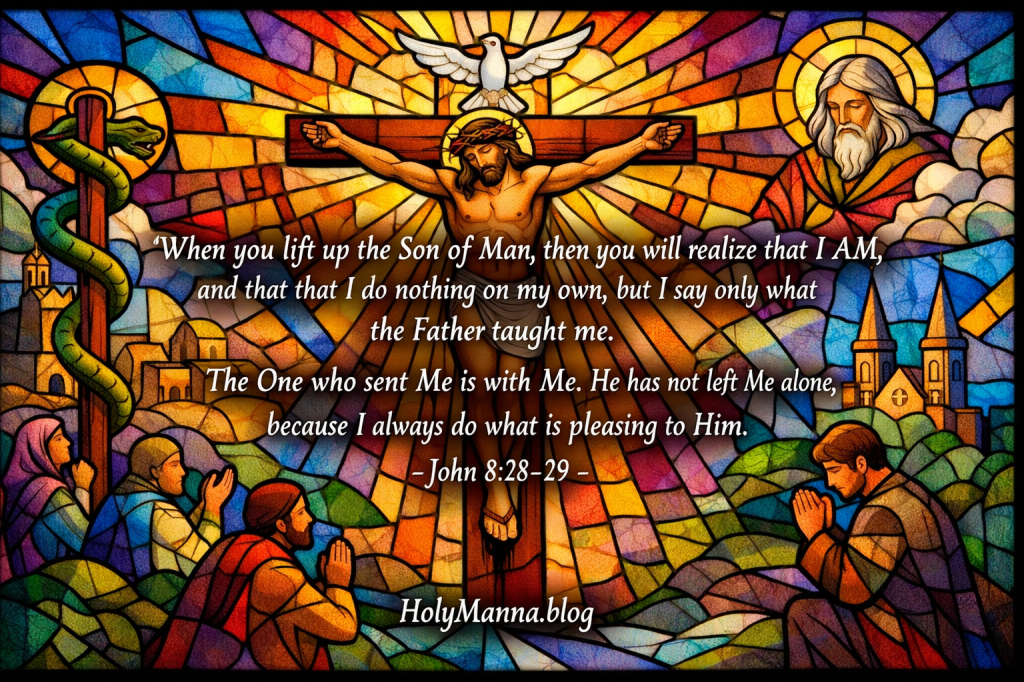
21 He said to them again, “I am going away and you will look for me, but you will die in your sin. Where I am going you cannot come.” 22 So the Jews said, “He is not going to kill himself, is he, because he said, ‘Where I am going you cannot come’?” 23 He said to them, “You belong to what is below, I belong to what is above. You belong to this world, but I do not belong to this world. 24 That is why I told you that you will die in your sins. For if you do not believe that I AM, you will die in your sins.” 25 So they said to him, “Who are you?” Jesus said to them, “What I told you from the beginning. 26 I have much to say about you in condemnation. But the one who sent me is true, and what I heard from him I tell the world.” 27 They did not realize that he was speaking to them of the Father. 28 So Jesus said [to them], “When you lift up the Son of Man, then you will realize that I AM, and that I do nothing on my own, but I say only what the Father taught me. 29 The one who sent me is with me. He has not left me alone, because I always do what is pleasing to him.” 30 Because he spoke this way, many came to believe in him.
Detailed Exegesis
Verse 21: “He said to them again, ‘I am going away and you will look for me, but you will die in your sin. Where I am going you cannot come.’”
Jesus speaks with sobering clarity. The phrase “you will die in your sin” means dying in unbelief, and “Where I am going you cannot come” points to His return to the Father, a place that cannot be reached apart from faith in His Passion and Resurrection. This is not mere harshness. It is a diagnosis. A heart that refuses Christ remains trapped in what is killing it.
Verse 22: “So the Jews said, ‘He is not going to kill himself, is he, because he said, “Where I am going you cannot come”?’”
The hearers misunderstand Jesus at the level of surface meaning. There is deep irony here. Jesus is indeed speaking about His death, but not as self-destruction. His death will be handed over according to the Father’s saving plan. Their confusion shows how far the natural mind can be from the mystery of Christ when it refuses faith.
Verse 23: “He said to them, ‘You belong to what is below, I belong to what is above. You belong to this world, but I do not belong to this world.’”
Jesus is not saying that creation is evil or that human life is worthless. He is exposing the source of their judgment. They are thinking according to the world’s standards, according to what John elsewhere describes as judging by merely human appearances. Christ comes from the Father and reveals heavenly truth. Until a person receives that truth, he remains stuck within the narrow horizon of a fallen world.
Verse 24: “That is why I told you that you will die in your sins. For if you do not believe that I AM, you will die in your sins.”
This is one of the most important lines in the passage. “I AM” was understood in Jewish tradition as God’s own self-designation. The Catechism deepens this when it says, “By giving his life to free us from sin, Jesus reveals that he himself bears the divine name.” CCC 211 Jesus is not simply claiming to be a prophet or a moral guide. He is revealing that the God who spoke to Moses is now standing before His people in the flesh.
Verse 25: “So they said to him, ‘Who are you?’ Jesus said to them, ‘What I told you from the beginning.’”
Their question shows that the deeper issue is not lack of information but resistance to revelation. The force of the reply is plain enough. Jesus has not hidden His identity. He has been revealing it from the beginning through His words, His signs, and His communion with the Father. The problem is not that He has been unclear. The problem is that they do not want the answer He is giving.
Verse 26: “I have much to say about you in condemnation. But the one who sent me is true, and what I heard from him I tell the world.”
Jesus does not speak on His own authority in isolation from the Father. He speaks what He has heard from the One who sent Him. This means His words are not one teacher’s opinion among many. They are the faithful speech of the Son sent by the Father. To reject Him is to reject the truth that comes from God Himself.
Verse 27: “They did not realize that he was speaking to them of the Father.”
This is one of the saddest lines in the passage. They are listening, but not hearing. The Father is the center of Jesus’ words, yet the meaning remains hidden from those whose hearts are closed. Pope Francis said that Jesus repeats this warning because they did not understand the mystery of Jesus and their hearts were closed. The tragedy of unbelief is not merely intellectual confusion. It is a heart that refuses to open.
Verse 28: “So Jesus said [to them], ‘When you lift up the Son of Man, then you will realize that I AM, and that I do nothing on my own, but I say only what the Father taught me.’”
This is the turning point. The Cross will become the place of revelation. The Catechism teaches, “The lifting up of Jesus on the cross signifies and announces his lifting up by his Ascension into heaven, and indeed begins it.” CCC 662 In John’s theology, being lifted up is both humiliation and glory, both sacrifice and revelation. Pope Francis, reflecting on this same passage, said that “I am he” is the name of God and linked it directly to the serpent lifted in the wilderness. The One hanging on the Cross is not defeated by the Cross. He is revealed through it.
Verse 29: “The one who sent me is with me. He has not left me alone, because I always do what is pleasing to him.”
This verse opens a window into the heart of Jesus. He lives in perfect communion with the Father and in perfect obedience to Him. Here the Gospel shows not only who Jesus is, but how the Son lives. His whole life is filial, obedient, and pleasing to the Father.
Verse 30: “Because he spoke this way, many came to believe in him.”
Even in the midst of tension and resistance, grace is at work. Not everyone hardens his heart. Some hear, some begin to believe, and some start to see. That matters deeply in Lent. The Gospel is severe because it is merciful. Jesus tells the truth about sin so that people might turn and live. The same words that expose unbelief can also awaken faith.
Teachings
One of the clearest teachings in this Gospel is the divinity of Christ. Jesus’ use of “I AM” is not a dramatic flourish. It is a revelation. The Church understands this expression as a disclosure of the divine identity. The Catechism gives the Church’s theological reading in a compact and beautiful line: “By giving his life to free us from sin, Jesus reveals that he himself bears the divine name.” CCC 211 That means the Cross is not the defeat of a merely human reformer. It is the self-giving revelation of the Lord.
This Gospel also teaches that the Cross is already the beginning of Christ’s exaltation. The Church says, “The lifting up of Jesus on the cross signifies and announces his lifting up by his Ascension into heaven, and indeed begins it.” CCC 662 That is why John speaks of the Cross with such majesty. Jesus is not dragged into meaninglessness. He is lifted up. He reigns from the wood. He reveals the Father most fully when He is most rejected by the world.
Pope Francis drew the connection to today’s First Reading with great force. Speaking on this Gospel and Numbers 21, he said that “I am he” is the name of God and that the Son of Man is lifted up like the serpent in the wilderness so that sinners may be saved. He also warned that dying in one’s sins happens where hearts remain closed to the mystery of Jesus. The Gospel, then, is not only a revelation of who Christ is. It is also a summons to decision. A closed heart remains below. A believing heart looks up and lives.
There is also an important Catholic caution here. When John speaks of opposition, the Church does not permit that to become a blame laid upon the Jewish people as a whole. The Catechism is careful to say that from the beginning, certain Pharisees, scribes, priests, and others moved against Jesus. The conflict in the Gospel is real, but it must never be twisted into contempt for a people whom God first chose and through whom the Messiah came.
Reflection
This Gospel lands hard because it leaves very little room for comfortable half-belief. Jesus does not present Himself as one spiritual option among many. He says that unless people believe that He is “I AM,” they will die in their sins. That means Christianity is not mainly a self-improvement plan. It is a rescue. The human person does not simply need better habits. He needs the Savior.
In daily life, this means the real battle is often about where the heart is looking. A person can stay below, trapped in appearances, anxieties, grudges, lusts, resentments, and constant self-reference. Or he can begin looking up to Christ, especially Christ crucified. That is why a crucifix matters so much in Catholic life. Pope Francis said the Crucifix is not a decoration or a luxury object, but the sign of the mystery by which Jesus defeats sin by taking it upon Himself. To look at the crucifix with faith is to let the truth of Christ challenge lies, expose pride, and heal despair.
This Gospel also presses the conscience in a practical way. If Jesus always does what is pleasing to the Father, then discipleship cannot be reduced to vague admiration. It has to become obedience. That touches speech, entertainment, purity, forgiveness, patience, prayer, and the small hidden decisions no one else sees. Lent is the season for asking where life has become worldly, where faith has become thin, and where the heart has stayed closed to what Christ is trying to say.
A good way to pray with this Gospel is to stand before a crucifix and slowly repeat the Lord’s words. Let them do their work. Then bring the wounds honestly to Him in confession, because the One who was lifted up was lifted up precisely for sinners. He was not raised before the world to shame the wounded. He was raised before the world to heal them.
Where has the heart been living too much “below,” judging everything by fear, appearances, and worldly standards?
Is Jesus being treated as a helpful teacher, or truly adored as the Lord who bears the divine name?
What would change this week if every decision were measured by the question, “Is this pleasing to the Father?”
Today’s Gospel does not merely ask whether Jesus has authority. It asks whether the soul is willing to be saved by the truth of who He is. The One lifted up is the same One who bears the divine name. To look at Him with faith is not to lose everything. It is to finally begin to live.
Look Up and Live
Today’s readings tell one beautiful and searching story. In the desert, the people are wounded by their own rebellion, yet God still gives them a way to live. In the psalm, the lowly cry out from distress, and the Lord bends down to hear them. In the Gospel, Jesus reveals that the deepest wound is sin itself, and that the true remedy is not found in human strength, but in faith in the One who is lifted up. Taken together, these readings lead the heart from poison to prayer, from fear to faith, and from death toward healing.
That is the great lesson of this day in Lent. Sin is real, and it does real damage. Complaint hardens the heart. Pride blinds the soul. Unbelief leaves a person stuck below, unable to rise into the life God desires to give. But the mercy of God is greater than the wound. He does not leave His people alone in their suffering. He calls them to turn, to cry out, and to look up. What was dimly prefigured in the bronze serpent is fulfilled completely in Jesus Christ, who is lifted up on the Cross so that sinners may not perish, but be healed.
There is something deeply comforting in that truth. God does not wait for the soul to fix itself before He comes near. He meets the wounded in the wilderness. He hears the cry of the lowly. He reveals His glory through the pierced and lifted Son. Lent, then, is not only a season of sacrifice. It is a season of rescue. It is the time to stop hiding the wound, stop defending the sin, and bring everything honestly to Christ.
The invitation for today is simple and urgent. Look at the crucifix. Speak honestly to God. Go to confession if grace is calling. Return to prayer if it has grown cold. Trust that the Lord still hears, still heals, and still rebuilds what has been broken. The heart does not need to stay poisoned by resentment, fear, lust, discouragement, or unbelief. Christ has already made a path to freedom.
What wound needs to be brought into the light of Christ today?
What might happen if the heart stopped looking inward in fear and started looking upward in faith?
This is a good day to begin again. The Lord who heard Israel in the wilderness, who listens to the cry of the poor, and who reveals His divine mercy in the lifted-up Son, is still calling souls to life. Those who look to Him with faith do not walk away empty. They begin to heal, and they begin to live.
Engage with Us!
Readers are invited to share their reflections in the comments below. What stood out most in today’s Mass readings? What challenged the heart, offered comfort, or called for deeper conversion? These readings speak with real honesty about sin, mercy, healing, and faith, and they open the door to a meaningful conversation about how God is working in daily life.
- In the First Reading from Numbers 21:4-9, where has impatience or discouragement tempted the heart to complain against God instead of trusting Him? What does it mean right now to look toward the remedy God provides rather than staying focused on the wound?
- In the Responsorial Psalm, Psalm 102:2-3, 16-21, which verse feels most personal today, and why? When life feels heavy or confusing, does the heart turn to God with honest prayer, or does it tend to shut down and carry the burden alone?
- In the Holy Gospel from John 8:21-30, what does Jesus’ warning about dying in sin reveal about the seriousness of unbelief? How is Christ inviting the heart to look up to Him with deeper faith, especially in areas of life that have been ruled by fear, pride, or resistance?
May today’s readings remain close to the heart long after the day is over. Keep walking with faith, keep turning back to the Lord with honesty, and keep doing all things with the love, mercy, and truth that Jesus taught.
Sacred Heart of Jesus, we trust in You!
Immaculate Heart of Mary, pray for us!
Saint Michael the Archangel, defend us in battle!
Follow us on YouTube, Instagram and Facebook for more insights and reflections on living a faith-filled life.

 Holy Manna!
Leave a comment