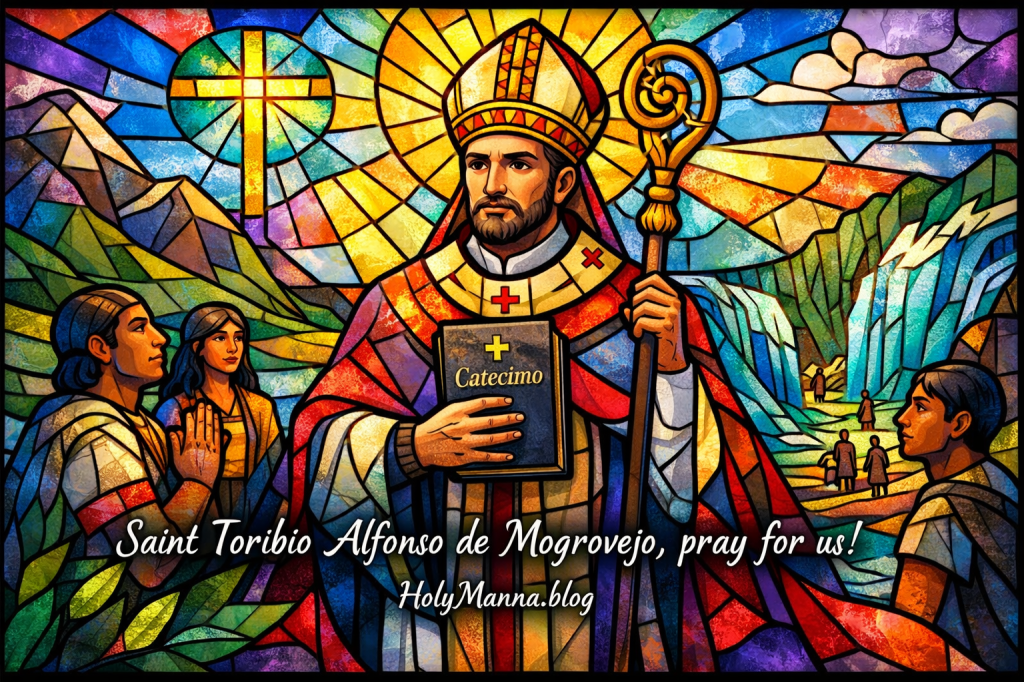
The Archbishop Who Wore Out His Sandals for Christ
Saint Toribio Alfonso de Mogrovejo stands as one of the great missionary bishops in the history of the Church. He was not simply a church administrator or a respected prelate with a long title. He was a true shepherd who gave his strength, his mind, his comfort, and finally his life to bring Christ to souls. The Church remembers him as the second Archbishop of Lima, a reformer of the clergy, a defender of the poor and Indigenous peoples, a founder of seminaries, and a tireless missionary who crossed enormous distances to preach the Gospel.
His importance in Christian tradition is hard to overstate. In the life of the Church, bishops are meant to be fathers, teachers, sanctifiers, and guardians of unity. The Catechism teaches that bishops receive the grace and responsibility to shepherd the People of God in communion with the Church. Saint Toribio lived that calling with unusual seriousness. He did not remain in the safety of the city while his people struggled in distant villages. He went to them. He learned their situation. He corrected what was broken. He preached Christ crucified and risen. He helped give stable Catholic form to the Church in South America.
That is why he is revered not only as a holy bishop from the past, but as a model of what a bishop should be. He is remembered as a pastor who loved truth, who did not bend to corruption, and who believed deeply that the Gospel belongs to every people and every language.
From Noble Spain to the Missions of Peru
Toribio was born in 1538 in Mayorga, Spain, into a noble and respected family. He received an excellent education and became known for his intelligence, discipline, and moral seriousness. He studied law and later taught at Salamanca, one of the great centers of learning in Spain. He also served in an important judicial role under the crown. By every outward measure, he seemed headed toward a distinguished legal and academic career.
Then God interrupted everything.
In one of the most surprising turns in the lives of the saints, Toribio was chosen to become Archbishop of Lima even though he was still a layman. That detail alone can stop a reader in his tracks. A man trained in civil law, not yet ordained, was selected to govern one of the most important dioceses in the New World. The choice was made because of his reputation for wisdom, virtue, and sound judgment.
He did not rush toward the honor. Catholic tradition remembers that he hesitated and approached the call with seriousness. When he accepted, he sought to prepare himself carefully and received Holy Orders in due course before taking possession of his see. He arrived in Peru in 1581, and from that moment on, his life ceased to belong to himself.
His faith did not begin with a dramatic conversion from unbelief. His story is not one of a libertine suddenly becoming holy. It is the story of a faithful Catholic man whose devotion deepened when God entrusted him with a mission far greater than anything he would have chosen for himself. His sanctity grew through obedience. His conversion was the conversion of a good man into a great shepherd.
What is he most known for? He is known for bringing order, discipline, doctrine, missionary zeal, and pastoral charity to the Church in Peru and beyond. He is also known for refusing to let distance, weather, politics, fatigue, or danger keep him from reaching souls.
Walking the Andes With the Heart of a Pastor
Once Saint Toribio became Archbishop of Lima, he embraced the work with astonishing energy. His archdiocese was massive. It covered difficult terrain, isolated villages, and populations speaking different languages. Many bishops would have relied mostly on reports and delegates. Toribio chose another path. He personally visited his people again and again, traveling on foot or by mule through mountains, forests, heat, and exhaustion.
This was not occasional heroism. This was the pattern of his life.
He held diocesan synods and provincial councils to reform abuses and strengthen the life of the Church. The Third Provincial Council of Lima became especially important because it helped shape Catholic life in the region for generations. Under his leadership, catechetical teaching was strengthened, clergy formation improved, and the faith was presented in a more serious and coherent way. He also founded the seminary at Lima, which is remembered as the first seminary in the Americas.
One of the most beautiful parts of his legacy is his concern that the faith be preached in the languages of the people. He did not act as though Spanish culture and the Catholic faith were identical. He understood that the Gospel must be proclaimed faithfully and clearly to every nation. Catholic tradition links him strongly to the catechism published in Spanish, Quechua, and Aymara, a remarkable achievement in the evangelization of the New World.
He was also closely connected to the great flowering of holiness in Peru. He is remembered as having administered the sacraments to figures such as Saint Rose of Lima and Saint Martin de Porres. That means his life touched not only institutions and councils, but souls who would themselves become lights in the Church.
Saint Toribio left behind lines that reveal his spiritual seriousness. One of the best known and most solidly attested sayings associated with him is this: “Time is not ours, it is very brief, and God will hold us strictly accountable for how we have used it.” That sentence alone says a great deal about the man. He lived like someone who expected to answer to Christ for every grace given.
A second saying preserved from one of his letters reads: “A Dios sean dadas las gracias, por quien sólo esto se hace, en edificación de los prójimos, procurando darles buen ejemplo y animándolos a lo mismo.” In English, this means, “To God be thanks, for it is only through Him that this is done, for the edification of our neighbors, striving to give them good example and encouraging them to do the same.” That is the heart of a bishop. Everything goes back to God, and everything is meant to help souls.
Signs of Grace Along the Road
Saint Toribio is remembered not only for administrative reform and missionary travel, but also for extraordinary events associated with his life. Some of these belong to well-loved Catholic tradition and are repeated in devotional sources. Others are harder to verify in a strict historical sense. It is still worth telling them, because they form part of how Catholic memory has honored him, but honesty requires noting where certainty is limited.
One longstanding tradition presents him as a kind of new Moses. In that tradition, a river or body of water opened or gave way so that he could pass and continue his mission to people waiting for the Gospel. This story has circulated in Catholic remembrance of him for a long time and has been reflected in Church imagery. It expresses how many believers saw him: as a man whose pastoral mission was so pleasing to God that heaven itself aided him. This story cannot be fully verified from the strongest historical records available.
Other testimonies from his cause speak of unusual signs surrounding his holiness. Some witnesses claimed that his face shone “like a star.” Others believed he experienced intimate communion with heavenly realities, even speaking with angels. These testimonies are part of his devotional tradition and were treated seriously in the context of his reputation for sanctity, but they cannot all be verified with equal historical certainty.
Yet in a deeper sense, the greatest miracle of his life may have been less spectacular and more demanding. He turned a brilliant legal career into a life of self-emptying missionary service. He crossed punishing territory to reach forgotten souls. He held together truth and charity. He preached the Gospel in a world full of competing ambitions, cruelty, and disorder. A man does not live like that for decades without grace.
That is why he should be remembered and imitated. He shows what happens when a Catholic does not ask, “What is easiest?” but asks, “What does Christ want from me?” He teaches that holiness is not made only in cloisters and chapels, though it surely is made there. Holiness is also made on hard roads, in difficult duties, in meetings, in corrections, in fatigue, and in the long patience required to build up the Church.
The Hard Road of a Bishop Without Comfort
Saint Toribio did not die a martyr’s death in the strict sense. He was not executed for the faith. Still, he lived what many Catholics would call a kind of white martyrdom, a life poured out in exhausting fidelity.
He faced serious resistance. Reform always stirs up enemies, especially when a saint refuses to flatter the powerful. Toribio worked to correct abuses among clergy and civil authorities. He defended Indigenous peoples and insisted on their dignity. He challenged corruption and disorder. That did not make him universally popular. Men attached to comfort, status, or unjust privilege rarely welcome a holy reformer.
He also endured the physical hardships of missionary life. He crossed dangerous routes, rough mountains, and remote regions under difficult conditions. He labored in a vast territory where the needs were endless. It is easy to romanticize missionary life from a distance. It was likely often lonely, dirty, slow, frustrating, and painful. Yet he kept going.
There are also traditions that divine protection accompanied him in his labors, especially in dangerous crossings and harsh journeys. These accounts form part of the saint’s devotional memory, though not all can be verified with complete historical certainty.
His final hardship came in the very act of serving. He fell ill while still on pastoral visitation and died far from comfort, far from ceremony, and far from the kind of ease that worldly success would have offered him in Spain. He died on Holy Thursday in 1606, near Zaña in Peru, while still carrying out his duties. There is something profoundly fitting in that. A bishop who spent himself for Christ died while still on the road for souls.
Catholic tradition also preserves that in his final hours he prayed with the words of Psalm 30 and surrendered himself peacefully to God. He did not die in bitterness. He died like a servant returning to his Master.
Wonders After Death and a Legacy That Still Breathes
After his death, devotion to Saint Toribio grew steadily. Many favors and miracles were attributed to his intercession. Some of these stories belong to the broad devotional memory surrounding his canonization and later veneration. They help show how deeply the faithful believed that this holy archbishop continued to care for souls from heaven.
One tradition says that extraordinary signs accompanied his death, including a luminous cross, tremors, and an eclipse-like darkness. These stories have been repeated in Catholic devotional sources and reflect the sense that heaven marked the passing of a great shepherd. These stories cannot be fully verified from the strongest historical records available.
Another important tradition states that when his body was translated about a year after his burial, it was found incorrupt. Incorruption has long held a special place in Catholic devotion as a sign associated with sanctity, though the Church always approaches such claims with seriousness rather than sensationalism. This story is part of the saint’s traditional legacy, but its details are not easy to verify with complete certainty from all modern historical standards.
His relics became and remain objects of deep veneration. In Lima, the faithful have honored his remains, including relics associated with his body and personal items. The veneration of relics is not superstition. It flows from the Catholic belief that the body matters, that grace works through real human lives, and that the saints remain united to the Church in glory. The Catechism teaches that the communion of saints is a living reality. In that light, relics remind the faithful that holiness happened in flesh and blood, in time and space, in a real human life.
His impact after death has also been cultural and ecclesial. He was beatified in 1697 and canonized in 1726. In 1983, Pope Saint John Paul II confirmed him as the patron of the bishops of Latin America. That is an extraordinary legacy. He is not honored only as a local Peruvian saint, but as a model for the episcopate of an entire continent.
His memory remains alive in Peru and in Spain. The Church celebrates his memorial on March 23, and local devotion has also strongly remembered the translation of his relics. Jubilee celebrations, liturgical commemorations, and public veneration of his relics have continued into recent years. Institutions also bear his name, showing that he is still seen as a fatherly figure in Catholic education and identity.
There is also a national dimension to his legacy. Peru remembers him as one of the great builders of its Catholic soul. He helped shape the Church that formed generations of believers, clergy, religious, and saints. His life helped leave a distinct Catholic mark on the spiritual history of the country.
What Saint Toribio Teaches the Church Today
Saint Toribio has a message that feels especially needed now. He teaches that truth and charity belong together. Many people try to separate them. Some use truth as an excuse for harshness. Others use charity as an excuse for compromise. Toribio did neither. He defended the dignity of souls, corrected real abuses, taught clearly, and kept moving outward in pastoral love.
He teaches that leadership in the Church must be sacrificial. Real shepherds smell like the sheep because they have been with the sheep. They do not govern only through paperwork, public image, or slogans. They teach, suffer, walk, listen, correct, and pray.
He teaches that time matters. His quote about time is not a gloomy threat. It is a wake-up call. Life is brief. Grace is real. Every day can be offered to God. Every duty can become holy. Every delay in conversion is dangerous.
He also teaches that the Gospel is for every people. He cared enough to support preaching and catechesis in native languages because he understood something very Catholic and very beautiful. Christ does not belong to one class, one nation, or one tribe. Christ came for all.
For readers today, the application is concrete. Take the duties already given and do them with greater love. Take prayer more seriously. Do not waste time on distractions that leave the soul thinner and colder. Defend the dignity of the weak. Learn the faith more deeply. Support faithful priests and bishops. Refuse the lie that holiness is for other people in other times.
What would change if each day were lived with the awareness that it belongs first to God? What hard road has Christ placed in front of the soul right now, and what would it look like to walk it faithfully instead of complaining? How can truth be spoken more clearly and charity be lived more deeply in daily life?
Saint Toribio’s life invites a serious examination of conscience, but it also brings encouragement. God often uses men and women in ways they never expected. A lawyer became a missionary archbishop. A respected official became a saint who wore out his body for the Church. Grace can do more than the world imagines.
Engage With Us!
Share your thoughts and reflections in the comments below. The life of Saint Toribio has a way of stirring both admiration and conviction, especially for anyone trying to live the faith seriously in an age of distraction and compromise.
- What part of Saint Toribio’s life speaks most strongly to the heart, his obedience, his missionary zeal, his defense of the vulnerable, or his endurance in hardship?
- How can his example help Catholics take better care of the time God has given them?
- What does his life teach about the kind of leadership the Church needs in every generation?
- Where might Christ be asking for greater sacrifice, courage, or perseverance in daily life right now?
- How can the faith be lived more intentionally at home, at work, and in the parish through the example of Saint Toribio?
May Saint Toribio Alfonso de Mogrovejo pray for the Church, for bishops, for missionaries, and for every soul trying to follow Christ with courage. Live the faith with seriousness, serve with humility, and do everything with the love and mercy Jesus taught us.
Saint Toribio Alfonso de Mogrovejo, pray for us!
Follow us on YouTube, Instagram and Facebook for more insights and reflections on living a faith-filled life.

 Holy Manna!
Leave a comment