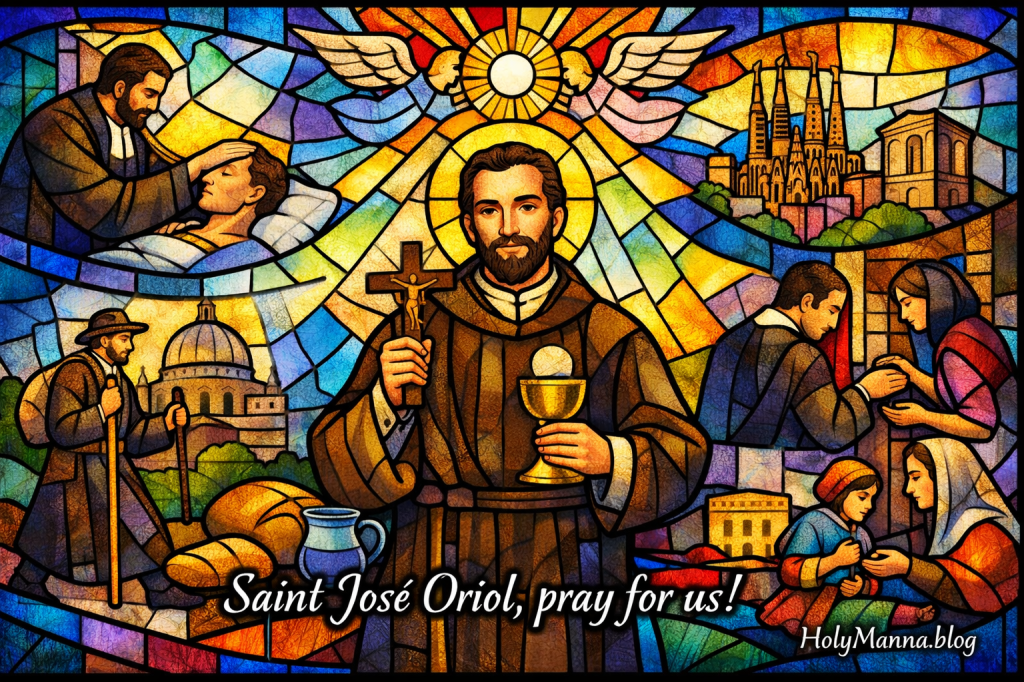
The Bread and Water Priest Who Healed a City
Some saints are remembered for founding religious orders. Some are remembered for martyrdom in the arena or for preaching before kings. Saint José Oriol is remembered for something that can seem smaller at first glance, but is actually one of the clearest signs of real holiness. He was a simple diocesan priest who loved God deeply, served the poor generously, heard confessions faithfully, and became a vessel of mercy for the people of Barcelona.
The Church reveres him because his life shows that sanctity is not reserved for the famous or the powerful. It belongs to the man who prays, fasts, gives, serves, and quietly lets Christ shine through him. He became known as the “Bread and Water doctor,” and also as the wonder-worker of Barcelona, because of his severe penance, his tender care for the sick, and the many healings associated with his ministry. In him, the faithful saw a priest wholly given over to Jesus Christ.
His life reflects what The Catechism teaches about the universal call to holiness. Every member of the Church is called to the fullness of Christian life and to the perfection of charity, not by worldly greatness, but by union with Christ in love and sacrifice, as taught in CCC 2013-2014. Saint José Oriol lived that truth in a way the people around him could see with their own eyes.
From the Streets of Barcelona to the Altar of God
Saint José Oriol was born in Barcelona on November 23, 1650, into a humble Christian family. He was the youngest of eight children. From the beginning, his life was shaped by the Church. He was baptized the same day he was born, and as a boy he served at the altar. That detail matters. So many saints first learned how to love Christ by being near the sanctuary, near the prayers of the Church, and near the mystery of the Holy Mass.
He studied well and eventually earned a doctorate in theology. He was ordained a priest in 1676. Yet even with academic success, his life did not become one of comfort or ambition. He did not use learning to build prestige. He used it to serve souls. He also made a pilgrimage on foot to Rome after the death of his mother, a journey that showed both his devotion and his deep longing to belong entirely to God.
He spent time connected to the Oratory of Saint Philip Neri and also worked as a tutor. These details reveal something beautiful. God was preparing him in hidden ways before placing him in the work for which he would be remembered. Eventually he became a beneficed priest at Santa Maria del Pi in Barcelona, and that church would become the center of his earthly mission.
What is he most known for? He is known for radical charity, severe penance, miraculous healings, deep prayer, and priestly service to the poor and the sick. He is also known for living with such detachment that people would wait for him when he received his stipend, because they knew he would give much of it away almost immediately.
The Priest Who Lived on Bread, Water, and Grace
Once Saint José Oriol began his long ministry at Santa Maria del Pi, his holiness became impossible to hide. He lived with extraordinary austerity. Catholic tradition remembers him as the “Bread and Water doctor” because of his life of penance. He ate very little, embraced sacrifice, and refused the comfortable life he could have pursued. This was not self-hatred. This was love. He wanted to belong to Christ without reserve.
His life among the people was marked by compassion. In a time with very limited medical care, he personally tended the sick, washed wounds, applied simple remedies, and prayed over suffering people. He was not merely a priest who preached from a distance. He entered into the pain of his flock. He carried their burdens in his body, his prayer, and his daily routine.
The people also came to him for confession and spiritual counsel. He was known for prudence, humility, and supernatural insight. Many saw in him a man who could read the suffering of the soul with clarity and gentleness. This is one reason his memory remains so strong. He did not just impress people. He helped convert them.
During his lifetime, many miracles were attributed to his intercession and presence. Catholic tradition remembers healings of the blind, the lame, the paralyzed, and those suffering grave sickness. He became especially associated with the Chapel of the Blood at Santa Maria del Pi, where many sought him out. These miracles were not treated as magic or spectacle. They were understood as signs of God’s mercy, flowing through the life of a priest who had emptied himself for the sake of Christ.
There is also a strong local tradition that connects him with the miracle of the coins, as well as the legend of the radishes and the coins. These stories remain part of his popular memory in Barcelona and continue to shape his feast-day celebrations. They belong to the living devotional tradition around him. The full historical details of those stories are not always preserved with the precision modern readers might want, so they should be received as part of local Catholic memory rather than as fully verifiable historical accounts.
Why should he still be remembered and imitated? Because he proves that holiness is not abstract. It has hands. It has habits. It has a schedule. It has prayer before dawn, simplicity at table, mercy toward sinners, and tenderness toward the suffering. Saint José Oriol teaches that the priesthood, and really the whole Christian life, bears fruit when it is poured out.
Trials, Suspicion, and the Cross He Chose to Carry
Not every saint suffered martyrdom by blood, but every saint suffered the cross. Saint José Oriol’s hardships came through bodily austerity, constant service, sickness, misunderstanding, and the weight of spiritual responsibility. He desired martyrdom and even made efforts connected to missionary aspirations, but God did not grant him the red crown. Instead, He gave him the hidden martyrdom of daily sacrifice.
At one point, elements of his spirituality were examined in the atmosphere of suspicion that surrounded certain mystical tendencies of the time. He was investigated, but no penalty followed. Even that detail reveals something important. The truly holy are not always immediately understood. Even so, he remained obedient to the Church. He did not turn inward in bitterness. He kept serving.
He also lived in a troubled Catalonia marked by unrest, poverty, and social suffering. His ministry touched not only ordinary parishioners but also those on the edges, including the sick, the poor, and soldiers. He carried all of this as a priest who knew the cost of love.
His final suffering came in illness. He reportedly foretold his coming death shortly before it arrived. He died on March 23, 1702. Even in death, his witness remained powerful. The crowds that gathered for his funeral showed how deeply the people of Barcelona already regarded him as a holy man. He was not canonized yet, but the faithful had already recognized the fragrance of sanctity.
The Wonder-Worker of Barcelona After Death
Saint José Oriol’s impact did not end when he died. In many ways, it deepened. His burial place at Santa Maria del Pi became a place of devotion, and stories of favors, healings, and heavenly help continued to surround his name. The Church eventually opened his cause for beatification, and the faithful kept his memory alive through prayer, celebration, and veneration.
He was beatified by Pope Pius VII in 1806 and canonized by Pope Pius X in 1909. His feast is celebrated on March 23. That formal recognition by the Church confirmed what the people of Barcelona had long believed. This priest had lived and died in heroic holiness.
His relics and chapel became important signs of his continuing presence in the life of the local Church. There were hardships even after death. During the violence of the Spanish Civil War, parts of the artistic and devotional heritage connected to him were destroyed, and relics associated with his cult were affected. Yet devotion to him endured. His memory survived fire, political chaos, and the passing of centuries. That endurance itself says something powerful. The saints are not preserved merely by stone or artwork. They are preserved by the love of the Church.
Barcelona still celebrates him in living ways. He remains connected to the neighborhood of the Pi and is honored as patron of the priests of the Archdiocese of Barcelona. Traditional festivities, sacred drama, hymns, floral offerings, and local customs continue to remember him. The Retaule de Sant Josep Oriol keeps his story alive in dramatic form, showing that Catholic memory is not cold history. It is a family remembering one of its own.
As for miracle stories after death, many favors and healings have long been associated with his intercession through popular devotion. Some of these are firmly embedded in Catholic tradition, while others cannot be historically verified in full detail today. When such stories are passed on, they should be received with reverence and prudence, in the spirit with which the Church always distinguishes between popular devotion and formally verified miracles. Even so, their persistence reveals how deeply the faithful experienced his closeness and help.
What Saint José Oriol Teaches the Soul Today
Saint José Oriol speaks with surprising force to the modern world. A culture obsessed with visibility has a hard time understanding hidden holiness. A culture addicted to comfort has a hard time understanding penance. A culture that wants quick spirituality without sacrifice has a hard time understanding a man who lived on bread, water, prayer, and mercy.
But that is exactly why he matters.
He reminds the faithful that holiness grows through fidelity in ordinary duties. He reminds priests to be fathers, confessors, servants, and men of prayer. He reminds lay Catholics that love of neighbor is not a slogan. It is a concrete duty. The poor need food. The sick need care. The sorrowful need consolation. The sinner needs truth and mercy together. This is the Gospel lived out in real time.
His life also teaches the value of hidden sacrifice. Penance is not popular, but it is deeply Catholic. Christ Himself said in The Gospel of Matthew, “Whoever wishes to come after me must deny himself, take up his cross, and follow me” Mt 16:24. Saint José Oriol took that seriously. He did not perform sacrifice for attention. He embraced it so that his heart could be freer for God and neighbor.
There is also a beautiful lesson here about vocation. He wanted great things for God, even martyrdom. Instead, God gave him parish life, the confessional, the sickroom, the city street, and the poor at his door. That was his road to glory. Many people today are tempted to think holiness requires some dramatic mission. Often it does not. Often it requires loving the person in front of you, doing your duty, praying faithfully, and staying close to the sacraments.
Where has God placed the soul right now to love Him more faithfully? What acts of hidden sacrifice could make more room for grace? How might deeper prayer and works of mercy change the atmosphere of daily life?
A practical way to live his example is simple. Return to confession regularly. Fast in some sincere and disciplined way. Give more generously to the poor. Visit someone who is sick, elderly, or lonely. Pray before the Blessed Sacrament. Ask God to make the heart less interested in comfort and more interested in charity. That is the road Saint José Oriol walked, and it is still open.
Engage with Us!
Share your thoughts and reflections in the comments below. Saint José Oriol is the kind of saint who quietly asks whether faith has become too comfortable, too private, or too detached from mercy. His life gives plenty to think about.
- What part of Saint José Oriol’s life stands out the most, his penance, his care for the sick, his love for the poor, or his hidden priestly fidelity? Why?
- Do the habits of daily life make more room for prayer and sacrifice, or more room for distraction and comfort?
- How can greater generosity toward the poor become a real part of Christian discipleship this week?
- What does Saint José Oriol’s life teach about the quiet power of confession, Eucharistic devotion, and ordinary parish life?
- Is there a hidden cross that can be offered to Jesus with more love and trust starting today?
May Saint José Oriol inspire a deeper love for prayer, a stronger commitment to penance, and a more generous heart toward the suffering. Live the faith with conviction. Love with courage. Serve with humility. And do everything with the love and mercy Jesus taught us.
Saint José Oriol, pray for us!
Follow us on YouTube, Instagram and Facebook for more insights and reflections on living a faith-filled life.

 Holy Manna!
Leave a comment