Monday of the Fifth Week of Lent – Lectionary: 251
When Mercy Stands in the Courtroom
Some of the most powerful moments in salvation history happen when it looks like truth is about to lose. A woman stands surrounded by accusers. A crowd is ready to believe the worst. The powerful seem untouchable. And yet, in today’s readings, the Lord shows that He is never absent when His people are tested. He sees what is hidden, He exposes what is false, and He does not abandon those who hope in Him.
The central theme tying these readings together is this: God defends the innocent, exposes hypocrisy, and offers mercy that calls sinners to conversion. In the story of Susanna, a righteous woman is nearly destroyed by corrupt judges who use their authority to serve lust and lies. In the Gospel, another woman is dragged into public shame by men who care less about holiness than about using her as a trap. Between those two scenes, Psalm 23 gives the Church the words to pray: “Even though I walk through the valley of the shadow of death, I will fear no evil, for you are with me.” That is the heartbeat of the whole day. The Lord is near in the valley. He is near in the courtroom. He is near when human judgment becomes twisted and cruel.
These readings also carry the weight of Israel’s moral and religious world. In both passages, the Law matters. Justice matters. Chastity matters. Sin is not treated lightly. But neither is the dignity of the human person. In Susanna’s case, the sin is not hers, but that of wicked elders who bear false witness and try to bury innocence under the appearance of legality. In The Gospel of John, the woman truly has sinned, yet Christ refuses to let the law be weaponized by men whose hearts remain unconverted. This is where the Roman Catholic reading becomes so important. The Lord Jesus does not excuse sin, but He also does not hand sinners over to humiliation as though shame itself could save them. He reveals a justice deeper than public rage and a mercy strong enough to tell the truth.
As Lent draws closer to Holy Week, the Church places these readings before her children to sharpen the conscience. They ask hard questions about lust, judgment, false witness, abuse of authority, and the difference between outward religion and real holiness. They also reveal the heart of God. He is not impressed by appearances. He is not deceived by titles. He is not bullied by mobs. He is the Shepherd who leads through dark valleys, the Judge who defends the innocent, and the Savior who tells the sinner, “Neither do I condemn you. Go, [and] from now on do not sin any more.” Today’s readings invite every soul to step out of the crowd, to put down the stone, and to trust that truth and mercy still belong to God.
First Reading, Daniel 13:1-9, 15-17, 19-30, 33-62
When the Innocent Are Put on Trial
The story of Susanna unfolds among the Jewish exiles in Babylon, a time when God’s people were living far from Jerusalem and trying to remain faithful in a foreign land. That setting matters. Israel did not only need protection from pagan kings. She also needed protection from corruption within her own community. The two elders in this reading were not outsiders. They were judges, men entrusted with the sacred duty of guarding justice according to the Law of Moses. Instead, they became men ruled by lust, deceit, and abuse of power. In that sense, this reading fits today’s theme with painful precision. God defends the innocent, exposes hypocrisy, and reveals that sin becomes most dangerous when it hides behind religious respectability. Susanna stands in this passage as a daughter of Israel who fears God more than man, and Daniel appears as the instrument through whom the Lord vindicates truth.
Daniel 13:1-9, 15-17, 19-30, 33-62 – New American Bible (Revised Edition)
Susanna. 1 In Babylon there lived a man named Joakim, 2 who married a very beautiful and God-fearing woman, Susanna, the daughter of Hilkiah; 3 her parents were righteous and had trained their daughter according to the law of Moses. 4 Joakim was very rich and he had a garden near his house. The Jews had recourse to him often because he was the most respected of them all.
5 That year, two elders of the people were appointed judges, of whom the Lord said, “Lawlessness has come out of Babylon, that is, from the elders who were to govern the people as judges.” 6 These men, to whom all brought their cases, frequented the house of Joakim. 7 When the people left at noon, Susanna used to enter her husband’s garden for a walk. 8 When the elders saw her enter every day for her walk, they began to lust for her. 9 They perverted their thinking; they would not allow their eyes to look to heaven, and did not keep in mind just judgments.
15 One day, while they were waiting for the right moment, she entered as usual, with two maids only, wanting to bathe in the garden, for the weather was warm. 16 Nobody else was there except the two elders, who had hidden themselves and were watching her. 17 “Bring me oil and soap,” she said to the maids, “and shut the garden gates while I bathe.”
19 As soon as the maids had left, the two old men got up and ran to her. 20 “Look,” they said, “the garden doors are shut, no one can see us, and we want you. So give in to our desire, and lie with us. 21 If you refuse, we will testify against you that a young man was here with you and that is why you sent your maids away.”
22 “I am completely trapped,” Susanna groaned. “If I yield, it will be my death; if I refuse, I cannot escape your power. 23 Yet it is better for me not to do it and to fall into your power than to sin before the Lord.” 24 Then Susanna screamed, and the two old men also shouted at her, 25 as one of them ran to open the garden gates. 26 When the people in the house heard the cries from the garden, they rushed in by the side gate to see what had happened to her. 27 At the accusations of the old men, the servants felt very much ashamed, for never had any such thing been said about Susanna.
28 When the people came to her husband Joakim the next day, the two wicked old men also came, full of lawless intent to put Susanna to death. 29 Before the people they ordered: “Send for Susanna, the daughter of Hilkiah, the wife of Joakim.” When she was sent for, 30 she came with her parents, children and all her relatives.
33 All her companions and the onlookers were weeping.
34 In the midst of the people the two old men rose up and laid their hands on her head. 35 As she wept she looked up to heaven, for she trusted in the Lord wholeheartedly. 36 The old men said, “As we were walking in the garden alone, this woman entered with two servant girls, shut the garden gates and sent the servant girls away. 37 A young man, who was hidden there, came and lay with her. 38 When we, in a corner of the garden, saw this lawlessness, we ran toward them. 39 We saw them lying together, but the man we could not hold, because he was stronger than we; he opened the gates and ran off. 40 Then we seized this one and asked who the young man was, 41 but she refused to tell us. We testify to this.” The assembly believed them, since they were elders and judges of the people, and they condemned her to death.
42 But Susanna cried aloud: “Eternal God, you know what is hidden and are aware of all things before they come to be: 43 you know that they have testified falsely against me. Here I am about to die, though I have done none of the things for which these men have condemned me.”
44 The Lord heard her prayer. 45 As she was being led to execution, God stirred up the holy spirit of a young boy named Daniel, 46 and he cried aloud: “I am innocent of this woman’s blood.” 47 All the people turned and asked him, “What are you saying?” 48 He stood in their midst and said, “Are you such fools, you Israelites, to condemn a daughter of Israel without investigation and without clear evidence? 49 Return to court, for they have testified falsely against her.”
50 Then all the people returned in haste. To Daniel the elders said, “Come, sit with us and inform us, since God has given you the prestige of old age.” 51 But he replied, “Separate these two far from one another, and I will examine them.”
52 After they were separated from each other, he called one of them and said: “How you have grown evil with age! Now have your past sins come to term: 53 passing unjust sentences, condemning the innocent, and freeing the guilty, although the Lord says, ‘The innocent and the just you shall not put to death.’ 54 Now, then, if you were a witness, tell me under what tree you saw them together.” 55 “Under a mastic tree,” he answered. “Your fine lie has cost you your head,” said Daniel; “for the angel of God has already received the sentence from God and shall split you in two.” 56 Putting him to one side, he ordered the other one to be brought. “Offspring of Canaan, not of Judah,” Daniel said to him, “beauty has seduced you, lust has perverted your heart. 57 This is how you acted with the daughters of Israel, and in their fear they yielded to you; but a daughter of Judah did not tolerate your lawlessness. 58 Now, then, tell me under what tree you surprised them together.” 59 “Under an oak,” he said. “Your fine lie has cost you also your head,” said Daniel; “for the angel of God waits with a sword to cut you in two so as to destroy you both.”
60 The whole assembly cried aloud, blessing God who saves those who hope in him. 61 They rose up against the two old men, for by their own words Daniel had convicted them of bearing false witness. They condemned them to the fate they had planned for their neighbor: 62 in accordance with the law of Moses they put them to death. Thus was innocent blood spared that day.
Detailed Exegesis
Verse 1. “In Babylon there lived a man named Joakim,”
The reading begins in Babylon, the place of exile. That single detail already tells the reader that God’s people are living in a spiritually hostile world. Even there, however, the covenant life of Israel continues. Families still exist, marriages still matter, and fidelity to God is still possible.
Verse 2. “who married a very beautiful and God-fearing woman, Susanna, the daughter of Hilkiah;”
Susanna’s beauty is mentioned, but Scripture immediately gives greater emphasis to her fear of God. In a Catholic reading, this matters deeply. Her true dignity is not her appearance, but her holiness. She is introduced first as a woman of reverence, not as an object for the gaze of others.
Verse 3. “her parents were righteous and had trained their daughter according to the law of Moses.”
This verse shows the power of faithful formation in the home. Susanna’s courage later in the story does not come out of nowhere. It has been planted in her from childhood by righteous parents who took the Law seriously. This is a quiet but strong witness to the vocation of mothers and fathers.
Verse 4. “Joakim was very rich and he had a garden near his house. The Jews had recourse to him often because he was the most respected of them all.”
Joakim’s home is a place of prominence and influence. The garden, which should symbolize order, beauty, and peace, becomes the place where hidden evil tries to flourish. Sin often seeks cover in respectable places.
Verse 5. “That year, two elders of the people were appointed judges, of whom the Lord said, ‘Lawlessness has come out of Babylon, that is, from the elders who were to govern the people as judges.’”
The tragedy of the passage is laid bare. The men appointed to uphold justice have become its betrayers. Their office is honorable, but their hearts are corrupt. This verse exposes one of the hardest truths in salvation history: authority can be twisted when those entrusted with it cease to fear God.
Verse 6. “These men, to whom all brought their cases, frequented the house of Joakim.”
The judges are constantly around the place where Susanna lives. Their access comes from their public role. This is how abuse often works. Authority creates access, and access becomes an occasion for temptation when virtue is absent.
Verse 7. “When the people left at noon, Susanna used to enter her husband’s garden for a walk.”
Susanna’s actions are simple and innocent. She is not scheming, flirting, or hiding. Scripture makes that plain. The evil in this passage does not come from her conduct, but from the corrupted eyes of the elders.
Verse 8. “When the elders saw her enter every day for her walk, they began to lust for her.”
Sin begins in the heart and in the gaze. What they saw should have remained under discipline. Instead, they chose lust. This verse echoes Christ’s later teaching that adultery begins in the heart before it reaches the body.
Verse 9. “They perverted their thinking; they would not allow their eyes to look to heaven, and did not keep in mind just judgments.”
This is one of the most revealing verses in the whole reading. Lust does not stay in one corner of the soul. It twists thought, darkens vision, and destroys justice. They stop looking to heaven, which means they stop living before God. Once that happens, unjust judgment becomes easier.
Verse 15. “One day, while they were waiting for the right moment, she entered as usual, with two maids only, wanting to bathe in the garden, for the weather was warm.”
The elders are no longer merely tempted men. They are now plotting men. Their sin has moved from desire to calculation. The phrase “waiting for the right moment” shows deliberate malice.
Verse 16. “Nobody else was there except the two elders, who had hidden themselves and were watching her.”
They are physically hidden, but morally exposed before God. Their secrecy reveals shame, yet instead of repenting they proceed further into darkness.
Verse 17. “‘Bring me oil and soap,’ she said to the maids, ‘and shut the garden gates while I bathe.’”
Again, Susanna acts with innocence and ordinary modesty. The shutting of the gates, which should provide privacy and safety, becomes the circumstance the elders exploit for evil.
Verse 19. “As soon as the maids had left, the two old men got up and ran to her.”
The speed of their movement shows the violence of lust once it is no longer restrained. Age has not sanctified them. They are elders in years, but not in wisdom.
Verse 20. “‘Look,’ they said, ‘the garden doors are shut, no one can see us, and we want you. So give in to our desire, and lie with us.’”
Their language is shameless and coercive. They reduce Susanna to an object for their gratification. There is no love here, no covenant, no reverence, only domination.
Verse 21. “If you refuse, we will testify against you that a young man was here with you and that is why you sent your maids away.”
Now lust becomes blackmail. The elders are willing not only to sin, but to weaponize their public credibility in order to destroy the innocent. This is the sin of false witness joined to sexual corruption.
Verse 22. “‘I am completely trapped,’ Susanna groaned. ‘If I yield, it will be my death; if I refuse, I cannot escape your power.’”
Susanna sees the trap clearly. This is not a moment of romantic temptation. It is a moment of terror. She is caught between physical coercion and public ruin.
Verse 23. “Yet it is better for me not to do it and to fall into your power than to sin before the Lord.”
Here is the moral summit of the reading. Susanna chooses fidelity over self-preservation. She would rather suffer injustice than commit sin. This is the language of conscience formed by the fear of God.
Verse 24. “Then Susanna screamed, and the two old men also shouted at her,”
Her cry is both protest and witness. She does not cooperate with evil. The elders answer her truth with louder lies, which is often how wickedness behaves when exposed.
Verse 25. “as one of them ran to open the garden gates.”
The opening of the gates brings the matter into public view, but not yet into public truth. Appearances can be manipulated before facts are known.
Verse 26. “When the people in the house heard the cries from the garden, they rushed in by the side gate to see what had happened to her.”
The household responds to the noise, but they do not understand the event. This prepares the reader for the terrible ease with which false narratives can spread.
Verse 27. “At the accusations of the old men, the servants felt very much ashamed, for never had any such thing been said about Susanna.”
The shame falls not first on the guilty, but on the innocent woman whose name has been attacked. Calumny wounds reputation immediately, even before truth has time to answer.
Verse 28. “When the people came to her husband Joakim the next day, the two wicked old men also came, full of lawless intent to put Susanna to death.”
Their plan has hardened into murderous intent. The reading makes clear that false witness is not a minor sin. It can become a path to killing the innocent.
Verse 29. “Before the people they ordered: ‘Send for Susanna, the daughter of Hilkiah, the wife of Joakim.’ When she was sent for,”
Susanna is summoned publicly and formally. The machinery of judgment is now moving against her. Evil often borrows the language of order and procedure to make itself look righteous.
Verse 30. “she came with her parents, children and all her relatives.”
Her family stands with her in sorrow. The accusation does not wound only one person. Sin, especially public sin and false accusation, spreads pain through the whole household.
Verse 33. “All her companions and the onlookers were weeping.”
The community senses the tragedy, yet emotion alone cannot save her. Tears are not enough. Truth must be spoken, and justice must be restored.
Verse 34. “In the midst of the people the two old men rose up and laid their hands on her head.”
This gesture mimics legal solemnity, but the men performing it are liars. The outward sign of testimony has been emptied of righteousness. It is a chilling image of sacred forms abused by sinful men.
Verse 35. “As she wept she looked up to heaven, for she trusted in the Lord wholeheartedly.”
This verse answers verse 9. The elders refused to look to heaven, but Susanna lifts her eyes there. Their gaze is closed in upon desire; hers is opened in trust. That contrast reveals the whole spiritual battle.
Verse 36. “The old men said, ‘As we were walking in the garden alone, this woman entered with two servant girls, shut the garden gates and sent the servant girls away.’”
They begin their fabricated narrative with ordinary details to make the lie sound believable. Falsehood often dresses itself in small facts to hide a great deceit.
Verse 37. “A young man, who was hidden there, came and lay with her.”
They invent the crime to cover their own desire. The guilty project their sin onto the innocent.
Verse 38. “When we, in a corner of the garden, saw this lawlessness, we ran toward them.”
They present themselves as guardians of morality. This is hypocrisy at its ugliest. They claim zeal for righteousness while concealing the wickedness of their own hearts.
Verse 39. “We saw them lying together, but the man we could not hold, because he was stronger than we; he opened the gates and ran off.”
The lie becomes more detailed because details can impress the crowd. Yet the story also contains its own weakness. The supposed witnesses can accuse the woman, but conveniently cannot produce the man.
Verse 40. “Then we seized this one and asked who the young man was,”
They speak as if they acted with proper authority. In truth, they are inventing authority in order to shield their crime.
Verse 41. “but she refused to tell us. We testify to this.” The assembly believed them, since they were elders and judges of the people, and they condemned her to death.”
This verse is devastating because it reveals how easily office can be mistaken for holiness. The assembly believes them because of who they are, not because the matter has been properly examined. Reputation replaces justice, and the innocent is condemned.
Verse 42. “But Susanna cried aloud: ‘Eternal God, you know what is hidden and are aware of all things before they come to be:’”
Susanna’s appeal is not to public opinion, but to divine omniscience. She knows that when every human voice turns against her, God still sees the truth.
Verse 43. “you know that they have testified falsely against me. Here I am about to die, though I have done none of the things for which these men have condemned me.’”
This is the prayer of a soul stripped of earthly defense. It is also the prayer of the innocent Church in every age when falsely accused, misrepresented, or betrayed.
Verse 44. “The Lord heard her prayer.”
Simple words, immense comfort. God is never deaf to the cry of the innocent. His answer may not come on the crowd’s timetable, but it comes.
Verse 45. “As she was being led to execution, God stirred up the holy spirit of a young boy named Daniel,”
The Lord chooses a young boy to correct aged judges. This reversal is deliberate. True wisdom comes from God, not from status or seniority.
Verse 46. “and he cried aloud: ‘I am innocent of this woman’s blood.’”
Daniel refuses silent complicity. He separates himself from the injustice being done. There are moments when faithfulness requires public speech.
Verse 47. “All the people turned and asked him, ‘What are you saying?’”
The crowd, which had moved so quickly toward judgment, is forced to pause. One righteous interruption can stop a great evil.
Verse 48. “He stood in their midst and said, ‘Are you such fools, you Israelites, to condemn a daughter of Israel without investigation and without clear evidence?’”
Daniel rebukes not only the elders, but the people. Their failure was not lust, but negligence. They accepted accusation without due inquiry.
Verse 49. “Return to court, for they have testified falsely against her.”
Justice must begin again from the truth. Daniel insists on real judgment, not mob judgment.
Verse 50. “Then all the people returned in haste. To Daniel the elders said, ‘Come, sit with us and inform us, since God has given you the prestige of old age.’”
Ironically, the very men exposed by Daniel flatter him. The phrase “prestige of old age” is telling. True authority rests in God’s wisdom, not in appearances.
Verse 51. “But he replied, ‘Separate these two far from one another, and I will examine them.’”
This is sound judgment. Lies often survive through collaboration, but collapse under separate examination. Daniel restores the discipline that should have been present from the beginning.
Verse 52. “After they were separated from each other, he called one of them and said: ‘How you have grown evil with age. Now have your past sins come to term:”
Daniel makes clear that this crime is not isolated. Habitual sin has now ripened into open wickedness. Age without repentance can deepen corruption rather than purify it.
Verse 53. “passing unjust sentences, condemning the innocent, and freeing the guilty, although the Lord says, ‘The innocent and the just you shall not put to death.’”
This verse places the elders’ crime inside Israel’s covenant law. Their behavior contradicts the Lord’s own command. They have not merely wronged Susanna. They have rebelled against God.
Verse 54. “Now, then, if you were a witness, tell me under what tree you saw them together.”
Daniel asks a precise question. Truth does not fear precision. Lies do.
Verse 55. “‘Under a mastic tree,’ he answered. ‘Your fine lie has cost you your head,’ said Daniel; ‘for the angel of God has already received the sentence from God and shall split you in two.’”
The first lie is exposed. Divine judgment now begins to overtake the false judge. The image is severe because false witness that aims at death is grave indeed.
Verse 56. “Putting him to one side, he ordered the other one to be brought. ‘Offspring of Canaan, not of Judah,’ Daniel said to him, ‘beauty has seduced you, lust has perverted your heart.’”
Daniel names the spiritual root of the crime. Beauty was not the problem. Lust was. The disorder lies in the heart that refuses to receive beauty rightly.
Verse 57. “This is how you acted with the daughters of Israel, and in their fear they yielded to you; but a daughter of Judah did not tolerate your lawlessness.”
This verse suggests that Susanna may not have been their first victim. It also magnifies her courage. She is not spared because she is safe, but because she refuses to cooperate with evil.
Verse 58. “Now, then, tell me under what tree you surprised them together.”
Daniel repeats the same question. Justice requires consistency. Truth will remain stable under scrutiny.
Verse 59. “‘Under an oak,’ he said. ‘Your fine lie has cost you also your head,’ said Daniel; ‘for the angel of God waits with a sword to cut you in two so as to destroy you both.’”
The contradiction seals their guilt. The two witnesses against Susanna have become witnesses against themselves. Their own words undo them.
Verse 60. “The whole assembly cried aloud, blessing God who saves those who hope in him.”
The people finally see clearly, and their response is praise. God is revealed not only as Judge, but as Savior of those who trust in Him.
Verse 61. “They rose up against the two old men, for by their own words Daniel had convicted them of bearing false witness. They condemned them to the fate they had planned for their neighbor:”
Justice is restored through the principle already present in the Mosaic law. The punishment they intended for the innocent returns upon their own heads.
Verse 62. “in accordance with the law of Moses they put them to death. Thus was innocent blood spared that day.”
The reading ends with the saving of innocent blood. That final line carries enormous biblical weight. The Lord does not treat false witness lightly, because truth and life belong together.
Teachings
The story of Susanna is one of the clearest biblical condemnations of false witness, corrupt authority, and weaponized lust. It shows that sin does not remain private for long. The elders first allow themselves an impure gaze, then they nurture desire, then they abandon the fear of God, and finally they twist the entire legal process toward murder. This is why the reading is so important for Lent. It does not let sin appear small. It shows how hidden vice can poison public justice.
The Catechism speaks directly to the gravity of what these elders have done. CCC 2476 teaches: “When it is made publicly, a statement contrary to the truth takes on a particular gravity. In court it becomes false witness. When it is under oath, it is perjury. Acts such as these contribute to condemnation of the innocent, exoneration of the guilty, or the increased punishment of the accused. They gravely compromise the exercise of justice and the fairness of judicial decisions.” That paragraph could almost serve as a commentary on Daniel 13. The elders do not simply lie. They corrupt the very place where justice should have been served.
The reading also speaks to the vocation of judgment itself. Judgment in Israel was never meant to be personal power dressed up in legal language. It was meant to reflect the righteousness of God. CCC 1807 says: “Justice is the moral virtue that consists in the constant and firm will to give their due to God and neighbor.” The elders fail in both directions. They do not give God reverence, because they refuse to look to heaven, and they do not give Susanna her due, because they steal her good name and nearly her life.
There is another teaching here that is painfully relevant in every age. People can trust titles too quickly. The assembly believes the elders because they are elders and judges. In other words, office is mistaken for holiness. But Scripture warns again and again that position does not guarantee virtue. The Church has always known that public authority, whether civil or religious, becomes dangerous when detached from personal conversion. Susanna reminds the faithful to respect authority, but never to idolize it.
This reading also highlights the beauty of a rightly formed conscience. Susanna knows that every earthly outcome before her looks terrible. Yet she still says that it is better to fall into their power than to sin before the Lord. That is the voice of a conscience formed by the Law, by family, and by prayer. Her parents trained her according to Moses, and in the hour of trial that formation bears fruit. The soul that has been prepared in quiet faithfulness can stand firm when terror arrives.
The Fathers of the Church saw in Susanna more than one woman in ancient Babylon. They often saw in her a figure of the faithful soul and even an image of the Church herself, hated by the corrupt, accused by false witnesses, yet finally vindicated by God. St. Augustine, when reflecting on false witnesses in Scripture, pointed to Susanna as a reminder that human testimony can fail, but divine truth does not fail. That insight fits this reading perfectly. Lies may dominate a courtroom for a while, but they never become truth before the eyes of God.
Historically, the Church has treasured Susanna as part of the sacred canon received in the Greek tradition and solemnly affirmed in the Church’s life and councils. Her story has long been read as a witness to chastity, integrity, and divine justice. It is fitting that the Church places this reading in Lent, because Lent is a season when masks come off. Hidden motives are exposed. The heart is tested. The soul is asked whether it wants mere appearance or real holiness.
Reflection
The story of Susanna reaches straight into ordinary life because most people will never stand in an ancient courtroom, but many will know what it feels like to be misunderstood, slandered, pressured, or cornered. Some will know what it is like to be asked to compromise in order to avoid suffering. Others will have to face the quieter temptation of the elders, which begins not with public scandal, but with an undisciplined gaze, a private fantasy, a small lie, or the misuse of influence. This reading speaks to both sides. It comforts the innocent, and it warns the sinner.
A faithful response to this reading begins with the eyes. The elders fell because they stopped looking to heaven. That is still where many falls begin. A soul that stops praying, stops examining motives, and stops guarding the imagination becomes easier prey for temptation. The next step is to guard speech. Susanna’s name was nearly destroyed by calumny, and that should make every Christian slower to repeat accusations, quicker to seek facts, and more careful with another person’s reputation. Then comes the deeper challenge of conscience. Susanna refused to buy safety at the price of sin. That kind of courage is not built in one dramatic moment. It is built through daily fidelity, daily prayer, daily truthfulness, and daily reverence for God.
The reading also asks whether there is a Daniel within the soul, meaning a readiness to speak when silence would make one complicit. There are moments in life when charity does not mean staying quiet. It means defending the innocent, questioning the easy narrative, and insisting that justice be rooted in truth.
Where has the temptation to judge too quickly shown up in daily life? Is there any habit of looking, speaking, or assuming that has begun to pervert the heart’s judgment? If a moment of pressure came today, would conscience be strong enough to choose fidelity over self-protection? Those are Lenten questions worth carrying into prayer.
The beauty of this reading is that Susanna does not save herself by cleverness, influence, or force. She entrusts herself to the Lord. That is the final lesson. The faithful are not promised a life free from accusation, but they are promised that God sees what is hidden. He hears the cry of the innocent. He raises up help in His own time. And He does not forget those who hope in Him.
Responsorial Psalm, Psalm 23
The Shepherd Who Leads Through the Valley
After the courtroom tension of Susanna and before the mercy-filled encounter in the Gospel, the Church places on the lips of the faithful one of the most beloved psalms in all of Scripture. Psalm 23 comes from the tradition of David, the shepherd who became king, and it carries the memory of ancient Israel’s landscape, where sheep depended entirely on the vigilance of the one who guided them. In the religious life of Israel, the image of God as shepherd was not sentimental. It was strong, royal, protective, and deeply personal. The Lord was the One who led His people through the wilderness, fed them, defended them, and brought them into covenant peace. That is why this psalm fits today’s theme so beautifully. In Susanna’s story, a righteous woman walks through a dark valley of false accusation. In the Gospel, another woman stands surrounded by danger and shame. Between those two moments, the Church sings with confidence that the Lord does not abandon His people when death, fear, or enemies close in. He guides, protects, feeds, anoints, and brings His own safely home.
Psalm 23 – New American Bible (Revised Edition)
The Lord, Shepherd and Host
1 A psalm of David.
The Lord is my shepherd;
there is nothing I lack.
2 In green pastures he makes me lie down;
to still waters he leads me;
3 he restores my soul.
He guides me along right paths
for the sake of his name.
4 Even though I walk through the valley of the shadow of death,
I will fear no evil, for you are with me;
your rod and your staff comfort me.5 You set a table before me
in front of my enemies;
You anoint my head with oil;
my cup overflows.
6 Indeed, goodness and mercy will pursue me
all the days of my life;
I will dwell in the house of the Lord
for endless days.
Detailed Exegesis
Verse 1. “The Lord is my shepherd; there is nothing I lack.”
The psalm begins with trust, not anxiety. God is not described first as judge, warrior, or ruler, even though He is all those things. He is called shepherd, which means He governs with closeness and care. In biblical life, a shepherd knew the terrain, watched for danger, found water, and kept the flock together. The line “there is nothing I lack” does not mean life becomes easy or luxurious. It means that under God’s care, the soul is never abandoned to ultimate poverty. The deepest need of the human person is God Himself, and the one who belongs to Him is never spiritually forsaken.
Verse 2. “In green pastures he makes me lie down; to still waters he leads me;”
This is a picture of rest, nourishment, and peace. Sheep do not lie down when terrified. They rest only when they feel secure. The Lord does not merely command from a distance. He leads His people into places where life can be restored. In the spiritual sense, green pastures speak of God’s Word, His grace, and the peace that flows from living under His care. Still waters suggest refreshment without turmoil. The soul that is tossed by fear, guilt, or conflict is led toward the quiet place where God heals what has been worn down.
Verse 3. “he restores my soul. He guides me along right paths for the sake of his name.”
The psalm moves from rest to renewal. God restores the soul because the human heart becomes exhausted, wounded, and disoriented by sin and suffering. He guides along right paths, which means He does not merely comfort. He directs. His care includes moral guidance. The path matters. This is especially fitting in today’s readings, where the elders leave the right path entirely, while Susanna chooses fidelity at great personal cost. The Lord leads not into confusion, but into righteousness, and He does so “for the sake of his name,” meaning out of His own covenant faithfulness.
Verse 4. “Even though I walk through the valley of the shadow of death, I will fear no evil, for you are with me; your rod and your staff comfort me.”
This is the heart of the psalm. The believer is not promised escape from every dark valley. The valley is real. The shadow is real. The danger is real. Yet fear does not reign, because the Lord is present. Notice the intimacy here. The psalm no longer speaks only about God in the third person. It says “you are with me.” The rod and staff are not instruments of harm. They are signs of protective authority. The rod defends against threat. The staff guides the sheep back to safety. God’s presence does not erase suffering, but it changes the meaning of suffering because the soul is no longer alone in it.
Verse 5. “You set a table before me in front of my enemies; You anoint my head with oil; my cup overflows.”
The image now shifts from shepherd to host. The Lord welcomes the faithful as honored guests. The table is not set after all enemies disappear. It is set “in front of my enemies.” That is a stunning image of divine security. Even in the presence of opposition, God gives abundance and peace. The anointing with oil evokes joy, blessing, dignity, and consecration. The overflowing cup speaks of superabundance. God does not ration His mercy in a spirit of reluctance. He pours it out. For Christians, this verse naturally opens toward the Eucharist, where the Lord prepares a table for His people in the midst of a wounded world.
Verse 6. “Indeed, goodness and mercy will pursue me all the days of my life; I will dwell in the house of the Lord for endless days.”
The psalm ends not with uncertainty, but with hope. Goodness and mercy do not merely visit the faithful once in a while. They pursue them. The believer is not chased by fate, but by covenant love. The final line lifts the whole psalm beyond temporary help toward communion with God Himself. To dwell in the house of the Lord is to live in His presence, under His blessing, and finally in the hope of eternal life. The journey ends where every faithful soul longs to be, in the Lord’s own dwelling.
Teachings
Psalm 23 is one of the clearest biblical windows into divine providence. It teaches that God does not create His people and leave them to fend for themselves. He leads, sustains, protects, and brings them to their proper end. This is why the psalm has remained so central in the prayer of the Church. It speaks to the frightened, the accused, the grieving, the repentant, and the faithful soul trying to walk through a hard season without losing heart.
The Catechism speaks about God’s providential care in a way that echoes the soul of this psalm. CCC 301 teaches: “With creation, God does not abandon his creatures to themselves. He not only gives them being and existence, but also, and at every moment, upholds and sustains them in being, enables them to act and brings them to their final end.” That is Psalm 23 in doctrinal language. The Shepherd does not abandon the flock. He sustains and leads it.
The psalm also has a strong Eucharistic resonance, especially in the line about the table prepared before the faithful. The Church has long heard in that verse an anticipation of the table of Christ. CCC 1324 says: “The Eucharist is ‘the source and summit of the Christian life.’ ‘The other sacraments, and indeed all ecclesiastical ministries and works of the apostolate, are bound up with the Eucharist and are oriented toward it. For in the blessed Eucharist is contained the whole spiritual good of the Church, namely Christ himself, our Pasch.’” When the psalm says that the Lord sets a table before His people, Christians cannot help but hear an echo of the altar, where the Good Shepherd feeds His flock with His very life.
This psalm also belongs deeply to the Church’s reflection on Christ as the Good Shepherd. In The Gospel of John, Jesus says that He is the Good Shepherd who knows His sheep and lays down His life for them. That means Psalm 23 is not only poetry about God in general. It finds its fullest face in Jesus Christ. He is the One who walks into the valley of death and comes out victorious. He is the One who prepares the table of the New Covenant. He is the One whose mercy pursues sinners and whose presence comforts the faithful.
The Fathers of the Church loved this psalm for that very reason. They saw in it both the ordinary care of God and the sacramental life of the Church. The green pastures were often read as the nourishment of divine teaching. The still waters suggested Baptism and the peace of grace. The table pointed toward the Eucharist. The house of the Lord signaled both the Church on earth and the heavenly dwelling to come. That rich spiritual reading has helped generations of Christians pray this psalm not only at funerals or in sorrow, but in daily confidence.
Historically, Psalm 23 has also been one of the most cherished prayers in times of persecution, exile, war, illness, and death. That history matters for today’s liturgy. Susanna’s story is a story of public danger. The woman in the Gospel stands in public shame. This psalm teaches the faithful how to stand in the middle of threatened circumstances without surrendering to despair. The Lord remains shepherd even when the valley is dark.
Reflection
There is something deeply comforting about the honesty of this psalm. It does not pretend that life is all green pastures and still waters. It speaks about dark valleys, enemies, and the real possibility of fear. That honesty is one reason it speaks so powerfully to everyday life. Most people know what it feels like to walk through some kind of valley. It may be a season of anxiety, family strain, temptation, slander, uncertainty, grief, or the heavy weariness that comes from carrying too much for too long. Psalm 23 does not say the valley is imaginary. It says the Lord is there.
That is the difference between worldly optimism and biblical hope. Worldly optimism says everything will probably work out. Biblical hope says that even when life becomes hard, the Shepherd will not leave His flock. That truth changes how daily life is lived. It means prayer is not a last resort, but a return to the Shepherd’s voice. It means the soul should keep close to the sacraments, especially in seasons when fear tries to take command. It means a Christian can choose not to panic, not because danger is unreal, but because God is nearer than the danger.
This psalm also asks whether the heart is allowing itself to be led. Sheep do not guide themselves. They follow. The spiritual life becomes exhausting when the soul insists on being its own shepherd. There is real peace in surrendering again to the Lord’s care, in letting Him correct the path, restore what has grown dry, and feed what has become weak. The rod and staff may not always feel comfortable, because God’s guidance sometimes includes correction, but correction in the hands of the Shepherd is mercy, not rejection.
The line about the table is also worth carrying into daily prayer. God does not merely help His people survive. He prepares a place for them. He gives them food for the journey. He anoints them with dignity. He fills the cup. In a culture that often teaches scarcity, fear, and self-protection, this psalm teaches confidence in divine generosity.
Where has the valley felt especially dark lately? Has the soul been trying to outrun fear without first listening for the Shepherd’s voice? What would it look like to trust that the Lord is not only watching from heaven, but actively leading even now? Those are not small questions. They are the kinds of questions that bring a restless heart back into prayer.
In the end, Psalm 23 is not simply a lovely song. It is a confession of trust. It is the cry of a soul that has learned, sometimes through tears, that the Lord really is enough. He restores. He guides. He defends. He feeds. He brings the faithful home. And in a day of readings filled with accusation, danger, and mercy, that is exactly the prayer the Church needs to sing.
Holy Gospel, John 8:1-11
When Mercy Writes in the Dust
The Gospel today brings the whole drama of the day into one unforgettable scene. A woman stands exposed in public shame. A circle of religious leaders stands ready to use both the Law and her sin as weapons. And Jesus, calm in the middle of the storm, refuses to let either hypocrisy or despair have the last word. This moment takes place in the Temple area in Jerusalem, the heart of Israel’s religious life, where teaching, prayer, sacrifice, and judgment all came together. That setting matters. The question put to Jesus is not merely about one woman’s sin. It is a test about the Law, authority, and the very identity of Christ. The scribes and Pharisees are not seeking holiness. They are trying to trap Him. If He dismisses the Law, they can accuse Him of rejecting Moses. If He supports the stoning without qualification, they can use His severity against Him and ignore the deeper corruption of their own hearts.
This Gospel fits today’s theme with striking clarity. In Susanna, the innocent woman is falsely accused by corrupt elders. Here, a guilty woman is dragged into the open by corrupt accusers. In the first reading, God defends the innocent. In the Gospel, God in the flesh confronts the sinner with mercy and truth. In both cases, wicked men try to turn judgment into a spectacle. In both cases, the Lord intervenes. Jesus does not call evil good. He does not deny that adultery is a grave sin. But He refuses to let justice become an excuse for cruelty or the Law become a tool for men whose own hearts remain unrepentant. What unfolds is not softness toward sin, but divine mercy that exposes hypocrisy and opens the door to conversion.
John 8:1-11 – New American Bible (Revised Edition)
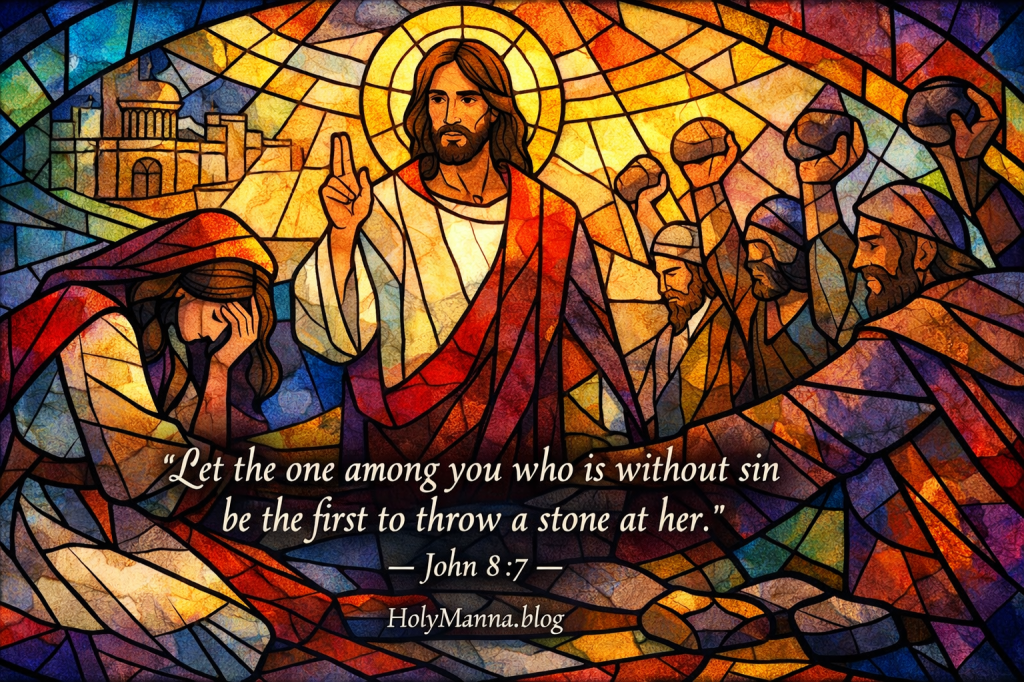
A Woman Caught in Adultery. 53 Then each went to his own house, 1 while Jesus went to the Mount of Olives. 2 But early in the morning he arrived again in the temple area, and all the people started coming to him, and he sat down and taught them. 3 Then the scribes and the Pharisees brought a woman who had been caught in adultery and made her stand in the middle. 4 They said to him, “Teacher, this woman was caught in the very act of committing adultery. 5 Now in the law, Moses commanded us to stone such women. So what do you say?” 6 They said this to test him, so that they could have some charge to bring against him. Jesus bent down and began to write on the ground with his finger. 7 But when they continued asking him, he straightened up and said to them, “Let the one among you who is without sin be the first to throw a stone at her.” 8 Again he bent down and wrote on the ground. 9 And in response, they went away one by one, beginning with the elders. So he was left alone with the woman before him. 10 Then Jesus straightened up and said to her, “Woman, where are they? Has no one condemned you?” 11 She replied, “No one, sir.” Then Jesus said, “Neither do I condemn you. Go, [and] from now on do not sin any more.”
Detailed Exegesis
Verse 1. “while Jesus went to the Mount of Olives.”
The verse is brief, but full of quiet meaning. While others return to their houses, Jesus goes to the Mount of Olives, a place associated in the Gospels with prayer, teaching, and intimate communion with the Father. Before the public conflict of the Temple comes the hidden life of prayer. The Church has always seen in this a reminder that Christ’s public authority flows from His perfect union with the Father.
Verse 2. “But early in the morning he arrived again in the temple area, and all the people started coming to him, and he sat down and taught them.”
Jesus comes at daybreak, the hour when light begins to push back darkness. That detail harmonizes beautifully with the spiritual meaning of the scene. He sits and teaches, assuming the posture of a rabbi. The people come to Him because He teaches with authority. Before the trap is set, Christ is already revealed as the true Teacher of Israel.
Verse 3. “Then the scribes and the Pharisees brought a woman who had been caught in adultery and made her stand in the middle.”
The woman is not led with dignity. She is displayed. The phrase “in the middle” shows the cruelty of the moment. She becomes a public object, a case, a means to an end. Already the reader can see that the leaders are less concerned with her soul than with their own scheme.
Verse 4. “They said to him, ‘Teacher, this woman was caught in the very act of committing adultery.’”
Their words sound factual and formal, but they are crafted for pressure. They address Jesus as “Teacher,” but not out of reverence. They use the title while preparing to oppose Him. The accusation itself also raises an uncomfortable question. Where is the man? Even at the level of the narrative, there is a strong hint of imbalance and manipulation.
Verse 5. “Now in the law, Moses commanded us to stone such women. So what do you say?”
They invoke Moses because they want to force Jesus into a false choice between mercy and fidelity to the Law. Yet the problem is not the Law itself. The problem is their use of it. The Law was given to reveal sin and guide the people toward holiness, not to serve as a stage prop for self-righteousness.
Verse 6. “They said this to test him, so that they could have some charge to bring against him. Jesus bent down and began to write on the ground with his finger.”
The Gospel now reveals their true motive. The woman is not really the center of their concern. Jesus is. She is being used as bait in a trap. Then comes one of the most mysterious gestures in Scripture. Jesus writes on the ground with His finger. The Church has often contemplated this in light of God writing the Law with His finger. Christ appears here as the true Lawgiver, not abolishing divine justice, but re-centering it in truth. His silence also refuses the frenzy of the accusers. He does not let their urgency dictate His response.
Verse 7. “But when they continued asking him, he straightened up and said to them, ‘Let the one among you who is without sin be the first to throw a stone at her.’”
This is not a denial of the woman’s guilt. It is a judgment upon the hearts of the accusers. Jesus appeals to the deeper righteousness required by the Law. He turns the focus from the exposed sinner to the hidden sin of those who would condemn her. The phrase does not mean that civil or moral judgment is impossible unless someone is sinless. It means that hypocritical, self-exalting condemnation is exposed and disarmed in the light of God’s holiness.
Verse 8. “Again he bent down and wrote on the ground.”
Jesus returns to silence. He does not argue with them endlessly. He has spoken the truth, and now He lets conscience do its work. The stillness of Christ stands in sharp contrast to the agitation of the crowd.
Verse 9. “And in response, they went away one by one, beginning with the elders. So he was left alone with the woman before him.”
The departure begins with the elders, which is a striking detail when read beside Susanna. In the first reading, corrupt elders led a crowd into injustice. Here, the elders are the first to retreat under the force of Christ’s word. Their outward authority cannot protect them from inward conviction. At last, the false courtroom dissolves, and the woman is left standing before Jesus alone.
Verse 10. “Then Jesus straightened up and said to her, ‘Woman, where are they? Has no one condemned you?’”
Jesus speaks to her directly now, not as a symbol, not as an example, but as a person. He restores dignity simply by addressing her. He does not begin with a lecture. He begins with a question that reveals what has changed. The accusers are gone. The public humiliation has ended.
Verse 11. “She replied, ‘No one, sir.’ Then Jesus said, ‘Neither do I condemn you. Go, [and] from now on do not sin any more.’”
This final verse contains the full Catholic balance of mercy and conversion. Jesus does not condemn her in the sense of handing her over to destruction. He opens a future for her. Yet His mercy is not permission. It is a call to change. “Do not sin any more” means that grace is meant to heal, redirect, and transform. Mercy tells the truth about sin, and then it offers the sinner a way forward.
Teachings
This Gospel is one of the clearest revelations of the heart of Christ. He confronts both sin and hypocrisy without surrendering to either legal harshness or moral relativism. That is why the Church returns to this passage again and again, especially in Lent. It shows that divine mercy does not erase moral truth. It fulfills it by bringing the sinner into a living encounter with the Savior.
The Catechism teaches that the Gospel is the revelation of God’s mercy toward sinners. CCC 1846 says: “The Gospel is the revelation in Jesus Christ of God’s mercy to sinners.” That line could almost stand as the title of this scene. The woman is not saved by argument. She is saved by meeting Mercy Himself.
At the same time, the Church never reads this passage as though adultery were insignificant. CCC 2380 teaches: “Adultery refers to marital infidelity. When two partners, of whom at least one is married to another party, have sexual relations, even transient ones, they commit adultery. Christ condemns even adultery of mere desire. The sixth commandment and the New Testament forbid adultery absolutely.” That is important because Jesus’ mercy never depends on pretending that sin is small. The woman is not told that nothing is wrong. She is told to leave sin behind.
The passage also speaks powerfully against rash judgment and the abuse of another person’s moral failure. CCC 2478 says: “To avoid rash judgment, everyone should be careful to interpret insofar as possible his neighbor’s thoughts, words, and deeds in a favorable way.” In this Gospel, the accusers do the opposite. They use another person’s real sin not as a reason for sorrow, but as an opportunity for accusation and self-advancement. Christ unmasks that spirit at once.
Among the Fathers of the Church, St. Augustine gave one of the most famous reflections on this passage. After the accusers leave, he writes: “There remained only two, the miserable one and mercy.” Those words have endured because they capture the heart of the scene. The woman stands there in misery, not only because she has sinned, but because sin always leaves a soul poor, exposed, and unable to save itself. Jesus stands before her as Mercy, not vague kindness, but the saving mercy of God made flesh.
Pope Benedict XVI reflected on this Gospel by explaining that Jesus condemns the sin but saves the sinner, and that He unmasks the hypocrisy of those who seem eager to apply the Law without first allowing it to judge their own lives. That is exactly what unfolds here. Christ does not set Moses aside. He reveals the Law’s true depth by showing that the one who would judge must first stand honestly before God.
Historically, this passage has also been treasured in the Church’s penitential life because it speaks directly to the sacrament of Reconciliation. The sinner comes forward with no defense. Christ does not crush the contrite soul. He forgives and sends it forth renewed. The pattern is deeply sacramental: truth is faced, mercy is received, and a new life is commanded.
Reflection
This Gospel reaches into ordinary life with uncomfortable precision because most people are not only the woman in need of mercy. They are often also somewhere in the crowd, tempted to hold a stone. That stone may not look dramatic. It may look like gossip, contempt, delight in another person’s downfall, constant suspicion, or the habit of defining others by their worst moment. The Gospel does not let that spirit hide behind religious language. Jesus places every accuser under the light of personal conscience.
That does not mean Christians are supposed to stop calling sin what it is. The woman’s sin is real, and Jesus says so plainly with His final command. But the Christian response to sin must always be shaped by the mind of Christ. He sees the sinner as a person to be redeemed, not merely a scandal to be managed or an example to be crushed. That changes how a Catholic approaches family wounds, failures in the Church, public scandal, and even private relationships. Truth must be spoken, but never with the cold pleasure of self-righteousness.
This Gospel also speaks to anyone carrying shame. The woman stands with nothing left to hide. Her guilt is real, her humiliation is public, and her accusers are relentless. Yet that is not the end of her story. Jesus does not turn away from her. He does not excuse her, but He does not abandon her either. That is the hope of the Christian life. No one is beyond the reach of Christ’s mercy if the heart is willing to stand before Him honestly.
A very practical way to live this Gospel is to examine both the hand and the heart. Is there a stone being held against someone? Is there a favorite accusation that keeps getting repeated? Is there some sin being excused in the personal life while being condemned loudly in someone else? The next step is to bring those things into prayer and, when needed, into Confession. The woman in the Gospel is not saved by the silence of the crowd, but by the voice of Christ. That same voice still speaks in the sacramental life of the Church.
Where has there been more eagerness to condemn than to heal? Is there a part of the heart that wants mercy for itself but justice without mercy for others? Have Christ’s words, “do not sin any more,” been received as a real call to change, or only as a beautiful line from Scripture? Those questions belong in the quiet of prayer.
In the end, this Gospel is not only about a woman caught in adultery. It is about what happens when human misery stands before divine mercy. The crowd disperses. The noise fades. The trap collapses. And there, in the silence, Christ speaks the words every repentant soul longs to hear and still needs to obey. He does not condemn the sinner to ruin. He gives the sinner a future. Then He commands that future to be holy.
When Truth and Mercy Meet the Soul
Today’s readings leave behind a powerful picture of the heart of God. In Susanna, the Lord defends the innocent when corruption and false witness seem ready to win. In Psalm 23, He reveals Himself as the Shepherd who does not abandon His people in the valley, but leads, protects, and feeds them. In The Gospel of John, Jesus stands before a sinner surrounded by accusers and shows that divine mercy is not weakness, not compromise, and not denial. It is truth spoken with the power to save.
Taken together, these readings teach something every soul needs to remember, especially in Lent. God is not fooled by appearances. He sees what is hidden. He knows when innocence is being crushed, and He knows when guilt is being exploited. He exposes hypocrisy, defends the vulnerable, and calls the sinner to real conversion. He does not ask His people to choose between truth and mercy. In Christ, both shine together. The innocent are vindicated. The guilty are invited to repent. The crowd is silenced. The Shepherd remains.
That is why this day’s message feels so personal. Every heart can find itself somewhere in these readings. At times, a soul may feel like Susanna, misunderstood, falsely judged, or pressured to compromise. At times, it may feel like the woman in the Gospel, ashamed, exposed, and desperately in need of mercy. And if the truth is told, there are also moments when the heart resembles the accusers, too quick to judge, too ready to hold a stone, too comfortable hiding its own sins while staring at the sins of others. The Word of God reaches into all of it. It calls the faithful to trust like Susanna, to rest like sheep under the Shepherd’s care, and to repent like the sinner who stands before Christ and hears both mercy and command.
The call to action is simple, but it is not small. Lift the eyes to heaven. Put down the stone. Guard the tongue from false judgment. Bring sin honestly to Christ. Stay close to the Shepherd in prayer, in Scripture, and in the sacraments. Let mercy do its work, not only by comforting the soul, but by changing it. What would daily life look like if Christ’s words, “Neither do I condemn you” and “do not sin any more,” were both taken seriously? That is the invitation of today’s readings. Walk with the Lord in truth. Trust Him in the valley. And let His mercy lead the soul into a holier life.
Engage with Us!
Share your reflections in the comments below. What stood out most in today’s readings? Which part of the Word challenged the heart, offered comfort, or called for deeper conversion? This is a beautiful day to slow down, pray with the Scriptures again, and let the Lord bring hidden things into the light with His truth and mercy.
- In the story of Susanna, what speaks most deeply to the heart: her courage, her purity, her trust in God, or Daniel’s defense of the innocent? How can daily life reflect that same courage when facing pressure, false judgment, or temptation to compromise?
- In Psalm 23, which image brings the most peace right now: the green pastures, the still waters, the dark valley, or the table prepared by the Lord? What would it look like this week to trust the Shepherd more completely in the middle of fear, uncertainty, or weariness?
- In the Gospel, is there a stronger connection with the woman in need of mercy or with the crowd tempted to condemn? How is Jesus calling the soul to both receive mercy honestly and extend that same mercy to others without excusing sin?
Keep walking in faith. Stay close to the Shepherd. Speak truth with charity, reject hypocrisy, and do everything with the love and mercy Jesus taught us. That is where peace grows, holiness deepens, and the heart begins to look more and more like His.
Sacred Heart of Jesus, we trust in You!
Immaculate Heart of Mary, pray for us!
Saint Michael the Archangel, defend us in battle!
Follow us on YouTube, Instagram and Facebook for more insights and reflections on living a faith-filled life.

 Holy Manna!
Leave a comment