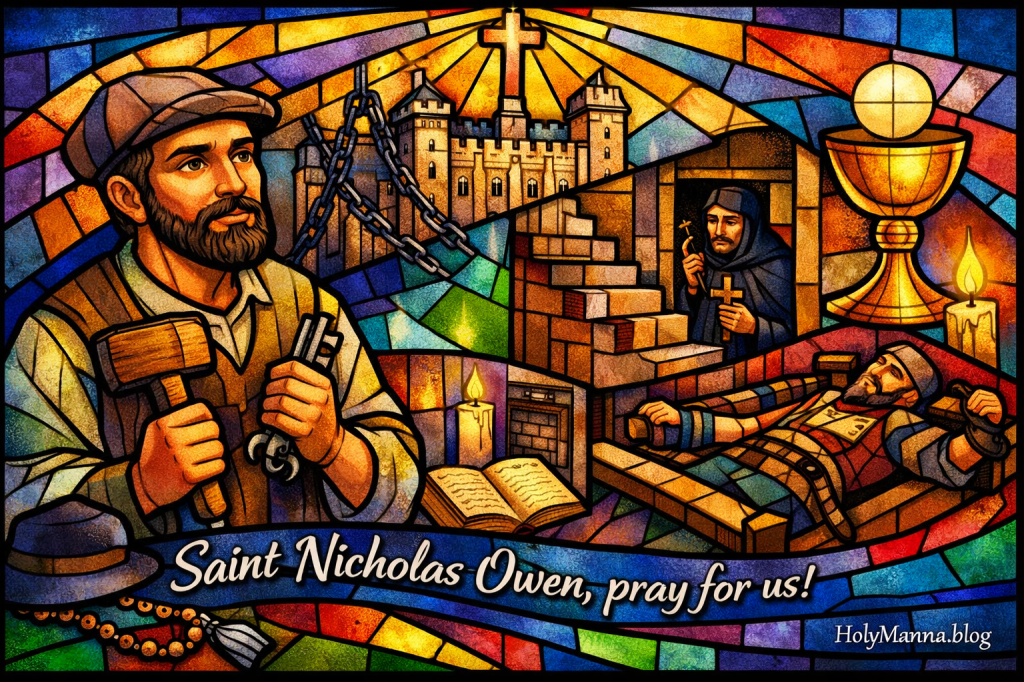
The Carpenter Who Built Silence for Christ
Saint Nicholas Owen is one of those saints whose greatness was almost entirely hidden during his lifetime. He was not a bishop, a famous preacher, or a public theologian. He was a Catholic lay brother, a carpenter, and a craftsman whose hands helped keep the sacraments alive in one of the darkest periods of English persecution. He is revered because he used ordinary skill with extraordinary courage, building secret hiding places for priests in recusant homes so that the Holy Mass, confession, and the ministry of the Church could continue when the state wanted them extinguished. That is why the Church remembers him not merely as a clever builder, but as a martyr whose hidden labor became an offering of love to Christ and His Church.
From Oxford Roots to a Hidden Vocation
Nicholas Owen was born in Oxford into a Catholic family during the age of the Penal Laws. His exact birth year is uncertain, but Catholic tradition places his life in the second half of the sixteenth century. He grew up in a household shaped by fidelity to the old faith in a time when that fidelity could cost a person everything. He learned the trade of carpentry from his father, and at least two of his brothers became priests. That family setting matters, because Nicholas’s path to holiness did not come through a dramatic conversion from unbelief, but through a deepening of the faith he had received at home.
As he came into contact with missionary priests, especially men connected with the Jesuit mission such as Father Edmund Campion and Father Henry Garnet, his trade became his vocation. He came to see that wood, nails, walls, stairs, and beams could be used for the service of the Gospel. In a world where Catholic priests were hunted and the Mass had to be celebrated in secret, a carpenter could become a protector of souls.
Nicholas is most known for designing and building priest holes, those brilliantly concealed hiding places crafted inside houses where priests could escape capture during sudden raids. He often worked alone and in secret, which made his life even more dangerous. He did not seek attention. He did not seek credit. He simply gave his talent to God and to the survival of the Church in England.
The Builder of Hidden Mercy
What makes Saint Nicholas Owen so unforgettable is that his work was both practical and heroic. He built secret chambers inside walls, under floors, behind staircases, and in other unlikely places. Some of them were so skillfully designed that even trained searchers could not find them. In some cases, one hidden space led to another, making discovery even less likely. Only Nicholas and the owner of the house might know where the hiding place truly was.
That may not sound like a miracle in the usual sense, but there is something deeply providential about it. His craftsmanship helped save the lives of many priests and faithful Catholics. Through his work, the sacraments remained available. Confession could still be heard. The Holy Eucharist could still be brought to the faithful. In a time when the enemies of the Church wanted to cut people off from sacramental grace, Nicholas Owen used his hands to make room for Christ.
There are no well-attested miracle stories from his lifetime in the sense of public supernatural wonders worked by him. No reliable Catholic source preserves a long list of healings or dramatic signs associated with him during life. Yet his whole life still shines with the quiet wonder of grace. He took ordinary labor and turned it into an act of heroic charity. He protected priests not by speeches, but by sacrifice. He lived the truth of The Catechism, which teaches that every baptized person is called to holiness according to his state in life. Nicholas shows that sanctity can be built into wood and stone as surely as it can be preached from a pulpit.
Catholic tradition also remembers that Nicholas endured physical weakness. He was said to be a small man, and some accounts describe him as suffering from a painful hernia and an injured leg. Even so, he continued demanding labor in cramped conditions, often under cover of darkness, because the mission of the Church mattered more to him than comfort, health, or safety. That detail makes his witness even more moving. He was not a grand figure in the eyes of the world. He was a wounded worker who kept going because he loved Christ.
The Silence That Cost Him Everything
The hardest chapter of Nicholas Owen’s life came after the Gunpowder Plot crisis. He was eventually arrested at Hindlip Hall, where he had helped create places of concealment. Catholic accounts recount that he and others hid for days in one of the very places he had built, with almost nothing to eat or drink, until they were finally forced to emerge. Once the authorities realized who they had captured, they understood they had seized no ordinary servant. They had taken the man who knew the hidden geography of Catholic England.
He knew which houses had secret chambers. He knew where priests had been sheltered. He knew enough to put many lives at risk if he spoke. He was first imprisoned in the Marshalsea and then taken to the Tower of London, where he was subjected to brutal torture. He was pressured to reveal names, places, and secrets. He did not betray anyone.
Catholic tradition is clear that he died from torture in the early hours of March 2, 1606. He died without giving up the priests he had protected or the Catholic households that had trusted him. The state tried to cover up what had happened by claiming he had taken his own life, but Catholics rejected that lie. The truth was plainer and more powerful. Nicholas Owen died as a martyr.
This is where his story becomes almost unbearably beautiful. He spent his life building hidden places for others, and then he died in hidden suffering for the same cause. The Catechism teaches, “Martyrdom is the supreme witness given to the truth of the faith” CCC 2473. Nicholas Owen gave that witness not in a public square, but in a prison cell, in agony, in silence, and in fidelity.
No verified personal quotations from Saint Nicholas Owen survive in Catholic sources. There are strong praises spoken about him by others, but no firmly preserved sayings from his own lips. That absence somehow fits him. He was a hidden man whose life spoke louder than words.
The Saint Who Still Guards the Memory of England
After his death, the Church did not forget him. Nicholas Owen was beatified with the English and Welsh martyrs and later canonized among the Forty Martyrs of England and Wales. His feast is commonly observed on March 22, and he is also honored in the wider remembrance of the English Martyrs. His memory remains woven into the Catholic story of England because he helped preserve the sacramental life of the faithful in a nation that was trying to extinguish it.
When it comes to miracles after death, there is an important distinction to make. There is no clearly documented list of individual miracles universally recognized and attached to Saint Nicholas Owen alone in the way some saints are associated with particular healing stories. However, as one of the Forty Martyrs of England and Wales, he shares in the canonization miracle recognized for that group. Beyond that, Catholic devotion has long remembered his intercession and the enduring power of his witness.
His impact after death is also tangible in a way that is almost unique. Some priest holes traditionally associated with him, or with the wider network of recusant Catholic houses, still survive. Whether every one of them can be verified with certainty or not, they remain powerful reminders of what Catholics endured to keep the faith alive. They are more than historical curiosities. They are silent monuments to courage, sacrifice, and devotion to the Eucharist.
There are also stories and traditions surrounding hidden chambers, escapes, and acts of preservation associated with his work that have grown in Catholic memory over time. Some of these cannot be verified in every historical detail, and honesty requires saying so. Even so, the larger truth remains beyond doubt. Nicholas Owen used his gifts to protect priests and preserve the sacramental life of the Church, and that work had an enormous impact on English Catholic survival.
His cultural importance is especially strong in England. He belongs to that great line of recusant saints and martyrs who remind Catholics that the faith was not preserved only by famous theologians or public leaders. It was also preserved by hidden laypeople, faithful households, quiet craftsmen, and ordinary believers who refused to surrender Christ. Nicholas Owen is one of the clearest examples of that truth.
What Hidden Fidelity Looks Like Today
Saint Nicholas Owen has a lesson that lands hard in ordinary life. Most people will never be asked to build priest holes or face the Tower of London, but everyone is asked to be faithful when faithfulness is costly. His life reminds the Church that discipleship is not always loud. Sometimes holiness looks like quiet endurance, careful work, loyalty under pressure, and refusing to betray Christ when the world demands compromise.
The Catechism teaches, “The disciple of Christ must not only keep the faith and live on it, but also profess it, confidently bear witness to it, and spread it” CCC 1816. Nicholas Owen did exactly that, even though his witness came through woodwork, secrecy, suffering, and martyrdom rather than public sermons.
His example invites a serious examination of conscience. Where has comfort become more important than fidelity? Where has fear kept the faith quiet? Where has ordinary daily work been treated as something too small to offer to God? Nicholas Owen teaches that the hidden duties of life can become holy ground when they are done with love for Jesus and His Church.
A practical way to imitate him is to begin by treating daily work as an offering. A father can protect his family, keep Sunday holy, defend the truth gently but clearly, and support the sacramental life of the Church even when the culture grows hostile. A mother can do the same in her vocation, in her witness, and in the quiet ways grace works through fidelity. Parents can build homes where the faith is not a decoration but a living reality. Parishioners can make space for priests, confession, Eucharistic devotion, reverence, and real sacrifice. Nicholas Owen built hiding places so priests could serve the faithful. Catholics today can build lives where Christ is welcomed openly, adored faithfully, and obeyed without shame.
Engage With Us!
Share your thoughts and reflections in the comments below. Saint Nicholas Owen’s story is one of those stories that can shake a soul awake, especially in a time when comfort and compromise can feel so normal.
- What part of Saint Nicholas Owen’s hidden life speaks most strongly to the heart right now?
- How can ordinary work become an offering of love to Jesus and service to His Church?
- What would greater courage in the Catholic faith look like in daily life, in the home, at work, or among friends?
- Does Saint Nicholas Owen’s silence under torture change the way perseverance and loyalty are understood?
- How can a home become a place where the faith is protected, nourished, and lived with greater reverence?
Saint Nicholas Owen reminds the Church that no act of fidelity offered to Christ is ever small. Hidden holiness is still holiness. Quiet courage is still courage. May his witness encourage a life of steady faith, deep reverence, and practical love, and may everything be done with the mercy, truth, and sacrificial love that Jesus Christ taught.
Saint Nicholas Owen, pray for us!
Follow us on YouTube, Instagram and Facebook for more insights and reflections on living a faith-filled life.

 Holy Manna!
Leave a comment