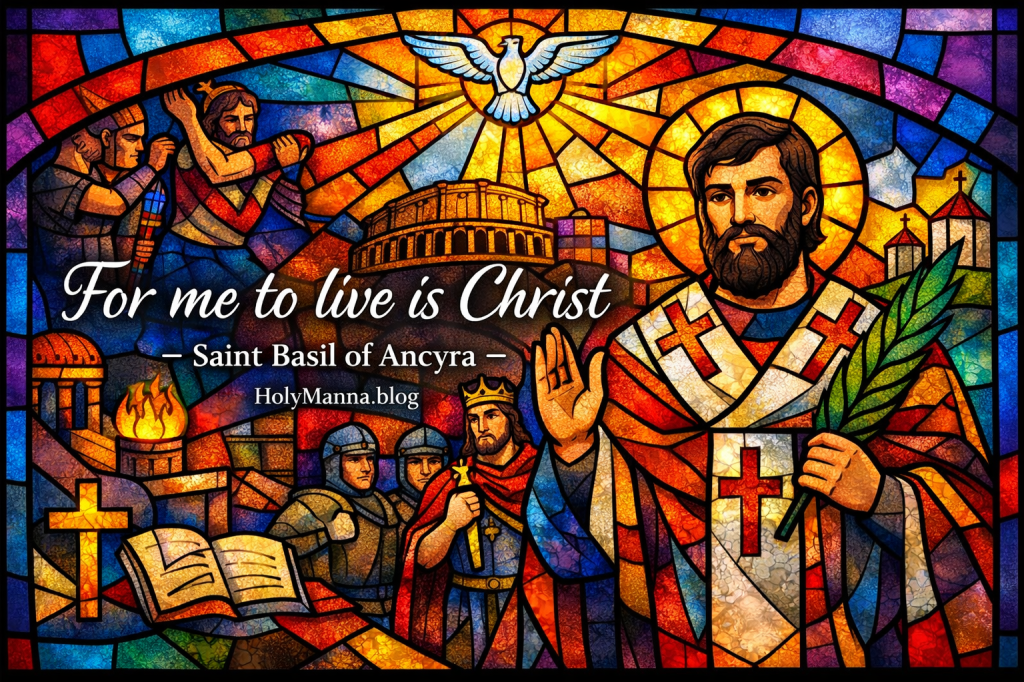
When the Name Christian Came First
Saint Basil of Ancyra is one of those saints who may not be widely known today, but once his story is heard, he is very hard to forget. He was a priest, a confessor of the faith, and a martyr in the fourth century during one of the most turbulent periods in the life of the Church. He is remembered not because he built great institutions or left behind famous theological books, but because he stood firm when both heresy and pagan power pressed hard against the faithful.
The Church reveres him as a holy priest of Ancyra, in Galatia, in what is now Ankara, Turkey. He lived during the age of the Arian crisis, when confusion about the divinity of Christ wounded many parts of the Christian world. At the same time, he suffered under Emperor Julian the Apostate, who tried to restore pagan worship and weaken the Church. In the middle of that chaos, Basil remained steady. He kept teaching, kept warning the faithful, and kept confessing Christ even when it cost him everything.
What makes Saint Basil so compelling is how simple and strong his witness was. He knew who he belonged to. In the ancient account of his martyrdom, when he was asked his name, he answered with a line that still strikes the heart: “The name ‘Christian’ comes first.” That is the whole story of his life in one sentence. Before status, before safety, before reputation, before even his own name, he belonged to Jesus Christ.
Formed in Piety in a Time of Confusion
Not much has been preserved about Saint Basil’s childhood, family, or early education. That is one of the humbling things about many of the early martyrs. The Church often remembers them most clearly at the point where they gave everything for Christ. Still, Catholic tradition does preserve a few important details. Basil seems to have been a native of Ancyra, and he was known as a man of holy life, upright conduct, and deep piety. He was not remembered as an ambitious man or a political schemer. He was remembered as a priest.
He served under Bishop Marcellus of Ancyra, and he lived in a world where the faithful were being battered by false teaching. This was not a quiet season in the Church. Arguments about the Person of Christ were not just academic disputes. They were questions about salvation, worship, and truth. Basil understood that if the faithful lost the truth about who Christ is, they would lose far more than a theological formula. They would lose the Gospel itself.
That seems to be where his life deepened into a more public mission. He became known for catechizing the people, strengthening the orthodox, and warning them against error. He did not retreat into silence when things became difficult. He walked into the middle of the struggle and tried to preserve what ancient Catholic tradition calls the faith of the Fathers. That is what he is most known for. He was a priest who defended the flock.
There is also an important historical note here. Saint Basil of Ancyra the martyr should not be confused with another Basil of Ancyra, a bishop associated with the Semi-Arian controversy. The saint honored by the Church is the priest and martyr, the man who suffered for remaining faithful to Christ.
A Shepherd of Souls
Saint Basil’s daily life as a priest seems to have been marked by courage, instruction, and pastoral care. He went among the people of the city, teaching them, correcting error, and calling them to remain loyal to Christ. In a time when many were shaken by fear, compromise, or confusion, Basil kept speaking with clarity. He understood that charity and truth belong together. A priest does not love souls by leaving them in error. He loves them by leading them toward Christ.
This is one reason the Church should still remember him. Saint Basil shows what spiritual fatherhood looks like when it is purified by courage. He did not preach for applause. He preached so that people would not be swept away. He did not simply condemn error from a distance. He stayed near the people and kept urging them to remain faithful.
As for miracles during his life, Catholic tradition does not preserve a long list of spectacular wonders in the way it does for some later saints. The ancient martyrdom account centers more on his endurance than on outward miracles. Still, one striking story has been handed down. After Basil had been severely tortured and portions of his flesh had been torn away, he declared the next day that the Lord Jesus Christ had healed him during the night. He reportedly showed his shoulders and sides as evidence of this mercy. This story comes from the ancient martyrdom tradition and cannot be independently verified.
Even without a long list of dramatic miracles, Basil’s life still bears the marks of divine strength. Sometimes the most powerful sign is not a public wonder but a soul that remains unwavering under immense pain. In saints like Basil, grace is seen in perseverance, clarity, and peace under suffering. That kind of miracle is quieter, but it is not smaller.
Another saying preserved in the ancient account reveals the heart of this saint. When facing death, he declared with the words of Philippians 1:21, “For me to live is Christ; to die is gain.” That was not poetic exaggeration. It was the truth by which he lived.
Before Governors and Emperors
The storm around Basil grew worse under Julian the Apostate. Julian had once been connected to the Christian world, but later rejected the faith and tried to reestablish pagan worship throughout the empire. For Christians, this was not just a political annoyance. It was a real attack on the public life of the Church. Basil responded by openly exhorting Christians not to defile themselves with pagan sacrifice and not to abandon the Lord.
That faithfulness made him a target. He was accused before the authorities, including the governor Saturninus. He was charged with stirring up the people and opposing the emperor’s religious policy. Basil did not try to save himself through careful half-truths. He spoke openly, exposing the emptiness of idols and remaining firm in his confession of Christ.
Eventually, he was brought before Julian himself. This is one of the most dramatic parts of his story. Basil did not flatter the emperor. He rebuked him. He spoke to Julian not as a frightened prisoner trying to bargain for his life, but as a priest still bearing witness to the truth. According to the ancient account, Basil was repeatedly tortured, flayed, and tormented for refusing to sacrifice to pagan gods.
One of the most unforgettable moments comes from that final confrontation. After part of his flesh had been torn away, Basil is said to have thrown it toward Julian and cried out, “Here, Julian, this will be your food there; for me to live is Christ; to die is gain.” This saying is preserved in the martyrdom tradition, and while the exact wording belongs to that ancient account, it has come down as one of the defining moments of his witness.
His martyrdom was brutal. He was tortured again and again, and at last he died on June 29, 362. The Church remembers him as a martyr because he did not merely suffer while being Christian. He suffered because he refused to deny Christ. That matters. Martyrdom is not simply pain. It is faithful love under persecution.
His witness also carries a lesson for every age. There are times when the world does not ask Christians to burn incense before idols of stone, but it does ask them to kneel before the idols of comfort, approval, lust, power, and fear. Saint Basil reminds the faithful that truth is worth suffering for.
A Legacy Preserved in the Church’s Memory
After his death, Saint Basil’s impact continued, though not in the flashy way modern people often expect. Catholic tradition does not preserve a large cycle of posthumous miracles, widespread healing stories, or famous pilgrimage legends centered on him. That absence is worth saying plainly. There is no need to invent what the Church has not handed down.
What the Church does preserve is his veneration, his feast, and his example. He is honored in the Church’s liturgical memory as a priest and martyr. His feast is celebrated on March 22, even though the ancient tradition places his death on June 29, 362. The exact reason for that feast date is not fully certain. Some have suggested that it may be connected to an earlier local observance, a dedication of a church, a translation of relics, or the practical fact that June 29 is already occupied by the great solemnity of Saints Peter and Paul. Those explanations are possible, but they cannot be verified with certainty.
His posthumous legacy is therefore mainly spiritual and liturgical. The Church did not forget him. His memory endured because his sacrifice strengthened the faithful. His name remained in the tradition because his witness said something every age needs to hear. Christ is worth everything.
In cultural terms, Saint Basil of Ancyra does not seem to have left behind a broad popular devotion with major national customs attached to his feast, at least not in a way that has survived clearly in Roman Catholic memory. His impact is quieter than that. He belongs to the deep foundation stones of Christian witness. He is one of those saints whose blood watered the Church and whose courage helped preserve the faith in a time of crisis.
That alone is a tremendous legacy.
What Saint Basil Teaches the Soul Today
Saint Basil of Ancyra teaches that fidelity is not measured by visibility. A saint does not have to be famous to be great. He teaches that truth matters, especially when it becomes costly. He teaches that the identity of a Christian is not supposed to sit on the edges of life but at the center of it.
There is something deeply relevant here for modern Catholics. The culture is full of pressure to make faith private, soft, negotiable, or secondary. Saint Basil’s answer cuts through all of that noise: “The name ‘Christian’ comes first.” That is not a slogan. It is a way of life.
Readers can imitate him by becoming more rooted in the faith of the Church, especially through prayer, study, and sacramental life. A Catholic who does not know the faith well can be easily shaken. Basil loved the faith of the Fathers, and modern Catholics are called to love it too. That means reading Scripture with the Church, learning from The Catechism of the Catholic Church, staying close to the sacraments, and refusing to let the spirit of the age become the guide for conscience.
He also teaches courage in speech. That does not mean being harsh, loud, or self-righteous. It means speaking the truth with charity and refusing to call darkness light. It means defending Christ without embarrassment. It means being willing to stand apart when compromise is easier.
Most of all, Saint Basil teaches endurance. Not every Christian is called to die as a martyr, but every Christian is called to die to self. That happens in daily sacrifices, quiet obedience, chastity, patience, honesty, and fidelity under pressure. What would change if the name Christian really came first in every decision? What fear would lose its power if Christ mattered more than comfort? What compromise has been excused simply because it seemed easier than standing firm?
The life of Saint Basil calls the heart back to seriousness, but not to gloom. His witness is hard, yet it is full of hope. A man who can say “For me to live is Christ” has already found the secret of freedom.
Engage With Us!
Share your thoughts and reflections in the comments below. Saint Basil of Ancyra may not be one of the most famous saints, but his witness is powerful and timely, especially for anyone trying to remain faithful in a confused world.
- What part of Saint Basil’s story speaks most deeply to the heart, and why?
- How can the faith of the Fathers be guarded more seriously in daily life?
- Where is there pressure right now to make the name Christian come second instead of first?
- What practical step can be taken this week to grow in courage, truth, and fidelity to Christ?
Saint Basil of Ancyra reminds the faithful that holiness is not built on comfort. It is built on love, truth, and perseverance. May his witness encourage every soul to live with deeper conviction, trust the Lord more fully, and do everything with the love and mercy Jesus taught us.
Saint Basil of Ancyra, pray for us!
Follow us on YouTube, Instagram and Facebook for more insights and reflections on living a faith-filled life.

 Holy Manna!
Leave a comment