Fifth Sunday of Lent – Lectionary: 34
When the Lord Calls the Dead to Rise
There are Sundays in Lent that feel like a gentle invitation, and then there are Sundays like this one, where the Word of God walks straight into the graveyard and tells death it does not get the last word. Today’s readings are bound together by one powerful theme: the Lord brings life where sin, sorrow, exile, and death seem to have already won. In Ezekiel 37:12-14, God promises to open graves and breathe His Spirit into His people. In Psalm 130, a wounded soul cries out from the depths and discovers that with the Lord there is mercy and redemption. In Romans 8:8-11, Saint Paul teaches that the same Spirit who raised Jesus from the dead dwells in the faithful. Then in John 11:1-45, Jesus stands before the tomb of Lazarus and reveals that He is not only a teacher of resurrection, but “the resurrection and the life.”
This is why the Church places these readings before the faithful as Lent nears its final stretch. The Fifth Sunday of Lent turns the heart toward the mystery that stands at the center of the Christian life: God does not save from a safe distance. He enters the place of mourning, uncleanness, helplessness, and death itself in order to rescue His people from within. For Israel, exile had felt like a living death. For the psalmist, sin had driven the soul into the depths. For Saint Paul, life in the flesh could never please God. For Martha and Mary, grief had become painfully concrete in a sealed tomb and a body four days dead. Yet in every reading, the Lord moves toward what is broken, not away from it.
There is also a deeply Catholic rhythm running through all of this. These readings do not speak only about the end of the world, though they certainly point there. They also speak about what God is doing now through His grace. The Church has long read these Lenten passages with baptismal eyes, because the Christian life always passes through death into life. The old self must die. The hardened heart must be opened. The sinner must be raised. As The Catechism teaches, the Spirit is the giver of life, and the God who raised Christ will also raise those who belong to Him. That is the hope shining through every line today. The Lord does not merely improve lives. He resurrects them.
That makes today’s readings both comforting and unsettling. They are comforting because they remind every weary sinner that no grave is too deep for God. They are unsettling because Jesus does not stand outside the tomb and offer vague encouragement. He calls people out. He commands stones to be moved. He forces a decision. What part of life has started to feel buried? What sorrow, sin, or fear has been treated as final when Christ says it is not? Lent brings the faithful to this moment so that by the time Holy Week arrives, the heart is ready to believe that the God who weeps at the tomb is also the God who empties it.
First Reading – Ezekiel 37:12-14
When God Walks Into the Graveyard
The prophet Ezekiel was speaking to a people who felt like their story was over. Jerusalem had fallen, the temple had been shattered, and many of God’s people were living in exile in Babylon. What made that pain even heavier was the spiritual meaning behind it. Israel was not only suffering politically. She was suffering the consequences of covenant infidelity. Sin had led to judgment, and judgment had led to a kind of living death. That is the world behind this reading. Ezekiel 37 belongs to the great vision of the dry bones, where the Lord shows that He can restore what human beings have completely lost. In today’s verses, the image sharpens. God does not merely promise improvement. He promises resurrection language, return, covenant restoration, and the gift of His Spirit. On this Fifth Sunday of Lent, that fits perfectly with the day’s great theme: the Lord brings life where death seems final, and He does it by His own power, not by human strength.
Ezekiel 37:12-14 – New American Bible (Revised Edition)
12 Therefore, prophesy and say to them: Thus says the Lord God: Look! I am going to open your graves; I will make you come up out of your graves, my people, and bring you back to the land of Israel. 13 You shall know that I am the Lord, when I open your graves and make you come up out of them, my people! 14 I will put my spirit in you that you may come to life, and I will settle you in your land. Then you shall know that I am the Lord. I have spoken; I will do it—oracle of the Lord.
Detailed Exegesis
Verse 12 – “Therefore, prophesy and say to them: Thus says the Lord God: Look! I am going to open your graves; I will make you come up out of your graves, my people, and bring you back to the land of Israel.”
This verse is startling because the Lord speaks to Israel as though the nation is already buried. That is exactly how exile felt. The people were alive, but their hope was dead, their worship was broken, and their future looked sealed shut. The Lord’s answer is not to tell them to become optimistic. He declares His own action. “I am going to open your graves.” The emphasis falls on divine initiative. This is one of the great patterns in salvation history. When man cannot climb out, God descends. When man cannot restore himself, God speaks life. In its original setting, this points first to national restoration, the return of God’s people from exile to the land promised to them. Yet the Church hears in these words something even deeper, because the language of graves and rising naturally opens toward the mystery of resurrection fulfilled in Christ. The Catechism teaches, “The Christian Creed… culminates in the proclamation of the resurrection of the dead on the last day and in life everlasting.” This means the reading is not only about ancient Israel coming home. It is also a shadow of the final victory God will reveal through Jesus.
Verse 13 – “You shall know that I am the Lord, when I open your graves and make you come up out of them, my people!”
This verse reveals the purpose of the miracle. God restores His people so that they may know Him. In Scripture, to “know that I am the Lord” is not bare information. It is covenant recognition. It is the moment when people who had forgotten God’s holiness, justice, and mercy are brought back into living relationship with Him. The exile had exposed Israel’s sin, but God’s rescue would reveal His faithfulness. That is an important correction for the spiritual life. Sometimes people think God saves only to make them feel better. In reality, He saves so that they may know Him, worship Him, and belong to Him again. The deepest tragedy in exile was not geography. It was distance from the living God. The deepest beauty in restoration is not merely survival. It is communion. That same pattern carries into Christian life. The Lord frees a soul from sin not simply to improve circumstances, but so the soul may know the Father through the Son in the Holy Spirit.
Verse 14 – “I will put my spirit in you that you may come to life, and I will settle you in your land. Then you shall know that I am the Lord. I have spoken; I will do it, oracle of the Lord.”
This final verse is the heart of the reading. God does not only bring His people out. He puts His Spirit within them. The restoration is not merely external. It is inward, life-giving, and covenantal. In the Old Testament, the Spirit of God is the divine breath that creates, renews, strengthens, and sanctifies. So when the Lord says, “I will put my spirit in you,” He is promising more than a political return. He is promising a recreated people. That is why this verse harmonizes so beautifully with Lent and with the Gospel of Lazarus. The same God who opens graves also breathes life. The Catechism says, “Immersion in water symbolizes not only death and purification, but also regeneration and renewal.” It also teaches that Baptism is “the gateway to life in the Spirit.” The Church therefore reads a passage like this with sacramental depth. Israel’s restoration prepares the way for the greater restoration Christ brings, where sinners are freed from sin, reborn by water and the Holy Spirit, and made temples of divine life. The verse ends with a line full of holy certainty: “I have spoken; I will do it.” God’s promise is not fragile. It rests on His own fidelity.
Teachings
This reading teaches that death, exile, and spiritual ruin are never beyond the reach of God. In its first historical sense, Ezekiel 37:12-14 proclaims that the Lord would restore Israel after the catastrophe of exile. The valley of bones in the larger chapter stands for the whole house of Israel, a people who had come to see themselves as dried up and cut off. Yet the Church has always read this text in the light of Christ, because the language of graves, rising, and Spirit-filled life points beyond one historical return and toward the full mystery of redemption. The same God who brought Israel back from exile has now acted definitively in Jesus Christ, whose Resurrection is the guarantee of the resurrection of the dead. The Catechism teaches, “We firmly believe, and hence we hope that, just as Christ is truly risen from the dead and lives for ever, so after death the righteous will live for ever with the risen Christ and he will raise them up on the last day.”
This reading also teaches that God restores by giving His Spirit. The life promised here is not self-generated. It is breathed into the people by God Himself. That is why the reading reaches naturally toward Christian initiation. The Lord does not merely pardon from a distance. He inwardly recreates. The Catechism says, “Baptism not only purifies from all sins, but also makes the neophyte ‘a new creature’… and a temple of the Holy Spirit.” This is the deeply Catholic heart of the passage. Salvation is not reduced to a legal declaration. It is real transformation by grace. A dead heart becomes alive. A sinner becomes a son. A ruined life becomes a dwelling place for the Holy Spirit.
Saint Augustine, preaching on the raising of Lazarus, gives a powerful lens for understanding this promise. He describes the man dead four days as an image of the sinner hardened by habit, then says, “The Lord delivers even from evil habits those who have been dead four days.” That insight fits Ezekiel 37 beautifully. The Lord is not intimidated by how long the soul has been stuck. He is not frightened by decay, shame, or patterns that look permanent. He speaks, and the dead rise. He commands, and the bonds begin to break. This is why the reading belongs so naturally near the end of Lent. As Holy Week draws near, the Church places before the faithful the God who does not merely sympathize with death, but invades it.
Reflection
There is something deeply personal in this reading, because most people know what it feels like to live through a season that seems buried. Sometimes it is an old sin that keeps coming back. Sometimes it is grief that settled in and never fully left. Sometimes it is a marriage gone cold, a prayer life gone numb, or a conscience worn down by compromise. This reading speaks into those places with unusual force. The Lord does not ask whether the grave seems realistic. He declares that He can open it.
The first step in living this reading is honesty. A soul cannot be raised if it keeps pretending it is healthy. The second step is hope. Not shallow optimism, but the kind that rests on God’s own words: “I have spoken; I will do it.” The third step is surrender to the Holy Spirit. Too many people try to become holy by willpower alone, and then wonder why they feel exhausted. This reading reminds the faithful that life comes from God’s Spirit within. The fourth step is sacramental living. A Catholic does not read a passage like this and stay abstract. The Lord’s life reaches souls concretely through confession, prayer, the Eucharist, and the daily repentance that keeps the heart open to grace.
What part of life has begun to feel sealed shut? What grave has quietly been accepted as permanent? What would it look like to believe that God can still breathe life into that place? Lent is the season for hearing this promise again. The Lord still opens graves. He still restores the ruined. He still puts His Spirit into His people. And He still keeps every word He speaks.
Responsorial Psalm – Psalm 130
Out of the Depths, the Soul Learns to Hope
There is something timeless about Psalm 130. It sounds like the prayer of a man standing in darkness, looking up for the first sign of dawn. This psalm, traditionally known as the De Profundis, which means “Out of the depths,” comes from the prayer life of Israel and was sung as one of the Songs of Ascents, likely prayed by pilgrims making their way toward Jerusalem. It carries the weight of repentance, longing, and trust. It is the voice of someone who knows sin is real, suffering is heavy, and God alone can save. On this Fifth Sunday of Lent, the psalm fits perfectly with the larger theme of the day. Ezekiel 37:12-14 speaks of graves being opened. Romans 8:8-11 speaks of the Spirit giving life. John 11:1-45 leads to the tomb of Lazarus. In the middle of those readings, Psalm 130 becomes the cry of the human heart standing in the graveyard of its own weakness, begging for mercy and waiting for redemption.
Psalm 130 – New American Bible (Revised Edition)
Prayer for Pardon and Mercy
1 A song of ascents.
Out of the depths I call to you, Lord;
2 Lord, hear my cry!
May your ears be attentive
to my cry for mercy.
3 If you, Lord, keep account of sins,
Lord, who can stand?
4 But with you is forgiveness
and so you are revered.5 I wait for the Lord,
my soul waits
and I hope for his word.
6 My soul looks for the Lord
more than sentinels for daybreak.
More than sentinels for daybreak,
7 let Israel hope in the Lord,
For with the Lord is mercy,
with him is plenteous redemption,
8 And he will redeem Israel
from all its sins.
Detailed Exegesis
Verse 1 – “Out of the depths I call to you, Lord.”
This opening line sets the tone for the entire psalm. The “depths” are not merely physical danger. They represent the deep place of helplessness, sorrow, guilt, and distress. In biblical language, the depths often evoke chaos, death, or the place where man feels overwhelmed and unable to rescue himself. This is the prayer of a soul that has stopped pretending. It does not stand tall before God with excuses. It cries out from below. That is why this line is so important in Lent. Real conversion begins when a man stops acting as though he can fix himself and finally calls on the Lord from the truth of his poverty.
Verse 2 – “Lord, hear my cry! May your ears be attentive to my cry for mercy.”
This verse reveals the confidence hidden inside the pain. The psalmist does not cry into emptiness. He cries to a God who hears. The prayer is urgent, direct, and deeply personal. Mercy is not treated as an abstract religious idea. It is the only hope of the sinner. This line teaches something beautiful about biblical prayer. The faithful are not told to hide their desperation from God. They are invited to bring it fully into His presence. The Church’s prayer has always preserved this honesty. The sinner does not approach God because he deserves to be heard. He approaches because God is merciful.
Verse 3 – “If you, Lord, keep account of sins, Lord, who can stand?”
This is one of the most humbling lines in all of Scripture. The psalmist does not compare himself to other men. He compares himself to the holiness of God. Once that happens, the illusion of self-righteousness collapses. If God were to deal with man on strict justice alone, no one could stand before Him. This verse cuts through pride, spiritual vanity, and every attempt to reduce sin to a minor inconvenience. The Christian life begins to deepen when a soul understands this. Sin is not small because God is not small. The gravity of sin is revealed by the holiness of the One against whom it is committed.
Verse 4 – “But with you is forgiveness and so you are revered.”
Here the psalm turns from fear toward hope. God’s forgiveness does not make Him less holy. It makes Him more deeply revered. That is a very Catholic insight. Mercy is not softness about evil. Mercy is the holy love of God overcoming sin without denying its seriousness. The psalmist does not say, “With you is indulgence,” as though sin does not matter. He says, “with you is forgiveness.” Forgiveness is costly. It means the Lord removes what truly separates the sinner from Him. Reverence grows when a soul realizes that God is both just and merciful, both holy and near.
Verse 5 – “I wait for the Lord, my soul waits and I hope for his word.”
After asking for mercy, the psalmist waits. This is not passive resignation. It is watchful trust. The soul clings to the word of God because God’s promise is more stable than human emotion. This verse fits beautifully into Lent because repentance is not only about sorrow for sin. It is also about patient hope in the Lord’s action. Many people want immediate relief, immediate change, and immediate spiritual comfort. But the psalm teaches the discipline of waiting. Hope matures when it is stretched.
Verse 6 – “My soul looks for the Lord more than sentinels for daybreak. More than sentinels for daybreak.”
This is one of the most vivid images in the psalter. A sentinel on the wall watches through the darkest hours of the night, longing for the first light of morning. That image captures the soul that truly longs for God. The repetition intensifies the desire. This is not casual religious interest. This is hunger. The soul waits because it knows dawn is coming, even if the darkness still feels long. In the context of today’s liturgy, this verse prepares the heart for resurrection. The tomb is dark, but the Lord is near. The night is real, but it does not last forever.
Verse 7 – “Let Israel hope in the Lord, for with the Lord is mercy, with him is plenteous redemption.”
The prayer now widens from the individual soul to the whole people of God. What began as a personal cry becomes a communal proclamation. This matters because biblical faith is never merely private. Israel is called to hope together. The reason for that hope is clear. The Lord possesses not a little mercy, but abundant mercy. He offers not partial rescue, but “plenteous redemption.” That phrase is rich with covenant meaning. Redemption implies that God does not merely soothe His people. He acts to rescue, restore, and reclaim them as His own.
Verse 8 – “And he will redeem Israel from all its sins.”
The psalm ends with confidence in God’s saving work. The final enemy named here is not political oppression, foreign armies, or bad circumstances. It is sin. That is a striking detail. The deepest bondage of man is not outside him. It is within. And the Lord promises redemption from that bondage. This verse reaches forward toward Christ, who comes not merely to improve earthly conditions, but to save His people from their sins. In that sense, Psalm 130 is not only a penitential cry. It is a quiet prophecy of the mercy that will be fully revealed in Jesus.
Teachings
Psalm 130 teaches that the soul’s path to life begins with honest repentance and confident hope in God’s mercy. It shows that sin is real, that man cannot stand before God on his own merits, and that redemption comes only from the Lord. This is deeply woven into Catholic doctrine. The Catechism teaches, “Hope is the theological virtue by which we desire the kingdom of heaven and eternal life as our happiness, placing our trust in Christ’s promises.” That is exactly what the psalmist does. He does not place his trust in his own strength. He places it in the Lord’s word.
This psalm also reveals the proper shape of repentance. It is not despair. It is sorrow turned toward mercy. The Catechism says, “The Gospel is the revelation in Jesus Christ of God’s mercy to sinners.” It also teaches, “There are no offenses, however serious, that the Church cannot forgive. ‘There is no one, however wicked and guilty, who may not confidently hope for forgiveness, provided his repentance is honest.’” That is the spirit of Psalm 130. The sinner stands in the depths, but he does not remain there without hope. He cries because he believes the Lord hears.
The saints loved this psalm because they understood the reality of sin and the greatness of divine mercy. Saint Augustine, reflecting on the condition of man before God, wrote, “For what am I to myself without You but a guide to my own downfall?” That line captures the helplessness behind the psalm’s opening cry. Yet Augustine never stopped there. He knew that the soul must descend into truth in order to rise by grace. Saint John Paul II, reflecting on this psalm, described it as the prayer of one who places himself before the just and merciful God, knowing that only divine forgiveness can lift him from the abyss of sin. That is why the Church has used this psalm so often in penitential prayer and in prayer for the dead. It belongs wherever the human heart feels its need for mercy most strongly.
Historically, Psalm 130 has also had a cherished place in Catholic life during times of mourning, repentance, and intercession for the faithful departed. That tradition makes sense. The psalm is not sentimental. It faces guilt, waiting, and human frailty honestly. But it does so with its eyes fixed on God. In the context of today’s readings, that makes it a bridge between the grave promised to be opened in Ezekiel 37:12-14 and the tomb Jesus approaches in John 11:1-45. Before Lazarus comes out, the heart learns to cry, “Out of the depths I call to you, Lord.”
Reflection
This psalm speaks to daily life because most people know what it means to live in the depths. Sometimes those depths come from personal sin. Sometimes they come from grief, anxiety, disappointment, or spiritual dryness. Sometimes they come from years of carrying something heavy and wondering whether relief will ever come. Psalm 130 gives the faithful a way to pray when life feels like that. It teaches that the first response to darkness is not to numb it, hide it, or explain it away. The first response is to cry out to the Lord.
There is also a practical wisdom here for the spiritual life. One important step is to stop minimizing sin. The psalmist does not pretend that everything is fine. Another step is to trust that mercy is greater than failure. The soul that truly repents does not stay trapped in shame. It waits for the Lord. Another step is to anchor hope in God’s word rather than in changing emotions. Feelings rise and fall, but the promise of God remains. Finally, this psalm teaches perseverance. The sentinel does not abandon his post because the night is long. He watches for dawn because he knows dawn will come.
What depths has the soul been trying to hide from God instead of bringing before Him? Has repentance become fear of punishment, or has it become a real return to the Father’s mercy? Is there confidence that with the Lord there is not only pardon, but plenteous redemption? Does the soul still watch for the dawn, or has it quietly made peace with the dark? These are good Lenten questions, because they lead the heart to the place where grace begins. The God who hears the cry from the depths is the same God who opens graves, sends His Spirit, and calls the dead to rise.
Second Reading – Romans 8:8-11
The Spirit Who Refuses to Leave Us in the Tomb
Saint Paul’s Letter to the Romans was written to Christians living in the heart of the empire, a world marked by power, luxury, pagan worship, and moral confusion. These believers were learning what it meant to belong to Christ in a society that constantly pulled them back toward the old life. In Romans 8, Saint Paul speaks with remarkable clarity about the difference between life according to the flesh and life according to the Spirit. He is not attacking the human body, as if matter were evil. He is describing two ways of living: one turned inward, ruled by sin and self, and the other opened to God, animated by grace, and destined for glory. That is why this reading fits today’s theme so well. Ezekiel 37:12-14 promised that God would put His Spirit into His people and make them live. Psalm 130 cried out for mercy from the depths. John 11:1-45 will show Christ calling Lazarus from the tomb. Here, Saint Paul explains how that divine life reaches the Christian even now. The same Spirit who raised Jesus from the dead has already been given to the faithful, and that changes everything.
Romans 8:8-11 – New American Bible (Revised Edition)
8 and those who are in the flesh cannot please God. 9 But you are not in the flesh; on the contrary, you are in the spirit, if only the Spirit of God dwells in you. Whoever does not have the Spirit of Christ does not belong to him. 10 But if Christ is in you, although the body is dead because of sin, the spirit is alive because of righteousness. 11 If the Spirit of the one who raised Jesus from the dead dwells in you, the one who raised Christ from the dead will give life to your mortal bodies also, through his Spirit that dwells in you.
Detailed Exegesis
Verse 8 – “and those who are in the flesh cannot please God.”
Saint Paul begins with a hard and necessary truth. To be “in the flesh” here does not simply mean to be embodied. It means to be trapped in the old condition of fallen humanity, living under the rule of sin, self-will, and rebellion against God. This is the man who wants life on his own terms. He may look polished on the outside, but inwardly he resists grace. Saint Paul says plainly that such a life cannot please God, because it refuses the very relationship for which man was made. This verse matters because it cuts through spiritual confusion. Christianity is not about sprinkling religious language onto a self-centered life. It is about being transferred from one mode of existence into another.
Verse 9 – “But you are not in the flesh; on the contrary, you are in the spirit, if only the Spirit of God dwells in you. Whoever does not have the Spirit of Christ does not belong to him.”
Now Saint Paul turns from warning to identity. Christians are no longer defined by the old order if the Spirit dwells in them. This is deeply baptismal language. The believer is not merely someone who admires Christ from a distance. He is someone in whom the Spirit of God lives. Saint Paul also speaks of the “Spirit of God” and the “Spirit of Christ,” showing the profound unity between the Father, the Son, and the Holy Spirit in the work of salvation. To belong to Christ is not a matter of cultural label or family background. It is a real participation in divine life. The Catechism teaches, “By Baptism all sins are forgiven, original sin and all personal sins, as well as all punishment for sin.” It also says, “Baptism not only purifies from all sins, but also makes the neophyte ‘a new creature,’ an adopted son of God, who has become a ‘partaker of the divine nature,’ member of Christ and co-heir with him, and a temple of the Holy Spirit.” Saint Paul’s words fit that truth exactly.
Verse 10 – “But if Christ is in you, although the body is dead because of sin, the spirit is alive because of righteousness.”
This verse holds together both realism and hope. Saint Paul does not pretend that the consequences of sin have vanished from human life. The body remains subject to suffering, weakness, and death in this fallen world. Yet that is not the whole story. If Christ is in the believer, the spirit is alive because of righteousness. This righteousness is not self-manufactured moral success. It is the right relationship with God established by grace. In other words, even while the Christian still carries mortal weakness, a new life has already begun within. This is the tension of the Christian life. The faithful still battle temptation, still age, still suffer, and still die. But they no longer belong to death as their final master.
Verse 11 – “If the Spirit of the one who raised Jesus from the dead dwells in you, the one who raised Christ from the dead will give life to your mortal bodies also, through his Spirit that dwells in you.”
This is one of the most beautiful promises in Saint Paul’s letters. The resurrection of Jesus is not an isolated miracle left behind in history. It is the beginning of the new creation, and the Holy Spirit is the bond between Christ’s Resurrection and the future resurrection of the faithful. Saint Paul does not say merely that souls will live on. He says God will give life to mortal bodies. That is thoroughly Catholic. The faith is not about escape from the body, but about the resurrection of the body. The Catechism teaches, “We believe in the true resurrection of this flesh that we now possess.” It also says, “Just as Christ is risen and lives for ever, so all of us will rise at the last day.” This verse therefore stands like a bridge between Lazarus coming out of the tomb and the final resurrection promised to all who belong to Christ.
Teachings
This reading teaches that the Christian life is not merely moral improvement, but life in the Holy Spirit. Saint Paul’s contrast between flesh and spirit is not a rejection of the body. It is a contrast between fallen humanity closed in on itself and redeemed humanity opened to God. That distinction is important because people often misunderstand passages like this. The Church does not teach that the body is bad. She teaches that sin disorders the whole person, and that grace heals and elevates the person from within. The Catechism says, “By the power of the Holy Spirit we take part in Christ’s Passion by dying to sin, and in his Resurrection by being born to a new life.” That is exactly what Saint Paul is describing in this passage. The Spirit is not an accessory to Christian life. He is the principle of new life itself.
This reading also teaches the believer’s union with Christ. Saint Paul says, “if Christ is in you,” and that language should not be rushed past. Through grace, the Christian is not merely forgiven externally. He is inwardly joined to the life of Christ. That is why the Church speaks so strongly about sanctifying grace. The Catechism says, “Sanctifying grace is an habitual gift, a stable and supernatural disposition that perfects the soul itself to enable it to live with God, to act by his love.” The Christian is therefore not left to imitate Jesus from the outside. He is enabled to live in Christ by the indwelling Spirit.
Saint John Chrysostom saw in this passage a tremendous dignity given to the baptized. Reflecting on Saint Paul’s words, he emphasized that the Spirit does not merely visit but dwells, and that this indwelling is the source of both present holiness and future resurrection. Saint Augustine likewise stressed that the Spirit raises the soul now before He raises the body later. That is a beautiful way to read this text. Before the final resurrection at the end of time, there is already a resurrection happening in the interior life. Pride begins to die. Lust begins to lose its throne. Bitterness begins to loosen its grip. The soul that once lay flat under sin begins to breathe again by grace.
This reading also points directly to one of the central teachings of the Creed, the resurrection of the body. In every age, there have been people who were willing to speak of immortality in some vague spiritual sense but uneasy with the idea that the body itself will rise. Saint Paul leaves no room for that vagueness. The God who raised Jesus will give life to mortal bodies. The Catechism says, “The term ‘flesh’ refers to man in his state of weakness and mortality. The ‘resurrection of the flesh’ means not only that the immortal soul will live on after death, but that even our ‘mortal body’ will come to life again.” That hope sits right at the center of this Sunday’s readings. The God who opens graves in Ezekiel, hears the cry from the depths in Psalm 130, and calls Lazarus from the tomb in John 11 is the same God who promises life to the faithful through the Spirit.
Reflection
This reading reaches into daily life with surprising force because most people know what it feels like to live pulled in two directions. One part of the heart wants God. Another part still clings to old habits, old comforts, old sins, and the old way of managing life without surrender. Saint Paul does not leave room for a casual Christianity that keeps one foot in the grave and one foot in grace. He reminds the faithful that if the Spirit dwells within them, then they belong to a new order of life. That means the struggle is real, but it is no longer hopeless.
A practical way to live this reading is to begin each day by remembering whose dwelling place the soul has become. The baptized Christian is not spiritually empty space. He is meant to be a temple of the Holy Spirit. That changes how he prays, how he speaks, how he fights temptation, and how he carries suffering. Another step is to stop treating sin like a personality trait that cannot change. Saint Paul does not say the flesh is strong and must simply be managed. He says the Spirit gives life. Another step is to keep the resurrection in view. A man who believes only in short-term comfort will panic when sacrifice arrives. A man who believes his mortal body is destined for glory can endure the cross with hope.
Has life in the Spirit become the center of the Christian life, or has faith quietly shrunk into routine? Is there still an expectation that grace can truly change the heart? What habits belong to the old life and need to be dragged into the light? Does the soul live as though the resurrection of the body is real, or only as though this world is all there is? These are good questions for Lent because they call the heart back to reality. The Spirit of God does not move into a soul in order to leave it half-buried. He comes to make it live now and to raise it fully on the last day.
Holy Gospel – John 11:1-45
The Lord Who Weeps, Waits, and Calls the Dead by Name
This Gospel stands at the edge of Holy Week like a thunderclap. Jesus has already revealed His power in signs and teachings, but here He walks straight toward a sealed tomb and forces everyone around Him to confront the question that matters most: who is He really? The setting matters. Bethany was a village near Jerusalem, close enough that anything Jesus did there would echo quickly into the city and deepen the tension with the religious authorities. Lazarus, Martha, and Mary were not strangers. They were beloved friends. The grief in this passage is real, the tears are real, and the danger is real. Jesus is returning to the region where His enemies had recently tried to stone Him. In the world of first-century Judaism, burial happened quickly, mourning was public, and the fourth day mattered because death was no longer in doubt. No one could mistake what Jesus was about to do for a mere recovery. That is why this Gospel fits today’s great Lenten theme so perfectly. Ezekiel 37:12-14 promised that God would open graves. Psalm 130 cried out from the depths. Romans 8:8-11 declared that the Spirit gives life even to mortal bodies. Now, in John 11:1-45, the promise steps into history. Christ does not merely talk about life after death. He stands before death itself and reveals that He is “the resurrection and the life.”
John 11:1-45 – New American Bible (Revised Edition)
The Raising of Lazarus. 1 Now a man was ill, Lazarus from Bethany, the village of Mary and her sister Martha. 2 Mary was the one who had anointed the Lord with perfumed oil and dried his feet with her hair; it was her brother Lazarus who was ill. 3 So the sisters sent word to him, saying, “Master, the one you love is ill.” 4 When Jesus heard this he said, “This illness is not to end in death, but is for the glory of God, that the Son of God may be glorified through it.” 5 Now Jesus loved Martha and her sister and Lazarus. 6 So when he heard that he was ill, he remained for two days in the place where he was. 7 Then after this he said to his disciples, “Let us go back to Judea.” 8 The disciples said to him, “Rabbi, the Jews were just trying to stone you, and you want to go back there?” 9 Jesus answered, “Are there not twelve hours in a day? If one walks during the day, he does not stumble, because he sees the light of this world. 10 But if one walks at night, he stumbles, because the light is not in him.” 11 He said this, and then told them, “Our friend Lazarus is asleep, but I am going to awaken him.” 12 So the disciples said to him, “Master, if he is asleep, he will be saved.” 13 But Jesus was talking about his death, while they thought that he meant ordinary sleep. 14 So then Jesus said to them clearly, “Lazarus has died. 15 And I am glad for you that I was not there, that you may believe. Let us go to him.” 16 So Thomas, called Didymus, said to his fellow disciples, “Let us also go to die with him.”
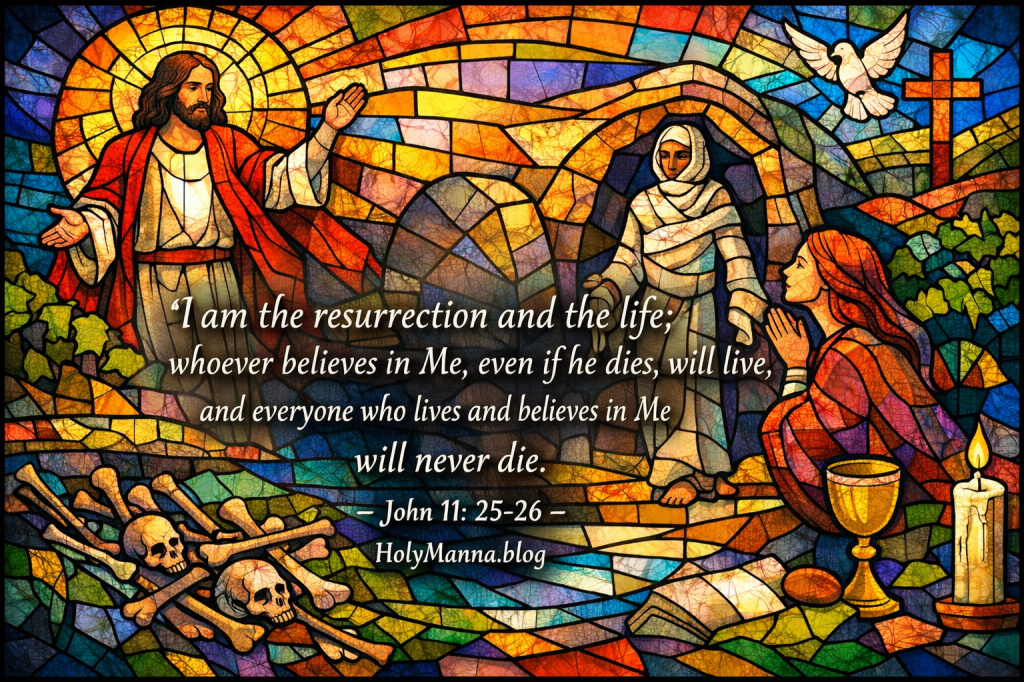
17 When Jesus arrived, he found that Lazarus had already been in the tomb for four days. 18 Now Bethany was near Jerusalem, only about two miles away. 19 And many of the Jews had come to Martha and Mary to comfort them about their brother. 20 When Martha heard that Jesus was coming, she went to meet him; but Mary sat at home. 21 Martha said to Jesus, “Lord, if you had been here, my brother would not have died. 22 [But] even now I know that whatever you ask of God, God will give you.” 23 Jesus said to her, “Your brother will rise.” 24 Martha said to him, “I know he will rise, in the resurrection on the last day.” 25 Jesus told her, “I am the resurrection and the life; whoever believes in me, even if he dies, will live, 26 and everyone who lives and believes in me will never die. Do you believe this?” 27 She said to him, “Yes, Lord. I have come to believe that you are the Messiah, the Son of God, the one who is coming into the world.”
28 When she had said this, she went and called her sister Mary secretly, saying, “The teacher is here and is asking for you.” 29 As soon as she heard this, she rose quickly and went to him. 30 For Jesus had not yet come into the village, but was still where Martha had met him. 31 So when the Jews who were with her in the house comforting her saw Mary get up quickly and go out, they followed her, presuming that she was going to the tomb to weep there. 32 When Mary came to where Jesus was and saw him, she fell at his feet and said to him, “Lord, if you had been here, my brother would not have died.” 33 When Jesus saw her weeping and the Jews who had come with her weeping, he became perturbed and deeply troubled, 34 and said, “Where have you laid him?” They said to him, “Sir, come and see.” 35 And Jesus wept. 36 So the Jews said, “See how he loved him.” 37 But some of them said, “Could not the one who opened the eyes of the blind man have done something so that this man would not have died?”
38 So Jesus, perturbed again, came to the tomb. It was a cave, and a stone lay across it. 39 Jesus said, “Take away the stone.” Martha, the dead man’s sister, said to him, “Lord, by now there will be a stench; he has been dead for four days.” 40 Jesus said to her, “Did I not tell you that if you believe you will see the glory of God?” 41 So they took away the stone. And Jesus raised his eyes and said, “Father, I thank you for hearing me. 42 I know that you always hear me; but because of the crowd here I have said this, that they may believe that you sent me.” 43 And when he had said this, he cried out in a loud voice, “Lazarus, come out!” 44 The dead man came out, tied hand and foot with burial bands, and his face was wrapped in a cloth. So Jesus said to them, “Untie him and let him go.”
Session of the Sanhedrin. 45 Now many of the Jews who had come to Mary and seen what he had done began to believe in him.
Detailed Exegesis
Verse 1 – “Now a man was ill, Lazarus from Bethany, the village of Mary and her sister Martha.”
The Gospel begins with human weakness. Lazarus is sick, and the family is introduced with warmth and familiarity. Bethany is not just a place on a map. It is a home Jesus knows. The scene opens not with a public controversy, but with an ordinary family crisis that becomes the setting for divine revelation.
Verse 2 – “Mary was the one who had anointed the Lord with perfumed oil and dried his feet with her hair; it was her brother Lazarus who was ill.”
John identifies Mary through an act of love and devotion that will soon take place in the narrative. This creates a sacred link between suffering, love, and worship. Even before the miracle, the household is already marked by intimate friendship with Christ.
Verse 3 – “So the sisters sent word to him, saying, ‘Master, the one you love is ill.’”
The message is simple and trusting. Martha and Mary do not tell Jesus what to do. They place the need before Him. This is a beautiful image of prayer. Faith does not always arrive with a plan. Sometimes it simply lays the beloved wounded one before the Lord.
Verse 4 – “When Jesus heard this he said, ‘This illness is not to end in death, but is for the glory of God, that the Son of God may be glorified through it.’”
Jesus immediately interprets the situation through the lens of divine glory. This does not mean Lazarus will not truly die. It means death will not have the final word. In John’s Gospel, glory is deeply tied to the revelation of Jesus’ identity and mission. Even sorrow is being drawn into something larger than itself.
Verse 5 – “Now Jesus loved Martha and her sister and Lazarus.”
This verse is crucial because it protects the rest of the story from misunderstanding. Jesus does not delay because He is cold. He delays because His love is working toward a deeper good than immediate relief. The Gospel wants the reader to know this before the waiting becomes painful.
Verse 6 – “So when he heard that he was ill, he remained for two days in the place where he was.”
This is one of the hardest lines in the story. Love does not move quickly in the way human beings expect. Jesus remains. The delay becomes part of the sign. Faith is often purified in the gap between prayer and visible answer.
Verse 7 – “Then after this he said to his disciples, ‘Let us go back to Judea.’”
Jesus chooses the moment. He is never dragged by circumstance. He returns to Judea on His own terms, and in doing so moves closer to both Lazarus’ tomb and His own Passion.
Verse 8 – “The disciples said to him, ‘Rabbi, the Jews were just trying to stone you, and you want to go back there?’”
The disciples react with understandable fear. They know Judea is dangerous ground. Their concern shows that this journey is not only about Lazarus. It is also about the rising conflict surrounding Jesus.
Verse 9 – “Jesus answered, ‘Are there not twelve hours in a day? If one walks during the day, he does not stumble, because he sees the light of this world.’”
Jesus speaks of divine timing and mission. As long as He walks in the Father’s will, His hour has not yet come. The image of light continues one of John’s major themes. To walk with God is to walk in the light of truth.
Verse 10 – “But if one walks at night, he stumbles, because the light is not in him.’”
Night here suggests more than darkness outside. It signals spiritual blindness and separation from divine guidance. Those who move apart from God’s light inevitably stumble.
Verse 11 – “He said this, and then told them, ‘Our friend Lazarus is asleep, but I am going to awaken him.’”
Jesus speaks of death as sleep, not to deny its reality, but to show His authority over it. What is final for man is not final for Him. Lazarus is called “our friend,” which reminds the disciples that this miracle unfolds within the bonds of love.
Verse 12 – “So the disciples said to him, ‘Master, if he is asleep, he will be saved.’”
The disciples misunderstand at the literal level, as often happens in John’s Gospel. Their confusion creates room for Jesus to reveal deeper truth. Spiritual realities often break into human language in ways that initially puzzle the hearer.
Verse 13 – “But Jesus was talking about his death, while they thought that he meant ordinary sleep.”
John makes the misunderstanding explicit. The reader is gently instructed to move beyond surface meaning. In this Gospel, misunderstanding often becomes the doorway to revelation.
Verse 14 – “So then Jesus said to them clearly, ‘Lazarus has died.’”
Jesus now speaks plainly. The miracle will not rest on ambiguity. Death is named directly. Christian hope never requires pretending that death is not real.
Verse 15 – “And I am glad for you that I was not there, that you may believe. Let us go to him.”
Jesus is glad not because Lazarus died, but because what is about to happen will deepen the faith of His disciples. The miracle is ordered toward belief. The Lord sometimes allows suffering to become the place where faith grows roots.
Verse 16 – “So Thomas, called Didymus, said to his fellow disciples, ‘Let us also go to die with him.’”
Thomas speaks with courage mixed with incomplete understanding. His words are gloomy, yet loyal. He sees danger and chooses to remain with Jesus anyway. Even imperfect discipleship can contain real love.
Verse 17 – “When Jesus arrived, he found that Lazarus had already been in the tomb for four days.”
The fourth day matters. Lazarus is not freshly dead. In the eyes of mourners, decay has already begun. Jesus arrives when hope has crossed into impossibility.
Verse 18 – “Now Bethany was near Jerusalem, only about two miles away.”
This detail heightens the public significance of the miracle. The sign will happen near the city where Jesus’ enemies hold influence. What occurs here cannot remain hidden.
Verse 19 – “And many of the Jews had come to Martha and Mary to comfort them about their brother.”
Mourning is communal. The sisters are surrounded by witnesses. This means the miracle, too, will have many witnesses, and that public testimony will intensify the coming decision about Jesus.
Verse 20 – “When Martha heard that Jesus was coming, she went to meet him; but Mary sat at home.”
Martha moves first. Her active love, already seen elsewhere in the Gospels, appears again here. Mary remains in the house, heavy with grief. Each sister approaches the Lord through her own temperament.
Verse 21 – “Martha said to Jesus, ‘Lord, if you had been here, my brother would not have died.’”
This is not merely complaint. It is sorrow mixed with faith. Martha believes Jesus could have healed Lazarus. Her grief is honest, and faith does not erase that honesty.
Verse 22 – “[But] even now I know that whatever you ask of God, God will give you.’”
Martha’s hope has not died with her brother. She does not yet understand what Jesus will do, but she still trusts His relationship with the Father. This is a strong, wounded faith.
Verse 23 – “Jesus said to her, ‘Your brother will rise.’”
Jesus speaks truth, but at a level Martha does not yet fully grasp. His words carry both immediate and ultimate meaning. Lazarus will rise now, and all the faithful will rise on the last day.
Verse 24 – “Martha said to him, ‘I know he will rise, in the resurrection on the last day.’”
Martha already shares the Jewish hope of final resurrection. Her theology is sound, but the Lord is about to reveal something even more immediate and personal. Resurrection is not only an event to await. It is bound up with Jesus Himself.
Verse 25 – “Jesus told her, ‘I am the resurrection and the life; whoever believes in me, even if he dies, will live.’”
This is one of the great “I am” statements in John. Jesus does not simply grant resurrection as an external gift. He is its source. Life is not separate from Him. In Him, death is no longer ultimate.
Verse 26 – “and everyone who lives and believes in me will never die. Do you believe this?’”
Jesus asks Martha for personal faith. The promise is not that believers avoid bodily death, but that death cannot sever them from divine life. The real question is not whether death exists. The question is whether faith rests in Christ.
Verse 27 – “She said to him, ‘Yes, Lord. I have come to believe that you are the Messiah, the Son of God, the one who is coming into the world.’”
Martha gives one of the most beautiful confessions of faith in the Gospel. Her grief does not prevent belief. In the middle of loss, she names Jesus rightly. That is a model of mature faith.
Verse 28 – “When she had said this, she went and called her sister Mary secretly, saying, ‘The teacher is here and is asking for you.’”
Faith now becomes mediation. Martha goes to bring Mary to Jesus. This is a quiet image of the Church’s work. Those who meet Christ are sent to call others into His presence.
Verse 29 – “As soon as she heard this, she rose quickly and went to him.”
Mary responds immediately. Even in grief, the soul moves when it hears that Jesus is near. Grace awakens movement.
Verse 30 – “For Jesus had not yet come into the village, but was still where Martha had met him.”
Jesus remains at the threshold. Symbolically, He stands just outside the place of sorrow and death, waiting to be met. The movement toward Him matters.
Verse 31 – “So when the Jews who were with her in the house comforting her saw Mary get up quickly and go out, they followed her, presuming that she was going to the tomb to weep there.”
The mourners follow Mary, thinking she goes to the tomb. Without realizing it, they are being drawn toward an even greater revelation. Human grief is being led toward divine action.
Verse 32 – “When Mary came to where Jesus was and saw him, she fell at his feet and said to him, ‘Lord, if you had been here, my brother would not have died.’”
Mary repeats Martha’s words, but from a more visibly emotional posture. She falls at His feet. Sorrow and adoration meet here. The same faith can appear through very different personalities.
Verse 33 – “When Jesus saw her weeping and the Jews who had come to her weeping, he became perturbed and deeply troubled.”
Jesus is deeply moved, and the language is stronger than mild sadness. He is shaken in spirit before the reality of death and the sorrow it causes. This is not detached observation. The Lord enters the anguish fully.
Verse 34 – “and said, ‘Where have you laid him?’ They said to him, ‘Sir, come and see.’”
Jesus asks to be led to the tomb. The Lord who knows all still chooses to walk toward the place of burial. Grace does not hover above grief. It enters it.
Verse 35 – “And Jesus wept.”
This is one of the shortest verses in Scripture and one of the deepest. Jesus truly weeps. His humanity is not an appearance. The Son of God has taken a real human heart, and that heart grieves.
Verse 36 – “So the Jews said, ‘See how he loved him.’”
The crowd recognizes love in His tears. They are right, though they do not yet see how far that love is about to go. Christ’s sorrow is not weakness. It is the tenderness of divine love in human form.
Verse 37 – “But some of them said, ‘Could not the one who opened the eyes of the blind man have done something so that this man would not have died?’”
The crowd voices the scandal of delay. Why would the miracle worker permit this? This question runs through every age. It is the question of every believer who has prayed and waited in pain.
Verse 38 – “So Jesus, perturbed again, came to the tomb. It was a cave, and a stone lay across it.”
Jesus arrives at the tomb still deeply moved. The stone across the entrance makes death appear fixed and sealed. The scene is set for a direct confrontation between the Lord of life and the reality of the grave.
Verse 39 – “Jesus said, ‘Take away the stone.’ Martha, the dead man’s sister, said to him, ‘Lord, by now there will be a stench; he has been dead for four days.’”
Jesus commands human cooperation. Others must move the stone. Martha’s objection is painfully realistic. Faith does not deny the ugliness of death. The body has begun to decay. Yet Christ’s command remains.
Verse 40 – “Jesus said to her, ‘Did I not tell you that if you believe you will see the glory of God?’”
Jesus brings Martha back to faith. Belief is the lens through which the glory of God is seen. The miracle is not magic for the curious. It is revelation for those willing to trust Him.
Verse 41 – “So they took away the stone. And Jesus raised his eyes and said, ‘Father, I thank you for hearing me.’”
Jesus prays aloud with filial confidence. The thanksgiving comes before the visible result, revealing His perfect communion with the Father. His miracles flow from divine sonship.
Verse 42 – “I know that you always hear me; but because of the crowd here I have said this, that they may believe that you sent me.’”
The prayer is spoken for the sake of the crowd. Jesus wants them to understand that this act reveals His mission from the Father. Faith in His identity is the real aim of the sign.
Verse 43 – “And when he had said this, he cried out in a loud voice, ‘Lazarus, come out!’”
The command is royal, direct, and irresistible. Jesus does not bargain with death. He speaks, and death must yield. The voice that called creation into being now calls one dead man back from the tomb.
Verse 44 – “The dead man came out, tied hand and foot with burial bands, and his face was wrapped in a cloth. So Jesus said to them, ‘Untie him and let him go.’”
Lazarus comes out still bound. The miracle is complete, but the unbinding remains. This has often been read beautifully in the Catholic tradition as an image of how Christ raises the sinner by His power and then uses His Church to help loose the remaining bonds.
Verse 45 – “Now many of the Jews who had come to Mary and seen what he had done began to believe in him.”
The sign achieves its immediate purpose in many hearts. Yet even this belief will soon provoke opposition and judgment from others. The raising of Lazarus is both revelation and turning point. It leads toward faith, and it also hastens the road to the Cross.
Teachings
This Gospel teaches first that Jesus Christ is true God and true man. He knows what He will do, yet He truly grieves. He delays with divine purpose, yet He sheds real human tears. The Catechism says, “The Son of God… worked with human hands; he thought with a human mind. He acted with a human will, and with a human heart he loved.” That truth shines powerfully in this passage. Jesus is not a distant deity pretending to care. He is the incarnate Son whose human heart trembles before the sorrow of death even as His divine authority commands the dead to rise.
This Gospel also teaches that Christ is Lord over death. Lazarus does not rise by his own strength or by the force of human longing. He rises because Jesus speaks. That is why the Lord’s words to Martha are so central: “I am the resurrection and the life.” The Catechism teaches, “Jesus links faith in the resurrection to his own person: ‘I am the Resurrection and the life.’” It also teaches, “Christ’s resurrection was not a return to earthly life, as was the case with the raisings from the dead that he had performed before Easter: Jairus’ daughter, the young man of Naim, Lazarus. These actions were miraculous events, but the persons miraculously raised returned by Jesus’ power to ordinary earthly life. At some particular moment they would die again. Christ’s Resurrection is essentially different.” This is a crucial distinction. Lazarus is a sign. Jesus is the source. Lazarus comes back to mortal life. Christ rises into glorified life never to die again.
The Catholic tradition has loved this Gospel because it speaks so directly to the mystery of conversion. Saint Augustine saw Lazarus as an image of the sinner. When Christ says, “Lazarus, come out,” Augustine hears the voice of grace calling a dead soul back to life. And when Jesus says, “Untie him and let him go,” Augustine sees the ministry of the Church helping to loose the bonds that remain. Saint Augustine says, “The Lord, after he had restored life, commanded the servants to loose him and let him go. What does this mean? Whatsoever you shall loose on earth shall be loosed also in heaven.” This is a beautiful way to see the Church’s sacramental life, especially in Lent. Christ raises. Christ forgives. Christ restores. Yet He also uses His Church to help unbind the sinner through prayer, penance, and the ministry of mercy.
This Gospel further teaches that suffering and divine love are not opposites. Martha and Mary both say, “Lord, if you had been here…” That cry has lived on the lips of believers in every century. Yet the Gospel answers that sorrow not by denying the pain, but by revealing the heart of Christ inside it. Saint John Chrysostom, reflecting on this passage, emphasizes that Christ allowed the death and delay so the miracle would be beyond dispute and faith might be strengthened. The story teaches that divine love is not always immediate rescue. Sometimes divine love leads the soul through darkness into a greater revelation of God’s glory.
Finally, this Gospel points toward the resurrection of the body and the final victory of Christ. The Catechism says, “We firmly believe, and hence we hope that, just as Christ is truly risen from the dead and lives for ever, so after death the righteous will live for ever with the risen Christ and he will raise them up on the last day.” The raising of Lazarus is therefore not an isolated wonder. It is a signpost pointing toward Easter and beyond Easter toward the resurrection of all the faithful. The same voice that cried into Bethany’s tomb will one day summon every grave to surrender its dead.
Reflection
This Gospel speaks so powerfully to daily life because most people eventually stand where Martha and Mary stood. A prayer seems unanswered. A loss feels irreversible. A grave, whether literal or spiritual, looks sealed shut. The hardest part is often not the suffering itself, but the delay. The heart knows Jesus loves, yet it does not understand why He waited. That tension lives in this Gospel, and the Lord does not shame it. He meets it.
A faithful way to live this Gospel begins with bringing sorrow honestly to Christ. Martha and Mary do not hide their pain, and neither should the faithful. Another step is to let the Lord define the situation, even when appearances feel final. Jesus sees beyond the grave, beyond the stone, beyond the fourth day. Another step is to obey even when the command feels unreasonable. “Take away the stone” must have sounded absurd beside a decaying body, yet that act of obedience prepared the way for glory. Another step is to remember that Christ still calls people by name. He still summons souls out of sin, despair, resentment, addiction, fear, and numbness. He still says, in effect, come out. And He still gives His Church the work of helping to untie what binds.
What tomb has the heart quietly accepted as permanent? Where has disappointment with God become a hidden wound? What stone is Christ asking to have moved, even though the soul is afraid of what lies behind it? Does faith still believe that Jesus can bring life out of what already smells like defeat? This Gospel does not leave the reader standing safely outside the story. It pulls him close enough to hear the weeping, smell the tomb, and tremble at the command. That is exactly where Lent wants the soul to stand. Right there, beside the grave, where the Lord of life reveals that death does not get the last word.
Step Out of the Tomb and Walk Toward Easter
Today’s readings move like one great story of salvation. Ezekiel 37:12-14 shows the Lord speaking to a people who feel buried, cut off, and finished, and He promises to open their graves and put His Spirit within them. Psalm 130 gives words to the soul crying from the depths, not with shallow optimism, but with real repentance and real hope in the mercy of God. Romans 8:8-11 lifts the eyes even higher and reminds the faithful that the same Spirit who raised Jesus from the dead already dwells in those who belong to Him. Then John 11:1-45 brings everything to its breathtaking center, as Jesus stands before the tomb of Lazarus and reveals that He is not merely a witness to resurrection, but “the resurrection and the life.”
Taken together, these readings tell the truth about both man and God. They tell the truth about man by showing how easily life can feel buried under sin, grief, fear, delay, and weakness. They tell the truth about God by showing that He is not frightened by graves. He is not repelled by decay. He is not absent from the tears of His people. He enters the place of loss, hears the cry from the depths, breathes His Spirit into what is lifeless, and calls the dead to rise. That is the heart of Lent. It is not a season for pretending to be strong. It is a season for letting the Lord bring life to what cannot be healed by human effort alone.
This Sunday invites the faithful to make a real decision as Easter draws near. It is time to stop making peace with the tomb. It is time to stop treating old sins, old wounds, and old despair as permanent residents of the soul. Christ still says, “Take away the stone.” He still calls people by name. He still tells His people to untie one another and walk in freedom. The road to Easter is not for the self-satisfied. It is for those willing to let the Lord meet them in the graveyard and lead them out into the light.
What part of life needs to be placed before Christ with fresh trust? What stone needs to be moved? What grave needs to hear His voice? This week is a good time to pray more honestly, repent more deeply, go to confession if needed, return to the Scriptures with greater attention, and ask the Holy Spirit for the courage to live like resurrection is real. The Lord who opened graves for Israel, heard the cry of the psalmist, inspired the words of Saint Paul, and stood weeping before Lazarus’ tomb is the same Lord who comes near now. He is still calling souls out of darkness. He is still leading His people toward Easter. And He is still faithful to every word He has spoken.
Engage with Us!
Share your reflections in the comments below. These readings speak to the deepest places of the heart, and sometimes the most powerful insights come from hearing how the Lord is moving in the lives of fellow believers.
- In Ezekiel 37:12-14, where does life feel buried right now, and what would it look like to trust that God can still open that grave and breathe new life into it?
- In Psalm 130, what depths has the soul been crying from, and has there been a real turning toward the Lord’s mercy instead of carrying the burden alone?
- In Romans 8:8-11, what part of daily life still looks more like life in the flesh than life in the Spirit, and how might there be a deeper surrender to the Holy Spirit this week?
- In John 11:1-45, what stone may Christ be asking to have moved, even if fear, grief, or doubt has made that step feel impossible?
Let these questions stay close throughout the week. Walk forward in faith, stay near to the sacraments, and do every ordinary thing with the love, mercy, and compassion that Jesus showed so clearly. The Lord still calls His people out of darkness and into life, so keep trusting Him, keep following Him, and keep loving others the way He has loved us.
Sacred Heart of Jesus, we trust in You!
Immaculate Heart of Mary, pray for us!
Saint Michael the Archangel, defend us in battle!
Follow us on YouTube, Instagram and Facebook for more insights and reflections on living a faith-filled life.

 Holy Manna!
Leave a comment