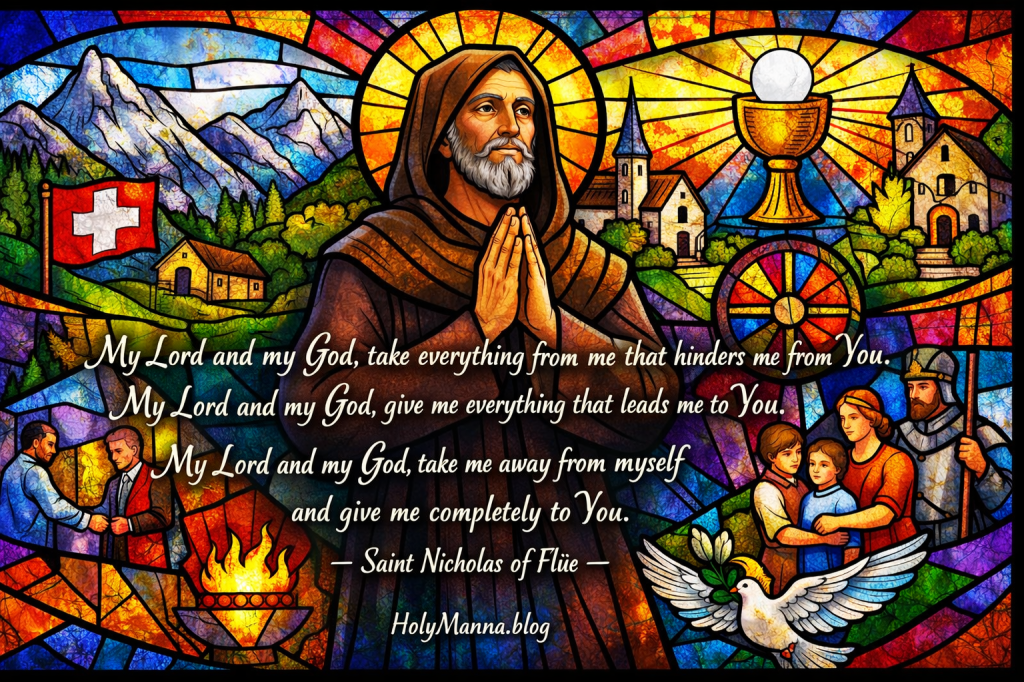
The Hermit Who Helped Save a Nation
Saint Nicholas of Flüe, often lovingly called Brother Klaus, is one of those saints who seems almost impossible to fit into a single category. He was not only a mystic in the woods. He was also a husband, a father of ten children, a farmer, a soldier, a judge, a public servant, a counselor, and finally a hermit whose holiness shaped the soul of Switzerland. That alone makes him unforgettable.
In Christian tradition, and especially in Roman Catholic memory, he is revered because his life proves that holiness does not belong only to priests, monks, or cloistered nuns. Holiness can begin in the home, at the dinner table, in public duty, in the struggle to be faithful day after day. Then, if God wills it, that same holiness can be carried into deeper silence and more radical surrender. Saint Nicholas of Flüe stands as a witness to what The Catechism teaches about the universal call to holiness in every state of life, as seen in CCC 2013.
He is best known as the patron saint of Switzerland, a peacemaker whose counsel helped prevent civil war, and a man of radical prayer who became famous for living for years with no ordinary food, sustained only by the Eucharist. Yet what makes him so compelling is not simply that parts of his life seem extraordinary. It is that everything in his story points back to God. His best-known prayer says it beautifully: “My Lord and my God, take everything from me that hinders me from You. My Lord and my God, give me everything that leads me to You. My Lord and my God, take me away from myself and give me completely to You.”
That is the heart of his life. Everything that hinders must go. Everything that leads to God must stay.
A Boy from the Mountains, Raised for Something More
Nicholas was born on March 21, 1417, in Flüeli near Sachseln, in what is now the Swiss canton of Obwalden. He came from a solid peasant family and grew up in a world of fields, mountains, prayer, labor, and local duty. He was not raised in luxury, but he was raised in a culture where the Catholic faith shaped daily life. From his youth, tradition says he showed seriousness, self-control, and a tendency toward prayer and recollection.
As a young man, he served his community and also served in military campaigns. That part of his life sometimes surprises people. The saint later remembered for peace once carried the responsibilities of a soldier. Yet that is part of what makes his witness so real. He knew the world he would later counsel. He understood conflict, political tension, and the pressures of leadership. Catholic tradition also preserves the memory that during military service he urged restraint and opposed unnecessary violence, including the destruction of a convent. Even before the Ranft, there were signs that he was a man whose conscience belonged to God.
He married Dorothea Wyss, and together they built a real home, not an imagined holy picture. They had ten children, five sons and five daughters. Nicholas worked as a farmer and became a respected public figure. He served as judge and councillor and was entrusted with responsibility by his neighbors. He was not famous because he fled duty. He was first faithful in duty.
This matters deeply. Too often, holiness gets imagined as an escape from ordinary life. Saint Nicholas shows something different. He lived the hard, beautiful, demanding vocation of marriage and family. He loved his wife. He raised children. He worked. He served the common good. He learned obedience to God in the middle of real life. That is one reason his story still hits so hard. He reminds modern Catholics that sanctity can begin in the middle of diapers, decisions, budgets, and public responsibilities.
When the World Could Not Hold His Soul
For many years Nicholas carried within himself a growing call to deeper solitude and prayer. This was not a sudden whim. It was a long interior struggle. Catholic tradition presents this period as a painful discernment, not a romantic adventure. He loved his family, but he also believed that God was drawing him into a more radical hidden life. Eventually, with the consent of Dorothea and the cooperation of his family, he left his ordinary public life in 1467.
That part of his life remains challenging, even for devout Catholics. It should be. Saints are not always comfortable. Brother Klaus is one of those saints who forces people to slow down and admit that God’s call can be mysterious and costly. His departure from home was not a rejection of marriage or fatherhood. It came only after years of faithful family life, long discernment, and consent within the household. Even then, it cost something. Dorothea’s sacrifice must not be minimized. Her yes was real, and her suffering was real too.
Nicholas first set out as a pilgrim, apparently intending to travel farther away, but he turned back and eventually settled in the Ranft, a ravine not far from home. There he lived in a hermitage near a chapel. He did not disappear into bitterness or eccentricity. He entered into a life of penance, prayer, silence, and contemplation.
This was the season in which Brother Klaus became the man most people remember. He lived hidden, but the hidden life did not make him irrelevant. It made him luminous.
The Miracles and Wonders of His Life in the Flesh
Saint Nicholas of Flüe is associated with several extraordinary signs during his lifetime, and Catholic tradition has preserved them with great reverence.
The most famous is his prolonged fasting. For many years, witnesses reported that he took no ordinary food and seemed to live only from Holy Communion. This was not a private rumor kept among a few admirers. Church and civil authorities examined the matter because it seemed so astonishing. Catholic sources say he was observed, tested, and questioned, yet the tradition remained firm that he lived in this way by a special grace of God. The Church saw in this a striking sign of what The Catechism calls the Eucharist as “the source and summit of the Christian life” in CCC 1324. Brother Klaus became a living sign that man does not live by bread alone.
He was also known for mystical visions. Traditions preserved at the Catholic shrine associated with him speak of visions from youth onward, including images of a tower, of divine mystery, and later of a meditation image often called his “wheel” or meditation tableau. This symbol became important in his spiritual life and later devotional life. It reflected his contemplation of God as the center from whom all things come and to whom all things return. These accounts belong to Catholic tradition surrounding his mystical life, though some details cannot be historically verified in every point.
Another miracle story associated with his life is the fire at Sarnen. Catholic tradition tells that through his prayer and the sign of the cross, a destructive fire was stopped and the town was spared. This story has long been preserved in Catholic accounts of his life. It belongs to the miracle traditions connected with him, though the modern historian cannot verify every detail with the same precision expected in a contemporary investigation.
Then there is the miracle of peace. That may sound less dramatic than fire or fasting, but in the life of Saint Nicholas it may be the most important miracle of all. In 1481, during the crisis at Stans, the Swiss cantons stood dangerously close to internal conflict. A priest came to Brother Klaus for counsel. Nicholas gave advice, and that advice helped bring about reconciliation. The exact words were not preserved publicly, which somehow makes the moment even more striking. His wisdom did not become famous because it was theatrical. It became famous because it saved lives and preserved unity.
That is why Catholics should remember him. He teaches that contemplation is not useless. Deep prayer does not make a man less helpful. It can make him the one man who sees clearly when everyone else is panicking.
The Hard Road of Obedience and the Cross He Carried
Saint Nicholas was not a martyr in the technical sense. He was not killed for the faith. Still, he carried real hardship, and his life was marked by forms of suffering that were severe and deeply human.
The first great hardship was interior. He had to discern a call that was painful for himself and painful for his family. That is not easy to romanticize. It required trust that God was leading, even when the path looked strange. It required his wife to surrender in faith. It required his children to live with absence and mystery. This alone makes his story heavier than many imagine.
The second hardship was bodily. His life in the Ranft was severe. Silence, fasting, exposure, solitude, and relentless prayer are not soft things. Catholic sources describe a life of real penance. He did not chase extraordinary experiences for their own sake. He embraced sacrifice so that his whole being could belong to God.
The third hardship was the burden of counsel. People came to him constantly. The hidden life did not remain private in the simple sense. Pilgrims, priests, and political leaders sought him out. Being a spiritual father to a nation is not light work. Brother Klaus had withdrawn from public office, yet public responsibility found him again in a new form.
And still, through all of this, his life radiated peace. One of the sayings associated with him captures that peace with striking simplicity: “Peace is always in God, for God is peace.” That line feels almost too simple until life falls apart. Then it becomes everything.
What Heaven Did Through Him After Death
Saint Nicholas died on March 21, 1487, the day of his seventieth birthday, with family near him. Even in death, the story comes full circle. The hermit who had once left home did not cease belonging to the people he loved. He died in the peace of God, and his memory began to spread more powerfully after his death.
He was buried in Sachseln, and his tomb quickly became a place of pilgrimage. That matters because devotion to him did not begin centuries later in some abstract way. It grew at the place where he had lived, prayed, suffered, and died. Catholics came seeking intercession, peace, healing, and clarity. Over time, his relics were honored in the parish church, and devotion to him became woven into Swiss Catholic identity.
Stories of graces and interventions multiplied after his death. Pilgrims reported favors received through his intercession, especially graces connected with peace, family needs, and spiritual help. Not every one of these later stories can be historically verified in a strict modern sense, but they belong to the devotional tradition that surrounded his tomb and helped sustain his veneration.
One posthumous story preserved in connection with his legacy is the account that Dorothea experienced a vision of him in glory near his grave. This story belongs to the traditional accounts surrounding his death and veneration. It cannot be historically verified with certainty, but it remains part of the Catholic memory attached to his early cult.
His official recognition by the Church came in stages. He was beatified in 1669 and canonized by Pope Pius XII in 1947. He is honored as the patron saint of Switzerland, and he is also named among the patrons of the Pontifical Swiss Guard. His memory is celebrated in different ways, especially on March 21 and, in Swiss tradition, on September 25. In parts of Switzerland, his feast became so important that it shaped public life and local celebration. That kind of cultural impact does not happen by accident. It happens when a saint becomes part of the soul of a people.
Even now, pilgrimages continue to the places associated with him, especially Flüeli-Ranft and Sachseln. His hermitage, his birthplace, his chapel, and his tomb continue to draw Catholics who are looking for silence, discernment, reconciliation, and peace.
Why Brother Klaus Still Matters Right Now
Saint Nicholas of Flüe feels especially important in an age that is loud, distracted, and spiritually tired. So many people live with constant noise, endless opinions, and very little interior stillness. Brother Klaus speaks straight into that world, not with trendy slogans, but with the authority of a life given over to God.
He teaches that holiness is not reserved for one kind of person. A married layman can become a saint. A father can become a saint. A public servant can become a saint. A sinner can become a saint. A nation in conflict can still be led toward peace. He also teaches that the deepest help a Christian can offer the world often begins in prayer. That does not mean prayer replaces action. It means action becomes blind without prayer.
His famous greeting, “The name of Jesus be your greeting!” sounds almost foreign to modern ears. Yet maybe that is exactly why it matters. He lived in a way that kept Christ at the center. Not politics first. Not self-expression first. Not comfort first. Christ first.
His prayer also offers a serious examination of conscience. “Take everything from me that hinders me from You.” That is not a safe prayer. It is a dangerous one. It asks God to remove what the heart may still be clinging to. But it is also the prayer that opens the soul to freedom.
For Catholics today, Brother Klaus offers several practical lessons. He teaches the value of silence. He teaches fidelity to vocation. He teaches reverence for the Eucharist. He teaches that peace in the soul must come before peace in society. He teaches that one holy life can become a shelter for many others. How much noise could be cut out of daily life so that the voice of God could be heard again? What attachment needs to be surrendered so that Christ can reign more fully in the heart? What conflict in family life, parish life, or public life might begin to heal if prayer came before reaction?
Learning to Live Like This Saint
To imitate Saint Nicholas of Flüe does not mean running away to a ravine in Switzerland. It means letting his virtues take root where life is already being lived.
It means taking prayer seriously instead of treating it like a leftover activity. It means protecting time for silence, even if only a little at first. It means receiving the Eucharist with deeper hunger and greater reverence. It means being a person of peace in a world that profits from outrage. It means understanding that the strongest soul in the room is not usually the loudest one.
It also means honoring the vocation already given. Brother Klaus was holy in marriage before he was holy in solitude. He was faithful in public life before he became a hermit. That matters. The first path to sanctity is not fantasy. It is fidelity. A husband becomes holy by loving his wife. A mother becomes holy by loving her children. A worker becomes holy by doing honest labor well. A citizen becomes holy by seeking justice. Then, in all of it, the soul learns to say yes when God asks for more.
Saint Nicholas did not save Switzerland by force. He helped save it by being close to God. That is the kind of lesson modern Christians cannot afford to miss.
Engage with Us!
Share your thoughts and reflections in the comments below. Saint Nicholas of Flüe has a way of speaking quietly but powerfully to the heart, and it would be beautiful to hear how his story speaks into your own life.
- What part of Saint Nicholas of Flüe’s life challenges you the most: his family life, his silence, his fasting, or his peacemaking?
- Do you believe prayer can truly change the course of a family, a community, or even a nation? Why or why not?
- What is one thing in your life that may be hindering you from drawing closer to God?
- How can you become a person of peace in your home, your parish, or your workplace this week?
- What does Saint Nicholas of Flüe teach you about trusting God even when His call feels difficult or mysterious?
May the life of Saint Nicholas of Flüe encourage a deeper love for Jesus, a stronger hunger for the Eucharist, and a steadier commitment to peace. Live with faith. Pray with courage. Love with mercy. Do everything with the love and mercy Jesus taught us.
Saint Nicholas of Flüe, pray for us!
Follow us on YouTube, Instagram and Facebook for more insights and reflections on living a faith-filled life.

 Holy Manna!
Leave a comment