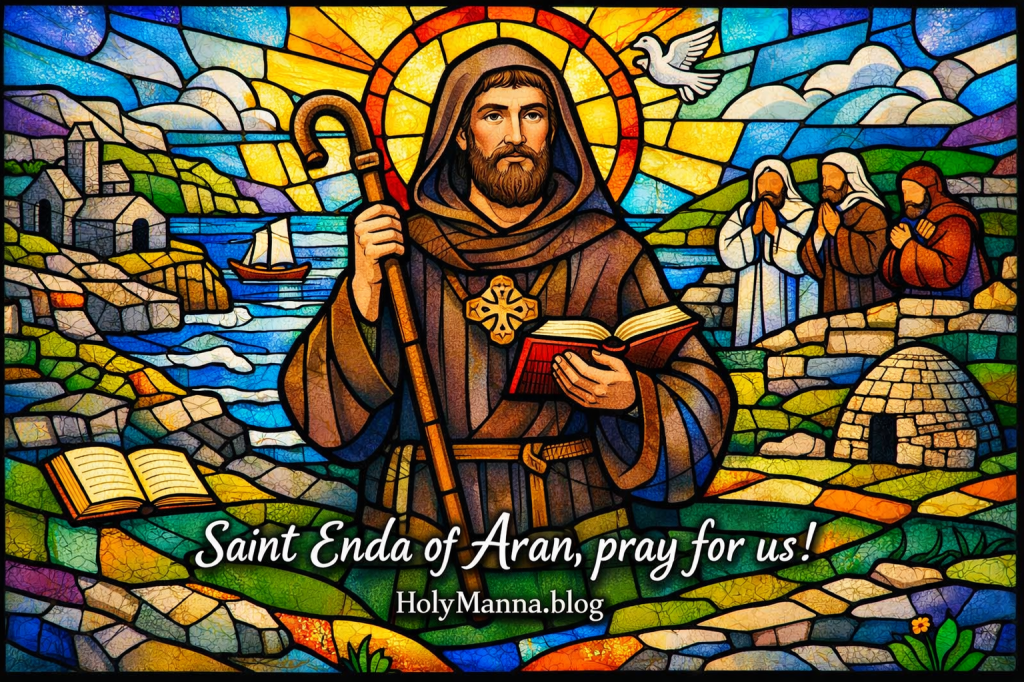
The Warrior Who Chose the Stone Desert for God
Saint Enda of Aran is one of those saints who quietly changed the course of Christian history without ever seeking attention for himself. In Catholic tradition, he is remembered as one of the great fathers of Irish monasticism, a man who turned away from the life of a warrior and gave himself completely to Christ. His name is closely tied to the Aran Islands, especially Inis Mór, where he built a spiritual home that helped form generations of saints.
That is why he is so revered. Saint Enda did not simply become holy in private. He created a place where holiness could take root in others. The island monastery associated with him became a school of prayer, penance, sacred learning, and deep union with God. In the life of the Church, he is remembered as an abbot and a spiritual father, a man whose witness helped guide many souls into the monastic life.
A Prince, a Warrior, and a Soul Called to Conversion
Saint Enda was born into a noble family in ancient Ireland, in the region traditionally associated with Oriel. Before his conversion, he lived like a prince and a warrior. He came from a world of power, honor, and battle. Catholic tradition presents him as a strong and capable man, but also as one still attached to earthly ambition before grace transformed him.
The turning point in his life is tied to his holy sister, Saint Fanchea. According to tradition, Enda desired to marry one of the young women connected with her religious community. Fanchea, wanting to save his soul, confronted him with the reality of death and the passing nature of earthly beauty. This moment shook him deeply. Whether every detail of the story can be historically verified or not, the tradition captures an important truth. God used this moment to pierce Enda’s heart and call him to something much greater.
After that, he left behind the path of worldly glory and began seeking the life of prayer. Tradition holds that he received formation in the monastic way, possibly studying under holy teachers outside his home region before returning to Ireland. What matters most is that his heart had changed. The man who once seemed destined for battle now desired to belong entirely to God.
Saint Enda is most known for bringing a strict and deeply spiritual form of monastic life to Ireland. He is remembered as one of the first to shape Irish monasticism in a way that would profoundly influence the nation’s saints, scholars, and missionaries.
The Island That Became a School of Saints
The great work of Saint Enda’s life was on the Aran Islands. Tradition says that land on Inis Mór was given to him through royal connections, and that he deliberately chose the harsh and barren island over a more comfortable location. That choice says a great deal about who he was. He was not looking for ease. He was looking for God.
On the island, he established his great monastic settlement at Cill Éanna, or Killeany. There he formed a community of monks who lived with seriousness, simplicity, and joy rooted in prayer. Their lives were marked by fasting, silence, manual labor, sacred study, and the chanting of the divine office. The monks lived in stone cells, worked with their hands, and gave themselves to the study of Scripture. This was not a random collection of holy practices. It was a way of life centered on loving God with the whole heart.
Saint Enda became important not only because he was personally holy, but because he formed other holy men. Catholic tradition associates his monastery with saints such as Brendan the Navigator, Ciarán, Jarlath, Carthage, Finnian, and Columba. In that sense, his legacy is larger than one man’s life. He became a father of fathers, helping shape the spiritual climate that made Ireland a land rich in sanctity.
There are miracle stories connected with his life, though many belong to later tradition and cannot be verified with certainty. One story tells of a dispute involving Saint Brecan over land on the island. According to the tradition, when Brecan acted unjustly, Enda prayed, and Brecan’s feet were fixed in the sand. The story expresses the belief that God defended Enda’s mission, but this story cannot be verified.
Another tradition tells of a man who mockingly offered heavy sacks and barrels of grain to Enda, expecting that the monks would be unable to carry them to the island. Enda is said to have received the gift with humility, and the provisions were miraculously transported across the water. This story highlights Enda’s faith and trust in divine providence, but this story cannot be verified.
There is also a local tradition about Saint Enda and a holy well. It is said that while he prayed on his journey westward, a spring arose where he knelt, and this place later became associated with pilgrimage and devotion. This tradition reflects the reverence people had for his holiness, but this story cannot be verified.
The Cross He Chose to Carry
Saint Enda was not a martyr in the way many early saints were. He did not die by execution for the faith. Yet his life was still marked by hardship, renunciation, and a kind of daily martyrdom. He gave up rank, comfort, marriage, and earthly status. He embraced a difficult life in a rocky and isolated place because he believed that nothing mattered more than belonging to Christ.
The island itself was a hardship. The Aran landscape is beautiful, but it is also severe. The wind, the stone, the isolation, and the poverty of the land made ordinary life difficult. Enda chose that setting because he wanted a place where men could be stripped of distraction and taught to depend on God. He did not seek suffering for its own sake. He accepted hardship as part of loving Christ without compromise.
There is something deeply moving about that witness. Enda did not ask how little he could give God and still be considered faithful. He gave everything. He made his life a living response to grace. That is why his witness still matters. He shows that holiness is not built on comfort. It is built on surrender.
He died peacefully after a life of prayer and spiritual fatherhood, probably in the early sixth century. Tradition places his death in his monastic cell near the sea. There is no dramatic martyrdom scene, but there is something beautiful in the image of a man who began with the sword and ended in silence, prayer, and total belonging to God.
Aran of the Saints and the Wonders of His Legacy
After Saint Enda’s death, his memory only grew stronger. The most important miracle associated with him after death is not one single healing or apparition. It is the lasting holiness of Aran itself. For centuries, the island was remembered as a place of sanctity, study, and monastic formation. So many holy men were associated with the island that tradition spoke of Aran almost as a burial place of saints beyond counting.
One later legend says that Saint Brendan the Navigator, who had earlier received Enda’s blessing, encountered him again in the mysterious western lands of his voyage. This story belongs to the spiritual imagination of later Christian tradition and cannot be verified. Still, it shows how deeply Saint Enda lived in the devotional memory of the Irish Church.
His posthumous legacy also lives on through sacred places connected to him. The ruins of his monastic site on Inis Mór remain part of the holy landscape of Ireland. Holy wells, church dedications, and local remembrance kept his name alive across centuries. His feast is celebrated on March 21, especially in Ireland, where he is still honored as one of the great early monastic saints.
Culturally, Saint Enda helped shape the soul of Irish Christianity. He belongs to that early generation of saints who made the island not just a geographical place, but a spiritual homeland. His influence helped prepare the ground for the flowering of Irish monastic life, with its love of prayer, learning, ascetic discipline, missionary zeal, and reverence for sacred Scripture.
What Saint Enda Teaches the Heart Today
Saint Enda’s life speaks clearly to the modern soul. He reminds the heart that conversion is possible, even after years of living for lesser things. A man shaped by ambition and battle became a father of monks. A prince became a servant. A warrior became a builder of holy lives.
His example also teaches that the hard place is not always the wrong place. Sometimes the barren island is exactly where grace wants to build something beautiful. What difficult place in life might actually be the place where God is trying to make a saint? That is the kind of question Enda leaves behind.
He also teaches the value of discipline. Prayer, fasting, study, labor, and silence are not outdated burdens. They are tools by which the Lord trains the soul in freedom. The Catechism teaches that all the faithful are called to the fullness of Christian life and the perfection of charity, as seen in CCC 2013. Saint Enda shows what that call can look like when it is embraced without reservation.
His life encourages daily faithfulness. Holiness is not usually built in one dramatic moment. It is built in repeated acts of love. It grows through prayer said when tired, work done honestly, desires surrendered to Christ, and Scripture received with reverence. Saint Enda teaches that when a soul gives everything to God, even a rocky island can become holy ground.
Engage With Us!
Share your thoughts and reflections in the comments below. Saint Enda’s story is quiet, strong, and deeply challenging in the best way. His life invites a serious look at what it means to leave behind lesser things in order to belong more fully to Christ.
- What part of Saint Enda’s conversion speaks most strongly to the heart right now?
- Is there a comfort, habit, or ambition that needs to be surrendered so God can shape life more deeply?
- How can prayer, sacrifice, and love for Scripture become more concrete in daily life this week?
Saint Enda of Aran reminds the Church that God can transform even the hardest places into places of grace. May his example inspire a deeper love for prayer, greater courage in sacrifice, and a stronger desire for holiness. Live a life of faith, stay close to Christ, and do everything with the love and mercy Jesus taught us.
Saint Enda of Aran, pray for us!
Follow us on YouTube, Instagram and Facebook for more insights and reflections on living a faith-filled life.

 Holy Manna!
Leave a comment