Saturday of the Fourth Week of Lent – Lectionary: 249
When Truth Steps Into the Crowd
There are days in the Church’s liturgy that feel like a quiet warning bell, and today is one of them. As Lent deepens and the shadow of Holy Week begins to stretch across the horizon, the readings gather around one central theme: God’s truth reveals the heart. When the Lord draws near, hidden motives rise to the surface, loyalty is tested, and every soul is gently but firmly asked to choose whether it will trust Him or resist Him.
That is the thread tying these readings together. In Jeremiah 11:18-20, the prophet discovers that the very people around him are plotting his destruction. In Psalm 7:2-3, 9-12, the just man cries out to God not as a last resort, but as his shield and judge. Then in John 7:40-53, Jesus stands before a divided crowd, and what should have been a moment of recognition becomes a moment of argument, confusion, pride, and fear. Some hear Him and begin to believe. Others harden themselves and look for reasons not to. The truth has not changed, but the human heart is exposed.
There is also an important Lenten background to the whole day. By the Fourth Week of Lent, the Church is already turning our eyes toward the Passion. The opposition against Jesus is no longer a distant possibility. It is building in public. The same pattern had already appeared in the lives of the prophets, especially Jeremiah, whose suffering foreshadows Christ. The innocent one is opposed, not because he has done evil, but because he speaks God’s word too clearly. The Church has long seen in Jeremiah’s image of the trusting lamb a figure of Jesus, the true Lamb who will be led to slaughter for the salvation of the world. What happened to the prophets in part is fulfilled perfectly in Christ.
The cultural and religious setting matters too. In the Gospel, the people are arguing over Jesus during a time of intense expectation about the Messiah. They know the Scriptures. They know the promises. They know what they think the Messiah should look like. And yet many of them cannot receive the One standing in front of them. That tension is timeless. Familiarity with religious things does not always lead to faith. Sometimes it can even become a shield against surrender. That is why today’s readings are so searching. They are not only about enemies, plots, or debates from long ago. They are about what happens when God’s voice interrupts human pride.
This is what makes today’s readings so personal and so powerful. They ask whether the heart will become like Jeremiah, entrusted to God; like the psalmist, sheltered in divine justice; or like the divided crowd, full of opinions but unwilling to kneel. Lent places that question before every Christian with unusual clarity. The Lord is still speaking. The real question is whether His voice will be received with trust, or pushed aside when it becomes inconvenient. What rises up in the heart when Christ speaks with authority?
First Reading – Jeremiah 11:18-20
The trusting lamb, the hidden plot, and the God who sees the heart
By the time this passage arrives in Jeremiah, the air in Judah is already thick with covenant failure, religious stubbornness, and the slow unraveling of a nation that has heard God’s warnings too many times without truly repenting. Jeremiah is not speaking from a place of comfort. He is a priest from Anathoth, a small town near Jerusalem, and he is preaching during the final troubled years of the kingdom of Judah, when reform had been attempted but many hearts remained divided. In chapter 11, the prophet has just been proclaiming the covenant and exposing the people’s unfaithfulness. Then the story turns sharply inward. The man who announced God’s word suddenly discovers that he himself has become a target. Even the men of Anathoth, his own people, are seeking his life. This is why the reading fits today’s theme so perfectly. God’s truth does not only comfort. It reveals, divides, and tests the heart.
The Church has long read this passage as more than the sorrow of one persecuted prophet. Jeremiah stands here as a figure of Christ. The innocent one is opposed, not because he has sinned, but because he has spoken truth. His words about being like a lamb led to slaughter reach forward toward the Passion of Jesus, the true Lamb who will be rejected by His own and entrusted entirely to the Father. That is why this reading belongs so naturally in late Lent. It teaches the soul to recognize the pattern of Christ before the Gospel even names Him.
Jeremiah 11:18-20 – New American Bible (Revised Edition)
The Plot Against Jeremiah. 18 I knew it because the Lord informed me: at that time you showed me their doings.
19 Yet I was like a trusting lamb led to slaughter, not knowing that they were hatching plots against me: “Let us destroy the tree in its vigor; let us cut him off from the land of the living, so that his name will no longer be remembered.”
20 But, you, Lord of hosts, just Judge,
searcher of mind and heart,
Let me witness the vengeance you take on them,
for to you I have entrusted my cause!
Detailed Exegesis
Verse 18 – “I knew it because the Lord informed me: at that time you showed me their doings.”
Jeremiah begins with revelation, not suspicion. He does not uncover the conspiracy by cleverness or by political instinct. The Lord shows it to him. That matters because the prophet’s life is never driven merely by appearances. He lives under divine light. In a world where plots stay hidden and motives stay buried, God sees clearly. This verse reminds the reader that the Lord is never caught off guard by the darkness of men. Before Jeremiah can respond, God has already seen, known, and disclosed.
There is also a painful tenderness here. God informs Jeremiah because the prophet belongs to Him. The revelation is not cold information. It is part of the covenant relationship between God and the one He has called. The Lord does not promise Jeremiah an easy path, but He does refuse to leave him blind in it. That pattern reaches its fullness in Christ, who goes knowingly toward His Passion, not as a victim of fate, but as the Son who sees the hour and walks into it in obedience to the Father.
Verse 19 – “Yet I was like a trusting lamb led to slaughter, not knowing that they were hatching plots against me: ‘Let us destroy the tree in its vigor; let us cut him off from the land of the living, so that his name will no longer be remembered.’”
This is the verse that pierces the heart. Jeremiah is not pictured as a hardened fighter. He is pictured as a lamb. He is unsuspecting, vulnerable, and innocent of the evil being planned against him. The image is haunting because it carries both gentleness and danger. A lamb does not defend itself well. A lamb is led. A lamb is exposed. The Church Fathers saw in this image a prophecy that reaches beyond Jeremiah. St. Jerome wrote, “It is the consensus of all the church that these words are spoken by Christ through the person of Jeremiah.” The prophet’s suffering becomes a window into the mystery of Christ’s own meekness before His enemies.
The line about destroying the tree in its vigor deepens the violence of the plot. The enemies do not merely want to silence Jeremiah for a moment. They want to erase him, root and branch. They want his memory gone from the land of the living. This is what sin does when it resists truth. It does not simply disagree. It seeks to eliminate the voice that exposes it. The same pattern appears in the life of Jesus. When truth becomes unbearable to proud hearts, the temptation is not dialogue but destruction. The Catechism says in CCC 608, “the suffering Servant who silently allows himself to be led to the slaughter.” Jeremiah gives Israel a preview of that mystery.
Verse 20 – “But, you, Lord of hosts, just Judge, searcher of mind and heart, Let me witness the vengeance you take on them, for to you I have entrusted my cause!”
Now the reading turns from plot to prayer. Jeremiah does not deny the injustice. He names God as the just Judge and the searcher of mind and heart. In other words, he places the entire matter where it belongs, before the One who sees perfectly and judges rightly. In biblical language, the heart is not merely emotion. It is the deep center of decision, loyalty, and moral truth. The Catechism teaches in CCC 368 that the heart is “the depths of one’s being, where the person decides for or against God.” Jeremiah knows that human courts may fail, public opinion may turn, and enemies may lie, but God reads the place no one else can fully see.
The difficult line is the plea to witness vengeance. The Church does not read this as permission for personal hatred. Rather, it is the cry of a wounded servant handing judgment over to God instead of seizing it for himself. Jeremiah entrusts his cause to the Lord. He does not canonize bitterness. He places justice into divine hands. In the light of Christ, this verse is purified and elevated even further, because the innocent Lamb will not only entrust His cause to the Father, but will also pray for His persecutors. So Jeremiah’s prayer is real, honest, and wounded, yet it is already pointing toward the greater innocence and deeper mercy of Jesus.
Teachings
This reading teaches first that fidelity to God does not guarantee human approval. Jeremiah is faithful, and still he is hunted. That is an important lesson for any Christian tempted to think that holiness should always produce applause. Sometimes obedience to God brings misunderstanding, rejection, or even betrayal from familiar faces. Anathoth was not a distant pagan city. It was Jeremiah’s own town, the home of his family. There is something painfully familiar here to anyone who has tried to live the faith seriously and discovered that opposition can come from close at hand.
Second, the reading teaches that the innocent sufferer in the Old Testament points toward Christ. St. Jerome’s line is too powerful to miss: “It is the consensus of all the church that these words are spoken by Christ through the person of Jeremiah.” The Church does not flatten Jeremiah into a mere symbol. Jeremiah truly suffered. But his suffering, in God’s providence, becomes prophetic. The Catechism says in CCC 608, “John the Baptist looked at Jesus and pointed him out as the ‘Lamb of God, who takes away the sin of the world.’” It continues by saying that Christ is “the suffering Servant who silently allows himself to be led to the slaughter.” When Jeremiah calls himself a trusting lamb, the Church hears an echo that will become flesh in the Passion.
Third, this passage teaches that God judges not by appearance but by the heart. That is one of the great biblical themes, and it is especially important in Lent. A person can look religious, sound informed, and still oppose God in the hidden chamber of the heart. The Catechism says in CCC 368 that the heart is “the depths of one’s being, where the person decides for or against God.” Jeremiah appeals to the God who searches that hidden place. This is not a small detail. It means the real battle in this reading is not only political or social. It is spiritual. The deepest drama is always the heart’s response to God.
Finally, the reading teaches the difference between vengeance and entrusted justice. Jeremiah does not pretend that evil is harmless. He does not call wickedness good. But he does hand his cause to God. That movement is essential for Christian life. The Lord invites the wounded soul not to deny pain, but to surrender judgment to divine justice. The same God who sees the plot also sees the wounds caused by it. The Christian does not need to become his own judge, jury, and executioner. He needs to remain close to the Judge who is perfectly just and perfectly holy.
Reflection
There is something deeply human in Jeremiah here. He is not floating above suffering like a stained glass figure untouched by real life. He is wounded, shocked, and exposed. He trusted, and he found out that others were plotting in secret. That experience has not disappeared from the world. It happens in families, workplaces, friendships, parishes, and even within the Church. Sometimes the hardest blow is not open hostility, but the discovery that a person or group has been quietly turning against what is good and true.
This reading invites the soul to do what Jeremiah did. Bring the wound to God quickly. Name Him as Judge before naming anyone else as enemy. Entrust the whole matter to Him before resentment gets time to grow roots. That does not mean becoming passive or pretending injustice does not matter. It means refusing to let another person’s sin decide the shape of one’s own heart. It means remaining a disciple even while being wronged.
Lent is a fitting time to ask harder questions. When truth has cost something, has the heart stayed tender before God or become secretly bitter? When wounded by others, has the soul entrusted its cause to the Lord, or has it been trying to hold court on its own? Is there a hidden hurt that needs to be brought into prayer before it hardens into anger? The trusting lamb in Jeremiah does not call the Christian to weakness. He calls the Christian to holy surrender. And in that surrender, the reading quietly prepares the heart to recognize Jesus, the true Lamb, who will walk this road all the way to the Cross.
Responsorial Psalm – Psalm 7:2-3, 9-12
A cry from the hunted heart that still trusts God
The Responsorial Psalm today sounds like the prayer of a man who has been cornered, but not conquered. In the life of Israel, the psalms were not private poems tucked away for quiet moments alone. They were prayed in worship, sung in the assembly, and carried in the memory of the people as words for sorrow, danger, repentance, praise, and hope. Psalm 7 belongs to that world. It rises out of conflict, accusation, and the fear of being crushed by the wicked, yet it never loses sight of the deeper truth that God is Judge, protector, and refuge. That is why it fits today’s readings so well. Jeremiah has discovered a hidden plot against him, and the Gospel shows a crowd divided over Christ. In the middle of that tension, the psalm gives the faithful heart its answer: when truth brings opposition, the soul must run to God, not away from Him.
There is also something profoundly Catholic about the way this psalm works within the liturgy. The Responsorial Psalm is not filler between readings. It is the Church’s prayerful response to the Word just heard. After the betrayal in Jeremiah 11:18-20, the psalm becomes the language of the wounded righteous man who still believes that God sees, God knows, and God will judge justly. It prepares the heart to understand Christ as well, because the one who is opposed by the crowd is also the one who perfectly entrusts Himself to the Father. Today’s central theme remains steady here: God’s truth reveals the heart, and the just must decide where to take their fear.
Psalm 7:2-3, 9-12 – New American Bible (Revised Edition)
2 Lord my God, in you I trusted;
save me; rescue me from all who pursue me,
3 Lest someone maul me like a lion,
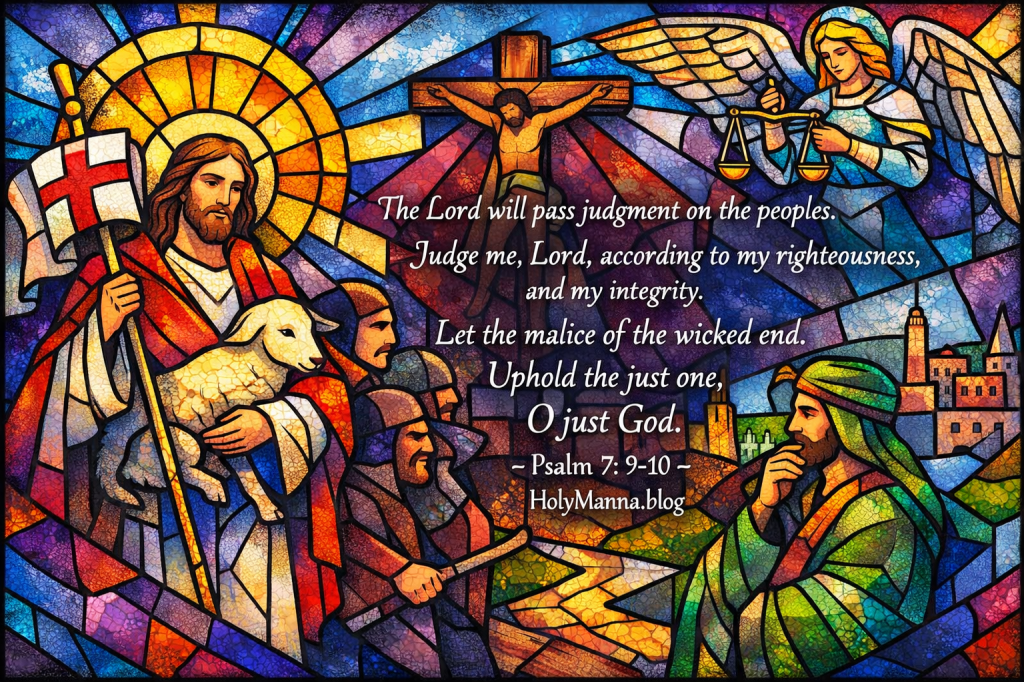
tear my soul apart with no one to deliver.9 the Lord will pass judgment on the peoples.
Judge me, Lord, according to my righteousness,
and my integrity.
10 Let the malice of the wicked end.
Uphold the just one,
O just God,
who tries hearts and minds.11 God is a shield above me
saving the upright of heart.
12 God is a just judge, powerful and patient,
not exercising anger every day.
Detailed Exegesis
Verse 2 – “Lord my God, in you I trusted; save me; rescue me from all who pursue me,”
The psalm begins with relationship before request. The prayer does not start with danger alone, but with the words “Lord my God.” That is covenant language. The psalmist is not speaking into the dark. He is calling on the God who has bound Himself to His people. Then comes the confession of trust. The danger is real, but it is framed by faith. This is important because the psalm teaches that fear does not cancel trust. In biblical prayer, trust is not the absence of threat. Trust is the act of placing oneself in God’s hands while the threat is still present.
This verse also shows that the righteous man does not pretend self-sufficiency. He asks to be saved and rescued. That humility matters. The Church teaches that prayer begins when man turns toward God in dependence, not when he proves his own strength. This verse trains the heart to call on God quickly and honestly, especially when surrounded by pressure, accusation, or spiritual attack.
Verse 3 – “Lest someone maul me like a lion, tear my soul apart with no one to deliver.”
The image shifts from pursuit to violence. The enemy is compared to a lion, a creature of force, speed, and tearing power. The psalmist is not being dramatic for effect. He is naming how evil feels when it closes in. It can feel predatory, merciless, and isolating. The phrase “with no one to deliver” sharpens the loneliness of the danger. Human help may fail. Earthly defenders may be absent. The soul may feel exposed.
For that reason, the verse carries spiritual weight beyond physical danger. The Fathers often read such lines with an awareness that visible enemies can also point to invisible warfare. Sin, temptation, accusation, and the devil himself seek not only to wound the body but to tear at the soul. The verse teaches the faithful not to minimize evil. Scripture never asks the believer to be naive. It teaches him to be sober, honest, and anchored in God.
Verse 9 – “The Lord will pass judgment on the peoples. Judge me, Lord, according to my righteousness, and my integrity.”
Now the psalm rises from fear to judgment. The hunted man looks beyond his pursuers to the tribunal of God. This is a decisive shift. He does not remain trapped in anxiety about what others think or do. He places himself before the Lord who judges all peoples. That is the only court that cannot be corrupted. In the context of today’s readings, this line echoes Jeremiah’s appeal to the God who searches mind and heart.
The words about righteousness and integrity must be read carefully. The psalmist is not claiming absolute sinlessness. He is appealing to covenant fidelity and sincerity of heart in the matter at hand. In Scripture, righteousness often means right relationship with God expressed in faithful living. Integrity means wholeness, not double-heartedness. The prayer is not boasting. It is a plea that God would see truly. In Lent, that matters deeply, because so much of the spiritual battle concerns whether the heart is divided or whole before the Lord.
Verse 10 – “Let the malice of the wicked end. Uphold the just one, O just God, who tries hearts and minds.”
This verse names both the problem and the hope. The problem is not merely suffering in general. It is the malice of the wicked, meaning evil with intention, evil that chooses harm. The hope is that God will bring that malice to an end and uphold the just. The psalm does not celebrate revenge for its own sake. It longs for the triumph of divine justice.
The phrase “who tries hearts and minds” opens the deepest layer of the reading. God does not judge by surface appearances. He sees motive, intention, hidden loyalties, and secret resistance. This fits perfectly with today’s theme. In Jeremiah, the plot is hidden until God reveals it. In the Gospel, the crowd is divided, and hearts are exposed by the presence of Christ. Here in the psalm, the faithful soul rests in the fact that God sees what human eyes cannot. The Lord knows the difference between the just and the merely impressive.
Verse 11 – “God is a shield above me, saving the upright of heart.”
After danger and judgment comes one of the most beautiful images in the psalm. God is a shield. A shield does not always remove the battle, but it stands between the vulnerable person and the blow. That is a deeply consoling image for the spiritual life. The faithful are not promised a life without conflict, but they are promised God’s protective presence. He covers, guards, and preserves those who remain upright of heart.
The phrase “upright of heart” matters just as much as the image of the shield. The heart, in biblical language, is the place of choice, devotion, and truth. Uprightness does not mean perfection in every emotion. It means sincerity before God. It means a heart not bent by deceit or rebellion. This verse reminds the believer that the deepest safety is not found in control, status, or cleverness, but in living with an honest heart under the protection of God.
Verse 12 – “God is a just judge, powerful and patient, not exercising anger every day.”
The psalm closes this selection by holding together two truths that sinful men often separate. God is just, and God is patient. He is not weak, and He is not reckless. He does not ignore evil, but neither is He driven by unstable passion. Divine justice is perfect because it is joined to divine patience. This is one of the reasons the psalm is so spiritually mature. It does not ask the faithful to choose between mercy and justice. It shows that both are held perfectly in God.
This verse is especially important during Lent. It reminds the soul that God’s patience is not indifference. His delay is often mercy, giving time for repentance. Yet His patience must never be mistaken for approval of evil. In the context of today’s readings, that truth stands with great force. The plotting against Jeremiah is seen by God. The confusion and hostility around Jesus are seen by God. Judgment is real, but it unfolds in the wisdom of the One who is both powerful and patient.
Teachings
This psalm teaches that the life of faith is not lived outside conflict, but within it. The just man prays because he is pursued. He trusts because he is threatened. He appeals to God because earthly circumstances are unstable. The Church has always understood the Psalms as the school of prayer for precisely this reason. In them, the believer learns how to speak to God from the middle of real life. The Catechism teaches that the Psalms become the prayer of the People of God and, in the fullness of time, the prayer of the Church. They are not relics of ancient devotion. They remain living speech for the soul under pressure.
This psalm also teaches that God’s justice reaches deeper than public judgment. Again and again, today’s readings return to the hidden interior. Jeremiah entrusts his cause to the One who searches mind and heart. The psalmist asks God to uphold the just one and end the malice of the wicked. In the Gospel, the crowd’s conflicting reactions to Christ reveal inner dispositions. The Catechism teaches that the heart is the place of decision, the place where a person stands for or against God. That means this psalm is not only about dangerous enemies outside the self. It is also about the war within, where fear, pride, resentment, and duplicity must be brought before the Judge who sees all.
The Fathers of the Church often read the Psalms as the voice of Christ and of His Body, the Church. St. Augustine frequently taught that when the psalms speak of the righteous one surrounded by enemies, the faithful should hear both the suffering of Christ and the experience of Christians united to Him. That matters here. The hunted voice in Psalm 7 belongs first to the inspired prayer of Israel, but it also prepares the heart to recognize Christ in His Passion. The innocent one is opposed. The just one is judged by men. The upright heart is upheld by the Father. In that sense, this psalm stands between Jeremiah and the Gospel like a bridge of prayer.
Finally, the psalm teaches the proper response to evil. It does not teach denial. It does not teach panic. It does not teach vengeance seized by one’s own hand. Instead, it teaches refuge, honesty, and surrender to divine justice. That is a necessary lesson in every age, and maybe especially in a time when people are quick to defend themselves, attack others, and pronounce judgment before prayer has even begun. The psalm tells the faithful to begin somewhere else. Begin with “Lord my God, in you I trusted.”
Reflection
There is a quiet strength in this psalm that speaks directly to daily life. Most people will never be chased through the wilderness by visible enemies, but nearly everyone knows what it feels like to be pursued by something. Sometimes it is an unjust accusation. Sometimes it is anxiety that keeps circling back. Sometimes it is spiritual exhaustion, family tension, temptation, or the heavy feeling of being misunderstood. The psalm gives words to that experience without letting the heart become dramatic, self-pitying, or bitter. It teaches the soul to turn fear into prayer.
One practical lesson from this reading is that the first move in trouble matters. The psalmist’s first move is not revenge, panic, or endless self-justification. It is trust. That is worth bringing into ordinary life. When conflict rises, begin by naming God. When the mind starts running in circles, stop and pray honestly. When someone wounds the heart, resist the urge to build a courtroom inside the mind. Bring the whole case to the Lord. Ask Him to search the heart, protect what is upright, and purify what is not.
Another lesson is that uprightness of heart matters more than winning every argument. The psalm does not celebrate being clever. It celebrates being rightly aligned with God. That can reshape daily choices in quiet but serious ways. Speak truthfully. Refuse to manipulate. Do not nurse secret malice. Make a good examination of conscience. Go to confession with real honesty. Pray the Psalms slowly instead of rushing through them. Let God teach the heart how to speak again.
Today’s psalm leaves the reader with searching questions worth carrying into prayer. When pressure rises, where does the heart run first? Is there trust in God, or only a scramble for control? Is the heart upright before the Lord, or is it divided by fear, resentment, or self-protection? What would it look like today to let God be a shield instead of trying to become one’s own savior? If these questions are faced honestly, the psalm becomes more than a response at Mass. It becomes a way of living under the gaze of the just and patient God.
Holy Gospel – John 7:40-52
When Christ stands before the crowd and every heart begins to speak
This Gospel unfolds in a tense and noisy moment in the life of Jesus. He is in Jerusalem during the Feast of Tabernacles, one of the great pilgrim feasts of Israel, when the city would have been full of worshipers, debate, expectation, and religious energy. The people are not indifferent. They are listening, arguing, reacting, and trying to decide who Jesus really is. That matters, because this is not a calm theological conversation in a quiet room. It is a public moment in which the presence of Christ forces a response. Some are moved toward faith. Others retreat into suspicion. Others still hide behind half-understood Scripture and wounded pride. That is exactly why this passage fits today’s theme so well. God’s truth reveals the heart.
The setting is also deeply important for understanding the Gospel. By this point in The Gospel of John, opposition to Jesus is no longer in the background. It is open, growing, and increasingly determined. Yet the opposition is not simply political. It is spiritual. The real drama is not only whether Jesus will be arrested, but whether the people will receive the One whom the Father has sent. Some in the crowd recognize something extraordinary in Him. The guards are shaken by His words. Nicodemus, who once came by night, now speaks a cautious but real word of justice. Meanwhile, others cling to arrogance, contempt, and a false confidence in their own judgment. The crowd is divided because Christ is not merely interesting. He is the truth in person, and truth always presses for a decision.
John 7:40-52 – New American Bible (Revised Edition)
40 Some in the crowd who heard these words said, “This is truly the Prophet.” 41 Others said, “This is the Messiah.” But others said, “The Messiah will not come from Galilee, will he? 42 Does not scripture say that the Messiah will be of David’s family and come from Bethlehem, the village where David lived?” 43 So a division occurred in the crowd because of him. 44 Some of them even wanted to arrest him, but no one laid hands on him.
45 So the guards went to the chief priests and Pharisees, who asked them, “Why did you not bring him?” 46 The guards answered, “Never before has anyone spoken like this one.” 47 So the Pharisees answered them, “Have you also been deceived? 48 Have any of the authorities or the Pharisees believed in him? 49 But this crowd, which does not know the law, is accursed.” 50 Nicodemus, one of their members who had come to him earlier, said to them, 51 “Does our law condemn a person before it first hears him and finds out what he is doing?” 52 They answered and said to him, “You are not from Galilee also, are you? Look and see that no prophet arises from Galilee.”
Detailed Exegesis
Verse 40 – “Some in the crowd who heard these words said, ‘This is truly the Prophet.’”
The crowd begins by reaching for a title rooted in Israel’s hope. “The Prophet” points back to the expectation in Deuteronomy 18, where Moses speaks of a prophet whom God will raise up. Some listeners can tell that Jesus is not ordinary. His words carry divine weight. Still, their recognition is incomplete. They are moving in the right direction, but they have not yet fully grasped that Jesus is not merely another prophet in the line of revelation. He is the fulfillment toward whom revelation has been moving.
This verse shows an important spiritual reality. A person can be genuinely impressed by Christ and still not yet know Him fully. Grace often begins there. The heart is stirred before it is fully surrendered.
Verse 41 – “Others said, ‘This is the Messiah.’ But others said, ‘The Messiah will not come from Galilee, will he?’”
Now the division sharpens. Some go further and confess that Jesus is the Messiah. Others immediately object based on His apparent place of origin. Their difficulty is not random. It comes from real messianic expectation. The Messiah was expected to be connected to David’s line and David’s city. Yet instead of investigating more deeply, they stop at what they think they know.
This is one of the Gospel’s painful ironies. They reject Jesus because of incomplete information, even though the truth is richer than they realize. He does belong to David’s line, and He was born in Bethlehem. Their error is not love for Scripture, but confidence without humility. They know enough to argue, but not enough to adore.
Verse 42 – “Does not scripture say that the Messiah will be of David’s family and come from Bethlehem, the village where David lived?”
This objection is rooted in genuine biblical prophecy. The people know the promise that the Messiah will come from David’s house and from Bethlehem. In itself, that is not wrong. The problem is that they use Scripture as a barrier instead of a doorway. Scripture is meant to lead souls to Christ. Here it becomes a weapon of dismissal because their hearts are no longer searching.
This verse is a warning for every age. It is possible to quote what is true and still miss the Truth standing in front of you. Religious knowledge without humility becomes a kind of blindness.
Verse 43 – “So a division occurred in the crowd because of him.”
The division is not a side effect. It reveals something essential about the mission of Christ. Jesus does not divide because He is confused, but because He is clear. Light separates what darkness had kept mixed together. The presence of Christ exposes the inner state of those around Him. Some move toward faith. Others move toward resistance.
This verse also echoes the whole history of salvation. The prophets divided Israel because the word of God always demanded a response. Now Jesus, who is more than a prophet, stands in their midst and the division becomes even deeper.
Verse 44 – “Some of them even wanted to arrest him, but no one laid hands on him.”
The hostility has now become practical. Some do not merely disagree. They want Jesus seized. Yet the verse ends with a quiet but powerful reminder of divine providence: “no one laid hands on him.” In The Gospel of John, Christ’s Passion is never the triumph of chaos. His hour will come, but not before the Father permits it. The Son is not dragged helplessly into His mission. He goes in freedom and obedience.
This verse teaches that opposition can be real without ever escaping God’s sovereignty. Human plans rage, but they do not outrun the will of God.
Verse 45 – “So the guards went to the chief priests and Pharisees, who asked them, ‘Why did you not bring him?’”
The scene shifts from the crowd to the authorities. The guards had been sent with a task, but they return empty-handed. That failure immediately creates tension with the chief priests and Pharisees. What happened? Why did armed obedience collapse in the face of one unarmed teacher?
The answer is not military weakness. It is the power of Christ’s word. Even men sent to arrest Him found themselves arrested inwardly by His authority.
Verse 46 – “The guards answered, ‘Never before has anyone spoken like this one.’”
This is one of the most striking lines in the reading. The guards do not offer an elaborate argument. They simply bear witness to an encounter. “Never before has anyone spoken like this one.” There is awe in that sentence. Christ’s words do not land like ordinary speech. They carry a force that pierces, unsettles, and reveals.
The verse also exposes a contrast that runs through the whole Gospel. The trained religious authorities, who should have been the first to recognize the Shepherd’s voice, resist Him. The guards, who came as instruments of control, are stunned into honesty. Grace often breaks through where pride has not yet fully hardened.
Verse 47 – “So the Pharisees answered them, ‘Have you also been deceived?’”
The authorities respond not with curiosity, but contempt. They do not pause to consider whether the guards may have heard something true. Instead, they frame any sympathy for Jesus as deception. This is how pride often defends itself. Once the heart has decided not to believe, every sign of faith in another person looks like gullibility.
There is a spiritual danger here that remains very modern. A proud soul often prefers mockery to discernment. It feels safer to ridicule faith than to examine whether Christ may actually be demanding conversion.
Verse 48 – “Have any of the authorities or the Pharisees believed in him?”
Now the argument becomes openly elitist. The Pharisees appeal to status, influence, and institutional approval. In effect, they say that if Jesus were real, the right people would already agree. But truth is not established by prestige. The history of salvation is filled with moments when the powerful missed what the lowly received.
This verse also reveals a temptation that can enter religious life very quietly. Instead of asking whether something is true, the heart asks whether the approved circle has endorsed it. That is not faith. That is fear dressed in respectable clothing.
Verse 49 – “But this crowd, which does not know the law, is accursed.”
The contempt grows uglier here. The crowd is dismissed as ignorant and accursed. The authorities do not simply reject Jesus. They despise the ordinary people who are drawn to Him. This line lays bare the spiritual sickness of religious pride. Knowledge of the law has not made them merciful. It has made them scornful.
This verse is especially sobering because it shows how easily religion can be used against the very people God loves. The learned men of the scene speak as though closeness to God were their private possession. Yet the Gospel repeatedly shows that the humble, the poor, and the searching often receive Christ more readily than the self-satisfied.
Verse 50 – “Nicodemus, one of their members who had come to him earlier, said to them,”
Nicodemus steps forward quietly, but his appearance matters enormously. He is not an outsider criticizing the council from a distance. He is “one of their members.” He belongs to the very group now hardening itself against Jesus. Earlier in John 3, he came to Jesus by night, drawn by curiosity and grace, yet still marked by caution. Here that hidden beginning starts to take public shape.
This is one of the consoling details in the Gospel. Not every conversion arrives all at once. Some men move slowly from darkness toward light. Nicodemus is not yet fearless, but he is no longer silent.
Verse 51 – “Does our law condemn a person before it first hears him and finds out what he is doing?”
Nicodemus does not yet make a full public confession of Christ, but he does appeal to justice. He asks for something basic, lawful, and honest: hear the man before condemning him. In a scene filled with prejudice and contempt, that is already an act of courage. The irony is powerful. The men who boast of knowing the law are failing to keep its demands, while Nicodemus, who once approached Jesus in the shadows, now becomes the voice of fairness.
This verse also teaches something important about truth. Truth does not fear examination. Christ has nothing to hide. The refusal to hear Him is not a mark of wisdom. It is a sign that judgment has outrun justice.
Verse 52 – “They answered and said to him, ‘You are not from Galilee also, are you? Look and see that no prophet arises from Galilee.’”
The answer given to Nicodemus is not thoughtful. It is mocking, dismissive, and inaccurate. Instead of dealing with his appeal to the law, they turn on him personally. This is often what happens when a heart does not want the truth. Argument gives way to insult. The issue is no longer evidence, but loyalty to the group.
Their final claim also reveals how anger can distort judgment. In their rush to reject Jesus, they speak carelessly and ignore the deeper complexity of the Scriptural witness. The tragedy of the scene is that they are so certain of themselves that they cannot imagine being wrong. And that is one of the most dangerous spiritual states a person can enter.
Teachings
This Gospel teaches first that Jesus is a sign of contradiction. His presence does not leave people comfortably neutral. The Catechism says in CCC 575, “Many of Jesus’ deeds and words constituted a ‘sign of contradiction’, but more so for the religious authorities in Jerusalem, whom the Gospel according to St. John often calls simply ‘the Jews’, than for the ordinary People of God.” That line fits today’s reading with remarkable precision. The crowd is divided. The guards are moved. The authorities are threatened. Nicodemus hesitates, yet begins to step forward. Christ reveals what is in each heart, not because He delights in conflict, but because truth always unmasks whatever is false.
This Gospel also teaches that correct religious information is not the same thing as faith. The people in the crowd know the messianic expectation about David and Bethlehem. The Pharisees know the law. The chief priests know the structures of worship. Yet knowledge alone does not save them from blindness. The problem is not information, but disposition. The heart that does not want to surrender can turn even holy things into defenses against God. That is why humility is so necessary in the spiritual life. Without humility, a man can stand close to revelation and still remain far from obedience.
There is also a beautiful teaching here about the Messiah Himself. The Catechism says in CCC 439, “Many Jews and even certain Gentiles who shared their hope recognized in Jesus the fundamental attributes of the messianic ‘Son of David’ promised by God to Israel.” The crowd in today’s Gospel is wrestling with exactly that question. Is Jesus truly the promised One? Some are beginning to see it. Others resist because His ordinary appearance does not match their expectations. This is the paradox of the Incarnation. God comes in humility. The Messiah does not flatter human pride. He stands among His people in a way that requires faith, not merely outward recognition.
Nicodemus also offers an important lesson in the slow work of grace. In John 3, he comes by night. In John 7, he speaks for justice before hostile men. In John 19, he will help bring myrrh and aloes for the burial of Jesus. His path is gradual, but real. That matters for the spiritual life because not every soul moves at the same speed. Some begin in fear. Some begin in confusion. Yet if they remain open to Christ, the light keeps drawing them forward. Nicodemus is a reminder that grace can grow quietly before it becomes visible.
Finally, the reading exposes the danger of spiritual elitism. The authorities despise the crowd as ignorant and accursed. They measure truth by approval from the powerful. They use religious status as a shield against conversion. That temptation has not disappeared. It can enter parishes, families, ministries, classrooms, and theological conversations. A person can speak the language of religion while quietly despising the very people Christ came to save. This Gospel warns against that poison. True knowledge of God makes a man humbler, more just, and more ready to hear.
Reflection
This Gospel feels uncomfortably current because the same drama still unfolds in every age. Christ still stands before the crowd, and the crowd still reacts in different ways. Some hear Him and feel drawn. Some argue from fragments. Some dismiss Him because He does not fit their expectations. Some hide behind religious language while refusing a living encounter. Some, like Nicodemus, are not yet bold saints, but they are beginning to move toward the light.
That makes this reading deeply personal. It is not only about what the crowd thought of Jesus in Jerusalem. It is about how a soul responds when Christ speaks with authority today. Sometimes the resistance is obvious. Sometimes it is quieter. Sometimes it looks like postponing obedience, clinging to a preferred narrative, or judging before listening. Sometimes it shows up as the belief that being informed about religion is the same thing as belonging to Christ. This Gospel tears through that illusion. Jesus does not ask only for analysis. He asks for faith.
There are practical ways to live this reading well. Listen to Christ in Scripture before listening to the noise of the crowd. Refuse the habit of judging quickly, especially when emotion is running high. Do not confuse institutional approval, social status, or intellectual confidence with holiness. Speak up for what is just, even if it is only one sentence at the right moment, as Nicodemus did. Stay close to confession, because pride hardens quietly and repentance softens the heart again. Most of all, let Jesus be who He is, rather than remaking Him into something easier to manage.
This Gospel leaves behind questions that deserve real silence before God. When Christ speaks through Scripture and the teaching of His Church, does the heart listen with humility or argue from a distance? Has religious familiarity turned into spiritual pride? Is there a place where fear has kept the soul from speaking one honest word for what is true? What would it look like to move, like Nicodemus, from the shadows into the light? The beauty of this Gospel is that even in the middle of division, grace is still at work. Christ is still speaking. The only question is whether the heart will finally let itself be heard.
Stand with the Lamb and Walk into the Light
Today’s readings come together like one steady call from God to the heart. Jeremiah 11:18-20 shows the pain of the innocent servant who is opposed for speaking the truth. Psalm 7:2-3, 9-12 teaches the soul how to pray when surrounded by fear, hostility, and injustice. Then John 7:40-53 brings everything to its fulfillment in Christ, the One whose very presence divides the crowd, exposes hidden motives, and invites every person to decide whether to trust Him or turn away.
That is the great message of the day. God’s truth is not vague, soft, or easily ignored. It searches the heart. It reveals what is hidden. It shows whether a person wants the Lord Himself, or only a version of religion that feels manageable and safe. Jeremiah entrusted his cause to God. The psalmist ran to God as shield and judge. Nicodemus, though still hesitant, began to step out of the shadows and speak what was just. Each reading, in its own way, asks the same question: what happens in the heart when truth stands near?
Lent is the right season to sit with that question honestly. This is not the time to play games with God, hide behind appearances, or settle for half-hearted faith. This is the time to let Christ search the heart, heal what is wounded, correct what is crooked, and strengthen what is weak. The crowd in the Gospel argued about Jesus. The saints learn to follow Him. That is the difference. One stays trapped in noise. The other finds peace in surrender.
So the invitation today is simple and serious. Stay close to the Lord. Bring Him the wound, the confusion, the fear, and the pride. Let His word judge what needs to be judged and heal what needs to be healed. Pray with honesty. Go to confession with humility. Listen to Scripture with a teachable heart. Speak the truth with charity. And when the world grows loud, do not follow the crowd into confusion. Stand with Christ, the true Lamb, and keep walking toward the light.
What would change if today were lived as though Jesus truly sees the heart, speaks the truth, and deserves complete trust? Let that question remain for prayer. Let it follow the soul into the rest of the day. And let it lead, little by little, into a deeper love for the Lord who never stops calling His people out of darkness and into His marvelous light.

 Holy Manna!
Leave a comment