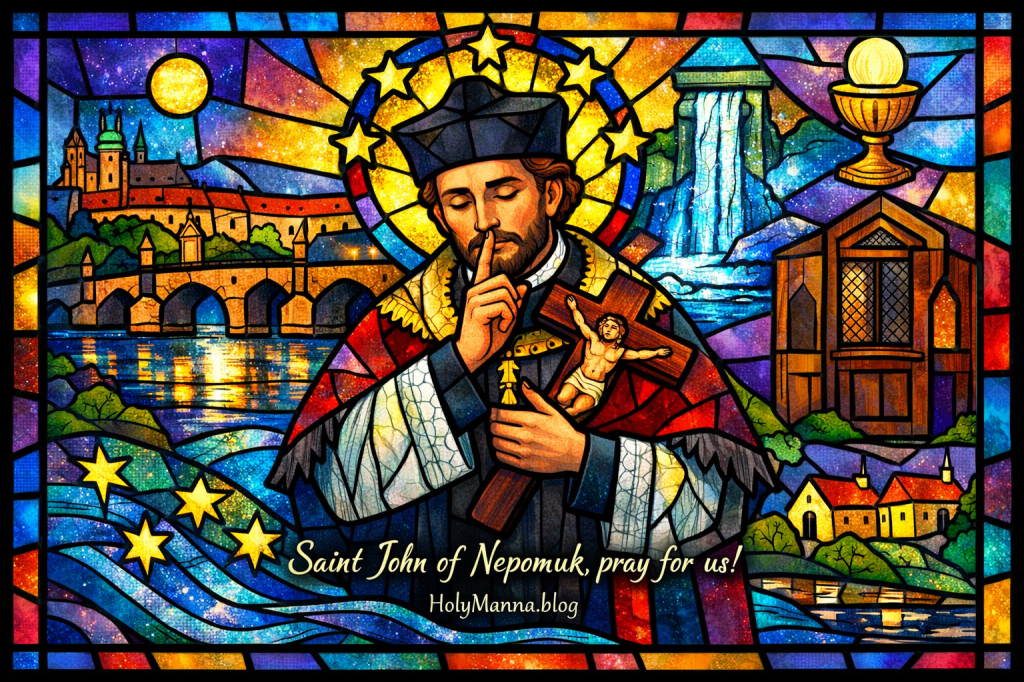
The Silence That Chose God Over a King
Saint John of Nepomuk stands in Catholic memory as one of those saints whose life seems quiet at first, but whose witness echoes across centuries. He was a priest, a canon lawyer, a faithful servant of the Church, and finally a martyr. He is remembered above all as the saint who would not betray what was sacred, even when a king demanded it.
For many Catholics, Saint John of Nepomuk is known as the martyr of the confessional. He is often honored as the priest who chose death rather than violate the seal of confession. At the same time, the strongest early historical records show him as a martyr for defending the freedom and rights of the Church against unjust royal interference. In the Catholic tradition, both truths have shaped the way he has been loved and remembered. He became a model of priestly courage, reverence for the sacraments, and fidelity when the cost became unbearable.
That is why he is still revered not only in the Czech lands, but throughout the Catholic world. His statues stand on bridges, near rivers, in village squares, and outside churches. His image usually shows him holding a crucifix, with five stars around his head, reminding the faithful that God glorifies those who remain faithful in darkness.
From Pomuk to Prague
Saint John was born around 1340 to 1345 in Pomuk, now called Nepomuk, in Bohemia. Catholic sources identify his father as Welflin, and his family appears to have belonged to the respectable local class. He was not born into worldly greatness, but into the kind of life where steady faith, discipline, and education could bear lasting fruit.
From an early age, he was marked by intelligence and seriousness. He studied first in Prague and later in Padua, where he advanced in canon law and even served in a leadership role among the students there. That detail matters because it shows something important about him. He was not only devout. He was also capable, disciplined, and trusted.
There is no dramatic conversion story preserved from his life, because he seems to have been formed in the faith from the beginning. Still, there was clearly a deepening of vocation. He did not become a priest casually. He gave himself fully to the service of Christ and His Church. He was ordained, served in ecclesiastical administration, became pastor of Saint Gallus in Prague, and eventually rose to become vicar general under the Archbishop of Prague.
That might sound like a life of administration and paperwork, but in the Church that kind of service matters. The saints are not only monks in deserts and martyrs in arenas. Some saints defend truth in courtrooms, chancery offices, and difficult meetings. Saint John of Nepomuk became one of those men who quietly kept the household of God in order until the day his fidelity was tested in fire.
He is most known for two things. First, he defended the liberty of the Church against the abuse of political power. Second, later Catholic tradition cherished him as the confessor who refused to reveal the queen’s confession. That second tradition made him one of the clearest symbols of the inviolable seal of confession in the Catholic imagination.
The Priest Who Stood Firm
Saint John’s life unfolded during a tense and troubled time in Bohemia. The Church and the crown were in conflict, and the powerful often tried to force their will on the things of God. John served the Archbishop of Prague faithfully during a major dispute involving the abbey of Kladruby. King Wenceslaus IV wanted control over ecclesiastical decisions that did not belong to him. John, acting as vicar general, upheld the lawful process of the Church.
That is one of the reasons the Church remembers him so strongly. He was not merely a victim of bad luck. He was a priest who knew that some lines cannot be crossed.
As for miracles during his lifetime, Catholic history is careful here. The earliest historical records do not preserve firmly documented public miracles worked by Saint John during his priestly ministry. What they preserve instead is the miracle of fidelity, the kind of grace that makes a man stand straight when everyone around him wants him to bend.
Still, later Catholic tradition includes stories connected with his life before martyrdom. One old account says that as a child he was gravely ill and was restored to health after his parents prayed and entrusted him to God. This story has long been repeated in Catholic devotional tradition, but it cannot be historically verified with certainty.
What can be said with confidence is that his priestly life itself bore the marks of grace. He served with learning, prudence, and courage. He was trusted with serious responsibilities. He was not a loud man chasing attention. He was a priest formed by the Church, committed to truth, and willing to suffer rather than serve injustice.
That is worth remembering now. In a world addicted to noise, Saint John teaches the strength of a soul that does not need applause to remain faithful.
When Power Turned Violent
The great trial of Saint John’s life came in 1393. Because of his role in defending the Church’s lawful rights, he fell into direct conflict with King Wenceslaus IV. He was arrested, tortured, and brutalized. Catholic tradition also preserves the powerful belief that the king wanted access to what the queen had confessed, and that John would not betray the sacred trust of the sacrament. Whether one emphasizes the historically earliest records or the later devotional tradition, the meaning remains deeply Catholic. He would not hand over to worldly power what belonged to God.
He endured suffering with remarkable constancy. He was bound, tortured, and finally thrown from the bridge into the Vltava River on March 20, 1393. His death was not random violence. It was the violent rejection of a priest who would not cooperate with sacrilege and injustice.
The Church later saw in him a luminous witness to the truth expressed in The Catechism: “Given the delicacy and greatness of this ministry and the respect due to persons, the Church declares that every priest who hears confessions is bound under very severe penalties to keep absolute secrecy regarding the sins that his penitents have confessed to him.” CCC 1467
That teaching was not invented in his honor. It was always the Church’s teaching. But his martyrdom gave that teaching a face. He showed that the seal of confession is not a mere rule of convenience. It is sacred. It belongs to Christ.
Later devotion also says that as his body fell into the river, five stars appeared above the water. This became one of the most beloved symbols connected to him and explains the stars often shown in his iconography. This story is deeply rooted in Catholic devotion, but it cannot be historically verified with certainty.
The Saint Whose Silence Still Speaks
Saint John’s body was later recovered from the river and buried with honor in Prague. His tomb in Saint Vitus Cathedral became a place of veneration, and devotion to him spread steadily. This did not happen centuries later out of nowhere. The memory of his holiness took root early.
Over time, many miracles were attributed to his intercession after death. Catholic tradition speaks of healings at his tomb, protection in times of plague, rescue from danger, help for the falsely accused, and aid for those suffering from slander or threatened reputations. These stories became part of his devotional legacy and helped spread his cult across Europe. While they belong to Catholic tradition, many individual miracle accounts cannot now be historically verified in detail.
One of the most famous signs associated with him came when his tomb was opened in 1719. His tongue was reported to be found in a striking state of preservation, and Catholics naturally connected this with his witness to sacred silence. Whether one focuses on the sign itself or on the devotional meaning attached to it, the symbolism is hard to miss. The tongue that would not betray the sacred mysteries became a sign of incorrupt fidelity.
He was beatified in 1721 and canonized in 1729. After that, his cult spread even more widely. He became one of the most beloved saints of Bohemia and of Central Europe. His statues were placed near bridges and rivers because of the manner of his martyrdom, and he became a patron invoked against floods, slander, and dangers to one’s good name. He is also honored as a patron of confessors and of those who guard sacred trust.
His cultural impact is enormous. In the Czech lands, his image is everywhere. The famous statue on Charles Bridge in Prague became a model for countless others. He is usually shown in priestly dress, holding a crucifix, with five stars around his head, and sometimes with a finger raised to his lips. That image has taught generations of Catholics that silence can be holy.
His feast is celebrated on May 16. In Prague, the Church still honors him with public celebrations, including the Navalis festivities connected to the river and to his martyrdom. His memory has also reached Rome, where his name became associated with institutions of priestly formation. His legacy is not locked in medieval Bohemia. It remains alive in Catholic life today.
One final detail deserves honesty. No firmly verified famous personal quotation from Saint John of Nepomuk survives in the strongest Catholic historical sources. His legacy comes to the faithful not through many preserved sayings, but through the force of his witness. Some saints preach with books. Others preach with blood.
A Quiet Courage the World Still Needs
Saint John of Nepomuk has a lot to teach modern Catholics. His life reminds the faithful that holiness is not always dramatic from the outside. Sometimes it looks like duty. Sometimes it looks like restraint. Sometimes it looks like telling the truth when a powerful person wants a lie.
He also teaches reverence. In a time when almost everything is exposed, shared, traded, and weaponized, he stands as a reminder that some things are sacred and must never be violated. That matters not only for priests, but for everyone. Every Christian is called to guard what is holy, to respect the dignity of others, and to refuse the temptation to use private knowledge as power.
There is also a lesson here about courage. Saint John did not choose the easier path. He did not protect himself by compromising just a little. He remained faithful all the way through. That kind of strength does not appear overnight. It is built in prayer, obedience, sacramental life, and love for Christ.
Where in life is there pressure to compromise what is holy?
Is there a habit of gossip, betrayal, or careless speech that needs to die?
What would it look like to become a person whose words are truthful, restrained, and merciful?
A practical way to live his example is simple and difficult at the same time. Guard the tongue. Speak less rashly. Refuse to feed gossip. Honor confession. Defend the Church without embarrassment. Keep promises. Respect what is entrusted in confidence. And when the truth becomes costly, stay with Christ anyway.
Saint John of Nepomuk proves that silence is not weakness when it is offered for God. Sometimes silence is the loudest testimony a Christian can give.
Engage with Us!
Share your thoughts and reflections in the comments below. This saint has a way of challenging the heart, especially in a time when privacy is cheapened, truth is bent, and loyalty is often treated like a burden. Take a few minutes to sit with his witness and consider what God may be asking for in daily life.
- What part of Saint John of Nepomuk’s story stands out the most, his defense of the Church, his connection to the seal of confession, or his courage in martyrdom? Why?
- Have there been moments when keeping faith with Christ cost something real, such as reputation, comfort, approval, or opportunity?
- How can greater care with speech help build a more holy home, stronger friendships, and deeper trust in parish life?
- What does Saint John’s example teach about the dignity of the sacrament of confession and the seriousness of the priest’s role?
- What is one concrete way to practice silence, restraint, or fidelity this week for the love of Jesus?
Saint John of Nepomuk is a reminder that a faithful life is never wasted, even when the world misunderstands it. Stay close to Christ, love His Church, guard what is sacred, and do everything with the love and mercy Jesus taught us.
Saint John of Nepomuk, pray for us!
Follow us on YouTube, Instagram and Facebook for more insights and reflections on living a faith-filled life.

 Holy Manna!
Leave a comment