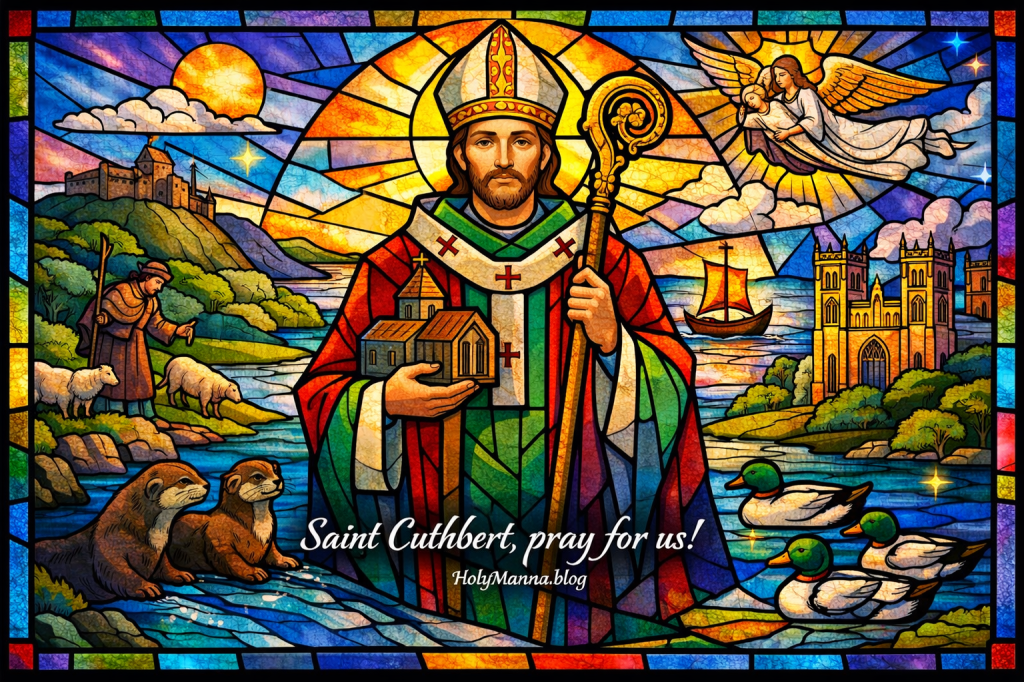
A Saint Who Made the Wild Places Holy
Saint Cuthbert of Lindisfarne stands among the great saints of early England as a monk, missionary, hermit, bishop, and wonder-worker whose life still shines with a distinctly Catholic beauty. He is revered because he loved Christ with his whole heart and spent his life bringing souls closer to God through prayer, preaching, sacrifice, and charity. He helped strengthen the Church in Northumbria during an important time of transition, especially as Roman Catholic practice was being more firmly embraced after the Synod of Whitby.
What makes Saint Cuthbert so memorable is that he was not only a man of deep silence and contemplation, but also a man who could walk into rough villages, speak to ordinary people, and move them to repentance. He was both a shepherd and a solitary. He loved the liturgy, cherished Catholic unity, embraced penance, and became one of the most beloved saints of the English Church. Even after death, his relics shaped the history of northern England, especially at Durham, where devotion to him endured for centuries.
He is remembered as a patron of Durham and of the Diocese of Hexham and Newcastle. He is also remembered as a saint of tenderness, spiritual strength, and holiness so luminous that even the land, the sea, the birds, and the people around him seem woven into the story of his sanctity.
From Shepherd Boy to Servant of Christ
Saint Cuthbert was born around the year 634 or 635, most likely near Melrose in what is now the border region between Scotland and England. Some later legends tried to give him noble or royal origins, but the older and more reliable tradition does not make that claim with certainty. What seems more likely is that he came from a humble background. As a boy, he worked as a shepherd, watching flocks in the fields and open country.
One of the most important moments of his youth came in the year 651. While still young, he saw a vision of angels carrying the soul of Saint Aidan to heaven. That vision marked him deeply. It stirred something in him and awakened a greater sense of God’s call. Catholic tradition sees this as one of the first clear signs that grace was already at work in his soul, drawing him toward the monastic life.
There is also reason to believe that before entering religious life, he served for a time as a soldier. That detail surprises many people, but it fits the strong and disciplined character that later appeared in his monastic vocation. After that period, he entered the monastery at Melrose, where he began the life that would define him. He grew in holiness, obedience, discipline, and learning. He later spent time at Ripon as guest-master, where his charity toward visitors became part of his reputation.
After a devastating plague in 664, Cuthbert became prior at Melrose. This was no small task. The Church and the monasteries were suffering deeply, and yet he rose to leadership in a time of weakness and grief. This already shows what he is most known for: he was a man who could remain rooted in God when others were shaken.
Saint Cuthbert is especially known for his holiness, his missionary zeal, his life of prayer, his role in helping establish Roman Catholic practice in Northumbria, and the many miracles associated with him both in life and after death.
A Preacher with Tears at the Altar
After the Synod of Whitby, the Church in Northumbria moved more fully into Roman usage. Cuthbert, though raised in the older Celtic tradition, accepted the Church’s decision with humility and fidelity. That matters greatly. He did not cling to preference out of pride. He obeyed the Church. He then went to Lindisfarne, where he helped introduce Roman Catholic customs with patience, gentleness, and wisdom. He did not force unity by harshness. He built it by holiness.
As prior at Lindisfarne, he became known for traveling into remote and neglected places to preach the Gospel. He went where others often did not want to go. He visited isolated villages, poor settlements, and difficult terrain. He called sinners to repentance, instructed the faithful, and strengthened the weak. He was remembered as a preacher whose words had unusual force because his life matched his message.
Catholic tradition also remembers that he could not celebrate the Holy Sacrifice of the Mass without tears. That is one of the most beautiful details in his story. It reveals a man whose heart was deeply moved by the mysteries of Christ. He did not approach the altar casually. He approached it like a man who knew he was standing before heaven.
Eventually, his desire for greater solitude led him away from the public life of the monastery. Around 676, he withdrew first to a more secluded place and then to Inner Farne, where he embraced the life of a hermit. There he lived in prayer, fasting, silence, and manual labor. Yet even there, people sought him out for counsel, healing, and intercession. His solitude did not make him less available to grace. It made him more transparent to it.
Several miracles are associated with him during his lifetime. One of the earliest was his vision of Saint Aidan’s soul ascending to heaven. Later, while living on Farne, a spring of fresh water is said to have appeared through his prayer on a barren island. In another story, barley sown out of season grew successfully, providing what was needed in a place that seemed unable to sustain life. Healings were also connected with water he blessed. He was believed to possess prophetic insight as well, including foreknowledge of the defeat and death of King Egfrid.
There are also beloved traditions connected to his life in prayer. One story says that when he prayed in the sea at night, otters came and warmed his feet afterward. Another tradition links him to the eider ducks around the Farne Islands, which came to be called “Cuddy’s ducks.” These stories are deeply loved in local Christian memory and help show how closely people associated him with peace, purity, and harmony with creation. These stories belong to longstanding tradition, but they cannot all be historically verified with certainty.
In time, Cuthbert was chosen as bishop, though he did not seek the office. He first resisted, preferring solitude, but he obeyed when called. He eventually became bishop of Lindisfarne and spent the final years of his life caring for the Church with the heart of both a monk and a shepherd. He preached, governed, healed, and served, but he never lost his love for silence and union with God. That is one reason he remains so important. He shows that contemplation and mission are not enemies. In a saint, they belong together.
The Cross He Carried Without Complaint
Saint Cuthbert was not a martyr in the strict sense. He did not die by execution for the faith. Still, his life was marked by real hardship, and those hardships reveal the depth of his sanctity.
He lived in a time of plague, instability, and ecclesial tension. He had to lead after widespread sickness had devastated religious communities. He had to help guide others through change after the Synod of Whitby. He embraced a life of severe penance and bodily hardship as a hermit. He spent long hours in prayer, often in harsh conditions. He accepted the burden of office when he would rather have remained hidden with God.
His hardships were not dramatic in the way of a martyrdom story, but they were deeply Christian. He died to self repeatedly. He laid aside comfort, reputation, and personal preference in order to serve Christ and His Church. That kind of hidden suffering is often harder to notice, but it is no less holy.
As death drew near, he sensed that the end was close. He resigned his bishopric and returned to Farne so that he could prepare for death in prayer and peace. His friend Abbot Herefrid came to him, and Cuthbert received the last sacraments with devotion. He died shortly after midnight on March 20, 687.
Catholic tradition preserves some of his final words in substance, and they are deeply revealing. He urged his monks to remain faithful to “Catholic unity and the traditions of the Fathers.” Those words matter because they show the heart of the man. Even at death, he was concerned that his spiritual sons remain faithful to the Church.
Another moving tradition concerns Saint Herbert, who had a close spiritual friendship with Cuthbert. When they met for the last time, Cuthbert is said to have told him, “Never shall we see one another again in this world.” Herbert then prayed that he might die the same day, so that they might be united before God. Tradition says that this prayer was granted and that Herbert died the same night. This story is part of the saint’s traditional memory and has long been cherished in Christian devotion.
The Incorrupt Saint and the Glory of Durham
After his death, devotion to Saint Cuthbert grew quickly. His tomb at Lindisfarne became a place associated with miracles, healings, and graces. He was remembered as a wonder-worker, and reports of divine intervention connected to his relics spread widely.
One of the most famous claims in his story is that when his body was translated in 698, it was found incorrupt. This became one of the defining marks of his posthumous cult. Later tradition also says that when his relics were examined again in 1104, his body was still found incorrupt. These claims played a major role in the growth of his shrine and his fame throughout medieval England.
His relics themselves became part of one of the most dramatic stories in English Catholic history. During the Danish invasions in 875, the monks fled Lindisfarne carrying his body with them. For years they wandered through different regions, eventually coming to Chester-le-Street and later to Durham. Tradition says that divine signs helped indicate that Durham was the place where Saint Cuthbert wished to remain. This story belongs to the historic devotional tradition surrounding his relics and shrine.
At Durham, his shrine became one of the greatest pilgrimage centers in England. Kings, clergy, monks, and ordinary laypeople honored him there. His presence helped shape the identity of the region for generations. Durham itself became inseparable from his memory.
One remarkable tradition says that the head of Saint Oswald was found with Saint Cuthbert’s relics, and this is why Cuthbert is sometimes shown in art with the head of Saint Oswald. This detail is part of the traditional account preserved around his shrine.
Saint Cuthbert also left a cultural legacy through sacred books. The Lindisfarne Gospels were produced in his honor and became one of the great treasures of Christian Britain. Another small copy of The Gospel of John was found in his coffin. That detail is especially beautiful because it fits the whole shape of his life. He was a man who carried the Gospel in his heart, and even in death the Gospel was found with him.
There are also local traditions connected to his memory that continue to fascinate people. Fossilized crinoids came to be called “St. Cuthbert’s Beads.” His association with the eider ducks remained so strong that they were known as “Cuddy’s ducks.” These traditions form part of his cultural memory and show how deeply he was loved by the people of the North. These details belong to longstanding local tradition, but they cannot all be historically verified with certainty.
The shrine of Saint Cuthbert was later plundered during the Reformation, but devotion to him never completely disappeared. His memory remained alive in the Church, in the land, in Christian storytelling, and in the hearts of the faithful. His feast is celebrated on March 20. In some Catholic contexts, September 4 is also observed in connection with the arrival of his relics at Durham.
Saint Cuthbert’s impact after death was not only religious but deeply cultural and national. He became one of the great saints of England, especially of the North. His life shaped Catholic identity, pilgrimage, sacred art, and the memory of Christian England. He remains one of those saints whose story feels large enough to carry a whole people.
What Saint Cuthbert Teaches the Soul
Saint Cuthbert teaches that holiness does not require noise. It requires fidelity. He was not trying to become famous. He was trying to belong completely to Christ. That is why his life still speaks so strongly.
He teaches the value of obedience to the Church. When old customs gave way to Roman practice, he did not react with resentment. He responded with humility. In a world where people often turn every disagreement into a personal war, his example is deeply needed. Fidelity matters more than preference.
He teaches the importance of silence and prayer. He spent time with people, preached to them, served them, and led them. But he also knew that a soul that never withdraws to be with God will eventually have nothing left to give. Prayer was not an extra part of his life. Prayer was the center.
He teaches that real strength is often hidden. His hardships were not always public. Much of his sanctity was formed in quiet endurance, long prayer, bodily discipline, and the ordinary demands of pastoral care. Many faithful Catholics live that way now. They carry crosses that few people see. Saint Cuthbert reminds them that hidden faithfulness is precious in the sight of God.
He also teaches that love for Christ should shape love for the world around us. The traditions about animals, nature, and peace surrounding him may not all be verifiable in every detail, but they reflect something true about the kind of holiness people saw in him. Saints bring order, gentleness, and reverence because they live close to the Creator.
For daily life, his example can be lived in practical ways. Set aside time for silence each day, even if only for a few minutes. Be faithful to the Mass and the sacraments with greater devotion. Accept the teachings of the Church with humility. Serve the people around you without needing praise. Stay steady when life becomes difficult. Let prayer shape speech. Let charity shape action. Let Christ shape everything.
What part of Saint Cuthbert’s life feels most needed in the Church today? Is it his obedience, his silence, his missionary zeal, or his love for Catholic unity? What would change if daily life were lived with the same seriousness toward prayer that he showed at the altar?
Engage with Us!
Share your thoughts and reflections in the comments below. Saint Cuthbert’s life has so much to teach about prayer, courage, obedience, and love for the Church, and it would be beautiful to hear what part of his story spoke most deeply to the heart.
- What part of Saint Cuthbert’s life challenges you the most personally?
- How can greater silence and prayer make you a stronger witness to Christ in daily life?
- What does faithfulness to Catholic unity look like in a time of confusion and division?
- Do you find it easier to serve others actively or to make time for deep prayer? Why?
- What is one concrete way you can imitate Saint Cuthbert this week?
May Saint Cuthbert inspire a life of steady faith, humble obedience, and deeper prayer. May every step be lived with trust in God, and may everything be done with the love and mercy Jesus taught us.
Saint Cuthbert, pray for us!
Follow us on YouTube, Instagram and Facebook for more insights and reflections on living a faith-filled life.

 Holy Manna!
Leave a comment