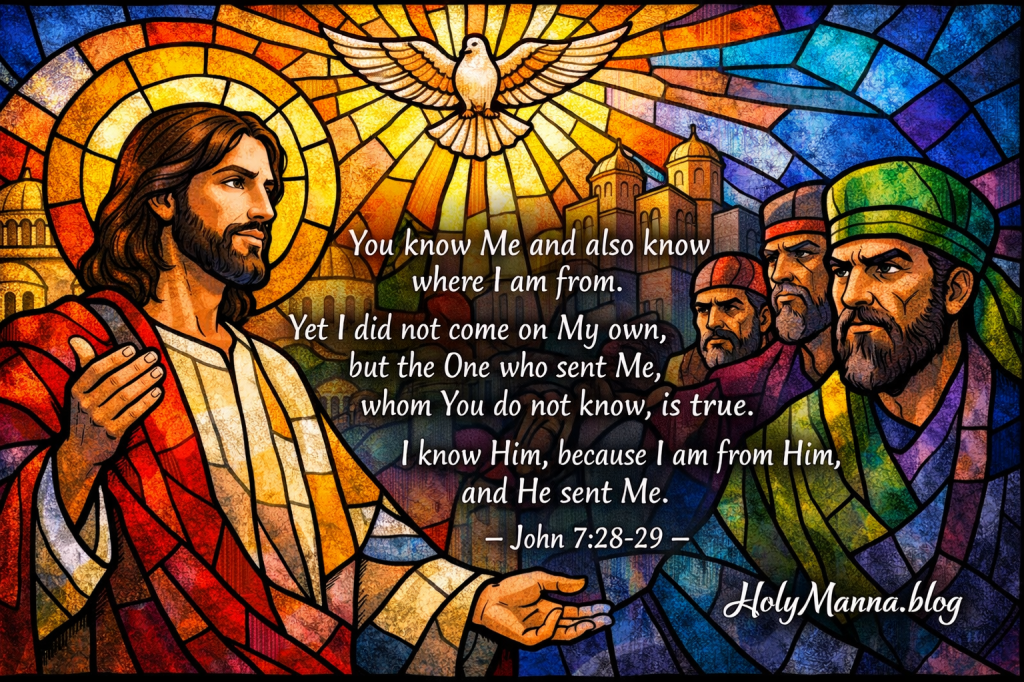
Friday of the Fourth Week of Lent – Lectionary: 248
When the Light Is Hated but Never Defeated
There are days in Lent when the Church lets the tension rise slowly, and today is one of them. The readings for this Friday of the Fourth Week of Lent draw the heart into a hard but necessary truth: when God’s truth enters the world, it does not always receive applause. Sometimes it is resisted. Sometimes it is mocked. Sometimes it is hunted down. In Wisdom 2, the righteous one is hated because his very life exposes the darkness around him. In Psalm 34, the afflicted righteous cry out and discover that the Lord is nearest not in comfort, but in their distress. In The Gospel of John, Jesus walks through growing hostility with calm authority, because his enemies do not control the story. The Father does.
That is the central theme holding these readings together: the righteous one may be opposed by the world, but he is never abandoned by God. This theme runs deep through salvation history, and during Lent it begins to sound even more urgent, because the Church is already turning our eyes toward the Passion. Wisdom 2 has long been heard by Christians as a striking foreshadowing of Christ. The wicked speak as if they are planning against one troublesome man, but their words echo forward into the suffering of Jesus, the true righteous Son. Then John 7 shows that this is no accident of history. The opposition against Christ is real, but it unfolds only within the mysterious timing of divine providence. His hour will come, but not one moment before the Father wills it.
There is also an important religious setting behind today’s Gospel. Jesus appears during the Feast of Tabernacles, one of Israel’s great pilgrimage feasts, a celebration filled with memory, expectation, and hope in God’s saving presence. In that holy atmosphere, people are asking who Jesus really is, where he comes from, and whether he could truly be the Messiah. That confusion matters, because it reveals a pattern that still exists: many think they know Jesus because they know something about him, yet they do not truly know him as the One sent by the Father. That is why these readings are not only about ancient enemies, suspicious crowds, or distant biblical drama. They are about the conflict between unbelief and faith, blindness and truth, fear and trust.
This is what makes today’s readings so fitting for Lent. They ask whether the heart will stand with the righteous one or shrink back when holiness becomes costly. They remind the faithful that suffering for what is right is not a sign of God’s absence. It can be the very place where his closeness is most deeply known. Before diving into each passage, it helps to carry this truth in mind: the world may test the righteous, but the Lord sees, the Lord hears, and in Jesus Christ the hidden counsels of God are brought into the light.
First Reading – Wisdom 2:1, 12-22
The World Cannot Bear the Man Who Belongs to God
The first reading today comes from The Book of Wisdom, one of the great wisdom books of the Old Testament, written in a world where Jewish believers were living among powerful pagan ideas and pressures. Many scholars place its composition in Alexandria, where Greek philosophy, worldly ambition, and religious compromise pressed hard against the faith of Israel. That setting matters, because this reading is not just about a few bad men plotting against one innocent person. It is about what happens when a soul shaped by unbelief comes face to face with real holiness.
In this passage, the wicked speak among themselves, and what they reveal is chilling. They are not simply angry. They are spiritually blind. They cannot understand righteousness, so they decide to destroy it. They cannot bear the man who reminds them that God exists, that sin is real, and that judgment is coming. That is why this reading fits today’s theme so perfectly. The righteous one is opposed by a world darkened by sin, yet God’s hidden plan is never defeated. The Church has long heard in these verses a prophetic shadow of Jesus Christ, the truly Righteous One, the Son who would be mocked, tested, and condemned by men who thought they were in control.
Wisdom 2:1, 12-22 – New American Bible (Revised Edition)
1 For, not thinking rightly, they said among themselves:
“Brief and troubled is our lifetime;
there is no remedy for our dying,
nor is anyone known to have come back from Hades.12 Let us lie in wait for the righteous one, because he is annoying to us;
he opposes our actions,
Reproaches us for transgressions of the law
and charges us with violations of our training.
13 He professes to have knowledge of God
and styles himself a child of the Lord.
14 To us he is the censure of our thoughts;
merely to see him is a hardship for us,
15 Because his life is not like that of others,
and different are his ways.
16 He judges us debased;
he holds aloof from our paths as from things impure.
He calls blest the destiny of the righteous
and boasts that God is his Father.17 Let us see whether his words be true;
let us find out what will happen to him in the end.
18 For if the righteous one is the son of God, God will help him
and deliver him from the hand of his foes.
19 With violence and torture let us put him to the test
that we may have proof of his gentleness
and try his patience.
20 Let us condemn him to a shameful death;
for according to his own words, God will take care of him.”21 These were their thoughts, but they erred;
for their wickedness blinded them,
22 And they did not know the hidden counsels of God;
neither did they count on a recompense for holiness
nor discern the innocent souls’ reward.
Detailed Exegesis
Verse 1 – “For, not thinking rightly, they said among themselves: ‘Brief and troubled is our lifetime; there is no remedy for our dying, nor is anyone known to have come back from Hades.’”
The reading begins by exposing the root of the problem. The wicked do not begin with violence. They begin with false thinking. Their moral corruption grows out of a distorted vision of life, death, and God. They believe life is short, chaotic, and ultimately meaningless. Since they see no hope beyond the grave, they live as though pleasure, power, and self-preservation are all that matter.
This is one of the oldest temptations in the world. When man forgets eternity, he starts treating this life like the only courtroom, the only feast, and the only prize. Sin becomes easier when heaven disappears from view. The Catechism teaches, “Death is transformed by Christ. Jesus, the Son of God, also himself suffered the death that is part of the human condition. Yet, despite his anguish as he faced death, he accepted it in an act of complete and free submission to his Father’s will” (CCC 1009). The wicked in Wisdom do not know this yet. They speak from despair, because they do not know that God will one day conquer death in Christ.
Verse 12 – “Let us lie in wait for the righteous one, because he is annoying to us; he opposes our actions, reproaches us for transgressions of the law and charges us with violations of our training.”
The righteous man is hated because he exposes what others want hidden. He does not need a sword to trouble the wicked. His holiness is enough. His life contradicts theirs. His fidelity becomes a judgment against their rebellion.
There is something very human in this verse. Fallen man often does not hate goodness in the abstract. He hates goodness when it becomes personal. It is one thing to praise virtue in a book. It is another thing to stand beside someone whose life reveals one’s own compromise. This is why the saints have always been both loved and hated. Saint Augustine saw this pattern clearly in the history of the world, where the city of man resists the city of God because love of self battles against love of God.
Verse 13 – “He professes to have knowledge of God and styles himself a child of the Lord.”
The wicked are especially provoked by the righteous man’s relationship with God. He does not merely follow moral rules. He lives in covenant. He knows the Lord and claims to belong to Him. That is offensive to proud hearts, because intimacy with God exposes the emptiness of a life built on self-rule.
For Christians, this verse points strongly toward Christ, who is Son of God by nature, and it also speaks to the baptized, who become children of God by grace. The Catechism teaches, “Baptism not only purifies from all sins, but also makes the neophyte ‘a new creature,’ an adopted son of God” (CCC 1265). The world is often less disturbed by vague spirituality than by someone who really lives as a son or daughter of the Father.
Verse 14 – “To us he is the censure of our thoughts; merely to see him is a hardship for us,”
The presence of the righteous becomes unbearable. Why? Because holiness does not flatter sin. It reveals it. The wicked feel judged even before the righteous man says a word. His life acts like a mirror.
This verse helps explain why Christ stirred such intense reactions. Jesus did not simply teach truth. He was truth standing in front of men who preferred darkness. The Gospel of John says, “the light came into the world, but people preferred darkness to light”. That same drama is already alive here in Wisdom. It also explains why serious Christians sometimes unsettle others without trying. A clean conscience, a faithful marriage, a reverent prayer life, a refusal to join in gossip or impurity, all of these can become a silent rebuke.
Verse 15 – “Because his life is not like that of others, and different are his ways.”
The righteous man does not blend in. His life has a different shape because it is ordered toward God. That difference is not pride. It is holiness. The problem is not that he acts strange for the sake of attention. The problem is that fidelity to God always creates a difference between the path of grace and the path of sin.
The Church never calls the faithful to be odd for its own sake. She calls them to be holy. Yet holiness will always look different from a world built on self-indulgence. Saint Peter would later say that the pagans are surprised when Christians do not plunge into the same flood of dissipation. Wisdom is already describing that tension.
Verse 16 – “He judges us debased; he holds aloof from our paths as from things impure. He calls blest the destiny of the righteous and boasts that God is his Father.”
The wicked feel condemned by the righteous man’s moral judgment, by his refusal to join their ways, and by his confidence in God’s blessing. They hear his separation from sin as a personal insult. Yet the real issue is not wounded pride. The real issue is impurity.
This verse reveals an old spiritual pattern. The sinner often interprets moral clarity as cruelty. But the saint avoids impurity because he loves God. The righteous man does not call evil impure because he is self-righteous. He calls it impure because it truly is. This is why Catholic moral teaching cannot simply bend to cultural pressure. The Lord Himself defines what is clean and unclean, holy and profane.
Verse 17 – “Let us see whether his words be true; let us find out what will happen to him in the end.”
Now the wicked move from irritation to testing. They want to see whether God will defend the righteous one. This is not honest inquiry. It is cynical challenge. They are not looking for truth. They are trying to force a crisis.
The line points forward to Calvary, where Christ is mocked with similar logic. If God is truly with Him, let God act. This reveals how unbelief thinks. It sets conditions for faith while remaining closed to conversion. It demands proof on its own terms. Yet God does not submit to proud testing. He reveals Himself according to His wisdom.
Verse 18 – “For if the righteous one is the son of God, God will help him and deliver him from the hand of his foes.”
This verse sounds astonishingly like the mockery directed at Jesus during His Passion. The Church has always seen this as one of the clearest prefigurations of Christ in the wisdom literature. The enemies of Jesus say, in effect, that if He is truly who He claims to be, then God should rescue Him immediately. But they fail to understand that the Father’s help does not always look like escape from suffering. Sometimes it looks like victory through suffering.
This is vital for Lent. Divine sonship does not exempt Christ from the Cross, and union with Christ does not exempt the Christian from trial. The Catechism says, “By his Passion and death on the Cross Christ has given a new meaning to suffering: it can henceforth configure us to him and unite us with his redemptive Passion” (CCC 1505). God’s help is real, but it is deeper than worldly expectations.
Verse 19 – “With violence and torture let us put him to the test that we may have proof of his gentleness and try his patience.”
The wicked want to break the righteous man and expose his goodness as a fraud. They assume suffering will uncover weakness, hypocrisy, or rage. But suffering often reveals the truth of a soul. In Christ, suffering revealed not failure, but perfect obedience, meekness, and love.
This verse also teaches something about the mystery of persecution. Trials often become the place where virtue is proved. The world thinks affliction destroys holiness. God often uses affliction to manifest it. The martyrs of the Church stand as living witnesses to this truth. Their patience under torment became testimony that grace is stronger than fear.
Verse 20 – “Let us condemn him to a shameful death; for according to his own words, God will take care of him.”
The wicked conclude that public humiliation and violent death will settle the matter. A shameful end, in their minds, will prove that the righteous man was wrong. This is one of the deepest illusions of fallen humanity. Men assume that if holiness is crushed, truth is defeated. But the Cross overturns that lie forever.
The shameful death of Christ became the throne of His glory. What looked like triumph for evil became the instrument of redemption. The Catechism teaches, “Jesus did not experience reprobation as if he himself had sinned. But in the redeeming love that always united him to the Father, he assumed us in the state of our waywardness of sin” (CCC 603). The shame laid upon Him by sinners became the place where divine mercy was poured out.
Verse 21 – “These were their thoughts, but they erred; for their wickedness blinded them,”
At last the sacred author speaks directly. The wicked are not clever realists. They are blind. Their problem is not lack of intelligence, but corruption of heart. Wickedness has clouded judgment. Sin does not merely stain behavior. It distorts perception.
This verse is painfully relevant in every age. Moral blindness does not only happen out there in some hostile culture. It can happen in any heart that clings to sin long enough to start calling darkness light. That is why repentance is so necessary in Lent. Without conversion, the soul loses the ability to see clearly.
Verse 22 – “And they did not know the hidden counsels of God; neither did they count on a recompense for holiness nor discern the innocent souls’ reward.”
The reading ends by lifting the reader above the blindness of the wicked. They cannot see the hidden counsels of God. They do not understand that holiness is never wasted, innocence is never forgotten, and fidelity is always rewarded. They judge everything by appearances, and so they miss eternity.
This is where the whole reading opens into Christian hope. The wicked can plot, accuse, test, and condemn, but they cannot read the mind of God. The Father’s plan is larger than their hatred. This verse points toward the Resurrection, toward heaven, and toward the final vindication of all who remain faithful to the Lord.
Teachings
A passage like this must be read with the eyes of the Church, because it stands at the crossroads of prophecy, morality, and Christology. Historically, The Book of Wisdom addresses a world where the just were pressured by a culture that prized human cleverness, prestige, and pleasure. Religiously, it reveals how unbelief leads not only to bad choices, but to hatred of goodness itself. The righteous become offensive because they remind sinners that they are accountable to God.
From the earliest centuries, Christians saw in this passage a prophetic portrait of Christ. The mockery of the righteous one as a “son of God,” the testing through suffering, and the condemnation to a shameful death all resonate with the Passion narratives. Saint Cyprian, speaking of Christ and His persecutors, wrote in substance that the prophets announced beforehand what impious men would do to the Lord, and that in Christ those mysteries came to fulfillment. The Church has always understood that the Old Testament does not merely contain moral lessons. It prepares the way for the Savior.
The Catechism teaches this beautifully: “The economy of the Old Testament was deliberately so oriented that it should prepare for and declare in prophecy the coming of Christ, redeemer of all men” (CCC 122). That line helps unlock today’s reading. Wisdom 2 is not an isolated complaint about unjust men. It is part of the great preparation for Christ.
This passage also reveals a crucial truth about sin. Evil is blinding. The sacred text says plainly that “their wickedness blinded them.” The Catechism echoes this moral realism when it teaches, “Man, enticed by the Evil One, abused his freedom at the very beginning of history” (CCC 1707). Then it adds, “By his sin Adam, as the first man, lost the original holiness and justice he had received from God” (CCC 416). Sin wounds the intellect as well as the will. It makes the soul less capable of recognizing truth, beauty, and goodness.
Saint Gregory the Great often reflected on this pattern, teaching that when the heart is darkened by vice, it loses the clarity needed to perceive heavenly things. Sin promises freedom, but it narrows the soul. Holiness, on the other hand, purifies vision. That is why the righteous man in Wisdom sees what the wicked cannot. He knows God. He knows purity. He knows the blessed destiny of the just.
There is also a teaching here about persecution. The righteous man is opposed not because he is cruel or reckless, but because he is faithful. This fits directly into the Church’s teaching on the Beatitudes. The Catechism says, “The Beatitudes depict the countenance of Jesus Christ and portray his charity” (CCC 1717). It also says, “The Beatitudes proclaim the blessings and rewards already secured, however dimly, for Christ’s disciples” (CCC 1717). Then it adds, “The Beatitudes respond to the natural desire for happiness” (CCC 1718). That matters here because Wisdom 2 shows the false road to happiness chosen by the wicked, while the Church points to the true road revealed in Christ, even when it passes through suffering.
Finally, this reading prepares the heart for the Passion by teaching that God’s plan remains hidden to the proud. The wicked think shameful death is the end of the righteous. But in Christ, shameful death becomes the doorway to glory. Saint Augustine put this mystery in unforgettable terms when he wrote that the Lord used the devil’s apparent victory as the very means of the devil’s defeat. Evil overreaches, and God turns the blow into salvation.
Reflection
This reading lands hard because it still feels familiar. There are moments when the righteous are treated as inconvenient, judgmental, or dangerous simply because they refuse to call darkness light. A faithful Catholic who speaks clearly about marriage, purity, truth, the dignity of life, or reverence before God will eventually feel some of that pressure. Sometimes it comes from the wider culture. Sometimes it comes from family, coworkers, or old friends. Sometimes it even comes from the quiet temptation to soften the truth just enough to avoid conflict.
But Wisdom 2 teaches that this conflict should not surprise the disciple. Holiness unsettles a world that wants permission to sin in peace. The answer is not bitterness. The answer is deeper fidelity. The righteous man in this reading does not win by becoming like the wicked. He remains who he is before God.
That makes this passage intensely practical for daily life. It calls for an examination of conscience. Where has the soul grown uncomfortable around holiness because it exposes something that still needs repentance? Has there been a tendency to avoid serious Catholics, serious prayer, or serious truth because it feels too revealing? Those are hard questions, but they are good Lenten questions.
This reading also calls for courage. When pressure comes, the Christian must remember that the Father’s plan is larger than public opinion. The wicked in Wisdom thought they understood everything, but they were blind. The same is true today. The culture often speaks with great confidence, but confidence is not the same thing as truth. The disciple must stay rooted in prayer, Scripture, the sacraments, and the moral teaching of the Church.
A few practical steps rise naturally from this reading. First, guard the mind against the despairing logic of verse 1. A life lived without eternity in view will always drift toward compromise. Keep heaven in front of the heart. Second, do not resent the people or teachings that expose sin. Receive that discomfort as an invitation to conversion. Third, when faithfulness becomes costly, do not assume God has stepped away. Very often, that is the very place where grace is doing its deepest work. Fourth, stay close to Christ crucified. He is the true righteous one whom this reading foreshadows, and in His Cross every faithful suffering finds meaning.
What part of the righteous one in this reading feels most uncomfortable, and why? Is there a temptation to seek peace with the world at the cost of peace with God? What would it look like today to remain gentle, patient, and faithful when truth becomes costly? Those are not abstract questions. They belong in the ordinary decisions of the day, in speech, purity, honesty, prayer, family life, and perseverance.
The good news hidden inside this dark reading is that the wicked never have the final word. They did not in Wisdom. They did not at Calvary. They do not now. God sees the righteous. God knows the innocent soul. God remembers holiness. And in Christ, even a shameful death can become the road to glory.
Responsorial Psalm – Psalm 34:17-21, 23
When the Brokenhearted Cry, the Lord Draws Near
After the dark plotting of Wisdom 2, the Church places Psalm 34 on our lips like a steady hand on a trembling shoulder. This is not a psalm for people who have never suffered. It is a psalm for the afflicted, the hunted, the misunderstood, and the faithful who are learning to wait on God when evil seems loud and mercy seems quiet. Traditionally, Psalm 34 is linked to David after a moment of danger and humiliation, when he escaped from the hands of his enemies and gave praise to God for deliverance. That background matters because the psalm does not rise from comfort. It rises from trial. It comes from a man who knows what it feels like to be vulnerable and rescued.
That is exactly why it fits today’s theme so beautifully. In the first reading, the wicked plot against the righteous one. In the Gospel, the pressure around Jesus continues to build as His enemies look for a chance to seize Him. Then this psalm steps in and teaches the faithful how to pray in the middle of that tension. It reminds the heart that the Lord is not distant from the righteous in their suffering. He sees, He hears, He stays near, and He redeems. The enemies of God may seem strong for a time, but they do not get the final word. The Lord does.
Psalm 34:17-21, 23 – New American Bible (Revised Edition)
17 The Lord’s face is against evildoers
to wipe out their memory from the earth.
18 The righteous cry out, the Lord hears
and he rescues them from all their afflictions.
19 The Lord is close to the brokenhearted,
saves those whose spirit is crushed.
20 Many are the troubles of the righteous,
but the Lord delivers him from them all.
21 He watches over all his bones;
not one of them shall be broken.23 The Lord is the redeemer of the souls of his servants;
and none are condemned who take refuge in him.
Detailed Exegesis
Verse 17: “The Lord’s face is against evildoers to wipe out their memory from the earth.”
This opening verse reminds the reader that God is not morally indifferent. He is not a passive observer of evil. The image of the Lord’s face being against evildoers expresses His holy opposition to sin and injustice. In Scripture, the face of God can signify favor, blessing, closeness, and peace. Here, that same divine presence stands against those who persist in evil.
This is an important correction for every age. There is a temptation to imagine that wickedness can grow without consequence, as though history belongs to the ruthless and the shameless. But this verse teaches that evil is never ultimately secure. It may seem powerful for a season, yet it stands under divine judgment. This does not mean that every earthly injustice is immediately corrected in visible ways. It means that God’s justice is real, and no rebellion against Him can become permanent. The wicked in Wisdom 2 think they are clever and in control, but Psalm 34 reveals that they are living under the gaze of the Lord they ignore.
Verse 18: “The righteous cry out, the Lord hears and he rescues them from all their afflictions.”
Now the psalm turns from judgment on evil to tenderness toward the righteous. The contrast is striking. The Lord’s face is against evildoers, but His ear is open to the cry of His faithful ones. He hears. That single truth can steady a whole life. The righteous are not promised an easy path, but they are promised a listening God.
This verse also reveals something essential about biblical prayer. The righteous do not pretend they are fine. They cry out. They bring affliction into the presence of God. They do not hide their distress behind polished language or spiritual performance. They speak honestly, and the Lord hears them. That is one reason the Psalms have been so precious to Israel and to the Church. They teach the soul to pray from inside real life, not outside of it.
Verse 19: “The Lord is close to the brokenhearted, saves those whose spirit is crushed.”
This is one of the most tender lines in all the Psalms. God is not only the Judge of evil. He is also the Companion of the wounded. The brokenhearted are not ignored by heaven. The crushed in spirit are not spiritually disqualified. In fact, the Lord draws especially near to them.
That matters deeply in Lent, because serious conversion often brings the soul face to face with its weakness, sorrow, and need. There are wounds from sin, wounds from loss, wounds from betrayal, wounds from long battles with temptation, and wounds from simply trying to stay faithful in a hard world. This verse says that none of those wounds places a soul beyond the reach of God. Quite the opposite. The Lord comes close there.
The Church has always understood this nearness in light of Christ. Jesus does not save from a distance. He enters the sorrow of the human condition, bears grief, and comes near to the crushed in heart. The Cross is the great proof that divine closeness is not sentimental. It is costly, incarnate, and personal.
Verse 20: “Many are the troubles of the righteous, but the Lord delivers him from them all.”
This verse is wonderfully honest. It does not say that the righteous have few troubles. It says they have many. Scripture never flatters the believer with false expectations. Fidelity to God does not remove all suffering from life. In a fallen world, righteousness often invites opposition, misunderstanding, and trial.
Yet the second half of the verse changes everything. “But the Lord delivers him from them all.” Deliverance may come in different ways and on different timetables than the heart expects, but the promise stands. No affliction is outside God’s power. No suffering is outside His providence. No trial can finally separate the faithful from His saving care.
This verse also helps correct shallow ideas of blessing. The blessed man is not the man who never suffers. The blessed man is the man whom God does not abandon in suffering. That is the pattern fulfilled perfectly in Christ. He is the truly righteous one, and though He passes through affliction, the Father does not leave Him to corruption or defeat.
Verse 21: “He watches over all his bones; not one of them shall be broken.”
At first glance, this verse may sound like a poetic image of total divine protection. And it certainly carries that sense. The Lord watches with such care that even the bones of the righteous are under His eye. But in the light of the Gospel, the Church hears something more here. This verse became one of the striking scriptural lines associated with Christ’s Passion, especially when the soldiers did not break His legs on the Cross.
That connection matters because it places this psalm inside the larger mystery of salvation. The righteous sufferer of the Old Testament finds his fullest meaning in Jesus. He is the true righteous one opposed by sinners, upheld by the Father, and revealed as the spotless Paschal Lamb. The unbroken bones point not only to preservation, but to fulfillment. What seemed like an ancient song of trust becomes a prophecy glowing with Eucharistic and Paschal meaning.
Verse 23: “The Lord is the redeemer of the souls of his servants; and none are condemned who take refuge in him.”
The psalm ends not with fear, but with refuge. The Lord is named as redeemer, not merely rescuer. Rescue can sound temporary. Redemption goes deeper. It means that God acts to reclaim, to save, to draw back into life those who belong to Him. The servants of the Lord are not defined by their troubles, nor by the threats surrounding them, but by the God in whom they take shelter.
The final phrase is especially consoling. “None are condemned who take refuge in him.” That is not permission for presumption. It is a promise of covenant faithfulness. Those who cling to the Lord, who entrust themselves to His mercy, who remain under His care, are not handed over to final ruin. The Christian heart hears in this verse an anticipation of the salvation won by Christ, who became the true refuge of sinners and the eternal redeemer of those who belong to Him.
Teachings
Psalm 34 teaches the Church how to pray when the world feels hostile and the heart feels bruised. It stands within the great biblical tradition of trusting God in affliction, and in the liturgy it becomes the faithful response to the threat described in Wisdom 2 and the gathering storm surrounding Jesus in John 7. The wicked may plot, but the righteous do not answer first with panic. They answer with prayer.
This is one of the reasons the Church treasures the Psalms so deeply. The Catechism says, “The Psalter is the book in which the Word of God becomes man’s prayer. In the other books of the Old Testament, ‘the words proclaim [God’s] works and bring to light the mystery they contain.’ The words of the Psalmist, sung for God, express the work of salvation. The same Spirit inspires both God’s work and man’s response” (CCC 2587). That teaching fits this passage perfectly. Psalm 34 is not just a poem about God. It is God teaching His people how to cry, trust, and hope.
There is also a powerful Christological meaning in this psalm. The line about the bones of the righteous not being broken takes on fuller depth in the Passion of Christ. Jesus is the perfectly righteous one. He is hated without cause, afflicted without guilt, and preserved according to the Father’s plan. The ancient Passover lamb was not to have its bones broken, and the Church sees Christ as the true Paschal Lamb whose sacrifice brings redemption. So this psalm does not merely describe a general principle of divine care. It reaches toward Jesus, in whom the righteous sufferer is fulfilled.
Saint Augustine loved to read the Psalms as the voice of Christ and His Body, the Church. In his preaching on the Psalms, he taught the faithful to find their own lives inside these sacred prayers. He wrote, “If the psalm prays, you pray; if it laments, you lament; if it rejoices, you rejoice; if it hopes, you hope; if it fears, you fear. For everything written here is a mirror” (Expositions on the Psalms). That is exactly how this psalm works. It becomes the prayer of David, the prayer of Christ, the prayer of the Church, and the prayer of the believer trying to remain steady in the middle of trial.
Saint John Chrysostom also saw in the Psalms a training ground for the soul. He understood that they teach reverence, repentance, courage, and hope in a way few other biblical texts do. When the Church puts Psalm 34 on the lips of the faithful today, she is not merely asking for participation in the liturgy. She is teaching the heart to see suffering correctly. Affliction is real, but it is not godless. Sorrow is heavy, but it is not hopeless. The righteous may be crushed, but they are never abandoned.
The psalm also harmonizes beautifully with the Church’s teaching on providence. God does not cease to be Lord when the righteous suffer. He remains attentive, active, and near. Even when deliverance is not immediate, the faithful are called to trust that God’s care is deeper than appearances. That truth becomes radiant in the life of Christ. His Passion did not mean the Father had forsaken Him in defeat. It meant the Father was accomplishing redemption through the very suffering that looked, to human eyes, like collapse.
Reflection
There is something deeply personal about this psalm because almost everyone knows what it means to feel brokenhearted in one way or another. Some wounds come from obvious suffering. Some come from hidden grief. Some come from carrying responsibilities that feel heavy and lonely. Some come from the strain of trying to stay faithful in a world that treats conviction like a problem. Psalm 34 does not speak to those realities from a distance. It steps right into them.
The first thing this psalm teaches for daily life is honesty before God. The righteous cry out. They do not numb themselves, distract themselves, or pretend to be untouched. They bring affliction to the Lord. That is a needed correction in a culture that often confuses constant distraction with peace. Real peace begins when the soul learns to speak plainly before God and wait there.
The second lesson is trust in divine nearness. The Lord is close to the brokenhearted. That means the place of pain is not automatically the place of abandonment. Very often, the soul grows most deeply in the very places where it feels weakest. A man trying to remain faithful in temptation, a woman carrying grief with quiet perseverance, a family enduring hardship with prayer, all of them may be far nearer to the heart of God than they realize.
The third lesson is perseverance. The psalm says plainly that the righteous have many troubles. That truth should keep the faithful from discouragement when life gets difficult. Trial does not prove that prayer has failed. It does not prove that God has withdrawn. It often proves that the Christian life is real, and that endurance is part of discipleship.
A few practical steps rise naturally from this psalm. Pray honestly when the heart is heavy instead of waiting to feel strong first. Return to the Psalms when words feel hard to find. Refuse the lie that suffering means God is absent. Stay close to Christ crucified, because He is the fullest revelation of the God who comes near to the afflicted. And when another person is brokenhearted, do not offer shallow answers. Be present. Listen. Pray. In doing so, the believer begins to reflect the nearness of the Lord described in this psalm.
Where has the heart been tempted to believe that suffering means God is far away? What would change if this verse were truly believed today: “The Lord is close to the brokenhearted”? Is there a need to stop hiding pain behind busyness and finally bring it to prayer? Those questions are worth carrying into the rest of the day.
This psalm does not promise a life without wounds. It promises something better. It promises that the Lord sees the righteous, hears their cry, guards them in ways deeper than they understand, and redeems those who take refuge in Him. That is not sentimental religion. That is the kind of truth that keeps a soul standing when the world grows dark.
Holy Gospel – John 7:1-2, 10, 25-30
The Son Moves Through the Crowd, but Only the Father Holds the Hour
Today’s Gospel unfolds in a tense and uneasy moment in the public ministry of Jesus. The setting is the Feast of Tabernacles, one of the great pilgrimage feasts of Israel, when the people remembered the years in the wilderness and celebrated the Lord’s faithful presence among them. Jerusalem would have been full of pilgrims, prayers, expectation, and religious conversation. It was a feast full of memory, but also full of hope. Israel looked back to the God who guided His people through the desert, and many hearts still longed for the Messiah who would come and bring definitive salvation.
That background makes this passage even more striking. In the middle of a feast celebrating God’s dwelling with His people, Jesus stands in the temple area as the One truly sent by the Father, and yet many do not recognize Him. Some are confused. Some are curious. Some are suspicious. Others are already hostile. The pressure around Him is real, and the danger is growing. That is why this Gospel fits today’s theme so powerfully. The righteous one is opposed, questioned, and targeted, but he is not abandoned. Jesus walks straight through rising hatred, not with panic, but with calm authority, because His life is not ruled by the schemes of men. His hour belongs to the Father.
John 7:1-2, 10, 25-30 – New American Bible (Revised Edition)
The Feast of Tabernacles. 1 After this, Jesus moved about within Galilee; but he did not wish to travel in Judea, because the Jews were trying to kill him. 2 But the Jewish feast of Tabernacles was near.
10 But when his brothers had gone up to the feast, he himself also went up, not openly but [as it were] in secret.
25 So some of the inhabitants of Jerusalem said, “Is he not the one they are trying to kill? 26 And look, he is speaking openly and they say nothing to him. Could the authorities have realized that he is the Messiah? 27 But we know where he is from. When the Messiah comes, no one will know where he is from.” 28 So Jesus cried out in the temple area as he was teaching and said, “You know me and also know where I am from. Yet I did not come on my own, but the one who sent me, whom you do not know, is true. 29 I know him, because I am from him, and he sent me.” 30 So they tried to arrest him, but no one laid a hand upon him, because his hour had not yet come.
Detailed Exegesis
Verse 1 – “After this, Jesus moved about within Galilee; but he did not wish to travel in Judea, because the Jews were trying to kill him.”
This verse opens with tension already in the air. Jesus is not wandering randomly. He is moving with intention. He remains in Galilee because Judea has become a place of active hostility. The Gospel is showing that the conflict has already deepened far beyond mere disagreement. There is now a desire to kill Him.
This does not mean Jesus is acting out of fear in the sinful sense. Rather, He acts according to divine wisdom and timing. The Church teaches that Christ’s life unfolds in obedience to the Father’s plan, not under the control of His enemies. The danger is real, but it does not master Him. His steps are deliberate, because the mission given by the Father governs everything.
It is also important to read this verse in a Catholic way. In John’s Gospel, references to “the Jews” in conflict passages must be understood carefully and historically, often referring to particular authorities or opponents, not to the Jewish people as a whole. The Church is very clear on this. The Catechism says, “The historical complexity of Jesus’ trial is apparent in the Gospel accounts. The personal sin of the participants, Judas, the Sanhedrin, Pilate, is known to God alone. Hence we cannot lay responsibility for the trial on the Jews in Jerusalem as a whole, despite the outcry of a manipulated crowd and the global reproaches contained in the apostles’ calls to conversion after Pentecost” (CCC 597).
Verse 2 – “But the Jewish feast of Tabernacles was near.”
This brief verse gives the religious setting that shapes the whole scene. The Feast of Tabernacles, or Booths, recalled Israel’s journey through the wilderness, when the people lived in temporary shelters and learned to depend on the Lord. It was also a joyful feast of harvest and thanksgiving. Over time, it carried strong messianic overtones, because it celebrated God’s saving presence and stirred hope for future redemption.
That is what makes this moment so rich. The feast remembers the Lord dwelling with His people in the desert, and now the true Son sent by the Father stands among them. The One whom the feast secretly points toward is present, yet many still see only the surface. This is part of the tragedy of the Gospel. People can stand very close to Christ and still fail to recognize who He truly is.
Verse 10 – “But when his brothers had gone up to the feast, he himself also went up, not openly but [as it were] in secret.”
Jesus goes to the feast, but not in a public, triumphal way. He does not stage His appearance according to human expectation. He moves quietly, almost hidden. This reveals both prudence and mystery. He is not absent from the feast, but He is not operating according to the dramatic instincts of the crowd.
There is something deeply revealing here about the way Christ works. He is present even when He is not yet fully recognized. He moves within history without bowing to spectacle. Saint Augustine saw in this quiet ascent a sign of Christ’s hiddenness in the mysteries of the Old Covenant and also a reminder that His glory is not grasped according to worldly categories. He is there, but He must be received in faith.
This verse also carries a practical lesson. God’s work is not always noisy. Grace often moves in quiet ways, hidden ways, patient ways. The world expects constant display. Christ often chooses fidelity over display.
Verse 25 – “So some of the inhabitants of Jerusalem said, ‘Is he not the one they are trying to kill?’”
Now the crowd begins to speak openly about the tension surrounding Jesus. The hostility is no longer hidden rumor. It is public knowledge. The people know there is a movement against Him, and that awareness creates confusion. If He is truly dangerous, why is He standing there teaching?
This verse shows the atmosphere of uncertainty that surrounds Jesus throughout this chapter. Some sense there is more going on than they understand. They are asking the right question, but they are not yet arriving at the right answer. Like many people in every age, they can recognize that Jesus provokes a crisis, but they do not yet understand what kind of crisis it is. He is not merely controversial. He is the dividing line between faith and unbelief.
Verse 26 – “And look, he is speaking openly and they say nothing to him. Could the authorities have realized that he is the Messiah?”
The crowd wonders whether the silence of the authorities means something has changed. Their reasoning is shaky, but understandable. If the leaders truly reject Him, why is He still standing there? Could it be that they now think He is the Christ?
This reveals how unstable public opinion can be. The crowd is trying to interpret events from the outside. It reads silence, reaction, and appearances, but it still lacks spiritual clarity. The question also shows that Jesus cannot simply be ignored. His words force people to ask who He is. That question stands at the center of every Gospel encounter.
The title Messiah matters here. Israel longed for the Anointed One, but many expected Him in political or dramatic terms. Because their expectations were too narrow, they were in danger of missing the One who stood before them. That remains a living warning. Christ will always be missed by those who insist He must fit their preferred image of power.
Verse 27 – “But we know where he is from. When the Messiah comes, no one will know where he is from.”
Here the crowd reveals the limits of its understanding. They think they know Jesus because they know His earthly background. They know His town, His region, His visible human setting. But they mistake familiarity for knowledge. They know something about Him, but not the truth of Him.
This is one of the deepest spiritual dangers in the Gospel. A person can know facts about Jesus and still not know Him. The crowd’s logic is built on partial knowledge and inherited assumptions. It measures Christ according to appearances. But Jesus cannot be understood only from below. He must be received from above, as the One sent by the Father.
This is also a strong Lenten warning. Religious familiarity can become a veil. A person can grow up around Scripture, the sacraments, Catholic language, and Christian culture, yet still fail to surrender to the living Christ. The problem is not lack of information. The problem is lack of faith.
Verse 28 – “So Jesus cried out in the temple area as he was teaching and said, ‘You know me and also know where I am from. Yet I did not come on my own, but the one who sent me, whom you do not know, is true.’”
Jesus responds with force and clarity. He cries out in the temple area, which gives the moment solemn weight. This is no private remark. It is a public unveiling. He acknowledges their superficial knowledge, but immediately exposes its inadequacy. They know His visible origins, but they do not grasp His divine mission. He did not come on His own. He was sent.
This verse opens the heart of Johannine theology. Jesus is the One sent by the Father. His identity cannot be understood apart from that relationship. To know Jesus rightly is to know that He is from the Father and lives in perfect obedience to Him. To reject that truth is to remain trapped in merely earthly categories.
The Catechism expresses this beautifully: “Jesus’ public life begins with his baptism by John in the Jordan. John preaches ‘a baptism of repentance for the forgiveness of sins’. A crowd of sinners, tax collectors and soldiers, Pharisees and Sadducees, and prostitutes come to be baptized by him. ‘Then Jesus appears.’ The Baptist hesitates, but Jesus insists and receives baptism. Then the Holy Spirit, in the form of a dove, comes upon Jesus and a voice from heaven proclaims, ‘This is my beloved Son’” (CCC 535). The Father’s testimony is the key to the Son’s identity. Without the Father, Jesus is reduced to a puzzle. With the Father, He is revealed.
Verse 29 – “I know him, because I am from him, and he sent me.”
This is one of the clearest declarations in the passage. Jesus knows the Father in a unique and perfect way because He is from Him and sent by Him. This is far more than prophetic commission. It reaches into the mystery of His divine sonship. Jesus does not simply speak about God as an outside messenger. He speaks as the eternal Son in communion with the Father.
This verse brings the conflict into sharp focus. The issue is not merely whether people approve of Jesus’ teaching style or interpret His actions favorably. The issue is whether they receive the One who comes from the Father. This is why unbelief is so serious. To reject Jesus is not to reject an opinion. It is to reject the One whom the Father has sent.
The Church holds this truth at the center of the faith. The Catechism says, “Moved by the grace of the Holy Spirit and drawn by the Father, we believe in Jesus and confess: ‘You are the Christ, the Son of the living God.’ On the rock of this faith confessed by St. Peter, Christ built his Church” (CCC 424). The whole Christian life stands on the truth that Jesus is the Son sent by the Father.
Verse 30 – “So they tried to arrest him, but no one laid a hand upon him, because his hour had not yet come.”
The reaction comes quickly. The words of Jesus provoke hostility. They try to arrest Him. Yet the attempt fails. The reason given is not political luck, crowd dynamics, or clever escape. The reason is theological and profound: “his hour had not yet come.”
This is one of the most important lines in the Gospel. Jesus is not seized by history. He is not cornered by fate. He is not crushed by forces greater than Himself. His hour is governed by the Father. When the hour comes, He will freely give Himself over in obedience and love. Until then, no one can lay hold of Him outside the Father’s will.
The Catechism teaches this sovereign freedom with great clarity: “Jesus freely offered himself for our salvation. Beforehand, during the Last Supper, he both symbolized this offering and made it really present: ‘This is my body which is given for you’” (CCC 621). That means this failed arrest is not a delay in divine control. It is proof of divine control. The Cross will come, but it will come as an offering, not as a defeat imposed from outside.
Teachings
This Gospel teaches several truths at once, and they all converge on the mystery of Christ’s identity and mission. First, Jesus is the One sent by the Father. He is not a religious innovator acting on private authority. He is the eternal Son, living and speaking in perfect communion with the Father. This is why the crowd’s confusion is so tragic. They judge Him by appearances, by rumor, by geographic familiarity, and by cultural expectation, but they fail to ask for the light of faith.
The Church teaches that the full truth of Jesus can only be received through grace. The Catechism says, “The first ‘profession of faith’ is made during Baptism. The ‘symbol of faith’ is first the baptismal creed. Since Baptism is given ‘in the name of the Father and of the Son and of the Holy Spirit,’ the truths of faith professed during Baptism are articulated in terms of their reference to the three persons of the Holy Trinity” (CCC 189). The Gospel today presses the soul toward that same confession. Who is Jesus? He is not merely from Nazareth. He is from the Father.
This passage also teaches the mystery of divine providence. Christ’s enemies are active, but they are not sovereign. Their plans are real, but limited. The line about His hour not yet having come is essential for understanding the Passion. Jesus is not a victim in the ordinary sense. He lays down His life in obedience to the Father and for the salvation of the world. The Catechism says, “The desire to embrace his Father’s plan of redeeming love inspired Jesus’ whole life, for his redemptive passion was the very reason for his Incarnation” (CCC 607). That quote brings enormous clarity to this Gospel. Every movement toward the Cross is governed by redeeming love.
Saint Augustine, reflecting on this chapter of John, saw in the confusion of the crowd a warning against shallow knowledge of Christ. People thought they knew Him because they knew His earthly setting, but they did not grasp His divine origin. Augustine pressed the point that Christ can only be truly known when the heart is opened to faith and to the mystery of His relation to the Father. The great danger is not ignorance alone, but prideful familiarity.
Saint John Chrysostom also emphasized the freedom of Christ in passages like this. He noted that the inability of His enemies to arrest Him proved that their power existed only within the limits permitted by divine providence. Christ does not stumble helplessly toward the Passion. He governs His own self-offering according to the Father’s will. That truth matters because it means the Cross is not the collapse of the mission. It is the fulfillment of the mission.
There is also a beautiful liturgical irony in this passage. The Feast of Tabernacles remembered God’s presence with Israel in the wilderness. Yet in the temple stands Jesus, Emmanuel, God with us, and many fail to recognize Him. The feast points toward Him, the Scriptures point toward Him, the Father points toward Him, and still the human heart can remain blind. This is why conversion is never just about learning religious facts. It is about receiving the Person to whom all the facts point.
Reflection
This Gospel reaches straight into ordinary Catholic life because the crowd’s mistake is still easy to make. Many know where Jesus is “from” in the sense that they know the story, the language, the holidays, the symbols, the religious customs. But knowing about Jesus is not the same as knowing Jesus. That gap matters. A soul can stay near the outer edges of the faith for years and never fully surrender to the Son sent by the Father.
Lent is the season that forces that question into the open. Is Jesus merely familiar, or is He Lord? Is He simply part of a religious background, or is He truly received as the One sent by the Father for salvation? The people in this Gospel thought they had Him figured out, and that false confidence kept them from faith. That same danger still exists. Spiritual complacency can be more dangerous than honest confusion.
This Gospel also gives real strength for difficult days. Jesus moves through hostility without panic because He knows the Father. He knows where He comes from, why He has been sent, and when His hour will come. That kind of peace does not come from controlling circumstances. It comes from belonging completely to the Father. That is a lesson worth carrying into daily life. The Christian does not need to master every outcome in order to remain faithful. The Christian needs to remain anchored in the will of God.
A few practical steps rise naturally from this passage. Spend time in prayer asking not merely to learn more about Jesus, but to know Him more deeply in faith. Read the Gospel slowly and reverently instead of only as familiar material. Entrust personal fears, conflicts, and uncertainties to the Father’s providence, remembering that even the enemies of Christ could not act outside the appointed hour. And when pressure rises in life, resist the urge to become frantic. Stay close to the Lord, who never moved one step outside the Father’s will.
This Gospel also invites an examination of how identity is understood. Jesus knows who He is because He knows the Father who sent Him. The modern world often tells people to invent themselves, define themselves, and protect themselves at all costs. Christ reveals a better way. Identity is received in relationship with the Father. Peace comes not from self-creation, but from obedience, communion, and mission.
Is there only familiarity with Jesus, or is there real surrender to Him? What fears begin to shrink when it is remembered that the Father governs the hour? Where has life become driven by appearances and human expectations rather than by trust in the One who sends and guides? Those questions belong in a Lenten heart.
In the end, this Gospel is both sobering and deeply consoling. It is sobering because people can stand close to Christ and still miss Him. It is consoling because no plot against Him ever outruns the Father’s will. The righteous one is opposed, but never abandoned. The Son is questioned, resisted, and pursued, but He walks calmly toward the hour of redemption. And for every faithful soul trying to walk through confusion, pressure, or fear, that is very good news.
Holy Gospel – John 7:1-2, 10, 25-30
The Son Moves Through the Crowd, but Only the Father Holds the Hour
Today’s Gospel unfolds in a tense and uneasy moment in the public ministry of Jesus. The setting is the Feast of Tabernacles, one of the great pilgrimage feasts of Israel, when the people remembered the years in the wilderness and celebrated the Lord’s faithful presence among them. Jerusalem would have been full of pilgrims, prayers, expectation, and religious conversation. It was a feast full of memory, but also full of hope. Israel looked back to the God who guided His people through the desert, and many hearts still longed for the Messiah who would come and bring definitive salvation.
That background makes this passage even more striking. In the middle of a feast celebrating God’s dwelling with His people, Jesus stands in the temple area as the One truly sent by the Father, and yet many do not recognize Him. Some are confused. Some are curious. Some are suspicious. Others are already hostile. The pressure around Him is real, and the danger is growing. That is why this Gospel fits today’s theme so powerfully. The righteous one is opposed, questioned, and targeted, but he is not abandoned. Jesus walks straight through rising hatred, not with panic, but with calm authority, because His life is not ruled by the schemes of men. His hour belongs to the Father.
Detailed Exegesis
Verse 1 – “After this, Jesus moved about within Galilee; but he did not wish to travel in Judea, because the Jews were trying to kill him.”
This verse opens with tension already in the air. Jesus is not wandering randomly. He is moving with intention. He remains in Galilee because Judea has become a place of active hostility. The Gospel is showing that the conflict has already deepened far beyond mere disagreement. There is now a desire to kill Him.
This does not mean Jesus is acting out of fear in the sinful sense. Rather, He acts according to divine wisdom and timing. The Church teaches that Christ’s life unfolds in obedience to the Father’s plan, not under the control of His enemies. The danger is real, but it does not master Him. His steps are deliberate, because the mission given by the Father governs everything.
It is also important to read this verse in a Catholic way. In John’s Gospel, references to “the Jews” in conflict passages must be understood carefully and historically, often referring to particular authorities or opponents, not to the Jewish people as a whole. The Church is very clear on this. The Catechism says, “The historical complexity of Jesus’ trial is apparent in the Gospel accounts. The personal sin of the participants, Judas, the Sanhedrin, Pilate, is known to God alone. Hence we cannot lay responsibility for the trial on the Jews in Jerusalem as a whole, despite the outcry of a manipulated crowd and the global reproaches contained in the apostles’ calls to conversion after Pentecost” (CCC 597).
Verse 2 – “But the Jewish feast of Tabernacles was near.”
This brief verse gives the religious setting that shapes the whole scene. The Feast of Tabernacles, or Booths, recalled Israel’s journey through the wilderness, when the people lived in temporary shelters and learned to depend on the Lord. It was also a joyful feast of harvest and thanksgiving. Over time, it carried strong messianic overtones, because it celebrated God’s saving presence and stirred hope for future redemption.
That is what makes this moment so rich. The feast remembers the Lord dwelling with His people in the desert, and now the true Son sent by the Father stands among them. The One whom the feast secretly points toward is present, yet many still see only the surface. This is part of the tragedy of the Gospel. People can stand very close to Christ and still fail to recognize who He truly is.
Verse 10 – “But when his brothers had gone up to the feast, he himself also went up, not openly but [as it were] in secret.”
Jesus goes to the feast, but not in a public, triumphal way. He does not stage His appearance according to human expectation. He moves quietly, almost hidden. This reveals both prudence and mystery. He is not absent from the feast, but He is not operating according to the dramatic instincts of the crowd.
There is something deeply revealing here about the way Christ works. He is present even when He is not yet fully recognized. He moves within history without bowing to spectacle. Saint Augustine saw in this quiet ascent a sign of Christ’s hiddenness in the mysteries of the Old Covenant and also a reminder that His glory is not grasped according to worldly categories. He is there, but He must be received in faith.
This verse also carries a practical lesson. God’s work is not always noisy. Grace often moves in quiet ways, hidden ways, patient ways. The world expects constant display. Christ often chooses fidelity over display.
Verse 25 – “So some of the inhabitants of Jerusalem said, ‘Is he not the one they are trying to kill?’”
Now the crowd begins to speak openly about the tension surrounding Jesus. The hostility is no longer hidden rumor. It is public knowledge. The people know there is a movement against Him, and that awareness creates confusion. If He is truly dangerous, why is He standing there teaching?
This verse shows the atmosphere of uncertainty that surrounds Jesus throughout this chapter. Some sense there is more going on than they understand. They are asking the right question, but they are not yet arriving at the right answer. Like many people in every age, they can recognize that Jesus provokes a crisis, but they do not yet understand what kind of crisis it is. He is not merely controversial. He is the dividing line between faith and unbelief.
Verse 26 – “And look, he is speaking openly and they say nothing to him. Could the authorities have realized that he is the Messiah?”
The crowd wonders whether the silence of the authorities means something has changed. Their reasoning is shaky, but understandable. If the leaders truly reject Him, why is He still standing there? Could it be that they now think He is the Christ?
This reveals how unstable public opinion can be. The crowd is trying to interpret events from the outside. It reads silence, reaction, and appearances, but it still lacks spiritual clarity. The question also shows that Jesus cannot simply be ignored. His words force people to ask who He is. That question stands at the center of every Gospel encounter.
The title Messiah matters here. Israel longed for the Anointed One, but many expected Him in political or dramatic terms. Because their expectations were too narrow, they were in danger of missing the One who stood before them. That remains a living warning. Christ will always be missed by those who insist He must fit their preferred image of power.
Verse 27 – “But we know where he is from. When the Messiah comes, no one will know where he is from.”
Here the crowd reveals the limits of its understanding. They think they know Jesus because they know His earthly background. They know His town, His region, His visible human setting. But they mistake familiarity for knowledge. They know something about Him, but not the truth of Him.
This is one of the deepest spiritual dangers in the Gospel. A person can know facts about Jesus and still not know Him. The crowd’s logic is built on partial knowledge and inherited assumptions. It measures Christ according to appearances. But Jesus cannot be understood only from below. He must be received from above, as the One sent by the Father.
This is also a strong Lenten warning. Religious familiarity can become a veil. A person can grow up around Scripture, the sacraments, Catholic language, and Christian culture, yet still fail to surrender to the living Christ. The problem is not lack of information. The problem is lack of faith.
Verse 28 – “So Jesus cried out in the temple area as he was teaching and said, ‘You know me and also know where I am from. Yet I did not come on my own, but the one who sent me, whom you do not know, is true.’”
Jesus responds with force and clarity. He cries out in the temple area, which gives the moment solemn weight. This is no private remark. It is a public unveiling. He acknowledges their superficial knowledge, but immediately exposes its inadequacy. They know His visible origins, but they do not grasp His divine mission. He did not come on His own. He was sent.
This verse opens the heart of Johannine theology. Jesus is the One sent by the Father. His identity cannot be understood apart from that relationship. To know Jesus rightly is to know that He is from the Father and lives in perfect obedience to Him. To reject that truth is to remain trapped in merely earthly categories.
The Catechism expresses this beautifully: “Jesus’ public life begins with his baptism by John in the Jordan. John preaches ‘a baptism of repentance for the forgiveness of sins’. A crowd of sinners, tax collectors and soldiers, Pharisees and Sadducees, and prostitutes come to be baptized by him. ‘Then Jesus appears.’ The Baptist hesitates, but Jesus insists and receives baptism. Then the Holy Spirit, in the form of a dove, comes upon Jesus and a voice from heaven proclaims, ‘This is my beloved Son’” (CCC 535). The Father’s testimony is the key to the Son’s identity. Without the Father, Jesus is reduced to a puzzle. With the Father, He is revealed.
Verse 29 – “I know him, because I am from him, and he sent me.”
This is one of the clearest declarations in the passage. Jesus knows the Father in a unique and perfect way because He is from Him and sent by Him. This is far more than prophetic commission. It reaches into the mystery of His divine sonship. Jesus does not simply speak about God as an outside messenger. He speaks as the eternal Son in communion with the Father.
This verse brings the conflict into sharp focus. The issue is not merely whether people approve of Jesus’ teaching style or interpret His actions favorably. The issue is whether they receive the One who comes from the Father. This is why unbelief is so serious. To reject Jesus is not to reject an opinion. It is to reject the One whom the Father has sent.
The Church holds this truth at the center of the faith. The Catechism says, “Moved by the grace of the Holy Spirit and drawn by the Father, we believe in Jesus and confess: ‘You are the Christ, the Son of the living God.’ On the rock of this faith confessed by St. Peter, Christ built his Church” (CCC 424). The whole Christian life stands on the truth that Jesus is the Son sent by the Father.
Verse 30 – “So they tried to arrest him, but no one laid a hand upon him, because his hour had not yet come.”
The reaction comes quickly. The words of Jesus provoke hostility. They try to arrest Him. Yet the attempt fails. The reason given is not political luck, crowd dynamics, or clever escape. The reason is theological and profound: “his hour had not yet come.”
This is one of the most important lines in the Gospel. Jesus is not seized by history. He is not cornered by fate. He is not crushed by forces greater than Himself. His hour is governed by the Father. When the hour comes, He will freely give Himself over in obedience and love. Until then, no one can lay hold of Him outside the Father’s will.
The Catechism teaches this sovereign freedom with great clarity: “Jesus freely offered himself for our salvation. Beforehand, during the Last Supper, he both symbolized this offering and made it really present: ‘This is my body which is given for you’” (CCC 621). That means this failed arrest is not a delay in divine control. It is proof of divine control. The Cross will come, but it will come as an offering, not as a defeat imposed from outside.
Teachings
This Gospel teaches several truths at once, and they all converge on the mystery of Christ’s identity and mission. First, Jesus is the One sent by the Father. He is not a religious innovator acting on private authority. He is the eternal Son, living and speaking in perfect communion with the Father. This is why the crowd’s confusion is so tragic. They judge Him by appearances, by rumor, by geographic familiarity, and by cultural expectation, but they fail to ask for the light of faith.
The Church teaches that the full truth of Jesus can only be received through grace. The Catechism says, “The first ‘profession of faith’ is made during Baptism. The ‘symbol of faith’ is first the baptismal creed. Since Baptism is given ‘in the name of the Father and of the Son and of the Holy Spirit,’ the truths of faith professed during Baptism are articulated in terms of their reference to the three persons of the Holy Trinity” (CCC 189). The Gospel today presses the soul toward that same confession. Who is Jesus? He is not merely from Nazareth. He is from the Father.
This passage also teaches the mystery of divine providence. Christ’s enemies are active, but they are not sovereign. Their plans are real, but limited. The line about His hour not yet having come is essential for understanding the Passion. Jesus is not a victim in the ordinary sense. He lays down His life in obedience to the Father and for the salvation of the world. The Catechism says, “The desire to embrace his Father’s plan of redeeming love inspired Jesus’ whole life, for his redemptive passion was the very reason for his Incarnation” (CCC 607). That quote brings enormous clarity to this Gospel. Every movement toward the Cross is governed by redeeming love.
Saint Augustine, reflecting on this chapter of John, saw in the confusion of the crowd a warning against shallow knowledge of Christ. People thought they knew Him because they knew His earthly setting, but they did not grasp His divine origin. Augustine pressed the point that Christ can only be truly known when the heart is opened to faith and to the mystery of His relation to the Father. The great danger is not ignorance alone, but prideful familiarity.
Saint John Chrysostom also emphasized the freedom of Christ in passages like this. He noted that the inability of His enemies to arrest Him proved that their power existed only within the limits permitted by divine providence. Christ does not stumble helplessly toward the Passion. He governs His own self-offering according to the Father’s will. That truth matters because it means the Cross is not the collapse of the mission. It is the fulfillment of the mission.
There is also a beautiful liturgical irony in this passage. The Feast of Tabernacles remembered God’s presence with Israel in the wilderness. Yet in the temple stands Jesus, Emmanuel, God with us, and many fail to recognize Him. The feast points toward Him, the Scriptures point toward Him, the Father points toward Him, and still the human heart can remain blind. This is why conversion is never just about learning religious facts. It is about receiving the Person to whom all the facts point.
Reflection
This Gospel reaches straight into ordinary Catholic life because the crowd’s mistake is still easy to make. Many know where Jesus is “from” in the sense that they know the story, the language, the holidays, the symbols, the religious customs. But knowing about Jesus is not the same as knowing Jesus. That gap matters. A soul can stay near the outer edges of the faith for years and never fully surrender to the Son sent by the Father.
Lent is the season that forces that question into the open. Is Jesus merely familiar, or is He Lord? Is He simply part of a religious background, or is He truly received as the One sent by the Father for salvation? The people in this Gospel thought they had Him figured out, and that false confidence kept them from faith. That same danger still exists. Spiritual complacency can be more dangerous than honest confusion.
This Gospel also gives real strength for difficult days. Jesus moves through hostility without panic because He knows the Father. He knows where He comes from, why He has been sent, and when His hour will come. That kind of peace does not come from controlling circumstances. It comes from belonging completely to the Father. That is a lesson worth carrying into daily life. The Christian does not need to master every outcome in order to remain faithful. The Christian needs to remain anchored in the will of God.
A few practical steps rise naturally from this passage. Spend time in prayer asking not merely to learn more about Jesus, but to know Him more deeply in faith. Read the Gospel slowly and reverently instead of only as familiar material. Entrust personal fears, conflicts, and uncertainties to the Father’s providence, remembering that even the enemies of Christ could not act outside the appointed hour. And when pressure rises in life, resist the urge to become frantic. Stay close to the Lord, who never moved one step outside the Father’s will.
This Gospel also invites an examination of how identity is understood. Jesus knows who He is because He knows the Father who sent Him. The modern world often tells people to invent themselves, define themselves, and protect themselves at all costs. Christ reveals a better way. Identity is received in relationship with the Father. Peace comes not from self-creation, but from obedience, communion, and mission.
Is there only familiarity with Jesus, or is there real surrender to Him? What fears begin to shrink when it is remembered that the Father governs the hour? Where has life become driven by appearances and human expectations rather than by trust in the One who sends and guides? Those questions belong in a Lenten heart.
In the end, this Gospel is both sobering and deeply consoling. It is sobering because people can stand close to Christ and still miss Him. It is consoling because no plot against Him ever outruns the Father’s will. The righteous one is opposed but never abandoned. The Son is questioned, resisted, and pursued, but He walks calmly toward the hour of redemption. And for every faithful soul trying to walk through confusion, pressure, or fear, that is very good news.
Engage with Us!
Share your reflections in the comments below. Today’s readings invite an honest look at the heart, because they show the tension between the righteous and the world, the closeness of God to the afflicted, and the steady authority of Jesus as He walks toward His appointed hour. There is a lot here to pray over, and there is also a lot here to live.
- In Wisdom 2:1, 12-22, what does the hatred of the righteous one reveal about the blindness that sin can cause in the human heart? Where might the Lord be calling for greater courage to remain faithful when truth, purity, or obedience become uncomfortable or costly?
- In Psalm 34:17-21, 23, which verse speaks most deeply to the heart today, and why does that verse feel especially important right now? What would change in daily life if it were truly believed that “The Lord is close to the brokenhearted”?
- In John 7:1-2, 10, 25-30, why do so many people seem close to Jesus and yet still misunderstand who He really is? What does “his hour had not yet come” teach about trusting God’s timing instead of giving in to fear or impatience?
- Looking at all three readings together, where is the Lord inviting a deeper surrender, a steadier trust, and a more faithful witness during this season of Lent?
Keep walking in faith with confidence. Stay close to Christ in prayer, in the sacraments, and in daily obedience. And in everything, whether in suffering, waiting, speaking, or serving, choose to live with the love, mercy, and truth that Jesus has taught.

 Holy Manna!
Leave a comment