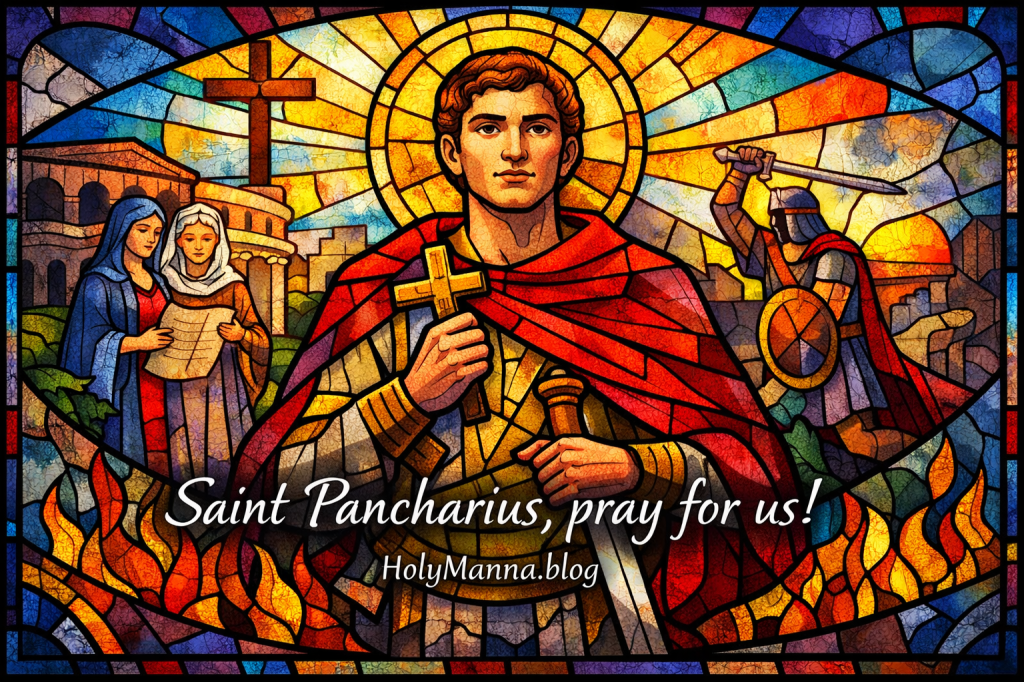
The Courage to Return and Stand for Christ
Saint Pancharius is one of those early Christian martyrs whose story comes down through the Church in a quiet, almost hidden way. He is not one of the saints whose name fills countless churches or whose life is surrounded by long collections of miracles and writings. Still, the Church remembers him, and that matters. In the memory of the Roman Catholic tradition, Saint Pancharius stands as a martyr of Nicomedia, a Roman Christian who gave his life for Christ during the persecution of Diocletian. That alone makes him worthy of reverence, because the Church has always honored those who sealed their faith with blood.
What makes Saint Pancharius especially moving is the tradition that he did not begin as a bold public hero. He is remembered as a man of rank and privilege, likely a senator or officer connected to the imperial court, who at one point seems to have hidden his Christianity or wavered under pressure. Then grace reached him. He turned back, confessed Christ openly, and accepted death rather than deny the Lord. That gives his story an immediate and deeply human power. He reminds Catholics that holiness is not only for those who never tremble. Holiness is also for those who repent, rise, and remain faithful in the end.
The Church teaches in The Catechism that martyrdom is the highest witness to the truth of the faith, and Saint Pancharius belongs to that noble company. His life may be obscure in the historical record, but his final testimony is clear. He died as a witness to Jesus Christ.
From Roman Honor to Christian Fidelity
The early details of Saint Pancharius’ life are not preserved with the fullness found in the stories of some other saints. Roman Catholic tradition remembers him as a Roman by origin and associates him with the imperial world, possibly as a senator or an official serving in a position of honor. He is linked to Nicomedia, the city that became one of the centers of imperial persecution under Diocletian. That setting is important, because Nicomedia was not some distant corner of the empire. It was a place of power, pressure, and danger for Christians.
Tradition also says that Pancharius had a Christian mother and sister, and that their witness played an important part in the turning point of his life. This detail, though not richly documented, fits beautifully within the Catholic understanding of how grace often works through family. So many saints were strengthened by the faith of a mother, a sister, a father, or a friend. In Pancharius’ case, tradition holds that when persecution sharpened and his own courage faltered, the exhortation of his loved ones stirred him to return fully to Christ.
That part of his story deserves real attention. He is not mainly remembered for building institutions, preaching across nations, or writing theological masterpieces. He is remembered for choosing Christ when it cost him everything. He is remembered for refusing to let fear have the final word. That is what he is most known for in Catholic memory. He shows what it means to move from hesitation to fidelity, from concealment to confession, and from fear to martyrdom.
The Grace of a Life Turned Back to God
When the tradition surrounding Saint Pancharius is read with care, what stands out is not a list of grand achievements but the drama of conversion and courage. He lived in a world where public honor, political survival, and obedience to imperial expectations carried tremendous weight. Men in such positions were not free in the modern sense. To refuse the demands of the emperor could mean disgrace, imprisonment, torture, and death.
Within that world, Pancharius becomes important because he shows the victory of grace over compromise. Catholic tradition remembers him as a man who may have hidden his faith for a time when danger increased. Then, through the encouragement of his mother and sister, he found the strength to profess Christ openly. That moment is the heart of his story. It was not spectacular in the worldly sense, but it was spiritually heroic.
There are no verified miracle accounts from his lifetime preserved in the Catholic sources connected with him. No reliable tradition attributes healings, wonders, or extraordinary signs to him while he lived. That absence should not be taken as a weakness. The saints are not important only when miracles surround them. Sometimes the greatest miracle is the conversion of a fearful heart into a faithful one. Sometimes the clearest work of divine grace is that a man facing power, loss, and death chooses Jesus Christ anyway.
That is why Saint Pancharius should still be remembered and imitated. He speaks to every Catholic who has ever been tempted to stay quiet about the faith, to blend into the world, or to avoid the cost of discipleship. His witness says that it is never too late to return, never too late to speak the truth, and never too late to stand with Christ.
The Fire of Persecution and the Crown of Martyrdom
Saint Pancharius lived during the age of the great persecutions, and his martyrdom is placed under the reign of Diocletian, around the year 303. This was one of the darkest periods for the early Church. Christians were pressured to sacrifice to pagan gods, hand over sacred books, and renounce the faith. Those who refused often lost position, safety, property, freedom, and life.
The Roman Martyrology preserves the core of Pancharius’ witness in a brief and solemn way. He was in Nicomedia, he was a Roman, and he was beheaded under Diocletian. That is the secure center of his story. Later tradition adds the deeply human detail that he had once faltered or concealed his Christianity, only to repent and confess Christ openly. If that tradition is accurate, then his martyrdom becomes even more powerful. He did not merely die as a victim of persecution. He died as a penitent believer who chose final fidelity.
There are no verified accounts of miraculous escape or divine intervention saving him from suffering. The tradition does not present him as one rescued from prison by angels or preserved unharmed in the face of torture. Instead, his story leads straight to the blade. In that simplicity there is something profoundly Catholic. The saints are not always delivered from suffering. Often they are given the grace to endure it.
His martyrdom matters because it reflects the very shape of Christ’s own witness. The disciple follows the Master. Jesus did not avoid the Cross, and the martyrs did not avoid the cost of belonging to Him. Saint Pancharius’ death becomes a small but real participation in the mystery of Christ’s Passion. His blood was not wasted. The Church remembers it as testimony.
A Saint Remembered More by the Church Than by the World
The legacy of Saint Pancharius after death is modest, but it is real. He is remembered in the Church’s martyrological tradition on March 19. That remembrance is significant even if it is largely overshadowed in the public life of the Church by the great solemnity of Saint Joseph on the same day. The fact that his memory remains preserved at all shows that the Church did not forget him, even if history left only a few lines behind.
No verified posthumous miracle stories could be found in the Catholic sources associated with him. No firmly attested healings at his tomb, no universally recognized relic cult, and no famous pilgrimage center tied specifically to his name emerged from the research. If such stories existed in local devotion at some point, they are not clearly preserved in the Catholic record now accessible. For that reason, no miracle narratives after his death can be responsibly told as established fact. None could be verified.
Even so, Saint Pancharius had an impact. His impact was not the kind measured by shrines, processions, or national patronage. His impact is the quieter kind that belongs to many ancient martyrs. He strengthens the Church’s memory of what happened in the age of persecution. He stands among those witnesses who teach, simply by existing in the calendar of the Church, that Christianity was bought dearly. His story also carries cultural value in the way Christian names and feast traditions preserved his memory, especially in older Catholic contexts where the name Pancharius or Pancario continued to be associated with his feast.
There is also a surprising beauty in how little of him survives. In a world obsessed with fame and personal branding, Saint Pancharius is remembered not because he left behind a great platform, but because he remained faithful unto death. The world barely remembers him. The Church does. That is enough.
What Saint Pancharius Teaches the Soul Today
Saint Pancharius speaks clearly to modern Catholics, especially to those who know what it feels like to be divided, hesitant, or afraid. His life does not tell the story of someone who moved through the world without pressure. It tells the story of someone who faced pressure from the center of power itself. He knew what it meant to have something to lose. He knew the temptation to hide. Yet by grace he returned and stood firm.
That lesson matters now. Many believers do not face the sword, but they do face ridicule, compromise, silence, and the slow temptation to keep the faith private when it becomes inconvenient. Saint Pancharius reminds the faithful that courage often begins in repentance. It begins when a person stops pretending, stops bargaining, and gives the heart back to Christ completely.
His story also highlights the role of faithful family members. Tradition says his mother and sister helped call him back to courage. That should encourage every Catholic who prays for loved ones. A holy word spoken at the right time may do more than anyone sees in the moment. God often uses ordinary voices to awaken extraordinary fidelity.
Readers can live his example by practicing quiet acts of courage. Speak clearly about the faith when charity requires it. Return to confession when fear or compromise has taken hold. Refuse to let public pressure dictate private conviction. Stay close to the sacraments. Read The Gospel of Matthew and the stories of those who confess Christ before men. Reflect on CCC 2473 and remember that every Christian is called to bear witness, even if only a few are called to literal martyrdom.
Where has fear made the heart quieter than it should be? What would it look like to return fully to Christ without compromise? Who might be waiting for one faithful word of encouragement, just as Pancharius was strengthened by his family? These are not small questions. They reach into daily life, marriage, friendship, parenting, work, and prayer.
Engage with Us!
Share your thoughts and reflections in the comments below. Saint Pancharius may be an obscure martyr, but his witness is deeply personal and surprisingly timely.
- What stands out most in Saint Pancharius’ story: his martyrdom, his repentance, or the role his family played in strengthening his faith?
- Have there been moments when fear or pressure made it difficult to live the faith openly? What helped bring courage back?
- How can faithful family members encourage one another more intentionally in times of spiritual weakness or trial?
- What does Saint Pancharius teach about God’s mercy for those who have wavered but want to return wholeheartedly?
- How can daily Catholic life become a more courageous witness to Jesus in the home, workplace, and public square?
May Saint Pancharius inspire a life of steady courage, honest repentance, and final fidelity. May his witness remind every soul that the mercy of Christ is stronger than fear, and that true greatness is found in belonging to Jesus without compromise. Live with faith. Speak with charity. Endure with hope. Do everything with the love and mercy Jesus taught us.
Saint Pancharius, pray for us!
Follow us on YouTube, Instagram and Facebook for more insights and reflections on living a faith-filled life.

 Holy Manna!
Leave a comment