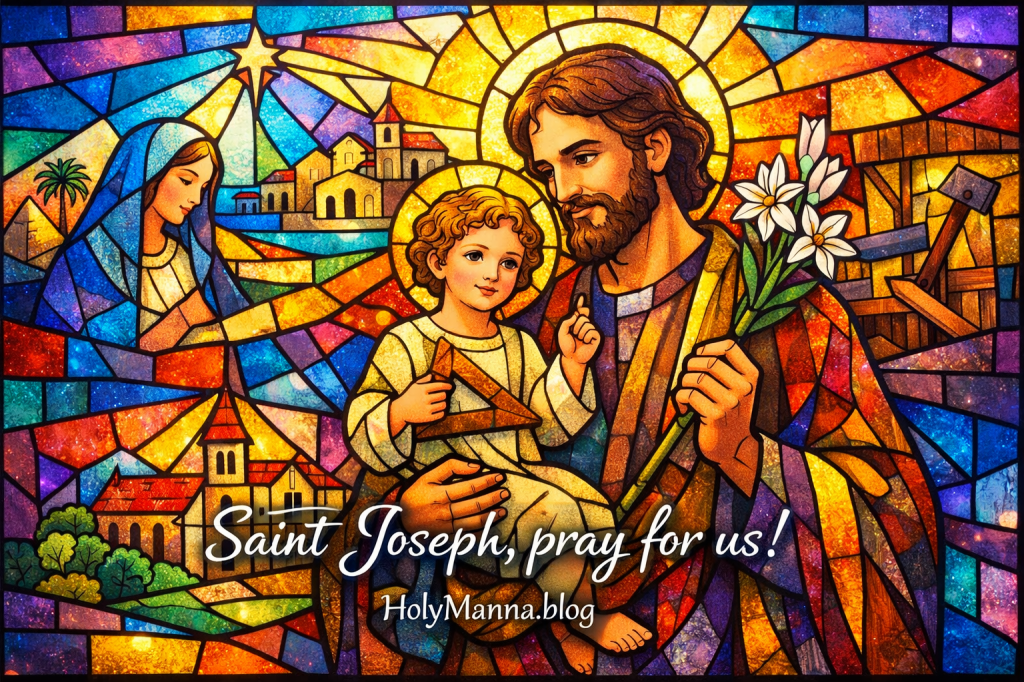
The Silent Strength Behind the Holy Family
Saint Joseph stands in a remarkable place in Christian history. He never preaches a sermon in Scripture. He never works public wonders like the Apostles. He never speaks a recorded word in The Gospel of Matthew or The Gospel of Luke. And yet, he is one of the greatest saints the Church has ever known.
He is revered because God entrusted him with two treasures beyond all earthly measure: the Blessed Virgin Mary and Jesus Christ, the Son of God made man. Joseph was chosen to be the virginal spouse of Mary, the legal father of Jesus, the guardian of the Redeemer, and the head of the Holy Family. The Church honors him as a just man, a faithful worker, a protector of the weak, a patron of fathers, a patron of workers, a patron of the Universal Church, and a patron of a happy death.
What makes Saint Joseph so beloved is not that he lived a flashy life. It is that he lived a faithful one. He listened when God spoke. He obeyed when the road was unclear. He protected his family when danger came. He worked with his hands and gave his strength to the hidden life of Nazareth. In a world that often celebrates noise, Joseph shows the beauty of holiness lived in silence, obedience, courage, and love.
Roots in David’s House
The Gospels tell us that Joseph was of the house of David. That detail matters deeply. God had promised that the Messiah would come from David’s line, and Joseph’s legal fatherhood placed Jesus within that royal lineage according to the law. This was not a small background detail. It was part of God’s providence from the beginning.
Scripture does not tell much about Joseph’s childhood, his parents, or the details of his upbringing. The Church does not pretend to know what God has not revealed. Still, what the Gospels do show tells a great deal about the man he became. Joseph was a Jewish man shaped by the faith of Israel, obedient to the law of God, and grounded in the promises made to the fathers. He was a working man, likely poor or modest in means, since the Holy Family offered the sacrifice of the poor at the Presentation of Jesus in the Temple.
Joseph was betrothed to Mary in a true and binding marriage according to Jewish custom. Before they lived together, he discovered that she was with child. This was the moment that revealed the depth of Joseph’s character. The Gospel of Matthew calls him a righteous or just man. He did not react with cruelty, rage, or a desire to shame her. Instead, he resolved to act quietly and mercifully. Then God intervened.
In a dream, the angel of the Lord told him, “Joseph, son of David, do not be afraid to take Mary your wife into your home. For it is through the Holy Spirit that this child has been conceived in her” as recorded in Mt 1:20. Joseph believed. He obeyed. He took Mary into his home. In that act, his faith deepened into one of the most beautiful acts of trust in all of salvation history.
Joseph is most known for this quiet obedience. He believed God when the mystery was beyond human explanation. He accepted a vocation that would cost him comfort, certainty, and reputation. He did not demand control. He surrendered to God’s plan.
The Guardian of the Redeemer
Saint Joseph’s life was hidden, but it was full of holy action. He named Jesus according to the angel’s command, and that naming mattered. In the world of the Bible, to name a child was to accept real paternal responsibility. Joseph was not the biological father of Jesus, but he was truly his legal father and earthly guardian. Jesus would grow under Joseph’s care, discipline, protection, and example.
Joseph led Mary to Bethlehem because of the census. There, in poverty and humility, he witnessed the birth of the Savior. One can only imagine the wonder in his heart as he looked upon the Child whom angels announced and whom shepherds came to adore. Joseph then brought Jesus to the Temple in obedience to the law. He heard Simeon’s prophecy and saw again that this child had come for the salvation of Israel.
Soon after, danger arrived. In another dream, Joseph was warned that Herod sought the Child’s life. Once again, Joseph did not hesitate. The Gospel of Matthew says, “Joseph rose and took the child and his mother by night and departed for Egypt” as recorded in Mt 2:14. That single verse says so much. He rose. He took. He departed. He acted. He protected. He obeyed. He became the strong and watchful guardian of the Redeemer.
After Herod’s death, Joseph was told in another dream to return. Then, warned again, he settled with Mary and Jesus in Nazareth. These dreams form a pattern in Joseph’s life. God speaks, and Joseph responds. There is no drama for its own sake. There is only holy obedience.
In Nazareth, Joseph lived the life that so many people overlook and that God seems to love very much: the daily life of labor, prayer, family responsibility, and perseverance. He worked as a carpenter or craftsman. Jesus learned from him. The Son of God chose to spend most of His earthly life not preaching to crowds, but living under the care of Mary and Joseph in an ordinary home. That alone tells the world how precious ordinary faithfulness really is.
As for miracles during Joseph’s earthly life, the Gospels do not record him performing public miracles in the way other saints later would. Yet his life is surrounded by miraculous events. He received divine revelation through dreams. He was entrusted with the Virgin Birth. He protected Christ from death through the flight into Egypt. He stood at the center of the mystery of the Incarnation. These are not small things. They are among the most sacred mysteries in history.
Joseph is important because he teaches that holiness is not reserved for the famous. Holiness can be built in workshops, guarded in family homes, and proven in the willingness to do the next faithful thing when God asks it.
The Crown of a Faithful Death
Saint Joseph was not a martyr in the way many saints were, and the Church does not teach that he died by persecution. Still, his life was marked by real hardship. He knew uncertainty. He knew poverty. He knew social tension. He knew the burden of responsibility. He knew what it meant to protect his family in a dangerous world.
He had to accept the mystery of Mary’s miraculous pregnancy without demanding that God explain everything. He had to make the exhausting journey to Bethlehem. He had to welcome the Savior of the world into conditions of poverty. He had to flee into Egypt by night with a vulnerable mother and child because a ruler wanted the boy dead. He had to live as an exile. He had to return and start again. He had to provide daily bread by work that was likely physically demanding and materially modest.
There is also the quiet suffering of loving a mission larger than oneself. Joseph’s whole life was given away for Jesus and Mary. He lived for them. He protected them. He served them. He disappeared into that service. The world may call that small. Heaven does not.
The Gospels do not record Joseph’s death, but Catholic tradition has long held that he died before Jesus’ public ministry. That is one reason the Church invokes him as the patron of a happy death. The tradition is beautiful and fitting. Joseph likely died with Jesus and Mary near him. What more peaceful death could a man desire than to leave this life in the presence of the Savior and His Blessed Mother.
So while Joseph was not crowned by martyrdom, he was crowned by something deeply holy: perseverance in hidden suffering, steadfast obedience, and a faithful death.
A Legacy That Still Shapes the Church
After his earthly life, Saint Joseph’s impact only grew. The Church’s devotion to him developed gradually, but once it flowered, it spread with extraordinary strength. Today he is honored throughout the Catholic world in liturgy, art, prayer, theology, and popular devotion.
The Church does not preserve verified spoken quotations from Saint Joseph himself. His greatness is found in action, not recorded speech. Yet the saints, popes, and faithful across centuries have testified to his powerful intercession. One of the most famous testimonies comes from Saint Teresa of Avila, who had profound devotion to Joseph and spoke of the extraordinary help she received through his prayers. Her testimony has helped countless Catholics turn to Saint Joseph with confidence. This is a well known and treasured witness in Catholic tradition.
Many stories of favors, healings, protections, financial provisions, and family blessings have been attributed to Saint Joseph through the centuries. These stories often come from devotional tradition rather than historical proof in the modern sense. For that reason, they can be appreciated as part of Catholic piety, but some cannot be verified.
There are also longstanding traditions tied to Saint Joseph’s care in times of famine and need. The Saint Joseph Altar, especially beloved in Sicilian Catholic communities, arose from trust in his intercession during hardship. Families prepared altars of thanksgiving, food was shared with the poor, and devotion to Joseph became woven into cultural memory. The practice reflects something deeply fitting about him. Joseph still leads people toward gratitude, charity, and family devotion.
His influence on the life of the Church is massive. Blessed Pope Pius IX declared him Patron of the Universal Church. His name was later placed into the Eucharistic prayers of the Mass. The Church’s official Litany of Saint Joseph gives him titles that reveal his legacy: spouse of the Mother of God, guardian of the Redeemer, head of the Holy Family, glory of family life, model for workers, protector of Holy Church, patron of the dying, patron of the poor, and even terror of demons. Those titles are not exaggerations. They show how the Church has come to understand the reach of his fatherly care.
Many places throughout the world are dedicated to Saint Joseph. Churches, shrines, religious communities, schools, and nations have taken him as patron. Countless Catholic fathers look to him as their model. Workers ask his intercession. The dying are commended to his care. Families consecrate their homes to him. Popes continue to hold him up as the saint for times of confusion, instability, and fear.
That cultural impact is not accidental. Joseph belongs to every age because every age needs what he had: courage without theatrics, purity without coldness, authority without pride, labor without complaint, and faith without applause.
Learning to Live Quietly Strong
Saint Joseph has a way of speaking to the heart without speaking at all. His life invites serious reflection because it shows how powerful holiness can be when it is lived in ordinary circumstances.
There is something deeply needed today in Joseph’s example. He teaches men to be protectors instead of consumers. He teaches families to trust God in uncertain times. He teaches workers that labor has dignity. He teaches believers that obedience matters even when God’s plan is hard to understand. He teaches that silence can be strong, that purity can be joyful, and that real leadership often looks like sacrifice.
His life also reminds the faithful that being close to Jesus and Mary is enough. Joseph did not build a public platform. He did not leave behind books or speeches. He built a home where the Son of God could grow in wisdom and age. He made room for Christ. That is a lesson worth carrying into daily life.
A reader can imitate Joseph in very practical ways. Pray before acting. Obey God promptly when conscience is clear. Protect the vulnerable. Honor the dignity of work. Be faithful to family duties. Do not despise hidden service. Be steady when others panic. Keep a clean heart. Be dependable. Stay close to Jesus and Mary.
What would change if daily responsibilities were treated as a path to holiness rather than a distraction from it? What if protecting one’s family, working honestly, and obeying God in small things were seen as heroic? What if silence, chastity, and integrity were embraced as strength rather than weakness?
Saint Joseph shows that sanctity does not require a spotlight. It requires surrender.
Engage with Us!
Share your thoughts and reflections in the comments below. Saint Joseph’s life speaks powerfully to the hidden struggles, duties, and hopes of everyday Christians, and it would be beautiful to hear how his witness speaks to your own journey.
- What part of Saint Joseph’s life moves the heart most deeply, his obedience, his silence, his courage, or his care for Jesus and Mary?
- How can Saint Joseph’s example help strengthen faith in moments when God’s plan is not fully understood?
- In what ways can daily work, family responsibility, and hidden sacrifice become offerings of love to God?
- What does Saint Joseph teach the modern world about real masculinity, fatherhood, and spiritual leadership?
- How can devotion to Saint Joseph help bring peace to the home, courage in suffering, and trust at the hour of death?
May Saint Joseph, Spouse of the Blessed Virgin Mary, guard every home, strengthen every father, comfort every worker, and lead every soul closer to Jesus Christ. Live with faith. Live with courage. Live with quiet obedience. And in all things, do everything with the love and mercy Jesus taught us.
Saint Joseph, pray for us!
Follow us on YouTube, Instagram and Facebook for more insights and reflections on living a faith-filled life.

 Holy Manna!
Leave a comment