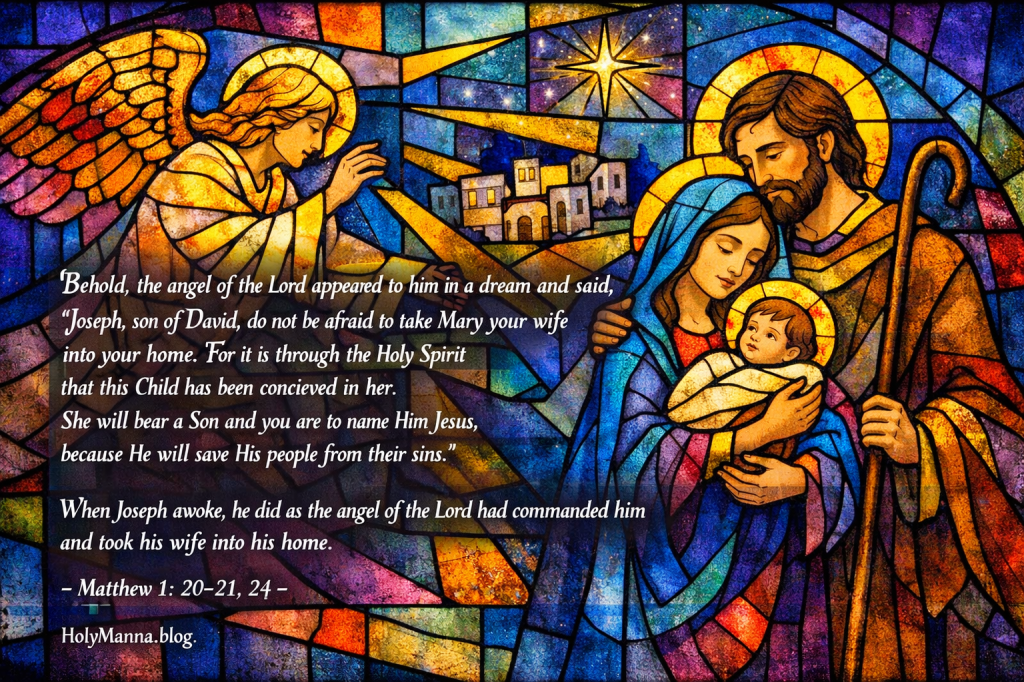
Solemnity of Saint Joseph, Spouse of the Blessed Virgin Mary – Lectionary: 543
The Quiet Man at the Center of God’s Promise
Some of the most important moments in salvation history arrive without noise, and today’s readings invite the heart to slow down long enough to notice one of them. On the Solemnity of Saint Joseph, Spouse of the Blessed Virgin Mary, the Church places before us a set of readings bound together by one powerful theme: God fulfills His promises through humble, obedient faith. What began with the covenant made to David, what was trusted by Abraham in hope against hope, and what came to fulfillment in Jesus Christ is gathered today around the silent, steady figure of Saint Joseph.
Taken together, these readings reveal that Saint Joseph is not standing at the edge of the story. He stands inside the very heart of it. In 2 Samuel 7, God promises David that his house and kingdom will endure forever. In Psalm 89, the Church sings of that covenant as a work of divine mercy and unshakable faithfulness. In Romans 4, Saint Paul turns to Abraham and reminds us that the promise is received through faith, not human power, calculation, or control. Then in The Gospel of Matthew, Joseph appears as the righteous son of David who receives Mary into his home and names the child Jesus, thus taking his place in the mystery by obedience. The promises to Abraham and David do not remain distant ideas. In Joseph’s hidden fidelity, they step into the world.
There is also a rich religious background that gives this feast its depth. Israel had long awaited the Messiah, the true Son of David, the king whose reign would never end. The Jewish people knew the weight of covenant, ancestry, fatherhood, and inheritance. In that world, Joseph’s role was not decorative. His place in the house of David mattered. His acceptance of Mary mattered. His naming of Jesus mattered. Through that legal and paternal act of obedience, Joseph becomes the guardian of the promises God had been preparing for centuries. The Church honors him today because his quiet yes helped shelter the mystery of the Incarnation itself.
That is what makes this solemnity so moving. These readings are not simply about royal lines, ancient promises, or family history. They are about the way God works. He works through covenant. He works through faith. He works through the obedience of men and women who trust Him even when they do not see the whole plan. Saint Joseph shows what that trust looks like in real life. He does not preach a sermon. He does not speak a single recorded word in Scripture. Yet his life proclaims “do not be afraid” more powerfully than many speeches ever could.
As the Church enters these readings today, she invites every believer to see that God still builds His house this way. He still keeps His promises. He still asks for faith. He still works through hidden holiness, quiet courage, and steadfast obedience. Saint Joseph stands before the faithful as a father, protector, and witness that the Lord’s plan is always greater than human expectations, and always worthy of trust.
First Reading – 2 Samuel 7:4-5, 12-14, 16
When God Promises a House Greater Than a Temple
The first reading opens in the age of King David, when Israel had finally begun to enjoy a measure of stability after years of warfare, tribal tension, and national struggle. David had taken Jerusalem, established it as the royal city, and desired to give the Lord a worthy dwelling place. From a human perspective, that desire sounded noble and even holy. A king wants to honor God. A temple seems like the right next step. Yet in this moment, the Lord reveals that His plan is deeper and far more sweeping than David yet understands.
This passage is often called the Davidic covenant, and it is one of the great turning points in salvation history. At first glance, it appears to concern a royal succession and the building of the temple. In its fullest meaning, however, it reaches beyond Solomon and points toward the Messiah, the true Son of David, whose kingdom will never end. That is why this reading is especially fitting for the Solemnity of Saint Joseph. Joseph is called the son of David in The Gospel of Matthew, and through his obedient acceptance of Mary and the Child Jesus, the ancient promise made in this reading is carried into the home of Nazareth. Today’s theme comes into focus here: God fulfills His promises not by human strength or ambition, but through faithful obedience to His plan.
Detailed Exegesis
Verse 4. “But that same night the word of the Lord came to Nathan:”
The timing matters. David has made his plans, but before those plans can harden into action, God speaks. Scripture often shows this pattern. Human beings move first in generosity, fear, zeal, or confusion, and then the Lord reveals the deeper truth. Nathan the prophet becomes the instrument of divine correction. This reminds the faithful that even good intentions must be purified by revelation. Not every holy idea is God’s immediate will. Sometimes the Lord must redirect a sincere heart so that it learns the difference between serving God and trying to manage God’s work.
Verse 5. “Go and tell David my servant, Thus says the Lord: Is it you who would build me a house to dwell in?”
This question is not merely a refusal. It is a holy reversal. David thinks he will build a house for God, but God is about to tell David that He Himself will build a house for David. In the ancient Near East, kings built temples to display power, piety, and legacy. The Lord refuses to let His covenant be reduced to royal self-expression. He is not a local deity to be contained, managed, or glorified by human architecture alone. The deeper point is this: God is always the initiator of salvation. Man responds, but God begins. That truth prepares the way for Saint Joseph as well. Joseph does not invent the mystery of the Incarnation. He receives it, reverences it, and obeys it.
Verse 12. “When your days have been completed and you rest with your ancestors, I will raise up your offspring after you, sprung from your loins, and I will establish his kingdom.”
This verse has an immediate and a fuller meaning. Immediately, it points to Solomon, David’s son, who will succeed him on the throne. But the language already stretches beyond Solomon. God is not merely promising succession. He is promising establishment. The kingdom will be upheld by divine fidelity, not merely dynastic politics. In the light of Christ, the Church sees here the beginning of the messianic line that reaches its fulfillment in Jesus. The promise to David is not extinguished by exile, corruption, or political collapse. It remains alive because God Himself guards it across generations.
Verse 13. “He it is who shall build a house for my name, and I will establish his royal throne forever.”
Again, Solomon is the first horizon of this verse. He will indeed build the temple in Jerusalem. Yet Solomon’s throne did not last forever in any earthly sense. The divided kingdom, the failures of later kings, and the Babylonian exile make that painfully clear. Because of that, the Church reads this verse with a fuller vision. The true and everlasting house is not finally a stone temple, but the kingdom of Christ. Jesus is the One who builds the definitive house for God’s name, and that house includes His Body, the Church. On this solemnity, Saint Joseph stands close to that mystery because he shelters the Child in whom the eternal throne is established. The promise of the kingdom passes through history, through a family line, and through the faithful guardianship of a righteous man.
Verse 14. “I will be a father to him, and he shall be a son to me. If he does wrong, I will reprove him with a human rod and with human punishments;”
In its original royal setting, this language reflects the covenant bond between God and the Davidic king. The king is adopted in a special way as God’s son, not by nature, but by office and covenant. This father and son language marked the king as one who ruled under God’s authority and for God’s purposes. Yet this verse also points beyond itself. The deeper and perfect Son is Jesus Christ, not adopted into sonship, but eternally begotten of the Father. The clause about wrongdoing applies to the imperfect kings of David’s line, but not to Christ, who is sinless. That contrast is important. The old covenant prepares; the new covenant fulfills. The shadows are real, but they are not the final light.
Verse 16. “Your house and your kingdom are firm forever before me; your throne shall be firmly established forever.”
This is the heart of the passage. The promise is astonishing. No merely human throne lasts forever. No political dynasty escapes weakness, betrayal, or death. If this promise is to be true, it must culminate in a king whose reign exceeds ordinary history. That is exactly what the Church confesses in Jesus Christ. He is the Son of David whose kingdom has no end. This is why the reading belongs so naturally to the feast of Saint Joseph. Joseph does not sit on a worldly throne, yet he belongs to David’s house and gives legal, earthly shelter to the promised King. The covenant promise is not abandoned. It is fulfilled in quietness, hiddenness, and grace.
Teachings
This reading reveals the pattern of God’s covenantal work. He chooses, He promises, and He fulfills. Human beings are invited into that mystery, but they do not control it. The promise to David becomes one of the great foundations for Israel’s hope in the Messiah, the anointed king who would come from David’s line and reign forever.
The Catechism speaks directly to this messianic expectation in CCC 439: “Many Jews and even certain Gentiles who shared their hope recognized in Jesus the fundamental attributes of the messianic ‘Son of David’, promised by God to Israel.” That line helps illuminate the whole reading. The promise given to David was never meant to remain locked in the past. It was always reaching toward Christ.
This passage also sheds light on Saint Joseph’s place in salvation history. When the angel addresses him as “Joseph, son of David” in The Gospel of Matthew, that title is not decorative. It is theological. Joseph stands within this covenant line. His role as the legal father and guardian of Jesus places him within the fulfillment of the promise first spoken by Nathan. God promised David a house. Centuries later, that promise enters the hidden home of Nazareth.
The Fathers of the Church consistently saw this passage as stretching beyond Solomon to Christ. Saint Augustine read the enduring throne promised to David as something no earthly kingdom could satisfy. The failures of Israel’s kings proved that the prophecy required a greater fulfillment. Christ alone is the King whose reign is truly forever. In that sense, this reading is not simply about monarchy. It is about divine fidelity. History may appear broken, but God’s covenant does not fail.
There is also a profoundly Catholic lesson here about the temple. David wants to build for God, but God first builds for David. Grace comes before achievement. Vocation comes before accomplishment. Covenant comes before construction. That truth runs through the whole spiritual life. Many souls want to do great things for God, and that desire can be sincere. Yet the deeper question is whether they are letting God build His house within them first. Saint Joseph is such a powerful model precisely because he receives before he acts. He listens before he moves. He obeys before he plans.
Reflection
This reading speaks with surprising force to everyday life. Many people want to build something solid. They want to build a family, a future, a reputation, a ministry, or a legacy. Those desires are not wrong. David’s desire was not wrong either. But this passage teaches that the spiritual life begins by asking whether the work being pursued is truly God’s will, or merely a good idea carried by human zeal.
Saint Joseph helps bring that lesson into daily life. He did not seize a role for himself. He accepted the role God entrusted to him. He allowed the Lord’s promise to pass through his obedience. That is what holiness often looks like. It looks like receiving the mission God gives instead of chasing the one the ego prefers. It looks like reverence, patience, restraint, and trust.
A soul can live this reading by making room for silence before making decisions, by praying before reacting, and by entrusting long awaited hopes to God instead of trying to force results. Fathers can learn from this reading that true strength is not domination, but faithful stewardship. Mothers, workers, spouses, and single people can all learn the same lesson. God is not absent when life feels hidden. Some of His greatest works unfold in places the world barely notices.
Where has the heart been trying to build without first listening to God?
What promise of God needs to be trusted more deeply, even when the outcome cannot yet be seen?
Could the Lord be asking for surrender before success, and obedience before visible results?
The first reading invites the faithful to stand before God with open hands. It reminds them that the Lord is faithful to His covenant, faithful to His promises, and faithful even when human history looks fragile. The throne of David finds its fulfillment in Christ, and the path to that fulfillment passes through humble, hidden obedience. That is why this reading belongs so beautifully to Saint Joseph. He teaches that when God decides to build His house, the holiest response is trust.
Responsorial Psalm – Psalm 89:2-5, 27, 29, 37
A Song for the God Who Never Breaks His Promise
After the first reading opens the great promise made to David, the Church places Psalm 89 on the lips of the faithful as a response of praise, trust, and remembrance. This is not a random song placed between readings. It is a royal covenant psalm, born from Israel’s memory of what God swore to David and shaped by the conviction that the Lord’s mercy is stronger than the rise and fall of earthly kingdoms. In the life of Israel, kings could fail, dynasties could weaken, and the nation could suffer humiliation, but the covenant of God remained the anchor of hope.
That is why this psalm fits today’s solemnity so beautifully. The Solemnity of Saint Joseph, Spouse of the Blessed Virgin Mary, is not simply about honoring a holy man from Nazareth. It is about seeing how God preserved His promise through generations and brought it to fulfillment in Jesus Christ. Psalm 89 gives voice to that confidence. It sings of mercy, covenant, fatherhood, and an enduring throne. Those same themes prepare the heart to understand Joseph’s role in salvation history. He stands within the house of David, and through his obedient faith, the promised King is received into the world. The psalm therefore teaches the soul to read history the way the Church reads it: not as a chain of accidents, but as the unfolding of divine faithfulness.
Detailed Exegesis
Verse 2. “I will sing of your mercy forever, Lord proclaim your faithfulness through all ages.”
The psalm begins with praise, but it is praise grounded in memory. Israel does not sing because life is easy. Israel sings because God is faithful. The two great words here are mercy and faithfulness. In the biblical world, these are covenant words. They speak of the Lord’s steadfast love, His unbreakable commitment, and His reliability across time. The psalmist is not admiring a passing feeling in God. He is proclaiming the character of God Himself. This matters greatly for today’s theme. Saint Joseph’s life makes sense only because God is faithful across generations. The promise did not die with David. It was carried forward by mercy.
Verse 3. “For I said, ‘My mercy is established forever; my faithfulness will stand as long as the heavens.’”
This verse lifts the mind from human history to cosmic stability. The heavens were seen as enduring, ordered, and fixed by God’s command. By comparing divine faithfulness to the heavens, the psalm declares that God’s covenant is not fragile or temporary. Human loyalty often shifts. Human institutions crumble. God’s truth does not. This verse also reveals something important about prayer. The believer strengthens his heart by speaking aloud what God has revealed. The psalmist is not creating hope out of thin air. He is repeating the truth until the soul learns to rest in it.
Verse 4. “I have made a covenant with my chosen one; I have sworn to David my servant:”
Here the psalm becomes explicit. The mercy and faithfulness being praised are not abstract qualities. They are tied to a covenant. God chose David and swore to him. In the ancient world, covenants were solemn bonds, often sealed with oath and sacrifice. This is why the covenant with David becomes so central to Israel’s hope. God is not merely blessing a king. He is pledging Himself to a plan that will reach far beyond one reign. On the feast of Saint Joseph, this verse carries special weight because Joseph belongs to that chosen line. His title as son of David is not poetic decoration. It means that the covenant sung in this psalm is alive in him.
Verse 5. “I will make your dynasty stand forever and establish your throne through all ages.”
This verse takes the promise of 2 Samuel 7 and turns it into song. Yet even as Israel sings it, the history of the monarchy shows that no merely earthly throne could fulfill these words in their deepest sense. Kings died. The kingdom split. The people went into exile. The promise, however, was never withdrawn. The Church therefore reads this verse in the light of Christ, the true Son of David whose kingship has no end. The throne that stands forever is fulfilled in Him. This is why the psalm is not a relic of royal nostalgia. It is a prophecy of Christ’s kingdom.
Verse 27. “He shall cry to me, ‘You are my father, my God, the Rock of my salvation!’”
This verse reveals the intimate relationship between the Davidic king and the Lord. The king is not self-made. He depends on God as Father, God, and Rock. In the Old Testament setting, this language marks the king as one who rules under divine authority. Yet in the full light of the Gospel, these words point even more deeply to Christ, who is Son in a way no earthly king ever was. At the same time, this verse also prepares the heart for Saint Joseph. Joseph is not the source of salvation, but he lives in total dependence on the God who saves. He receives his mission not through self-assertion, but through trust.
Verse 29. “Forever I will maintain my mercy for him; my covenant with him stands firm.”
This is one of the most consoling lines in the psalm. God does not say that David’s line will stand because every heir will be holy, wise, or victorious. He says His mercy will remain and His covenant will stand firm. That distinction matters. The history of salvation is not the story of human consistency. It is the story of divine fidelity. Even when men fail, God remains true. This gives the faithful a way to understand the long road from David to Joseph. There were centuries of waiting, weakness, sin, exile, and longing. Still, the covenant stood firm. God preserved the line. God kept the promise.
Verse 37. “His dynasty will continue forever, his throne, like the sun before me.”
The image of the sun adds brightness, permanence, and public visibility to the covenant promise. The sun rises day after day as a sign of order and steadiness in creation. So too the Davidic promise is presented as something God upholds before His own face. In its ultimate sense, this points to the kingship of Christ, which cannot be extinguished by death, political collapse, or time itself. On this solemnity, the verse also sheds light on Joseph’s hidden greatness. The man who lived in obscurity was entrusted with the One whose throne endures forever. Joseph’s home sheltered the sunrise of the new covenant.
Teachings
Psalm 89 teaches the faithful how to pray with covenant memory. It does not deny hardship, but it refuses to interpret hardship apart from God’s promise. That is a deeply Catholic way of praying. The Church does not look at history merely from below. She reads history through revelation. She remembers what God has said, sings what God has promised, and entrusts the future to Him.
This psalm also shows why David holds such an important place in biblical spirituality. The Catechism speaks of David in a way that brings this psalm into sharper focus. In CCC 2579, it teaches: “David, the ‘shepherd’ who prays for his people and in their name, is the king after God’s own heart, the shepherd of his people’s prayer and the one whose submission to the divine will, whose praise and whose repentance will be a model for the prayer of the People of God. His prayer, the prayer of God’s anointed, is a faithful adherence to the divine promise, a loving and joyful trust in him who is the only King and Lord.” That line could almost serve as a summary of this entire psalm. David’s greatness is not merely political. It is spiritual. He becomes the pattern of trusting the promise.
The psalm also points toward Christ as the long awaited Son of David. The Catechism states in CCC 439: “Many Jews and even certain Gentiles who shared their hope recognized in Jesus the fundamental attributes of the messianic ‘Son of David’, promised by God to Israel.” That is exactly why the Church places this psalm on the lips of the faithful today. The throne promised to David is not finally secured by military power or royal strategy. It is fulfilled in Jesus Christ. And because Saint Joseph is the righteous son of David who receives Jesus into his home, the feast allows the faithful to see the covenant passing from promise into presence.
Historically, this psalm carried enormous weight for Israel, especially in times of instability. When the monarchy weakened and later collapsed, the covenant with David did not become meaningless. It became even more precious. It formed the soil of messianic hope. That hope endured through exile, foreign domination, and centuries of waiting. By the time Joseph appears in the Gospel, Israel has no Davidic king on an earthly throne. Yet the covenant has not failed. It has ripened in silence. That is one of the great spiritual lessons of this solemnity. God’s faithfulness is often most powerfully at work when history appears quiet or even broken.
Reflection
This psalm reaches into ordinary life with surprising tenderness. It teaches the soul to begin not with panic, but with praise. Not because every problem has already been solved, but because God’s mercy is established forever. That is a hard lesson for a restless age. Many hearts measure God’s faithfulness by immediate results. Psalm 89 teaches a better way. It says that the believer must remember before he reacts. He must sing before he despairs. He must anchor himself in what God has promised.
There is also a practical lesson here about prayer in the home. Saint Joseph lived inside the mystery this psalm anticipates. He knew what it meant to trust God’s word in silence. Families can imitate that spirit by making room for prayer that remembers God’s mercy, by speaking aloud His faithfulness in times of fear, and by teaching children that the Lord’s promises outlast every passing crisis. Men especially can hear a call here to become steady in prayer, stable in duty, and rooted in God the Father rather than in pride or control.
One simple way to live this psalm is to begin the day by naming God’s faithfulness before naming personal anxieties. Another is to recall concrete moments when the Lord has carried the soul through confusion, delay, or disappointment. The psalm teaches that memory strengthens trust. It also invites the faithful to stop treating prayer as mere emotional release and to begin treating it as covenant remembrance.
What promise of God needs to be remembered again today?
Has the heart been focusing more on what seems delayed than on the mercy that has already been given?
How might daily life change if it began with praise for God’s faithfulness instead of fear about the future?
Psalm 89 does not ask the faithful to pretend life is simple. It asks them to remember who God is. His mercy stands. His covenant stands. His promise stands. And on the Solemnity of Saint Joseph, that truth shines with special beauty, because the hidden carpenter of Nazareth stands as living proof that God’s faithfulness often unfolds quietly, patiently, and right on time.
Second Reading – Romans 4:13, 16-18, 22
Hope Against Hope in the Footsteps of Abraham
The second reading takes the soul even deeper into the mystery of today’s solemnity. After hearing God’s covenant with David and singing of His enduring mercy in Psalm 89, the Church now turns to Abraham, the great father of faith. Saint Paul is writing to the Christians in Rome, a community made up of both Jews and Gentiles, and one of his major concerns is to show that salvation is not earned by human effort or restricted to one ethnic boundary. The promise of God is received through faith, and that faith opens the way for all nations.
That matters profoundly on the Solemnity of Saint Joseph. Joseph is the righteous son of David, but he is also a man who walks in the spirit of Abraham. He receives what God is doing not because he has all the answers, but because he trusts the One who speaks. In this reading, Saint Paul shows that the history of salvation has always moved this way. God makes a promise, man receives it by faith, and grace accomplishes what human strength never could. That is the heart of today’s theme. The covenant is fulfilled through humble, obedient faith.
Detailed Exegesis
Verse 13. “It was not through the law that the promise was made to Abraham and his descendants that he would inherit the world, but through the righteousness that comes from faith.”
Saint Paul begins by clarifying the basis of the promise. Abraham did not receive God’s pledge because he had already fulfilled the Mosaic law, since the law would come centuries later. The promise came first. Grace came first. Faith came first. This is essential to Paul’s argument. God’s saving plan has never been rooted in human self-justification. It begins in divine initiative and is received in trust.
The phrase about inheriting the world expands the horizon far beyond land or earthly prestige. Paul sees in Abraham the beginning of a universal blessing that reaches all nations in Christ. This helps the reader see why the Church places this reading on Saint Joseph’s feast. Joseph stands inside this same movement of promise and faith. He receives a mission that he did not create and a mystery that he cannot fully explain. Like Abraham, he walks by trust.
Verse 16. “For this reason, it depends on faith, so that it may be a gift, and the promise may be guaranteed to all his descendants, not to those who only adhere to the law but to those who follow the faith of Abraham, who is the father of all of us,”
This verse reveals the tenderness of God’s design. The promise depends on faith precisely so that it may remain a gift. If it depended on human achievement, it would always become a source of pride, exclusion, or despair. But because it depends on faith, it can be guaranteed to all who believe. Paul is not dismissing the law as evil. He is showing that the law cannot be the source of the promise. The promise flows from God’s mercy.
Abraham therefore becomes father not only of one people according to the flesh, but of all who share his faith. This prepares the Christian heart to understand the Church herself. The people of God are gathered not by bloodline alone, but by faith in the God who fulfills His word. In today’s solemnity, Joseph stands as a beautiful example of this living faith. He receives the promise in a hidden home, but that hidden fidelity serves the salvation of the whole world.
Verse 17. “As it is written, ‘I have made you father of many nations.’ He is our father in the sight of God, in whom he believed, who gives life to the dead and calls into being what does not exist.”
Paul now reaches back to the divine word spoken over Abraham and interprets it in a profoundly theological way. Abraham believed in the God who gives life to the dead and calls into being what does not exist. That line opens the mystery of faith in a remarkable way. Abraham trusted God not merely as a helper of human efforts, but as the Lord of creation and resurrection. He believed in the God who can bring fruitfulness out of barrenness, a nation out of one elderly couple, and life where there seems to be no future.
This line resonates deeply with the whole mystery of Christ. The God Abraham trusted is the God who will raise Jesus from the dead. It also resonates with Saint Joseph’s story. Joseph is asked to accept a virginal mystery that does not fit ordinary human expectation. He is drawn into the saving work of the God who does what man cannot imagine. Faith begins where human calculation reaches its limit.
Verse 18. “He believed, hoping against hope, that he would become ‘the father of many nations,’ according to what was said, ‘Thus shall your descendants be.’”
This is one of the most beautiful descriptions of faith in all of Scripture. Abraham hoped against hope. Human hope had run thin. Natural expectation had little to stand on. Yet Abraham still trusted God’s promise. This is not optimism. It is theological hope rooted in the character of God. Abraham did not close his eyes to difficulty. He looked beyond difficulty to the Lord who had spoken.
This verse is especially fitting for Saint Joseph. Joseph too was placed in a situation that demanded trust beyond ordinary expectation. He had to believe that God’s plan was holy even when it overturned his assumptions. The Church therefore gives this reading today because Joseph’s obedience belongs to the same spiritual family as Abraham’s faith. Both men received what seemed impossible because they trusted the Lord more than their own fears.
Verse 22. “That is why ‘it was credited to him as righteousness.’”
Paul concludes this portion by returning to the great biblical statement about Abraham’s faith. Abraham is reckoned righteous not because he achieved perfection by his own efforts, but because he believed God. In Paul’s thought, righteousness here is not a legal fiction detached from the heart. It is the right relationship established by grace through faith. Abraham’s trust opened him to God’s saving action.
This verse also sheds light on why Joseph is called a righteous man in The Gospel of Matthew. Biblical righteousness is not cold legalism. It is a heart rightly ordered toward God, receptive to His word, obedient to His will, and willing to walk in trust. Abraham is righteous because he believes. Joseph is righteous because he believes and obeys. The same pattern runs through both.
Teachings
This reading teaches that faith is not a religious accessory added onto human effort. Faith is the way the soul receives the promise of God. That is why Saint Paul places such emphasis on Abraham. He is not merely an ancient ancestor. He is the great biblical witness that salvation begins in grace and is welcomed through trust.
The Catechism speaks of Abraham with extraordinary clarity in CCC 146: “Abraham thus fulfills the definition of faith in Hebrews 11:1: ‘Faith is the assurance of things hoped for, the conviction of things not seen’: ‘Abraham believed God, and it was reckoned to him as righteousness.’ Because he was ‘strong in his faith,’ Abraham became the ‘father of all who believe’.” That teaching sits right at the center of this reading. Abraham is not praised for having a detailed roadmap. He is praised for believing the God who made the promise.
The Catechism also teaches in CCC 145: “The Letter to the Hebrews, in its great praise of the faith of Israel’s ancestors, lays special emphasis on Abraham’s faith: ‘By faith, Abraham obeyed when he was called to go out to a place which he was to receive as an inheritance; and he went out, not knowing where he was to go.’ By faith, he lived as a stranger and pilgrim in the promised land. By faith, Sarah was given to conceive the son of the promise. And by faith Abraham offered his only son in sacrifice.” That quote matters for today because it shows how biblical faith works. Faith obeys. Faith walks. Faith entrusts. Faith surrenders. That is exactly why this reading belongs on the feast of Saint Joseph.
Historically, Saint Paul’s teaching in Romans was crucial for the early Church as it discerned the relationship between the old covenant, the Mosaic law, and the inclusion of the Gentiles. The question was not whether Israel’s history mattered. It mattered completely. The question was how that history reached its fulfillment in Christ. Paul’s answer is that Abraham already shows the way. The promise always aimed beyond national borders toward a people formed by faith. In that light, Joseph’s role becomes even more luminous. He stands at the meeting point of promise, covenant, faith, and fulfillment.
This reading also offers a vital corrective to modern spiritual confusion. Many people think faith means vague religious feeling or blind sentiment. Scripture presents something far stronger. Faith is the surrender of the whole person to the living God. It is trust in His word when the path is unclear. It is obedience when the outcome is hidden. It is endurance when visible evidence seems thin. Abraham lived that way. Joseph lived that way. The saints live that way.
Reflection
This reading speaks directly to anyone carrying uncertainty, delay, or disappointment. Abraham hoped against hope. That means there are moments in life when the only solid ground left is the word of God. Careers can change. plans can fail. health can weaken. family life can become complicated. Yet the promise of God remains. The reading does not invite the soul to fantasy. It invites the soul to faith.
Saint Joseph helps make that lesson practical. He did not receive a neat explanation for every difficulty ahead. He received enough light for obedience. That is often how grace works. God usually gives daily bread, not a ten year blueprint. A faithful life is built by receiving the light given today and walking in it.
One way to live this reading is to identify the places where fear has been speaking louder than God’s promise. Another is to pray with Abraham’s example and ask for the grace to trust even when timing remains mysterious. Families can also take something strong from this passage by speaking openly about God’s faithfulness in the home. Children need to hear that Christian hope is not wishful thinking. It is confidence in the God who keeps His word.
Where has hope grown thin because the heart has been measuring God by visible results alone?
What promise of God needs to be trusted again, even if its fulfillment still seems far away?
Is there a place in daily life where obedience is being delayed until every answer appears?
The second reading teaches that God’s promise becomes fruitful in the soil of faith. Abraham believed. Joseph obeyed. Christ fulfilled. That is the sacred pattern. And for every soul willing to trust the Lord in the dark, it remains the pattern still.
Holy Gospel – Matthew 1:16, 18-21, 24
The Silent Yes That Welcomed the Savior
The Holy Gospel brings today’s theme into its most intimate and decisive moment. What 2 Samuel 7 promised to David, what Psalm 89 sang with confidence, and what Romans 4 described in the faith of Abraham now comes into focus in the quiet obedience of Saint Joseph. Saint Matthew writes with a strong Jewish and messianic emphasis, eager to show that Jesus is not an isolated religious teacher but the long awaited Christ, the true Son of David and fulfillment of God’s covenant promises. That is why Matthew begins with genealogy and why Joseph’s place in that genealogy matters so deeply. The Church teaches that Jesus was born into the messianic line of David through Joseph’s role as Mary’s husband, and recent papal catechesis has emphasized that Joseph’s legal fatherhood truly grafts Jesus into David’s dynasty.
The cultural and religious background matters here. In the world of ancient Israel, betrothal was already a real and binding marital bond, even though the couple had not yet begun living together. So when Mary is found to be with child, Joseph faces not a minor misunderstanding but a moment of profound suffering, bewilderment, and moral testing. Yet this is exactly where his greatness begins to shine. Today’s Gospel reveals that God fulfills His saving plan through a righteous man who does not grasp for control, does not lash out in anger, and does not resist divine mystery. Joseph becomes the living bridge between the promises made to Abraham and David and their fulfillment in Christ.
Matthew 1:16, 18-21, 24 – New American Bible (Revised Edition)
16 Jacob the father of Joseph, the husband of Mary. Of her was born Jesus who is called the Messiah.
18 Now this is how the birth of Jesus Christ came about. When his mother Mary was betrothed to Joseph, but before they lived together, she was found with child through the holy Spirit. 19 Joseph her husband, since he was a righteous man, yet unwilling to expose her to shame, decided to divorce her quietly. 20 Such was his intention when, behold, the angel of the Lord appeared to him in a dream and said, “Joseph, son of David, do not be afraid to take Mary your wife into your home. For it is through the holy Spirit that this child has been conceived in her. 21 She will bear a son and you are to name him Jesus, because he will save his people from their sins.”
24 When Joseph awoke, he did as the angel of the Lord had commanded him and took his wife into his home.
Detailed Exegesis
Verse 16. “Jacob the father of Joseph, the husband of Mary. Of her was born Jesus who is called the Messiah.”
Matthew’s wording is deliberate and theologically rich. Throughout the genealogy, the pattern is steady and formulaic, but here it changes. Joseph is not called the biological father of Jesus. He is called “the husband of Mary”, and Jesus is said to be born “of her.” This preserves the truth of the virginal conception while still showing Joseph’s real place within the mystery. The Church teaches that Joseph is not Jesus’ biological father, yet his fatherhood is real in a legal, familial, and covenantal sense. Through Joseph, Jesus belongs to David’s house. This verse therefore protects both truths at once: Jesus is conceived by the Holy Spirit, and Jesus truly stands in the Davidic line.
Verse 18. “Now this is how the birth of Jesus Christ came about. When his mother Mary was betrothed to Joseph, but before they lived together, she was found with child through the holy Spirit.”
Matthew now moves from genealogy to mystery. The phrase “before they lived together” makes clear that this conception is not the result of ordinary marital union. The evangelist is guarding the truth that Jesus is conceived by the power of the Holy Spirit. This is not a poetic symbol. It is a historical and saving mystery at the heart of the faith. The Catechism teaches that Jesus was conceived “solely by the power of the Holy Spirit” and that the angel’s words to Joseph reveal this conception as God’s work. This verse also shows that Joseph is drawn into the mystery not after the fact, but at the very threshold of the Incarnation’s manifestation.
Verse 19. “Joseph her husband, since he was a righteous man, yet unwilling to expose her to shame, decided to divorce her quietly.”
This verse has moved Christians for centuries because it reveals Joseph’s heart before it reveals his decision. He is righteous, and his righteousness is already shown in mercy. He is faithful to the law, but he is not harsh. He is wounded, yet he refuses to humiliate Mary. Pope Francis has reflected that Joseph’s justice is not cold legalism but a justice matured by love, chastity, respect, humility, and openness to God’s deeper plan. Joseph’s first instinct is to protect Mary from public shame, even when he himself is suffering. This is righteousness in the biblical sense: a life rightly ordered to God and therefore marked by truth and charity together.
Verse 20. “Such was his intention when, behold, the angel of the Lord appeared to him in a dream and said, ‘Joseph, son of David, do not be afraid to take Mary your wife into your home. For it is through the holy Spirit that this child has been conceived in her.’”
The dream is not a romantic detail. In Scripture, dreams can be moments of divine revelation, especially when God is guiding the unfolding of salvation history. The angel addresses Joseph as “son of David,” which places the whole Davidic covenant back in the foreground. Joseph is being summoned not merely as a good man, but as the royal heir through whom the messianic promise will be sheltered and handed on. The command “do not be afraid” reveals that Joseph’s obedience will require courage. He must receive Mary fully, receive the mystery fully, and step into a mission he never could have invented. The Church teaches that God called Joseph to take Mary as his wife so that Jesus, conceived by the Spirit, would be born into the messianic lineage of David.
Verse 21. “She will bear a son and you are to name him Jesus, because he will save his people from their sins.”
Here Joseph receives a specifically paternal mission. In the biblical world, naming a child is not a casual gesture. It is an act bound up with authority, responsibility, and fatherhood. By commanding Joseph to name the child, the angel entrusts him with a real paternal role. The name Jesus means that the child’s identity and mission are united. He is the one who saves. Not merely from political occupation or temporal hardship, but from sin itself. This verse therefore reveals both who Jesus is and what Joseph must do. Joseph is to serve the Savior by publicly receiving Him as son, even while knowing that the child’s deepest origin is divine. Saint John Paul II taught that by naming the child, Joseph declares his legal fatherhood and proclaims the saving mission entrusted to Jesus.
Verse 24. “When Joseph awoke, he did as the angel of the Lord had commanded him and took his wife into his home.”
This is one of the most beautiful verses in all of Scripture because of its simplicity. Joseph does not argue. He does not negotiate. He does not ask for a second sign. He rises and obeys. This is the obedience of faith in action. Saint John Paul II wrote that what Joseph did is the clearest expression of the “obedience of faith.” His response is quiet, but it is immense. By taking Mary into his home, Joseph takes into his care the Virgin Mother and the incarnate Son. He becomes guardian of the mystery of God. Today’s whole solemnity leads to this moment. God’s covenant, God’s promise, God’s mercy, and God’s plan all find shelter in the obedience of a just man.
Teachings
This Gospel teaches that Saint Joseph is not a background figure in the story of Christ. He is entrusted with a real mission in salvation history. The Catechism states in CCC 437: “God called Joseph to ‘take Mary as your wife, for that which is conceived in her is of the Holy Spirit’, so that Jesus, ‘who is called Christ’, should be born of Joseph’s spouse into the messianic lineage of David.” That one line gathers together nearly the whole theology of today’s Gospel. Joseph protects the mystery of the virginal conception while also giving Jesus His rightful place in David’s house.
The Church also teaches in CCC 497: “The Gospel accounts understand the virginal conception of Jesus as a divine work that surpasses all human understanding and possibility.” This is essential. Joseph’s obedience is not ordinary moral decency alone. It is faith before mystery. He is asked to receive what he cannot explain by natural reasoning. In that way, Joseph stands beside Abraham. Both men trust the God who acts beyond human expectation.
Saint John Paul II offered one of the most beautiful summaries of Joseph’s role in Redemptoris Custos: “What he did is the clearest ‘obedience of faith’.” He also wrote that Joseph “took her in all the mystery of her motherhood.” Those lines matter because they show that Joseph’s holiness is not passive. He does not merely tolerate a difficult situation. He welcomes a divine mystery and shapes his entire life around guarding it.
Pope Francis has deepened the Church’s contemplation of this Gospel by describing Joseph as the man who assumes the legal paternity of Jesus, thereby linking Him to the promise made to David. He has also emphasized that Joseph’s justice is not rigid, but open to the surprising demands of God. That helps explain why Joseph remains such a powerful model for the Church. In him, masculine authority is neither domineering nor weak. It is reverent, responsible, protective, and obedient to God.
The Fathers of the Church also recognized the depth of this passage. They saw Joseph’s righteousness as a sign of holiness rather than suspicion, and they defended both Mary’s perpetual virginity and Joseph’s true place in the mystery. Historically, this Gospel helped shape the Church’s clear teaching on the virginal conception, the Davidic identity of Jesus, and the singular vocation of Saint Joseph within the Holy Family. What might look simple on the surface becomes, in truth, one of the richest windows into the mystery of the Incarnation.
Reflection
This Gospel reaches straight into daily life because Joseph’s holiness is lived in the middle of confusion, disappointment, interruption, and costly obedience. He had plans. He had expectations. He likely imagined a life with Mary that looked very different from the road suddenly placed before him. Yet when God revealed His will, Joseph surrendered his own script and accepted heaven’s. That is where many souls struggle. They want to follow God, but only if the path still feels familiar, explainable, and manageable.
Joseph teaches a better way. He teaches that holiness often begins when control ends. He teaches that love protects rather than exposes. He teaches that a righteous man does not need to dominate a mystery in order to serve it faithfully. He teaches that fear can be answered not with noise, but with obedience. In a loud and self-promoting age, Joseph remains refreshingly strong because he is silent, pure, disciplined, and dependable.
There are concrete ways to live this Gospel. A husband can imitate Joseph by protecting the dignity of his wife and children, especially when sacrifice is required. A father can imitate him by remembering that real authority is exercised in service. A single man can imitate him by learning that chastity and strength belong together. A mother, a worker, or anyone carrying hidden burdens can imitate him by entrusting uncertainty to God and doing the next faithful thing without delay. Joseph did not receive every detail of the future. He received enough light to obey, and that was enough.
Where has fear been making obedience feel impossible?
Is there a place in life where the heart has been asking for full understanding before offering trust?
How might daily life change if it began to imitate Saint Joseph’s quiet readiness to do what God asks?
The Holy Gospel of this solemnity does not merely praise Saint Joseph. It reveals him. It shows a man who stands in the line of David, walks in the faith of Abraham, receives the mystery of Mary with reverence, and takes the Savior into his home with obedient love. That is why the Church loves him so deeply. He teaches every soul that God’s greatest works are often entrusted to those willing to listen in silence, believe in the dark, and rise without delay.
Under Saint Joseph’s Mantle
Today’s readings come together like one beautiful story of promise, faith, and quiet obedience. In 2 Samuel 7, the Lord promises David a house and a kingdom that will stand forever. In Psalm 89, the Church sings back to God with confidence, praising His mercy and His faithfulness across every age. In Romans 4, Saint Paul points to Abraham, who believed when fulfillment still seemed impossible and hoped when there was no visible reason to hope. Then in The Gospel of Matthew, all that promise and waiting comes into the hidden life of Saint Joseph, the righteous son of David who receives Mary into his home and accepts the Savior with obedient trust.
That is the great message of this solemnity. God keeps His promises. He does not forget His covenant. He does not abandon His people. He does not fail when history feels slow, hidden, or uncertain. He works steadily, faithfully, and often quietly. He worked through Abraham’s faith. He worked through David’s line. He worked through Joseph’s silence and courage. And He still works that way now.
Saint Joseph stands in these readings as a model of what real holiness looks like in ordinary life. He does not preach long speeches. He does not seek attention. He does not force his own plans onto God. He listens, trusts, and obeys. That witness matters deeply in a world that rewards noise, self-assertion, and control. Joseph reminds the faithful that some of the holiest lives are built in hiddenness, reverence, and steady fidelity to whatever God has placed right in front of them.
The call today is simple, but it is not easy. Trust God’s promises even when the road ahead is not fully visible. Protect what is holy in the home, in the heart, and in daily life. Choose obedience over panic. Choose prayer over control. Choose faith over fear. Let Saint Joseph teach the soul how to welcome Jesus with reverence and how to remain close to Mary with purity and devotion.
What would change if life were lived with Saint Joseph’s quiet confidence in God’s plan?
This solemnity is an invitation to stop measuring God’s faithfulness by human timing and to begin resting in His word. Stay close to Saint Joseph. Ask for his intercession. Ask for his courage. Ask for his purity, his steadiness, and his obedient heart. Then take the next faithful step. God is still building His house, and those who trust Him will never be disappointed.
Engage with Us!
Share your reflections in the comments below. What stood out most in today’s readings? Which verse stayed with you, challenged you, or gave you peace? This Solemnity of Saint Joseph invites the faithful to slow down and notice how God works through quiet trust, steady obedience, and humble love. These questions are meant to help the heart pray more deeply and to open a meaningful conversation with others walking the same road of faith.
- In the First Reading from 2 Samuel 7:4-5, 12-14, 16, what does God’s promise to David reveal about the difference between human plans and God’s greater design? Where might the Lord be asking for deeper trust instead of control?
- In the Responsorial Psalm, Psalm 89:2-5, 27, 29, 37, which words about God’s mercy and faithfulness speak most strongly to the heart right now? How can daily prayer become more rooted in remembering God’s past faithfulness?
- In the Second Reading from Romans 4:13, 16-18, 22, what does Abraham’s example of hoping against hope teach about faith during uncertainty, delay, or disappointment? Is there an area of life where God is asking for stronger confidence in His promise?
- In the Holy Gospel from Matthew 1:16, 18-21, 24, what part of Saint Joseph’s righteousness and obedience feels most moving or convicting? How can his example help shape the way family life, work, prayer, and daily responsibilities are lived?
May this day’s readings inspire a stronger love for God, a deeper confidence in His promises, and a more faithful imitation of Saint Joseph’s quiet strength. Keep moving forward with courage, stay close to Jesus and Mary, and do everything with the love, patience, and mercy that Christ has taught.
Sacred Heart of Jesus, we trust in You!
Immaculate Heart of Mary, pray for us!
Saint Michael the Archangel, defend us in battle!
Follow us on YouTube, Instagram and Facebook for more insights and reflections on living a faith-filled life.

 Holy Manna!
Leave a comment