The Bishop Who Taught Us How to Enter the Mysteries of Christ
Saint Cyril of Jerusalem stands among the great teachers of the early Church, not because he chased power or fame, but because he handed on the faith with clarity, reverence, and courage. He was a fourth century bishop of Jerusalem, a defender of the true faith during the storms of the Arian crisis, a master catechist, and later recognized by the Church as a Doctor of the Church. His memorial is celebrated on March 18.
What makes Saint Cyril so compelling is that he did not treat Christianity like a set of cold ideas. He taught the faith as something living, sacramental, and deeply personal. He led souls toward Baptism, Confirmation, and the Holy Eucharist with the heart of a pastor and the precision of a teacher. In him, the Church sees a shepherd who knew that doctrine matters because salvation matters.
He is especially revered for his Catechetical Lectures, which remain one of the clearest windows into how the early Church formed converts in the holy city of Jerusalem. Through those teachings, Saint Cyril still helps Christians understand what it means to confess the Creed, bear the Cross, and receive Christ in the sacraments. His voice is ancient, but it still sounds fresh because it leads straight to Jesus.
Formed by Scripture
Saint Cyril was born around A.D. 315, likely in or near Jerusalem. Catholic sources preserve only limited details about his parents and family background, so the Church speaks carefully here. What is clear is that he was raised in the Christian faith and received a serious formation in Sacred Scripture. He also received a good education, which later showed itself in the depth and structure of his teaching.
From an early age, Cyril seems to have embraced a disciplined and ascetical life. Catholic tradition remembers him as a man marked by poverty, celibacy, and devotion. He did not have a dramatic conversion story like some saints. His was the quieter and no less beautiful path of a soul deeply formed within the life of the Church. His deepening faith came through prayer, Scripture, and service.
He was ordained a priest by Bishop Maximus of Jerusalem, and in time he became bishop of that same holy city, probably around the year 348. That alone would have been a heavy burden. Jerusalem was not just another diocese. It was the city of the Passion, Death, and Resurrection of Christ. To shepherd the faithful there meant guarding both the sacred memory of the Gospel and the truth of the Gospel itself.
Saint Cyril is most known for two things. First, he is remembered as one of the Church’s great catechists, especially through the lectures he gave to catechumens and the newly baptized. Second, he is remembered as a steadfast bishop who suffered greatly during the doctrinal chaos of his time. He lived in an age when many tried to weaken or deny the full divinity of Christ. Cyril stood firmly with the faith the Church had received and proclaimed.
The Teacher of the Creed, the Cross, and the Eucharist
If Saint Cyril has one enduring gift to the Church, it is the way he taught Christians to enter the mysteries of Christ. His Catechetical Lectures were addressed first to those preparing for Baptism and then to those who had newly received the sacraments at Easter. In these teachings, he explained the Creed, the moral life, the sacraments, and the liturgy with remarkable beauty and balance.
He knew that a Christian must not only learn the faith, but live it. He taught that the truths of the Creed were not empty formulas. They were the map of salvation. He led his hearers through the mystery of sin, redemption, the Incarnation, the Passion, the Resurrection, and the life of the Church. He showed them that to become Christian meant dying to sin and rising to new life in Christ.
His teaching on the Eucharist remains one of the treasures of Catholic tradition. Saint Cyril spoke with unmistakable confidence about the Real Presence of Christ. He wrote, “Since then He Himself declared and said of the Bread, This is My Body, who shall dare to doubt any longer?” In a time when some today still reduce the Eucharist to mere symbolism, Saint Cyril stands as a powerful witness to the faith the Church has always held and still proclaims in The Catechism, CCC 1374.
He also loved to teach about the Cross. He urged Christians not to hide their faith or be embarrassed by the Crucified Lord. One of his best known exhortations says, “Let us not then be ashamed to confess the Crucified.” That line still hits the heart because it sounds like a word for the present age. Saint Cyril knew that every generation is tempted to soften the scandal of the Cross. He refused to do so.
He also taught the faithful to mark themselves boldly with the sign of the Cross in daily life. That detail matters. It shows how the early Church did not separate doctrine from devotion. Saint Cyril knew that the truths we profess should shape our bodies, our habits, our prayer, and our courage.
Another beautiful line from his teaching comes at the beginning of his catechesis, when he says to those preparing to enter the Church, “You have come within the Church’s nets: be taken alive, flee not.” That is such a striking image. It sounds firm, but it is full of mercy. The Church is not trapping souls to crush them. She is drawing them out of the sea of sin and into the life of Christ.
Grace at Work in His Ministry
The most famous miracle associated with Saint Cyril during his lifetime is the appearance of a luminous cross in the sky over Jerusalem. According to the ancient Catholic tradition, Cyril himself wrote to Emperor Constantius describing a brilliant cross of light stretching from Golgotha to the Mount of Olives. This sign was said to have appeared over the city for hours and to have been seen by many. For Christians living in a time of doctrinal confusion, this heavenly sign was understood as a divine confirmation of the truth of Christ crucified and glorified.
Another extraordinary event associated with Saint Cyril concerns the attempt of Julian the Apostate to rebuild the Temple in Jerusalem. Catholic tradition holds that Cyril trusted the words of Christ concerning the Temple and foresaw that the effort would fail. Ancient accounts speak of earthquake and fire interrupting the project. This story has long been repeated in Catholic memory as a sign of God’s providence and of the truth of the Lord’s prophecy. The traditional story cannot be verified in every detail.
Saint Cyril is not remembered for performing a long list of personal miracle stories in the later medieval style. His greatness during life shines more through his fidelity, his teaching, and the divine signs associated with his ministry and times. Still, that is not a lesser holiness. Some saints astonish by public wonders. Others astonish by helping the Church see more clearly. Cyril did both, but especially the second.
He is important because he shows how a bishop can be both strong and pastoral, both doctrinal and tender. He should be remembered because he did not hand on his own opinions. He handed on what he had received. That is one of the purest forms of holiness. In an age full of confusion, he became a steady voice calling souls back to Christ, to the Creed, and to the sacraments.
The Cost of Fidelity
Saint Cyril did not live an easy life. His episcopate was marked by conflict, exile, and suspicion. Much of this hardship grew out of the Arian crisis, which tore through the Church in the fourth century. Bishops were opposed, councils were contested, and politics often mixed with theology in ugly ways.
Cyril came into serious conflict with Acacius of Caesarea. Part of the struggle involved doctrine, and part involved questions of authority and influence. The result was painful. Saint Cyril was exiled three times. One exile came in 357, another in 360, and a longer one in 367. That last exile lasted about eleven years. Altogether, a huge portion of his episcopate was spent away from his see.
One of the accusations leveled against him was that he sold valuable church property. Catholic tradition preserves an important context for that charge. During a famine, Cyril is said to have sold church ornaments or plate in order to help the poor. If that is exactly what happened, then the accusation becomes a testimony to his charity. He was criticized not for luxury, but for sacrificial care.
Saint Cyril was not a martyr in the strict sense. He was not put to death for the faith. Yet he lived the life of a confessor, which means he suffered greatly for fidelity to Christ and His Church. That witness matters. Not every saint bleeds on the execution ground. Some bleed through years of humiliation, isolation, false accusation, and endurance. Cyril’s perseverance under those trials is part of what makes him so admirable.
In time, the Church vindicated him. After years of controversy, his orthodoxy was recognized, and he took part in the First Council of Constantinople in 381. The Church ultimately saw clearly what history sometimes struggles to see in the moment: Saint Cyril had remained faithful.
The Light He Left Behind
Saint Cyril died around 386 or 387. After his death, his influence did not fade. In many ways, it only became stronger. His writings continued to nourish the Church, especially in matters of sacramental theology, catechesis, and the meaning of the Church’s worship. Later generations came to see more clearly just how precious his witness had been.
His impact after death has been less about dramatic posthumous miracle tales and more about doctrinal and liturgical influence. Catholic tradition does preserve the memory of the luminous cross and the Temple episode as extraordinary signs connected with his life. But what truly endured after his death was the fruit of his teaching. Through his words, countless Christians across the centuries have come to understand more deeply what happens in Baptism, how the Holy Spirit sanctifies, and why the Eucharist is truly the Body and Blood of Christ.
Saint Cyril also contributed to the Church’s understanding of relics and the honor given to the saints. His teaching reflects the early Christian conviction that the bodies of the saints, having been united to holy souls and temples of the Holy Spirit, are not treated as meaningless remains. This fits beautifully with Catholic reverence for the body and the resurrection of the dead.
There is also a tradition that some relics of Saint Cyril came to be associated with Rome, especially the Basilica of San Clemente. This tradition has been repeated in Catholic devotional sources, though not every detail can be firmly verified.
His cultural and ecclesial impact is real and lasting. He is remembered in both East and West. He was declared a Doctor of the Church by Pope Leo XIII in 1882, a title given to saints whose teaching is of special importance to the universal Church. His writings were later cited by the Second Vatican Council, which shows how deeply his voice still echoes in the Church’s reflection on Revelation and the people of God.
Saint Cyril’s greatest shrine is not only a place of stone. It is the living memory of the Church. Every time catechumens prepare for Baptism, every time the faithful are taught to approach the sacraments with reverence, and every time Catholics defend the truth of the Real Presence, something of Cyril’s legacy lives on.
Living the Faith the Way Saint Cyril Taught It
Saint Cyril of Jerusalem has a lot to teach modern Catholics. He reminds the faithful that Christianity is not vague spirituality. It is a revealed faith received through the Church, confessed in the Creed, lived in holiness, and nourished in the sacraments. That is deeply important in a time when many want Jesus without doctrine, religion without obedience, or spirituality without the Cross.
He also teaches the importance of reverence. He did not speak casually about Baptism, Chrism, or the Eucharist. He understood that God was doing something real, powerful, and transforming in the sacraments. That same reverence should shape the way Catholics prepare for Mass, approach Holy Communion, and teach the faith to children and converts.
His life also shows the value of endurance. Saint Cyril was misunderstood, opposed, and driven from his place more than once. Yet he did not surrender to bitterness. He stayed faithful. What would happen if more Christians stopped measuring faithfulness by comfort and started measuring it by perseverance? That is a question worth carrying into prayer.
There is also a beautiful lesson in his way of teaching. He did not reduce the faith to slogans. He walked people patiently into the mysteries of Christ. That is a needed example for parents, catechists, priests, sponsors, and anyone trying to help another person grow in faith. Truth should be taught clearly, but also lovingly. Saint Cyril did both.
A practical way to live his example is to return seriously to the basics of Catholic life. Learn the Creed. Pray the sign of the Cross with attention. Read the Sunday readings before Mass. Study The Catechism. Approach the Eucharist with deeper reverence. Teach children and friends that the sacraments are not empty rituals, but encounters with the living Christ. Saint Cyril would recognize that path immediately.
Engage with Us!
Share your thoughts and reflections in the comments below. Saint Cyril of Jerusalem still has so much to teach the Church, especially when it comes to courage, reverence, and handing on the faith without compromise.
- What stands out most in Saint Cyril’s life: his courage in exile, his love for the sacraments, or his clarity in teaching the faith?
- How can reverence for the Eucharist grow deeper in daily life, especially before and after Mass?
- What does Saint Cyril’s fidelity during years of conflict teach about staying faithful when the world, or even other believers, bring confusion?
- How can families, parishes, and catechists do a better job of forming souls not only to know the faith, but to live it?
- What part of Saint Cyril’s witness feels most needed in the Church today?
Saint Cyril of Jerusalem reminds the faithful that truth is not a burden when it comes from Christ. It is a gift. His life calls Christians to love the faith, suffer for it if necessary, and receive the mysteries of God with awe and gratitude. May his example move hearts to live with conviction, pray with reverence, and do everything with the love and mercy Jesus taught us.
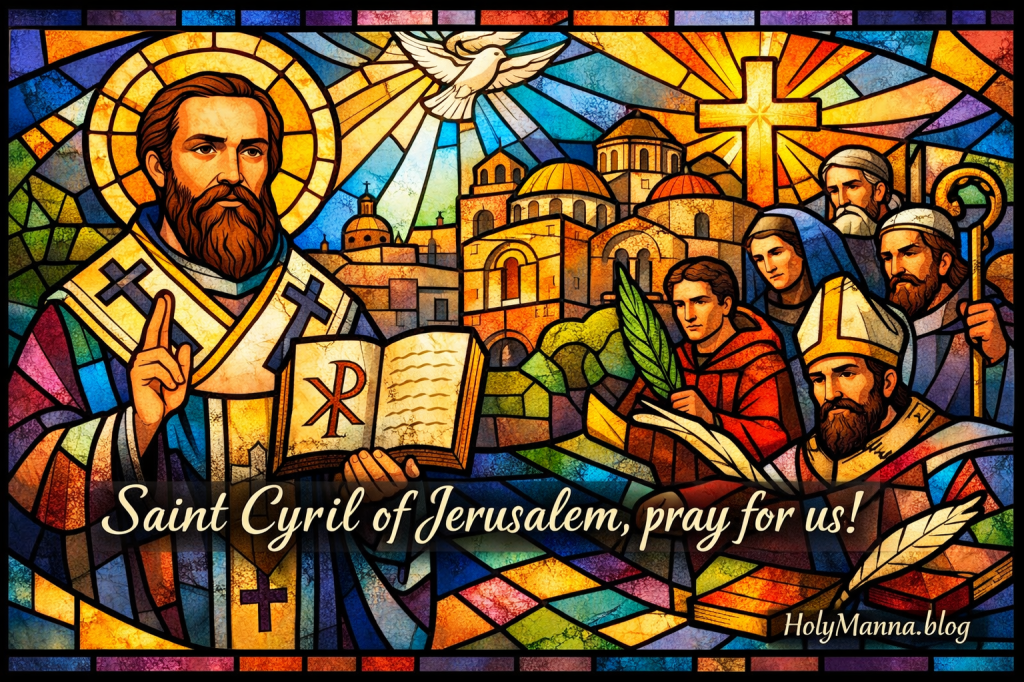
Saint Cyril of Jerusalem, pray for us!
Follow us on YouTube, Instagram and Facebook for more insights and reflections on living a faith-filled life.

 Holy Manna!
Leave a comment