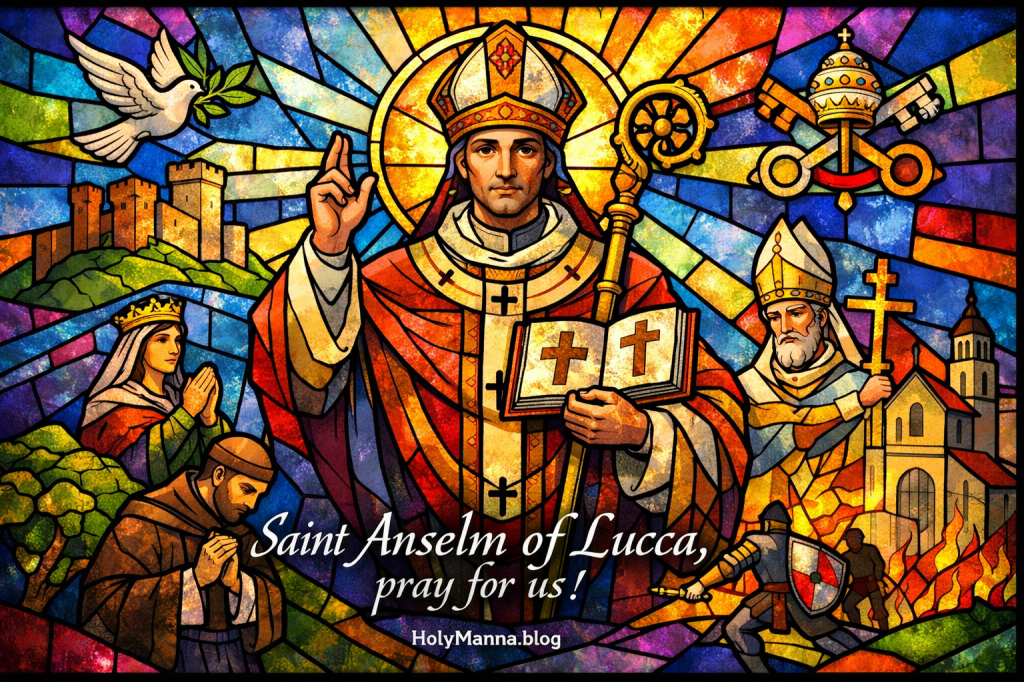
The Bishop Who Chose Christ Over Comfort
Saint Anselm of Lucca stands out as one of those saints who may not be as famous as some of the better-known medieval giants, but once his story is heard, he is hard to forget. He was a bishop, a Benedictine monk, a reformer, a defender of the papacy, and a man who suffered exile rather than compromise the freedom of the Church. In a time when kings and emperors tried to control the life of the Church, Saint Anselm of Lucca held fast to the conviction that the things of God could not be treated like political prizes.
He is revered in Catholic tradition because he lived with unusual courage during one of the most difficult struggles in medieval Christendom. He defended the rights of the Church, worked to reform the clergy, guided souls with the discipline of a monk, and remained faithful to the Roman See even when that fidelity cost him comfort, security, and his own place in the city he served. His life reminds the faithful that holiness is not always loud, but it is always costly. He shows what it looks like to love Christ and His Church more than position, reputation, or peace with the world.
The Call to Deeper Fidelity
Saint Anselm of Lucca, often called Anselm the Younger so he is not confused with Saint Anselm of Canterbury, was born in the eleventh century, around 1036. Catholic sources preserve some uncertainty about his exact birthplace. Some traditions place his origins in Mantua, while others connect him to Baggio near Milan. What is clear is that he came from a family of influence and strong ecclesial ties. He was the nephew of Anselm of Lucca the Elder, the man who later became Pope Alexander II.
That family connection opened the path to ecclesiastical responsibility, but Anselm’s life shows that he was not simply carried along by family privilege. He was formed in an age of deep Church crisis, and the struggle over who had the right to appoint bishops shaped his conscience profoundly. When he was designated for the see of Lucca, he found himself caught in the conflict over lay investiture, which was the practice by which secular rulers claimed the power to bestow the ring and crosier of a bishop. For many men, this might have seemed like a normal political step. For Anselm, it became a matter of conscience.
At one point he recoiled from receiving spiritual office through imperial hands. Later, when he did accept investiture, his conscience troubled him so deeply that he resigned the bishopric and withdrew into the Benedictine monastery of Polirone near Mantua. That moment says a great deal about the man. He was not interested in winning arguments while keeping his soul half surrendered. He would rather lose office than live with a compromised conscience. In time, Pope Gregory VII ordered him back to episcopal service, and Anselm obeyed. That obedience is important. His story is not one of self-will. It is the story of a man who wanted the will of God more than his own preferences.
He is most known for his role in the Gregorian Reform, for his loyalty to Pope Gregory VII, for his defense of the Church against imperial control, for his reform of clerical life, and for his contribution to canon law. He was also known as a gifted student of Sacred Scripture and a man of real ascetical discipline. In him, scholarship, prayer, and courage were not separate things. They belonged together.
Defender of the Church
When Anselm returned to Lucca, he did not return as a man eager for prestige. He returned as a monk-bishop, carrying the spirit of the cloister into the chaos of diocesan life. He sought to reform the clergy and especially to bring greater discipline to the cathedral canons. He wanted the clergy to live in a way worthy of their sacred office. That mattered because the reform of the Church never begins with slogans. It begins with conversion, discipline, purity of life, and fidelity to Christ.
This is one of the great lessons of Saint Anselm’s life. He understood that if the clergy were lax, worldly, or morally compromised, the people would suffer. A bishop who truly loves his flock must love holiness first. His reforming zeal made him important not only in Lucca but in the wider struggle of the Church. He became a trusted ally of Pope Gregory VII and later served as papal legate in Lombardy. He was also closely associated with Countess Matilda of Tuscany, one of the most important Catholic lay figures of the age, and served as her spiritual adviser.
In addition to his pastoral and political role, Anselm left behind an intellectual legacy. Catholic tradition remembers him as a skilled biblical scholar and as a contributor to the development of canon law. He wrote works in defense of Pope Gregory VII and against the errors surrounding lay investiture. His canonical collections later influenced the tradition that fed into Gratian’s Decretum, which would shape the life of the Church for generations. That may sound technical at first, but it mattered deeply. Men like Anselm helped the Church defend her spiritual integrity in a world constantly trying to bend her to political power.
When it comes to miracles during his lifetime, Catholic sources do not preserve a large body of well-documented miracle stories in the way they do for some saints. That matters because it would be wrong to invent wonders where the tradition is restrained. His life itself was a sign of grace. His fidelity, repentance, courage, and steadfastness were the great wonders most clearly remembered. There is also a devotional tradition that his prayers helped obtain victory over the enemies of Pope Gregory VII. That tradition survives in Catholic devotional retellings, but it is not documented with the same certainty as the central facts of his life, so it should be received with caution and humility.
Even so, his importance is clear. He should be remembered because he teaches that holiness is not only found in dramatic visions or spectacular signs. Sometimes holiness looks like telling the truth when it is costly, repenting when conscience stings, and standing with the Church when powerful men demand surrender.
The Cost of Faithfulness
Saint Anselm did not live an easy holy life. He faced resistance not only from political enemies but also from within the local Church. His reforms angered many. His insistence on discipline and his fidelity to the papal reform movement made him a target. In 1081, he was driven out of Lucca with the help of imperial forces and supporters of the antipope Guibert.
That exile is one of the defining sorrows of his life. He was a bishop driven from his own see because he refused to cooperate with corruption and false authority. It is one thing to talk about loyalty to the Church in theory. It is another thing to lose home, influence, and stability because of it. Saint Anselm endured that loss with perseverance.
There is no martyrdom in the strict sense attached to his name. He was not executed for the faith. But he did live a form of white martyrdom, the kind that bleeds in hidden ways. He suffered humiliation, displacement, conflict, and isolation for the sake of Christ and His Church. That kind of suffering should not be overlooked. Many Catholics today will never face a sword, but they may face ridicule, rejection, or loss because they remain faithful. Saint Anselm speaks directly to that kind of disciple.
His endurance also reflects the teaching of The Catechism on conscience and obedience to God. The Church teaches that man must not be forced to act against his conscience, especially in religious matters, and that citizens are not bound to follow civil directives when those directives oppose the moral order and the rights of God and His Church, as taught in CCC 1782 and CCC 2242. Saint Anselm lived that truth before those paragraph numbers ever existed. He refused to let earthly power define sacred office.
The Legacy He Left Behind
Saint Anselm died in Mantua on March 18, 1086. His death did not end his influence. In fact, his posthumous legacy became one of the strongest parts of his story. He was canonized in 1087 by Pope Victor III, and his cult took deep root, especially in Mantua. Though he had served Lucca, Mantua became the great center of his veneration because it was there that he died, was buried, and came to be honored as a patron.
The most famous miracle associated with him after death is the tradition of his incorrupt body. Catholic sources from Mantua continue to speak of his body as incorrupt and preserved in the cathedral. His relics remain objects of devotion, and his urn is opened in connection with his liturgical celebrations. For the faithful, relics are never magical objects. They are signs that grace works through real bodies, real histories, and real saints. They remind the Church that sanctity is not an abstraction. It is embodied. It touches time, place, flesh, and memory.
Another traditional story connected to his legacy is that his prayers obtained help against the enemies of Pope Gregory VII. This has been repeated in Catholic devotional sources, but it does not have the same level of historical verification as the enduring veneration of his relics. It is worth mentioning because it belongs to the tradition surrounding his memory, but it cannot be verified with certainty.
His impact after death also spread through liturgy, local devotion, and ecclesial memory. He is honored especially on March 18 in the Roman Martyrology. In Mantua he is revered as a principal patron. His cult also extended beyond Mantua into Lucca, San Miniato, and the Benedictine world. His memory shaped not only church calendars but local Catholic identity. He became the kind of saint whose name is woven into the life of a people.
There is also a cultural impact to his story that still matters. He represents an entire chapter of Catholic history when bishops, monks, popes, and lay rulers were all wrestling over whether the Church belonged first to Christ or to political systems. Saint Anselm’s answer was clear. The Church belongs to Christ. His witness helped preserve that truth in practice, not just in theory.
No widely verified famous quotations securely attributed to Saint Anselm of Lucca survive in the mainstream Catholic sources in the way some saints are remembered by a single striking line. That silence is worth respecting. His life is his loudest statement.
What Saint Anselm of Lucca Teaches Us Today
Saint Anselm’s story lands hard in every age because the temptation he faced never really disappears. The world is always trying to tell the Church what she should be, what she should permit, and where she should stay quiet. Saint Anselm reminds the faithful that the Church cannot sell her soul for peace with worldly power.
His life also teaches the importance of repentance. One of the most moving parts of his story is not that he never faltered, but that when his conscience was pierced, he responded seriously. He stepped away, embraced monastic life, and allowed himself to be corrected and re-sent by the Church. That is a deeply Catholic pattern. It reflects the truth that holiness is not pretending to be perfect. Holiness is responding to grace with honesty and obedience.
His example can be lived today in practical ways. Catholics can imitate him by treating conscience seriously, by learning the faith well, by respecting the sacred nature of the Church, and by refusing to treat religion as a tool for politics, status, or convenience. Families can imitate him by building homes where truth matters more than appearances. Priests and religious can imitate him by living their vocation with discipline and purity. Lay faithful can imitate him by staying close to the sacraments, praying for bishops and priests, and loving the Church enough to desire her holiness.
His life also points back to the mystery of the Church herself. The Catechism teaches that the Church is both human and divine, visible and spiritual, and that Christ governs her through the successors of the apostles, as taught in CCC 771, CCC 874, and CCC 896. Saint Anselm suffered because he believed those truths were not just ideas. They were realities worth defending. He knew that if bishops became servants of princes before they were servants of Christ, the life of the Church would be wounded at its core.
What would it look like to love the Church enough to suffer for her purification rather than complain from a distance? Where has conscience grown too quiet under the pressure of comfort, politics, or fear? How might a more serious prayer life and deeper obedience help strengthen the soul for the battles that really matter?
Saint Anselm of Lucca speaks to the Catholic who wants a faith that is real, serious, and unafraid. He shows that reform begins with the soul, that courage is born from prayer, and that fidelity is worth more than worldly security.
Engage with Us!
Share your thoughts and reflections in the comments below. Saint Anselm of Lucca is not the kind of saint most people grow up hearing about, but his life has a powerful way of exposing the difference between comfortable religion and costly faithfulness.
- What part of Saint Anselm’s story speaks most strongly to your own life right now?
- Have there been moments when staying faithful to Christ or His Church came with a real personal cost?
- How can Catholics today defend the freedom and holiness of the Church without becoming bitter, political, or prideful?
- What does Saint Anselm’s repentance and return to obedience teach about handling mistakes in the spiritual life?
- How can prayer, study, and sacramental life strengthen the courage needed to remain faithful in a confused age?
May Saint Anselm of Lucca pray for every soul seeking courage, clarity, and fidelity. Keep moving forward in faith. Stay close to Christ and His Church. Live with conviction, and do everything with the love and mercy Jesus taught us.
Saint Anselm of Lucca, pray for us!
Follow us on YouTube, Instagram and Facebook for more insights and reflections on living a faith-filled life.

 Holy Manna!
Leave a comment