Wednesday of the Fourth Week of Lent – Lectionary: 246
The God Who Does Not Forget
There are days in the spiritual life when heaven can feel quiet, prayer can feel heavy, and the heart can start to wonder whether God has stepped back and left His people to fend for themselves. Today’s readings speak directly into that ache with a clear and steady answer: God does not forget His people, and in Jesus Christ that faithful love takes on a face, a voice, and the power to give life.
That is the central theme holding these readings together. In the first reading from Isaiah 49:8-15, the Lord speaks to a people marked by exile, loss, and humiliation. Israel knew what it was like to feel scattered, defeated, and forgotten. Yet into that wounded history God announces restoration, mercy, and covenant love. He promises to lead His people out of darkness, feed them on the journey, and gather them home. Even when Zion cries out “The Lord has forsaken me; my Lord has forgotten me,” the Lord answers with one of the most tender assurances in all of Scripture: “I will never forget you.” That promise sets the tone for everything else the Church places before us today.
The responsorial psalm, Psalm 145:8-9, 13-14, 17-18, takes that promise and turns it into prayer. The God who restores Israel is not distant or indifferent. He is gracious, merciful, just, trustworthy, and near to those who call upon Him in truth. This is not sentimental religion. It is the steady faith of Israel, and of the Church, that knows God’s mercy is not weakness but strength. He lifts up the fallen. He remains close to the bowed down. He reigns through every generation without abandoning the ones who wait for Him.
Then the Holy Gospel from John 5:17-30 reveals how God’s faithful love reaches its fullest expression. Jesus does not simply speak about the Father’s care. He shows that He is perfectly united to the Father in divine power and mission. He gives life. He judges with justice. He speaks with the authority of the Son who shares in the Father’s work. In other words, the mercy promised in Isaiah is not left as a distant hope. It arrives in the person of Christ. The God who says “I will never forget you” is the same God who, in Jesus, calls the dead to life and leads His people out of spiritual darkness.
That makes these readings especially fitting in the heart of Lent. The Church is preparing souls for Easter, but she does so by first reminding them who God is. He is not a God who loses interest. He is not a God who abandons His covenant. He is not a God who watches suffering from a distance. He is the Lord who remembers, restores, and raises up. Today’s readings invite the reader to step into that truth and to see that even in seasons of weakness, waiting, or discipline, the Father is still at work, and the Son is still speaking life.
First Reading – Isaiah 49:8-15
When the Forgotten Hear Their Name Again
The first reading opens like a sunrise over a people who have spent too long in the dark. These verses come from the part of Isaiah that speaks to Israel in the shadow of exile, when the people of God knew what it felt like to lose land, stability, worship, and confidence. The wider section belongs to the great Servant passages of Isaiah 40 to 55, a portion of the book that the Church has long read with both Israel and Christ in view. These chapters arise toward the end of the Babylonian Exile and include the Servant Songs that echo forward into the New Testament’s understanding of Christ’s saving mission.
That setting matters for today’s theme. The people are not being addressed from a place of comfort. They are being addressed from ruin, displacement, and deep spiritual fatigue. That is why the Lord’s words strike with such force. He speaks of restoration, release, nourishment, mercy, and remembrance. He answers not just political loss, but the interior wound that exile leaves behind. This reading fits today’s larger message perfectly because it reveals the heart of God before the Gospel reveals the face of that heart in Jesus Christ. The Lord does not forget His people. He comes for them, gathers them, and leads them home.
Isaiah 49:8-15 – New American Bible (Revised Edition)
The Liberation and Restoration of Zion
8 Thus says the Lord:
In a time of favor I answer you,
on the day of salvation I help you;
I form you and set you
as a covenant for the people,
To restore the land
and allot the devastated heritages,
9 To say to the prisoners: Come out!
To those in darkness: Show yourselves!
Along the roadways they shall find pasture,
on every barren height shall their pastures be.
10 They shall not hunger or thirst;
nor shall scorching wind or sun strike them;
For he who pities them leads them
and guides them beside springs of water.
11 I will turn all my mountains into roadway,
and make my highways level.
12 See, these shall come from afar:
some from the north and the west,
others from the land of Syene.13 Sing out, heavens, and rejoice, earth,
break forth into song, you mountains,
For the Lord comforts his people
and shows mercy to his afflicted.14 But Zion said, “The Lord has forsaken me;
my Lord has forgotten me.”
15 Can a mother forget her infant,
be without tenderness for the child of her womb?
Even should she forget,
I will never forget you.
Detailed Exegesis
Verse 8 – “Thus says the Lord: In a time of favor I answer you, on the day of salvation I help you; I form you and set you as a covenant for the people, To restore the land and allot the devastated heritages.”
This verse sounds like a royal decree of mercy. God announces that the moment of rescue is not accidental. It is a chosen “time of favor” and “day of salvation.” The Servant is not only sent with a message. He is “set… as a covenant for the people.” That is a remarkable phrase. The Lord binds restoration to a person and a mission. In the immediate context, the promise concerns Israel’s renewal after devastation, but in the Catholic reading it also points forward to Christ, in whom the covenant reaches its fullness. God is not improvising. He is acting according to His saving plan.
Verse 9 – “To say to the prisoners: Come out! To those in darkness: Show yourselves! Along the roadways they shall find pasture, on every barren height shall their pastures be.”
Here the Lord speaks like a liberator. The prisoners are summoned out, and those hidden in darkness are called into the open. The imagery is larger than politics. Israel certainly knew literal captivity, but the language also reaches into the spiritual condition of man apart from God. The road home becomes a place of pasture, which means the return will not be a march of bare survival. It will be shepherded. Even barren heights become places of provision because the Lord’s mercy can make nourishment appear where no one expected it. This is the kind of promise that prepares the soul to recognize Christ as the one who frees, leads, and feeds His flock.
Verse 10 – “They shall not hunger or thirst; nor shall scorching wind or sun strike them; For he who pities them leads them and guides them beside springs of water.”
This verse takes the old memory of the Exodus and fills it with fresh tenderness. The God who once brought Israel through the wilderness now promises a new journey marked by protection and compassion. The crucial phrase is “he who pities them leads them.” The Lord does not guide His people coldly or mechanically. He leads with pity, which in biblical language means deep mercy and active compassion. The image of springs of water suggests not only survival, but refreshment and life. God does not merely pull His people out of danger. He personally tends to them on the way.
Verse 11 – “I will turn all my mountains into roadway, and make my highways level.”
Mountains usually block movement, but here God turns obstacles into paths. That reversal is the point. What stood in the way becomes part of the way. In salvation history, the Lord repeatedly shows that He is not limited by the terrain of human weakness, national defeat, or impossible circumstances. He is the one who opens roads where there were none. For the exiles, this meant that the path home depended less on geography than on divine fidelity. For the Christian soul, it means that repentance is possible even when the road looks closed. Grace can flatten what pride, fear, or sin has made steep.
Verse 12 – “See, these shall come from afar: some from the north and the west, others from the land of Syene.”
The horizon widens here. The scattered are coming back from every direction. Syene refers to Aswan in southern Egypt, which shows just how far the promise reaches. The picture is one of a gathering so wide that no corner of exile lies beyond the Lord’s reach. In a Catholic reading, this also hints at the universality of God’s saving work. The Servant’s mission is not small or local. The same section of Isaiah insists that the servant’s vocation reaches beyond Israel to the nations. God’s mercy always gathers more than man expects.
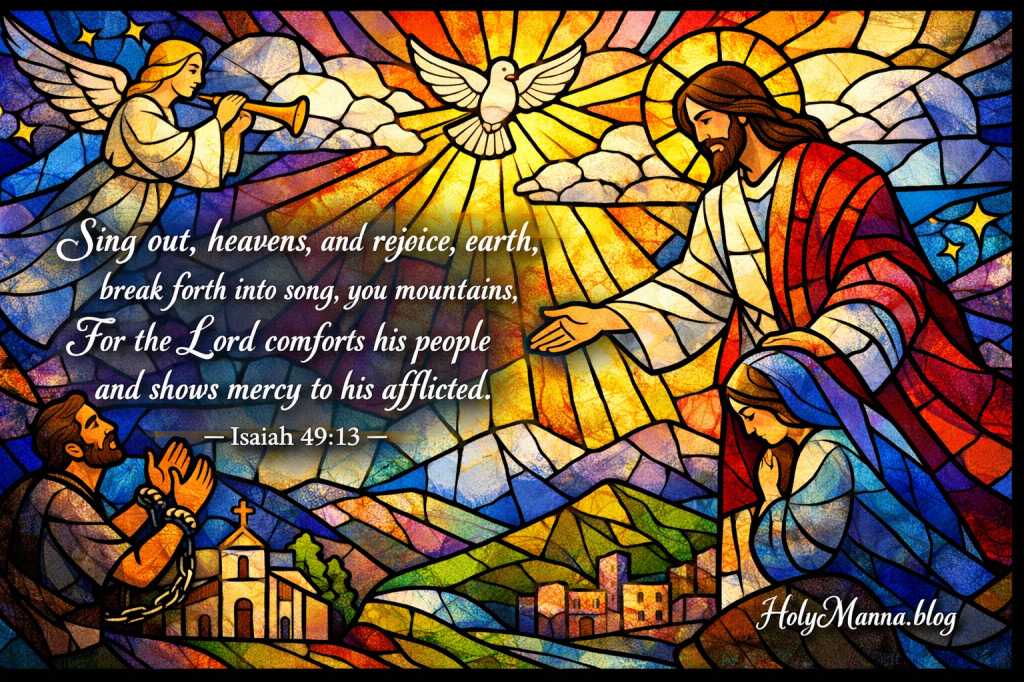
Verse 13 – “Sing out, heavens, and rejoice, earth, break forth into song, you mountains, For the Lord comforts his people and shows mercy to his afflicted.”
Creation itself is summoned to rejoice because redemption is never a private matter. When God consoles His people, heaven and earth are invited to respond. The afflicted are not ignored, and their suffering is not meaningless. The Lord is named here as one who “comforts” and “shows mercy.” Those two verbs reveal the tone of the whole passage. This is not merely a legal restoration. It is a compassionate restoration. God acts not only because He is powerful, but because He loves the people who have been crushed.
Verse 14 – “But Zion said, ‘The Lord has forsaken me; my Lord has forgotten me.’”
This is one of the most honest lines in Scripture. Zion gives voice to the fear that suffering often produces. Delay begins to feel like neglect. Silence begins to feel like absence. The people have heard the promise, yet their pain still speaks. That is why this verse matters so much. Scripture does not hide the wound. It lets the cry be heard. In the life of faith, there are moments when believers say with their lips that God is faithful while the heart quietly wonders whether He has stepped away. The Lord does not reject Zion for this cry. He answers it. That alone is a lesson in prayer.
Verse 15 – “Can a mother forget her infant, be without tenderness for the child of her womb? Even should she forget, I will never forget you.”
The passage reaches its summit here. God answers Zion’s fear with one of the most tender comparisons in all of Sacred Scripture. Human motherhood is presented as one of the strongest images of faithful love, yet even that is not the measure of God’s mercy. He exceeds it. Even in the unthinkable case of human failure, the Lord remains constant. This does not feminize God or blur revealed doctrine. Rather, as The Catechism teaches, God’s parental tenderness can be expressed through the image of motherhood even while He transcends all human categories. The point is not that God is like us, but that the purest love we know comes from Him and only dimly reflects Him.
Teachings
This reading teaches first that God’s covenant is the foundation of His people’s hope. The Lord does not rescue Israel because they earned rescue. He rescues them because He has bound Himself to them in love. The Catechism places this within the whole history of salvation: “After the patriarchs, God formed Israel as his people by freeing them from slavery in Egypt. He established with them the covenant of Mount Sinai and, through Moses, gave them his law so that they would recognize him and serve him as the one living and true God, the provident Father and just judge, and so that they would look for the promised Saviour.” CCC 62 shows that Israel’s history was always meant to prepare for the Savior, so when Isaiah 49 speaks of restoration and covenant, the Church hears not only a return from exile but a deeper preparation for Christ.
This reading also teaches that God’s tenderness is real, personal, and stronger than human inconsistency. The Catechism says: “By calling God ‘Father’, the language of faith indicates two main things: that God is the first origin of everything and transcendent authority; and that he is at the same time goodness and loving care for all his children. God’s parental tenderness can also be expressed by the image of motherhood, which emphasizes God’s immanence, the intimacy between Creator and creature. The language of faith thus draws on the human experience of parents, who are in a way the first representatives of God for man. But this experience also tells us that human parents are fallible and can disfigure the face of fatherhood and motherhood. We ought therefore to recall that God transcends the human distinction between the sexes. He is neither man nor woman: he is God. He also transcends human fatherhood and motherhood, although he is their origin and standard: no one is father as God is Father.” CCC 239 is almost a direct theological echo of Isaiah 49:15.
Saint John Paul II drew on this same biblical truth when reflecting on divine mercy. He wrote: “Let us appeal to that love which has maternal characteristics and which, like a mother, follows each of her children, each lost sheep, even if they should number millions.” That line from Dives in Misericordia helps explain why this passage lands so deeply in Lent. God’s mercy is not abstract. It follows. It searches. It remembers. It does not grow tired of coming after the wounded.
The reading also points beyond itself to Christ, because every true prophetic promise reaches its fullness in Him. The Catechism preserves the words of Saint John of the Cross: “In giving us his Son, his only Word for he possesses no other, he spoke everything to us at once in this sole Word and he has no more to say. . . because what he spoke before to the prophets in parts, he has now spoken all at once by giving us the All Who is His Son.” That matters here because the restoration promised in Isaiah is not merely about returning to a map. It is about being brought home to God, and that homecoming reaches its fulfillment in Jesus Christ.
Historically, this prophecy stood before a people bruised by exile and national humiliation. Religiously, it reminded Israel that their future did not depend on imperial power but on the fidelity of the Lord. That historical wound becomes spiritually universal in the Church’s reading. Exile is not only geographic. It is also the condition of the sinner far from God. The promise of release, pasture, water, comfort, and remembrance becomes a map of redemption itself.
Reflection
This reading lands close to the heart because almost everyone knows what it is like to feel delayed, overlooked, or spiritually tired. There are seasons when prayer feels dry, old sins feel stubborn, and the soul begins to whisper what Zion said out loud: “The Lord has forsaken me.” Today’s reading does not shame that fear, but it does correct it. God answers the fear of being forgotten with a promise stronger than emotion, stronger than memory, and stronger than circumstance. “I will never forget you.”
That truth can shape daily life in very practical ways. It means a person can stop interpreting every delay as abandonment. It means repentance can begin again, even after many failures. It means the Christian can bring dark places into the light instead of hiding in them. One good way to live this reading is to name honestly where the heart feels exiled right now, bring that place to prayer, and then act as though God’s promise is true. That may mean going to Confession, returning to daily prayer, forgiving someone who caused deep pain, or refusing the lie that shame gets the final word.
This reading also invites a different way of seeing hardship. The Lord says He will make mountains into roads. That means the very places that looked like barriers can become the places where grace teaches trust. The burden may not disappear overnight, but the soul can learn to walk it with God instead of without Him.
Where has the heart quietly started to believe that God has forgotten it?
What prison is the Lord telling you to leave behind today?
What would change this week if you truly believed that God’s mercy is more constant than your weakness?
Can you let the Lord love you with the tenderness you keep trying to earn?
Responsorial Psalm – Psalm 145:8-9, 13-14, 17-18
The King Who Bends Down in Mercy
The responsorial psalm today gives the heart a way to answer everything the first reading has proclaimed. After hearing the Lord promise that He has not forgotten His people, the Church places on our lips a song that names His character with calm and confidence. Psalm 145 is a hymn of praise to God the King, traditionally attributed to David, and it stands as one of the great songs of trust in the Psalter. In the life of Israel, the psalms were not private meditations only. They were prayed in worship, sung in assembly, and handed on as the living prayer of God’s people. This particular psalm praises the Lord’s kingship, His justice, His tenderness, and His nearness.
That makes it a perfect companion for today’s theme. Isaiah shows a wounded people wondering whether God has forgotten them. Psalm 145 answers that fear by proclaiming who God truly is. He is gracious. He is merciful. He is trustworthy. He lifts up the fallen. He stays near to those who call on Him in truth. The psalm does not deny suffering, but it refuses to interpret suffering as proof of abandonment. Instead, it teaches the soul to remember that the Lord’s reign is steady and His mercy is active. The God who rules all things is also the God who stoops low enough to hold up the weak.
Psalm 145:8-9, 13-14, 17-18 – New American Bible (Revised Edition)
8 The Lord is gracious and merciful,
slow to anger and abounding in mercy.
9 The Lord is good to all,
compassionate toward all your works.13 Your reign is a reign for all ages,
your dominion for all generations.
The Lord is trustworthy in all his words,
and loving in all his works.
14 The Lord supports all who are falling
and raises up all who are bowed down.17 The Lord is just in all his ways,
merciful in all his works.
18 The Lord is near to all who call upon him,
to all who call upon him in truth.
Detailed Exegesis
Verse 8 – “The Lord is gracious and merciful, slow to anger and abounding in mercy.”
This verse places mercy at the center of God’s identity. It echoes the great self-revelation of God in the Old Testament, especially when the Lord revealed Himself to Moses as merciful, patient, and rich in kindness. Israel’s faith was built not only on what God had done, but on who God had shown Himself to be. To say that the Lord is gracious means that His goodness is freely given and not earned. To say that He is merciful means that He bends toward misery in order to heal it. To say that He is slow to anger means that His justice is never rash, petty, or unstable. His patience is real. His mercy is abundant.
Verse 9 – “The Lord is good to all, compassionate toward all your works.”
This verse widens the horizon. God’s goodness is not limited to one moment, one people, or one category of person. His compassion extends toward all His works. That does not mean every person receives the same vocation or the same share in salvation history, but it does mean that all creation rests under the care of the Creator. In Catholic thought, this reflects divine providence. God does not make the world and then walk away from it. He sustains, governs, and cares for what He has made. His compassion is not abstract. It is woven into His continual care for creation.
Verse 13 – “Your reign is a reign for all ages, your dominion for all generations. The Lord is trustworthy in all his words, and loving in all his works.”
This verse joins kingship and tenderness in a way the world rarely does. Human rulers often gain power and lose compassion, or show compassion but lack the power to save. The Lord is different. His reign is eternal, and His dominion reaches every generation. Yet His rule is not cold domination. He is trustworthy in all His words and loving in all His works. That means His authority is never separated from His goodness. Everything He says is dependable, and everything He does is shaped by love. In the life of faith, this becomes a source of deep peace. The soul can surrender to God not because He is merely stronger, but because He is good.
Verse 14 – “The Lord supports all who are falling and raises up all who are bowed down.”
Here the psalm becomes especially personal. God’s kingship is shown not first in thunder, but in support. He upholds those who are falling and lifts those who are bowed down. That language reaches both physical weakness and spiritual weariness. The bowed down are the burdened, the humbled, the afflicted, and the exhausted. The Lord does not despise them. He draws near to sustain them. This is one of the most consoling images in the psalm because it shows that divine majesty and divine tenderness are not opposites. The King of heaven is not too high to carry those who can barely stand.
Verse 17 – “The Lord is just in all his ways, merciful in all his works.”
This verse keeps two truths together that the modern world often tries to separate. God is just, and God is merciful. His mercy does not cancel His justice, and His justice does not erase His mercy. Everything He does is right, and everything He does is marked by compassion. In Catholic teaching, this is essential. God is never indulgent toward sin, but neither is He cruel toward sinners. He judges truthfully because He is holy, and He shows mercy because He is love. His works are never confused, divided, or inconsistent. His justice and mercy meet perfectly in Him.
Verse 18 – “The Lord is near to all who call upon him, to all who call upon him in truth.”
The psalm ends this section with intimacy. After praising God’s eternal reign and universal goodness, it speaks of nearness. The Lord is not only exalted above all things. He is close to those who call upon Him. Yet the verse adds an important phrase: “in truth.” This is not a vague promise of spiritual comfort for anyone saying religious words. It is a promise for those who truly turn to God with sincerity, humility, and faith. Truth in prayer means honesty before God. It means calling on Him as He is, not as a projection of personal preference. The Lord draws near to the heart that seeks Him without pretense.
Teachings
This psalm teaches the Church how to speak about God rightly. It forms the heart to see divine power through the lens of divine mercy. The Catechism says, “God reveals his fatherly omnipotence by the way he takes care of our needs; by the filial adoption that he gives us, finally by his infinite mercy, for he displays his power at its height by freely forgiving sins.” CCC 270 fits this psalm beautifully because Psalm 145 presents God’s greatness not as distance, but as merciful strength. His power reaches its beauty not in crushing the weak, but in sustaining them.
The psalm also teaches divine providence. The Catechism says, “Creation has its own goodness and proper perfection, but it did not spring forth complete from the hands of the Creator. The universe was created ‘in a state of journeying’ toward an ultimate perfection yet to be attained, to which God has destined it. We call divine providence the dispositions by which God guides his creation toward this perfection.” CCC 302 helps illuminate the line “The Lord is good to all, compassionate toward all your works.” God’s care is not passive. He actively guides creation toward its fulfillment.
The psalm also reflects the biblical revelation that mercy is not secondary in God, but central to how He has made Himself known. The Catechism teaches, “The Gospel is the revelation in Jesus Christ of God’s mercy to sinners.” CCC 1846 brings the psalm into the light of Christ. What Israel praised in hope, the Church sees unveiled in Jesus. The mercy sung in the psalm becomes visible in the Gospel when Christ heals, forgives, teaches, and lays down His life for sinners.
Saint Augustine saw in the psalms a school of the heart, where God teaches His people how to desire Him rightly. He wrote, “If the psalm prays, you pray. If it laments, you lament. If it rejoices, you rejoice. If it hopes, you hope. If it fears, you fear. Everything written here is a mirror.” That insight matters here because Psalm 145 trains the soul to mirror the truth about God even when emotions resist it. It teaches praise as an act of faith, not merely as a feeling.
Saint Thomas Aquinas also spoke clearly about mercy as belonging most properly to God. He wrote, “To sorrow, therefore, over the misery of another, belongs not to God; but it does most properly belong to Him to dispel that misery, whatever be the defect we call by that name.” That line is deeply helpful for reading this psalm. God’s mercy is not emotional instability or helpless sympathy. His mercy is His powerful goodness at work to relieve misery and bring healing.
In the worship of the Church, the psalms have always held a privileged place because they are inspired prayer. They teach believers how to praise, repent, grieve, and trust. This particular psalm is especially fitting in Lent because it steadies the soul in the middle of spiritual struggle. It reminds the reader that God’s rule is not threatened by human weakness, and His compassion is not exhausted by repeated need.
Reflection
There is something deeply calming about this psalm because it slows the soul down and makes it look again at who God is. In daily life, it is easy to let frustration, anxiety, temptation, or discouragement define the way God is imagined. The heart starts to picture Him as impatient, distant, or disappointed. Psalm 145 pushes back against those distortions. It reminds the Christian that the Lord is gracious, merciful, trustworthy, just, and near.
That truth has a very practical edge. When someone falls again into an old weakness, this psalm says God supports those who are falling. When someone feels crushed by grief, exhaustion, or shame, this psalm says God raises up those who are bowed down. When someone worries that the world is unstable and history is spinning out of control, this psalm says His reign is for all ages. When prayer feels dry and weak, this psalm says the Lord is near to those who call upon Him in truth.
One good way to live this psalm is to pray it slowly and personally. Take one line at a time and let it challenge whatever false image of God has taken root. If the heart is tempted to think God is harsh, pray “The Lord is gracious and merciful.” If the heart is tempted to despair after failure, pray “The Lord supports all who are falling.” If the heart feels alone, pray “The Lord is near.” This is how the psalms begin to shape the inner life.
This reading also invites believers to imitate the God they praise. If the Lord is compassionate toward all His works, then His people cannot become hard, cynical, or indifferent. If He raises up the bowed down, then His people should become a source of encouragement and mercy in their homes, parishes, and friendships. Praise that stays only in words has not gone deep enough.
Do you truly believe that God’s mercy is part of His strength, not a soft exception to it?
Where in daily life do you most need to remember that the Lord supports those who are falling?
Are you calling upon the Lord in truth, or only speaking to Him from the surface?
How can you reflect God’s compassion to someone who feels bowed down this week?
Holy Gospel – John 5:17-30
The Voice of the Son Who Gives Life
Today’s Holy Gospel takes place after Jesus heals the man at the pool on the sabbath, and that detail matters. In the religious life of Israel, the sabbath was not a small custom. It was a sign of covenant identity, a sacred day rooted in creation, commanded in the Law, and treasured as a mark of fidelity to the Lord. So when Jesus heals on the sabbath and then speaks of God as His own Father, the tension rises immediately. This is no longer just a dispute about religious practice. It becomes a revelation about who Jesus is.
That is why Saint John tells us that the Jews sought all the more to kill Him. Jesus is not merely defending a miracle. He is unveiling His divine sonship. He reveals that the Father and the Son work in perfect unity, that the Son gives life, that the Son judges, and that the Son deserves the same honor as the Father. This Gospel fits today’s theme with striking force. Isaiah shows the Lord promising not to forget His people. Psalm 145 sings of the God who is gracious, merciful, and near. Now in the Gospel, that mercy and nearness stand before the world in the person of Jesus Christ. The God who does not forget His people has come among them in His Son, and His voice has the power to call the dead to life.
John 5:17-30 – New American Bible (Revised Edition)
17 But Jesus answered them, “My Father is at work until now, so I am at work.” 18 For this reason the Jews tried all the more to kill him, because he not only broke the sabbath but he also called God his own father, making himself equal to God.
The Work of the Son. 19 Jesus answered and said to them, “Amen, amen, I say to you, a son cannot do anything on his own, but only what he sees his father doing; for what he does, his son will do also. 20 For the Father loves his Son and shows him everything that he himself does, and he will show him greater works than these, so that you may be amazed. 21 For just as the Father raises the dead and gives life, so also does the Son give life to whomever he wishes. 22 Nor does the Father judge anyone, but he has given all judgment to his Son, 23 so that all may honor the Son just as they honor the Father. Whoever does not honor the Son does not honor the Father who sent him. 24 Amen, amen, I say to you, whoever hears my word and believes in the one who sent me has eternal life and will not come to condemnation, but has passed from death to life. 25 Amen, amen, I say to you, the hour is coming and is now here when the dead will hear the voice of the Son of God, and those who hear will live. 26 For just as the Father has life in himself, so also he gave to his Son the possession of life in himself. 27 And he gave him power to exercise judgment, because he is the Son of Man. 28 Do not be amazed at this, because the hour is coming in which all who are in the tombs will hear his voice 29 and will come out, those who have done good deeds to the resurrection of life, but those who have done wicked deeds to the resurrection of condemnation.
30 “I cannot do anything on my own; I judge as I hear, and my judgment is just, because I do not seek my own will but the will of the one who sent me.
Detailed Exegesis
Verse 17 – “But Jesus answered them, ‘My Father is at work until now, so I am at work.’”
Jesus begins with a statement that reaches far beyond the immediate controversy. The Father did indeed rest from the work of creation on the seventh day, yet God never ceased sustaining the world in being. Divine providence does not pause. God remains at work in governing, preserving, and guiding creation. Jesus takes that truth and applies it to Himself. He does not say merely that God works and He imitates. He says that as the Father is at work, so He is at work. This is the beginning of a revelation of equality, not merely cooperation.
Verse 18 – “For this reason the Jews tried all the more to kill him, because he not only broke the sabbath but he also called God his own father, making himself equal to God.”
Saint John explains the reaction clearly. The issue is not that Jesus used the word Father in a general sense. Israel could speak of God as Father, but Jesus speaks of God as “his own father” in a unique way. The people listening understood exactly what this implied. Jesus was claiming a relationship to the Father unlike that of any prophet or righteous man. Saint John leaves no ambiguity. By speaking this way, Jesus was making Himself equal to God. The Church receives this verse as part of the foundation for confessing Christ’s true divinity.
Verse 19 – “Jesus answered and said to them, ‘Amen, amen, I say to you, a son cannot do anything on his own, but only what he sees his father doing; for what he does, his son will do also.’”
At first glance, this could sound like weakness, but it is actually a statement of perfect union. Jesus is not saying that He lacks power. He is saying that nothing in Him is separate from the Father. There is no rivalry, no independent agenda, no division of will. What the Father does, the Son does. The phrase reveals intimacy, unity, and sameness of action. The Son acts not as a lesser copy, but in perfect communion with the Father.
Verse 20 – “For the Father loves his Son and shows him everything that he himself does, and he will show him greater works than these, so that you may be amazed.”
The relationship between the Father and the Son is revealed here as one of eternal love. The Father does not hide His works from the Son. He shows Him “everything” that He Himself does. The greater works to come point beyond the healing that caused the controversy. They anticipate resurrection, judgment, and the full revelation of Christ’s glory. Jesus is preparing His listeners for a truth even more astonishing than the miracle they have already seen.
Verse 21 – “For just as the Father raises the dead and gives life, so also does the Son give life to whomever he wishes.”
Here the Gospel climbs higher. In the Scriptures, the power to give life and raise the dead belongs to God. Jesus now says that the Son shares in this divine prerogative. He does not present Himself as a mere instrument through whom God may occasionally act. He says the Son gives life “to whomever he wishes.” That is a staggering statement of divine authority. Life is in His hands, and He bestows it according to His will, which is one with the Father’s.
Verse 22 – “Nor does the Father judge anyone, but he has given all judgment to his Son.”
Judgment too belongs to God, yet here it is entrusted to the Son. This does not mean the Father is absent from judgment, but that the Father wills to judge the world through the Son. This verse begins to show why the Incarnation matters so deeply. The one who will judge humanity is not a distant force, but the Son who has entered human history. The Judge is the One who has walked among men, spoken truth, and offered mercy.
Verse 23 – “So that all may honor the Son just as they honor the Father. Whoever does not honor the Son does not honor the Father who sent him.”
This verse leaves no room for reducing Jesus to merely a teacher, reformer, or holy messenger. The Son is to be honored “just as” the Father is honored. That is an astonishing phrase, and it would be blasphemous if Christ were not truly divine. Yet because He is the eternal Son, such honor is right and necessary. Jesus also makes clear that no one can claim reverence for God while rejecting the Son. The Father cannot be honored apart from the One He has sent.
Verse 24 – “Amen, amen, I say to you, whoever hears my word and believes in the one who sent me has eternal life and will not come to condemnation, but has passed from death to life.”
This verse brings consolation into the heart of the discourse. Eternal life is not only a distant promise. It begins now for the one who hears Christ’s word and believes in the Father who sent Him. The believer has already passed from death to life. That does not abolish the future resurrection, but it does mean that union with Christ already draws the soul into divine life. Faith is not mere agreement with ideas. It is an entrance into life.
Verse 25 – “Amen, amen, I say to you, the hour is coming and is now here when the dead will hear the voice of the Son of God, and those who hear will live.”
Jesus speaks here of an hour that is both present and future. Even now, the spiritually dead can hear His voice and live. Sin deadens the soul, but Christ’s word can awaken it. At the same time, these words also point toward the resurrection to come. The voice of Jesus is not ordinary speech. It is the divine word that summons life out of death. This is the same authority seen when He later calls Lazarus from the tomb.
Verse 26 – “For just as the Father has life in himself, so also he gave to his Son the possession of life in himself.”
This verse reaches into the mystery of the Trinity. The Father has life in Himself, which means He is the uncreated source of life. The Son too has life in Himself, not as a creature receiving borrowed existence, but as the eternally begotten Son who shares the divine nature. The language of being given this life points to the eternal relation of the Son to the Father, not to a beginning in time. The Church reads this as part of the biblical witness to the Son’s consubstantiality with the Father.
Verse 27 – “And he gave him power to exercise judgment, because he is the Son of Man.”
Jesus joins divine authority with the title “Son of Man.” This title recalls the figure in Daniel 7 who receives dominion, glory, and kingship from the Ancient of Days. It also emphasizes that the judge of humanity is truly human as well as truly divine. Christ judges not as a stranger to human life, but as the incarnate Son who has entered history. The one seated in judgment knows the condition of man from within human experience, yet judges with divine justice.
Verse 28 – “Do not be amazed at this, because the hour is coming in which all who are in the tombs will hear his voice.”
Jesus now moves clearly to the future bodily resurrection. Earlier He spoke of the dead hearing His voice even now. Here He speaks of those literally in the tombs. This is not a metaphor only. Christianity proclaims not just the immortality of the soul, but the resurrection of the body. Christ’s authority extends even into the grave. Death itself is not beyond the reach of His command.
Verse 29 – “And will come out, those who have done good deeds to the resurrection of life, but those who have done wicked deeds to the resurrection of condemnation.”
This verse is sober and necessary. Jesus does not flatten human life into moral irrelevance. What one does matters. The Gospel is grace from beginning to end, but grace calls forth a real response. The resurrection will reveal the truth of each life. Those who have done good will rise to life, and those who have done wicked deeds will rise to condemnation. The Church has always read this as a serious witness to judgment according to works, while also affirming that all truly good works are themselves fruits of grace.
Verse 30 – “I cannot do anything on my own; I judge as I hear, and my judgment is just, because I do not seek my own will but the will of the one who sent me.”
Jesus closes this section by returning to His unity with the Father. His judgment is just because it is not self-seeking, arbitrary, or separate from the Father’s will. Everything Christ does reveals divine harmony. In a fallen world, judgment is often distorted by pride, ignorance, or selfishness. In Christ, judgment is perfectly righteous because the Son lives in complete communion with the Father. His will is not in competition with the Father’s will, but one with it.
Teachings
This Gospel is one of the clearest passages in Scripture for understanding the divinity of Christ and His unity with the Father. The Catechism teaches: “Jesus revealed that God is Father in an unheard of sense: he is Father not only in being Creator; he is eternally Father in relation to his only Son, who is eternally Son only in relation to his Father: ‘No one knows the Son except the Father, and no one knows the Father except the Son and any one to whom the Son chooses to reveal him.’” CCC 240 helps illuminate why the reaction in verse 18 is so intense. Jesus is not claiming a poetic closeness to God. He is revealing His eternal divine sonship.
The Church also teaches the full divinity of the Son in language that echoes this Gospel. The Catechism says: “The Church uses the term ‘consubstantial’ to confess that the Son is ‘of the same substance’ as the Father, that is, one God with him.” CCC 242 stands directly behind the Church’s reading of verses 19 through 23. When Jesus says that whatever the Father does, the Son does also, the Church hears not a lesser being imitating God, but the consubstantial Son acting in perfect unity with the Father.
This Gospel also teaches that eternal life begins even now through faith in Christ. The Catechism says: “By his death and Resurrection, Jesus Christ has ‘opened’ heaven to us. The life of the blessed consists in the full and perfect possession of the fruits of the redemption accomplished by Christ.” CCC 1026 reminds the reader that eternal life is ultimately the fullness of communion with God, but John 5:24 shows that this communion begins already in the believer who hears and believes.
At the same time, the Gospel insists on judgment, resurrection, and moral accountability. The Catechism teaches: “Each man receives his eternal retribution in his immortal soul at the very moment of his death, in a particular judgment that refers his life to Christ.” It also says: “The Last Judgment will reveal even to its furthest consequences the good each person has done or failed to do during his earthly life.” CCC 1022 and CCC 1039 help explain verses 29 and 30. The Christian life is not casual. Human choices matter because they are made before Christ, who is both Savior and Judge.
Saint Augustine read this Gospel as a revelation of the inseparable works of the Father and the Son. He insisted that when Jesus says the Son can do nothing on His own, this does not mean inability, but unity: the Son does nothing apart from the Father because the Father and the Son are never divided. Saint John Chrysostom makes a similar point and says that Christ’s words are meant to destroy the false idea that the Son acts as an inferior servant. Instead, the Son reveals the same power, the same authority, and the same will as the Father.
The Church Fathers also saw in this passage a deep consolation. The one who judges the world is the same Christ who has come to save it. This does not remove the seriousness of judgment, but it does show its character. The Judge is not indifferent. He is the Son who heals, speaks, calls, and loves. In salvation history, this passage became especially important during the early Church’s struggles against Arianism, because it gave clear biblical testimony that Jesus is not the highest creature but true God from true God. The confession of Nicaea stands in continuity with the truth revealed here.
Reflection
This Gospel speaks into a world that often wants Jesus to remain manageable. Many prefer a Jesus who inspires but does not judge, a Jesus who comforts but does not command, a Jesus who teaches morality but does not claim divine authority. John 5 does not allow that smaller version of Christ. Here Jesus says things that force a decision. He gives life. He receives the same honor as the Father. He judges the world. He calls the dead from their graves. He is not simply a wise religious figure. He is the eternal Son of God.
That truth changes daily life more than it first appears. If Jesus is truly the Son who gives life, then prayer is not a motivational exercise. It is an encounter with the living Lord. If He is the one who judges justly, then conscience matters, repentance matters, and holiness matters. If His voice can call the dead to life, then no one is too far gone, no sin is beyond His power to forgive, and no heart is too cold for grace to awaken.
There is also a very practical invitation here for Lent. Hear His word. That is where Jesus begins in verse 24. The one who hears and believes has passed from death to life. This means giving Christ more than quick attention. It means listening to Him in Scripture, receiving Him in the sacraments, examining life honestly in the light of His truth, and letting His will correct everything that has drifted off course. It also means living with sober hope. Judgment is real, but so is mercy. The one who will judge the living and the dead is the same Lord who stretched out His hands for the salvation of the world.
This Gospel also invites a deeper trust in the Father’s love. The Son does not stand against the Father. He reveals the Father perfectly. Whoever sees Christ’s mercy sees the Father’s mercy. Whoever hears Christ’s call hears the Father’s will. The God who said in Isaiah that He would never forget His people now proves that promise in the Son who comes to raise them up.
Do you treat Jesus as truly divine, or only as a teacher whose words can be admired from a safe distance?
What area of life still resists the judgment of Christ because it fears the truth?
Where do you need the voice of the Son to call you from death to life right now?
If Jesus will be honored just as the Father is honored, what needs to change in the way you pray, obey, and live?
When Mercy Calls You by Name
Today’s readings come together like one steady voice from the heart of God. In Isaiah 49:8-15, the Lord speaks to a people who feel abandoned and answers their fear with covenant love, saying in effect that His mercy is stronger than their exile and His remembrance is stronger than their pain. In Psalm 145:8-9, 13-14, 17-18, the Church teaches the soul how to respond by praising the God who is gracious, merciful, trustworthy, and near. Then in John 5:17-30, that same mercy stands before the world in Jesus Christ, the eternal Son who works in perfect union with the Father, gives life to the dead, and judges with perfect justice.
That is the great message of the day. God has not forgotten His people, and Jesus Christ is the living proof. The Lord who promised to lead prisoners out of darkness is the same Lord whose voice now calls souls from death to life. The God who supports those who are falling is the same God whose Son speaks with divine authority and offers eternal life to those who hear and believe. The readings do not offer a shallow comfort that ignores suffering, sin, or judgment. They offer something stronger and truer. They reveal a God whose mercy is real, whose justice is holy, and whose love remains faithful even when the human heart is tired, wounded, or afraid.
That is why this day should not end as a beautiful reflection only. It should become an invitation. Let the Lord find the place in the heart that still feels exiled. Let Him speak into the fear that whispers “The Lord has forsaken me.” Let Him answer that lie with His own living word. Return to prayer with honesty. Return to Confession with trust. Return to Scripture with attention. Return to Christ with the confidence that the one who judges the world is also the one who came to save it.
Lent is not just a season for giving things up. It is a season for coming home. The Father is still at work. The Son is still speaking. Mercy is still reaching for the bowed down, the distracted, the ashamed, and the weary. So take the next step with faith. Call upon the Lord in truth. Listen for the voice of Christ. Walk forward like someone who has not been forgotten, because in Him, that is exactly what is true.
Engage with Us!
Share your reflections in the comments below. What stood out most in today’s readings, and where did the Lord speak to your heart? These questions are meant to help deepen prayer, stir honest conversation, and draw each soul closer to the mercy of God.
- In the First Reading from Isaiah 49:8-15, where have you been tempted to believe that God has forgotten you, and how does the Lord’s promise, “I will never forget you” , speak into that place?
- In the Responsorial Psalm from Psalm 145:8-9, 13-14, 17-18, which truth about God do you most need to hold onto right now: that He is gracious, that He supports the falling, that He is just, or that He is near to those who call upon Him in truth?
- In the Holy Gospel from John 5:17-30, what part of Jesus’ identity strikes you most deeply: that He is equal to the Father, that He gives life, that He judges justly, or that His voice can call the dead to rise?
- Looking at all three readings together, where is the Lord inviting you this Lent to come out of darkness, trust His mercy more deeply, and walk more faithfully with Him?
Keep living the faith with courage, humility, and trust. Let every thought, word, and action be shaped by the love and mercy Jesus taught us, so that daily life itself becomes a witness to His truth, His compassion, and His saving power.

 Holy Manna!
Leave a comment