The Joy of Belonging to Christ
Saint Gertrude of Nivelles is one of those saints who can seem quiet at first glance, but the closer you get, the more luminous she becomes. She was a noblewoman, an abbess, a lover of Scripture, a patron of travelers, and a woman whose whole life pointed away from worldly ambition and toward Jesus Christ. The Church remembers her on March 17, and for centuries Catholics have honored her as the holy woman whose monastery at Nivelles became a center of prayer, hospitality, and Christian life. She is still revered today not only because she was holy in private, but because her holiness built something lasting for the Church.
What makes Gertrude especially beautiful is that her sanctity was not flashy. She did not become famous by conquering kingdoms, writing great theological treatises, or dying a martyr’s death in public spectacle. She became a saint by belonging completely to Christ, serving His people, loving His word, and persevering in hidden sacrifice. In her, the Church sees the beauty of consecrated life offered fully to the Lord, a gift the Church continues to honor as something deeply rooted in Christ’s own life and mission.
A Noble Daughter Who Refused the World
Gertrude was born around the year 626, probably at Landen, into one of the most important Frankish families of her time. She was the daughter of Pepin of Landen and Blessed Itta, and the younger sister of Saint Begga. From the outside, her life looked destined for influence, alliance, and privilege. In the world she was born into, noble daughters were often used to secure political advantage through marriage. Gertrude’s life could easily have followed that path.
But even as a child, she showed that her heart belonged somewhere else. Catholic tradition preserves the striking moment when, at about ten years old, during a banquet attended by King Dagobert and the nobles of the realm, she was urged toward marriage with the son of the Duke of Austrasia. Her answer has echoed through the centuries: “Christ alone would be her bridegroom.” That was not a romantic flourish. It was the program of her whole life. There was no dramatic conversion from unbelief in her story. Instead, there was something just as powerful: an early and steady surrender to God that only grew deeper with time.
After the death of her father in 639, her mother Itta, following the counsel of Saint Amand, transformed the family estate at Nivelles into a monastery. It was a double monastery, one community for men and one for women, and Gertrude was appointed its first abbess. Her mother lived there too, helping guide the young community. This was the turning point that fixed Gertrude’s vocation in a public and permanent way. She was no longer simply a noble girl who had refused marriage. She had become a spiritual mother in the Church.
The Abbey That Became a Lighthouse
Gertrude is most remembered for what she built at Nivelles. Under her care, the monastery became a place of prayer, learning, and welcome. Catholic sources emphasize that she loved Holy Scripture so deeply that she almost knew it by heart. That is not a small detail. It tells you what kind of saint she was. Gertrude was not holy by vague religious feeling. She was shaped by the Word of God, and from that interior life flowed works of charity and leadership. She used the wealth available to her not for comfort, but for churches, monasteries, and hospices.
Her abbey also became a place of Christian hospitality. Pilgrims passed through Nivelles. So did missionaries. Among them were the Irish monks Saint Follian and Saint Ultan. Gertrude and her mother gave them land at Fosses, helping extend the work of evangelization. That matters because it shows that Gertrude’s life was not turned inward. She was contemplative, but never self enclosed. She loved prayer, but her prayer made her generous. She loved Scripture, but her love of Scripture made her fruitful for the wider Church.
This is one reason she is still worth remembering. The Church does not preserve the saints as museum pieces. The saints show what the Gospel looks like when it takes flesh in a real human life. Gertrude shows that a soul can be deeply prayerful without being detached from the needs of others. She shows that learning the things of God should lead to service, not pride. She shows that renouncing worldly greatness can become the beginning of real fruitfulness.
Signs of Grace Along the Way
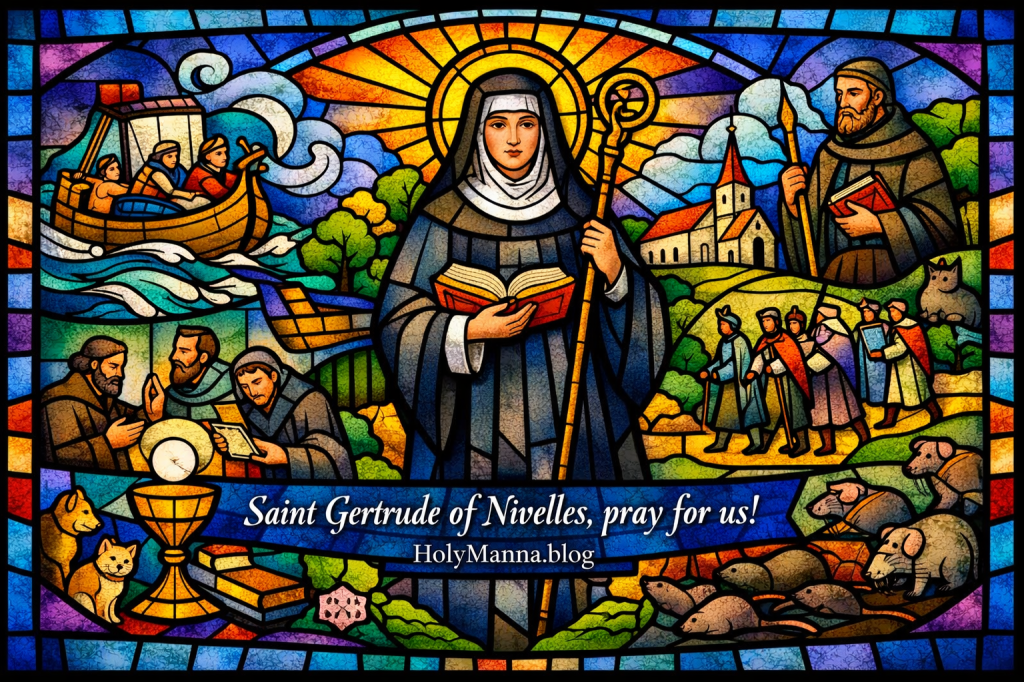
The miracle most often associated with Gertrude during her lifetime is tied to travelers. A long standing Catholic legend says that she once sent some of her people on a distant journey with the assurance that no misfortune would befall them. During the voyage, they were threatened by a violent storm and even by a sea monster, but the danger vanished when they invoked her. This story became one of the reasons she was so closely associated with travelers in Catholic devotion. It is part of her traditional legend and cannot be historically verified with the same certainty as the basic facts of her life.
Another remarkable tradition from her life concerns the approach of her death. After years of prayer, fasting, and self denial, Gertrude’s health gave way. She resigned her office in December 658 and named her niece Wulfetrude as her successor. The day before she died, she sent a monk to Saint Ultan to ask whether God had revealed the hour of her passing. He answered that she would die the next day during Holy Mass, and Catholic tradition says exactly that happened. Even here, Gertrude’s life ends the way it was lived: in relation to the Eucharist, in humility, and under the providence of God.
Her Cross Was Hidden
Gertrude was not a martyr in the strict sense. She did not shed her blood in persecution. But that does not mean she did not carry a real cross. Her hardship was the long, hidden suffering of self denial, responsibility, and bodily exhaustion. Catholic sources say that by the age of thirty two she had become so weak through continual abstinence from food and sleep that she could no longer govern the monastery. That is sobering. Her sanctity was costly. It was not soft, decorative religion. It was a life poured out.
There is something deeply Catholic in that witness. Not every saint dies dramatically, but every saint dies to self. Gertrude’s life looks a lot like what older Christians sometimes called a white martyrdom, not the shedding of blood, but the offering of one’s whole life in fidelity. She renounced status, comfort, marriage, and eventually even her own strength. She let herself be spent for Christ. That kind of sacrifice is easy to miss because it does not make headlines, but in the eyes of God it shines. Her death on March 17, 659, after a life of prayer and service, sealed the offering she had been making for years.
The Saint Who Never Really Left Nivelles
Gertrude’s influence did not end when she died. Catholic sources say she was venerated as a saint almost immediately after her death, and that Agnes, the third abbess of Nivelles, built a church in her honor. A monk who had known her wrote her Vita only a few years later, and the local Catholic tradition at Nivelles still treats that early witness as authentic. That is one of the strongest reasons her story carries so much weight. Her sanctity was recognized close to the source, by people who had known her world and remembered her life.
Her tomb became a place of pilgrimage, and over time the town gathered around the monastery so fully that Nivelles itself grew in the shadow of her memory. The local Catholic tradition says her cult spread rapidly through Europe, and that more than a thousand churches and chapels have been dedicated to her from Norway to Spain. Her relics were placed in a Gothic shrine in 1296, much of that shrine was destroyed in 1940, and the precious remains recovered from it were placed in a new shrine in 1982. Gertrude remains, in the words of the local Catholic tradition, the Lady of Nivelles.
Even now, devotion to her is not just a relic of the past. The Tour Sainte Gertrude is still held each year on the Sunday after the feast of Saint Michael. Her shrine is solemnly displayed, placed upon a triumphal cart, and carried in procession around Nivelles in a route of about fourteen kilometers. The event still draws roughly one thousand to two thousand pilgrims. That continuing devotion is a beautiful example of what The Catechism of the Catholic Church teaches about Catholic popular piety: relics, pilgrimages, and processions do not replace the liturgy, but they can extend and deepen the life of faith among the people of God.
There are also a few striking details tied to her memory. Catholic sources preserve her patronage of travelers and her invocation against fever, rats, and mice. In more recent popular culture she is sometimes called the patron saint of cats, but that connection appears to be much later and not part of the older, well attested Catholic tradition. A fascinating archaeological note connected to her tomb is that fragments of prayer beads were reportedly found there, making her burial part of the long early history of Christians using beads in prayer.
As for miracles after death, the surviving Roman Catholic reference works do not preserve a long catalog of individually documented healings at her shrine in the way later canonization causes sometimes do. What they do preserve is something just as telling: a strong and enduring cult, pilgrimages to her tomb, continued invocation of her intercession, and centuries of devotion around her relics and feast. That kind of lasting veneration is itself part of her impact after death, and it shows how deeply her witness took root in the life of the Church.
What Saint Gertrude Still Teaches the Church
Saint Gertrude speaks in a way that feels surprisingly fresh. The modern world tells people to keep every option open, guard independence at all costs, and build a life around personal advancement. Gertrude did almost the opposite. She belonged to Christ without reserve. She treated wealth as something to place at the service of God. She let prayer shape her mind. She welcomed pilgrims. She helped the Church grow. She reminds us that freedom is not found in keeping everything for ourselves. Freedom is found in giving ourselves rightly.
Her example also pushes back against shallow ideas of holiness. It is easy to admire saints who do dramatic things far away from ordinary life. Gertrude shows the holiness of steady fidelity. She prayed. She studied. She served. She sacrificed. She endured weakness. She trusted God. That is a pattern any Catholic can learn from. The Church teaches in The Catechism of the Catholic Church that the works of mercy are concrete acts by which we aid our neighbor in spiritual and bodily needs. Gertrude lived that before the term ever became familiar to most people. Her monastery welcomed, instructed, sheltered, and served.
For daily life, her witness can be lived in simple but demanding ways. Read Scripture more seriously. Welcome people instead of treating them like interruptions. Practice detachment from comfort. Use whatever resources God has entrusted to you for His glory and for the good of others. Stay close to the Eucharist. Choose Christ again when the world offers some easier substitute. Saint Gertrude’s life says, with calm force, that holiness is not built in one grand gesture. It is built in a thousand faithful yeses.
Engage with Us!
Share your thoughts and reflections in the comments below. Saint Gertrude of Nivelles has a quiet kind of strength, and her witness has a way of reaching the heart. Take a moment to think about what in her story stands out most and where the Lord may be inviting deeper fidelity.
- What does Saint Gertrude’s early refusal of a worldly future for the sake of Christ say to the choices being made right now?
- How can a deeper love for Scripture reshape the home, work, and prayer life?
- Where is there a need to grow in hospitality, especially toward the people who feel inconvenient or unexpected?
- Does hidden sacrifice feel discouraging, or can it be seen as a real offering to God like Gertrude’s?
- What would it look like this week to belong to Christ more plainly and more completely?
May Saint Gertrude pray for every heart that longs to belong wholly to Jesus. May her example help build lives marked by steadiness, mercy, courage, and reverence for the things of God. Live the faith with conviction, stay close to the Church, and do everything with the love and mercy Jesus taught us.
Saint Gertrude of Nivelles, pray for us!
Follow us on YouTube, Instagram and Facebook for more insights and reflections on living a faith-filled life.

 Holy Manna!
Leave a comment