Tuesday of the Fourth Week of Lent – Lectionary: 245
Where the Healing Waters Lead
Some days, the soul does not feel dramatic ruin so much as quiet exhaustion. It feels like a dried riverbed, a place that once held life but now seems cracked by waiting, disappointment, and old wounds. That is the world today’s readings step into. They speak to hearts that are tired, to lives that feel stuck, and to the deep human ache to be made whole again. The central theme tying these passages together is simple and beautiful: God sends forth healing life from his holy presence, and that life reaches its fullness in Jesus Christ, who restores what sin, suffering, and spiritual dryness have damaged.
That is why the imagery of water matters so much today. In Ezekiel, the prophet sees water flowing out from the temple, not as a flood of destruction, but as a river of life. It moves outward from the sanctuary and transforms everything it touches. In Psalm 46, that same divine presence becomes a stream that gladdens the city of God and makes it unshakable. Then, in The Gospel of John, the scene shifts to another body of water, the pool at Bethesda, where the sick have gathered in hope. Yet the real healing does not come from the pool itself. It comes from Christ, whose word does what no water, no ritual expectation, and no human effort could accomplish on its own. The readings move like a single story, from promise to fulfillment, from symbol to Person, from the temple’s river to the voice of the Son of God.
There is also an important backdrop that gives these readings even more depth. Ezekiel was speaking to a people marked by exile, loss, and the memory of a damaged temple. His vision offered hope that God had not abandoned his people and that life could flow again from the place where the Lord dwelt. By the time of John 5, Jerusalem was still the center of Jewish worship, and the sabbath remained a sacred sign of covenant identity. Against that setting, Jesus heals a man who had suffered for thirty eight years, and he does so on the sabbath, revealing that he is not disregarding God’s law but bringing it to its divine purpose. The Lord of the sabbath has come, and the true Temple is no longer only a building of stone. In Christ, God’s mercy stands before the wounded and says “Rise.”
This makes today’s readings especially fitting for Lent. The Church places before the faithful these images of water, healing, temple, and mercy because Lent is not only about giving things up. It is about returning to the source of life. It is about letting Christ lead the soul back to the place where grace begins to flow again. These passages prepare the heart to see that God does not merely point out what is broken. He enters into brokenness to heal it. He does not leave his people thirsting at the edge of holiness. He brings the river to them. And where that river flows, everything lives.
First Reading – Ezekiel 47:1-9, 12
God shows his people a river no drought can stop
The vision in today’s First Reading comes from one of the most haunting and hope filled parts of The Book of Ezekiel. The prophet Ezekiel was speaking to a people who knew what it meant to watch everything sacred seem shattered. Jerusalem had fallen. The temple, the visible sign of God’s dwelling among his people, had been desecrated and destroyed. Israel was in exile, carrying grief, shame, and the heavy question of whether life with God could ever truly be restored. Into that devastation, the Lord gives Ezekiel a vision of a new temple, and from that temple flows water that grows deeper, wider, and more powerful with every step.
That image is not simply poetic. It is theological, sacramental, and deeply prophetic. Water flows from the sanctuary because life flows from God. Healing begins where God dwells. What is dead becomes living. What is barren becomes fruitful. What is polluted becomes fresh. That is why this reading fits so beautifully into today’s theme. The readings as a whole reveal that God does not merely observe the dryness of the human condition. He enters it with healing power. In Ezekiel, that power appears as a river from the temple. In the Gospel, that same divine life is revealed fully in Jesus Christ, the true Temple, whose word heals what no earthly water could cure.
Ezekiel 47:1-9, 12 – New American Bible (Revised Edition)
The Wonderful Stream. 1 Then he brought me back to the entrance of the temple, and there! I saw water flowing out from under the threshold of the temple toward the east, for the front of the temple faced east. The water flowed out toward the right side of the temple to the south of the altar. 2 He brought me by way of the north gate and around the outside to the outer gate facing east; there I saw water trickling from the southern side. 3 When he continued eastward with a measuring cord in his hand, he measured off a thousand cubits and had me wade through the water; it was ankle-deep. 4 He measured off another thousand cubits and once more had me wade through the water; it was up to the knees. He measured another thousand cubits and had me wade through the water; it was up to my waist. 5 Once more he measured off a thousand cubits. Now it was a river I could not wade across. The water had risen so high, I would have to swim—a river that was impassable. 6 Then he asked me, “Do you see this, son of man?” He brought me to the bank of the river and had me sit down. 7 As I was returning, I saw along the bank of the river a great many trees on each side. 8 He said to me, “This water flows out into the eastern district, runs down into the Arabah and empties into the polluted waters of the sea to freshen them. 9 Wherever it flows, the river teems with every kind of living creature; fish will abound. Where these waters flow they refresh; everything lives where the river goes.
12 Along each bank of the river every kind of fruit tree will grow; their leaves will not wither, nor will their fruit fail. Every month they will bear fresh fruit because the waters of the river flow out from the sanctuary. Their fruit is used for food, and their leaves for healing.”
Detailed Exegesis
Verse 1. “Then he brought me back to the entrance of the temple, and there! I saw water flowing out from under the threshold of the temple toward the east, for the front of the temple faced east. The water flowed out toward the right side of the temple to the south of the altar.”
The vision begins at the temple because everything begins with God. The source of life is not the land, the strength of the people, or even their religious effort. It is the Lord’s own dwelling. The detail that the water flows from beneath the threshold matters. It is quiet at first, almost hidden, as grace often is. The eastward direction also carries meaning. In biblical symbolism, the east is linked with beginnings, light, and expectation. The right side of the temple, near the altar, brings sacrifice into view. Life flows from the place of worship and offering. Already this points toward Christ, from whose pierced side blood and water would flow, revealing the sacramental life of the Church.
Verse 2. “He brought me by way of the north gate and around the outside to the outer gate facing east; there I saw water trickling from the southern side.”
Ezekiel is not allowed to glance at the mystery from a distance. He is led around so he can see it carefully. God teaches patiently. The water is still only a trickle, but it is unmistakable. This is how restoration often begins in the spiritual life. Grace does not always arrive first as a flood. Sometimes it appears as a trickle of hope, a first confession after years away, a small return to prayer, a first honest repentance. The important thing is not the size of the beginning, but the certainty of the source.
Verse 3. “When he continued eastward with a measuring cord in his hand, he measured off a thousand cubits and had me wade through the water; it was ankle-deep.”
The man with the measuring cord reveals that this vision is ordered, deliberate, and under God’s authority. Nothing here is accidental. The ankle deep water suggests the first contact with divine life. It is real, but still shallow enough that a man feels in control. Spiritually, this can describe the early stages of conversion, when grace has touched the soul but has not yet carried it beyond self reliance. The river has begun to claim the ground, but not yet the whole man.
Verse 4. “He measured off another thousand cubits and once more had me wade through the water; it was up to the knees. He measured another thousand cubits and had me wade through the water; it was up to my waist.”
The water deepens in stages. This is important because the Lord often leads souls by degrees. Knees are the posture of prayer. Waist deep water reaches the center of a man’s strength and stability. The river is no longer decorative. It is demanding surrender. God’s life is not meant to remain at the edges of existence. It presses inward, deeper into prayer, trust, purification, and dependence. The Christian life is not about visiting grace from time to time. It is about being drawn ever further into it.
Verse 5. “Once more he measured off a thousand cubits. Now it was a river I could not wade across. The water had risen so high, I would have to swim, a river that was impassable.”
Now the vision reaches its turning point. The water becomes more than Ezekiel can manage. He cannot simply walk through it. He must be carried by it. This is one of the great images of the spiritual life. There comes a point when grace is no longer something manageable, explainable, or neatly contained. The life of God exceeds human control. That is not a threat. It is salvation. The Lord does not invite his people merely to stand in holy things. He invites them to abandon themselves to his living power.
Verse 6. “Then he asked me, ‘Do you see this, son of man?’ He brought me to the bank of the river and had me sit down.”
The question is striking. “Do you see this?” God is not only giving Ezekiel a spectacle. He is training him to perceive. The prophet must learn to see what the Lord is revealing. Then he is made to sit, as if to contemplate before speaking. Real spiritual vision requires reverence, patience, and attention. It is easy to look without seeing. The Lord slows Ezekiel down so that the meaning of the vision can sink into the heart.
Verse 7. “As I was returning, I saw along the bank of the river a great many trees on each side.”
What began as a trickle has become a river bordered by abundance. Trees line both banks, turning what should have been arid ground into a place of life. This is Eden language. It recalls paradise, fruitfulness, and the restoration of creation. Wherever God’s life flows, signs of life appear around it. In the soul, this means that grace never remains isolated. When God truly heals a person, fruit begins to show in prayer, speech, habits, relationships, and charity.
Verse 8. “He said to me, ‘This water flows out into the eastern district, runs down into the Arabah and empties into the polluted waters of the sea to freshen them.’”
The destination of the river makes the miracle even more powerful. It flows into the Arabah and into the sea, traditionally understood as the Dead Sea, a place of lifelessness because of its salt. The river does not avoid what is damaged. It goes straight toward it. This is how divine mercy works. God does not send grace only to the already beautiful or the already healthy. He sends it into the bitter, polluted, dead places. He goes where healing is most needed.
Verse 9. “Wherever it flows, the river teems with every kind of living creature; fish will abound. Where these waters flow they refresh; everything lives where the river goes.”
This is the heart of the vision. “Everything lives where the river goes.” That line can carry a whole Lenten meditation on its own. Life does not rise out of death by human force. It comes because God’s life arrives. The river refreshes, multiplies, and restores. In Catholic reading, this becomes a radiant image of grace, of Baptism, of the Holy Spirit, and of the life that comes through Christ and into the Church. The river is not symbolic in a weak or vague sense. It points toward the concrete way God saves, washes, nourishes, and restores his people.
Verse 12. “Along each bank of the river every kind of fruit tree will grow; their leaves will not wither, nor will their fruit fail. Every month they will bear fresh fruit because the waters of the river flow out from the sanctuary. Their fruit is used for food, and their leaves for healing.”
The final image is one of enduring abundance. This is not a seasonal blessing that quickly fades. The trees remain fertile because the source remains holy. Their fruit feeds. Their leaves heal. The life flowing from God is both nourishing and medicinal. It sustains and it restores. The Church has long heard in this passage an echo of the sacraments and of the life of the Church herself. What comes from God’s sanctuary does not merely decorate human life. It feeds the hungry soul and heals the wounded one.
Teachings
This reading has always invited the Church to look beyond the literal temple and see its fulfillment in Christ. The temple in Ezekiel is not merely an architectural vision. It is a sign that God intends to dwell with his people again and pour divine life into what had become barren. In the fullness of revelation, that promise reaches completion in Jesus. He is the true Temple because the fullness of God dwells in him bodily. He is the source from whom living water flows. That is why the imagery of Ezekiel 47 naturally leads the Christian heart toward Baptism, the Holy Spirit, and the sacramental life of the Church.
The Catechism teaches this with beautiful clarity in CCC 694: “Water. The symbolism of water signifies the Holy Spirit’s action in Baptism, since after the invocation of the Holy Spirit it becomes the efficacious sacramental sign of new birth.” That single line opens the whole reading. The river is not simply about irrigation or national restoration. It points toward the rebirth God gives through his Spirit. The water from the sanctuary in Ezekiel prepares the heart to understand sacramental grace, the kind of grace that does not remain abstract but truly changes the soul.
The vision also carries a profoundly ecclesial meaning. The river does not remain hidden inside the sanctuary. It flows outward. That is what the life of God always does. Grace is given so that it may overflow. In the Church, the holiness of Christ is not locked away as a private treasure. It is poured out for the life of the world. The Fathers loved to see in this river the life of the Church flowing from Christ into the nations, making dead things live again.
There is also a strong biblical harmony here with the final vision of The Book of Revelation, where the river of life flows from the throne of God and the Lamb, and the leaves of the trees are for the healing of the nations. The Church reads Scripture as one story, and this passage stands as one of the great Old Testament anticipations of that final restoration. What was shown to Ezekiel in exile becomes, in Christ, the beginning of the new creation already at work in the Church and destined for fulfillment in heaven.
Historically, this reading would have been a thunderclap of hope for a people who feared that exile had ended the story. Religiously, it proclaimed that the Lord had not abandoned his covenant. Culturally, it spoke into a world where water was precious, life determining, and inseparable from survival itself. A river in a dry land was not just pretty imagery. It meant life, harvest, stability, and joy. That makes the symbolism even more powerful. God is not offering sentimental comfort. He is promising real restoration.
The saints and spiritual writers have often understood this passage as a map of the interior life. Grace begins small, deepens over time, and eventually carries the soul beyond self mastery into surrender. That pattern should sound familiar to any Catholic who has seriously tried to follow the Lord. At first, prayer may feel shallow and effort driven. Then grace begins to reorder the heart. Then the soul discovers that holiness is not a project of self construction, but a life received from God and yielded to with trust.
This is why the reading also speaks to the sacraments with such force. The waters flowing from the sanctuary nourish like the Eucharist and heal like Confession. They bear fruit month after month, because divine grace is not exhausted. God does not run dry. The sanctuary of the New Covenant is Christ himself, and from him the Church receives the grace that feeds, heals, restores, and sends forth.
Reflection
There is something deeply personal in this vision. Every soul knows what dryness feels like. Some people carry obvious suffering. Others carry hidden barrenness. A marriage can feel tired. Prayer can feel thin. Old sins can keep returning. A person can keep functioning on the outside while inwardly feeling as lifeless as the sea in Ezekiel’s vision. That is why this reading matters so much. It reminds the heart that God’s grace is not powerless against dead places. In fact, dead places are precisely where he loves to send his river.
One of the great lessons here is that healing begins at the sanctuary. In everyday life, that means returning to the place where God gives himself. It means not treating prayer as an afterthought. It means going to Mass with attention, going to Confession with honesty, and refusing to live as though grace were optional. The river in Ezekiel is not manufactured by human effort. It is received. That is still true now. The Christian life begins not with self improvement, but with opening the soul to the life of God.
Another lesson is that grace deepens gradually. Many people become discouraged because they want instant transformation. But in this reading, the water deepens in measured stages. God is patient. He leads the soul step by step. That means daily fidelity matters. A few minutes of real prayer matter. One sincere confession matters. One act of repentance matters. One decision to forgive matters. One choice to return to the Lord matters. The trickle is already the beginning of the river.
This reading also calls for trust. Eventually, the water becomes too deep to control. That can feel frightening, especially for people who like to keep spiritual life tidy and manageable. But there is no real holiness without surrender. At some point, God asks the soul not merely to admire grace, but to yield to it. That may mean letting go of an old sin, a false identity, a resentment, a fear, or the illusion of self sufficiency. The river is not meant to stay at ankle depth.
There is also a missionary note hidden in the beauty of this passage. The healed soul becomes fruitful for others. The trees by the river feed and heal. A Catholic who truly lives near the waters of grace should become a source of strength, nourishment, and mercy for family, friends, parish life, and even strangers. The point is not spiritual self absorption. The point is that the life of God received inwardly should bear fruit outwardly.
Where in life does the heart feel dry, salty, or far from the stream of grace?
Has prayer become something shallow and hurried, when the Lord is inviting the soul to go deeper?
What would it look like this week to return to the sanctuary in a serious way, through prayer, Confession, reverence at Mass, and a more deliberate trust in God?
The beautiful promise of Ezekiel 47 is still true. God can send life where there has been death. He can make the barren fruitful. He can heal what has been poisoned by sin, disappointment, or long neglect. The river still flows from the sanctuary. The real question is whether the soul is willing to step in until it can no longer live on its own strength, but must be carried by grace.
Responsorial Psalm – Psalm 46:2-3, 5-6, 8-9
When the world shakes, the city of God still stands
After the sweeping vision of life giving water in Ezekiel, the Church places on the lips of the faithful a psalm of steady confidence. Psalm 46 is not the voice of someone living an easy life. It is the voice of God’s people standing in a world that feels unstable, threatened, and loud with danger. This psalm likely arose from the worship of Israel in connection with Jerusalem, the holy city where the temple stood as the visible sign of the Lord’s dwelling among his people. In the ancient world, cities trusted in walls, armies, political alliances, and natural defenses. Yet this psalm makes a striking claim. The real safety of Jerusalem is not stone, but God.
That is what makes this psalm such a powerful companion to today’s readings. In Ezekiel, water flows from the sanctuary and brings life wherever it goes. In Psalm 46, the river becomes the gladness of the city of God, the sign that the Lord himself is present and active in the midst of his people. Then the Gospel reveals that the deepest fulfillment of that presence is found in Christ, who speaks healing into a broken man’s life. The common thread is unmistakable. God is not distant from the places of chaos and weakness. He dwells with his people, strengthens them, and brings peace where fear once ruled.
Psalm 46:2-3, 5-6, 8-9 – New American Bible (Revised Edition)
2 God is our refuge and our strength,
an ever-present help in distress.
3 Thus we do not fear, though earth be shaken
and mountains quake to the depths of the sea,5 Streams of the river gladden the city of God,
the holy dwelling of the Most High.
6 God is in its midst; it shall not be shaken;
God will help it at break of day.8 The Lord of hosts is with us;
our stronghold is the God of Jacob.
Selah9 Come and see the works of the Lord,
who has done fearsome deeds on earth;
Detailed Exegesis
Verse 2. “God is our refuge and our strength, an ever-present help in distress.”
The psalm opens with a declaration of trust. God is called both refuge and strength. He is not merely a shelter to hide in after disaster has already struck. He is also the strength that sustains his people within the trial itself. The phrase “an ever-present help in distress” carries great spiritual weight. The psalmist does not say that God helps occasionally, or only after human solutions fail. He is present in the distress. This is one of the great biblical truths about divine providence. The Lord is not absent from the hour of trial. He remains near, active, and faithful.
For the Christian, this verse teaches that confidence in God is not denial of suffering. It is the refusal to let suffering define reality more deeply than God does. In Lent especially, the soul is reminded that temptations, sorrows, and trials do not prove abandonment. Often they become the very place where God’s nearness is discovered most clearly.
Verse 3. “Thus we do not fear, though earth be shaken and mountains quake to the depths of the sea.”
This is dramatic language, and it is meant to be. The psalm imagines creation itself collapsing. The earth shakes. Mountains, symbols of stability and permanence, are thrown into the sea. Everything that looked immovable appears to fall apart. Yet the faithful response is not panic, but trust. This verse does not say the people of God never face terrifying circumstances. It says they are not ultimately ruled by fear, even when everything visible appears unstable.
Spiritually, this verse reaches into very ordinary human experience. There are moments when life feels exactly like this. A family crisis hits. Health changes suddenly. Work falls apart. A long battle with sin exposes weakness. A friendship breaks. A season of grief arrives. The mountains move. The psalm teaches the heart to anchor itself somewhere deeper than circumstances. God remains God even when the ground seems to shift beneath human feet.
Verse 5. “Streams of the river gladden the city of God, the holy dwelling of the Most High.”
This verse beautifully echoes the first reading. The river is a sign of life, joy, and divine presence. One fascinating detail is that Jerusalem was not known for being built around a great river like other ancient cities. That makes the image even more theological. The true river of Jerusalem is not merely geographical. It is the life of God flowing from his holy presence. The city rejoices because God dwells there.
In the context of today’s liturgy, this river connects directly to the healing water of Ezekiel and prepares the heart for the Gospel, where healing comes not from water itself, but from Christ. The Church has long seen in this verse the joy of grace, the life of the Holy Spirit, and the blessed security of dwelling near God. The city of God is gladdened because the Lord is not a distant ruler. He lives in the midst of his people.
Verse 6. “God is in its midst; it shall not be shaken; God will help it at break of day.”
The reason the city stands is now made explicit. “God is in its midst.” That is the entire foundation of biblical hope. Not human cleverness. Not national power. Not religious pride. God himself. Because he dwells there, the city will not finally collapse. The phrase “at break of day” carries the sense of divine intervention arriving right on time. Night may be long, but dawn belongs to the Lord.
This verse speaks with special force to the spiritual life. There are seasons when darkness feels prolonged, when prayer seems dry, when discouragement lingers, and when the soul wonders whether light will really return. The psalm answers with quiet strength. God helps at daybreak. He does not forget his people in the night. The help may not come according to human impatience, but it comes according to divine wisdom.
Verse 8. “The Lord of hosts is with us; our stronghold is the God of Jacob.”
This refrain gathers the whole psalm into one cry of confidence. The title “Lord of hosts” presents God as the ruler of the heavenly armies, the sovereign over all powers visible and invisible. Yet the verse immediately balances that majesty with intimacy. The God of armies is “with us.” He is also “the God of Jacob,” the God who bound himself in covenant to a flawed and struggling people.
That is a profound comfort. The God worshiped by Israel is not merely the God of the strong, the polished, or the victorious. He is the God of Jacob, the God who remains faithful to imperfect people and carries forward his promises despite human weakness. This is one of the most reassuring truths in Catholic spirituality. God’s covenant love is not fragile. He is a stronghold precisely for those who know they need one.
Verse 9. “Come and see the works of the Lord, who has done fearsome deeds on earth.”
The psalm ends by calling the faithful to contemplation. “Come and see.” Trust is strengthened by remembering what God has done. The phrase “fearsome deeds” does not mean cruel deeds. It means deeds so mighty, holy, and overwhelming that they inspire awe. The Lord acts in history with a power that humbles human pride and reveals his sovereignty.
In the liturgical setting, this invitation matters. The people of God are not asked to manufacture confidence out of thin air. They are asked to look, remember, and behold. The Christian life depends on holy memory. It remembers creation, covenant, exodus, temple, cross, resurrection, sacrament, mercy, and the daily providence of God. Faith grows when the soul learns to see history through the works of the Lord.
Teachings
This psalm teaches one of the most central truths of biblical religion and Catholic life: peace comes from the presence of God. The city of God is secure because God dwells there. That reality reaches its fullness in the New Covenant. The Lord is not only present in a holy city or temple of stone. He comes to dwell in Christ, in the Church, and by grace within the faithful soul.
The Catechism speaks beautifully about the place of the Psalms in the prayer of the Church. CCC 2587 says, “The Psalter is the book in which the Word of God becomes man’s prayer. In the other books of the Old Testament, ‘the words proclaim [God’s] works’ and bring to light the mystery they contain. The words of the Psalmist, sung for God, express the saving works of God. The same Spirit inspires both God’s work and man’s response. Christ will unite the two. In him, the psalms continue to teach us how to pray.” That teaching opens this psalm in a powerful way. Psalm 46 is not just ancient poetry. It is the Church’s own prayer, now taken up in Christ.
This psalm also speaks strongly to divine providence. The Catechism teaches in CCC 301, “With creation, God does not abandon his creatures to themselves. He not only gives them being and existence, but also, and at every moment, upholds and sustains them in being, enables them to act and brings them to their final end.” That is the theology underneath the psalmist’s confidence. God is not a distant architect who built the world and then stepped away. He upholds it. He sustains his people. He remains present in history and in the personal struggles of every soul.
The Fathers of the Church loved to read the city of God both as the Church and as the soul in which God dwells by grace. St. Augustine, especially in his great reflection on the City of God, saw the true city not simply as an earthly society, but as the community gathered under God’s reign. That makes this psalm deeply relevant for Catholic life. The city of God is gladdened by the river because the Church lives by grace, not by worldly power. She stands because Christ is in her midst.
Historically, this psalm also carried enormous force for Israel because it arose in a world of war, invasion, and uncertainty. Nations rose and fell. Armies threatened. Political security was always fragile. In that setting, this prayer was a radical act of faith. It declared that God’s presence was more decisive than the shaking of nations. The Church still prays this way because the world still shakes. Empires still boast. Human plans still fail. Yet the Lord remains the stronghold of his people.
Today, when this psalm is prayed alongside Ezekiel 47 and John 5, its meaning becomes even richer. The river gladdening the city points toward the grace of God that heals, refreshes, and restores. The city that stands firm points toward the community gathered around Christ. The help that comes at break of day points toward the dawn of resurrection and every moment when the Lord breaks into darkness with mercy.
Reflection
There is something deeply calming about this psalm because it does not pretend the world is easy. It knows about earthquakes, chaos, and fear. It knows that life can feel unstable. But it also knows something greater. It knows that the presence of God changes the meaning of instability. The world may shake, but the soul that rests in God does not have to collapse with it.
That lesson matters in ordinary life more than most people realize. Many hearts live in a constant state of quiet trembling. They worry about finances, health, children, aging parents, the future of the Church, the state of the culture, and private battles no one else sees. This psalm does not scold that fear. It redirects it. It teaches the heart to say that God is still refuge, still strength, still present, still near.
One practical way to live this psalm is to begin each difficult day by naming God as refuge before naming the trouble. That changes the inner posture of the soul. Another way is to remember that the river of God still gladdens the city through prayer, Scripture, the sacraments, and the steady life of grace. If the heart feels dry, it should return to the source. If life feels shaken, it should remember who dwells in the midst of the city.
This psalm also calls the faithful to stop measuring safety only by visible circumstances. The city of God is secure because God is there. That means real peace is not the same thing as a trouble free life. Real peace is knowing who is in the boat, who is in the city, who is in the soul. The Christian does not deny storms. The Christian learns to recognize the Lord within them.
There is also a challenge hidden in this psalm. The soul must decide where it runs in distress. Some run to distraction. Some run to anger. Some run to self pity. Some run to control. The psalm invites a different movement. Run to God as refuge. Stand within his presence. Let his word be stronger than panic. Let his promises be more believable than fear.
When life feels unsteady, what has become the usual refuge of the heart?
Does the soul truly believe that God is present in distress, or does it only seek him after every other support has failed?
What would it look like this week to live as though the Lord really is in the midst of the city, and that his presence is stronger than the shaking of the world?
Psalm 46 teaches the faithful how to stand when everything else seems to move. It teaches them to pray not from fantasy, but from trust. The river still gladdens the city of God. The Lord of hosts is still with his people. And at break of day, in ways both quiet and powerful, God still comes to help.
Holy Gospel – John 5:1-16
Mercy tells a broken man to rise
Today’s Gospel takes place in Jerusalem, near the Sheep Gate, in the shadow of the temple and in the middle of a religious world shaped by sacrifice, purification, sabbath observance, and longing for God’s saving intervention. The setting matters. This is not just a random miracle story dropped into the middle of Lent. It unfolds in the holy city, near a pool associated with healing hope, and on the sabbath, the day consecrated to the Lord. All of that gives the scene weight. The sick man has been waiting for years near water that promised relief. Yet when salvation finally comes, it does not come from the pool. It comes from a Person.
That is why this Gospel is the perfect fulfillment of today’s theme. In Ezekiel, life giving water flows from the temple and heals what is barren and dead. In Psalm 46, the river gladdens the city of God because the Lord dwells there. In The Gospel of John, the long hoped for healing is revealed fully in Jesus Christ, who stands in the midst of suffering and does with a word what the waters of Bethesda could never do. The old signs point toward him. The temple, the pool, the sabbath, and even the man’s long paralysis all become part of one great revelation. The healing waters of God are no longer only an image. They have a face and a voice.
John 5:1-16 – New American Bible (Revised Edition)
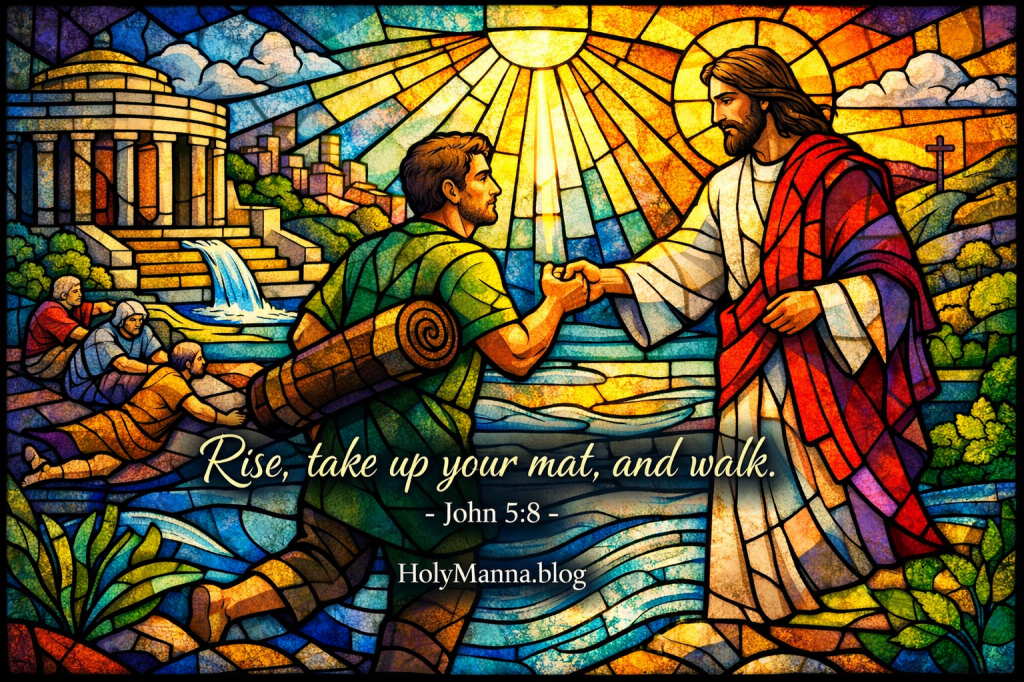
Cure on a Sabbath. 1 After this, there was a feast of the Jews, and Jesus went up to Jerusalem. 2 Now there is in Jerusalem at the Sheep [Gate] a pool called in Hebrew Bethesda, with five porticoes. 3 In these lay a large number of ill, blind, lame, and crippled. [4 ] 5 One man was there who had been ill for thirty-eight years. 6 When Jesus saw him lying there and knew that he had been ill for a long time, he said to him, “Do you want to be well?” 7 The sick man answered him, “Sir, I have no one to put me into the pool when the water is stirred up; while I am on my way, someone else gets down there before me.” 8 Jesus said to him, “Rise, take up your mat, and walk.” 9 Immediately the man became well, took up his mat, and walked.
Now that day was a sabbath. 10 So the Jews said to the man who was cured, “It is the sabbath, and it is not lawful for you to carry your mat.” 11 He answered them, “The man who made me well told me, ‘Take up your mat and walk.’” 12 They asked him, “Who is the man who told you, ‘Take it up and walk’?” 13 The man who was healed did not know who it was, for Jesus had slipped away, since there was a crowd there. 14 After this Jesus found him in the temple area and said to him, “Look, you are well; do not sin any more, so that nothing worse may happen to you.” 15 The man went and told the Jews that Jesus was the one who had made him well. 16 Therefore, the Jews began to persecute Jesus because he did this on a sabbath.
Detailed Exegesis
Verse 1. “After this, there was a feast of the Jews, and Jesus went up to Jerusalem.”
John places the event within the liturgical life of Israel. Jesus goes up to Jerusalem because he is not outside the covenant history of his people. He enters into it fully. The mention of the feast reminds the reader that this miracle happens in the heart of Jewish worship and expectation. Jesus does not appear as a rival to the Father’s work, but as the one who brings it to fulfillment.
Verse 2. “Now there is in Jerusalem at the Sheep Gate a pool called in Hebrew Bethesda, with five porticoes.”
The Sheep Gate likely carried sacrificial associations, since sheep for temple sacrifice were connected to that part of the city. That detail is quietly significant. Near the place where sacrificial animals entered, the true Lamb of God comes to restore a suffering man. The pool called Bethesda, often understood as meaning a house of mercy or grace, becomes the stage where divine mercy appears in person.
Verse 3. “In these lay a large number of ill, blind, lame, and crippled.”
This is a painful picture of fallen humanity gathered in one place. The pool is surrounded by weakness, disappointment, and longing. The blind cannot see. The lame cannot walk. The crippled cannot make themselves whole. Spiritually, the image reaches far beyond physical illness. It reflects the human condition under sin, wounded, limited, and unable to heal itself by its own strength.
Verse 4. “This verse is omitted in many modern critical editions; some later manuscripts add an explanation that an angel stirred the water, and the first person to enter after the stirring would be healed.”
Even though this verse is textually uncertain in many manuscripts, it helps explain the man’s answer in the next verse and the atmosphere of expectation at the pool. Whether John included the explanation directly or whether it arose in the manuscript tradition to clarify the scene, the point remains the same. Many sufferers believed healing would come through a brief stirring of the waters. Jesus will show that his word is greater than all such waiting.
Verse 5. “One man was there who had been ill for thirty eight years.”
John pauses the whole scene and draws attention to one man. Thirty eight years is an agonizingly long time. This is not a recent wound or a temporary setback. His suffering has become the shape of his life. The number itself emphasizes endurance, helplessness, and the human tendency to settle into a story of hopelessness when pain goes on for too long.
Verse 6. “When Jesus saw him lying there and knew that he had been ill for a long time, he said to him, ‘Do you want to be well?’”
Jesus sees him first. Grace always begins with the Lord’s gaze. Then comes the question, and it is more searching than it first appears. “Do you want to be well?” is not cruel. It is personal. It reaches beyond the body into the will. It asks whether the man is ready not only to be healed, but to receive a changed life. Christ never treats human beings like objects of pity. He addresses them as persons.
Verse 7. “The sick man answered him, ‘Sir, I have no one to put me into the pool when the water is stirred up; while I am on my way, someone else gets down there before me.’”
The man answers from inside his disappointment. He does not yet respond in faith, because he does not yet know who is speaking to him. He speaks out of loneliness, helplessness, and the bitterness of repeated failure. “I have no one” may be one of the saddest lines in the passage. His suffering is not only physical. It is social and emotional. He is isolated in the middle of a crowd.
Verse 8. “Jesus said to him, ‘Rise, take up your mat, and walk.’”
The command is direct, sovereign, and life giving. Jesus does not stir the pool. He does not perform a ritual. He speaks. The word itself heals. This reveals divine authority. The same God who spoke creation into being now speaks restoration into a broken life. The command also restores dignity. The man is not merely cured. He is told to stand, to act, and to walk. What had defined him no longer has the last word.
Verse 9. “Immediately the man became well, took up his mat, and walked. Now that day was a sabbath.”
The healing is immediate, complete, and effective. John gives no slow process, because the point is the power of Christ’s word. Then comes the note that turns the story toward conflict. It happened on the sabbath. What should have been received as a sign of divine mercy becomes, for some, a reason for accusation. John is already preparing the reader to see that hardness of heart can stand beside a miracle and still miss God.
Verse 10. “So the Jews said to the man who was cured, ‘It is the sabbath, and it is not lawful for you to carry your mat.’”
The attention shifts from healing to regulation. The restored man is confronted not with joy, but with suspicion. This shows the spiritual danger of legalism. The problem is not reverence for the sabbath itself, which is holy. The problem is a way of reading God’s law that has lost sight of God’s heart. When law is severed from mercy, even a miracle can be treated as an inconvenience.
Verse 11. “He answered them, ‘The man who made me well told me, “Take it up and walk.”’”
The man’s response is simple and revealing. He does not offer a theological defense. He points to the one who healed him. The authority of the healer explains the action. In a profound sense, this is already a model of Christian obedience. The command of Christ is trustworthy because of who Christ is. The restored man does not yet understand everything, but he knows enough to obey the one who gave him life back.
Verse 12. “They asked him, ‘Who is the man who told you, “Take it up and walk”?’”
Their question is not born from wonder, but from investigation. They want to identify the offender, not adore the Savior. This is one of the tragic notes in John’s Gospel. A person can encounter signs of God’s power and still approach them with a closed heart. The issue is not lack of evidence, but resistance to what the evidence requires.
Verse 13. “The man who was healed did not know who it was, for Jesus had slipped away, since there was a crowd there.”
The healed man’s ignorance is important. He has received the gift before knowing the giver. Grace often precedes full understanding. Jesus slips away, not because the miracle is unimportant, but because he will not reduce his mission to spectacle. His works reveal who he is, but they are meant to lead to faith, not to mere amazement.
Verse 14. “After this Jesus found him in the temple area and said to him, ‘Look, you are well; do not sin any more, so that nothing worse may happen to you.’”
This verse deepens the whole Gospel. Jesus seeks him out again, this time in the temple, the place of worship. The man has been restored bodily, but Christ now addresses his soul. “Do not sin any more” shows that physical healing is not the highest good. The greater danger is separation from God. Jesus is not crudely teaching that every illness comes from a particular sin. Rather, he is revealing that moral and spiritual conversion matter even more than bodily relief. To be healed and then return to sin would be to miss the deepest mercy being offered.
Verse 15. “The man went and told the Jews that Jesus was the one who had made him well.”
The man now knows the healer’s identity, and he reports it. Whether he acts with gratitude, simplicity, or a still imperfect understanding, the narrative moves forward through his testimony. Once Christ is known, his name must be spoken. Even imperfect witnesses can still bear witness to the truth of what Jesus has done.
Verse 16. “Therefore, the Jews began to persecute Jesus because he did this on a sabbath.”
The miracle becomes the occasion for persecution. John is already drawing the lines that will continue through the Gospel. Jesus reveals the Father through signs of life and mercy, yet some respond by hardening themselves against him. The sabbath controversy is not finally about one healed man carrying a mat. It is about whether people will recognize that the Lord of the sabbath is present among them.
Teachings
This Gospel reveals Christ as the healer of the whole person. He heals the body, but he does not stop there. He seeks the man again and calls him to conversion. That is deeply Catholic. The Church has always taught that Jesus did not come only to relieve earthly suffering, but to save the human person completely. The Catechism says in CCC 1503, “Christ’s compassion toward the sick and his many healings of every kind of infirmity are a resplendent sign that ‘God has visited his people’ and that the Kingdom of God is close at hand. Jesus has the power not only to heal, but also to forgive sins; he has come to heal the whole man, soul and body; he is the physician the sick have need of.” That teaching fits this passage exactly. The miracle is a sign, but the sign points toward something greater than walking legs. It points toward a restored life in communion with God.
This passage also sheds light on the sabbath. Jesus is not destroying what God commanded. He is revealing its true meaning. The Catechism states in CCC 2173, “The Gospel reports many incidents when Jesus was accused of violating the sabbath law. But Jesus never fails to respect the holiness of this day. He gives this law its authentic and authoritative interpretation: ‘The sabbath was made for man, not man for the sabbath.’ With compassion, Christ declares the sabbath for doing good rather than harm, for saving life rather than killing.” That is exactly what happens at Bethesda. The sabbath finds its fulfillment not in loveless rule keeping, but in the mercy of God at work.
The Church Fathers saw great depth in this scene. St. Augustine read the five porticoes as a figure of the five books of Moses. In his reading, the law could reveal sickness but could not itself heal the wounded heart without grace. That insight is powerful and still relevant. Rules can expose what is wrong, but only Christ can restore what is broken. St. John Chrysostom, on the other hand, marveled at the perseverance of the sick man and at the sheer authority of Christ’s command. He saw in the miracle a revelation that Jesus does not borrow power from anywhere else. He heals by his own word because he acts with divine authority.
There is also a temple theme running quietly through the whole passage. The first reading showed water flowing from the sanctuary. The Gospel brings us near a pool in Jerusalem, but the decisive healing does not come from the water. It comes from Jesus. That is no small detail. It means the old signs are giving way to the one they always pointed toward. Christ is the true Temple. He is the place where heaven and earth meet, where mercy is encountered, and where the wounded come to be made whole.
Historically, this miracle also fits within the growing tension of Jesus’ public ministry. In John’s Gospel, signs do not merely gather admiration. They reveal hearts. Some come to faith. Others harden into hostility. That pattern still holds. Christ’s mercy always demands a response. A man cannot be told to rise and then choose to remain lying down forever. A heart cannot meet divine mercy and remain neutral forever.
This Gospel also has sacramental resonance. The pool and the healing naturally call to mind Baptism, but the deeper lesson is that salvation does not come from water considered in isolation. It comes from Christ working through the means he has appointed. The Church does not worship sacraments as magical things. She receives them as the saving action of Jesus himself. The same Lord who said “Rise” to the paralytic is the one who still heals, forgives, strengthens, and restores through the sacramental life of his Church.
Reflection
There is something in this Gospel that reaches straight into ordinary life. Many people know what it feels like to wait by a pool that never quite delivers. They wait for the perfect circumstances, the perfect mood, the perfect break, the perfect moment when everything will finally change. Meanwhile the years go by. The heart gets used to discouragement. A person starts telling the same story over and over. No one helps. Nothing changes. This is just how life is.
Then Christ arrives and asks a question that cuts through all of it. “Do you want to be well?” It is not a shallow question. It reaches into the hidden places. Do you want healing badly enough to let Christ change your habits, not just your feelings? Do you want freedom badly enough to obey when he says rise? Do you want mercy badly enough to stop defending the sin that keeps you on the ground?
That is where this Gospel becomes very personal. Some paralysis is obvious. Some is inward. A person can be outwardly functional and still inwardly stuck. There can be paralysis in prayer, paralysis in forgiving someone, paralysis in fighting lust, paralysis in telling the truth, paralysis in returning to Confession, paralysis in finally surrendering an old resentment or secret sin to the Lord. The beauty of this Gospel is that Jesus is not intimidated by long term brokenness. Thirty eight years did not scare him. He is not worn out by old wounds. He still speaks with authority.
This passage also warns against a religion that notices mats more than miracles. It is possible to become so focused on appearances, technicalities, routines, or the failures of others that the heart no longer rejoices when grace is clearly at work. That is a danger in parish life, family life, and the inner life too. Christ’s mercy should make the soul more grateful, more truthful, and more alive, not more cold.
There is also a final challenge in Jesus’ words at the temple. “Do not sin any more.” Healing is not permission to drift back into the old life. Grace is given so that conversion may become real. That means practical steps matter. Go to Confession honestly. Return to daily prayer even when it feels dry. Stop feeding the habit that keeps the soul crippled. Remove what leads to sin. Ask for help where isolation has become part of the bondage. Stay close to Christ in the Eucharist. When he says rise, do not keep negotiating with the floor.
Where has the heart been lying still for too long, telling itself that change is for someone else?
Has there been more attention given to excuses than to the voice of Christ?
What sin, habit, fear, or wound is the Lord addressing right now with the words “Rise, take up your mat, and walk”?
This Gospel is not just about a miracle long ago in Jerusalem. It is about the way Jesus still enters the places of waiting, loneliness, and exhaustion. He still finds people who have almost given up. He still asks if they want to be made well. He still commands the impossible. And where his word is received with faith, even very old paralysis can give way to a new life.
Step Into the River of Mercy
Taken together, today’s readings tell one beautiful story. In Ezekiel, a river flows from the temple and brings life wherever it goes. In Psalm 46, that same divine presence becomes the stream that gladdens the city of God and keeps it from falling apart. Then in The Gospel of John, the promise stands in flesh before a suffering man at Bethesda. The healing does not come from stirred water, but from Jesus Christ, the true Temple, the true source of life, the one whose word still has the power to raise what has been lying still for far too long.
That is the heart of today’s message. God does not abandon dry places. He does not turn away from weakness, delay, or long years of suffering. He sends his life into them. He goes toward the barren places, the wounded places, the places that have grown used to disappointment. And where his grace is welcomed, life begins again. The river still flows. The city of God still stands. Christ still says to the weary soul, “Rise.”
Lent is the perfect time to stop lingering at the edge of grace and step more fully into it. This is the moment to return to prayer with greater honesty, to approach Confession with real repentance, to receive the Eucharist with deeper hunger, and to let the Lord heal not only outward struggles, but the inner patterns of sin, fear, and resignation that keep the heart from walking freely. God is not offering shallow comfort. He is offering restoration.
What part of life most needs the healing waters of Christ right now?
What has the soul been postponing that the Lord is asking it to face with trust?
What would change if this Lent were lived not as a season of mere effort, but as a season of surrender to grace?
The invitation of today’s readings is simple and powerful. Do not stay on the shore. Do not settle for spiritual dryness. Do not keep waiting for someone else to carry you into healing. Go to Christ. Stay near his Church. Open the heart to his mercy. Let his life run deeper than fear, deeper than habit, and deeper than old wounds. Where his river flows, everything lives.
Engage with Us!
Readers are warmly invited to share their reflections in the comments below. What stood out most in today’s readings? What challenged the heart, brought comfort, or called for a deeper trust in God? The word of God is never meant to remain distant on the page. It is meant to be prayed with, wrestled with, and lived.
- In the First Reading from Ezekiel 47:1-9, 12, what part of life feels most dry or lifeless right now, and how might the Lord be inviting that place to receive his healing waters? What does it mean to trust that where God’s grace flows, new life can begin again?
- In Psalm 46:2-3, 5-6, 8-9, what fears or uncertainties have been shaking the heart lately? How does this psalm speak to the struggle to believe that God is truly a refuge, a strength, and an ever present help in distress?
- In the Holy Gospel from John 5:1-16, where has there been a kind of spiritual paralysis, a place of waiting, excuses, or discouragement? What might Jesus be saying personally through his words “Do you want to be well?” and “Rise, take up your mat, and walk”?
May today’s readings lead every heart closer to Christ, the true source of healing, peace, and mercy. Let this day be lived with faith, with courage, and with a love that reflects the tenderness of Jesus in every word, every choice, and every act of mercy.
Sacred Heart of Jesus, we trust in You!
Immaculate Heart of Mary, pray for us!
Saint Michael the Archangel, defend us in battle!
Follow us on YouTube, Instagram and Facebook for more insights and reflections on living a faith-filled life.

 Holy Manna!
Leave a comment