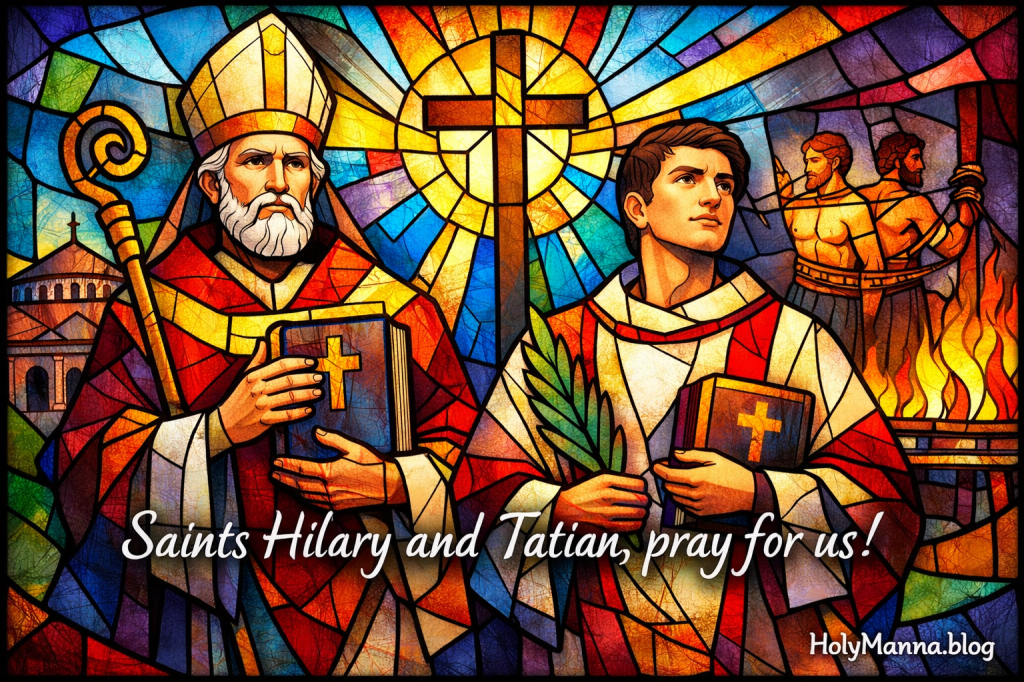
When a Bishop and His Deacon Refused to Bend
Some saints are remembered because they left books behind. Others are remembered because they left a trail of institutions, speeches, and public victories. Saints Hilary and Tatian are remembered for something even more elemental. They held the line when it cost them everything.
Hilary was remembered as a bishop of Aquileia, and Tatian was remembered as his deacon. The Church keeps them together because they witnessed together, suffered together, and were honored together. Their story comes down to the essentials: shepherd and servant, altar and witness, fidelity and martyrdom. In a world where compromise often feels like the easiest option, their memory keeps asking a sharper question. What is Christ worth when the price is real?
A City at the Crossroads and Two Men Mostly Hidden
The early life details for Hilary and Tatian are not preserved in the way many later saints are. Their birthplace, their family background, and the personal steps of their conversion are not clearly recorded in the surviving Catholic liturgical notices and later summaries. That silence is not an insult to their importance. It is a reminder of what the early Church most wanted to protect: the fact of their witness.
Aquileia was a significant Roman city in the region, a place of roads and commerce and imperial order. It was also a place where Christianity was taking root, often under pressure. Hilary appears in tradition as a bishop there, and Tatian as his deacon, which already tells a lot. A bishop is a spiritual father responsible for guarding the faith and feeding the flock. A deacon is a minister of service, often close to the altar and close to the poor. Their partnership points to something deeply Catholic: the Church is not built by lone heroes, but by ordered communion, where different vocations serve the same Lord.
What they are most known for is not a dramatic origin story. They are known for steadfastness. They are known for refusing to treat the Gospel like a private hobby. They are known for loving Christ publicly, in an age when public love of Christ could become a death sentence.
The Shepherd’s Courage and the Deacon’s Fire
Hilary and Tatian matter because they show what spiritual fatherhood and spiritual service look like under threat. Their lives are remembered not as a string of achievements but as a single clear note: fidelity.
There is a later tradition that adds a dramatic episode to Hilary’s ministry, saying that his prayers were connected with the collapse of pagan temples or idols, which then intensified the rage of local authorities against him and his deacon. This story is part of later devotional retellings, but it cannot be verified from the earliest brief martyrology notices, which are much more restrained. Still, even as an unverified tradition, it carries a spiritual meaning that fits Catholic instincts. When Christ is taken seriously, idols do not remain comfortable. The Gospel does not merely decorate a culture. It challenges it.
Even without a detailed list of verified miracles during their lifetime, the Church remembers them as men who served the Church in the normal, demanding way: preaching, praying, baptizing, shepherding, assisting at the mysteries, and holding the faith steady when the world tried to shake it loose.
The Rack, the Threat, and the Final Yes
The Catholic liturgical memory of their martyrdom is direct and sobering. Tradition places their suffering under Emperor Numerian, and it names a local authority, Beronius, in connection with their persecution. The Roman Martyrology tradition speaks of harsh torments, including the rack, before their death. The Church commemorates them on March 16, and tradition often associates their martyrdom with the year 284.
This is where their story becomes painfully relevant. Martyrdom is not a romantic idea in the Catholic mind. It is a real death, carried by a real body, with fear pressing in from every side. The Church does not venerate martyrs because suffering is good in itself. The Church venerates martyrs because love can be so total that it refuses to lie.
Here is the heart of it, in the Church’s own teaching: “Martyrdom is the supreme witness given to the truth of the faith.” CCC 2473. Hilary and Tatian did not win by escaping. They won by belonging to Jesus more than they belonged to life on earth.
If there were moments of divine protection along the way, they are not recorded for us like they are for some other saints. Their miracle was the one the world least understands: they endured, and they did not betray Christ.
Relics Carried Through Crisis
After death, their impact becomes easier to trace in the Church’s memory through relics, devotion, and place.
A powerful posthumous legacy is the survival and transfer of their relics during times of upheaval. In the period of Lombard invasions, tradition records that the patriarch fled from Aquileia toward Grado and carried relics with him, including relics associated with Hilary and Tatian. That detail matters because it shows that devotion to them was not a late invention. Their memory had weight. Their relics were treated as treasures of the Church.
There is also a long-standing association of Hilary with an early memorial shrine, an octagonal martyrium connected with the early Christian landscape of Aquileia. Even when personal biographies are sparse, sacred architecture and local memory can speak loudly. Christians do not build martyria for myths. They build them because the blood of martyrs becomes a signpost that says, “This ground has been claimed for Christ.”
Their cultural impact becomes especially vivid in Gorizia, where Saints Hilary and Tatian are honored as patrons and where the cathedral bears their names. Local tradition includes public celebrations around their patronal feast, including solemn liturgy and civic expressions of honor. A community that keeps saints as patrons is doing something quietly radical. It is saying that holiness is not only for private prayer corners. Holiness belongs in the streets, in the calendar, in the public imagination.
As for miracles after death, there is not a widely circulated, detailed set of specific healings or interventions uniquely tied to these saints in the way some later saints have extensive documented cases. Much of what is strongly preserved is their veneration, their relic legacy, and their place in the Church’s living memory. When later devotional stories circulate about dramatic signs connected to Hilary, those stories can be told as tradition, but honesty requires a simple note: the details cannot be verified from the earliest sources.
Pilgrimage and devotion for these saints tend to be tied to place more than to a single famous miracle narrative. Aquileia, Grado, and Gorizia become a kind of spiritual map, reminding the faithful that the communion of saints is not an idea. It is a family with history, memory, and visible footprints in the Church.
Fidelity That Costs Everything
Most people will not be asked to face a rack or a public execution for the faith. But plenty of people are asked to compromise quietly, to soften the truth, to treat the Church like a social club, or to keep Jesus safely locked away from the hard parts of life.
Hilary and Tatian show a different path. They show the power of spiritual fatherhood that does not negotiate with falsehood, and the power of diaconal service that does not abandon the shepherd when the wolves come.
Their witness also teaches something Catholics sometimes forget: vocation is not a solo performance. A bishop needs faithful ministers. A minister needs faithful leadership. Holiness grows best in communion. That is one reason the Church speaks so insistently about the communion of saints and the shared life of grace. CCC 946-962.
There is also a practical, daily takeaway that fits the rhythm of real life. Fidelity is usually built before the crisis arrives. It is built by Sunday Mass that does not get negotiated away. It is built by confession that is not postponed forever. It is built by prayer that is simple but steady. It is built by refusing to make peace with “respectable” sins. It is built by choosing truth when it costs a little, so that choosing truth when it costs a lot does not feel impossible.
And for anyone who feels small next to the heroism of martyrs, the Church offers a quiet encouragement: holiness is not reserved for extraordinary personalities. It is the fruit of grace. The saints prove that grace can make ordinary men unbreakable.
Engage With Us!
Share your thoughts and reflections in the comments below. Saints Hilary and Tatian have a way of shining a light on the places where faith gets treated as optional, and they also offer hope that courage can be learned.
- Where does faith feel most pressured to stay quiet in daily life right now?
- What is one concrete habit that could strengthen fidelity, such as Mass, confession, Scripture, or prayer, so that conviction is not only emotional but steady?
- Who is one person who needs encouragement to stay faithful, and what is a respectful way to support them this week?
- What “idol” tends to demand compromise most often, comfort, approval, success, or pleasure, and what would it look like to place it under Christ’s lordship?
- When thinking about the communion of saints, what does it change to remember that the Church is a family that includes martyrs who already finished the race? CCC 946-962
May Saints Hilary and Tatian intercede for courage that is calm, fidelity that is steady, and love that does not bargain with truth. Live a life of faith, and do everything with the love and mercy Jesus taught us.
Saints Hilary and Tatian, pray for us!
Follow us on YouTube, Instagram and Facebook for more insights and reflections on living a faith-filled life.

 Holy Manna!
Leave a comment