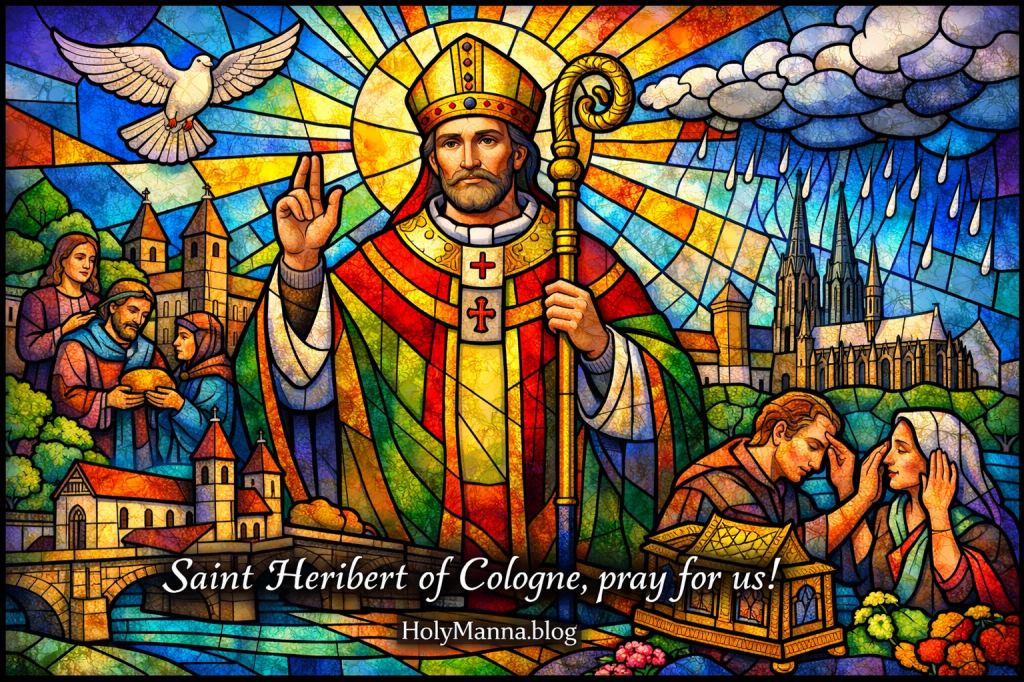
The Rain Saint Who Built a City of Mercy
Saint Heribert of Cologne lived at the turn of the first millennium, when politics were rough, winters were unforgiving, and the Church had to be both brave and practical. He served as Archbishop of Cologne from 999 until his death in 1021, and before that he moved in the highest circles of the empire as a trusted chancellor and adviser to Emperor Otto III.
That sounds like the kind of résumé that can make a man proud. Heribert did something different. He took every ounce of influence he had and poured it into prayer, reform, and mercy. Cologne remembers him as a builder of churches and a founder of a monastery, but even more as a bishop who showed up for the poor when the cupboards were empty. Catholic tradition especially remembers him as a saint invoked for rain in times of drought, which is why many people still call him the “rain saint” of Cologne.
A Soul Trained for God
Heribert was born around 970 in Worms, into a noble family with access to serious education. He was formed at the cathedral school of Worms, and Catholic tradition ties his spiritual formation to reform-minded monastic life, especially the disciplined current associated with Gorze. That matters because it helps explain the shape of his holiness later. His sanctity was not sentimental. It was steady, structured, and rooted in prayer.
Even before the big titles arrived, there are hints of a man who could say “no” to ambition. A tradition preserved in local materials says he once refused a proposed bishopric early on and recommended another instead. Whether every detail of that story can be verified or not, the theme fits what is clear in his life: Heribert could hold power without letting power hold him.
Power Turned Into Pastoral Charity
Heribert was ordained a priest in 994, and almost immediately he was pulled into imperial service. He became chancellor for the empire, first connected to Italy and then more broadly, serving closely under Otto III. When he was elected Archbishop of Cologne in 999, he received the pallium from Pope Sylvester II and was consecrated that same year on Christmas Day.
Then came the moment that would humble any strong personality. Otto III died in 1002, and Heribert found himself caught in a painful succession struggle. He was even briefly imprisoned during the conflict around the rise of Henry II. This was not martyrdom, but it was real suffering. It was the kind of trial that strips a man down and reveals what he actually loves.
After peace returned, Heribert’s legacy shines brightest in what he did for ordinary people. Catholic tradition and local remembrance emphasize how he organized relief during famine years. He did not just toss coins. He established order. He appointed people to distribute alms responsibly and kept track of those in need so nobody was forgotten. That kind of structured mercy sounds modern, but it is deeply Catholic. The Church teaches that love of neighbor becomes real through concrete works of mercy, because Christ identifies Himself with the hungry, the stranger, and the poor. CCC 2447 points to this tradition of mercy as a basic expression of Christian life, not a hobby for especially nice people.
Heribert also founded and endowed the Benedictine monastery at Deutz, across the Rhine from Cologne, and he helped strengthen the Church’s presence there in a way that shaped the city for centuries. Deutz was not only a building project. It was a spiritual anchor. It said, in stone and liturgy, that God comes first.
The Rain Miracle
When Catholics speak about miracles, there is a healthy realism. The Church does not ask anyone to be gullible. At the same time, Catholics know that God can act in history, and the lives of the saints often carry stories that the faithful have handed on for generations.
The most famous sign associated with Saint Heribert is the rain miracle. Tradition says Cologne suffered a severe drought. Heribert called the people to prayer and penance, and after public supplication and the offering of Mass, rain finally came. Some versions of the story include the image of a dove circling above him during the procession. This miracle story is part of why he is invoked for rain to this day. The details of the dove cannot be independently verified with modern tools, but the tradition itself is ancient and consistent in Cologne’s devotion.
Other miracle stories are also attached to his life in Catholic hagiography, including healings of the sick and deliverance of someone afflicted by evil. These stories reflect what the faithful believed God was doing through a bishop known for prayer and charity. Not every detail can be verified historically, but they form part of the saint’s received memory and devotional legacy.
Holiness Without Drama
Not every saint dies under a sword. Some are hammered into holiness through politics, pressure, misunderstanding, and the slow grind of leadership. Heribert’s hardships were real. He lived in a time when Church leaders could become chess pieces in imperial struggles. He experienced political conflict, captivity, and suspicion.
One striking thread in his story is reconciliation. Henry II, who once opposed him, later recognized Heribert’s integrity. That kind of turn is quietly powerful because it shows something deeply Christian: a saint is not someone who wins every argument. A saint is someone who belongs to Christ, even when misunderstood.
There was no martyrdom in Heribert’s story, but there was sacrifice. He poured himself out for his people, especially in crisis. That is a living echo of the Gospel pattern: laying down one’s life does not always mean a sudden death. Sometimes it means years of faithful service, when the work is hard and the thanks are thin.
A City That Still Remembers
Saint Heribert died on March 16, 1021. He was buried at Deutz, and devotion began quickly. Later generations honored him by elevating his relics, and a great shrine was crafted to hold them. His reliquary became one of the better-known treasures of Cologne’s Romanesque sacred art, decorated with images meant to preach his virtues as much as his history.
Catholics venerate relics, not because bones have magic, but because the human body matters to God. The Word became flesh. The Holy Spirit makes the Christian body a temple. The Church has long recognized that relics and shrines can strengthen faith and devotion when they lead people toward Christ. CCC 1674 speaks about popular piety and devotional expressions, and Catholic tradition includes relic veneration among those practices when rightly ordered toward God.
His feast is kept on March 16, and Cologne also has a local commemoration connected to the elevation of his relics. Over the centuries, people have continued to seek his intercession, especially for rain during drought. Processions and prayers tied to his memory became part of the region’s spiritual culture. Some healings and favors have been attributed to his intercession after death. These stories are part of the living devotion around him, even when they cannot be verified in a strict historical sense.
As for “famous quotes,” there are no clearly authenticated writings from Heribert like the letters of later saints. Still, the people’s devotion left its own words behind. One popular acclamation preserved in Catholic tradition says “Le preghiere di Eriberto ci hanno salvati.” This means “The prayers of Heribert have saved us.” It is not a quotation from Heribert himself, but it is a window into how Catholics experienced his intercession.
A Bishop for Anyone Trying to Live the Faith
Saint Heribert is a gift to Catholics who feel stuck between ideals and reality. His holiness was not a cloud of perfect feelings. It was organized mercy, steady prayer, and leadership that took responsibility for people.
A modern Christian can learn a lot from that. The faith is not only about avoiding evil. It is about building good. It is about making love practical. The works of mercy are not optional decorations on top of religion. They are part of what it means to follow Jesus, who says the hungry and the stranger are somehow standing in His place. Mt 25:35-36 is not sentimental. It is direct.
Heribert also teaches something about prayer. When the city needed rain, he did not treat God like a vending machine. He called for penance, public prayer, and the offering of Mass. That is a Catholic instinct: bring the need to God, but bring the heart too. Conversion always comes before complaint.
How might life change if charity became more structured, more faithful, and less driven by mood?
Where has God entrusted influence, money, skills, or authority, and how could those gifts be turned into mercy instead of ego?
When life feels like drought, could prayer become more humble and more consistent instead of more frantic?
Engage with Us!
Readers are invited to share thoughts and reflections in the comments below, because the saints are meant to be lived, not merely studied.
- Where is there “famine” nearby, meaning a real need for food, friendship, stability, or hope, and what concrete work of mercy can be done this week?
- What kind of power shows up in daily life, and how can it be used like Heribert used it, as service rather than self-promotion?
- When facing a personal drought, what would it look like to return to prayer, penance, and the sacraments with a steadier heart?
May Saint Heribert of Cologne teach hearts to be strong and merciful, and may every day be lived with the faith, love, and mercy Jesus taught, so that even ordinary life becomes a quiet witness to the Kingdom of God.
Saint Heribert of Cologne, pray for us!
Follow us on YouTube, Instagram and Facebook for more insights and reflections on living a faith-filled life.

 Holy Manna!
Leave a comment