Monday of the Fourth Week of Lent – Lectionary: 244
When God Says “New,” He Means It
Some days arrive with a quiet ache, the kind that makes ordinary life feel heavy. People keep moving, meals still get made, work still gets done, but the heart carries questions it does not know how to phrase. The Church, like a wise mother, does not pretend that sorrow is imaginary. Instead, she places three living words in front of the faithful today: creation, restoration, and trust. These readings belong together because they tell one story. God does not merely repair what broke. God makes all things new, and that newness begins the moment a person decides to believe His Word.
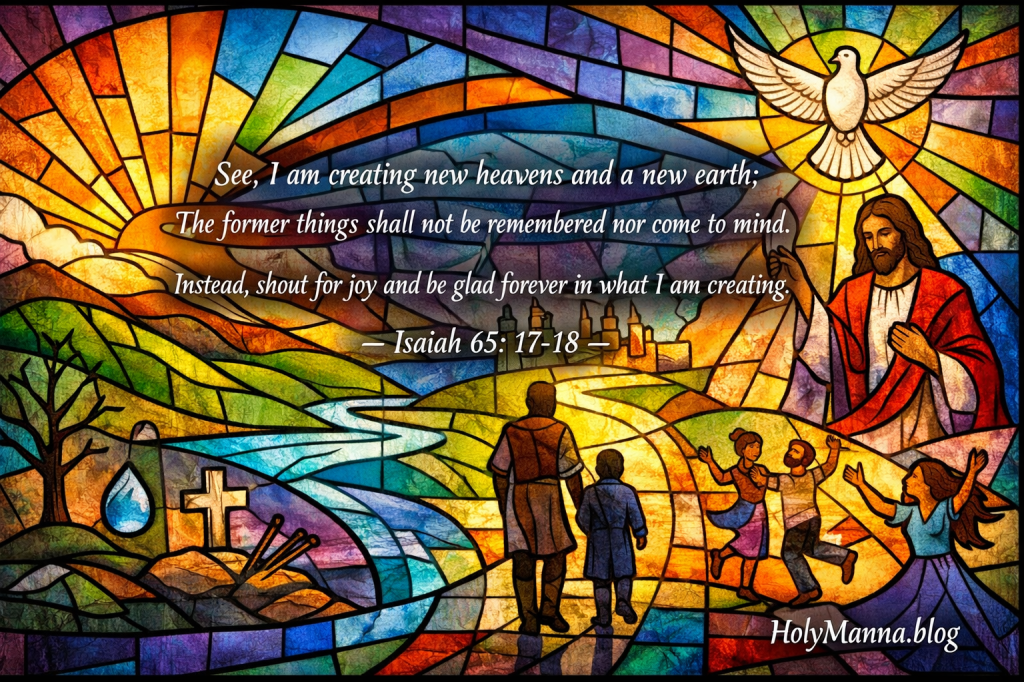
This is the heart of Lent, especially in the Fourth Week, when the liturgy starts letting more light leak into the season’s purple hush. The Church has been leading souls through repentance and discipline, but she never lets anyone forget the destination. The goal is not spiritual self-improvement. The goal is resurrection. Isaiah 65:17-21 speaks to a people who know what it means to lose a city, a home, and the sense of stability that made life feel safe. Israel’s history is marked by exile and return, by the humiliation of watching what once was holy fall into ruins. Into that reality, God makes a promise that sounds almost impossible: “See, I am creating new heavens and a new earth”. That promise is not just about better days. It is about a recreated world where joy replaces weeping and life is no longer haunted by fragility.
Psalm 30 answers like a witness giving testimony in court. It does not speak like someone who has never suffered. It speaks like someone who has been pulled back from the edge. The Psalm holds the rhythm of salvation in a single line: “At dusk weeping comes for the night; but at dawn there is rejoicing”. In Lent, that is not just poetry. That is a map. It is the shape of the Cross and the shape of every conversion. God does not waste sorrow, and He does not abandon those who cry out. He turns mourning into praise because He is the Lord of life, not the Lord of loss.
Then John 4:43-54 brings the promise and the praise into the dust of everyday panic. A father stands in fear for a dying son, and Jesus does not even travel to the child. He speaks. He gives a sentence that must be carried like bread for the journey: “You may go; your son will live”. The miracle begins before the father sees anything change, because faith is not sight. Faith is trust in the Word of Christ. That is why the Church places this Gospel inside Lent. The Lord is teaching what real belief looks like: it walks home obediently before the proof arrives.
What would change if Christ’s Word were treated as more reliable than fear, more solid than circumstances, and more lasting than yesterday’s failures? Today’s readings prepare the soul for that question. They announce that God’s plan is renewal, that His mercy is stronger than the night, and that His Son speaks life into what looks beyond saving. The story is not about a distant past. It is about the Lord who still creates, still raises up, and still says to anxious hearts: “Your son will live”.
First Reading – Isaiah 65:17-21
A Future So Real It Rewrites the Past
The prophet Isaiah is speaking to a people who know what it feels like to have the ground ripped out from under them. Jerusalem had been shattered by conquest, the temple had been desecrated, and many had tasted exile. Even after some returned, the rebuilding was slow, the memories were sharp, and the question lingered in the background like smoke after a fire: Could anything truly be new again, or would life always feel like a weaker version of what was lost?
Into that wounded history, God does not offer a small upgrade. He announces a creation-level promise. This reading fits today’s theme because it teaches that the Lord’s mercy is not limited to patching cracks in the old world. God’s plan is renewal so deep that sorrow and loss no longer get the final word. Lent, especially as it moves deeper toward Easter, trains the heart to stop living as if sin and death are permanent. This prophetic vision sets the stage for the Gospel, where Christ speaks life with a word, and a desperate father learns what it means to trust that word before seeing the results.
Isaiah 65:17-21 – New American Bible (Revised Edition)
A World Renewed
17 See, I am creating new heavens
and a new earth;
The former things shall not be remembered
nor come to mind.
18 Instead, shout for joy and be glad forever
in what I am creating.
Indeed, I am creating Jerusalem to be a joy
and its people to be a delight;
19 I will rejoice in Jerusalem
and exult in my people.
No longer shall the sound of weeping be heard there,
or the sound of crying;
20 No longer shall there be in it
an infant who lives but a few days,
nor anyone who does not live a full lifetime;
One who dies at a hundred years shall be considered a youth,
and one who falls short of a hundred shall be thought accursed.
21 They shall build houses and live in them,
they shall plant vineyards and eat their fruit;
Detailed Exegesis
Verse 17 – “See, I am creating new heavens and a new earth; The former things shall not be remembered nor come to mind.”
This is God speaking like the Creator again, not like a mere repairman. The phrase “new heavens and a new earth” is not casual imagery. It is a promise of a renewed creation, a world healed at the root. The “former things” are not erased in a way that denies history, but they lose their power to haunt and rule the heart. God is describing a future where trauma is not the main storyline, and where the past does not keep believers trapped in bitterness, regret, or fear.
Verse 18 – “Instead, shout for joy and be glad forever in what I am creating. Indeed, I am creating Jerusalem to be a joy and its people to be a delight.”
God calls His people to rejoice, not because everything feels easy now, but because His creative action is already in motion. Notice the tenderness: the Lord does not only rebuild structures. He reshapes a people into a “delight.” Jerusalem here is more than a city on a map. It stands as a sign of God dwelling with His people, which prepares the imagination for the Church’s ultimate hope of the heavenly Jerusalem.
Verse 19 – “I will rejoice in Jerusalem and exult in my people. No longer shall the sound of weeping be heard there, or the sound of crying.”
This is one of the most personal lines in the whole passage. God does not merely permit joy. God Himself rejoices. The renewal is not distant or cold. It is relational. The end of weeping and crying points beyond temporary relief and toward a definitive victory over the sources of misery. This is not the optimism of human effort. It is the joy that comes from God’s presence and God’s triumph over what breaks His children.
Verse 20 – “No longer shall there be in it an infant who lives but a few days, nor anyone who does not live a full lifetime; One who dies at a hundred years shall be considered a youth, and one who falls short of a hundred shall be thought accursed.”
In the ancient world, infant mortality and short lifespans were painfully common. This verse speaks into a world where death felt close and personal in every household. God describes a future where life is no longer fragile in the same way. The language is poetic and uses the categories people understood, but the direction is clear: the reign of death is being challenged. The reading is not claiming that a mere longer earthly life is the final goal. It is pointing toward the deeper promise that God is undoing the curse and restoring life.
Verse 21 – “They shall build houses and live in them, they shall plant vineyards and eat their fruit.”
This is a picture of stability, dignity, and peace. In times of war and exile, people build for others to enjoy, and plant for others to harvest. God promises a future where labor is not constantly stolen by violence or injustice. There is something deeply human here: a home that remains, work that matters, fruit that is enjoyed. It is a glimpse of life ordered rightly, where God’s people are no longer surviving, but living.
Teachings
This reading is one of the Old Testament doorways into the Church’s teaching on Christian hope. The vision of “new heavens and a new earth” becomes a cornerstone for how Catholics understand the end of history. The Lord does not abandon creation. He renews it.
The Catechism describes this final renewal as the fulfillment of God’s plan, where creation itself is transformed in Christ. In CCC 1044, a key excerpt reads “the universe itself will be renewed”. That short line carries a massive truth: salvation is not only about souls escaping the world. Salvation is about God making all things whole.
Then CCC 1045 offers another key excerpt: “for man, this consummation will be the final realization of the unity of the human race”. The Church teaches that the end is not isolation, but communion. God’s renewed creation is a home where division, injustice, and death do not rule, because Christ reigns.
The saints often describe this hope in a way that feels intensely practical. They remind believers that the future God promises should shape how believers live right now. Saint Augustine famously insists that the heart remains restless until it rests in God, and that restless ache is often the very place where hope begins to breathe. The Lord’s promise in Isaiah is not escapism. It is a summons to live as citizens of a coming kingdom, even while walking through a world that still groans.
This also connects to Lent’s deeper logic. Penance is not punishment. It is preparation. Fasting, prayer, and almsgiving are not spiritual tricks. They are training for a new creation, because they teach the heart to stop clinging to “former things” as if they were permanent.
Reflection
There is a quiet temptation in adult life to assume that the past is the truest thing about a person. Old sins can start to feel like identity. Old wounds can start to feel like destiny. Old failures can start to feel like prophecy. This reading confronts that lie with God’s voice. The Lord does not say that the former things were not real. He says they will not rule the mind forever. God promises a future where grief is not the soundtrack, and where joy is not fragile.
This is where the reading becomes concrete for daily life. A believer can begin practicing the new creation by refusing to rehearse the past like a courtroom accusation. A believer can start praying with the confidence that God’s creative power is not limited by how stuck life feels. A believer can choose one act of obedience today that looks small, but is actually revolutionary, because it says, “God is able to make this new.”
What is the “former thing” that keeps getting replayed in the mind, even after confession, even after prayer, even after time has passed?
What would change if God’s promise of renewal were treated as more reliable than personal regret and more solid than today’s anxiety?
Where is God inviting a step of hope that looks unreasonable to a tired heart but makes perfect sense in the light of His Word?
Responsorial Psalm – Psalm 30:2, 4-6, 11-13
When God Turns the Page
In the ancient world of Israel, people did not talk about suffering in vague, polite terms. They named it. They prayed it. They brought it to the Lord with raw honesty because the God of the covenant was not a distant idea. He was the living God who heard, saved, corrected, and restored. Psalm 30 is a thanksgiving psalm, traditionally linked to deliverance from a grave danger, often imagined as a life threatening illness or a near-death crisis. It even speaks the language of the underworld, “Sheol,” the shadowy realm of the dead in Old Testament imagery, to show just how close the psalmist came to the edge.
That is why this psalm fits today’s theme so perfectly. Isaiah speaks of a world renewed, where weeping fades and life is restored. The Gospel shows Christ speaking life into a dying situation with a single word. Psalm 30 becomes the bridge between promise and fulfillment, because it teaches the heart how to respond when God brings someone up from the pit. It gives Lent a voice that sounds like Easter in advance, because it insists that the night is real, but it is not permanent.
Psalm 30:2, 4-6, 11-13 – New American Bible (Revised Edition)
2 I praise you, Lord, for you raised me up
and did not let my enemies rejoice over me.4 Lord, you brought my soul up from Sheol;
you let me live, from going down to the pit.5 Sing praise to the Lord, you faithful;
give thanks to his holy memory.
6 For his anger lasts but a moment;
his favor a lifetime.
At dusk weeping comes for the night;
but at dawn there is rejoicing.11 Hear, O Lord, have mercy on me;
Lord, be my helper.”12 You changed my mourning into dancing;
you took off my sackcloth
and clothed me with gladness.
13 So that my glory may praise you
and not be silent.
O Lord, my God,
forever will I give you thanks.
Detailed Exegesis
Verse 2 – “I praise you, Lord, for you raised me up and did not let my enemies rejoice over me.”
The psalm begins with gratitude that is personal and direct. The Lord “raised” the psalmist up, which suggests being pulled from danger like someone hauled out of a well. The mention of “enemies” is not always about a battlefield. In the biblical imagination, enemies can include sickness, unjust accusers, and even the invisible powers that rejoice when a person collapses into despair. The psalmist is praising God because God did not allow humiliation to be the final chapter.
Verse 4 – “Lord, you brought my soul up from Sheol; you let me live, from going down to the pit.”
This line gets right to the depth of the crisis. “Sheol” and “the pit” express the sense of slipping into death, the place where human strength stops and where nothing can be controlled. Spiritually, it also names those moments when life feels sealed shut, as if hope itself has been buried. The psalmist confesses that survival was not luck or willpower. It was mercy. God intervened.
Verse 5 – “Sing praise to the Lord, you faithful; give thanks to his holy memory.”
Now the prayer widens. Personal rescue becomes communal worship. The psalmist calls “the faithful” to praise, because God’s saving action is never meant to stay private. “His holy memory” points to God’s faithfulness in history, the way He keeps His covenant promises. In Catholic life, this instinct becomes even more concrete. The Church does not merely remember God like recalling a fact. She celebrates His saving deeds liturgically, especially in the Eucharist, where Christ’s sacrifice is made present and His victory is proclaimed.
Verse 6 – “For his anger lasts but a moment; his favor a lifetime. At dusk weeping comes for the night; but at dawn there is rejoicing.”
This is one of the most hopeful lines in the whole psalter. God’s “anger” should not be imagined as divine moodiness. In Scripture, it often names God’s just opposition to sin and the painful consequences that follow when a people wander from Him. The point is not that God is harsh. The point is that correction is temporary, but covenant love is enduring. The dusk and dawn imagery is not denial. It is a theology of time. The faithful can endure the night because God has already promised the morning.
Verse 11 – “Hear, O Lord, have mercy on me; Lord, be my helper.”
Even inside thanksgiving, the psalm makes room for pleading. That is a very Catholic instinct. Prayer is not a performance that must be emotionally consistent. The heart can thank God for rescue and still beg for mercy, because conversion and healing often unfold in stages. This verse shows the posture of dependence that Lent tries to rebuild in the soul, so pride does not quietly take over again.
Verse 12 – “You changed my mourning into dancing; you took off my sackcloth and clothed me with gladness.”
“Sackcloth” was the outward sign of grief and penance. The psalmist describes God Himself removing it, as if the Lord personally lifts the burden and replaces it with joy. This is not shallow happiness. It is the kind of gladness that comes from being restored to life, restored to relationship, restored to worship. It also echoes today’s Gospel, where a father’s mourning is interrupted before it can fully begin, because Christ’s word brings life at the very moment hope seems ready to die.
Verse 13 – “So that my glory may praise you and not be silent. O Lord, my God, forever will I give you thanks.”
“Glory” here points to the whole self, the inner life, the voice, the breath, the identity. The purpose of rescue is worship. God saves so praise will not be silenced. The psalm ends with permanence, “forever,” because true gratitude refuses to treat grace as a one time event. It becomes a way of life.
Teachings
This psalm teaches the Church how to pray through the full arc of human experience, from danger to deliverance, from lament to praise. It also reveals something essential about the Bible itself. The psalms are not just religious poetry from the past. They are the prayer of the People of God, taken up and perfected in Christ.
The Catechism speaks plainly about the psalms’ unique role in the life of prayer. CCC 2588 says, “The Psalms are the masterwork of prayer in the Old Testament.” This matters because Psalm 30 shows what “masterwork” looks like. It is honest about the pit, confident in mercy, and unashamed of praise.
This psalm also teaches a deeply Catholic understanding of suffering and hope. God’s favor is not measured by whether life stays easy. God’s favor is revealed in His saving presence and His power to turn mourning into dancing. Lent places this psalm on the lips of the faithful because it trains the soul to see beyond the immediate moment. The night can feel endless, but it is still night, and God still makes mornings.
Saint Augustine loved the psalms because they teach believers how to speak to God with a fully human heart. He described the psalms as a school of prayer, where Christ Himself is heard in the voice of the Church. When the Church prays deliverance from the pit, she is praying with Christ, through Christ, and in Christ, because the deepest “pit” was conquered by His death and Resurrection. That is why Psalm 30 can sound like a resurrection hymn even when it is prayed in a season of penance.
Reflection
Many people live like the night is the truest thing about them. They wake up, handle responsibilities, and smile when necessary, but inside they are bracing for the next blow. This psalm does not shame that struggle. It gives it language and then it gives it direction. It teaches that the Lord can be addressed directly, even when the heart feels weak, because mercy is not earned by being impressive.
A practical way to live this reading is to pray it as a pattern. When fear rises, speak honestly, like the psalmist did, and ask for mercy with confidence. When a small deliverance happens, even something as simple as a temptation resisted or a relationship softened, respond with thanksgiving instead of moving on like it meant nothing. Gratitude is not extra credit in the spiritual life. Gratitude is how the heart stays awake to grace.
This psalm also invites a quiet but serious examination. Some people want “dawn rejoicing” without letting God work through the night. Lent teaches patience with the process. It is not weakness to be in the night. It is only dangerous to forget that God still makes dawn.
Where has weeping become so familiar that the heart has stopped expecting rejoicing?
What would it look like to pray “Lord, be my helper” before reacting with irritation, panic, or distraction?
If God has already brought someone out of a pit before, why should that mercy be considered impossible again today?
Holy Gospel – John 4:43-54
The Miracle Begins When the Man Starts Walking Home
If today’s readings were a single story told by candlelight, this Gospel would be the moment the room goes quiet. Isaiah promised a world remade, where sorrow no longer has the loudest voice. Psalm 30 sang about dusk giving way to dawn. Now The Gospel of John shows how that new creation starts breaking into ordinary life: Jesus speaks a word of life into a desperate household, and faith is tested in the space between the promise and the proof.
This scene lands in Galilee, a region often looked down on by the religious elites of Judea, yet constantly chosen by God as a place where big grace meets regular people. Cana and Capernaum sit miles apart, which makes the miracle even sharper. In a world where healers were expected to touch, travel, and perform, Jesus heals from a distance. He does not chase drama. He calls for trust. The royal official, likely connected to the local ruling class and used to command, is forced into a posture he cannot control: he must receive a gift and obey a word. That is why this Gospel fits today’s theme so perfectly. God makes all things new, and Christ begins that renewal by teaching the heart to believe before it sees.
John 4:43-54 – New American Bible (Revised Edition)
Return to Galilee. 43 After the two days, he left there for Galilee. 44 For Jesus himself testified that a prophet has no honor in his native place. 45 When he came into Galilee, the Galileans welcomed him, since they had seen all he had done in Jerusalem at the feast; for they themselves had gone to the feast.
Second Sign at Cana. 46 Then he returned to Cana in Galilee, where he had made the water wine. Now there was a royal official whose son was ill in Capernaum. 47 When he heard that Jesus had arrived in Galilee from Judea, he went to him and asked him to come down and heal his son, who was near death. 48 Jesus said to him, “Unless you people see signs and wonders, you will not believe.” 49 The royal official said to him, “Sir, come down before my child dies.” 50 Jesus said to him, “You may go; your son will live.” The man believed what Jesus said to him and left. 51 While he was on his way back, his slaves met him and told him that his boy would live. 52 He asked them when he began to recover. They told him, “The fever left him yesterday, about one in the afternoon.” 53 The father realized that just at that time Jesus had said to him, “Your son will live,” and he and his whole household came to believe. 54 [Now] this was the second sign Jesus did when he came to Galilee from Judea.
Detailed Exegesis
Verse 43 – “After the two days, he left there for Galilee.”
Jesus is leaving Samaria, where many had welcomed Him and believed. The movement matters because it shows the mission of Christ widening. He does not belong to one town, one tribe, or one comfort zone. His mercy travels.
Verse 44 – “For Jesus himself testified that a prophet has no honor in his native place.”
This line is not self-pity. It is spiritual realism. Familiarity can breed contempt, and people who think they already “know” Jesus often resist being converted by Him. A prophet disrupts the local narrative, and hometown pride does not like disruption.
Verse 45 – “When he came into Galilee, the Galileans welcomed him, since they had seen all he had done in Jerusalem at the feast; for they themselves had gone to the feast.”
The welcome sounds warm, but the reason is telling. Many are impressed by what they saw in Jerusalem. Their faith is tempted to become a reaction to spectacle rather than a surrender to the person of Christ. This sets up Jesus’ later warning about signs.
Verse 46 – “Then he returned to Cana in Galilee, where he had made the water wine. Now there was a royal official whose son was ill in Capernaum.”
Cana is not random. It is where the first sign happened, the transformation of water into wine, a quiet preview of how Christ brings newness where emptiness used to be. Now the crisis is not a wedding’s embarrassment but a child’s life. The official has status, but status cannot buy health.
Verse 47 – “When he heard that Jesus had arrived in Galilee from Judea, he went to him and asked him to come down and heal his son, who was near death.”
The man’s love makes him bold. He “went,” and that movement is already a kind of faith. He believes Jesus can help, but he assumes Jesus must do it on the man’s terms, in the man’s way, at the man’s pace.
Verse 48 – “Jesus said to him, ‘Unless you people see signs and wonders, you will not believe.’”
Jesus is not cruel here. He is diagnosing a sickness deeper than fever. The human heart can start bargaining with God: “Show me, then I will trust.” Christ exposes that pattern because it keeps people spiritually immature. He wants faith that clings to His word, not faith that depends on constant proof.
Verse 49 – “The royal official said to him, ‘Sir, come down before my child dies.’”
The man does not argue theology. He pleads. This is a prayer stripped down to essentials. It is not elegant, but it is real. It is also the turning point, because desperate love is often where pride finally collapses.
Verse 50 – “Jesus said to him, ‘You may go; your son will live.’ The man believed what Jesus said to him and left.”
This is the heart of the Gospel. Jesus gives a promise, not a performance. The man believes, and then he leaves. Faith becomes obedience. The miracle begins, in a sense, not only in the boy’s body, but in the father’s heart, because he trusts the word enough to walk home without dragging Jesus behind him.
Verse 51 – “While he was on his way back, his slaves met him and told him that his boy would live.”
The confirmation comes along the road, not immediately. God often does this. He strengthens faith, but He also stretches it. The man receives the good news as a gift, not as something he forced into existence.
Verse 52 – “He asked them when he began to recover. They told him, ‘The fever left him yesterday, about one in the afternoon.’”
The father wants to know the moment, not because he is suspicious, but because faith is waking up into certainty. The timing matters. Grace is not vague. Jesus’ word is effective, and it acts in real time.
Verse 53 – “The father realized that just at that time Jesus had said to him, ‘Your son will live,’ and he and his whole household came to believe.”
The sign produces a deeper fruit than physical healing. It becomes the doorway to belief for an entire household. This is how the Gospel spreads: one person encounters Christ, trusts His word, sees His faithfulness, and then others are drawn into the light.
Verse 54 – “Now this was the second sign Jesus did when he came to Galilee from Judea.”
John calls it a “sign” because it points beyond itself. The miracle is real, but it is not the final destination. It reveals who Jesus is, the Lord of life, whose word creates newness where death seemed inevitable.
Teachings
This Gospel teaches that Christ’s miracles are never just about power. They are about revelation and conversion. Jesus does not heal in order to collect applause. He heals to unveil the Kingdom and to draw people into faith that is sturdy and personal.
The Catechism explains the purpose of Christ’s signs with remarkable clarity. CCC 548 says, “The signs worked by Jesus attest that the Father has sent him.” That is exactly what happens here. The healing proves that Jesus is not merely a religious teacher. He acts with divine authority.
The Church also teaches that Christ’s compassion for the sick is not a side story. It belongs to His saving mission. CCC 1503 says, “Christ’s compassion toward the sick and his many healings of every kind of infirmity are a resplendent sign.” The healing at a distance is still compassion. It is still personal. It is still a sign that salvation is not just an idea but an encounter with the living God.
This passage also reveals how faith grows. The official begins with a limited understanding, expecting Jesus to come down physically. Jesus purifies that expectation. He invites the man into a stronger faith, faith that trusts the word itself. That pattern echoes throughout the spiritual life. Many people begin by seeking God for a specific need. God answers, but He also reshapes the seeker, turning need into discipleship.
Saint Augustine often contrasts faith that demands signs with faith that trusts Christ’s word. The official is corrected gently but firmly, then he is invited upward. The result is not shame, but maturity. The man becomes an image of what Lent is meant to produce: a heart that stops negotiating and starts surrendering.
There is also a quiet teaching here about authority. The “royal official” likely lived in a world of rank, command, and influence. Yet in front of Jesus, he becomes simply a father begging for his child. That is a Catholic lesson worth remembering. No title outranks the truth that every person is a dependent creature before God, and every prayer is ultimately an appeal to mercy.
Reflection
This Gospel is for anyone who has ever prayed with urgency and then stared at the silence, wondering what happens next. The official hears a promise and must walk home carrying only a word. That is the space where many believers live more often than they want to admit. The Lord rarely gives the whole picture at once. He gives enough light for the next step, then He asks for obedience.
A practical way to live this passage is to identify what “Capernaum” looks like in daily life. It might be a loved one’s struggle, a marriage under stress, a child drifting, a recurring sin, a health scare, or a financial fear that keeps the mind racing at night. Christ is not offended by urgent prayer. He welcomes it. The deeper question is what happens after the prayer is spoken. Does the heart keep grasping for control, or does it start walking home in trust?
This reading also challenges the modern habit of sign-chasing. It is easy to treat God like a constant proof machine, demanding emotional highs, dramatic confirmations, or perfect timing. Jesus calls that out because it keeps the soul stuck. Faith is not pretending everything is fine. Faith is trusting that Christ’s word is true, even when the road home feels long.
What prayer has been offered, but then taken back through anxiety, as if worrying were a form of responsibility?
Where is Christ saying, in a way that does not feel flashy but is still real, “You may go”, because the next step is obedience, not more bargaining?
What would change if the words of Jesus were treated as more solid than the fears that keep returning at one in the morning?
The official’s story ends with a household believing. That is not just a detail. It is a promise in miniature. When one person chooses to trust Christ’s word, God can renew more than one heart. He can begin making a whole home new.
Walk Home with the Word: Lent’s New Creation Starts Today
Today’s readings sound like three voices harmonizing around one promise: God makes all things new, and He begins that renewal by teaching the heart to trust Him. Isaiah 65:17-21 lifts the eyes past the ruins of yesterday and speaks God’s bold declaration of a renewed creation, a future where grief no longer dominates the landscape and where life is not constantly stolen by fragility. That promise is not sentimental. It is the Lord announcing that He is powerful enough to rewrite the story of a people, and merciful enough to turn devastation into joy.
Psalm 30 then steps forward like someone who has lived through the dark and can testify with a steady voice. It admits the night without pretending it was easy, and it dares to say what faith always says in the end: “At dusk weeping comes for the night; but at dawn there is rejoicing”. The psalm teaches that God’s help is not a theory. He raises up. He brings out. He turns mourning into dancing. He puts praise back in the mouth of someone who thought they might never sing again.
Then John 4:43-54 brings it all down to street level, where a father is terrified and time feels like an enemy. Jesus does not offer a show. He offers a word: “You may go; your son will live”. The man believes and starts walking home. That is where the miracle begins, because faith is not only receiving what God can do. Faith is trusting who God is, even before the evidence arrives. This is how the new creation starts breaking into ordinary life. Christ speaks, and those who trust Him begin living differently right now.
That is the invitation for today. Do not treat Lent like a season of spiritual perfectionism. Treat it like preparation for resurrection. Bring the real wound, the real fear, the real habit that keeps returning, and place it before the Lord without bargaining. Then take the next obedient step, even if it feels small, because small obedience becomes a doorway for big grace. Let prayer sound like Psalm 30 when the heart feels heavy, and let hope sound like Isaiah when the mind starts replaying the past as if it were permanent.
Where is Christ asking for trust that walks forward before it sees proof? Let that question guide the day. A believer does not need to manufacture certainty. A believer needs to cling to the Word of Jesus and keep walking. God is still creating. God is still raising up. God is still turning nights into mornings.
Engage with Us!
Share reflections in the comments below. Hearts grow stronger when faith is spoken out loud, and someone else might need the hope that comes from a simple, honest testimony.
- First Reading, Isaiah 65:17-21: What “former thing” keeps replaying in the mind as if it still has authority over the future, and what would it look like to surrender it to God’s promise of “new heavens and a new earth” today?
- Responsorial Psalm, Psalm 30:2, 4-6, 11-13: Where has life felt like “dusk” lately, and how can the heart practice trust in the Lord’s promise that “at dawn there is rejoicing”, even before emotions catch up?
- Holy Gospel, John 4:43-54: What situation is like Capernaum right now, something that feels out of reach or beyond control, and how can that burden be placed before Jesus while choosing to “walk home” in obedience to His Word instead of demanding constant signs?
Keep showing up. Keep praying. Keep taking the next faithful step. Live with the steady confidence that God really does make all things new, and do everything with the love and mercy Jesus taught, so that the world sees not just words, but a life shaped by the Gospel.
Sacred Heart of Jesus, we trust in You!
Immaculate Heart of Mary, pray for us!
Saint Michael the Archangel, defend us in battle!
Follow us on YouTube, Instagram and Facebook for more insights and reflections on living a faith-filled life.

 Holy Manna!
Leave a comment