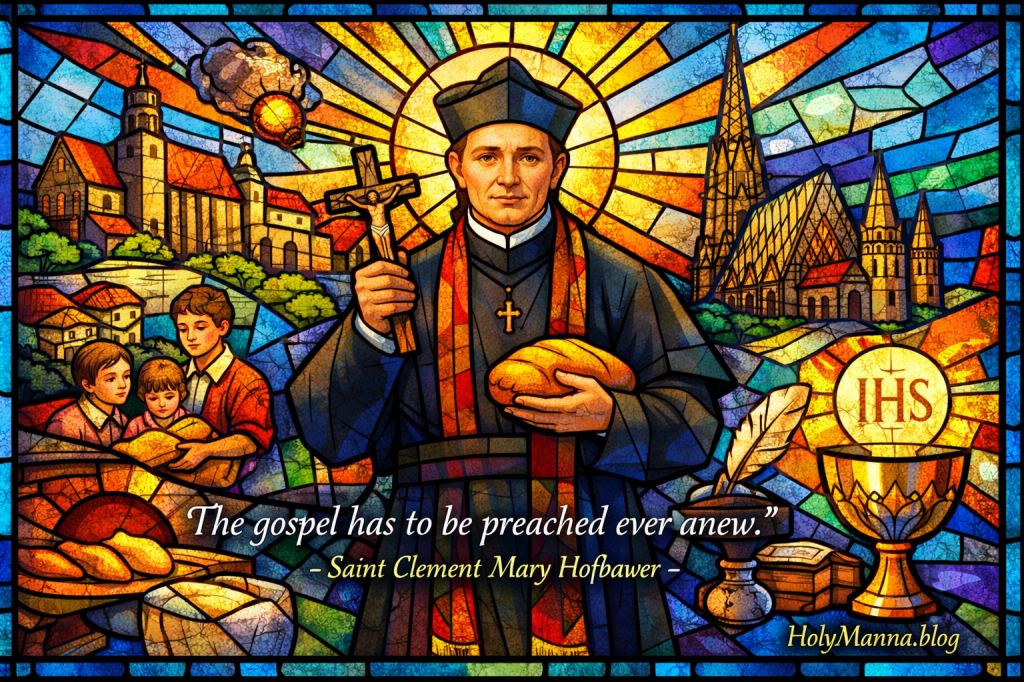
The Baker Who Rekindled a City
Saint Clement Mary Hofbauer has a way of sneaking up on a soul. He was not born into comfort. He did not glide into a polished religious career. He did not become holy because life was easy or because the world applauded him. He became holy because he would not stop trusting that God can build a saint out of ordinary work, setbacks, and a stubborn desire to bring people back to Jesus.
The Church remembers him as a Redemptorist priest, often called a second founder of the Redemptorists because he carried the mission of Saint Alphonsus beyond Italy and planted it in places where it seemed impossible. He is celebrated as the Apostle of Vienna, and he is honored as a patron of Vienna and of bakers, which is fitting because he knew the smell of flour long before he ever preached from a pulpit.
His story matters because it shows what the Church teaches so clearly, that holiness is not a prize for the perfect, but a calling for the faithful. The saints are not museum pieces. They are proof that the Gospel can be lived in real life, in real places, under real pressure, and still bear fruit. That is exactly why the Church says the saints are a continual witness and a continual call to renewal, CCC 828.
Flour on the Hands, Fire in the Heart
Clement was born Johannes Hofbauer in 1751 in Moravia, in a world where being poor could shut doors fast. After his father died, the dream of priesthood did not disappear, but it became complicated. Seminary cost money, and he did not have it. So he worked. He learned the trade of a baker. He served where he could. He studied when he could. He kept walking forward with the kind of patience that is easy to admire and hard to imitate.
At different moments he tried the hermit life, not because he was chasing a spiritual hobby, but because he was searching for where God wanted him. The twists in his path were not wasted. They formed him. They humbled him. They trained him to rely on grace, not control. That is the quiet genius of God, shaping a missionary heart in hidden places.
If there is a conversion story here, it is not a conversion from unbelief to belief. It is a conversion from self planning to surrender. His faith deepened through disappointment, through waiting, and through learning to serve without being seen. That is a very Catholic kind of growth, the slow purification of desire that the Church describes as the path of holiness, CCC 2012–2014.
A Mission Too Big for One Country
Eventually, providence opened what poverty had closed. Benefactors helped him study. Clement and a close companion, Thaddäus Hübl, made their way to Rome. In 1785 they entered the Congregation of the Most Holy Redeemer, the Redemptorists, founded by Saint Alphonsus to preach the Gospel especially to the poor and the spiritually abandoned.
Clement was ordained a priest, and almost immediately the mission turned outward. The plan was to found Redemptorist life beyond Italy, but the political climate in the Austrian lands made foundations difficult. So Clement did what faithful missionaries do. He adjusted without quitting. He went where the doors opened, and the most important door opened in Warsaw.
This is where Clement becomes unforgettable. He did not preach like a man building a personal brand. He preached like a man who believed souls were at stake, and who believed Christ’s mercy was not a rumor, but a living reality in the Church, especially in the sacraments, CCC 1422–1498.
Warsaw’s Perpetual Mission
In Warsaw, Clement and his companions were given St. Benno’s Church. What followed became famous in Redemptorist memory: a kind of constant missionary rhythm sometimes described as a perpetual mission. The doors were open wide. Preaching was frequent. Confessions were constant. Catechesis was serious. Charity was real.
Clement did not separate doctrine from mercy. He preached clearly, but he also fed the hungry and cared for the abandoned. He helped establish care for orphans and education for boys, and he begged for them when he had to. This is not sentimental charity. This is the corporal works of mercy as a way of life, CCC 2447.
One story that has been treasured in Redemptorist tradition captures his humility and his love for those children. It is said that when he was insulted or mocked while begging, he absorbed the humiliation and immediately turned the moment toward the boys who depended on him. “This is for me. Now, what do you give my boys?” That line sounds like a saint, because it sounds like someone who learned how to let pride die so that love could live.
Warsaw was not peaceful. Empires were shifting. Suspicion and violence hung in the air. Yet Clement kept preaching Christ. The Church’s mission is not a luxury for calm seasons. It is the Church’s identity, CCC 849–856. Clement lived that like he meant it.
When the World Turns Hostile
Clement’s mission drew resistance, not only because he was zealous, but because the times were harsh and the Church was often treated like a political problem. Redemptorist tradition recounts a dramatic moment during conflict in Warsaw when bombs crashed through the roof of the church and did not explode. People remembered it as providential protection, a sign that God was not absent even when chaos was loud.
That story is part of the traditional memory around Clement, and it is shared as a remarkable deliverance. It cannot be independently verified with the kind of documentation modern readers might want, but it has long been repeated within Catholic Redemptorist tradition as a sign of God’s care.
Later the mission was suppressed, the community was expelled, and Clement tasted the humiliation of seeing good work dismantled. Some accounts also recall a period of imprisonment connected to the suppression. Clement did not respond with bitterness. He responded like a priest who believed that God’s will is not stopped by human power, only redirected into a new mission field.
Vienna’s Quiet Revolution
When Clement came to Vienna, he did not arrive as a celebrated hero. He arrived as a priest who had lost a major mission field and had to begin again. And yet, Vienna became the place where his legacy grew even more.
He served as chaplain and spiritual director, including ministry connected with an Ursuline community, and his influence spread in a very Catholic way, through preaching, spiritual direction, confession, and personal holiness. He reached ordinary laborers and high society. He reached students and intellectuals. He reached people who had grown cold toward the Church. He did not win them by being trendy. He won them by being clear, kind, and relentlessly available.
In Vienna, Clement became associated with a renewal of Catholic life, and he influenced a circle that included notable thinkers and writers of his era. There is a reason he is called the Apostle of Vienna. He helped make faith feel real again in a city that had every reason to drift into spiritual boredom.
This is also why one line tied to him is remembered so often in the Redemptorist family. “The gospel has to be preached ever anew.” It is not a slogan. It is a diagnosis. People do not stop needing Jesus just because they have heard His name before. Clement understood that, and he lived it.
A Saint Still Working
Clement died in Vienna on March 15, 1820, and devotion to him grew. His memory did not stay trapped in history books. The Church eventually beatified him and later canonized him, and he was proclaimed patron of Vienna and of bakers. That is the Church putting a spotlight on a simple truth: the man who once worked with bread became a sign of the Bread of Life, the Eucharist, which is the source and summit of the Christian life, CCC 1324.
Stories of healings were later connected to his intercession. In accounts preserved in Redemptorist circles, two striking healings in Vienna in the nineteenth century were attributed to his intercession, involving grave physical conditions and sudden recovery after prayer and the use of a relic. These accounts are part of the tradition surrounding his cause and are presented as miracles in that context.
There are also broader signs of impact that are not “miracles” in the sensational sense, but are still deeply supernatural. Conversions. Vocations. Renewed love for confession. Renewed Eucharistic devotion. Reconciled families. A city remembering a priest as its patron. These are the kinds of fruits that last.
Today his relics are venerated in Vienna, and the places tied to his ministry remain part of Catholic memory and pilgrimage. Warsaw also remembers him with affection because his missionary labor there marked an era.
The Saint Who Teaches Perseverance
Saint Clement Mary Hofbauer is a gift for anyone who feels stuck, delayed, or discouraged. His life says that God is not rushing, but God is never wasting time. A poor baker became a priest. A frustrated founder became an apostle. A rejected missionary became a patron of a city.
Here is the lesson worth carrying into daily life. Do not romanticize holiness. Choose it. Choose it in the ordinary. Choose it when plans collapse. Choose it when nobody claps. Clement’s greatness was built on daily fidelity and sacramental seriousness.
If someone wants to imitate him, the path is not complicated, but it is demanding. Stay close to the sacraments, especially confession and the Eucharist, CCC 1422–1498 and CCC 1324. Take catechesis seriously so faith does not become a vague feeling. Practice mercy in concrete ways, not just in opinions, CCC 2447. And keep speaking the Gospel with confidence and patience, because Christ never stops seeking the lost, CCC 849–856.
What would change this week if faith stopped being a private feeling and became a mission of love toward the people God has placed nearby?
Where has discouragement been pretending to be “realism,” and how might Saint Clement’s perseverance expose that lie?
Engage with Us!
Share thoughts and reflections in the comments below, because the saints are meant to be lived with, not simply read about.
- What part of Saint Clement Mary Hofbauer’s story felt most relatable, the delayed vocation, the setbacks, or the relentless charity?
- What is one practical way to “preach the Gospel ever anew” in daily life, at home, at work, or with friends, without being preachy or weird?
- What is one work of mercy that can be done this week, quietly and concretely, for someone who is struggling?
- What is one sacramental habit that needs strengthening right now, especially confession or Sunday Mass, and what is one step that makes it easier to follow through?
May Saint Clement Mary Hofbauer pray for every tired heart that wants to begin again. May his example strengthen the resolve to live a life of faith, and to do everything with the love and mercy Jesus taught, with courage, clarity, and a joyful heart.
Saint Clement Mary Hofbauer, pray for us!
Follow us on YouTube, Instagram and Facebook for more insights and reflections on living a faith-filled life.

 Holy Manna!
Leave a comment