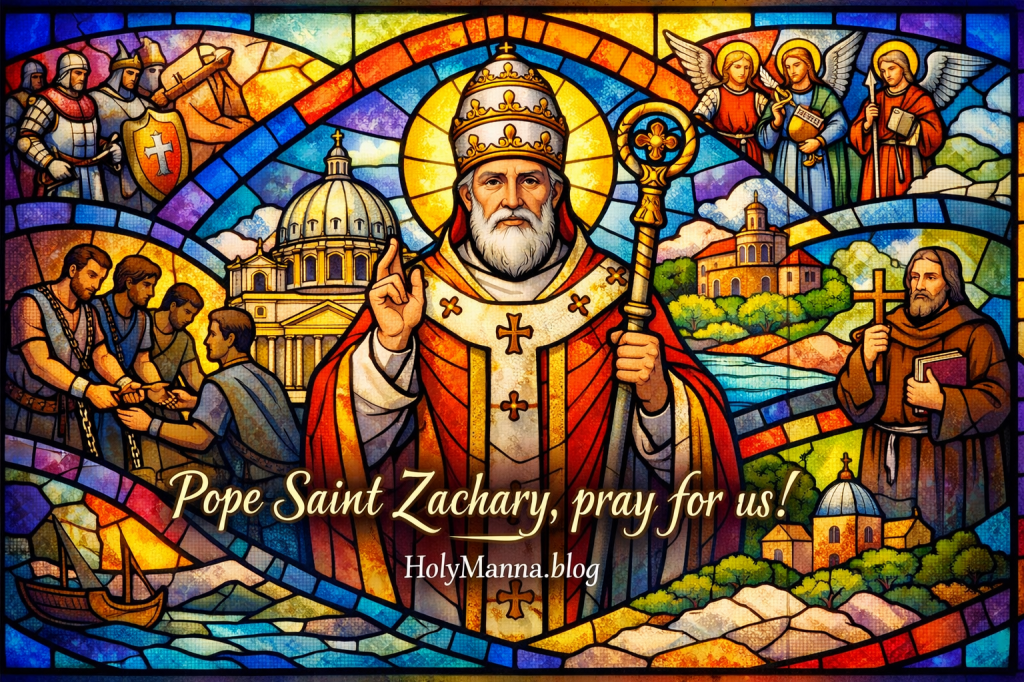
The Pope Who Won Wars Without Weapons
If someone ever wonders how the Church survived some of the most chaotic centuries in European history, Pope Saint Zachary is part of the answer. He did not lead armies. He did not thunder from the balcony with dramatic speeches. He did something harder. He held the line with holiness, clear teaching, and fearless diplomacy, when Rome was surrounded by threats and the wider Christian world was divided by fierce controversies.
He is remembered as a peacemaker who protected Rome from the Lombards, a steady ally of great missionaries like Saint Boniface, and a shepherd who defended the Church’s discipline and sacraments with calm precision. His life is a reminder that leadership in the Church is not first about power. It is about guarding the flock, serving the truth, and trusting that Christ is still Lord of history. That is exactly the kind of pope the Church needed in the eighth century.
From Calabria to the Chair of Peter
Zachary was born into a Greek family in Calabria, in southern Italy. His father’s name is remembered as Polichronius. Even those simple details matter, because Zachary stood at the crossroads of East and West. His Greek roots helped him understand the world of Constantinople, while his Roman service shaped him into a disciplined, practical churchman.
Before becoming pope, he served in the Roman Church and appears connected to the clergy leadership of his time. When Pope Gregory III died, Zachary was elected quickly, and he stepped into a storm. Rome was vulnerable. Political alliances shifted constantly. The emperor in the East was tangled in religious conflict. The Lombards pressed in from the north. Zachary’s conversion story is not a dramatic moment of “before and after.” It is something more recognizable and more challenging. It is the conversion of a man who stays faithful over decades, who keeps saying yes to responsibility, and who lets that fidelity form him into a saint.
A Pope Who Defended Holy Images Because Christ Took Flesh
One of the defining conflicts of the era was iconoclasm, the attempt to destroy or forbid sacred images. Zachary had to deal with an empire that was not only politically powerful but also pushing religious policies that threatened Catholic practice. Zachary’s approach was strong but careful. He resisted the errors without tearing the Church apart through reckless escalation.
This matters because sacred images are not “decoration” in Catholic life. They are witnesses to the Incarnation. The Son of God truly took a human face. Christianity is not an idea floating in the clouds. It is the Word made flesh. That is why the Church defends the right and value of holy images, rooted in the mystery of Christ’s true humanity, as taught in CCC 1159 to 1162.
Zachary’s stand belongs in that same Catholic logic. He defended the faith not by shouting, but by shepherding the Church through a dangerous and confusing moment.
The Peacemaker Who Faced Kings Without Flinching
When the Lombard king Liutprand threatened Roman territories, Zachary did something that sounds almost unbelievable today. He went in person and negotiated. He secured the return of cities and lands, recovered Church property, and established a long truce. He did not accomplish that because he had military strength. He accomplished it because God gave him a rare combination of courage, wisdom, and moral authority.
This is where Zachary’s story starts to feel like one of the Beatitudes lived out in real time. “Blessed are the peacemakers, for they will be called children of God.” Matthew 5:9.
Zachary’s peacemaking was not soft. It was costly. It required travel, risk, and a willingness to put himself between the wolves and the flock.
The “Miracles” of Reform, Clarity, and Courage
Catholic sources do not preserve a clear catalog of miraculous healings or dramatic wonders performed by Pope Saint Zachary during his lifetime. That should not be forced or embellished. Sainthood does not require a public list of miracles attached to a person’s biography.
Still, there are moments in his life that feel like God’s providence moving through a faithful shepherd. He repeatedly prevented war, saved cities from devastation, and protected vulnerable people when the powerful treated them like property.
One of the most striking examples of his charity involves enslaved Christians. When slave traders sought to purchase people in Rome in order to sell them abroad, Zachary intervened in the most concrete way possible. He bought them, not to own them, but to set them free. That act shines with the Church’s insistence that every human person bears a dignity that cannot be reduced to a price, a labor output, or a political convenience. Even when history is dark, the saints show what it looks like to live as if Christ truly meant what He said about the least and the vulnerable.
Zachary also strengthened the Church by rebuilding and restoring sacred places in Rome. He worked to repair churches and stabilize the life of the city, not as a mere administrator, but as a pastor who believed that the visible life of the Church supports the invisible work of grace.
A Teacher of the Sacraments Who Refused Scrupulosity
One of the most important things Zachary left behind is clarity about the sacraments, especially Baptism. In a correspondence connected with Saint Boniface’s missionary work, Zachary addressed cases where the baptismal formula had been mangled by poor Latin. Zachary’s ruling was sober and deeply Catholic. If the minister did not intend heresy and intended to do what the Church does, then the Church should not spiral into panic and start repeating Baptism.
His line is famous because it is so direct: “We cannot agree to a repetition of the baptismal rite.”
That is classic Catholic sacramental realism. The sacraments are Christ’s work, not a magic spell dependent on perfect performance. The Church protects validity, but she also protects peace of conscience. Baptism leaves an indelible mark and is not repeated, as taught in CCC 1272 and CCC 1280. Zachary’s judgment helps Catholics avoid both extremes. It avoids carelessness, and it avoids anxious superstition.
A Pope Who Guarded Devotion From Going Off the Rails
Mission territory can be messy. New converts often bring old superstitions with them. Zachary supported the missionary reform work of Saint Boniface and helped the Church correct dangerous spiritual distortions.
A classic example involves invented angel names and unhealthy fascination with secret spiritual knowledge. The Church honors angels, as taught in CCC 328 to 336, but she rejects fantasies that lead people away from Christ and into obsession.
The line associated with the Roman action in this missionary reform context is blunt and memorable: “There are only three angels, Michael, Gabriel and Raphael.”
This was not meant to deny the existence of other angels. It was meant to cut off a trend of naming and invoking supposed angels that were not part of Christian revelation and that could easily become spiritually harmful.
When a Pope Helped Decide the Fate of Kingdoms
Zachary’s influence reached far beyond Rome. In the Frankish world, a massive political shift was underway. The question was simple but explosive. Should a man be called king if he holds no real power, while another man governs everything in practice?
Zachary gave an answer that helped reshape European history. His judgment helped clear the way for Pepin to become king, which eventually laid groundwork for the Carolingian era and the future alignment between the papacy and the Franks.
This moment is often misunderstood as if it were just politics. In reality, it shows how the Church sometimes has to speak into real-world questions of moral legitimacy, leadership, and the common good. The pope is not merely a spiritual influencer. He is the successor of Peter, tasked with strengthening the brethren and guarding unity, as expressed in CCC 880 to 882.
A Saint Forged in Pressure, Not Blood
Pope Saint Zachary was not martyred, but he lived in a constant pressure cooker. His hardships were the grind of responsibility when everything could collapse. He faced military threats from the Lombards, religious conflict driven by imperial iconoclasm, and the enormous challenge of supporting missionary reform across Europe while keeping Rome stable.
He endured by doing what saints often do. He stayed faithful to daily duty. He negotiated peace without surrendering truth. He protected the Church’s worship and discipline without becoming rigid or cruel. He built, repaired, and restored, even when chaos made those efforts feel fragile.
This is an important reminder for modern Catholics. Not every saint dies dramatically. Some saints die tired, having spent themselves keeping the lamp burning.
The Legacy That Kept Working
Catholic historical sources do not preserve a strong stream of miracle stories at Zachary’s tomb in the way some saints are known for. That should be stated plainly, because devotion should rest on truth.
Still, his impact after death is undeniable, and it looks like a slow-moving grace that reshaped the map. His work with Saint Boniface strengthened the Church’s missionary structure in German lands. His support of reform helped protect Christian life from corruption and confusion. His decisions and diplomacy helped stabilize the papacy’s role in a violent era, which shaped the centuries that followed.
His cultural impact is also visible in the way his pontificate helped set the stage for a new relationship between the papacy and the Frankish world. That relationship would later become central to Western Christendom. Even when a saint’s relics are quiet and their miracle stories are few, their faithful decisions can still become instruments of God’s providence across generations.
Zachary is commemorated by the Church on March 15, and his burial in Rome connects him to the living memory of the Apostolic See. His legacy is not centered on spectacle. It is centered on stability, reform, mercy, and courage.
What Pope Saint Zachary Teaches Modern Catholics
Pope Saint Zachary is a saint for anyone who feels stuck between forces they cannot control. He teaches that holiness is not passivity. It is faithful action rooted in truth.
He teaches that peacemaking is not people-pleasing. It is the hard work of protecting the vulnerable, standing firm in doctrine, and choosing unity without compromising Christ.
He teaches that Catholic life needs both devotion and discipline. The heart must love God, and the mind must stay grounded in what the Church actually teaches. That is why he cared about sacraments, about true devotion to angels, and about reform in mission lands.
His story also challenges modern Catholics to take mercy seriously in practical ways. He did not merely condemn evil. He acted to free enslaved people when it cost him something. That is a real examination of conscience for any generation.
Where is peace needed right now, not as a feeling, but as a concrete act of courage and charity?
Where is confusion creeping into faith, and how can it be corrected with truth and patience instead of pride?
Where is mercy being reduced to words, when Christ calls for action?
Engage with Us!
Share your thoughts and reflections in the comments below. Let the conversation build up the Church, because honest reflection helps everyone walk more steadily toward Christ.
- Where is God calling for peacemaking in your life right now, in your family, workplace, or parish?
- What is one area of your spiritual life that needs clearer discipline, especially around prayer, devotion, or sacramental life?
- How can you practice mercy in a concrete way this week, especially toward someone who cannot repay you?
- What does Pope Saint Zachary’s calm courage reveal about how you handle pressure and conflict?
- What is one practical step you can take to deepen your trust in the Church’s wisdom, especially in confusing times?
Keep going. Live a life of faith. Do everything with the love and mercy Jesus taught us, and let the quiet strength of the saints remind you that God still writes history through humble obedience.
Pope Saint Zachary, pray for us!
Follow us on YouTube, Instagram and Facebook for more insights and reflections on living a faith-filled life.

 Holy Manna!
Leave a comment