Fourth Sunday of Lent – Lectionary: 31
When God Teaches the Heart to See
There are moments when God quietly exposes how easily the human heart confuses appearance with truth. The Fourth Sunday of Lent, often called Laetare Sunday, arrives like a warm break in a long fast, and the Church dares to whisper joy even before Easter arrives. The liturgy traditionally softens the penitential mood because the finish line is closer than it looks, and because today’s readings announce something even more personal than relief. They announce a new way of seeing. In 1 Samuel 16:1, 6-7, 10-13, the Lord overturns Samuel’s instincts and teaches him that holiness and vocation cannot be measured by height, strength, or status, because “The LORD looks into the heart.” In Psalm 23, that same Lord is not only Judge and King, but Shepherd and Host, guiding, protecting, and even anointing, as though God’s mercy were meant to be felt, not merely understood.
That story of anointing and guidance opens naturally into the baptismal heartbeat of Lent. In many parishes, these Sundays were shaped for the ancient catechumens preparing for Baptism at Easter, and the Church still prays them that way, especially in the Year A cycle with John 9. St. Paul speaks to believers who have already crossed from the old life into Christ, reminding them in Ephesians 5:8-14 that conversion is not cosmetic. It is a change of identity. “You were once darkness, but now you are light in the Lord. Live as children of light.” Then the Gospel places that claim into flesh and mud and water, as Jesus heals a man blind from birth and draws him, step by step, into faith bold enough to worship. The miracle is not only that eyes open, but that a soul learns to say the most honest creed a modern person can still offer: “One thing I do know is that I was blind and now I see.”
What might change if the day’s prayer became less about proving something to God and more about letting Christ heal what is still blind inside the heart?
First Reading – 1 Samuel 16:1, 6-7, 10-13
God Chooses the Hidden Heart, Not the Highlight Reel
Israel’s first experiment with monarchy has already gone sideways. Saul has been rejected as king, not because God enjoys humiliating leaders, but because Saul’s heart has drifted from obedience into self-protection and image management. Samuel, the prophet and judge, is grieving like a spiritual father who watched a son waste his calling. In that ache, the Lord gives Samuel a hard mercy: stop clinging to what God has already moved past, because a new anointing is coming.
This scene unfolds in Bethlehem, a small town that would have seemed insignificant to the powerful. Jesse’s household is not a royal court, and the chosen one is not even invited to the lineup. That is the point. The Lord is training His people to recognize a different kind of king, one whose strength begins in the interior. Today’s theme of light and sight starts here, because the Lord teaches Samuel, and every reader, that spiritual vision is not about spotting the tallest candidate. It is about learning to see as God sees, with the heart.
1 Samuel 16:1, 6-7, 10-13 – New American Bible (Revised Edition)
Samuel Is Sent to Bethlehem. 1 The Lord said to Samuel: How long will you grieve for Saul, whom I have rejected as king of Israel? Fill your horn with oil, and be on your way. I am sending you to Jesse of Bethlehem, for from among his sons I have decided on a king.
6 As they came, he looked at Eliab and thought, “Surely the anointed is here before the Lord.” 7 But the Lord said to Samuel: Do not judge from his appearance or from his lofty stature, because I have rejected him. God does not see as a mortal, who sees the appearance. The Lord looks into the heart.
10 In the same way Jesse presented seven sons before Samuel, but Samuel said to Jesse, “The Lord has not chosen any one of these.” 11 Then Samuel asked Jesse, “Are these all the sons you have?” Jesse replied, “There is still the youngest, but he is tending the sheep.” Samuel said to Jesse, “Send for him; we will not sit down to eat until he arrives here.” 12 Jesse had the young man brought to them. He was ruddy, a youth with beautiful eyes, and good looking. The Lord said: There—anoint him, for this is the one! 13 Then Samuel, with the horn of oil in hand, anointed him in the midst of his brothers, and from that day on, the spirit of the Lord rushed upon David. Then Samuel set out for Ramah.
Detailed Exegesis
Verse 1 “The Lord said to Samuel: How long will you grieve for Saul, whom I have rejected as king of Israel? Fill your horn with oil, and be on your way. I am sending you to Jesse of Bethlehem, for from among his sons I have decided on a king.”
The Lord does not scold Samuel for grieving. He redirects him. Grief can be holy, but it becomes dangerous when it turns into paralysis. The horn of oil signals that God’s answer is not merely political. It is sacramental in flavor, a visible sign pointing to an invisible choice. God is not improvising. He has already “decided on a king,” which teaches that divine providence is not reactionary. It is steady, even when human leadership fails. Bethlehem matters, too. God loves to begin great restorations in places the world overlooks.
Verse 6 “As they came, he looked at Eliab and thought, ‘Surely the anointed is here before the Lord.’”
Samuel is experienced, faithful, and still vulnerable to surface-level judgment. Eliab looks the part. He fits the cultural expectation of what leadership should look like. The verse is honest about how temptation works. It does not always arrive as something obviously evil. Sometimes it arrives as something that simply looks reasonable.
Verse 7 “But the Lord said to Samuel: Do not judge from his appearance or from his lofty stature, because I have rejected him. God does not see as a mortal, who sees the appearance. The Lord looks into the heart.”
This is one of Scripture’s great corrections. God is not impressed by the traits that impress crowds. The Lord’s gaze is not shallow, and His judgment is not cosmetic. The “heart” in biblical language is not merely emotion. It is the interior core of decision, desire, conscience, and worship. The Lord is teaching Samuel that discernment must be purified. A prophet must learn to see beyond charisma and toward fidelity. This verse also exposes a subtle spiritual danger: the habit of treating people as “appearances” instead of souls.
Verse 10 “In the same way Jesse presented seven sons before Samuel, but Samuel said to Jesse, ‘The Lord has not chosen any one of these.’”
Seven sons feels complete, like the story should end here. In Scripture, seven often signals fullness. That makes this moment feel even more surprising. The Lord refuses the neat conclusion. This verse teaches that discernment can require patience and humility. Samuel is willing to say, clearly and publicly, that none of the obvious options are the one. That takes courage, because it invites confusion and criticism.
Verse 11 “Then Samuel asked Jesse, ‘Are these all the sons you have?’ Jesse replied, ‘There is still the youngest, but he is tending the sheep.’ Samuel said to Jesse, ‘Send for him; we will not sit down to eat until he arrives here.’”
The chosen son is not in the room, which exposes how families and societies can unconsciously rank human worth. The youngest is assigned the low-visibility work, the kind of work that smells like animals and never gets applause. Yet Samuel insists on waiting. The line about not sitting down to eat is more than manners. It signals reverence for God’s choice. When the Lord is selecting, no one gets to rush the process, and no one gets to dismiss the “least important” person as an afterthought.
Verse 12 “Jesse had the young man brought to them. He was ruddy, a youth with beautiful eyes, and good looking. The Lord said: There, anoint him, for this is the one!”
Scripture is not allergic to describing David’s appearance, but it refuses to make appearance the foundation of election. David is pleasing to look at, yet he is chosen for deeper reasons. The description sets up a contrast: even when someone has outward gifts, God’s choice still goes deeper than optics. The Lord’s command is direct and unmistakable. Discernment reaches clarity when God speaks, and the community is invited to accept what it might not have expected.
Verse 13 “Then Samuel, with the horn of oil in hand, anointed him in the midst of his brothers, and from that day on, the spirit of the Lord rushed upon David. Then Samuel set out for Ramah.”
The anointing happens “in the midst” of the brothers, which means God’s call is not always private. Sometimes it is public and humbling for everyone involved. The Spirit “rushed upon” David, signaling empowerment for mission, not merely personal comfort. This is not the Spirit as a warm feeling. This is the Spirit as divine strengthening for a vocation that will include battles, temptations, failures, repentance, and perseverance. Samuel’s quiet departure back to Ramah underscores that the prophet’s job is obedience, not control. He anoints, and then he gets out of the way.
Teachings
This reading teaches that God’s way of choosing is a kind of holy reversal. The world hunts for the tallest, the loudest, the most polished. The Lord searches for the heart that can be formed. That does not mean God prefers weakness for its own sake. It means God prefers humility, because humility can receive grace.
The Church understands this pattern as part of a larger biblical logic that reaches its fulfillment in Jesus Christ. David, the anointed shepherd-king from Bethlehem, points forward to Christ, the true Anointed One, also associated with Bethlehem and the house of David. The language of anointing matters because the Church teaches that oil and anointing are not random religious props. They are signs that speak. CCC 695 says “Anointing. The symbolism of anointing with oil also signifies the Holy Spirit, to the point of becoming a synonym for the Holy Spirit.” That helps explain why the reading does not merely say David was selected. It says the Spirit rushed upon him. God’s choice is accompanied by God’s gift.
This is also why the Church speaks of Baptism and Confirmation as sacraments that mark the Christian with Christ’s own anointing. The Christian life is not only moral improvement. It is participation in the life of the Anointed One. When the Lord teaches Samuel to see the heart, He is already preparing the Church to recognize the King who will reign from a Cross, and to recognize His people who will be called to live with interior light even when the world judges only by appearances.
The saints often echo this spiritual realism. They warn that the eye can be trained to admire the wrong things, and the heart can be trained to desire the wrong praise. The remedy is not cynicism about outward gifts. The remedy is conversion of vision, learning to ask what the Lord values: obedience, truth, repentance, and love. David will later fall in serious ways, but he will also repent with seriousness. That is part of what God sees in the heart: not perfection, but a heart that returns.
Reflection
This reading lands like a gentle but firm question for modern life, because the modern world is loud with appearances. People are evaluated by snapshots, resumes, style, and confidence. Even spiritual life can become performance if the heart is not guarded. The Lord’s words to Samuel are not only about picking a king. They are about how to look at a spouse, a coworker, a child, a priest, a parish, and even the person in the mirror.
A good Lenten practice here is to slow down judgments. When a strong first impression rises, it can be offered to God instead of obeyed. When someone seems unimpressive, it becomes an act of faith to remember that the Lord may be doing His best work in hidden places. It also applies inwardly. Many people assume God must be disappointed because they feel ordinary, or because their life looks small compared to others. Yet David was literally out with sheep when God called him.
Where has the heart been tempted to chase appearance, approval, or being impressive, rather than chasing fidelity?
Who has been quietly dismissed because they did not “look” important, even though the Lord might be inviting deeper respect and love?
What would change this week if prayer became less about managing an image and more about asking God to purify the heart?
The story ends with oil poured and the Spirit rushing, which is a reminder that God never calls without also supplying grace. If the Lord is asking for a truer heart, He is also offering the strength to become that person, one obedient step at a time.
Responsorial Psalm – Psalm 23
The Shepherd Who Leads Through Shadows and Sets a Table in the Light
Long before this psalm became familiar at funerals and hospital bedsides, it was the prayer of a people who understood danger, distance, and the daily grind of survival. Ancient Israel lived close to the reality of predators, drought, enemies, and sudden loss. In that world, calling the Lord “shepherd” was not sentimental. It was a bold confession that God protects, guides, and provides when life feels exposed.
Tradition attributes this psalm to David, the shepherd who became king, which makes its placement today feel almost seamless. In the First Reading, the Lord chooses David not for appearance but for the heart, and then anoints him. In this psalm, that same Lord shepherds the soul, leads through the valley, and even anoints the head with oil. The story keeps moving toward the day’s central theme: God teaches His people how to see and how to trust. The Shepherd does not only point out the path. The Shepherd walks it with His people, guiding them out of darkness and into a home where mercy outlasts fear.
Psalm 23 – New American Bible (Revised Edition)
The Lord, Shepherd and Host
1 A psalm of David.
The Lord is my shepherd;
there is nothing I lack.
2 In green pastures he makes me lie down;
to still waters he leads me;
3 he restores my soul.
He guides me along right paths
for the sake of his name.
4 Even though I walk through the valley of the shadow of death,
I will fear no evil, for you are with me;
your rod and your staff comfort me.5 You set a table before me
in front of my enemies;
You anoint my head with oil;
my cup overflows.
6 Indeed, goodness and mercy will pursue me
all the days of my life;
I will dwell in the house of the Lord
for endless days.
Detailed Exegesis
Verse 1 “The LORD is my shepherd; there is nothing I lack.”
This opening line sets the relationship before it addresses the problem. The psalm does not begin with a list of threats. It begins with belonging. A shepherd does not manage sheep from a distance. A shepherd stays near, watches, and intervenes. “There is nothing I lack” does not mean the believer never suffers. It means the believer is not abandoned, and what is truly necessary for salvation will not be withheld. This is the foundation for the courage that shows up later in the valley.
Verse 2 “In green pastures he makes me lie down; to still waters he leads me.”
Green pastures and still waters are not decoration. They are images of survival and rest in a land where both could be scarce. The phrase “makes me lie down” suggests safety. Sheep do not rest if they sense danger. The Lord is portrayed as the One who does not merely command peace but provides it. Spiritually, this verse echoes the rhythm of prayer and worship, where God restores what anxiety drains.
Verse 3 “He restores my soul. He guides me along right paths for the sake of his name.”
The Lord restores from the inside out. The soul is not repaired by distraction but by guidance and truth. “Right paths” are not whatever feels right in the moment. They are paths aligned with God’s will. The phrase “for the sake of his name” is crucial because it means God’s faithfulness is anchored in who He is. He guides because He is good, and His glory is revealed in saving His people.
Verse 4 “Even though I walk through the valley of the shadow of death, I will fear no evil, for you are with me; your rod and your staff comfort me.”
This is where the psalm turns from third person to direct address. The prayer becomes personal, as if the darkness forces the believer to speak to God more directly. The “valley” is not an imagined fear. It is the narrow place where threats feel close, where the sun can be blocked, where escape looks uncertain. The courage here is not bravado. It is companionship. “You are with me” is the reason fear loses its power. The rod and staff symbolize protection and guidance, a reminder that God’s authority is not oppressive but saving.
Verse 5 “You set a table before me in front of my enemies; you anoint my head with oil; my cup overflows.”
The image shifts from shepherding to hospitality. In the ancient world, setting a table was an act of covenant friendship and protection. To eat under someone’s roof meant safety under their honor. The enemies do not vanish, but they no longer control the story. The anointing with oil speaks of welcome, dignity, and blessing, the kind given to honored guests. The overflowing cup is abundance that is not earned, a generosity that feels almost excessive. In today’s liturgy, this verse naturally resonates with the Lord’s table and with the language of anointing that runs through David’s story and through the sacramental life of the Church.
Verse 6 “Indeed, goodness and mercy will pursue me all the days of my life; I will dwell in the house of the LORD for endless days.”
The final line does not say the believer will chase goodness and mercy. It says goodness and mercy will chase the believer. The Lord’s faithful love is not passive. It pursues. The destination is not merely relief from trouble but communion, dwelling in the Lord’s house. The psalm ends where Lent aims: not simply improved behavior, but a life turned toward home, a life that longs to remain with God.
Teachings
The Church has always heard in Psalm 23 the voice of Christ, the true Shepherd, and the voice of the Church, His flock. The Shepherd image is not a poetic accident. It belongs to God’s way of revealing Himself as One who gathers, protects, and leads. The Catechism speaks of the Church with shepherd language that fits this psalm’s tone of belonging and guidance. CCC 754 says “The Church is accordingly a sheepfold, the sole and necessary gateway to which is Christ. It is also the flock of which God himself foretold he would be the shepherd, and whose sheep are in spite of their human shepherds, unfailingly nourished and led by Christ himself, the good Shepherd and the Prince of Shepherds, who gave his life for the sheep.”
The psalm’s table imagery also points toward the Eucharistic life of the Church. It is not a forced connection. Scripture itself trains believers to recognize God’s saving presence in meals, covenant hospitality, and divine provision. The Catechism describes the Eucharist as a true banquet of the Lord. CCC 1329 says “The Eucharist is called ‘the Lord’s Supper’ because of its connection with the supper which the Lord took with his disciples on the eve of his Passion and because it anticipates the wedding feast of the Lamb in the heavenly Jerusalem.” When Psalm 23 speaks of a table prepared in the presence of enemies, the Church hears more than comfort. She hears a sacramental prophecy of the Lord feeding His people while they still live in a world of conflict and temptation.
Finally, the psalm’s anointing line connects to the day’s broader theme of God marking and strengthening His chosen ones. The anointing of David in 1 Samuel 16 and the anointing language of Psalm 23 prepare the mind for the Church’s understanding of oil as a sign of the Holy Spirit. CCC 695 says “Anointing. The symbolism of anointing with oil also signifies the Holy Spirit, to the point of becoming a synonym for the Holy Spirit.” In Lent, this matters because conversion is not merely moral effort. It is grace. God does not only tell His people where to walk. He strengthens them to walk it.
Reflection
This psalm speaks to ordinary life because it refuses to pretend life is tidy. It does not deny valleys, enemies, or fear. It simply refuses to give them the final word. That is a deeply Catholic kind of realism, the kind that can look suffering in the face and still pray with confidence because the Shepherd is near.
A practical way to live this psalm is to notice where fear has started driving decisions. Fear can make people lash out, shut down, compromise, or isolate. This psalm offers a different script: stay close to the Shepherd, keep walking the right path, and trust that God can prepare a table even when problems are still present. The table image is especially important for a week like this. It invites reverence for Sunday Mass, and it invites a renewed seriousness about receiving the Lord with attention and gratitude, because the Eucharist is not a religious accessory. It is a place of strength.
Where does life currently feel like “the valley of the shadow of death,” not necessarily because of dramatic tragedy, but because hope feels thin and the heart feels tired?
What would change if the day’s prayer shifted from “Why is this happening?” to “Lord, stay with me, and lead me on the right path”?
Is the soul chasing goodness and mercy through control and overthinking, instead of letting God’s goodness and mercy pursue it through prayer, confession, and faithful worship?
The Shepherd of Psalm 23 does not promise an easy road. He promises His presence, His guidance, and a home at the end of the journey. That is why this psalm fits so perfectly with a Lent that is learning to see. The eyes may still notice danger, but the heart learns to notice God first.
Second Reading – Ephesians 5:8-14
From Night to Noon: When Baptism Turns the Lights On
Ephesus was not a quiet little church town. It was a major Roman city, crowded with commerce, status games, and pagan worship, including a culture that treated the body, pleasure, and power as tools for self-rule. Into that world, St. Paul speaks to Christians who have been pulled out of one way of living and planted into another. He does not talk to them like they are merely “improving.” He talks to them like they have crossed a threshold. They used to belong to darkness, but now they belong to Christ.
That is why this reading fits so perfectly with today’s theme of sight and light. David is chosen because God sees the heart. The blind man is healed because Christ is the Light of the world. Psalm 23 promises guidance through the valley. Now St. Paul tells the baptized what all of that means in daily life: the Christian does not flirt with the dark anymore. The Christian learns to walk in the light, even when it costs something.
Ephesians 5:8-14 – New American Bible (Revised Edition)
8 For you were once darkness, but now you are light in the Lord. Live as children of light, 9 for light produces every kind of goodness and righteousness and truth. 10 Try to learn what is pleasing to the Lord. 11 Take no part in the fruitless works of darkness; rather expose them, 12 for it is shameful even to mention the things done by them in secret; 13 but everything exposed by the light becomes visible, 14 for everything that becomes visible is light. Therefore, it says:
“Awake, O sleeper,
and arise from the dead,
and Christ will give you light.”
Detailed Exegesis
Verse 8 “For you were once darkness, but now you are light in the Lord. Live as children of light.”
St. Paul describes a total identity change. He does not say they merely lived “in” darkness, but that they “were” darkness. This is how Scripture speaks about sin when it becomes a way of life. It shapes how a person thinks, desires, and chooses. Then comes the miracle of grace: “now you are light in the Lord.” The light is not self-manufactured. It is received “in the Lord,” meaning in communion with Christ. The command is simple and demanding: live like what grace has made you.
Verse 9 “For light produces every kind of goodness and righteousness and truth.”
Light is not only something seen. It produces fruit. “Goodness” points to a life shaped by charity and mercy. “Righteousness” points to living in right relationship with God and neighbor, not just having strong opinions. “Truth” points to integrity, the refusal to live a divided life where the public self and the hidden self are at war. This verse makes it clear that moral living is not random rule-keeping. It is the natural fruit of life united to Christ.
Verse 10 “Try to learn what is pleasing to the Lord.”
This is the posture of a disciple. The Christian life is not driven by whatever feels validating in the moment. It is driven by a desire to please the Lord, which requires prayer, formation, and a conscience trained by Scripture and the Church. The word “try” does not excuse laziness. It describes ongoing discernment. A Christian learns, over time, to recognize what leads toward God and what leads away.
Verse 11 “Take no part in the fruitless works of darkness; rather expose them.”
Darkness produces “works,” but they are “fruitless.” They promise satisfaction and deliver emptiness. St. Paul does not say to manage darkness or keep it as a hobby. He says to take no part in it. Then he adds something sharper: expose it. Exposure does not mean public shaming of sinners for entertainment. It means refusing secrecy, refusing complicity, and refusing the quiet agreements that keep sin protected. The light exposes because it loves.
Verse 12 “For it is shameful even to mention the things done by them in secret.”
St. Paul acknowledges the ugliness of certain sins, especially those that flourish in secrecy. Some things are not “spicy stories” for conversation. They corrode the heart. This verse also explains why darkness loves hidden corners. A sin that stays secret can stay unchallenged. St. Paul is calling the Church to a kind of moral sobriety, where evil is not treated as entertainment.
Verse 13 “But everything exposed by the light becomes visible, for everything that becomes visible is light.”
Light reveals reality. It brings the truth into the open so healing can begin. There is also a surprising hope here: what becomes visible can become “light.” This is the logic of conversion. When sin is dragged into the light of truth, grace can transform what was dark. Exposure is not meant to crush. It is meant to redeem.
Verse 14 “Therefore, it says: ‘Awake, O sleeper, and arise from the dead, and Christ will give you light.’”
St. Paul quotes what sounds like an early Christian hymn, a line that fits the baptismal story perfectly. Sleep and death are images of spiritual numbness. The command is urgent: wake up, rise, step out of the grave clothes. Then comes the promise: Christ will give light. That is the heart of Christian hope. The Lord does not merely demand change. He supplies the light that makes change possible.
Teachings
This reading stands in the center of the Church’s Lenten rhythm because Lent is not only about giving up snacks and screen time. Lent is about conversion, which means turning away from darkness and turning toward Christ. The Church consistently teaches that Baptism is a passage from darkness to light, and that the baptized are called to live what they have received. The moral life is not an accessory to faith. It is faith working its way into choices, habits, and relationships.
The Church also teaches that sin thrives in secrecy, and that grace thrives in truth. That is why Catholic spirituality insists on honest examination of conscience and the regular practice of sacramental confession. Darkness wants isolation and excuses. The light of Christ wants clarity and repentance. It is the same pattern seen in the Gospel of the man born blind. Once the light enters his life, he cannot pretend anymore. He tells the truth, even when pressure and ridicule close in.
Saints and Doctors of the Church often return to this theme with a kind of blunt tenderness. They warn that a person can be surrounded by religious language and still sleepwalk through life, anesthetized by sin, distraction, and fear of what others think. The Church’s answer is not despair, and it is not self-esteem talk. The answer is Christ Himself. The hymn says it plainly: Christ gives light. The Christian life is not a solo project. It is a life lived in the Lord, where grace heals the eyes of the heart and teaches the soul to walk in truth.
Reflection
This reading challenges modern habits because modern life is friendly to hidden darkness. It is easy to curate a public image while quietly feeding private sin. It is easy to call it “stress relief” or “just how life is” and then keep it protected. St. Paul refuses that bargain. He says darkness is fruitless. It cannot deliver what it promises. Then he offers a better path: live as children of light.
A practical response begins with one honest choice: bringing what is hidden into the light of Christ. That can mean a serious confession, a hard conversation, real accountability, or simply telling the truth in prayer without pretending. When St. Paul says to expose the works of darkness, the point is not humiliation. The point is freedom. The light reveals so the Lord can heal.
It also applies to how people treat others. Children of light do not enjoy gossip. They do not take pleasure in tearing people down. They do not excuse shady business, shady relationships, or shady entertainment as long as it stays quiet. They learn what is pleasing to the Lord and choose it, even when no one is clapping.
Where has spiritual life become sleepy, like routine without real conversion?
What has been kept secret because it feels safer in the dark, even though it is slowly stealing joy?
What would change this week if the heart took St. Paul seriously and asked, with humility and courage, what is pleasing to the Lord?
The reading ends with a promise strong enough to carry a tired soul through Lent. “Christ will give you light.” That promise means the next step does not have to be perfect. It has to be honest. When a person wakes up and turns toward Christ, the light begins to spread, and the valley stops feeling like home.
Holy Gospel – John 9
The Light of the World Opens Eyes and Exposes Hearts
Jerusalem in the time of Jesus was filled with religious devotion, but it was also filled with arguments about suffering, purity, and who “deserved” what. Many assumed that visible affliction must come from hidden guilt, because that explanation felt tidy and controllable. A man blind from birth becomes the battlefield for that worldview, and Jesus refuses to play along. This Gospel is not only a miracle story. It is a conversion story, and it unfolds like a courtroom drama where the healed man becomes a witness, the authorities become the cross-examiners, and Jesus reveals what real blindness looks like.
This reading is proclaimed in Lent because it trains the soul to recognize the difference between physical sight and spiritual sight. The Lord who taught Samuel that “The LORD looks into the heart” now shows what that looks like in real time. The Shepherd of Psalm 23 leads through the valley, and St. Paul’s command to live as children of light becomes flesh in the One who says, “I am the light of the world.” The question underneath every scene is simple: will the heart step into the light, or will it defend its darkness with excuses?
John 9 – New American Bible (Revised Edition)
The Man Born Blind. 1 As he passed by he saw a man blind from birth. 2 His disciples asked him, “Rabbi, who sinned, this man or his parents, that he was born blind?” 3 Jesus answered, “Neither he nor his parents sinned; it is so that the works of God might be made visible through him. 4 We have to do the works of the one who sent me while it is day. Night is coming when no one can work. 5 While I am in the world, I am the light of the world.” 6 When he had said this, he spat on the ground and made clay with the saliva, and smeared the clay on his eyes, 7 and said to him, “Go wash in the Pool of Siloam” (which means Sent). So he went and washed, and came back able to see.
8 His neighbors and those who had seen him earlier as a beggar said, “Isn’t this the one who used to sit and beg?” 9 Some said, “It is,” but others said, “No, he just looks like him.” He said, “I am.” 10 So they said to him, “[So] how were your eyes opened?” 11 He replied, “The man called Jesus made clay and anointed my eyes and told me, ‘Go to Siloam and wash.’ So I went there and washed and was able to see.” 12 And they said to him, “Where is he?” He said, “I don’t know.”
13 They brought the one who was once blind to the Pharisees. 14 Now Jesus had made clay and opened his eyes on a sabbath. 15 So then the Pharisees also asked him how he was able to see. He said to them, “He put clay on my eyes, and I washed, and now I can see.” 16 So some of the Pharisees said, “This man is not from God, because he does not keep the sabbath.” [But] others said, “How can a sinful man do such signs?” And there was a division among them. 17 So they said to the blind man again, “What do you have to say about him, since he opened your eyes?” He said, “He is a prophet.”
18 Now the Jews did not believe that he had been blind and gained his sight until they summoned the parents of the one who had gained his sight. 19 They asked them, “Is this your son, who you say was born blind? How does he now see?” 20 His parents answered and said, “We know that this is our son and that he was born blind. 21 We do not know how he sees now, nor do we know who opened his eyes. Ask him, he is of age; he can speak for himself.” 22 His parents said this because they were afraid of the Jews, for the Jews had already agreed that if anyone acknowledged him as the Messiah, he would be expelled from the synagogue. 23 For this reason his parents said, “He is of age; question him.”
24 So a second time they called the man who had been blind and said to him, “Give God the praise! We know that this man is a sinner.” 25 He replied, “If he is a sinner, I do not know. One thing I do know is that I was blind and now I see.” 26 So they said to him, “What did he do to you? How did he open your eyes?” 27 He answered them, “I told you already and you did not listen. Why do you want to hear it again? Do you want to become his disciples, too?” 28 They ridiculed him and said, “You are that man’s disciple; we are disciples of Moses! 29 We know that God spoke to Moses, but we do not know where this one is from.” 30 The man answered and said to them, “This is what is so amazing, that you do not know where he is from, yet he opened my eyes. 31 We know that God does not listen to sinners, but if one is devout and does his will, he listens to him. 32 It is unheard of that anyone ever opened the eyes of a person born blind. 33 If this man were not from God, he would not be able to do anything.” 34 They answered and said to him, “You were born totally in sin, and are you trying to teach us?” Then they threw him out.
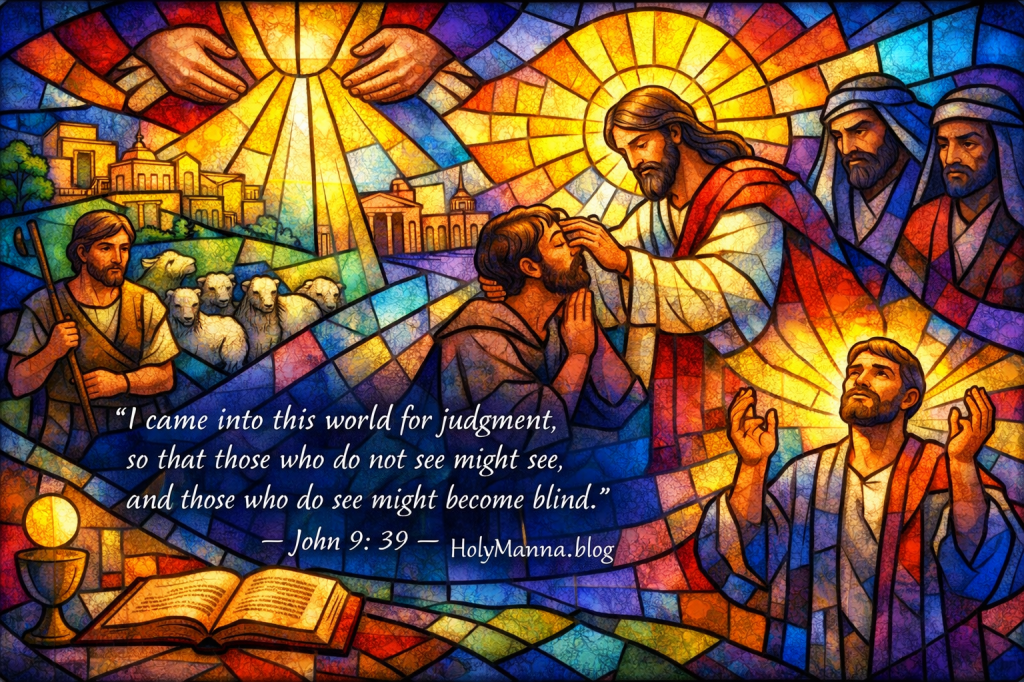
35 When Jesus heard that they had thrown him out, he found him and said, “Do you believe in the Son of Man?” 36 He answered and said, “Who is he, sir, that I may believe in him?” 37 Jesus said to him, “You have seen him and the one speaking with you is he.” 38 He said, “I do believe, Lord,” and he worshiped him. 39 Then Jesus said, “I came into this world for judgment, so that those who do not see might see, and those who do see might become blind.”
40 Some of the Pharisees who were with him heard this and said to him, “Surely we are not also blind, are we?” 41 Jesus said to them, “If you were blind, you would have no sin; but now you are saying, ‘We see,’ so your sin remains.
Detailed Exegesis
Verse 1 “As he passed by he saw a man blind from birth.”
Jesus “sees” first, and that detail matters. The Lord notices the forgotten and does not walk past suffering as if it is someone else’s problem.
Verse 2 “His disciples asked him, ‘Rabbi, who sinned, this man or his parents, that he was born blind?’”
The disciples assume a strict punishment model. This reveals a common temptation: turning another person’s pain into a theological puzzle, instead of a call to compassion.
Verse 3 “Jesus answered, ‘Neither he nor his parents sinned; it is so that the works of God might be made visible through him.’”
Jesus refuses the blame game and reveals a deeper horizon. This does not mean every suffering has a neat explanation, but it does mean suffering is not the final word when God is present.
Verse 4 “We have to do the works of the one who sent me while it is day. Night is coming when no one can work.’”
The urgency is missionary and moral. Daylight is the time of grace, and discipleship is not procrastination.
Verse 5 “While I am in the world, I am the light of the world.”
Jesus names His identity. The miracle will not be a random favor. It will be a sign revealing who He is.
Verse 6 “When he had said this, he spat on the ground and made clay with the saliva, and smeared the clay on his eyes,”
Jesus uses matter to heal. The action hints that God’s saving work often comes through tangible signs, not disembodied ideas.
Verse 7 “and said to him, ‘Go wash in the Pool of Siloam’ (which means Sent). So he went and washed, and came back able to see.”
Obedience becomes the doorway to healing. The detail “Sent” quietly points to Jesus, the One sent by the Father, and it also echoes the cleansing logic that Christians recognize in baptismal imagery.
Verse 8 “His neighbors and those who had seen him earlier as a beggar said, ‘Isn’t this the one who used to sit and beg?’”
People struggle to accept transformation. Familiar categories feel safer than miracle.
Verse 9 “Some said, ‘It is,’ but others said, ‘No, he just looks like him.’ He said, ‘I am.’”
The healed man claims his identity without theatrics. Grace restores not only sight, but dignity.
Verse 10 “So they said to him, ‘So] how were your eyes opened?’”
Curiosity begins the inquiry. The story invites honest questions, but it also warns that questions can become weapons.
Verse 11 “He replied, ‘The man called Jesus made clay and anointed my eyes and told me, “Go to Siloam and wash.” So I went there and washed and was able to see.’”
His testimony is concrete and humble. He does not pretend to know everything. He simply tells the truth.
Verse 12 “And they said to him, ‘Where is he?’ He said, ‘I don’t know.’”
The witness is not a polished apologist. The man speaks within his limits, which makes his testimony even more credible.
Verse 13 “They brought the one who was once blind to the Pharisees.”
The controversy escalates because healing threatens control. The question becomes less about the man and more about authority.
Verse 14 “Now Jesus had made clay and opened his eyes on a sabbath.”
The Sabbath detail frames the conflict. Some leaders treat the law as a shield against God’s mercy rather than a path toward it.
Verse 15 “So then the Pharisees also asked him how he was able to see. He said to them, ‘He put clay on my eyes, and I washed, and now I can see.’”
The man remains consistent. Truth does not need new costumes to survive new interrogations.
Verse 16 “So some of the Pharisees said, ‘This man is not from God, because he does not keep the sabbath.’ [But] others said, ‘How can a sinful man do such signs?’ And there was a division among them.”
A divided response appears even among the experts. Miracles force a decision, and not everyone can ignore what happened.
Verse 17 “So they said to the blind man again, ‘What do you have to say about him, since he opened your eyes?’ He said, ‘He is a prophet.’”
The healed man’s faith begins to grow. He moves from describing “the man called Jesus” to recognizing a messenger of God.
Verse 18 “Now the Jews did not believe that he had been blind and gained his sight until they summoned the parents of the one who had gained his sight.”
Unbelief demands paperwork. When hearts resist grace, they often demand endless verification to avoid surrender.
Verse 19 “They asked them, ‘Is this your son, who you say was born blind? How does he now see?’”
The questions shift from the miracle to undermining credibility. The focus becomes control of the narrative.
Verse 20 “His parents answered and said, ‘We know that this is our son and that he was born blind.’”
They confirm the facts they cannot deny. Partial truth is the first crack in fear.
Verse 21 “We do not know how he sees now, nor do we know who opened his eyes. Ask him, he is of age; he can speak for himself.’”
Fear makes them evasive. They choose safety over solidarity, leaving their son to face the pressure alone.
Verse 22 “His parents said this because they were afraid of the Jews, for the Jews had already agreed that if anyone acknowledged him as the Messiah, he would be expelled from the synagogue.”
This reveals the cost of confession. The threat of exclusion becomes a tool to enforce silence.
Verse 23 “For this reason his parents said, ‘He is of age; question him.’”
The repetition underscores how fear becomes rehearsed. Fear produces scripts that protect comfort but weaken witness.
Verse 24 “So a second time they called the man who had been blind and said to him, ‘Give God the praise! We know that this man is a sinner.’”
The leaders attempt to control the conclusion before the evidence is heard. They use religious language to pressure the man into agreeing with their judgment.
Verse 25 “He replied, ‘If he is a sinner, I do not know. One thing I do know is that I was blind and now I see.’”
This is one of Scripture’s purest testimonies. The man refuses to pretend expertise and clings to undeniable experience.
Verse 26 “So they said to him, ‘What did he do to you? How did he open your eyes?’”
They circle back, hoping repetition will produce contradiction. This is how intimidation often works.
Verse 27 “He answered them, ‘I told you already and you did not listen. Why do you want to hear it again? Do you want to become his disciples, too?’”
A surprising boldness emerges. The healed man exposes their real problem: they are not listening.
Verse 28 “They ridiculed him and said, ‘You are that man’s disciple; we are disciples of Moses!’”
Mockery replaces argument. When pride loses ground, it often reaches for contempt.
Verse 29 “We know that God spoke to Moses, but we do not know where this one is from.’”
They claim certainty about the past to avoid the present. Tradition is used as a wall instead of a bridge to the Messiah.
Verse 30 “The man answered and said to them, ‘This is what is so amazing, that you do not know where he is from, yet he opened my eyes.’”
The man points out the contradiction. The experts cannot explain the sign, yet they refuse its meaning.
Verse 31 “We know that God does not listen to sinners, but if one is devout and does his will, he listens to him.’”
He argues from common religious principles: God’s power is not allied with rebellion. His reasoning is imperfect but sincere, and it moves toward truth.
Verse 32 “It is unheard of that anyone ever opened the eyes of a person born blind.’”
He highlights the uniqueness of the miracle. This is not a minor improvement. This is a sign that demands reverence.
Verse 33 “If this man were not from God, he would not be able to do anything.’”
His conclusion becomes bolder. Faith grows as courage grows.
Verse 34 “They answered and said to him, ‘You were born totally in sin, and are you trying to teach us?’ Then they threw him out.”
Their final move is expulsion. They return to the disciples’ original error, treating suffering as proof of guilt, and they punish the man for speaking truth.
Verse 35 “When Jesus heard that they had thrown him out, he found him and said, ‘Do you believe in the Son of Man?’”
This is one of the most tender moments in the Gospel. Jesus seeks the rejected. The world throws out, and Christ finds.
Verse 36 “He answered and said, ‘Who is he, sir, that I may believe in him?’”
The man is ready. He does not demand proof to protect pride. He asks for the Person so he can respond.
Verse 37 “Jesus said to him, ‘You have seen him and the one speaking with you is he.’”
The revelation is personal and direct. The miracle of sight becomes the doorway to the greater gift, the sight of faith.
Verse 38 “He said, ‘I do believe, Lord,’ and he worshiped him.”
The story reaches its summit. The healed man does not merely admire Jesus. He worships, which is the proper response to divine revelation.
Verse 39 “Then Jesus said, ‘I came into this world for judgment, so that those who do not see might see, and those who do see might become blind.’”
Judgment here means unveiling. Christ’s light reveals hearts. The humble receive sight, and the proud reveal their blindness.
Verse 40 “Some of the Pharisees who were with him heard this and said to him, ‘Surely we are not also blind, are we?’”
They sense the accusation and try to dodge it. Pride fears repentance more than it fears sin.
Verse 41 “Jesus said to them, ‘If you were blind, you would have no sin; but now you are saying, “We see,” so your sin remains.’”
The final line is severe because it is honest. The refusal to admit blindness becomes the root of guilt, because it blocks mercy at the door.
Teachings
This Gospel teaches that Christ’s miracles are signs meant to lead to faith, not party tricks meant to entertain. The healing of the blind man reveals Jesus as the Light of the world and exposes the tragedy of spiritual pride. Physical blindness is not treated as moral failure by Jesus. Instead, hardness of heart is treated as the true danger, because it resists truth even when truth stands in front of it.
The Church’s tradition has long read this passage as a baptismal icon. The man is “anointed,” sent to wash, and returns seeing. That pattern mirrors how God often works: grace touches first, obedience follows, and then new life appears. Lent has always been the Church’s season of preparation for Baptism and renewal of baptismal life. This Gospel insists that Christian life is not merely a set of religious opinions. It is illumination, the opening of the eyes of the heart so a disciple can recognize Christ and worship Him.
This passage also teaches something important about suffering and sin. Jesus rejects the simplistic conclusion that the man’s suffering is a direct punishment for personal sin. At the same time, Jesus does not deny sin’s reality. He reveals that the deeper sin is the refusal to come into the light, the refusal to admit need, and the refusal to worship the One who saves.
The story also shows the shape of Christian witness. The healed man does not begin as a theologian. He begins as a beggar with a story. He becomes a witness precisely by telling the truth he knows, even when pressure increases. Fear silences the parents, but grace strengthens the son. When religious power throws him out, Jesus finds him. That is a pattern repeated across Christian history: fidelity can cost belonging in certain circles, but it gains deeper communion with Christ.
Saints and ancient teachers loved this Gospel because it reveals how conversion happens in stages. Faith often grows by steps: honest testimony, courageous endurance, deeper recognition, and finally worship. The miracle is not only that a man can see faces and sunlight. The greater miracle is that a man can look at Jesus and say, “I do believe, Lord,” and mean it.
Reflection
This Gospel speaks directly to modern habits because modern culture is full of subtle spiritual blindness. There is a constant temptation to explain away suffering, to control the story, or to protect an image rather than tell the truth. The disciples want an explanation. The authorities want control. The parents want safety. The healed man chooses honesty, and Jesus meets him with revelation.
A strong Lenten response begins with refusing the blame reflex. When suffering appears, the first move does not have to be, “Who deserves this?” The first move can be, “Where is Christ the Light, and what work does He want to make visible?” That shift changes how a person treats the sick, the struggling, the sinner, and the self.
A second response is learning to bring hidden darkness into the light. The Gospel shows that darkness thrives in secrecy and intimidation, but the light wins through truth. This can mean a serious examination of conscience and a sincere confession, not as a shame ritual, but as an act of stepping into the light so Christ can heal what is wounded.
A third response is embracing simple witness. The healed man’s line is still the best model for everyday evangelization. It is not a speech. It is a testimony that refuses to be bullied. A disciple does not need a thousand arguments to begin. A disciple needs honesty, courage, and love for the truth.
Where has the heart been trying to stay “safe” by avoiding the light, whether through excuses, secrecy, or fear of what others will think?
What would change if the week’s prayer became a direct request, asking Christ to open the eyes of the heart and expose what needs healing?
Is there a place where truth has been softened to keep approval, even though Jesus is asking for the courage to say, with the healed man, “I was blind and now I see”?
The Gospel ends with a warning, but it is also an invitation. The only truly hopeless blindness is the kind that insists it can already see. The moment a person admits need, the Light of the world is already near, already speaking, already ready to heal.
Step Into the Light and Let the Shepherd Lead
Today’s readings move like one steady story, from a quiet house in Bethlehem to a crowded street in Jerusalem, and then straight into the hidden rooms of the human heart. In 1 Samuel 16:1, 6-7, 10-13, God corrects Samuel’s instincts and teaches a lesson that never stops being relevant: “The LORD looks into the heart.” The Lord chooses David, the overlooked shepherd, and anoints him, not because the world would have picked him, but because grace sees deeper than appearances. Then Psalm 23 answers the fear that always follows God’s call. It reminds the believer that the Lord does not abandon His people in the valley. He guides, protects, and provides, and He even sets a table in the presence of enemies, promising that mercy is not fragile and goodness is not temporary.
St. Paul takes that story and makes it personal in Ephesians 5:8-14. He speaks to the baptized with the kind of clarity modern life rarely offers. “You were once darkness, but now you are light in the Lord. Live as children of light.” That is not motivational language. That is identity. It is a call to step out of hidden sin, out of double lives, out of excuses and half-truths, and into the freedom that only Christ can give. Then the Gospel, John 9:1-41, shows what that looks like in the flesh. Jesus refuses the blame game, heals the man born blind, and leads him from confusion to courage, from testimony to worship. The healed man’s simple words still sound like the kind of faith the world cannot manufacture: “One thing I do know is that I was blind and now I see.” The story also exposes the danger of spiritual pride. The hardest blindness is not the one that admits need. The hardest blindness is the one that insists it already sees.
Laetare Sunday offers a kind of mid-Lent joy that is not shallow. It is the joy of realizing that God is not only asking for change, but offering light. It is the joy of realizing that the Shepherd is near, even in the valley. It is the joy of realizing that the Lord can take what is hidden, wounded, and tired, and make the works of God visible through it.
The call to action is simple and strong. Let this week be a week of honest sight. Let prayer stop being a performance and become a real encounter. Let the conscience come into the light, especially in the places it tries to keep secret. Let Sunday Mass be received with attention and gratitude, like a table prepared by the Lord for people who still have enemies and still fight temptations. Let one concrete act of repentance replace a dozen vague intentions. Christ is still the Light of the world, and He still asks the same question in every generation: will the heart step into the light, or will it protect its darkness? The brave answer is not perfection. The brave answer is trust, obedience, and the willingness to be found by Jesus, even after the world has thrown someone out.
Engage with Us!
Readers are invited to share their reflections in the comments below, because God often deepens understanding through honest conversation and shared witness. These readings speak to real life, and it helps to name what stood out, what challenged the heart, and what brought hope.
- First Reading, 1 Samuel 16:1, 6-7, 10-13: Where has life been tempted to judge by appearance, status, or charisma instead of asking what God sees in the heart? What is one concrete way to practice deeper spiritual discernment this week?
- Responsorial Psalm, Psalm 23: Where does life currently feel like “the valley of the shadow of death,” and what would it look like to trust that the Shepherd is truly present there? How can Sunday Mass become more like a received gift than a routine habit?
- Second Reading, Ephesians 5:8-14: What “work of darkness” has been protected by secrecy, excuses, or fear, and what step would bring it into Christ’s light? What does it mean, in practical daily choices, to “live as children of light”?
- Holy Gospel, John 9:1-41: Where has the heart been tempted to blame, control the narrative, or stay spiritually “safe” instead of surrendering to Jesus? Can the healed man’s words become personal this week, in a way that is honest and specific: “I was blind and now I see”?
May this week be lived with courage and humility, walking in the light Christ gives, trusting the Shepherd through every valley, and doing everything with the love and mercy Jesus taught, so that faith becomes visible not only in words, but in a life transformed.
Sacred Heart of Jesus, we trust in You!
Immaculate Heart of Mary, pray for us!
Saint Michael the Archangel, defend us in battle!
Follow us on YouTube, Instagram and Facebook for more insights and reflections on living a faith-filled life.

 Holy Manna!
Leave a comment