The Bishop Who Taught a City to Pray
Saint Leobinus of Chartres, better known in France as Saint Lubin, belongs to that early generation of bishops who helped shape Christian life in the countryside when the world still felt fragile and half-converted. He is remembered as a monk and a shepherd of souls, a reforming bishop with a disciplined heart, and a wonder-worker in the Church’s memory. Even if the details of his life come to us through ancient Christian storytelling rather than modern biographies, the Church’s affection for him is unmistakable. Chartres kept his name close, not only in prayers and calendars, but also in sacred spaces, relic traditions, and stained glass that catechized generations who could not read.
In the Catholic view, saints are not celebrities. They are witnesses. Their lives become a living reminder that holiness is possible in ordinary places, in hard times, and even in jobs that seem small. The Church calls this the Communion of Saints, the mysterious family bond between the faithful on earth and those already with Christ, who continue to intercede for the Church. This is why Catholics ask saints to pray for them, because love does not stop at death, and Christ keeps His Body united across time, as taught in CCC 956 and CCC 957.
A Peasant Boy Who Would Not Stop Searching
Catholic tradition places Leobinus’s beginnings near Poitiers, with roots in simple rural life. The story is not one of privilege. It is one of hunger. He wanted God. He wanted wisdom. He wanted the kind of life that did not merely survive the chaos of the world, but sanctified it.
That desire pulled him toward monastic life. He is remembered as a monk formed in serious discipline, shaped by prayer and community, and later entrusted with leadership as an abbot. Some traditions connect him to major monastic centers of his era, places where the faith was preserved not only in books, but in daily habits of fasting, liturgy, obedience, and service. This matters because his “conversion” is not described like a dramatic one-time moment. It looks more like a long road of deepening. He kept saying yes again and again until his whole life became a single direction toward Christ.
There is also a strong stream of tradition that remembers him living as a hermit for a time, drawing away from noise so his soul could become quiet enough to listen. That season of hidden prayer is often where God forges men who later carry public responsibility. When the Church eventually called him out of the shadows, she did not choose him because he was loud, but because he was faithful.
When a Bishop Becomes a Living Sign
Leobinus eventually became Bishop of Chartres in the mid-sixth century. Catholic sources remember him as a bishop who kept the sobriety of a monk. He did not treat the episcopacy as a platform. He treated it as a burden carried for love of Christ and for love of his people. He is also associated with the wider Church life of his time through participation in major councils, which tells you he was not a hermit bishop disconnected from reality. He belonged to the Church, and he helped the Church govern, teach, and correct.
The miracle stories tied to him come primarily through an ancient Vita, a traditional “Life of the saint,” which preserves the Church’s memory in the storytelling style of that era. These miracle accounts are part of Catholic devotional tradition. They reveal how Christians understood God’s nearness through His servants, and they show what kind of saint people believed Leobinus to be.
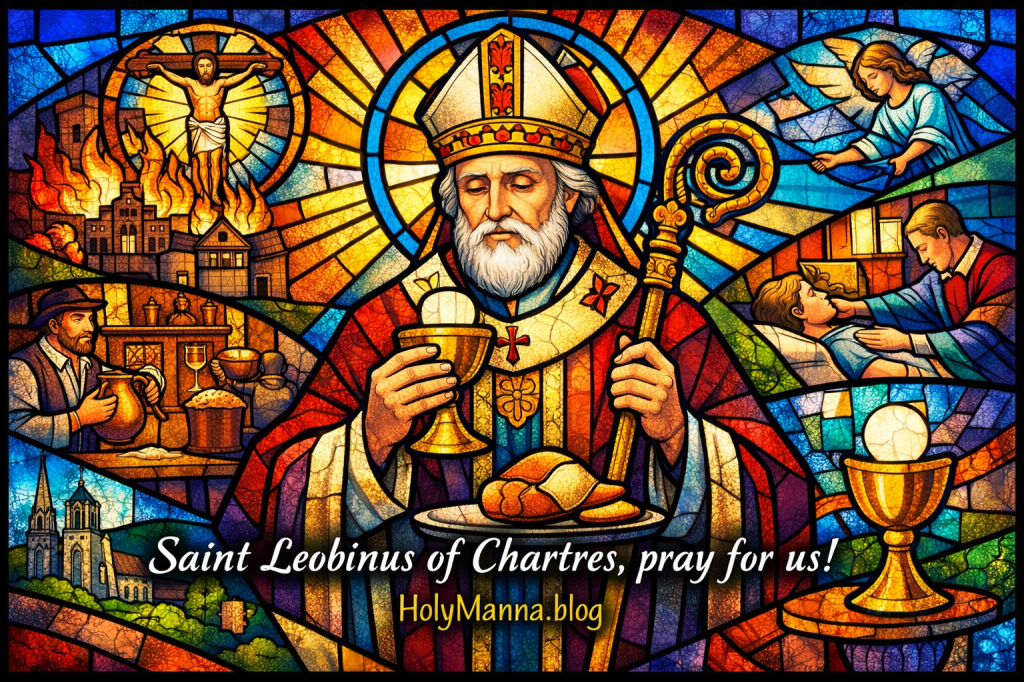
One of the clearest themes is fire. In more than one story, Leobinus is called when flames are out of control and human strength is not enough. The pattern is always the same. He does not arrive as a magician. He arrives as a priest. He prays, he invokes Christ, and he acts as though God is not distant. In the famous account connected to a fire in Paris, the saint is presented as turning people away from panic and toward prayer. The ancient text places on his lips a line that still sounds like solid Catholic instinct today: “Divinum potius quam humanum imploretur auxilium.” “Let divine help be sought rather than merely human help.” That is not a slogan. It is a worldview.
Healing miracles also appear often in his tradition. The Vita describes healings of blindness and fever, and it repeatedly connects him to healing those suffering from dropsy or swelling illnesses. That connection is one reason he is remembered in popular Catholic devotion as a helper for those afflicted with edema-like conditions. The stories frequently include signs of prayer, the sign of the Cross, and contact with cloth or relic-like objects. This is very typical of early medieval Catholic piety, which saw the physical world as capable of carrying God’s mercy, not because matter is magical, but because the Word became flesh.
There are also deliverance stories. The ancient tradition attributes to him prayers that freed people from demonic oppression and disturbances, again presenting him as a bishop who took spiritual warfare seriously. In at least one striking account, the tradition even presents him as praying a girl back to life. None of these miracle stories should be read as entertainment. They are meant to teach trust. They are meant to say, “Christ is alive, and He has not abandoned His people.”
Suffering Without Becoming Bitter
Saint Leobinus is not remembered as a martyr in the strict sense, but the tradition does not portray him living a comfortable life. One Catholic narrative stream recounts that during conflict near Lyon he was captured and cruelly treated, left for dead, yet survived. The details of that episode are part of received saint tradition and cannot be verified like a modern court record, but the spiritual meaning is clear. Leobinus is remembered as a man who suffered and kept going.
Even apart from that story, the very role of a sixth-century bishop carried hardships that modern people rarely imagine. He had to hold together communities in an unstable era, defend discipline, correct scandal, protect the poor, and keep the faith intact when culture was shifting. The heroic part is not that he avoided pain. It is that he did not let pain deform him. He endured. He remained a pastor.
This is one of the most quietly challenging parts of his witness. A lot of people want holiness as long as it stays convenient. Saints like Leobinus show another way. They show that holiness is often forged by perseverance, not comfort.
A Saint Who Stayed Close to Chartres
After Leobinus died, devotion to him did not fade. It concentrated. Catholic tradition in Chartres held tightly to his memory through relics, sacred spaces, and stories of healing.
One enduring element is the tradition that his body was venerated at Chartres, while his head relic was preserved separately in a precious reliquary. Later history is painful, as it often is for relics in France. Catholic memory records that shrines and reliquaries suffered during violent periods, including religious wars and the Revolution. Even then, the devotion did not disappear. The point is not the gold. The point is the love. When Catholics preserve relics, they are honoring what God did in a human life, and they are confessing belief in the resurrection of the body, not treating remains as superstitious trinkets. Popular devotion like this belongs to the Church’s life when it remains ordered toward Christ and the sacraments, as the Church explains when speaking about popular piety and sacramentals in CCC 1674.
A famous after-death miracle story, preserved in later Catholic tradition, describes a peasant suffering a severe hand injury and hemorrhage who turned in faith toward the saint’s relic shrine and experienced immediate relief and healing. This specific story cannot be verified by modern historical standards, but it is part of the saint’s devotional legacy and shows how people trusted his intercession.
Leobinus’s cultural impact also shines through Chartres itself. The cathedral’s memory includes a crypt associated with his name, and stained glass that tells his story as catechesis. One of the most surprising details preserved in Catholic presentations of the Chartres glass is how the imagery connects Leobinus to Eucharistic reverence. The window depicts sacred liturgy and the consecration of bread and wine, and it even preserves the memory of a rare liturgical practice through the image of a small tube used historically for receiving the Precious Blood. The lesson is obvious: the saint’s story is meant to lead the eye and the heart toward the altar. The Eucharist is not a decorative detail. The Church calls it the source and summit of the Christian life in CCC 1324. The stained glass preaches that wordlessly.
There is also a moral contrast in the art tradition that is easy to miss. In the same visual world, tavern life and wine trades appear alongside Eucharistic imagery. That pairing helps explain why popular devotion later connected him with innkeepers and wine merchants. It is not because the Church celebrates drunkenness. It is because the Church insists that good things can be ordered toward God or disordered toward sin, and the Eucharist reveals what wine was ultimately made for in the economy of grace.
The Kind of Faith That Prays First
Saint Leobinus is a strong saint for an anxious age. His tradition does not show him solving everything with strategy. It shows him praying first, then acting with courage. That ancient line attributed to him still speaks clearly: “Let divine help be sought rather than merely human help.” This is not anti-intellectual and not anti-planning. It is simply Catholic realism. God is real. Grace is real. The spiritual world is real. Christ is Lord.
Here is what his life teaches in practical terms. A Catholic man or woman can treat ordinary responsibilities as a path to sanctity, not as distractions from holiness. Work can become prayer when it is offered. Leadership can become charity when it is rooted in humility. Suffering can become purifying when it is endured without resentment. The saint’s story also pushes back against the modern habit of waiting until things are desperate before praying. Leobinus’s example is the opposite. Prayer is not the last resort. Prayer is the first response.
This is also a saint who invites deeper Eucharistic seriousness. His memory in Chartres points toward the altar and says, without words, that the Church’s power is not mainly political or cultural. The Church’s power is Jesus Christ, present in the sacraments, especially in the Holy Eucharist. When Catholics live close to the Mass, they become less reactive, less fearful, and more steady, because they are being fed by Something that does not change.
Where has life trained the heart to rely on human solutions first and to pray second?
What would change if prayer became the beginning of the response instead of the end?
How would daily life look different if the Eucharist truly sat at the center, as the Church teaches in CCC 1324 ?
Engage With Us!
Share thoughts and reflections in the comments below. Saint Leobinus is not a saint of flashy noise. He is a saint of steady faith, and that is exactly what many souls need right now.
- What part of Saint Leobinus’s story feels most needed today, his discipline, his prayer under pressure, or his trust in God’s help during crisis?
- When stress hits, what is usually the first response, prayer or control? What is one concrete way to change that pattern this week?
- How could a deeper love for the Mass and the Eucharist reshape the way daily decisions are made, especially decisions made under pressure?
- Who in life needs the kind of steady pastoral care Saint Leobinus gave, and what is one simple act of charity that could be offered to them?
May Saint Leobinus of Chartres pray for every home, every family, and every anxious heart. Keep walking in faith. Keep returning to the sacraments. Keep choosing repentance over pride. Do everything with the love and mercy Jesus taught, because that is how ordinary life becomes holy.
Saint Leobinus of Chartres, pray for us!
Follow us on YouTube, Instagram and Facebook for more insights and reflections on living a faith-filled life.

 Holy Manna!
Leave a comment