Saturday of the Third Week of Lent – Lectionary: 242
When Mercy Gets Real
Some days in Lent feel like walking back into a house after a long cold night, with the lights off and the silence loud. The door is familiar, but the heart hesitates. That is where today’s readings begin, not with a lecture, but with an invitation, and it sounds like a voice from the family calling down the hallway: “Come, let us return to the LORD.” In Hosea 6:1-6, Israel is being called out of spiritual drifting and back into covenant love. The wound is real, because sin always tears something, but God’s purpose is healing, not humiliation. The prophet speaks into a religious culture that knew sacrifice well, yet had learned the dangerous trick of offering gifts to God while withholding the heart. That is why the Lord’s word cuts through the noise with clarity: “It is love that I desire, not sacrifice, and knowledge of God rather than burnt offerings.”
That same truth rises again in Psalm 51:3-4, 18-21, the Church’s great prayer of repentance. In Israel’s worship, burnt offerings mattered, because they taught that sin costs something and that God is holy. Yet even in the Old Covenant, the Lord kept teaching that the altar was never meant to be a stage for self-approval. The real offering was always interior. That is why the psalm dares to say what pride never wants to admit: “My sacrifice, O God, is a contrite spirit; a contrite, humbled heart, O God, you will not scorn.” Lent does not erase sacrifice, because Catholics know the world is saved by a sacrifice, the Cross. Lent purifies sacrifice, so it stops being performance and becomes love.
Then the Gospel lands the message right in the middle of everyday religion. In Luke 18:9-14, two men walk into the Temple, the beating heart of Israel’s public prayer. One man stands tall with a clean record and a loud interior monologue. The other stands at a distance with nothing to boast about, and he prays the one sentence that can rebuild a soul: “O God, be merciful to me a sinner.” The central theme of today is not that fasting is bad or that tithing is pointless. The central theme is that God is not impressed by religious résumé lines. God responds to humility, because humility tells the truth, and truth is where mercy can finally enter.
What happens when religion stops being a comparison game and becomes a homecoming? Today’s readings answer that question with one steady voice. Return to the Lord. Bring a contrite heart. Choose humility over self-exaltation. That is where healing begins, and that is how Lent becomes real.
First Reading – Hosea 6:1-6
Return Without Pretending, Love Without Performing
The prophet Hosea steps into a wounded love story. He preaches in a time of political anxiety and spiritual compromise, when Israel was tempted to treat God like a last resort instead of a first love. The northern kingdom is often called “Ephraim,” and Judah is the southern kingdom, so the reading speaks to the whole covenant family, not just one region. Worship was still happening, sacrifices were still being offered, and prayers were still being said, but the Lord exposes what is missing: a heart that stays. The central theme of today shines here with uncomfortable clarity. God does not want religious motion without real conversion. God wants covenant love, lived from the inside out.
Hosea 6:1-6 – New American Bible (Revised Edition)
1 “Come, let us return to the Lord,
For it is he who has torn, but he will heal us;
he has struck down, but he will bind our wounds.
2 He will revive us after two days;
on the third day he will raise us up,
to live in his presence.
3 Let us know, let us strive to know the Lord;
as certain as the dawn is his coming.
He will come to us like the rain,
like spring rain that waters the earth.”4 What can I do with you, Ephraim?
What can I do with you, Judah?
Your loyalty is like morning mist,
like the dew that disappears early.
5 For this reason I struck them down through the prophets,
I killed them by the words of my mouth;
my judgment shines forth like the light.
6 For it is loyalty that I desire, not sacrifice,
and knowledge of God rather than burnt offerings.
Detailed Exegesis
Verse 1: “Come, let us return to the LORD, for it is he who has torn, but he will heal us; he has struck down, but he will bind our wounds.”
This is the sound of repentance waking up, but it is also the sound of a people who have learned that sin eventually hurts. Hosea does not pretend that consequences are imaginary. The Lord “tears” and “strikes” in the sense that He allows the truth of sin to break illusions, like a surgeon cutting to remove poison. Yet the purpose is never cruelty. The purpose is healing. The covenant God does not abandon His people to their wounds. He binds them, because mercy is not sentimental. Mercy is medicinal.
Verse 2: “He will revive us after two days; on the third day he will raise us up, to live in his presence.”
In the world of the prophets, “after two days” and “on the third day” can speak like a strong idiom, meaning that restoration will come, and it will not be delayed forever. Still, Christians cannot hear “the third day” without remembering the rhythm of the Gospel. God’s deepest healing is not a quick patch. It is resurrection life. Lent trains the heart to seek more than relief. Lent trains the heart to seek communion, because the goal is “to live in his presence.”
Verse 3: “Let us know, let us strive to know the LORD; as certain as the dawn is his coming. He will come to us like the rain, like spring rain that waters the earth.”
Biblical “knowledge” is not trivia about God. It is relationship, obedience, and covenant intimacy. To “strive to know” the Lord is to pursue Him with a steady heart, not with bursts of enthusiasm that vanish as soon as life gets hard. The images are tender and physical. Dawn is dependable. Rain is life-giving. God is not distant or stingy. God desires to come close, to water what is dry, and to make holiness grow where the soul feels stuck.
Verse 4: “What can I do with you, Ephraim? What can I do with you, Judah? Your loyalty is like morning mist, like the dew that disappears early.”
This is not God being confused. This is God grieving. The Lord describes a love that evaporates as soon as it meets heat. The “loyalty” here is covenant fidelity, a love that lasts beyond emotions. Israel’s pattern is familiar: panic, promises, religious activity, then the same old compromise. The Lord is not mocking them. The Lord is revealing the instability of a divided heart, because a half-converted life cannot hold joy for long.
Verse 5: “For this reason I struck them down through the prophets, I killed them by the words of my mouth; my judgment shines forth like the light.”
The prophets are not hired motivational speakers. They are God’s messengers, and their words cut because they are true. When the Lord says He “killed” by His words, it is the language of judgment exposing lies, destroying excuses, and putting sin to death. Light feels harsh to someone hiding. Light feels like freedom to someone who wants to be healed. God’s judgment is not a random temper. God’s judgment is clarity, like daylight on a long night of self-deception.
Verse 6: “For it is love that I desire, not sacrifice, and knowledge of God rather than burnt offerings.”
This is the heartbeat of the reading and the backbone of today’s theme. God is not rejecting sacrifice as such. God is rejecting sacrifice used as a mask. Burnt offerings were part of Israel’s worship, but they were never meant to replace love, justice, and fidelity. The Lord demands a relationship that reaches the neighbor, because covenant love always becomes concrete. The deepest insult is not failing at a ritual. The deepest insult is trying to buy off God while refusing to be changed by Him.
Teachings
The Church has always read Hosea’s cry as a warning against religious externalism and as an invitation to interior conversion. In CCC 1430, the Church teaches: “Jesus’ call to conversion and penance… aims at the conversion of the heart.” This is exactly what Hosea confronts. A heart can offer “burnt offerings” while staying proud, resentful, and unmerciful. God refuses that bargain.
The Church also insists that outward worship matters only when it expresses a real interior offering. In CCC 2100, the Church teaches: “Outward sacrifice, to be genuine, must be the expression of spiritual sacrifice.” Hosea is not anti-liturgy. Hosea is anti-fake. The Lord desires love and the true “knowledge of God,” because worship is meant to form the worshiper.
Saints and doctors echo this same thread with blunt honesty. Saint Augustine explains the inner sacrifice God seeks when he writes: “A humble heart is a sacrifice to God.” That line fits Hosea like a key fits a lock, because it reveals the difference between a religious life built on pride and a religious life built on repentance.
Historically, Hosea’s preaching lands in an era when Israel faced enormous pressure from surrounding powers and often looked for security through alliances, wealth, and compromise. In that kind of climate, religion can become a tool, a way to manage anxiety and maintain social identity. Hosea refuses to let God be used. The covenant is not a political strategy. The covenant is a marriage, and God does not accept being treated like a weekend hobby.
Reflection
Hosea reads like a mirror held close to the face, and the goal is not shame. The goal is truth that leads to healing. Many people do not struggle with the idea of returning to God. Many people struggle with returning without keeping a secret escape route. The reading warns against devotion that looks passionate for a moment and then disappears like mist when temptation shows up or when prayer stops feeling “useful.”
A practical way to live this is to make repentance steady instead of dramatic. A simple examination of conscience at night can form a faithful heart over time. A regular confession schedule can turn “Come, let us return” into a real pattern of life. A deliberate act of mercy toward someone difficult can prove that love is becoming more than words. The Lord’s desire is not to collect religious activity. The Lord’s desire is to rebuild the heart.
Is loyalty to the Lord steady like dawn, or does it fade like dew when comfort is threatened?
Is prayer being used to know God, or is prayer being used to feel in control?
What would change this week if the heart stopped offering God “burnt offerings” of performance and began offering God real love through obedience, mercy, and humility?
Responsorial Psalm – Psalm 51:3-4, 18-21
When the Heart Stops Performing and Finally Tells the Truth
Some prayers sound polished because they are meant to be heard. This psalm sounds different because it is meant to save a soul. Psalm 51 rises from the ashes of a man who has run out of excuses. It belongs to Israel’s deep tradition of penitence, and it has been prayed for centuries as the Church’s go-to confession when sin is no longer theoretical. In the life of God’s people, the Temple sacrifices mattered, not because God needed food or smoke, but because the whole system taught holiness, justice, and the cost of sin. Still, the psalm makes the same point Hosea makes. God is not impressed by ritual offered without repentance. Today’s theme lands here with force and tenderness. Mercy is not purchased with religious activity. Mercy is received with a contrite heart.
Psalm 51:3-4, 18-21 – New American Bible (Revised Edition)
3 Have mercy on me, God, in accord with your merciful love;
in your abundant compassion blot out my transgressions.
4 Thoroughly wash away my guilt;
and from my sin cleanse me.18 For you do not desire sacrifice or I would give it;
a burnt offering you would not accept.
19 My sacrifice, O God, is a contrite spirit;
a contrite, humbled heart, O God, you will not scorn.20 Treat Zion kindly according to your good will;
build up the walls of Jerusalem.
21 Then you will desire the sacrifices of the just,
burnt offering and whole offerings;
then they will offer up young bulls on your altar.
Detailed Exegesis
Verse 3: “Have mercy on me, God, in accord with your merciful love; in your abundant compassion blot out my transgressions.”
The psalm begins where pride refuses to begin. It begins with mercy. The speaker appeals to who God is, not to what the speaker has done. This is covenant language. God’s “merciful love” is faithful love, the kind that does not quit when the beloved is unfaithful. “Blot out” is the imagery of a debt record being wiped clean. The psalm is not asking God to pretend sin did not happen. The psalm is begging God to remove sin’s guilt and its claim.
Verse 4: “Thoroughly wash away my guilt; and from my sin cleanse me.”
This verse leans into the language of washing and purification, which would have been vivid in Israel’s worship life, where ritual washings symbolized the need for interior purity. The psalmist is saying that sin is not just a mistake on a page. Sin clings. Sin stains. Sin needs cleansing. In Catholic life, this prepares the heart to understand why the Church treasures the Sacrament of Penance, because forgiveness is not only a legal declaration. It is a real purification and restoration of communion.
Verse 18: “For you do not desire sacrifice or I would give it; a burnt offering you would not accept.”
This is not a rejection of Temple worship as if it were meaningless. It is a rejection of trying to use worship as a substitute for conversion. The psalmist knows that offerings without repentance are like flowers placed on a grave while refusing to stop the violence that caused the death. God does not accept bribes. God seeks truth. When worship becomes a way to avoid humility, it becomes empty, even if it looks religious.
Verse 19: “My sacrifice, O God, is a contrite spirit; a contrite, humbled heart, O God, you will not scorn.”
This is the verse that turns the key in the lock. God wants the heart. “Contrite” is not mere sadness. Contrition is sorrow for sin because it offends God, and it includes the desire to change. A “humbled heart” is a heart that stops defending itself and starts surrendering. God does not “scorn” that heart, because humility is the doorway where mercy can enter without being fought.
Verse 20: “Treat Zion kindly according to your good will; build up the walls of Jerusalem.”
The prayer widens from personal repentance to communal restoration. In Scripture, personal sin is never merely personal. Sin tears at the fabric of the people of God. Zion and Jerusalem represent the covenant community and the place of worship. Asking God to “build up the walls” is asking for protection, renewal, and stability, because a community needs more than policies. A community needs holiness.
Verse 21: “Then you will desire the sacrifices of the just, burnt offering and whole offerings; then they will offer up young bulls on your altar.”
Here the psalm returns to sacrifice, but in the right order. First comes conversion, then comes right worship. The “sacrifices of the just” are not perfect people showing off. They are forgiven people living in right relationship with God. Once the heart is aligned, external worship becomes pleasing, because it expresses a life being offered, not a life pretending.
Teachings
This psalm is practically a soundtrack for Lent because it teaches the Catholic balance that the world constantly misses. The Church never says outward acts are irrelevant. The Church says outward acts must be rooted in an interior return to God.
CCC 1430 puts it plainly: “Jesus’ call to conversion and penance, like that of the prophets before him, does not aim first at outward works, ‘sackcloth and ashes,’ fasting and mortification, but at the conversion of the heart, interior conversion.” This is Psalm 51 in one sentence.
The Church also teaches that repentance is not simply feeling bad. Repentance is a grace that moves the will. CCC 1431 says: “Interior repentance is a radical reorientation of our whole life, a return, a conversion to God with all our heart, an end of sin, a turning away from evil, with repugnance toward the evil actions we have committed.” That is what “contrite spirit” means when it is alive.
Saint Augustine loved this psalm because it reveals how God saves without flattering pride. He teaches that God does not want a proud offering. God wants a humbled soul. That is why this psalm has never disappeared from the Church’s prayer. It shows the truth about repentance. God is not waiting for a performance. God is waiting for surrender.
Historically, Israel’s worship included real sacrifices, and those sacrifices were not empty by nature. They were a God-given pedagogy, teaching that sin is serious and that communion with God is not casual. Still, both the prophets and the psalms insist that sacrifice without justice and humility becomes an insult. The Lord desires worship that matches life, because worship is supposed to shape the worshiper.
Reflection
This psalm gives permission to stop pretending. It also gives direction for what to do next. A contrite spirit is not developed by vague guilt. A contrite spirit is formed by truth and grace, by naming sin honestly and trusting God’s mercy more than the ego’s defense mechanisms.
A practical step is to pray this psalm slowly, not as poetry, but as confession. Another step is to replace spiritual bargaining with spiritual honesty. Instead of promising God a dozen impressive habits, it is better to offer one humble truth: the heart needs cleansing. A serious Catholic life includes outward penance, but it must begin with interior repentance, because God is not collecting religious trophies.
Does the heart approach God with a résumé, or does the heart approach God with repentance?
Is there a hidden place where religious activity is being used to avoid humility, avoid confession, or avoid making amends?
What would change if the day started with this simple posture: “Have mercy on me, God, in accord with your merciful love”, and the day ended with a contrite heart that stopped excusing sin and started surrendering to grace?
Holy Gospel – Luke 18:9-14
The Prayer God Answers, and the One God Refuses
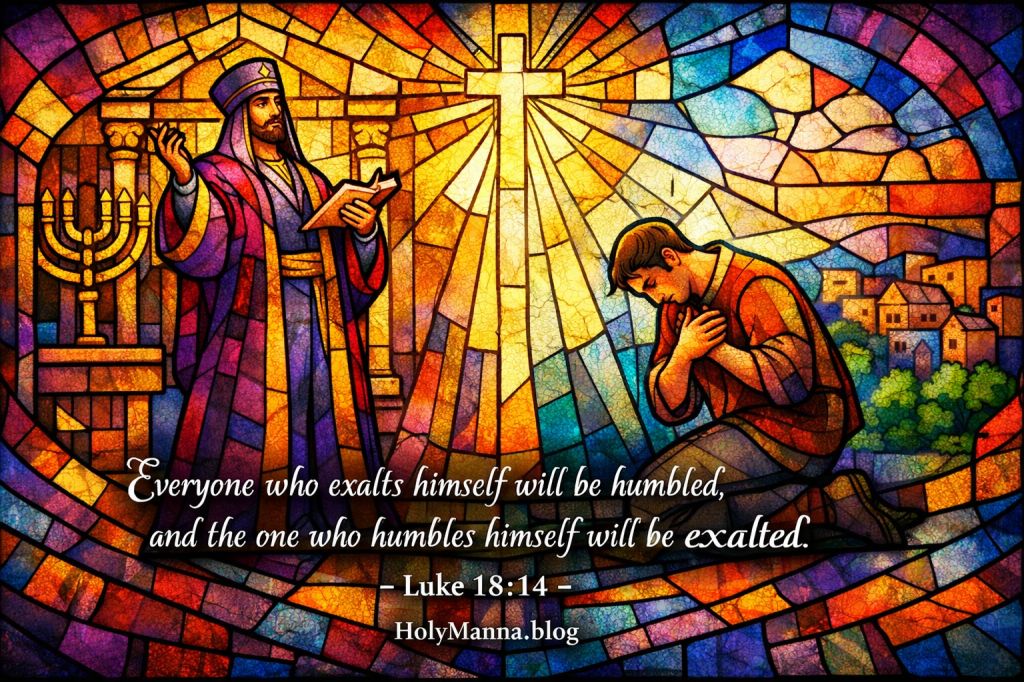
The Temple in Jerusalem was not a quiet corner for private spirituality. It was the heartbeat of Israel’s worship, the place of sacrifice, psalms, and public prayer, and it carried the weight of centuries of covenant history. Into that sacred space, Jesus places two men who would have looked completely different to the crowd. The Pharisee represented serious religious devotion, a man trained in the habits of the Law, respected for discipline and public piety. The tax collector represented compromise with the Roman occupation, a man often assumed to be greedy and unclean, and treated as a public sinner. Jesus does not tell this parable to mock religion. Jesus tells it to expose a counterfeit version of religion, the kind that performs holiness while despising people. Today’s theme comes to a sharp point here. God desires mercy, truth, and humility, not a spiritual highlight reel.
Luke 18:9-14 – New American Bible (Revised Edition)
The Parable of the Pharisee and the Tax Collector. 9 He then addressed this parable to those who were convinced of their own righteousness and despised everyone else. 10 “Two people went up to the temple area to pray; one was a Pharisee and the other was a tax collector. 11 The Pharisee took up his position and spoke this prayer to himself, ‘O God, I thank you that I am not like the rest of humanity—greedy, dishonest, adulterous—or even like this tax collector. 12 I fast twice a week, and I pay tithes on my whole income.’ 13 But the tax collector stood off at a distance and would not even raise his eyes to heaven but beat his breast and prayed, ‘O God, be merciful to me a sinner.’ 14 I tell you, the latter went home justified, not the former; for everyone who exalts himself will be humbled, and the one who humbles himself will be exalted.”
Detailed Exegesis
Verse 9: “He then addressed this parable to those who were convinced of their own righteousness and despised everyone else.”
Jesus names the target before the story begins. The danger is not only being “convinced” of righteousness. The deeper poison is contempt. When prayer becomes a platform for judging others, religion turns inward and starts worshiping the self.
Verse 10: “Two people went up to the temple area to pray; one was a Pharisee and the other was a tax collector.”
Both men do something good. They go to pray. Jesus immediately makes the contrast social, religious, and emotional. One man arrives with status. The other arrives with shame. The Temple becomes the stage where hearts are revealed.
Verse 11: “The Pharisee took up his position and spoke this prayer to himself, ‘O God, I thank you that I am not like the rest of humanity, greedy, dishonest, adulterous, or even like this tax collector.’”
The Pharisee’s prayer begins with “thanks,” but it is built on comparison. The prayer is not centered on God’s mercy. The prayer is centered on the Pharisee’s identity as “not like them.” The phrase about speaking “to himself” is a quiet dagger. Prayer can keep God’s name on the lips while the self remains the true audience.
Verse 12: “I fast twice a week, and I pay tithes on my whole income.”
These are real practices, and Jesus does not call them evil. Fasting and tithing can be holy when they express love of God and neighbor. The problem is the way these practices are being used. They become evidence in a case for self-justification. They are offered as proof of superiority instead of as gifts of love.
Verse 13: “But the tax collector stood off at a distance and would not even raise his eyes to heaven but beat his breast and prayed, ‘O God, be merciful to me a sinner.’”
Everything about the tax collector’s posture speaks. Distance, lowered eyes, and the beating of the breast show sorrow and honesty. The prayer is short because it is real. It does not explain. It does not blame-shift. It simply asks for mercy. This is the soul finally telling the truth in God’s presence.
Verse 14: “I tell you, the latter went home justified, not the former; for everyone who exalts himself will be humbled, and the one who humbles himself will be exalted.”
Jesus delivers the verdict. The tax collector goes home “justified,” meaning put back into right relationship with God. The Pharisee does not, even though the Pharisee’s actions appear impressive. The deciding factor is humility, because humility opens the heart to grace. Pride blocks grace by insisting it is not needed.
Teachings
This Gospel is a masterclass in Catholic prayer because it shows what kind of heart can actually receive God. CCC 2559 gives the key in a line that sounds simple until it hits home: “Humility is the foundation of prayer.” The Pharisee’s words are religious, but the posture is proud. The tax collector’s words are plain, but the posture is humble, and humility is where prayer becomes real.
The tax collector’s plea also carries the Church’s teaching on contrition. CCC 1451 says: “Among the penitent’s acts contrition occupies first place. Contrition is ‘sorrow of the soul and detestation for the sin committed, together with the resolution not to sin again.’” That is exactly what is happening in the tax collector’s body language and in his one honest sentence. The heart is not negotiating. The heart is repenting.
Then Jesus uses the word “justified,” and the Church guards that word carefully. CCC 1991 teaches: “Justification is at the same time the acceptance of God’s righteousness through faith in Jesus Christ. Righteousness here means the rectitude of divine love. With justification, faith, hope, and charity are poured into our hearts, and obedience to the divine will is granted us.” The tax collector is not declared righteous because he earned it. He is made right because he turns toward mercy with faith instead of turning inward with pride.
The saints preach this parable like a warning sign and a rescue rope. Saint Augustine describes the contrast with blunt clarity: “The Pharisee boasted of his merits; the publican bewailed his sins.” St. Augustine, Sermon on the Parable of the Pharisee and the Tax Collector. That line captures the whole spiritual battle. Boasting shuts the door. Bewailing sin opens it.
Reflection
This Gospel is not mainly about two ancient men. It is about two ways of living in the presence of God. The Pharisee is the cautionary tale for anyone who practices the faith and slowly starts believing that holiness is a personal achievement instead of a gift. The tax collector is the hope for anyone who feels unworthy, because his prayer proves that honesty is stronger than shame when it is offered to God.
A practical step is to examine how prayer sounds on the inside. If prayer is mostly a comparison, it becomes self-therapy with God-language. If prayer is mostly a confession of need, it becomes communion. Another practical step is to stop using spiritual disciplines as a scoreboard. Fasting, tithing, and consistency matter, but they become dangerous when they feed contempt. A final step is to pray the tax collector’s prayer slowly, then carry it into daily life by choosing one concrete act of humility, such as admitting fault quickly, asking forgiveness without excuses, or offering mercy to someone who does not “deserve it.”
When prayer happens, is God being loved, or is the ego being protected?
Is the heart secretly grateful to be “better than” someone else, or is the heart grateful that God is merciful at all?
What would change this week if the main prayer sounded more like “O God, be merciful to me a sinner” and less like a spiritual résumé read aloud in heaven?
Walk Home Like the Tax Collector
Today’s readings sound like three voices in the same room, all saying the same thing with different intensity. Hosea 6:1-6 calls the soul back to the Lord with urgency and honesty, because God heals what sin tears apart, but God refuses to be treated like a ritual shortcut. The line that refuses to be ignored still stands at the center: “It is love that I desire, not sacrifice, and knowledge of God rather than burnt offerings.” Psalm 51:3-4, 18-21 answers that call with the prayer every sinner needs, because mercy is not earned by performance. Mercy is received by humility, and the true offering is the interior one: “My sacrifice, O God, is a contrite spirit; a contrite, humbled heart, O God, you will not scorn.” Then Luke 18:9-14 puts feet on the message, showing what it looks like when religion becomes pride and what it looks like when repentance becomes prayer. One man lists achievements. The other man tells the truth. Jesus makes the verdict clear: “The latter went home justified.”
The key message is simple, but it is not easy. God is not looking for religious polish. God is looking for a real return, a contrite heart, and the kind of humility that stops despising others. That is how Lent becomes more than a season on a calendar. Lent becomes a homecoming. The call to action is just as clear as the readings themselves. Choose one concrete step that proves the heart is returning, not performing. Pray Psalm 51 slowly and mean it. Make a good examination of conscience tonight and name what needs to change. Go to Confession soon and bring the truth, not excuses. Offer one act of mercy to someone who is easy to judge, because mercy offered is mercy understood.
Will the heart walk into God’s presence like a Pharisee protecting a reputation, or like a tax collector begging for grace? The answer to that question will shape the day, and by God’s mercy, it can shape a whole life.
Engage with Us!
Share reflections in the comments below. These readings are meant to be lived, not just understood, and it helps to hear how God is working in different hearts through the same Word.
- First Reading, Hosea 6:1-6: Where has loyalty to God been more like morning mist than a steady commitment, and what would a real return to the Lord look like this week? How can “knowledge of God” become more than information and turn into obedient love in daily life?
- Responsorial Psalm, Psalm 51:3-4, 18-21: What is one concrete area where a contrite, humbled heart needs to replace self-defense or excuses? If God desires a contrite spirit more than outward sacrifice, what practical change would make prayer and penance more honest and less performative?
- Holy Gospel, Luke 18:9-14: Is prayer ever shaped by comparison, subtle contempt, or a need to feel superior, even quietly? What would change if the day began with the tax collector’s prayer, “O God, be merciful to me a sinner”, and that humility shaped every conversation and decision?
Keep walking forward in faith. Let repentance be real, let prayer be humble, and let every sacrifice be filled with love. Do everything today with the mercy Jesus taught, because that mercy is how hearts come home and how the world is changed.
Sacred Heart of Jesus, we trust in You!
Immaculate Heart of Mary, pray for us!
Saint Michael the Archangel, defend us in battle!
Follow us on YouTube, Instagram and Facebook for more insights and reflections on living a faith-filled life.

 Holy Manna!
Leave a comment