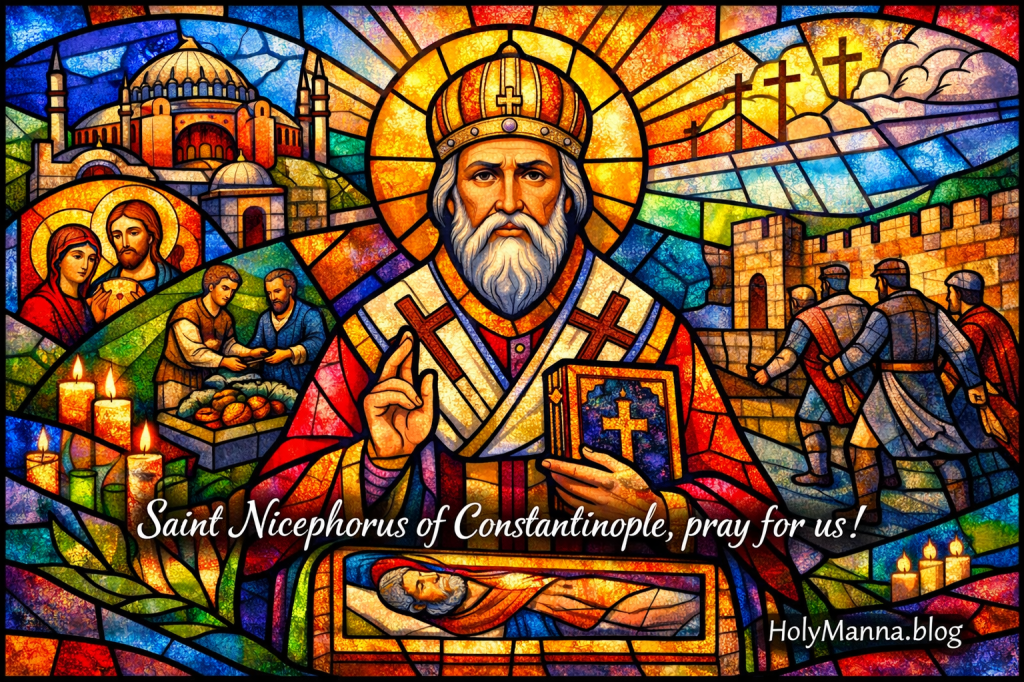
The Patriarch Who Would Not Let the Light Go Out
Some saints are remembered for dramatic miracles. Others are remembered because, when the world tried to rewrite the faith, they refused to let the Church forget what she had received from Christ. Saint Nicephorus of Constantinople belongs to that second group. He lived before the Great Schism, so Catholics can claim him without hesitation as a saint of the undivided Church. He served as Patriarch of Constantinople in a tense era when emperors still tried to bully bishops, and when the Christian people were pressured to treat sacred images as if they were idols. Nicephorus stood his ground, not because he was stubborn, but because the Church had already spoken clearly through the Seventh Ecumenical Council, and because the truth of the Incarnation is not up for renegotiation.
His legacy still matters every time a Catholic kneels in front of a crucifix, kisses an icon, or prays before a statue. The Church does not worship wood and paint. The Church worships the living God, and she honors His saints, and she allows sacred images to preach to the eyes what the Gospel preaches to the ears. That is the fight Nicephorus refused to abandon, and that is why he is remembered as a Confessor, a man who suffered for the faith without being killed for it.
Early Life and Conversion: A Family That Paid the Price
Nicephorus was born around the year 758 in Constantinople, the heart of the Eastern Roman Empire. He grew up in a home where faith was not a private hobby but a public cost. His father, Theodore, served as an imperial secretary and suffered exile because he supported the Church’s defense of holy images during the earlier wave of iconoclast persecution. That kind of childhood forms a person. It teaches a son that truth is not decided by the loudest official in the room, and that loyalty to Christ can come with real consequences.
Nicephorus himself entered public service and became an imperial secretary. He was educated, capable, and trusted in the corridors of power. Yet the story does not stay in the palace. At a key moment in the Church’s history, he was connected with the Church’s restoration of the veneration of icons after the iconoclast crisis, especially in the era of the Second Council of Nicaea (787). Over time, he stepped back from public life and turned toward prayerful study and ascetic discipline. Catholic sources also remember him for being placed in charge of major charitable work in the city, including care for the poor and sick. Even before he wore a bishop’s vestments, he was learning how to shepherd human suffering with practical mercy.
What he became most known for was not court politics or academic writing, though he did plenty of both. He became known for defending the Church’s received faith when the state tried to turn doctrine into a political tool. In a sentence, Nicephorus became a man who would not let Christ be reduced to an idea, because Christ had taken flesh.
Life and Miracles During Life: The Quiet Miracle of Courage and Mercy
There is a surprising twist in Nicephorus’ life. When the Patriarch of Constantinople died in 806, Nicephorus was chosen to succeed him even though he was not already a bishop. He was rapidly ordained and consecrated, and he took on the burden of leading one of the most prominent sees in Christendom. That alone tells something important. People did not choose him because he was flashy. They chose him because he was trusted, serious about the faith, and able to lead.
As Patriarch, he worked in a Church world full of tension. There were disputes about discipline and political pressure from the emperor. There were heated conflicts with strict reformers, including the circle around Saint Theodore the Studite. Even when Catholics today read those disputes, the main takeaway is simple. Nicephorus was trying to hold the Church together in unity while keeping fidelity to what the Church taught and practiced.
When it comes to miracles during his lifetime, the Catholic record does not preserve a long list of dramatic wonders attributed to him the way it does for some other saints. That is not a weakness. It is part of his witness. His life shows another kind of miracle, the kind that does not make headlines but changes history. He served the needy through charitable administration, and he defended the faith through clear teaching, and he refused to pretend that truth changes because an emperor is impatient.
And when the crisis returned, he did not treat it like a debate club topic. He treated it like a matter of fidelity to Christ and the Church’s living tradition.
Hardships and Martyrdom: Exile Instead of Compromise
The defining trial of Saint Nicephorus came when Emperor Leo the Armenian revived iconoclasm, the movement that attacked sacred images and tried to strip the Church’s worship spaces of icons. The pressure was not subtle. The emperor wanted compliance, and he wanted it to look like the Church had agreed with him.
Nicephorus resisted, because the Church had already affirmed the legitimacy of venerating icons, and because the logic behind that teaching is Christological. The Son of God truly became man. He could be seen, touched, and depicted. The Catechism explains it with beautiful clarity when it teaches that the Church’s defense of icons rests on the mystery of the Incarnate Word, and that the veneration of icons is justified in light of the Word made flesh in the Seventh Ecumenical Council at Nicaea. That teaching is summarized directly in CCC 2131, and it is exactly the kind of truth Nicephorus suffered to protect.
Tradition remembers him speaking with a bishop’s backbone when illegal gatherings tried to bully him. One line preserved in Catholic hagiographical tradition captures his refusal to accept a fake authority inside his own diocese: “Who gave you this authority? was it the pope, or any of the patriarchs? In my diocese you have no jurisdiction.” Another line, also preserved in Catholic tradition, captures his core stance: “We cannot change the ancient traditions…”
Eventually, Nicephorus was deposed and exiled in 815. He was not killed, so he is not honored as a martyr in the strict sense. He is honored as a Confessor, because exile can be a kind of long martyrdom when it is endured for love of the truth. Some Catholic accounts also speak of attempts on his life before his banishment. Those details belong to the tradition surrounding his suffering, and they underline the basic point even if every specific incident cannot be proven with modern precision. The man endured serious danger because he would not betray what the Church had received.
In exile, he continued to write, to defend the veneration of icons, and to live in fidelity. He died on June 2, commonly placed around the year 828, still bearing the cost of that refusal to compromise.
Miracles and Impact After Death: Vindication, Relics, and the Scent of Honor
After his death, the Church’s memory of Nicephorus did not fade. The most famous posthumous sign associated with him in Catholic Eastern tradition is tied to the translation of his relics. Tradition recounts that when his relics were brought back with honor and opened, they were found to be incorrupt and fragrant. This story is treasured in Byzantine Catholic remembrance, and it is presented as a sign of sanctity. It cannot be verified today in the way modern investigations might demand, but it remains part of the living Catholic tradition about his posthumous veneration, and it matches a pattern found in the lives of many saints whose bodies were honored after long suffering.
His translation and veneration also carried a public message. The man who was pushed out of his see was, in time, honored again by the Church. His story became a reminder that empires rise and fall, but the faith is not the emperor’s property. The commemoration associated with his relics is remembered on March 13 in the Roman tradition, and that keeps his witness present even for Catholics who have never heard his name preached from a pulpit.
His wider impact is especially felt in the Church’s confidence about sacred images and sacred art. The Catechism teaches that sacred art is meant to evoke and glorify the transcendent mystery of God, and that it serves faith and prayer, as expressed in CCC 2502. Nicephorus did not defend icons because he was sentimental about art. He defended icons because the Gospel is not an abstraction. The Word became flesh. The Christian faith is concrete, visible, historical, and sacramental.
Reflection: The Saint Who Teaches Steadfastness Without Drama
Saint Nicephorus is a needed saint for an age that confuses peace with compromise. His life shows that unity is not built by pretending doctrine does not matter. Unity is built by clinging to Christ and receiving what the Church has handed down, even when it costs something.
There is a practical lesson here for daily Catholic life. When the culture pressures believers to keep faith private, Nicephorus reminds Catholics that the faith has public consequences because it is true. When people mock statues or icons as if Catholics are worshiping objects, Nicephorus reminds Catholics to explain the difference between adoration and veneration with patience and confidence. God alone is adored. The saints are honored as God’s work. Sacred images are tools that lift the mind to Christ, not replacements for Him, and that is exactly why the Church can defend them without fear.
His witness also speaks to anyone who feels worn down by conflict. Not every battle is chosen. Some battles arrive at the front door. Nicephorus did not ask to be the headline figure of a renewed iconoclast crisis, but when that crisis arrived, he did not pretend it was harmless. He stayed faithful. He suffered. He kept writing. He refused to bargain with silence.
How often does daily life tempt the soul to trade truth for comfort, even in small ways?
Where is courage needed to live the faith with clarity, but also with charity and steadiness?
What would change in a home if sacred images were treated less like decoration and more like invitations to prayer?
Engage with Us!
Share thoughts and reflections in the comments below. Let the conversation be honest and practical, because saints are given to the Church to be followed, not simply admired.
- What part of Saint Nicephorus’ story feels most relevant to the pressures Catholics face right now?
- How does the Church’s teaching on sacred images, especially in CCC 2131, help clear up misunderstandings about Catholic worship?
- What is one concrete way to strengthen prayer at home this week through sacred art, a crucifix, or an icon, without treating it as mere decoration?
- Where is the Lord asking for quiet steadfastness rather than dramatic gestures, especially in family life, work, or online conversations?
Saint Nicephorus shows that a life of faith is not always loud, but it must be loyal. Keep close to Jesus, stay close to His Church, and do everything with the love and mercy that Christ taught, because truth without love becomes harsh, and love without truth becomes thin. In the end, the goal is not to win arguments. The goal is to belong to Christ and help others find Him.
Saint Nicephorus of Constantinople, pray for us!
Follow us on YouTube, Instagram and Facebook for more insights and reflections on living a faith-filled life.

 Holy Manna!
Leave a comment